Polyurethane Foam Chemical Recycling to Polyol in Japan
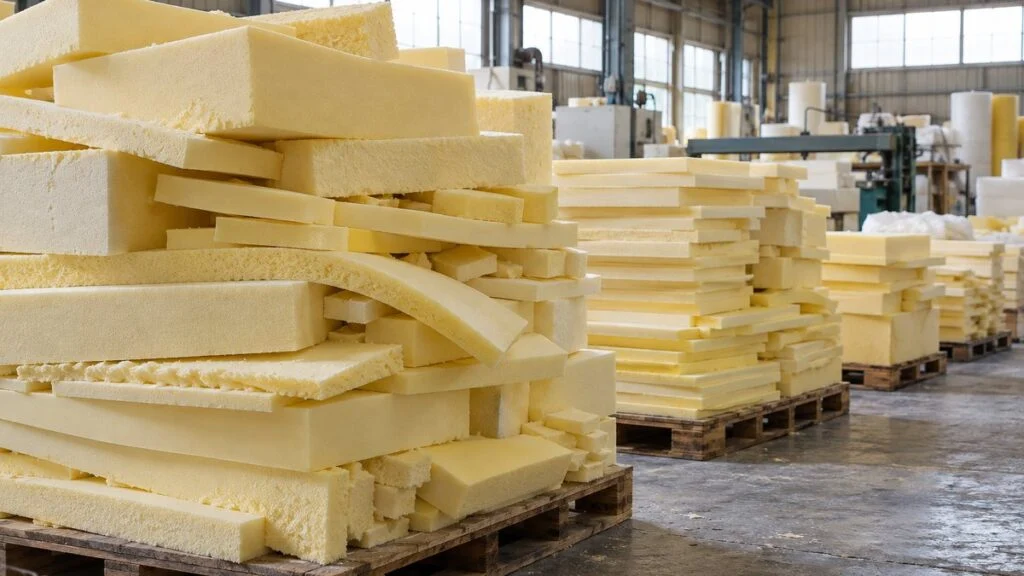
A Japanese foam supplier or seat maker tells you that "recycled polyol" may soon be available in Japan. Your team wants to know what that means: how much recycled content, what quality, and when. A joint announcement from three companies on October 13, 2026, is the starting point for most of those conversations.
On that date, Toyotsu Chemiplas Corporation, Sanyo Chemical Industries, and Evonik launched a joint initiative on chemical recycling of polyurethane (PU) foam in Japan. The plan is to break down used foam from car seats, mattresses, and furniture and turn it back into polyol, the main liquid raw material for PU foam.
This article covers what the three companies have and have not announced, and why foam has mostly gone to landfill or incineration. It then explains the purity problem with earlier recycling routes and compares the project with similar work in Europe. It ends with a checklist and questions you can send to a Japanese supplier.
Contents
- What the Three Companies Announced, and What They Did Not
- Why Foam Has Mostly Been Landfilled or Burned
- Recycling Routes and the Purity Problem
- How the Japanese Project Compares with Work Outside Japan
- From Collection to New Foam: Scrap vs. End-of-Life Foam
- What It Means Along the Supply Chain
- Checklist: Evaluating Recycled Polyol from a Japanese Supplier
- Limits of This Article
- FAQ
- Sources
What the Three Companies Announced, and What They Did Not
According to the joint release, the partners will collect both end-of-life foam (post-consumer recycled, PCR) and production scrap (post-industrial recycled, PIR). They will regenerate polyol from it with Evonik's technology. The goal is high-purity recycled polyol that can go back into new foam.
Each company covers one part of the chain. Toyotsu Chemiplas, a chemical trading company in the Toyota Tsusho group that also handles mobility materials and polyurethane, coordinates the project using its collection network and logistics. Evonik brings its chemical recycling technology, and Sanyo Chemical adds its polyol design and process technology.
Figure 1 shows how the three roles fit together.
Collection, breakdown, and raw-material design are each handled by one company.
Based on the joint release of October 13, 2026.
Sanyo Chemical, together with its subsidiary San Chemical, makes raw materials for PU foam and sells them for automotive seating and other uses, according to its annual securities report. That puts the company in a position to judge recycled polyol against the same yardstick as its regular products.
The release marks the start of the initiative, not a production plan. Evonik's technology has a track record at a pilot plant in Germany. However, the release does not say where a plant in Japan would be built, when it would start, or how much foam it would process.
Figure 2 separates what is known from what is still open.
The structure and goals are public; timing, volume, and facilities are not.
Based on the joint release of October 13, 2026. PCR = post-consumer recycled (from used products); PIR = post-industrial recycled (from production scrap). LCA = life cycle assessment.
Why Foam Has Mostly Been Landfilled or Burned
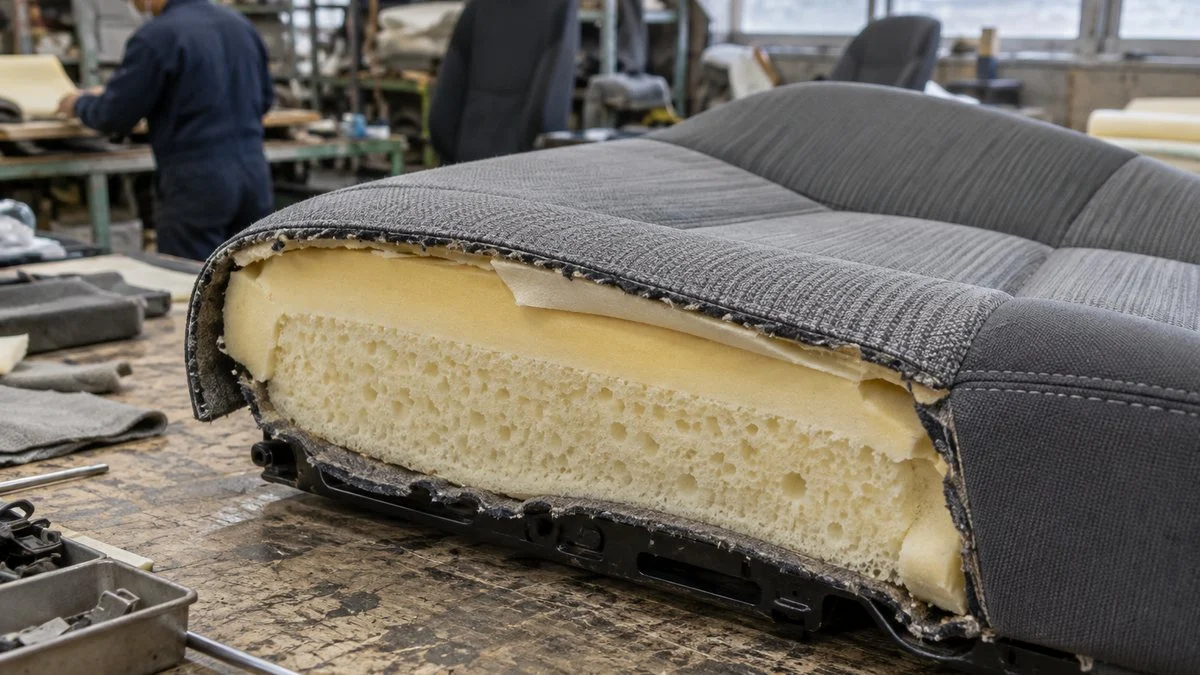
Polyurethane is made by reacting two liquid raw materials: a polyol and an isocyanate. Adding catalysts, blowing agents, and surfactants (foam stabilizers) makes it foam, either as soft flexible foam or as rigid foam for insulation.
Flexible foam goes into car seats, mattresses, and furniture cushions, while rigid foam is mainly used in building insulation and refrigerators. The three companies' release names seats, mattresses, and furniture, so it focuses on the flexible side.
Figure 3 shows the basic route from raw materials to a seat cushion.
Two liquids are mixed and foamed, then used as cushioning in seats and bedding.
Real formulations also include catalysts, blowing agents, and surfactants. The initiative aims to recover polyol from foam at the end of its life.
Most used foam is still landfilled or incinerated. The release lists three problems with that: CO2 emissions from incineration, shrinking landfill capacity, and the loss of organic material that could be reused.
The release gives no figure for waste foam in Japan. Evonik has, however, published an estimate for Europe: about 40 million mattresses are thrown away each year, containing roughly 300,000 metric tons of flexible PU foam.
Figure 4 shows where those European mattresses end up.
About 8 out of 10 are landfilled or incinerated.
About 8 in 10 landfilled or incinerated (about half landfilled, about a third incinerated); about 17% recycled
Evonik's estimate for the roughly 40 million mattresses (about 300,000 t of flexible foam) discarded in Europe each year.
Some foam is recycled, but mostly by shredding and rebonding it. That route rarely gets back to the quality of the original seat or mattress, so the material ends up in lower-value uses. The industry has been looking for a way to recycle foam at the raw-material level, and that is the gap this initiative targets.
Recycling Routes and the Purity Problem
PU foam recycling falls into two broad groups. Mechanical recycling reshapes the material; chemical recycling uses reactions to break the polymer down into raw materials. The Japanese initiative is chemical, and it aims to recover high-purity polyol by adding purification after the breakdown step.
Figure 5 compares the three approaches by what they produce and how it can be used.
The key difference is how much of the output can go back into new foam.
Based on the joint release and a 2024 review of PU foam glycolysis (Materials).
Routes Differ by What Breaks the Bonds
Chemical recycling methods are named after the agent that cleaves the urethane bonds. Glycolysis uses a glycol, hydrolysis uses water, and aminolysis and acidolysis use amines and acids. A 2024 review in Materials describes glycolysis as the most widespread of these.
The table below summarizes the main routes.
| Route | Breakdown agent | What is recovered | Role in this article |
|---|---|---|---|
| Glycolysis | Glycol (a polyhydric alcohol) | Recycled polyol (often with partly decomposed components) | The most common conventional route |
| Hydrolysis | Water (Evonik uses its own catalyst system) | Polyol and an amine (TDA) | The route Evonik brings to the Japanese project |
| Aminolysis | Amines | Polyol and other products | Other route listed in the review |
| Acidolysis | Acids | Polyol and other products | Other route listed in the review |
What Glycolysis Leaves Behind
In flexible-foam glycolysis, the product often separates into two layers. The upper layer is the recovered polyol, while the lower layer holds unreacted glycol and partly decomposed components such as amines and carbamates.
Any amines left in the recovered polyol make it more reactive, which shifts how a foam formulation behaves.
As a result, studies typically test glycolysis polyol blended with virgin polyol, replacing only part of it, and check the foam properties at that ratio. One commercial example: Dow says the polyol from its RENUVA plant in France can replace up to 30% of the polyol in new foam formulations.
Why Purity Matters
The three companies point to the same issue. With conventional technology, recycled polyol contains many by-products and undecomposed components, so it must be blended with virgin polyol. That makes it difficult to use as a 100% recycled raw material.
The release also names quality stability and compliance with Japan's chemical substance regulations as hurdles. A raw material with an unclear composition is harder to describe and manage. If you plan to use a recycled stream, ask the supplier how it fits Japan's Chemical Substances Control Law (CSCL), including new-substance notification, and your own substance-of-concern requirements.
How Evonik's Hydrolysis Differs
Evonik's process is hydrolysis with a specially developed catalyst system. The output is a liquid mixture of polyol and an amine, toluene diamine (TDA). After separation and purification, the TDA can be converted back into the isocyanate TDI (toluene diisocyanate) in a separate reaction, according to Evonik.
At its pilot plant in Hanau, Germany, Evonik commissioned the hydrolysis unit at the end of 2022. A separation unit has operated since 2023. Working with UK foam maker The Vita Group, Evonik has produced mattress foam in which recycled polyol makes up as much as 100% of the polyol.
That 100% figure is a European development result. It does not mean the Japanese project has already reached the same quality or formulation. Whether Japanese feedstock yields the same purity, and how Sanyo Chemical applies its polyol design technology to reach the required quality, is exactly what the joint evaluation will test.
How the Japanese Project Compares with Work Outside Japan
Recovering polyol from mattress and seat foam is not unique to Japan. Several European chemical companies have run pilots or plants for years. The table places the Japanese initiative alongside the projects we could verify.
| Project | Route and output | Status (as published) |
|---|---|---|
| Toyotsu Chemiplas, Sanyo Chemical, Evonik (Japan) | Evonik hydrolysis; aims for high-purity polyol (and amine) from PCR and PIR foam | Announced October 13, 2026; joint evaluation stage, no volumes or dates |
| Evonik (Hanau, Germany) | Catalytic hydrolysis; polyol plus TDA, which can be converted to TDI | Pilot plant since end of 2022; Remondis sorts end-of-life mattress foam (cooperation announced September 2023); foam with up to 100% recycled polyol made with The Vita Group |
| Dow and Orrion Chemicals Orgaform, RENUVA (Semoy, France) | Chemical breakdown to a single polyol product | Plant opened September 2021; designed for up to 200,000 mattresses a year at full capacity; polyol replaces up to 30% in new foam |
| Covestro (Leverkusen, Germany) | Chemolysis and purification for polyol, then hydrolysis to TDA | Polyol recovery piloted from 2021 |
| BASF (Schwarzheide, Germany) | Chemical process to recover the original polyol from flexible foam | Pilot tests announced in 2020 |
Two points stand out. First, the Japanese project uses a process already piloted in Europe rather than a new chemistry, so the open questions are mostly about Japanese feedstock, collection, and scale. Second, the European projects show that collection and sorting partners, such as Remondis for Evonik and Eco-mobilier for RENUVA, are part of every working model.
From Collection to New Foam: Scrap vs. End-of-Life Foam
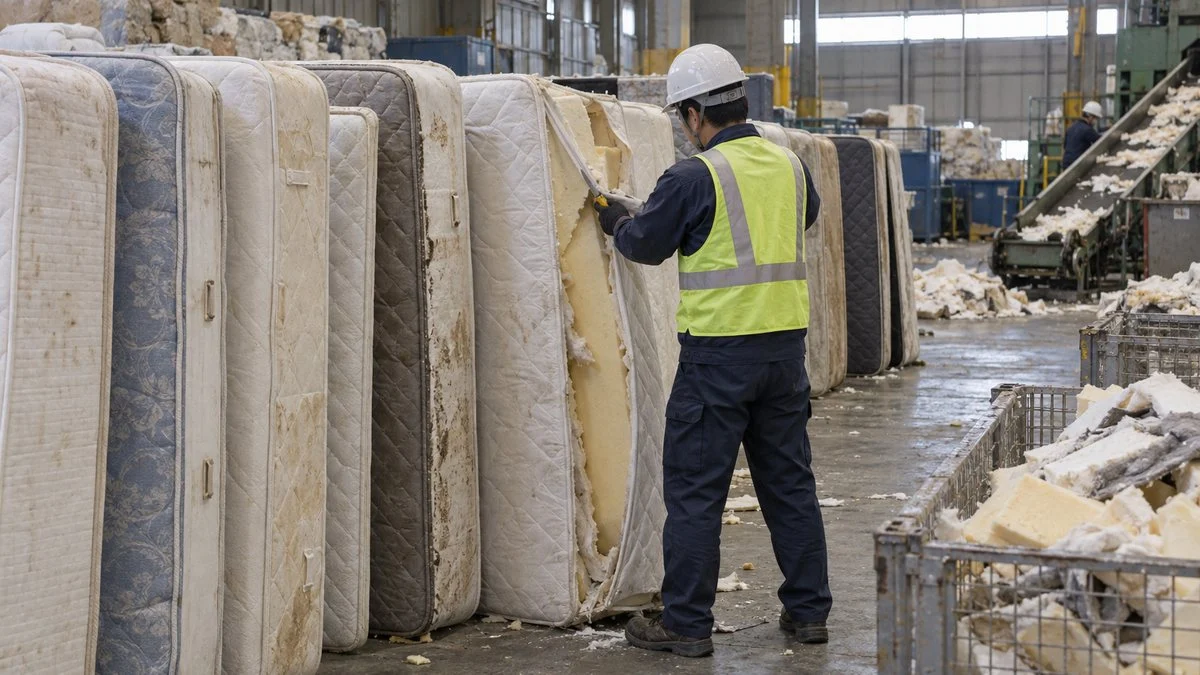
The three companies will jointly evaluate the whole value chain, from collection and sorting through high-purity polyol production to new products. Besides quality testing, they will check Evonik's existing life cycle assessment (LCA), which measures environmental impact from raw material to disposal, against data from the project.
Figure 6 breaks that chain into six steps.
The loop only closes when the steps before and after the recycling process also work.
The step breakdown is our own, based on the release's wording "from collection and sorting to production of high-purity recycled polyol and new products."
Production scrap (PIR) is the easier feedstock. Its source plant and formulation are known, and it carries no dirt from use. Volumes are limited, but it lets the partners test breakdown conditions and quality on feedstock with a consistent composition.
End-of-life foam (PCR) is harder. A mattress has fabric and springs, and a car seat has a frame and trim cover, so the product has to be taken apart to get the foam out first. Age and formulation vary, and contamination is more likely.
The circular-flow diagram in the release also shows collected mattresses being dismantled before chemical recycling. Evonik's sorting cooperation with Remondis in Europe exists for the same reason: the steps before the recycling reactor decide whether the loop works.
That is also why a trading company with a collection network coordinates the Japanese project. Only once the partners know where foam will come from, how much, and in what condition, can they size a plant and judge whether the business is viable.
What It Means Along the Supply Chain
If the project reaches commercial scale, the effects will spread beyond the three companies, along a chemical supply chain that runs from naphtha to finished products. Polyol suppliers, trading companies that run collection, foam converters, and finished-product makers will each see it differently.
Figure 7 summarizes those views.
The same recycled polyol raises different questions depending on where you sit.
Our own reading of the announcement. None of the companies has published specific plans.
On the demand side, the EU is moving toward minimum recycled plastic content in new vehicles. Under a provisional agreement on the End-of-Life Vehicles (ELV) Regulation reached in December 2025, new vehicle types would need at least 15% recycled plastic within six years of entry into force and 25% within 10 years. Of that plastic, 20% would have to come from end-of-life vehicles or parts removed from vehicles in use.
The agreement still needs formal approval by the European Parliament and the Council. We could not confirm how recycled polyol in seat foam would be counted toward these targets. Even so, auto parts suppliers are widening their search for recycled materials, and a domestic supply of recycled polyol in Japan would be one more option for programs that source there.
Checklist: Evaluating Recycled Polyol from a Japanese Supplier
The release sets no target values, so the items below are evaluation criteria, not pass/fail limits. The actual numbers will come from trials. Product development and quality assurance teams at polyol makers and foam converters will do most of this work.
Variation in recovered feedstock adds a new variable to formulation development, so these teams may need to rethink how they run evaluations.
- Quality: purity, lot-to-lot variation, and foam properties such as hardness and durability
- Processing: whether it runs in existing formulations and foaming lines, and whether reactivity changes
- Regulatory: whether the composition can be documented, and whether it meets Japan's chemical regulations and your substance-of-concern requirements
- Supply: whether regional and seasonal swings in collected foam can be smoothed to secure stable volumes
- Feedstock: share of production scrap (PIR) vs. end-of-life foam (PCR), and how that affects recycled-content claims
- Carbon data: which LCA the CO2 figures come from, its scope, and whether it reflects the Japanese value chain
Questions to Ask the Japanese Side
These questions follow from what the announcement leaves open. Use them in early discussions with a supplier, distributor, or converter.
- Is the recycled polyol from the Toyotsu Chemiplas, Sanyo Chemical, and Evonik project, or from another source?
- Is it available now as samples, or only after commercialization? What is the expected timeline?
- What replacement ratio in our formulation do you recommend, and what data supports it?
- What purity, hydroxyl value, and lot-to-lot range can you specify?
- Is the feedstock production scrap, end-of-life foam, or a mix?
- How is recycled content calculated and verified (for example, third-party certification or mass balance)?
- Which LCA backs your carbon footprint figure, and does it cover Japanese collection and logistics?
- How does the material fit Japan's chemical regulations and the regulations in our market?
Sample Inquiry Email
You can adapt this email for a first contact. Replace the bracketed parts.
Subject: Inquiry about recycled polyol for flexible foam
Dear [Name],
We are evaluating recycled polyol for [car seat / mattress / furniture] foam produced at [plant / country]. We saw the October 2026 announcement on PU foam chemical recycling by Toyotsu Chemiplas, Sanyo Chemical Industries, and Evonik.
Could you tell us (1) whether samples are available and on what timeline, (2) the specified purity, hydroxyl value, and lot-to-lot range, (3) the recommended replacement ratio in flexible foam, (4) the feedstock source (production scrap or end-of-life foam) and how recycled content is verified, and (5) the basis of any carbon footprint data?
We would also appreciate any information on regulatory documentation for [market].
Best regards,
[Name], [Company]
Limits of This Article
- It is based on public information as of early November 2026. The project is at the evaluation stage, and quality targets, volumes, and timing have not been published.
- The 100% recycled polyol foam is a European result by Evonik. It has not been shown with Japanese feedstock.
- The status of the European projects in the comparison table reflects each company's announcement and may have changed.
- Regulatory treatment (Japan's CSCL, EU ELV targets, recycled-content claims) depends on the product and market. Confirm it with the supplier and with regulatory specialists in your market.
FAQ
What Is the Difference Between Recycled Polyol and Bio-Based Polyol?
Bio-based polyol is made from plant-derived raw materials such as castor oil. Recycled polyol is recovered by breaking down used polyurethane. Both aim to reduce petroleum-based feedstock, but they come from different sources.
Can New Foam Be Made from 100% Recycled Polyol?
Evonik has made foam with up to 100% polyol from its hydrolysis process. With conventional breakdown methods, purity issues meant recycled polyol had to be blended with virgin polyol. How close the Japanese project gets to 100% will be tested in the joint evaluation.
Does the Japanese Project Cover Rigid Insulation Foam?
The release mentions flexible-foam products such as car seats, mattresses, and furniture, and says nothing about rigid foam. Research on breaking down rigid foam exists, but no information has been published on rigid foam being in scope.
Will Chemical Recycling Replace Mechanical Recycling?
No. Mechanical recycling by shredding and remolding still serves uses that can accept lower quality. Chemical recycling fits cases where you need raw material of the same quality as the original.
When Will Recycled Polyol from This Project Be Available in Japan?
No date has been announced. The companies are jointly evaluating the value chain and aim to commercialize the technology in Japan, so ask suppliers directly about sample timing.
Sources
- Announcement: Toyotsu Chemiplas, Sanyo Chemical Industries, and Evonik Industries, joint release on starting PU foam chemical recycling (October 13, 2026) (Japanese)
- English coverage of the announcement: Indian Chemical News, "Evonik, Toyotsu Chemiplas, and Sanyo Chemical launch Japan polyurethane recycling initiative" (October 13, 2026)
- Japanese trade press: MONOist (October 15, 2026) (Japanese)
- Evonik hydrolysis, Hanau pilot plant, and European mattress estimates: Evonik, "Hydrolysis"; Evonik, "Sustainable mattresses"
- Up to 100% recycled polyol and The Vita Group: Evonik, "PU recycling"
- Remondis cooperation: Evonik press release (September 20, 2023)
- Dow RENUVA: Dow, "Dow moves ahead with the RENUVA Mattress Recycling Program"; Cefic case study
- Covestro: The Chemical Engineer (April 8, 2021)
- BASF: Chemical Engineering, "BASF begins piloting new chemical recycling process for mattress materials"
- Recycling routes and glycolysis: Wieczorek et al., "Recycling of Polyurethane Foams via Glycolysis: A Review," Materials 17(18), 4617 (2024)
- Sanyo Chemical's PU foam raw-material business: Sanyo Chemical Industries, annual securities report (fiscal year ended March 2026) (Japanese)
- Toyotsu Chemiplas: Toyotsu Chemiplas website (Japanese)
- EU ELV recycled-content targets: SCI, "Driving sustainability: Europe wants more recycling from end-of-life vehicles" (December 19, 2025)
Original article in JapaneseThis guide is adapted from a MONOSCOPE article written for readers in Japan: ウレタンフォームを原料に戻す|3社協業と高純度リサイクルポリオール
About the editor
 MONOSCOPE EditorFOUNDER & EDITOR
Spent about ten years at a plant equipment maker and a plant engineering company, proposing, designing, and commissioning equipment, then moved into web marketing. Now a web consultant for B2B manufacturers, helping them explain their products and technology. Licensed in Japan as an Energy Manager and a Third-Class Chief Electrical Engineer.
Has run an engineering blog since 2017 (500+ articles) and a Japanese YouTube channel with about 20,000 subscribers. Each English guide is written from the Japanese shop-floor point of view and checked against the cited standards.