Pressure Unit Conversion Table: kgf/cm2, MPa, bar, psi
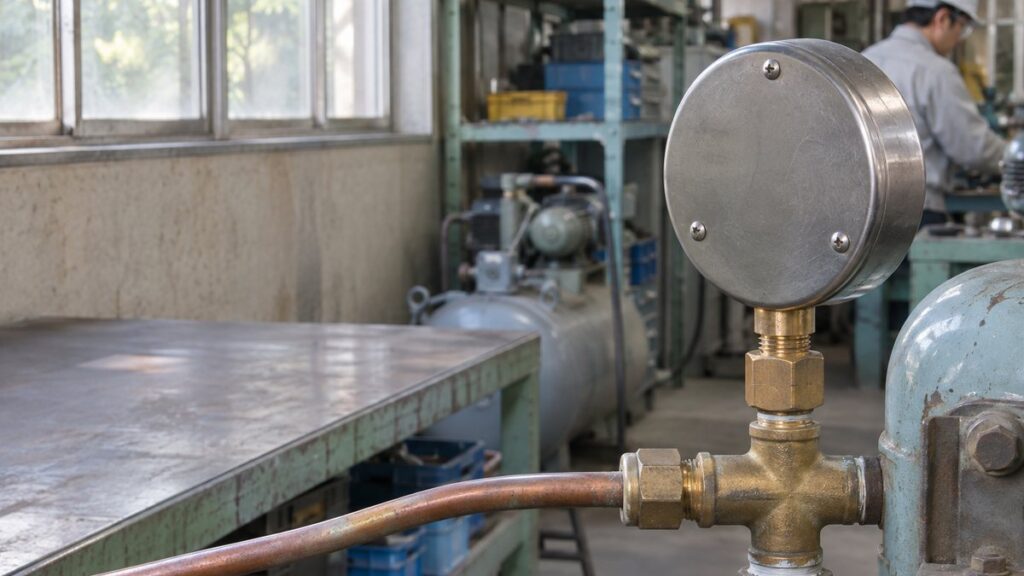
Picture a compressor from Japan: the nameplate says 0.69 MPa, an older drawing in the manual says 7 kgf/cm², and the supplier's technician says on a call that it runs at "nana kiro" (seven kiro). Your plant gauges read psi. All three can describe the same pressure (7 kgf/cm² is 0.686 MPa, which rounds to 0.69), but only if you know each unit and whether the value is gauge or absolute pressure.
The short answer: 1 kgf/cm² = 98.0665 kPa = 0.0980665 MPa ≈ 14.22 psi ≈ 0.981 bar. In the other direction, 1 MPa = 1,000 kPa = 10 bar ≈ 10.2 kgf/cm² ≈ 145.0 psi. When someone in Japan says "kiro" (キロ) for pressure, it often means kgf/cm², not kPa, so confirm the unit in writing.
This guide gives you a conversion table with SI and US units, explains the "kiro" habit, shows how to read MPaG and MPaA against psig and psia, and covers the water and mercury column units (mmAq, mmHg) that still appear on Japanese documents. It ends with a checklist, questions for your Japanese supplier, and an email template.
Contents
- Pressure Unit Conversion Table
- What "Kiro" Means on a Japanese Shop Floor
- Pa, kPa, and MPa: The SI Basics
- bar, atm, and psi: Close but Not the Same
- Gauge vs. Absolute: MPaG, MPaA, psig, and psia
- Water and Mercury Columns: mmAq, mmH₂O, mmHg, and Torr
- Old Japanese Drawings and the Measurement Act
- Recording Pressure: Value, Unit, Reference, and Location
- Checklist for Japanese Pressure Values
- Questions for Your Japanese Supplier
- Where This Guide Does Not Apply
- Summary
- FAQ
- Sources
Pressure Unit Conversion Table
The table below shows what one of each common unit on Japanese and US documents equals in kPa, MPa, psi, and bar. Each factor compares unit sizes only. None of them adds or subtracts atmospheric pressure, so a gauge value stays a gauge value after conversion.
| 1 unit of | kPa | MPa | psi | bar | Definition / notes |
|---|---|---|---|---|---|
| 1 Pa | 0.001 | 0.000001 | 0.000145 | 0.00001 | SI unit (1 N/m²) |
| 1 hPa | 0.1 | 0.0001 | 0.0145 | 0.001 | 100 Pa |
| 1 kPa | 1 | 0.001 | 0.145038 | 0.01 | 1,000 Pa |
| 1 MPa | 1,000 | 1 | 145.038 | 10 | 1,000,000 Pa |
| 1 kgf/cm² | 98.0665 | 0.0980665 | 14.2233 | 0.980665 | Exact, based on standard gravity |
| 1 bar | 100 | 0.1 | 14.5038 | 1 | 100,000 Pa, exact |
| 1 atm | 101.325 | 0.101325 | 14.6959 | 1.01325 | Standard atmosphere, 101,325 Pa, exact |
| 1 psi | 6.894757 | 0.006894757 | 1 | 0.0689476 | Pound-force per square inch |
| 1 Torr | 0.133322 | 0.000133322 | 0.0193368 | 0.00133322 | 1/760 of 1 atm |
| 1 mmHg | 0.133322 | 0.000133322 | 0.0193368 | 0.00133322 | Conventional; equal to 1 Torr in Japan's legal definition |
| 1 inHg | 3.386389 | 0.003386389 | 0.491154 | 0.0338639 | Conventional |
| 1 mH₂O | 9.80665 | 0.00980665 | 1.42233 | 0.0980665 | Conventional water column (1,000 kg/m³, standard gravity) |
| 1 mmH₂O (mmAq) | 0.00980665 | 0.00000980665 | 0.00142233 | 0.0000980665 | Conventional; mmAq is the same unit |
| 1 inH₂O | 0.2490889 | 0.0002490889 | 0.0361273 | 0.00249089 | Conventional (other temperature bases exist) |
Factors follow NIST Special Publication 811, Appendix B.9. The number of decimal places shows the factor, not the accuracy of any measurement.
When a Japanese document gives a value in kgf/cm², the next table lets you sanity-check common round values at a glance.
| kgf/cm² | MPa | kPa | bar | psi |
|---|---|---|---|---|
| 1 | 0.0981 | 98.1 | 0.981 | 14.2 |
| 3 | 0.294 | 294 | 2.94 | 42.7 |
| 5 | 0.490 | 490 | 4.90 | 71.1 |
| 7 | 0.686 | 686 | 6.86 | 99.6 |
| 10 | 0.981 | 981 | 9.81 | 142.2 |
Values are rounded to three significant figures (psi to one decimal place). Keep the exact factor, 98.0665, for test pressures and set points.
How to Use the Table
Multiply the value by the factor in the row of the unit you start from. For example, 2.5 bar × 100 = 250 kPa, and 250 kPa ÷ 1,000 = 0.25 MPa. The pressure reference (gauge or absolute) does not change along the way.
To go the other way, divide. Converting 350 kPa to kgf/cm² means dividing by 98.0665:
If a pair of units is not in the table, convert to kPa first and then to the target unit. For kgf/cm² to psi, multiply by 98.0665 to get kPa, then divide by 6.894757.
Write down the original value, its unit, and each intermediate result rather than converting in your head. That way a colleague can check the work.
If you build the table into a spreadsheet, keep the number and the unit in separate cells and keep the original entry. Then test each formula with an easy value: 1 MPa should return 1,000 kPa, and 1 bar should return 100 kPa. This quickly catches a factor used upside down or a ×1,000 applied twice.
Keep full factors through the calculation and round only at the end, to suit the instrument resolution and the purpose. Input values in the examples here, such as 350 or 0.7, are illustrations only; they do not indicate the significant figures or uncertainty of a real measurement.
What "Kiro" Means on a Japanese Shop Floor
You may still hear "nan-kiro?" (how many kiro?) asked about pressure on Japanese shop floors. In that phrase, "kiro" is often short for kgf/cm². The trouble is that kPa is also read "kiro-pasukaru," so a number spoken without its unit can carry two meanings that differ by a factor of about 98.
The "f" in kgf stands for force. One kilogram-force is the weight of a 1 kg mass under standard gravity: 1 kgf = 9.80665 N. Shortening kgf/cm² to "kg" or "kg/cm²" blurs the difference between mass, force, and pressure, so treat any such shorthand as kgf/cm² only after you confirm it.
Figure 1 shows where the factor 98.0665 comes from. Convert the force to newtons and the area to square meters, and the rest follows.
Figure 1: Why 1 kgf/cm² Equals 98.0665 kPa
Convert the force on top to newtons and the area below to square meters.
The area step is where mistakes happen. One meter is 100 cm, but 1 m² is 100 cm × 100 cm = 10,000 cm², so 1 cm² is 0.0001 m². This conversion uses the defined standard gravity; you do not substitute the local gravity at your site.
"1 Kiro Is About 0.1 MPa": Fine for Estimates Only
Treating 1 kgf/cm² as 0.1 MPa is handy for getting a feel for a pressure range. However, 0.1 MPa is about 1.97% larger than 1 kgf/cm², so use 98.0665 for test pressures and official set points.
Take "7 kiro." Converted exactly, 7 kgf/cm² is 0.6864655 MPa, or about 0.69 MPa.
Reading it as 0.7 MPa adds 0.0135345 MPa. When you transfer values from an old setting sheet, record how you rounded them.
The same applies when you replace an instrument. An old gauge with a 10 kgf/cm² full scale covers 0–0.980665 MPa, which is not strictly the same as a 0–1 MPa gauge. Match the physical range, not the number printed on the dial.
Safety valve set pressures and equipment pressure ratings are specified separately from normal operating values. Read them in the unit and reference stated in the governing specification, and leave any change to the people responsible for the equipment.
One more trap: "10K" on a Japanese flange is a JIS nominal pressure class, not a pressure of 10 kgf/cm². Check the flange's pressure-temperature rating in JIS B 2220 instead of converting the "K" number.
Pa, kPa, and MPa: The SI Basics
Pressure is force acting perpendicular to a surface, divided by the area of that surface. One pascal (Pa) is the pressure of a 1 newton force acting evenly and perpendicularly on 1 m². The newton (N) is a unit of force and the kilogram (kg) a unit of mass, and neither the force alone nor the mass of the load tells you the pressure.
For the same force, a smaller area means a higher pressure. Doubling the area halves the pressure, as Figure 2 shows.
Figure 2: Same Force, Different Area, Different Pressure
A 100 N force on an area of 0.01 m² gives 10 kPa.
The width of the drawing is not to scale. The result is the average pressure under the plate.
If you know the pressure and the area, you can work back to the force. A pressure difference of 0.5 MPa acting evenly on 10 cm² produces 500 N, so a "low" pressure can still push hard on a large surface.
The pascal is small for industrial equipment, so specifications use kPa and MPa. The k (kilo, ×1,000) and M (mega, ×1,000,000) are prefixes: kPa and MPa are not different kinds of pressure, just different places for the decimal point.
The h in hPa (hecto, ×100) is common in weather reports: 1 kPa = 10 hPa.
Figure 3 writes one pressure, 0.35 MPa, in four ways. The smaller the unit, the larger the number.
Each step down uses a smaller unit, so the number gets larger.
Changing the unit does not change the pressure in the pipe. The ladder works for both gauge and absolute pressure. For reference, 0.35 MPa ≈ 50.8 psi.
Unit symbols are case-sensitive. Write kPa, MPa, and hPa, never KPa or Mpa. When you copy values between drawings and spreadsheets, copy the unit symbol exactly as well; that alone prevents many factor-of-1,000 errors.
bar, atm, and psi: Close but Not the Same
One bar is 100 kPa and one standard atmosphere (atm) is 101.325 kPa. Treating "1 atmosphere" as "1 bar" leaves a gap of 1.325 kPa, which matters in vacuum work and precise calculations.
The atm is a fixed, defined value. It does not mean the atmospheric pressure at your site today, which changes with weather and altitude. Converting gauge to absolute pressure does not always mean adding exactly 1 atm.
The psi is the pressure of one pound-force on one square inch. On US and other non-Japanese equipment you will see psig and psia: the g means gauge and the a means absolute. Read that letter together with the number.
Likewise, a specification of 0.5 MPa is 5 bar or about 72.5 psi on the same reference. If you add atmospheric pressure to 0.5 MPa before converting, you have calculated a different quantity.
When only one of two documents marks its values with G or abs, align the references before you compare anything. Matching units with mismatched references still gives a wrong comparison, so read the footnotes and test conditions in the catalog too.
Gauge vs. Absolute: MPaG, MPaA, psig, and psia
Gauge pressure uses the surrounding pressure, normally the atmosphere, as zero. Absolute pressure uses a perfect vacuum as zero. Measure the same pipe both ways and the two readings differ by the atmospheric pressure.
Japanese specifications may mark the reference with a suffix. The table below maps the common notations to their US counterparts.
| Reference | Japanese documents | US / other documents | Zero point |
|---|---|---|---|
| Gauge | MPaG, kPaG | psig, barg | Ambient (atmospheric) pressure |
| Absolute | MPaA, MPa abs | psia, bara | Perfect vacuum |
| Differential | kPa (differential), ΔP | psid, ΔP | The other measuring point |
The G and A are labels, not SI prefixes. A formal record can simply state "gauge pressure 0.7 MPa." If a Japanese document gives MPa with no suffix, do not assume either reference; ask.
Figure 4 shows the two zero points. With the atmosphere at 101.325 kPa, a gauge pressure of 700 kPa is an absolute pressure of 801.325 kPa.
Figure 4: Two Pressures, Two Zero Points
With the atmosphere at 101.325 kPa, 700 kPa gauge equals 801.325 kPa absolute.
Schematic only; spacing is not to scale. The blue arrow runs from perfect vacuum and the orange arrow from atmospheric pressure to the measured point.
Changing the unit means multiplying or dividing. Changing the reference means adding or subtracting atmospheric pressure. Put both values in the same unit first, then add or subtract, so you never add a kPa value to an MPa value.
For example, boiler steam at 0.7 MPaG is roughly 0.8 MPaA. Steam tables generally list absolute pressure, so check which reference the table's pressure column uses.
If you enter a gauge value into an absolute steam table, you look up steam in a different state. Enthalpy and other properties depend on that state, so the reference has to match as well as the unit.
Vacuum and Differential Pressure
Where the pressure is below ambient, the gauge reading is negative. At an ambient pressure of 101.325 kPa, −80 kPa gauge is 21.325 kPa absolute. Absolute pressure itself never goes below zero.
Vacuum equipment may show either a low absolute pressure or a negative gauge pressure. On equipment such as steam condensers, where you judge the operating state from the reading, the abs or G label is essential.
Differential pressure is the difference between any two points, not only between a point and the atmosphere. With 0.60 MPaG upstream and 0.55 MPaG downstream, the difference is 0.05 MPa (50 kPa). Adding the same atmospheric pressure to both values does not change the difference.
If the two points differ in height or flow velocity, not all of the measured static pressure difference is friction loss. Also avoid subtracting values taken at different times or on different references. For filters and piping, log the differential at the same operating condition and the same pair of points so you can compare trends.
Water and Mercury Columns: mmAq, mmH₂O, mmHg, and Torr
On older Japanese documents you may find small pressures, such as fan or draft pressures, given as a column of water: mmAq or mmH₂O. The "Aq" comes from aqua, and both labels mean the same unit. The conventional value is 1 mmH₂O = 9.80665 Pa, so 1 kPa ≈ 102 mmAq.
The US equivalent is inches of water (inH₂O). The conventional inch of water is 249.0889 Pa, or 25.4 mmH₂O, so 1 kPa ≈ 4.01 inH₂O and 100 mmAq ≈ 3.94 inH₂O.
Be careful with temperature. NIST lists separate factors for an inch of water at 39.2°F (249.082 Pa), at 60°F (248.84 Pa), and the conventional value, and it also separates a 4°C water column from the conventional one. If a document names a water temperature, use the factor for that condition.
Real Water Depth vs. the Unit
The conventional unit assumes a density of 1,000 kg/m³ and standard gravity. To turn an actual water depth into pressure, use the real density and gravity. Hot water or other liquids have a different density, so 1 m of liquid does not always give the same pressure.
Figure 5 shows an open tank with 5 m of water. The gauge pressure at the bottom is about 49.0 kPa.
Figure 5: In an Open Tank, Depth Sets the Pressure
With a density of 1,000 kg/m³ and 5 m of water, the gauge pressure at the bottom is about 49.0 kPa.
Static liquid only. Pressure changes from pumps or flow are not included.
Under the same conditions, 10 m of water gives about 98.1 kPa. That is where the shop-floor rule "10 m of water is about 0.1 MPa" comes from. In a closed tank, add any pressure above the liquid surface to the depth term.
Pump head expresses the energy given to the fluid as a height of liquid. Keep head and pressure separate, and match the liquid density and operating conditions when you read a pump curve.
With a U-tube manometer, read the difference between the two liquid levels, not the depth on one side.
mmHg, Torr, and inHg
The torr is 1/760 of a standard atmosphere: 1 Torr = 101,325/760 Pa. In Japan's Measurement Unit Ordinance, the mmHg used for in-body pressures and blood pressure has the same value, so in Japanese legal terms 1 mmHg = 1 Torr.
The conventional mmHg used in many non-Japanese references is calculated from a set mercury density and standard gravity. It comes to about 133.322387 Pa, while the torr is about 133.322368 Pa. For everyday industrial conversion the difference does not show at six digits, so 1 mmHg ≈ 0.133322 kPa is fine, but precision calibration should follow the definition in the document.
Defined units and real mercury columns are also different things. Reading 760 mm on an actual mercury column brings in mercury temperature and local gravity, so measuring a column is a separate task from converting a unit. For US vacuum gauges in inches of mercury, use 1 inHg ≈ 3.386 kPa (conventional).
For example, 20 Torr absolute is about 2.66645 kPa absolute. Converting that to gauge pressure means subtracting the ambient pressure, which is a separate step from changing the unit.
Old Japanese Drawings and the Measurement Act
Japan's revised Measurement Act took effect on November 1, 1993, and moved units used in trade and certification to SI. Non-SI units got grace periods ending on September 30 of 1995, 1997, or 1999, depending on the unit. For kgf/cm² and other kgf-based pressure units, and for meters of mercury and water, the deadline was September 30, 1999.
That is why drawings and gauges from before the transition may show kgf/cm². A 1997 guidance notice from Japan's Fire and Disaster Management Agency explains the transition this way:
- Deleted non-SI units can no longer be used for trade or certification.
- Equipment and instruments marked in those units before the deadline can still be used if unchanged, but values used for trade or certification must be converted to SI.
- An instrument with a non-SI scale does not have to be replaced at repair time, but the repair certificate must give SI values.
Japan's legal units are not the same list as SI units. The bar and the atmosphere are still legal units in Japan, so a value in bar is not a legal problem by itself.
Torr, mercury column, and water column units are legal only for measuring pressure inside the body, and mmHg is defined separately for blood pressure. Neither permission allows their free use in general industrial trade or certification.
When you copy an old value into a current specification, keep the original and add the converted value and the factor. A note such as "Old drawing: 7 kgf/cm²; converted: 0.6864655 MPa" lets anyone check later whether the value was rounded or the setting changed.
Recording Pressure: Value, Unit, Reference, and Location
"The pressure is 7" tells you neither the unit nor where it was measured. Record the value, unit, reference, and measuring point together, and the same information carries from the gauge to the report.
Figure 6 turns a spoken "7 kiro" into a complete record. Confirm the original unit first, then write it in this form.
Figure 6: Turning "7 Kiro" into a Measurement Record
Confirm what the spoken value meant, then record it in full.
- Original
- 7 kgf/cm²
- Reference
- Gauge
- Converted
- ≈ 0.686 MPaG (≈ 99.6 psig)
- Location
- Gauge at air receiver outlet
- Condition
- Under load; time recorded
Take the unit from the gauge face or the specification, and confirm gauge or absolute. Convert while keeping the original value. Then compare with past records at the same point and the same load, so you can separate a change of unit from a real change in operation.
Transmitter Ranges and 4–20 mA Signals
If a pressure transmitter and the control panel disagree, check the input range as well as the unit. A 4–20 mA signal maps the lower and upper range values to the current, so a new range changes what the same current means.
A 0–1 MPa range and a 0–1,000 kPa range are the same if the reference is the same. Rescaling to 0–10 bar, however, is a different operation from switching gauge to absolute, because the zero point moves only in the second case.
On a transmitter ranged 0–1 MPa for 4–20 mA, 12 mA is 50% of span: 0.5 MPa, or 500 kPa. Changing the display unit does not change the pressure that 12 mA represents.
If only the transmitter is replaced with a 0–2 MPa model, 12 mA now means 1 MPa. A receiver still set to the old range will display 0.5 MPa, and no unit conversion will fix that.
On a before-and-after replacement sheet, record the range limits and the reference along with the display unit. Checking both the field device and the panel shows whether a mismatch is a conversion error, a range error, or a real change in operation.
Resolution and Accuracy Carry Through Conversion
Base the number of digits on the accuracy and purpose of the measurement. More decimal places in the factor do not make a reading from a coarse gauge any more accurate.
If the smallest division is 0.01 MPa, the converted division is 10 kPa. Writing the result to 1 kPa claims a resolution the original reading never had.
Where F.S. means full-scale span, ±1% F.S. is not 1% of the reading. On a 0–1 MPa gauge it is ±0.01 MPa, which is ±10 kPa or about ±1.45 psi.
That figure applies under the specified conditions; temperature effects and display digits may be listed separately. When you add a measured atmospheric pressure to get absolute pressure, its uncertainty also enters the result.
Finally, a gauge's maximum scale value and the equipment's maximum allowable working pressure are different pieces of information. A gauge that reads to 1.6 MPa does not mean the equipment can run at 1.6 MPa. Any change to set points or operating pressure should follow the plant's own procedures.
Checklist for Japanese Pressure Values
Run through these points whenever a pressure value comes from a Japanese nameplate, drawing, datasheet, or phone call.
- Unit: MPa, kPa, kgf/cm² (or "kg/cm²"), bar, mmAq, mmHg, or Torr. Treat a spoken "kiro" as unconfirmed until you see it in writing.
- Reference: G (gauge), A or abs (absolute), or differential. No suffix means you still need to ask.
- Type of value: operating, design, maximum allowable working, set, or test pressure. These are different numbers.
- Conversion: exact factor used (98.0665 for kgf/cm²), original value kept, rounding recorded.
- Water or mercury columns: conventional unit or a specified temperature.
- Instruments: range, scale unit, 4–20 mA scaling, and accuracy (% F.S. or % of reading).
- Flanges and fittings: a "K" number is a JIS pressure class, not a pressure value.
- Drawing revision: older drawings may still show kgf/cm² when newer documents use MPa.
Questions for Your Japanese Supplier
If any item on the checklist is unclear, ask in writing. These questions cover most cases.
- Is this value gauge pressure or absolute pressure? Please mark it as MPaG or MPaA.
- Where the drawing says "kg/cm²" or kgf/cm², may we read it as kgf/cm² (1 kgf/cm² = 0.0980665 MPa)?
- Is this value the operating, design, maximum allowable working, set, or test pressure?
- For mmAq or mmH₂O values, is it the conventional water column or water at a specified temperature?
- What are the transmitter range, the 4–20 mA scaling, and the reference?
- Was the MPa value converted from an older kgf/cm² value? If so, how was it rounded?
- Which document governs if the nameplate, drawing, and datasheet disagree?
Email Template
You can copy and adapt the message below. Numbered questions make it easy for the supplier to answer each point.
Dear [Name],
Thank you for the documents for [equipment, model, serial no.]. To avoid errors in our installation and settings, please confirm the following pressure values:
- Drawing [no.], rev. [ ]: "[value as written, e.g. 7 kg/cm²]". Is the unit kgf/cm², and is it gauge or absolute pressure?
- Nameplate: "[value, e.g. 0.69 MPa]". Is this gauge (MPaG) or absolute (MPaA)? Is it the operating, design, or maximum allowable working pressure?
- Datasheet: "[value] mmAq". Is this the conventional water column (1 mmAq = 9.80665 Pa)?
- Transmitter [tag no.]: please confirm the range, the 4–20 mA scaling, and the reference.
Our converted values are [values in psig / bar]. Please tell us if any of them is incorrect.
Best regards,
[Your name]
Where This Guide Does Not Apply
This guide covers unit conversion and notation. It does not cover these situations:
- Ratings for pressure vessels, boilers, piping, and safety valves come from the applicable codes and the equipment designer. Confirm them with the supplier and the responsible engineer rather than converting and adjusting values yourself.
- Notation habits vary by company, industry, and the age of a document. The suffixes shown here are common, not universal.
- Precision calibration needs the exact definition used by the calibration document, including water and mercury temperature bases.
- Rules on which units may appear on certificates differ by country. The Japanese rules above apply to trade and certification in Japan.
Summary
- 1 MPa = 1,000 kPa = 10 bar ≈ 145.0 psi. The pascal is the SI unit: 1 N on 1 m².
- 1 kgf/cm² = 98.0665 kPa ≈ 14.22 psi. A spoken "kiro" often means kgf/cm², but confirm it in writing.
- 1 bar = 100 kPa and 1 atm = 101.325 kPa. The numbers are close, but the units are not the same.
- Unit conversion is multiplication. To go from gauge to absolute, add atmospheric pressure; to go back, subtract it. MPaG and MPaA correspond to psig and psia.
- mmAq is mmH₂O (9.80665 Pa). Check the temperature basis for inH₂O and mmHg in precise work.
- Record value, unit, reference, and measuring point together, keep the original value, and round at the end.
FAQ
How do I convert kgf/cm² to MPa?
Multiply by 0.0980665. For example, 7 kgf/cm² × 0.0980665 = 0.6864655 MPa, about 0.69 MPa. To go from MPa to kgf/cm², multiply by about 10.197.
How do I convert kgf/cm² to psi?
Multiply by about 14.223 (98.0665 ÷ 6.894757). For example, 10 kgf/cm² ≈ 142.2 psi. The reference carries over: kgf/cm² gauge becomes psig.
What is the difference between MPaG and MPaA?
MPaG is gauge pressure, measured from the surrounding atmosphere, like psig. MPaA is absolute pressure, measured from a perfect vacuum, like psia. At an ambient pressure of 101.325 kPa, MPaA = MPaG + 0.101325.
Is 1 kgf/cm² the same as 1 bar or 0.1 MPa?
No. 1 kgf/cm² is 0.980665 bar, or 0.0980665 MPa, so 1 bar (0.1 MPa) is about 1.97% larger. The shortcut is fine for estimates, but use the exact factor for set points and test pressures.
Does 0 MPaG mean vacuum?
No. Zero gauge pressure means the pressure equals the surrounding pressure. On an absolute scale it equals the atmospheric pressure at that moment, about 0.1 MPaA (14.7 psia) at standard conditions.
Sources
- Conversion factors: NIST SP 811, Appendix B.9, Factors for units listed by kind of quantity
- Liquid column temperature, density, and gravity: NIST, Pressure and Vacuum Measurements
- Conventional mmHg: WMO Codes Registry, mmHg
- SI units and prefixes: NMIJ/AIST, The International System of Units, 9th edition (Japanese)
- Japan's legal units: Measurement Unit Ordinance (Japanese), Measurement Act (Japanese)
- SI transition and grace periods: Fire and Disaster Management Agency, notice on SI units for fire protection equipment, 1997 (Japanese)
- Gauge and absolute pressure: Nagano Keiki, gauge vs. absolute pressure (Japanese); psig and psia: Fluke, PSI vs PSIG vs PSIA
- Accuracy in % F.S.: Nagano Keiki, % F.S. and digits (Japanese)
- Pressure unit conversion: Panasonic, pressure unit conversion (Japanese)
- Steam tables: TLV, how to read steam tables (Japanese)
Original article in JapaneseThis guide is adapted from a MONOSCOPE article written for readers in Japan: 圧力の単位換算表|kPa・MPa・kgf/cm²と「キロ」の違い
About the editor
 MONOSCOPE EditorFOUNDER & EDITOR
Spent about ten years at a plant equipment maker and a plant engineering company, proposing, designing, and commissioning equipment, then moved into web marketing. Now a web consultant for B2B manufacturers, helping them explain their products and technology. Licensed in Japan as an Energy Manager and a Third-Class Chief Electrical Engineer.
Has run an engineering blog since 2017 (500+ articles) and a Japanese YouTube channel with about 20,000 subscribers. Each English guide is written from the Japanese shop-floor point of view and checked against the cited standards.