Japanese Engineer Career Path: Hiring, Rotation, Tenure
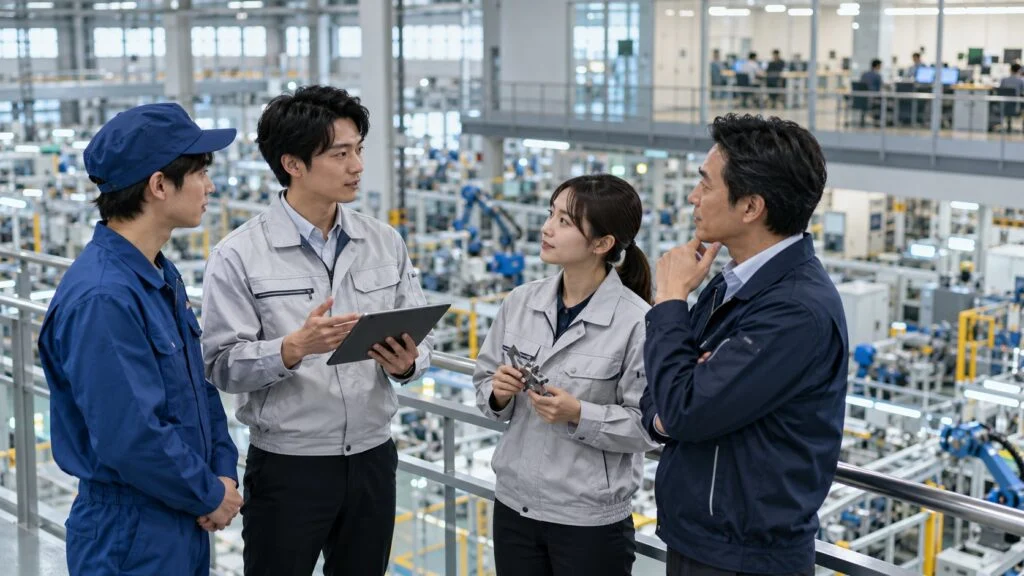
Suppose an engineer you have worked with for three years writes to say they are moving to another department next month. Their successor is capable but was never in your project meetings. Or suppose your contact at another Japanese supplier has been there for over 20 years and can explain why every tolerance on an old drawing is what it is.
Both situations are common at manufacturers that combine long-term employment with internal transfers. Many Japanese manufacturers hire engineers straight out of school, train them on the job, move them between roles, and expect them to stay for a long time. Knowing how these practices work helps you plan handovers and find the people who hold the technical know-how.
This guide explains graduate mass hiring, on-the-job training, job rotation, seniority-based pay, and long-term employment, using recent government statistics and some older research. It also shows what is changing and what all this means when you work with Japanese engineers. Practices differ widely by company size, industry, and generation, so read it as a map of common patterns.
Most statistics cited here cover employees in all occupations, not engineers alone. They give context for working with Japanese partners; they do not describe any one engineer's career.
Two models that Japanese researchers use to describe employment systems. Real companies often mix elements of both.
Our own summary based on Maeura (JILPT, Japan Labor Issues, Autumn 2024), which draws on Hamaguchi's definitions. Researchers define "job-based" in different ways.
Contents
The Traditional Model in Brief
Japanese researchers often describe the traditional system as membership-based employment. In a 2024 overview for the Japan Institute for Labour Policy and Training (JILPT), Hodaka Maeura sums it up this way: "Japanese companies assign jobs to persons, rather than assigning persons to jobs."
In this model, employees are hired into a broad role, and the contract usually does not name a specific job. The company has strong influence over assignments, moves people when needed, and bases pay largely on length of service or age.
Actual terms vary by company and contract. Maeura notes that most Japanese companies still seem to fit this model, even as many talk about change.
The idea of "lifetime employment" goes back further. The American scholar James Abegglen wrote about a "lifetime commitment" between Japanese companies and employees in his 1958 book The Japanese Factory. A 2009 PRESIDENT Online column (Japanese) notes that the phrase was translated as shushin koyo (終身雇用, lifetime employment) and that Abegglen meant an unwritten understanding, not a legal guarantee.
How Engineers Are Hired: Shinsotsu Ikkatsu Saiyo
Shinsotsu ikkatsu saiyo (新卒一括採用) means hiring new graduates as a group. Students apply and get offers while still at school, and the whole group starts work on the same day, usually in April at the start of the Japanese fiscal year. Colleagues who join in the same year are called doki (同期, same-year entrants), and companies often manage them as a group.
The Hiring Calendar
The schedule for university students is a government request, not a legal deadline. For students finishing in fiscal 2027 (most will graduate in March 2028), the government again asked employers to follow the usual dates, according to the Ministry of Health, Labour and Welfare (MHLW) (Japanese):
- March 1, 2027 (just before the final school year): publicity, such as information sessions, starts.
- June 1, 2027: selection, such as interviews, starts.
- October 1, 2027: formal job offers are made.
Keidanren, Japan's largest business federation, used to publish these rules. In September 2018 it announced it would stop, and the government took over the role from the class graduating in spring 2021, according to the Japan Center for Economic Research. There is one exception: students assessed through a certain type of longer, specialist internship do not have to wait until June for selection.
High school graduates follow a separate route. Schools play the main role in matching students with local employers, and a student applying through a school recommendation can usually apply to only one company at a time until the end of September. A December 2025 Nippon.com article reports that about 14% of high school graduates now go straight into work.
Hired by the Company, Placed by HR
A new engineering graduate is often hired as an engineer for the company, not for one specific post. Maeura notes that human resources departments have a strong say in where new graduates are first assigned. The first placement may follow the person's studies, the company's needs, or both.
This differs by company size. A 2026 survey by JILPT, summarized in the government's 2026 White Paper on Manufacturing Industries (Japanese), found that larger manufacturers recruit mainly new graduates, while smaller ones recruit mainly mid-career workers. Smaller companies were also less likely to say they hired new graduates roughly as planned.
How They Learn: OJT and Job Rotation
Much of the training in this model happens at work. Senior colleagues teach juniors through on-the-job training (OJT), and moving people between jobs is part of their development.
On-the-Job Training
In the MHLW Basic Survey of Human Resources Development for fiscal 2025 (Japanese, released July 2026), 60.6% of establishments in all industries gave regular employees planned OJT. Planned OJT means training with a set plan, such as a named trainer and a schedule, not just learning by watching.
The same survey found that 80.1% of establishments had some problem with training and development. Data for manufacturing alone comes from the previous survey, for fiscal 2024: among manufacturing establishments with problems, 62.8% named a shortage of people who can teach, the most common answer, according to the 2026 White Paper.
Job Rotation and Transfers
Two terms are easy to mix up. Job rotation means moving between roles as part of an employee's development. A personnel transfer, or jinji ido (人事異動), is broader: it can change a person's role, department, or location.
In the membership-based model, companies use both widely. Maeura lists four common features:
- Several purposes: transfers serve the organization's needs, but also staff development and motivation, especially at larger companies.
- Company control: the company, often the HR department, has strong authority over who moves where.
- Narrowing range: after some years, an employee's moves tend to stay within their field. Promotion to manager can still mean moving across departments.
- Moves beyond the company: shukko (出向) is a temporary transfer to a supplier, subsidiary, or other company while staying employed by the original one. Tenseki (転籍) is a permanent move to the other company.
The share of companies that use transfers for staff development rises with size. In a 2013 JILPT survey of companies that use transfers, 82.2% of companies with 1,000 or more employees named employee development as a reason, compared with 61.1% of companies with fewer than 100.
Transfers can be hard on families. A tenkin (転勤) is a transfer that requires moving house, and some employees choose tanshin funin (単身赴任), living apart from their family. Maeura reports that self-declaration systems and internal job postings, which let employees state preferences or apply for posts, are spreading, though, in his assessment, not many companies have gotten good results from them yet.
A simplified picture of the traditional pattern. Timing and steps vary widely by company, and many engineers do not follow it.
Our own illustration based on Maeura (JILPT, 2024), MHLW data, and the 2026 White Paper on Manufacturing Industries cited in this article.
Pay, Promotion, and "Lifetime" Employment
Seniority-Based Pay and Late Promotion
Nenko joretsu (年功序列) is the practice of raising pay and rank with years of service. Japan's 2025 Basic Survey on Wage Structure (Japanese) shows large pay differences between age groups. If average monthly scheduled pay for full-time male employees aged 20–24 is set to 100, men aged 55–59 averaged 181, and pay fell after 60.
For full-time female employees, measured against women aged 20–24, the curve was much flatter and peaked at about 128. These are averages for different age groups, not the pay history of individual employees. They mix the effects of seniority, promotion, and who stays in work.
Promotion has also tended to come late. Maeura cites a 1996 study of university-educated white-collar workers by Koike and Inoki (2002): the first promotion gap between same-year entrants appeared after 7.85 years on average in Japan, versus 3.2 years in the United States and 3.71 years in Germany.
The study is old and covers only its own sample. For a current project, do not infer authority from age or title; confirm who can approve technical, cost, and schedule changes.
Long Tenure
Average tenure with one employer is relatively long in Japan. In the JILPT Databook of International Labour Statistics 2026, it was 12.4 years in 2024. Data sources and coverage differ by country, so read the chart below as a rough comparison, not an exact ranking.
Average years of service for employees. Japan covers full-time employees at private establishments.
Source: JILPT, Databook of International Labour Statistics 2026, Table 3-13-2. Japan: MHLW wage survey, full-time employees at private establishments. Other countries: OECD data on dependent employment. Coverage differs, so this is not a like-for-like ranking. The US figure, 3.9 years in January 2024, is a median, not an average, so it is not shown on the same scale.
Within Japan, tenure varies by industry and company size. In the 2025 wage survey, full-time employees in manufacturing had 15.3 years of service on average, compared with 12.7 years for all industries. Average tenure was 14.1 years at large companies, 12.4 at medium-sized ones, and 11.5 at small ones.
"Lifetime" Means Until Retirement Age
Lifetime employment usually means employment until a mandatory retirement age, called teinen (定年). Employers are required to have measures that secure employment up to age 65, such as a continued-employment system. MHLW's report released on December 19, 2025 (Japanese) covers companies with 21 or more employees as of June 1, 2025.
In that report, 99.9% of companies had such measures. 65.1% used a continued-employment system, such as re-hiring after retirement, and 34.9% had a retirement age of 65 or older or no retirement age. These are company-level figures, not the share of employees who keep working.
Older employees matter for passing on skills. In the 2026 JILPT survey of manufacturers cited above, the most common answer about how they pass on skills was keeping older employees at work through re-hiring or extended employment, chosen by 54.8% (multiple answers allowed).
What Is Changing
The model is changing, but slowly and unevenly. The data points in different directions depending on company size and age group.
New-Graduate Turnover by Industry and Workplace Size
MHLW tracks how many new graduates leave their first employer within three years, following each graduating class. For those who graduated in March 2023, the October 2026 release (Japanese) shows a rate of 31.2% for university graduates and 36.9% for high school graduates. In manufacturing, the rates were lower: 18.8% for university graduates and 27.0% for high school graduates.
The size of the workplace makes a large difference. For university graduates, turnover at establishments with 1,000 or more employees was less than half the rate at those with 5–29.
Graduates of March 2023, all industries. Size is the number of employees at the establishment (workplace), not the whole company.
Source: MHLW, "Separation of New Graduates (March 2023 Graduates)," October 23, 2026 (Japanese). Based on employment insurance records; any separation counts, whatever the reason.
The annual separation rate is a different measure: it covers all employees in one year and cannot be compared directly with the three-year figures. It is also lower in manufacturing.
In MHLW's Survey on Employment Trends for 2025 (Japanese, released August 2026), the separation rate was 9.8% in manufacturing and 13.7% across all industries. At the same time, about two-thirds of the people hired in 2025, in manufacturing and overall, had held a job within the previous year, so they were job changers rather than new entrants.
Mid-Career Hiring and Job-Based Systems
Hiring experienced people, called chuto saiyo (中途採用), has become more visible. Since April 2021, companies with more than 300 employees must publish the share of mid-career hires among their regular hires, under an amendment to the Act on the Comprehensive Promotion of Labor Policies (MHLW regulatory assessment, Japanese).
Some large companies have adopted job-based HR, with written job descriptions and pay set by job. Fujitsu, for example, introduced it for managers in Japan in April 2020 and, in its words, "in 2022 introduced a job-based human resources management system for all employees in Japan." In August 2024, the government published job-based HR guidelines with case studies from 20 companies, as reported by the Daiwa Institute of Research (Japanese).
The label can be misleading, though. Maeura notes that "job-based" is defined differently by different researchers and that the debate often confuses it with performance-based evaluation. A company that says it is job-based may still rotate engineers.
Attitudes in the 2021 Survey
Survey data does not show young people simply rejecting the old model. In JILPT's Survey on Working Life, as reported in a July 2025 JILPT column (Japanese), 82.0% of adults surveyed in 2021 said lifetime employment was a good thing, down from 87.9% in 2015. Among people in their twenties, the figure was 75.1%.
This measures stated attitudes in 2021, not whether people actually stay with one employer.
What This Means When You Work With Them
None of this tells you how a particular engineer works. It does suggest some practical habits for working with engineers at companies that follow the traditional model, especially large and long-established ones. For how decisions move inside these companies, see our guide to nemawashi and ho-ren-so.
- Expect breadth as well as depth. An engineer who has rotated through design, production engineering, and quality may know how your part flows through the whole company. They may be newer to the exact technology, so ask who the in-house specialist is.
- Plan for transfers. Personnel changes can move your contact with little notice. Before a handover, confirm the current drawing and specification revisions, approved deviations, open quality issues, test results, tooling status, and pending change requests. Give each open item an owner and a due date.
- Find the know-how holders. With long tenure, some history may never have been written down. Ask who maintains the design rationale and process history, including specialists who support the team part-time or after retirement.
- Do not read rank as skill. Title and age tell you little about expertise or authority. Ask who can approve decisions that affect cost, schedule, or quality.
- Do not assume one model. Smaller suppliers, foreign-owned companies, and job-based employers may work very differently. Mid-career hires may also bring habits from their previous employers.
Suggested questions to adapt to your project and relationship.
Our own checklist. It is not based on a survey.
Limits of This Guide
This guide is based on public statistics and published research. We did not interview Japanese engineers or HR staff. The national figures cover all occupations unless noted, not engineers alone, and the sources we used do not measure how often engineers rotate.
Some sources are dated, such as the 1996 promotion data and the 2013 transfer survey, and newer practice may differ. Many Japanese engineers change employers, work at companies with job-based systems, or never rotate at all. Use these patterns to ask better questions, not to predict how one person will act.
FAQ
Do Japanese Engineers Still Stay at One Company for Life?
Many stay a long time, but not all. Average tenure in Japan was 12.4 years in 2024, and 15.3 years in manufacturing in 2025. At the same time, 18.8% of university graduates who joined manufacturers in spring 2023 left within three years.
What Is Job Rotation in Japan?
It means moving employees between roles to build broad experience, often decided mainly by the company. It is part of wider personnel transfers, which can also change a person's department or location. Moves tend to narrow to one field after some years.
What Does "Jobu-Gata" Mean?
It means job-based employment: hiring for a defined job with a written description and paying for that job. Some large companies, such as Fujitsu, have adopted it, but definitions vary and many companies still follow the membership-based model.
Why Did My Japanese Contact Suddenly Change?
It may be a routine transfer or another staffing decision. Ask for a handover meeting, and confirm who now owns open items and approvals.
Sources
- Membership-based employment, transfers, promotion: Hodaka Maeura, "Allocation and Transfer Management by Japanese Companies," Japan Labor Issues, vol. 8, no. 49, Autumn 2024 (JILPT)
- Abegglen and "lifetime commitment": PRESIDENT Online, August 21, 2009 (Japanese)
- Hiring calendar: MHLW, schedule for job-hunting and recruiting activities (Japanese); Japan Center for Economic Research, "Guideline for University Graduates Recruitment"
- High school graduate hiring: Nippon.com, "Japan's School-to-Work Employment System," December 16, 2025
- Training: MHLW, Basic Survey of Human Resources Development, FY2025, July 31, 2026 (Japanese)
- Manufacturing hiring, training problems, skill transfer: MHLW, summary of the 2026 White Paper on Manufacturing Industries, May 2026 (Japanese)
- Pay curve and tenure in Japan: MHLW, Basic Survey on Wage Structure 2025 (Japanese)
- International tenure: JILPT, Databook of International Labour Statistics 2026, Table 3-13-2
- Retirement and continued employment: MHLW, employment of older workers as of June 1, 2025, released December 19, 2025 (Japanese)
- New graduate turnover: MHLW, October 23, 2026 (Japanese)
- Separation rates and job changers: MHLW, Survey on Employment Trends 2025, August 31, 2026 (Japanese)
- Mid-career hiring disclosure: MHLW regulatory impact assessment (Japanese)
- Job-based HR: Fujitsu press release, March 13, 2024; Fujitsu press release, March 8, 2022 (fiscal 2020 start for managers); Daiwa Institute of Research, October 30, 2024 (Japanese)
- Attitudes to lifetime employment: JILPT Research Eye No. 88, July 25, 2025 (Japanese)
About the editor
 MONOSCOPE EditorFOUNDER & EDITOR
Spent about ten years at a plant equipment maker and a plant engineering company, proposing, designing, and commissioning equipment, then moved into web marketing. Now a web consultant for B2B manufacturers, helping them explain their products and technology. Licensed in Japan as an Energy Manager and a Third-Class Chief Electrical Engineer.
Has run an engineering blog since 2017 (500+ articles) and a Japanese YouTube channel with about 20,000 subscribers. Each English guide is written from the Japanese shop-floor point of view and checked against the cited standards.