Skills Transfer in Japanese Plants: Shokunin to Ginou Kentei
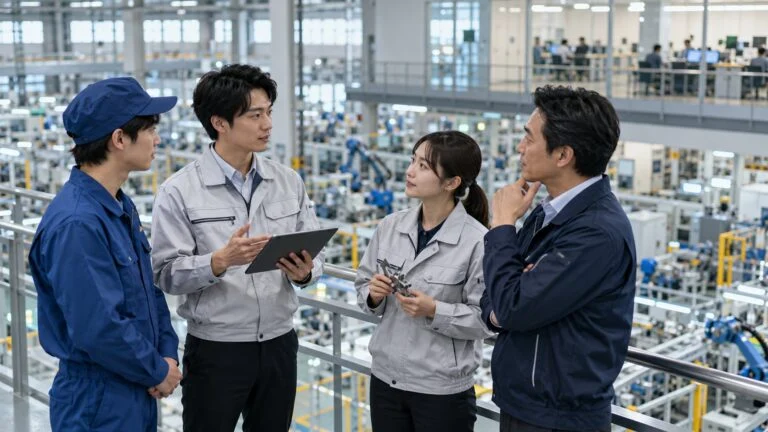
A senior technician at your Japanese supplier is retiring next year, and the supplier says the job is "fine" because gino densho is under way. Or a Japanese manager at your plant asks for a skills transfer plan before an expat veteran goes home. Or a resume from Japan lists "1st grade ginoshi, machining." All three point to the same thing: how Japanese plants pass shop-floor skill from veterans to the next generation.
In short: the Japanese approach is to make skills transfer a planned company system, not a side effect of working together, though many plants are still building that system. They sort skills into what can be written down and what has to be learned by doing. They teach through structured on-the-job training (OJT) backed by classroom training (Off-JT), and they measure progress with gino kentei, Japan's national trade skills test. The pressure is real. In Japan's latest government survey, 65.8% of manufacturing establishments reported problems passing on skills, the highest share of any industry.
This guide explains the Japanese terms, the data behind the urgency, how the training system and the national skills test work, and how plants build a transfer plan. It ends with a plan template and questions you can ask a Japanese supplier or head office.
Contents
- What Gino Densho Means, and Where Shokunin Fits
- Why Japanese Plants Treat Skills Transfer as Urgent
- What Gets Transferred: Explicit and Tacit Skills
- How Japanese Plants Train: OJT, Off-JT, and Self-Study
- Gino Kentei: Japan's National Trade Skills Test
- How Japanese Plants Build a Skills Transfer Plan
- Who Does What: The Company, the Veteran, and the Learner
- Skills Transfer Plan Template
- Questions to Ask a Japanese Supplier or Head Office
- Where This Guide Does Not Apply
- FAQ
- Sources
What Gino Densho Means, and Where Shokunin Fits
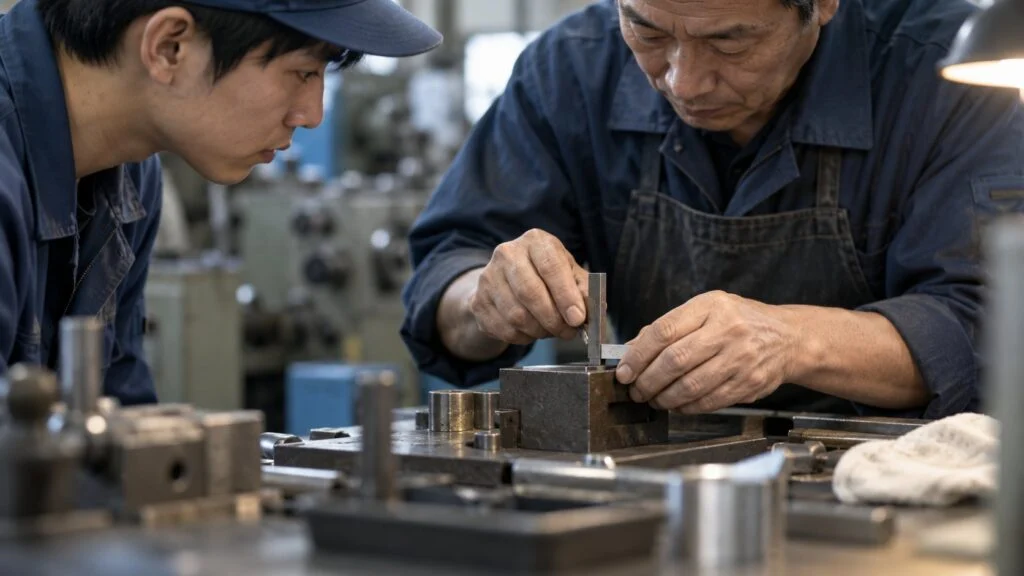
Gino densho (技能伝承, also gino keisho, 技能継承) means handing down skills and know-how from experienced workers in a form the next generation can actually use. In a factory, that covers more than machining or assembly technique. It includes a feel for setups, the sense that equipment is not running right, and the eye that tells good quality from bad.
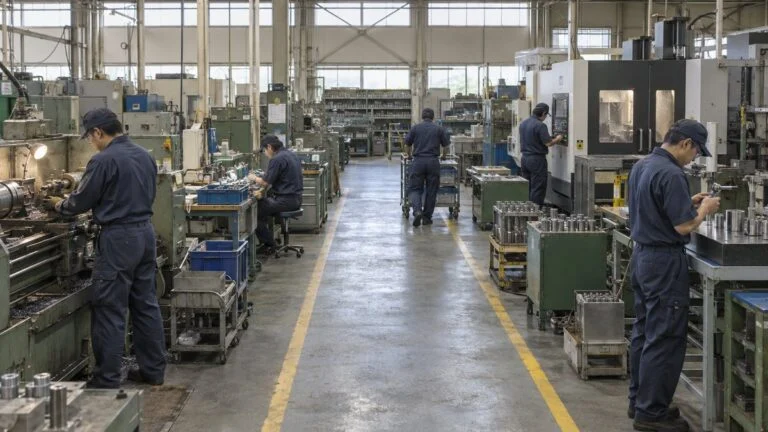
You will also hear shokunin (職人). Outside Japan the word is often used for a craftsperson who has spent a lifetime perfecting one craft. In a Japanese plant you will also hear jukurensha (熟練者, skilled or experienced worker) or simply "veteran" (beteran) for the people whose skills need to be passed on. The point of skills transfer is to stop treating that expertise as something only one person can have. The goal is to capture as much of it as possible and spread it across the team.
Why Japanese Plants Treat Skills Transfer as Urgent
Japan's Ministry of Health, Labour and Welfare (MHLW) asks employers about this every year in its Basic Survey on Human Resource Development. In the fiscal 2025 survey, 44.2% of establishments across all industries said they had problems passing on skills. Manufacturing was the highest at 65.8%, followed by construction at 59.2%. Put another way, about two out of three manufacturing establishments see skills transfer as a problem.
Manufacturing has the highest share of all industries surveyed.
Source: MHLW, Basic Survey on Human Resource Development, fiscal 2025 (establishment survey).
Across all industries, the problem most often cited was difficulty finding motivated young and mid-career workers (74.5%), followed by skills and know-how taking too long to pass on (60.6%). The barrier is twofold: too few people to receive the skills, and too little time to transfer them.
The workforce itself has changed. According to Japan's 2026 White Paper on Manufacturing Industries (Monozukuri Hakusho), the number of people working in Japanese manufacturing fell from 12.02 million in 2002 to 10.33 million in 2025. Over the same period, the number of workers aged 34 and under went down, while the number aged 65 and over went up. If veterans leave before their skills are passed on, the know-how leaves with them. That is why skills transfer is often described in Japan as a race against time.
What Gets Transferred: Explicit and Tacit Skills
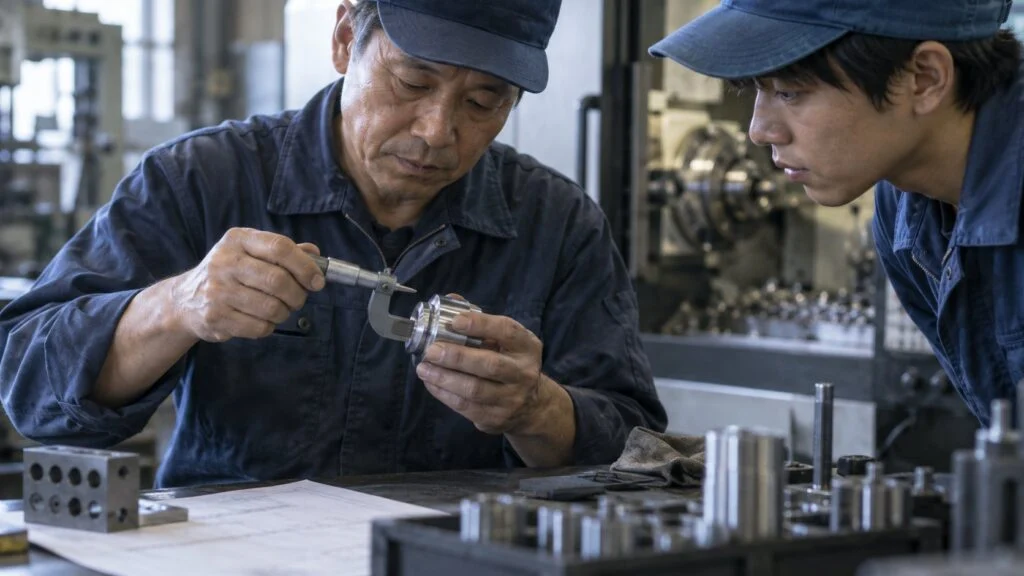
"Skill" means different things in different plants and processes. Some skills are about making things, such as cutting or welding. Others are about keeping equipment running steadily, or telling good quality from bad. Before planning anything, Japanese plants usually split skills into two kinds: those you can put into words and numbers, called explicit knowledge (keishikichi, 形式知), and those you cannot easily write down, called tacit knowledge (anmokuchi, 暗黙知).
They are passed on differently, so separating them makes a transfer plan easier to build.
Real skills mix both kinds, and some tacit knowledge can be turned into explicit knowledge with effort.
Skills You Can Write Down
Machining conditions, the order of operations, and inspection criteria can go into a work standard (sagyo hyojunsho, 作業標準書) or a checklist. Once written down, the content stays consistent even when the trainer changes.
The catch is that a written procedure has to match how the work is actually done. If it does not, new hires get confused because the document says one thing and the person training them says another. A work standard is never finished. The floor keeps using it and keeps correcting it.
Judgment Built on Experience
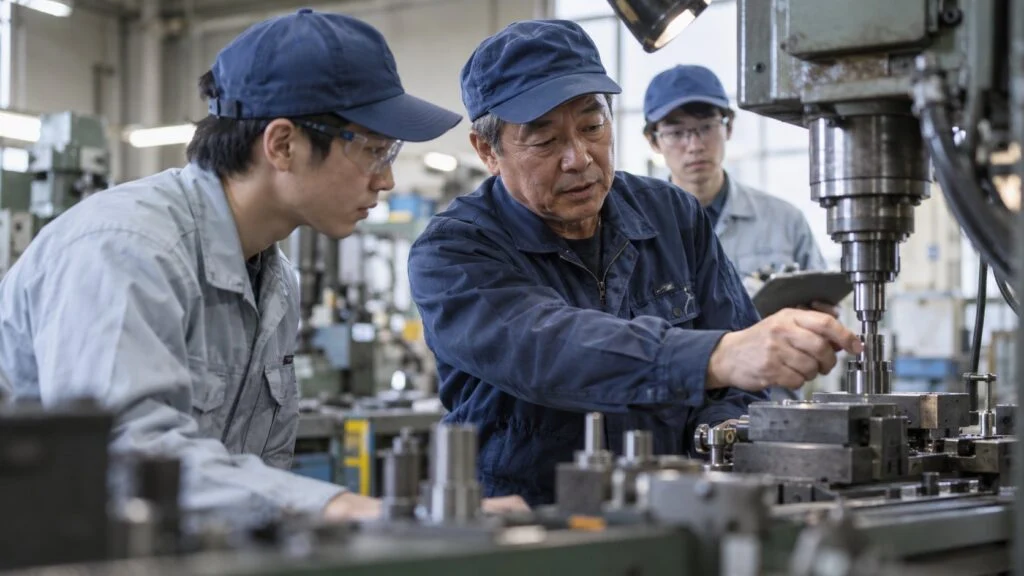
"When you hear this sound, change the tool." "If it feels like this, the finish is good enough." Veterans themselves often struggle to explain judgments like these. Tacit knowledge of this kind moves a little at a time, as the learner watches, tries, and asks questions while working alongside the veteran.
More plants now film skilled workers and add commentary on hand movements and decision points. Some also use sensors to collect data during machining so that the process can be compared in numbers.
Changeovers and Troubleshooting
Product changeovers (dandori, 段取り), responses to equipment problems, and finding the cause of defects also depend heavily on experience. Because these events are infrequent, young workers get few chances to build that experience.
Plants handle this by recording past problems and how they were fixed, then using those cases in study sessions. Recording why someone made a call, not just what they did, is what lets the next person apply it to a new situation.
Related: Maintenance Workflow at Japanese Plants: 8 Steps in 3 Phases
How Japanese Plants Train: OJT, Off-JT, and Self-Study
Training in Japanese manufacturing combines OJT, learning while doing the real job, with Off-JT, learning away from the job. Plants use each where it works best rather than choosing one.
OJT suits shop-floor skills; Off-JT suits structured knowledge.
Planned OJT
OJT is the core of training in Japanese plants. But if it stops at "watch and learn," what people learn and how fast they progress depend on who teaches them. In the fiscal 2025 MHLW survey, 60.6% of establishments across all industries gave regular employees planned OJT (keikakuteki na OJT). Planned OJT fixes three things in advance:
- The training goal and the time frame
- What will be taught, and in what order
- How progress will be checked
Many plants base these plans on a skill matrix (rikiryo-hyo, 力量表) that shows who can do which job at which level. Our skill matrix guide covers how to build one.
Some companies also train the trainers so that teaching quality is more even. Trainers learn how to teach: break a job into small steps, show it, have the learner do it, and confirm what the learner got right. That method comes from TWI Job Instruction, explained step by step in our guide to how Japanese plants run OJT.
Off-JT for Structured Knowledge
Off-JT works best for structured knowledge such as quality control, occupational safety and health, and the basics of mechanical and electrical engineering. The 2026 White Paper on Manufacturing Industries reports that 76.0% of manufacturing establishments provided Off-JT to regular employees in fiscal 2024, higher than before the COVID-19 pandemic.
For non-regular workers, the figure was only 29.0% in the same year. In plants with many agency or fixed-term workers, giving basic training to everyone regardless of employment type remains an open issue.
Self-Study
Beyond company training, Japanese plants also count on self-development (jiko keihatsu, 自己啓発). According to the same white paper, roughly 40% of regular employees in manufacturing do some self-study, compared with under 20% of non-regular workers, and these levels have stayed roughly flat. Self-study spreads further when people do not lose out by doing it. Typical supports include:
- Paying for certification fees
- In-house study groups
- Setting aside time for learning
Gino Kentei: Japan's National Trade Skills Test
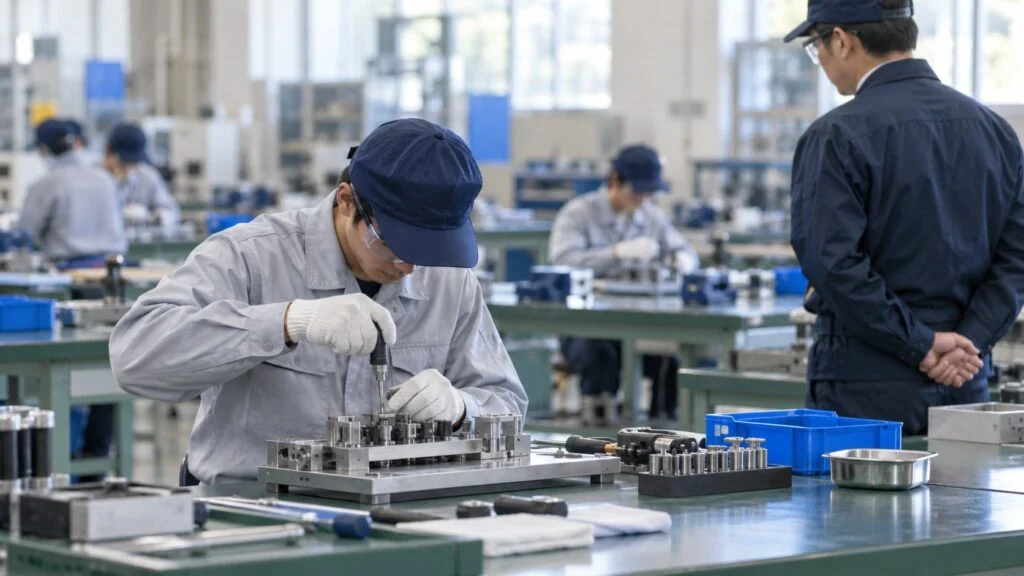
Japanese plants do not have to build every part of skills transfer themselves. Public programs help set training goals and supply outside instructors. The most visible one is gino kentei (技能検定), the national trade skills test. It assesses how well a worker has mastered the skills a trade requires.
As of March 2026, the test covered 133 trades: prefectures run 111, and designated testing bodies run 22. Many trades are directly relevant to manufacturing, such as machining, finishing, electronic equipment assembly, and machine maintenance. People who pass receive a certificate and may use the title ginoshi (技能士, certified skilled worker).
| Grade | Skill level it represents | Certificate issued by |
|---|---|---|
| Special grade (tokkyu) | What a manager or supervisor in the trade is normally expected to have | Minister of Health, Labour and Welfare |
| Grade 1 (ikkyu) / single grade | Advanced skilled worker | Minister of Health, Labour and Welfare |
| Grade 2 (nikyu) | Intermediate skilled worker | Prefectural governor (or head of the designated testing body) |
| Grade 3 (sankyu) | Entry-level skilled worker | Prefectural governor (or head of the designated testing body) |
| Basic grade (kisokyu) | Basic skills needed for routine tasks | Prefectural governor |
The grades give everyone a shared yardstick, which makes training goals easier to set. Some companies write them into training plans, for example "Grade 3 within three years of joining, Grade 2 within five." For young workers, taking the test is a way to confirm their own progress. For the veterans who trained them, results show what their teaching achieved. Setting aside practice time at work is one of the surest ways to help people pass.
If you see ginoshi on a resume or in a supplier's quality documents, read it as evidence that the person passed a tested skill level in a specific trade. Ask which trade and which grade. It is a Japanese certification, not a license to perform regulated work in your country, so do not treat it as interchangeable with a local credential.
Skills Competitions (Gino Gorin)
Japan also holds a national skills competition, Gino Gorin Zenkoku Taikai (技能五輪全国大会, literally "skills Olympics"), for young workers who are generally 23 or younger. Competitors qualify through prefectural preliminaries or are recommended by prefectural vocational ability development associations. MHLW and the Japan Vocational Ability Development Association (JAVADA) organize it, and the 2025 event in Aichi Prefecture also served as selection for Japan's team at WorldSkills, the international competition, in Shanghai in 2026.
Monozukuri Meister: Outside Instructors
MHLW's Monozukuri Meister program registers highly skilled, experienced workers as "meisters" who give hands-on instruction to young workers at small and medium-sized companies and training institutions. In manufacturing and construction, the criteria have included holding Special Grade, Grade 1, or single-grade ginoshi status (or equivalent skill), or placing high in the national skills competition, plus about 15 years of hands-on experience. For small companies short of in-house trainers, this is a way to learn directly from an outside expert. Contact details and dispatch conditions are available from each prefecture's vocational ability development association and similar bodies.
Foreign Workers and the Skills Test
Gino kentei also matters to readers in Southeast Asia. Besides the standard grades, it has a Basic grade and "as-needed" (zuiji) Grade 2 and Grade 3 tests aimed mainly at foreign technical intern trainees, to assess the skills they gained in Japan. The Technical Intern Training Program is scheduled to be replaced on April 1, 2027, by a new Employment for Skill Development system (ikusei shuro, 育成就労), designed to develop workers in labor-short fields toward Specified Skilled Worker status. If your company sends or receives workers through these programs, check the current rules with the Immigration Services Agency of Japan. The details are still changing.
How Japanese Plants Build a Skills Transfer Plan
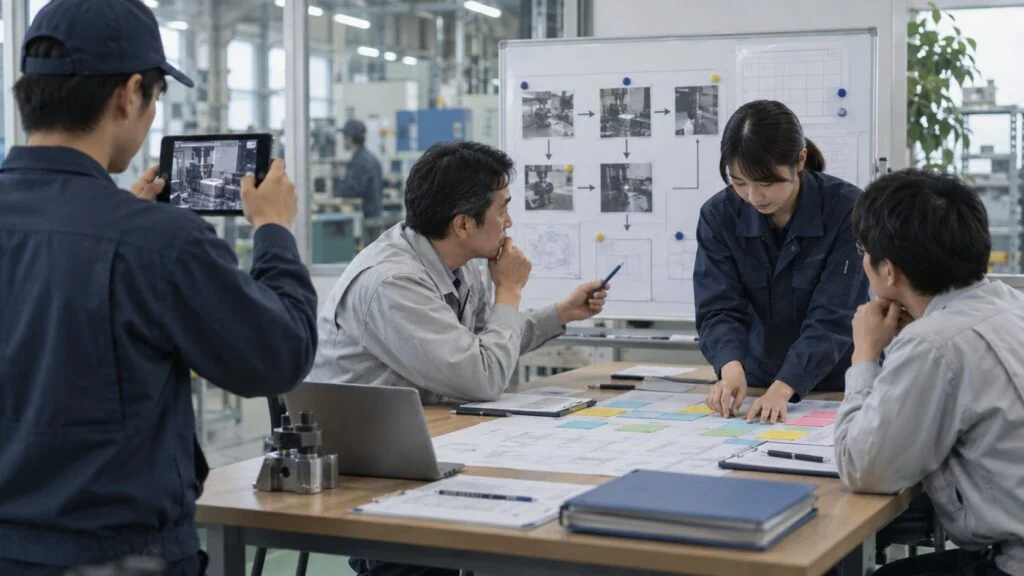
To move skills transfer from individual effort to a company system, Japanese plants commonly follow three phases: make skills visible, teach them, and make them stick.
The work falls into three phases: make visible, teach, and make it stick.
Small workplaces can start with only the most urgent skills.
Do not aim for a perfect system on day one. Start with one process or one veteran's skills, then roll out what works to other processes. Starting small also makes it easier to get the shop floor on board.
Make Visible: Decide What Passes From Whom to Whom
The first step is to list the skills each process needs and put them into a skill matrix. Then line up how many people hold each skill and when they are likely to retire. The skills that need to be passed on first become obvious.
Jobs only one person can do and processes where a veteran is close to retirement come first. Trying to cover everything at once overloads the floor, and the effort will not last.
Teach: Secure Trainers and Time
One of the most common reasons skills transfer fails is that trainers have no time. Veterans are often the people the line depends on, so they end up teaching on top of keeping production running.
Put training time into the schedule as real work, and reflect the trainer's extra load in their performance evaluation. For training materials, it helps if a younger worker or an engineer interviews the veteran and takes on the job of writing things up.
Make It Stick: Check and Review
Check whether the skills took hold through practical checks, in-house certification, or gino kentei. Record new skills in the skill matrix and link them to pay and roles, which keeps learners motivated.
Work standards and training materials also need updating when equipment is replaced or processes change. Keeping the system running is itself part of skills transfer.
Who Does What: The Company, the Veteran, and the Learner
What Companies Do
In the fiscal 2025 MHLW survey, the measure establishments across all industries most often took to pass on skills was hiring more mid-career workers (56.2%). Next was keeping selected retirees on through extended employment or rehiring and using them as instructors (54.7%). Only 22.0% were documenting or building databases of the skills and know-how that retiring workers need to pass on.
Transfer goes more smoothly when people, systems, and tools are all in place.
Rehiring veterans works quickly, but it only buys time. A system that lasts runs both tracks at once: transfer through people and transfer through records. Factory data collection from equipment can also help preserve skills as numbers.
Related: Retrofit Machine Monitoring on Older Japanese Machines
What Veterans Can Do
The most valuable thing a veteran can do is put the reasons behind their methods into words. When they explain why the steps come in that order and what they look at to make a call, younger workers can adapt the skill to new situations instead of copying it. Teaching is also a chance for veterans to review their own skills, and in Japanese plants, developing others counts when people are considered for team leader or trainer roles.
What Learners Can Do
Younger workers should not just wait to be taught. Ask questions on the spot, and record what you learn in notes and photos. Your own work notebook becomes an asset when it is your turn to teach. Aiming for the gino kentei grade in your field also makes it clearer what to pay attention to in daily work. Anyone who wants to get better at spotting equipment problems early will find the basics of Japanese plant maintenance useful; see our guide to hozen and TPM.
Skills Transfer Plan Template
This template turns the steps above into a one-page plan. Make a copy for each skill at risk and fill in every field. The example column is illustrative, not real data.
| Column | What to fill in | Example (illustrative) |
|---|---|---|
| Process / skill | The specific skill, not just the job title | Changeover on Press Line 2, including die height adjustment |
| Type | Explicit, tacit, or both | Both: steps are written; final adjustment is by feel |
| Current holders | Number of people at "can work alone" level or above | 1 |
| Risk date | Earliest date a holder may leave (retirement, transfer, return to Japan) | March of next year |
| Learner(s) | Role and current level on the skill matrix | Two operators, currently "can work with support" |
| Method | OJT, Off-JT, video, case review, outside instructor | Planned OJT on every changeover, plus filmed walkthrough with commentary |
| Materials to create | Work standard updates, video, troubleshooting log | Revise the work standard; record "why" for each adjustment |
| Trainer time | Hours per week set aside in the schedule | Hours blocked on the shift schedule |
| Completion check | Practical check, in-house sign-off, gino kentei grade | Three changeovers in a row within standard time, no defects, signed off by supervisor |
| Review date | When the plan and materials are updated | Every quarter, and after any equipment change |
Questions to Ask a Japanese Supplier or Head Office
If a critical process at a Japanese supplier depends on a few veterans, skills transfer becomes a supply risk for you too. These questions help you judge it without asking for anything confidential.
- For our parts, which processes can only one or two people do today?
- When are those people expected to retire, transfer, or reduce their hours?
- Is there a skill matrix (rikiryo-hyo) for those processes, and how often is it updated?
- Which of those skills are written into work standards, and which are still tacit (judged by sound, feel, or experience)?
- Who is being trained to take over, what is their current level, and what is the target date?
- How do you confirm a trainee is ready: practical check, in-house certification, or gino kentei grade?
- Are retired veterans being rehired as trainers? For how long?
- If a key person leaves, will you notify us as a 4M change (man, machine, material, method)?
- For an expat veteran leaving our plant: what must be documented, filmed, or handed over before departure, and who signs off?
Where This Guide Does Not Apply
- Survey scope: The MHLW figures come from establishments in Japan with 30 or more regular employees. They describe Japan, not overseas subsidiaries, and some breakdowns cover all industries rather than manufacturing alone, as noted in the text.
- Company practice varies: How formal planned OJT, skill matrices, and in-house certification are depends on the company, the industry, and the plant size. Small suppliers may run all of this informally.
- Gino kentei is Japan-specific: It is a Japanese national certification. It does not replace licenses or certifications required for regulated work, such as electrical work, welding of pressure equipment, or crane operation, in your country.
- Foreign worker programs are changing: Rules for technical intern trainees and the new Employment for Skill Development system are set by the Japanese government and may change. Check official sources before acting.
- Safety training is separate: Legally required safety training is not something to fold into general skills transfer. Follow the requirements where your plant operates.
FAQ
What Does Shokunin Mean in a Japanese Factory?
Shokunin (職人) means a craftsperson or artisan. In Japanese plants, people more often say jukurensha (skilled worker) or "veteran" for the experienced technicians whose skills need to be passed on. The term for passing those skills on is gino densho.
What Is Gino Kentei?
Gino kentei is Japan's national trade skills test, covering 133 trades as of March 2026. It is graded from Special grade through Grade 1, 2, and 3 (some trades have a single grade), and people who pass may call themselves ginoshi (certified skilled worker).
Is a Ginoshi Certificate Valid Outside Japan?
It is a Japanese certification, so it shows a tested skill level in a specific trade, but it is not a license to do regulated work in another country. Ask for the trade and grade, and check local requirements separately.
What Is the Difference Between OJT and Off-JT?
OJT is training while doing the real job, best for equipment operation and setups. Off-JT is training away from the job, such as classes or outside courses, best for structured knowledge like quality control, safety, and mechanical and electrical basics. Japanese plants combine the two.
How Do You Transfer Tacit Knowledge From Retiring Workers?
Pair the veteran with learners on real work, film the job with commentary on decision points, and record past problems along with why each call was made. Start with skills held by only one person, prioritizing those whose holders are closest to retirement, and check progress with a practical test.
Sources
- Skills transfer problems, causes, measures, and planned OJT: MHLW, Basic Survey on Human Resource Development, fiscal 2025, summary of results (Japanese); press release (Japanese)
- Manufacturing employment, Off-JT, and self-development: MHLW, 2026 White Paper on Manufacturing Industries, summary (Japanese)
- Gino kentei trades and the ginoshi title: MHLW, About the National Trade Skills Testing System (Japanese)
- Gino kentei grades, certificate issuers, and grades for technical intern trainees: Kagoshima Prefecture, Trade Skills Testing System (Japanese)
- National Skills Competition (63rd, 2025): Shimane Prefecture press release (Japanese); WorldSkills Shanghai team selection: MHLW skills promotion site (Japanese)
- Monozukuri Meister: MHLW, Monozukuri Meister (Japanese); program leaflet (Japanese)
- Employment for Skill Development system: OECD, International Migration Outlook 2025: Japan
Original article in JapaneseThis guide is adapted from a MONOSCOPE article written for readers in Japan: 製造業の技能伝承と人材育成|OJT・技能検定・仕組みづくりの進め方
About the editor
 MONOSCOPE EditorFOUNDER & EDITOR
Spent about ten years at a plant equipment maker and a plant engineering company, proposing, designing, and commissioning equipment, then moved into web marketing. Now a web consultant for B2B manufacturers, helping them explain their products and technology. Licensed in Japan as an Energy Manager and a Third-Class Chief Electrical Engineer.
Has run an engineering blog since 2017 (500+ articles) and a Japanese YouTube channel with about 20,000 subscribers. Each English guide is written from the Japanese shop-floor point of view and checked against the cited standards.