Working With Japanese Engineers: Nemawashi and Ho-Ren-So
You send a technical question to a Japanese supplier and get a short "Received, thank you" the same day, then nothing for a week. A design review ends with "We will consider it" and no decision. Your contact, an engineer you trust, says they have to "check internally" before agreeing to a two-day schedule change.
Many engineers and buyers who work with Japanese companies know these moments. A delay can have ordinary causes, such as workload or missing information. But it often reflects how work is reported, shared, and approved inside the company, not a lack of interest.
Once you can see those steps, you can plan around them and often speed them up.
This guide explains the practices behind the friction: ho-ren-so (reporting and consulting), nemawashi (building agreement before a meeting), ringi (written approval), genba-first thinking, and how to read silence and "we will consider it." It ends with concrete moves and three English email templates you can adapt. Practices differ a lot between companies, industries, and generations, so treat this as a map of common patterns, not a rulebook.
Each row is a common situation. The middle column lists common explanations, not the only ones.
Our own summary based on the sources cited in this article. Many companies, including some smaller and foreign-owned firms, decide faster and more directly.
Contents
- Why Replies Take Time: Ho-Ren-So
- Why Meetings End Without a Decision: Nemawashi and Ringi
- Silence in Meetings and What "Kento Shimasu" Means
- Genba-First Thinking: Show the Real Part
- When Your Contact Has No Authority
- Practical Moves That Help
- Sample English Emails (Templates)
- What Is Changing
- Limits of This Guide
- FAQ
- Sources
Why Replies Take Time: Ho-Ren-So
Ho-ren-so (報連相) is short for hokoku (report), renraku (inform), and sodan (consult). It sounds like ho-ren-so, the Japanese word for spinach, which makes it easy to remember. New employees at many Japanese companies are taught it as a basic work habit: keep your manager informed, share facts with the people affected, and consult before you decide something on your own.
The phrase is usually traced to Tomiji Yamazaki, then president of Yamatane Securities, who promoted it inside his company around 1982. A 2024 PRESIDENT Online article (Japanese) says he launched it as a company campaign once the staff had passed 1,000 people. The story comes from business writing, not from research, but the term has been in wide use for decades.
For a foreign partner, ho-ren-so explains a lot of waiting. When you ask an engineer to accept a deviation or move a date, a careful engineer will often report it to a manager and consult quality, production control, or purchasing first.
A fast "yes" from one person can cause trouble later if the other departments were not told. A slow reply may mean that this internal review is under way. If you are not sure, ask what is still being reviewed and when to expect an update.
Ho-ren-so also has critics in Japan. In 2021 a social media post that got more than 70,000 likes said that bosses want ho-ren-so from their staff, while staff want ohitashi from their bosses: do not get angry, do not reject, help, and give instructions (ABEMA TIMES, February 2021, Japanese).
Ohitashi is a boiled spinach dish, so the joke turns the same vegetable back on managers. The point is that reporting only works when the person receiving the report responds well.
What This Means for Your Emails
You cannot remove the internal review, but you can make it shorter. Write questions that your contact can forward without rewriting, and ask for a reply date instead of an immediate answer.
- One topic per email, with the part number, drawing number, or project name in the subject line.
- Numbered questions, each answerable on its own, so different departments can answer different items.
- A deadline with a reason ("We need your answer by May 12 because the mold order closes on May 15").
- A "received" request: "Please confirm you received this and tell us when you expect to reply." A short acknowledgment is a normal and useful reply.
For a change request, give reviewers everything they need in one place:
- Part number and drawing revision
- Current and proposed requirement
- Affected lots, orders, or shipments
- Supporting data (test results, measurements, photos)
- Expected effect on cost and schedule
- Requested implementation date
Then ask three separate questions: is the change technically feasible, is it formally approved, and when will it be implemented? A "yes" to the first is not a "yes" to the other two.
Why Meetings End Without a Decision: Nemawashi and Ringi
If you are used to making decisions during meetings, a meeting that ends without one can be confusing. In many Japanese companies, the main decision work happens before and after the meeting, and the meeting itself often confirms what has already been discussed. When in doubt, ask whether a meeting is meant to gather input, approve a proposal, or confirm an earlier agreement.
Nemawashi: Agreement Before the Meeting
Nemawashi (根回し) literally means digging around the roots of a tree before moving it. The Lean Enterprise Institute defines it as "the process of gaining acceptance and preapproval for a proposal by evaluating first the idea and then the plan." In practice, the person proposing a change talks to each affected manager or department one by one, hears their concerns, and adjusts the proposal before any formal meeting.
This is why a new proposal raised for the first time in a meeting often gets no answer. The people in the room may not have had a chance to check it with their own teams, and some people prefer not to disagree in front of others. Silence in that moment is not the same as agreement or rejection.
Ringi: Formal Written Approval
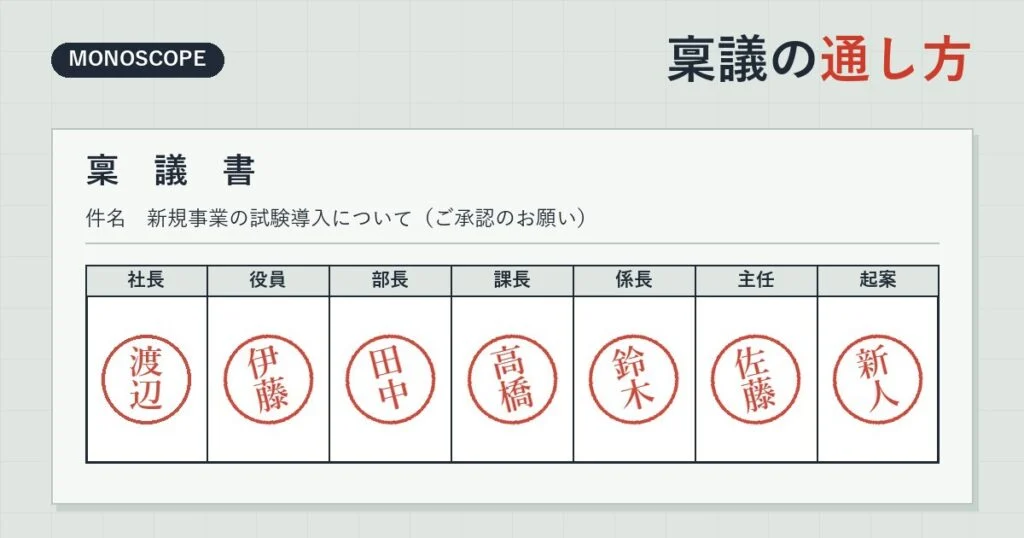
Ringi (稟議) is a formal written approval process, on paper or in an electronic workflow. A ringi-sho (稟議書, approval request) circulates to approvers in order, often from the section manager up to the department head or higher, depending on the amount and type of decision. Purchases of equipment, new suppliers, and design changes may need one, depending on the company.
In the two survey groups below, approval usually took days rather than hours. In a 2022 survey by the workflow software company ATLED (Japanese) of 109 people at companies with 100 or more employees, the most common average time from submission to approval was 1 to under 3 days (37.6%), and about half said 3 days or more.
In a survey of 312 users of the e-contract service CloudSign, published by Bengo4.com (Japanese; fieldwork in fall 2024, released January 2025), 73.5% said approval takes a day or more. The top problem was "too many people involved before approval" (41.0%), and 35.9% said consultation and nemawashi before drafting take too long.
Both surveys are small and run by companies that sell approval tools, so treat them as a rough picture, not a national average. Still, respondents in both surveys named slow approval or too many approvers as common problems, so the people inside the process see the delay too. For your own request, ask your contact what timing to expect.
One common path for a change request at a company that uses nemawashi and ringi. The order, the steps, and their length vary by company and by the size of the decision; ask how it works at your supplier or customer.
You can help: send data and answers to likely questions early.
You can help: send the agenda and material days ahead.
Still confirm: capacity, materials, validation, and the start date.
You can help: ask what the approvers need and when.
Our own illustration. Some companies skip formal ringi for small decisions, and some use electronic workflows instead of paper.
What Consensus Buys
Slow decisions have a payoff that outsiders sometimes miss. Erin Meyer, a professor at INSEAD who studies cross-cultural management, describes ringi as "a very consensual decision-making protocol." In her account, the decision takes longer, but once it is made, implementation is rapid because the affected people already support it.
Jeffrey Liker's book The Toyota Way (2004) states a similar idea as one of its 14 principles: make decisions slowly by consensus, considering all options, and implement them rapidly. Meyer also notes the downside: once the group has decided, the decision is hard to change.
For you, that means the best time to influence a decision is during nemawashi, not after the ringi has been approved. Approval alone does not set a start date, so still confirm capacity, materials, validation, and the schedule.
Silence in Meetings and What "Kento Shimasu" Means
Pauses in a meeting with a Japanese team can feel long to people used to quick back-and-forth. In an interview published by the Japanese software company HENNGE, Meyer said, "Japan is very comfortable with silence." Silence can mean the person is thinking, waiting for a senior colleague to speak first, or unsure how to respond in front of others.
In an English-language meeting, a pause may also be someone working out a careful answer in a second language. Sharing key questions in writing before the meeting, allowing time to respond, and offering a written follow-up all help.
Reading "Kento Shimasu"
Kento shimasu (検討します) means "we will consider it" or "we will study it," and sometimes that is exactly what happens. A Japanese business-language article in Oggi (March 2026) notes that the phrase is also sometimes used to avoid an immediate answer or to soften a refusal. You usually cannot tell which from the words alone.
Instead of guessing, ask about the next step. The answers tell you whether real work is planned.
- "Who will review this, and is there any data we can send them?"
- "When do you expect to have an answer?"
- "Is there anything in our proposal that makes it difficult?"
If you get a clear date and a list of what the reviewers need, the study is likely real. If the timing stays unclear after a polite follow-up, treat the proposal as not approved for planning purposes. Agree on the next update date, prepare an alternative, and ask whether a smaller trial would be easier to approve.
Genba-First Thinking: Show the Real Part
Genba (現場) is the actual place where work happens: the line, the field site, the service bay. Many Japanese manufacturers encourage engineers to go and see the real situation before deciding, often called genchi genbutsu (現地現物, the actual place and the actual thing). Toyota's page on the Toyota Way explains genchi genbutsu as going to see the location or process where the problem exists.
This explains requests that can feel like distrust: a Japanese customer may ask for the actual defective part, photos from several angles, a video of the process, or a visit to your line before accepting a root cause.
These requests are often meant to support failure analysis or verification rather than signal distrust. Ask what evidence is needed, what question it will answer, and how samples should be labeled and shipped. We cover the wider idea in Monozukuri Meaning: Japan's Philosophy of Making Things.
When you report a problem, lead with what you observed: the part, the lot, the measurement, the photo. Put your interpretation after the facts. A structured report such as a why-why analysis helps the reader follow your reasoning step by step.
When Your Contact Has No Authority
Your daily contact may be a capable engineer with little formal authority. In many Japanese companies, a decision that affects cost, schedule, or quality needs a kacho (課長, section manager) or bucho (部長, department manager), and sometimes other departments too. If your contact is a sales engineer, technical questions may also pass through the design or quality team; see Japanese Sales Engineers and FAEs.
Contacting a senior manager without involving your contact can backfire. It can embarrass your contact and skip the internal checks the company relies on. A better approach is to help your contact build the case inside.
- Ask who else needs to agree: "Which departments need to review this?" is a normal question.
- Offer material for each reviewer: a one-page summary for the manager, test data for quality, a cost table for purchasing.
- Ask for a joint call when stakes are high: suggest that your contact invite the manager, rather than inviting the manager yourself.
- Escalate through your own side: if a routine issue must be escalated, have your manager contact their manager, and tell your contact first.
- Urgent issues are different: for a quality, safety, or line-stop problem, use the agreed escalation procedure right away and inform your contact at the same time.
If a trading company (shosha, 商社) sits between you and the maker, add a step for it in your timeline. It may pass questions on in both directions and in two languages.
Practical Moves That Help
These steps do not ask you to change your own style. They help your contact explain your request and coordinate the internal reviews.
Use it before a meeting, a change request, or a quality report.
Our own checklist. The 3–5 day lead time is a planning suggestion, not a rule from any source.
Write in plain English: short sentences, one idea each, no idioms or slang. English skills vary widely; Japan ranked 96th of 123 countries and regions in the 2025 EF English Proficiency Index. The index is based on people who chose to take EF's online test and says nothing about any one engineer, but it is a good reason to keep emails simple.
Some readers run long emails through a translation tool, and simple sentences survive that better. Spell out dates ("June 3, 2026") instead of formats like 6/3, which can be read differently in different countries.
Sample English Emails (Templates)
The three templates below are written by us as starting points. They are not real correspondence. Replace the bracketed parts, and address your contact the way they sign their own emails.
Subject: Material for our [date] meeting – [Project / Part No.]
Dear [Name],
Thank you for arranging the meeting on [date]. To give your team time to review, we are sending the material now.
Attached:
1. Agenda
2. Test results for [item], with the test conditions
3. Our proposal: [one-line summary]
At the meeting, we would like to agree on:
1. [Decision 1]
2. [Decision 2]
If any department has questions before the meeting, we are happy to answer by email or join a short call. If a decision needs internal approval after the meeting, please tell us what information would help.
Best regards,
[Your name]
Subject: Next steps on [proposal] – [Project / Part No.]
Dear [Name],
Thank you for considering our proposal on [topic].
To support your review, could you tell us:
1. Who will review it (department or role is fine)
2. What additional data would help
3. When you expect to reach a decision
For our planning, we need an answer by [time and time zone] on [date] because [reason, e.g., we must place the material order then to keep the production schedule]. If that timing is difficult, please let us know and we will look for options.
If anything in the proposal is a concern, we would be glad to adjust it, for example by starting with a smaller trial.
Best regards,
[Your name]
Subject: Summary of [date] meeting – [Project / Part No.]
Dear [Name],
Thank you for your time today. Here is our summary. Please correct anything we misunderstood.
Confirmed in the meeting:
1. [Item] – owner: [company/role], due: [date]
2. [Item] – owner: [company/role], due: [date]
Pending (after internal review):
1. [Item] – review by: [department/role], next update: [date]
Please confirm or correct this summary by [date]. We will not implement any change to [part/process] until we receive your written approval.
Best regards,
[Your name]
A meeting summary is not an approval. For changes that affect quality, cost, delivery, or safety, keep the confirmed and pending items separate and wait for written approval.
What Is Changing
The patterns above are shifting, though unevenly. Remote work, for one, has not gone away.
In Japan's Ministry of Land, Infrastructure, Transport and Tourism (MLIT) telework survey for fiscal 2025 (Japanese, 40,000 respondents), 25.2% of employed workers had ever teleworked and 16.8% had teleworked in the past year. MLIT reports that both figures had been falling since the pandemic and rose again in that survey.
Shop-floor roles in manufacturing are hard to do remotely, so your factory contacts may work very differently from office staff. Confirm your contact's working hours, preferred channel (email, chat, or phone), and a backup contact.
Other changes are visible but harder to measure:
- Tools: in the CloudSign user survey cited above, 67.6% of respondents used a workflow system for ringi and 7.4% used paper and seals. These users are likely ahead of the average company. Electronic approval can make it easier to see where a request is waiting.
- Attitudes: the 2021 ohitashi post is one example of open criticism of how managers receive reports. It does not prove a generational trend, but habits can differ between people in the same team, so ask rather than assume.
- Ownership and size: foreign-owned companies, startups, and owner-run small firms may have shorter approval routes than large, long-established companies. Ownership or size alone does not tell you the process, though.
Do not assume a company works one way because it is Japanese. Ask your contact how decisions are made in their team, and update your plan when you learn more.
Limits of This Guide
This guide is based on public sources: published surveys, a government statistic, interviews, and reference definitions. We did not interview Japanese engineers for it. The surveys cited are small or limited to certain groups, and none measures how common nemawashi or ringi is across Japanese manufacturing.
Practices described here also appear in many other countries, and many Japanese engineers are direct, fast, and comfortable disagreeing in meetings. Use these patterns as a starting point for questions, not as a way to predict how a specific person will act.
FAQ
What Does Ho-Ren-So Mean?
It is short for hokoku (report), renraku (inform), and sodan (consult), a work habit taught at many Japanese companies. It is usually traced to a campaign at Yamatane Securities around 1982.
What Is the Difference Between Nemawashi and Ringi?
Nemawashi is the informal groundwork: talking to the people affected and hearing their concerns before a proposal is formal. Ringi is the formal written approval route that comes after.
Does "Kento Shimasu" Mean No?
Not always. It can mean real study or a need for internal approval, and it is sometimes used to soften a refusal. Ask who will review the proposal and when to expect an answer.
Should I Contact My Contact's Boss Directly to Speed Things Up?
Usually not without telling your contact. It is better to offer material for the manager or suggest a joint call. If you need to escalate, do it manager to manager and let your contact know first.
Why Do Japanese Customers Ask for the Actual Defective Part?
Many Japanese manufacturers prefer to see the real part and process before accepting a cause, a habit called genchi genbutsu. It is often about checking facts rather than distrust.
Sources
- Origin of ho-ren-so: PRESIDENT Online, December 29, 2024 (Japanese)
- "Ohitashi" post: ABEMA TIMES, February 19, 2021 (Japanese)
- Nemawashi definition: Lean Enterprise Institute, "Nemawashi"
- Ringi and consensus: Erin Meyer, "Avoiding Culture Clashes When Making Decisions"; Jeffrey K. Liker, The Toyota Way (McGraw-Hill, 2004), Principle 13
- Silence in meetings: HENNGE, interview with Erin Meyer
- Approval time surveys: ATLED, March 28, 2022 (Japanese); Bengo4.com / Professional Tech Institute, January 16, 2025 (Japanese)
- English proficiency: Nippon.com, "Very Low Proficiency: Japan Drops into Bottom Group in English Ability Ranking," December 8, 2025
- "Kento shimasu": Oggi, March 30, 2026 (Japanese)
- Genchi genbutsu: Toyota Ireland, "The Toyota Way"
- Telework: MLIT press release, March 24, 2026 (Japanese)
About the editor
 MONOSCOPE EditorFOUNDER & EDITOR
Spent about ten years at a plant equipment maker and a plant engineering company, proposing, designing, and commissioning equipment, then moved into web marketing. Now a web consultant for B2B manufacturers, helping them explain their products and technology. Licensed in Japan as an Energy Manager and a Third-Class Chief Electrical Engineer.
Has run an engineering blog since 2017 (500+ articles) and a Japanese YouTube channel with about 20,000 subscribers. Each English guide is written from the Japanese shop-floor point of view and checked against the cited standards.