Strain Wave Gear vs Cycloidal RV Reducer for Robot Joints
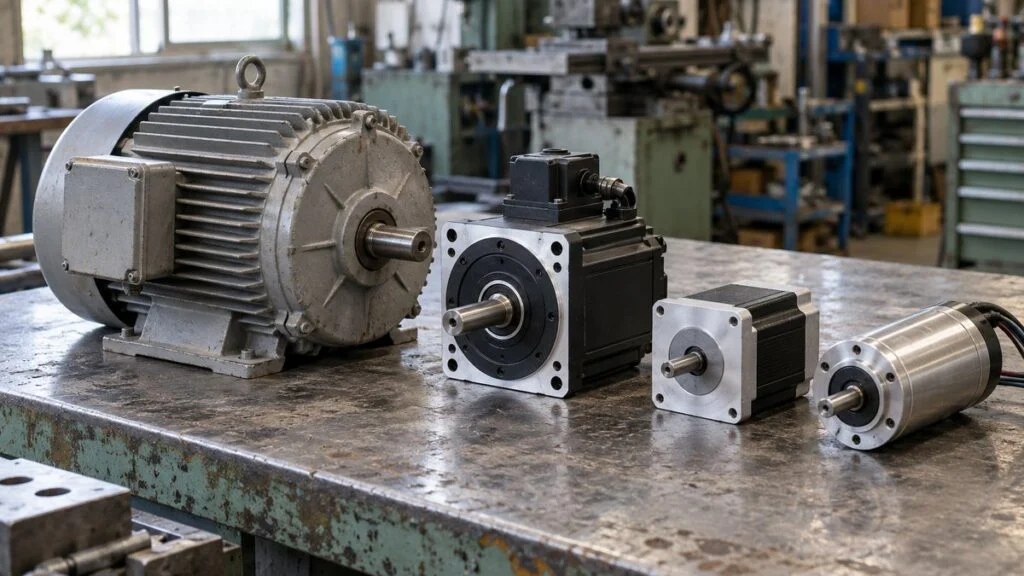
Inside each joint of a six-axis robot arm, a servo motor turns much faster than the arm itself. Between the two sits a compact gearbox that cuts the speed, multiplies the torque and keeps play in the joint very small. Two Japanese companies, Nabtesco and Harmonic Drive Systems, are among the best-known suppliers of these gearboxes.
This article explains the two main types of precision reducer, called seimitsu gensokuki (精密減速機, precision speed reducers) in Japan. Strain wave gearing is closely tied to Harmonic Drive Systems, and the RV reducer, a two-stage cycloidal design, to Nabtesco. We cover how each works, where each goes in a robot, how they compare on backlash, stiffness, ratio and life, and how Chinese makers are changing the supply picture.
Specifications quoted here are catalog examples for single models, not limits for each technology. Always check the datasheet for the exact size and ratio you plan to use.
Key numbers
Sources: Nabtesco, Precision Reduction Gears product page (accessed October 2026; no survey year given); International Federation of Robotics, World Robotics 2025 press release (September 25, 2025); Harmonic Drive LLC, Strain Wave Gear Technology page.
Contents
- What a Robot Joint Reducer Does
- Strain Wave Gearing: How It Works
- RV Reducers: How the Cycloidal Design Works
- Strain Wave vs RV: Backlash, Stiffness, Ratio and Life
- Where Each Type Goes in a Robot
- Why the Leading Suppliers Are Japanese
- Chinese Competitors and Supply Constraints
- What to Check When Specifying a Reducer
- Limits of This Article
- FAQ
- Sources
What a Robot Joint Reducer Does
A servo motor usually runs much faster than the joint needs to move. The reducer lowers the speed and raises the output torque, with some power lost to friction, so a small motor can move a heavy arm. As reference points for life ratings, Harmonic Drive's catalog uses a rated input speed of 2,000 rpm, while Nabtesco rates its RV reducers at an output speed of 15 rpm.
The reducer also sets how precisely the arm can hold a position. Any play or twist in the joint grows with distance, so a tiny angle at the shoulder becomes a visible error at the tool tip. Three terms matter most:
- Backlash: free play when the load reverses. Nabtesco defines it as the width of the hysteresis curve at zero torque.
- Lost motion: the twist measured at a small load. Nabtesco defines it at about ±3% of rated torque.
- Torsional stiffness (rigidity): how much torque it takes to twist the output by a given angle, often given in Nm per arc-minute.
One arc-minute is 1/60 of a degree. On a 1 m arm, 1 arc-minute of twist moves the tip by about 0.29 mm. That is why reducer makers quote backlash and lost motion in arc-minutes.
For how joints, motors and controllers fit together in a full robot system, see Japanese robot makers: pendants, service and safety rules.
Strain Wave Gearing: How It Works
Strain wave gearing, often called a harmonic drive, uses an elastic part instead of rigid gears alone. In Japan it is called hado haguruma sochi (波動歯車装置, wave gear device). "Harmonic Drive" is a registered trademark, so engineers use "strain wave gear" as the generic name.
It has three parts. The diagram below shows how they turn input rotation into a slow, high-torque output.
A flexible cup is squeezed into an oval, so its teeth mesh with a rigid ring in two places.
Source: Harmonic Drive LLC, Strain Wave Gear Technology page. The 200-tooth example is our calculation from the two-tooth difference.
Harmonic Drive's catalog describes the gear element as having zero backlash, because teeth stay engaged in two zones. Zero backlash does not mean zero elastic twist or zero hysteresis.
The same CSF/CSG catalog notes that the Oldham coupling on the input side, used to absorb motor shaft misalignment, adds a small amount, usually negligible. The design is light and short, with a hollow center option for cables.
The trade-off is that the flexspline bends on every turn. Its fatigue strength limits torque capacity, and the wave generator bearing sets the rated life. Stiffness also changes with load: the catalog describes the torque–twist curve with three straight-line slopes rather than one value.
From a US Patent to a Japanese Industry
Harmonic Drive LLC says C. Walton Musser invented and patented the strain wave gear in 1955, and the US company USM (United Shoe Machinery) commercialized it. In Japan, Hasegawa Gear Works began domestic production in 1964 through a technical tie-up with USM. The two companies then jointly founded Harmonic Drive Systems in 1970.
Today, Harmonic Drive Systems in Japan, Harmonic Drive LLC in the US and Harmonic Drive SE in Germany all make strain wave gears. They are not the only makers: Nabtesco has owned OVALO GmbH, a German strain wave gear maker, since 2017, and Sumitomo Drive Technologies also sells strain wave gearboxes.
RV Reducers: How the Cycloidal Design Works
The RV reducer takes a different path to the same goal. Instead of a flexible part, it uses two stages of rigid gears and a ring of pins. "RV" is Nabtesco's trademark for its design.
A spur-gear stage feeds crankshafts, which roll two cycloidal gears around a ring of pins.
Source: Nabtesco, Precision Reduction Gear RV catalogs (AF and RD2 series), "Principle of speed reduction." Speed ratio R = 1 + (Z2/Z1) × Z4, where Z1 = input gear teeth, Z2 = spur gear teeth, Z4 = number of pins.
Nabtesco's catalog links the many meshing teeth and pins to high rigidity and strong resistance to overload. The crankshafts are supported on both sides, and the built-in main bearing carries the arm's moment loads. According to the RD2 catalog, this can remove the need for a separate external bearing and support table, as long as radial load, axial load and tilting moment stay within the model's ratings.
Nabtesco says the RV design started as actuators for construction machinery. Its history records that Teijin Seiki developed the RV reduction gear in 1985 and began mass production in 1986. Teijin Seiki and Nabco merged to form Nabtesco in 2003.
Cumulative RV output passed 1 million units in 2000 and 5 million in 2014, according to Nabtesco Precision's company history. Other Japanese firms also make cycloidal reducers for robots, such as Sumitomo Drive Technologies with its FINE CYCLO line, which includes single-stage cycloidal models.
Strain Wave vs RV: Backlash, Stiffness, Ratio and Life
The table lists selected catalog examples, not a matched-size performance test. The products also differ in build: the CSG values are for component sets, while the RV-125N has its own main bearing.
Example values from Harmonic Drive CSG/CSF and Nabtesco RV-N catalogs.
Sources: Harmonic Drive LLC, CSF/CSG Component Sets catalog; Nabtesco Precision Europe, RV-125N and RV series pages; Nabtesco AF and RD2 series catalogs. Accuracy and life values use each maker's own definitions and test conditions, so they cannot be compared directly.
The life row needs care.
Harmonic Drive gives an L10 life for the wave generator bearing at a rated input speed, while Nabtesco gives a rated service life at a rated output speed. Both makers give formulas to estimate life for your torque and speed. Even then, check what each rating covers and how failure is defined, because converting torque and speed alone does not make the ratings equivalent.
The values also move over time. Harmonic Drive's catalog says its CSG series raised torque capacity by 30% and L10 life from 7,000 to 10,000 hours compared with the CSF. New tooth profiles and materials keep changing what each type can do.
Where Each Type Goes in a Robot
A six-axis arm carries more load near the base than at the wrist. That simple fact drives a common split, shown below, although every robot maker chooses its own layout.
Heavy-load axes near the base often use RV or other cycloidal reducers; wrist axes often use strain wave gears.
Simplified diagram by MONOSCOPE; joint labels are schematic and do not show rotation axes. Actual layouts vary by maker, payload and model; some small robots use strain wave gears on all axes, and some designs use other reducer types.
Nabtesco describes its share estimate in terms of joints for medium and large industrial robots, which fits this split. Small robots and many collaborative robots (cobots) need light, slim joints and often use strain wave gears. A cobot's safety depends on the whole application and its risk assessment, not on the reducer.
Humanoid Robots
Humanoids need many compact joints, and both Japanese makers are working on them. At iREX 2025 in Tokyo, Harmonic Drive showed flat, high-torque reducers for the neck and arms and very small units for fingers, according to TrendForce (December 2025). Nabtesco has also promoted strain wave gears and actuators for humanoid robot joints, according to the German trade journal Industrial Production.
Designs are still changing, and no single reducer type has become the standard. Some developers use planetary gears or screw-driven linear actuators in some joints instead of strain wave gears. Treat any forecast of reducer demand from humanoids as an estimate that depends on which design wins.
Why the Leading Suppliers Are Japanese
Nabtesco says it has about 60% of the global market for precision reducers used in the joints of medium and large industrial robots. This is the company's own estimate, and its website gives no survey year. We could not find a comparable figure for Harmonic Drive Systems from a named source, so we describe it as one of the leading suppliers of strain wave gears.
Public sources do not show how much each factor contributed to Japan's position. The record points to a few factors, and this list is our reading, not a statement by the companies:
- An early start: Japanese production of strain wave gears began in 1964, and the RV reducer entered mass production in 1986.
- Close ties to robot makers: Japanese robot makers such as Fanuc and Yaskawa were customers close to home, and a reducer must prove itself in long life testing before a robot maker adopts it.
- Process know-how: both designs depend on precise tooth profiles, heat treatment, bearings and assembly. Some of that skill is hard to see in a drawing.
- A long track record: robot makers tend not to change a joint reducer once a model has proven itself in the field.
Japan also has strong suppliers of the bearings these reducers rely on. See Japanese bearing manufacturers compared and, for other companies with large niche shares, Japan's hidden champions.
Chinese Competitors and Supply Constraints
Demand for robots has shifted toward China. In 2024, Chinese factories installed 295,000 industrial robots, according to the International Federation of Robotics (IFR).
Figure 5: Where New Industrial Robots Were Installed (2024)
More than half of the robots installed in 2024 went into Chinese factories, which is why Chinese reducer makers matter.
- China295k
- Japan44.5k
- United States34.2k
- Republic of Korea30.6k
- Germany27k
- Others110.7k
Source: International Federation of Robotics, World Robotics 2025 press release (September 25, 2025). Values in thousands of units. "Others" is the world total (542,000) minus the five markets shown, calculated by MONOSCOPE.
The IFR also reports that Chinese robot makers took 57% of their home market in 2024. It says this was the first time they sold more robots in China than foreign suppliers did. A larger share for Chinese robot makers gives Chinese reducer makers more customers close to home.
A leading Chinese strain wave gear maker is Leaderdrive (Leader Harmonious Drive Systems), founded in 2011 and listed on Shanghai's STAR Market in 2020. VnExpress International reported in April 2026 that J.P. Morgan put its share of China's harmonic reducer market at 30–40%; the report does not give the estimate's date or market definition.
The same report gives Leaderdrive's 2025 revenue as 570.7 million yuan, up 47%, and names humanoid makers Agibot and UBTech among its customers.
Leaderdrive is not alone: Laifual Drive, another Chinese harmonic reducer maker, launched an initial public offering in Hong Kong in June 2026, with listing planned for June 30, according to Gasgoo. Chinese firms such as Zhejiang Shuanghuan Driveline also make RV-type reducers. We did not find a reliable, named estimate of their combined global share.
Supply Has Been Tight Before
Demand spikes can stretch reducer lead times. In 2017, The Robot Report wrote that Harmonic Drive had extended delivery times because orders outran output, even as it expanded capacity.
That is a past example, not evidence of a shortage today. Nabtesco's history lists the opening of its Tsu plant in Japan in 1991 and the founding of a Chinese subsidiary, Nabtesco (China) Precision Equipment, in 2016.
For a buyer, the lesson is to plan reducer supply early, not after the design is frozen. Ask suppliers for current lead times, capacity commitments and regional stock. A second source helps only if its unit is qualified for fit, load, stiffness, accuracy, life, lubrication and heat.
What to Check When Specifying a Reducer
Whether you design a robot arm, a rotary table or a welding positioner, the same questions apply. The cards below list what to check before you choose a type and size.
Six points to confirm with the datasheet and the supplier.
A few more questions are worth asking the supplier directly:
- What lubricant is used, and what is the relubrication or replacement interval at my duty cycle?
- How much does efficiency drop at low temperature or low speed, and how much heat will the joint generate?
- Is the unit a component set I must assemble and seal, or a sealed gearhead with its own bearing?
- For strain wave gears: does this model need an Oldham coupling? If the motor can connect directly to the wave generator, what alignment tolerance applies?
- For RV reducers: which first-stage ratios are available, and which ones are standard stock?
Limits of This Article
This article relies on maker catalogs and websites, the IFR, and press reports. We did not interview the companies or test any reducer. Catalog values change between series and editions, so check the current datasheet before you design.
The axis split in Figure 4 is a common pattern, not a rule. Other reducer types, such as precision planetary gears and single-stage cycloidal drives, also appear in robots and positioners. Market share figures for these components are scarce, and the ones cited here are a company estimate and a bank estimate reported in the press.
FAQ
What Is the Difference Between a Strain Wave Gear and a Cycloidal Reducer?
A strain wave gear uses a flexible toothed cup that an oval cam bends into mesh with a rigid ring. A cycloidal reducer, such as the RV, rolls rigid lobed gears around a ring of pins. Strain wave gears are lighter and more compact, while RV reducers are usually chosen for heavy loads because of their torque, stiffness and shock capacity.
Is a Harmonic Drive the Same as a Strain Wave Gear?
They describe the same mechanism. "Strain wave gear" is the generic term, while "Harmonic Drive" is a trademark used for products from the Harmonic Drive companies. Other makers sell strain wave gears under their own names.
Why Do Robot Wrists Use Strain Wave Gears?
Wrist axes carry lighter loads but must be small and light, because every gram at the wrist adds load to the joints below it. A strain wave gear gives a high ratio in one short stage and can have a hollow center for cables.
Does an RV Reducer Have Zero Backlash?
Not zero, but very low. Nabtesco's AF series catalog lists backlash of 1 arc-minute, and its RV-125N page lists hysteresis loss under 1 arc-minute. Many teeth and pins share the load, which also gives it high resistance to overload.
Are There Non-Japanese Precision Reducer Makers?
Yes. Harmonic Drive LLC (US) and Harmonic Drive SE (Germany) make strain wave gears, and Nabtesco makes some in Germany through OVALO. In China, Leaderdrive is a major strain wave gear maker, and several Chinese firms make RV-type reducers.
Sources
- Nabtesco, Precision Reduction Gears (accessed October 2026)
- Nabtesco Precision, Company History
- Nabtesco, Precision Reduction Gear RV, AF Series catalog and RD2 Series catalog (distributor copies)
- Nabtesco Precision Europe, RV-125N, Strain wave gears and news on OVALO (subsidiary since 2017)
- Harmonic Drive LLC, Strain Wave Gear Technology and CSF/CSG Component Sets catalog
- JAXA, Harmonic Drive Systems company profile
- International Federation of Robotics, Global Robot Demand in Factories Doubles Over 10 Years (September 25, 2025)
- TrendForce, press release on humanoid robots (December 9, 2025)
- VnExpress International, Chinese brothers behind robot joint maker Leaderdrive become billionaires (April 26, 2026)
- Gasgoo, Laifual Drive Launches IPO
- The Robot Report, Global robot growth causing shortages of critical components (October 1, 2017)
- Industrial Production, Antriebstechnik für humanoide Roboter (German)
- Research and Markets, Global and China Industrial Robot Speed Reducer Industry Report, 2020–2026 (summary)
- Sumitomo Drive Technologies, Robotics
About the editor
 MONOSCOPE EditorFOUNDER & EDITOR
Spent about ten years at a plant equipment maker and a plant engineering company, proposing, designing, and commissioning equipment, then moved into web marketing. Now a web consultant for B2B manufacturers, helping them explain their products and technology. Licensed in Japan as an Energy Manager and a Third-Class Chief Electrical Engineer.
Has run an engineering blog since 2017 (500+ articles) and a Japanese YouTube channel with about 20,000 subscribers. Each English guide is written from the Japanese shop-floor point of view and checked against the cited standards.