City Gas 13A, LNG and LPG: Wobbe Index and Conversion
The nameplate on a Japanese boiler, furnace burner, or water heater reads "都市ガス 13A" (city gas 13A) or "LPG." Your plant runs on pipeline natural gas in the US, piped natural gas (PNG) from a city gas distribution (CGD) network in India, or regasified LNG in Southeast Asia. Before anyone opens a valve, you need to know whether "13A" covers your gas.
The short answer: 13A is not a gas recipe. It is a Japanese gas group defined by a Wobbe index range and a burning-velocity range, and those Wobbe numbers are stated per cubic meter at 0°C on a gross (higher heating value) basis.
Local gas data is often stated at another reference temperature, such as 15°C or 60°F, and sometimes on a net basis. Check your supplier's basis and convert before you compare.
This guide explains what LNG, LPG, and Japanese city gas actually are, what 13A means, how to calculate and convert the Wobbe index, and how to estimate gas flow from a heat demand. It ends with a checklist, a question list for the Japanese manufacturer, and a sample inquiry email.
Contents
- LNG vs. LPG vs. City Gas: Three Different Kinds of Names
- What "13A" on a Japanese Nameplate Means
- Wobbe Index: Definition and Calculation
- Nm³ vs. Sm³ vs. scf: Converting Japanese Gas Data
- How Japanese Gas Groups Compare with EN 437 Gas Families
- From Required Heat to Gas Flow
- Comparing Fuel Cost on the Same Basis
- After the Switch: Combustion and Flue Gas
- Checklist: Can This Japanese Equipment Run on Your Gas?
- Questions for the Japanese Manufacturer
- Limits of This Guide
- FAQ
- Sources
LNG vs. LPG vs. City Gas: Three Different Kinds of Names
LNG is natural gas cooled into a liquid. LPG is liquefied petroleum gas, made up mainly of propane and butane. City gas (toshi gasu, 都市ガス) is simply the gas a utility delivers through pipes, and in Japan it is mostly made by vaporizing LNG.
So the three terms are not classified on the same basis. Two describe a fuel and its physical state, and the third describes a supply arrangement. The table below sets them side by side.
Figure 1: LNG and LPG Name Fuels; City Gas Names a Supply
The city gas column shows typical Japanese supply made mainly from natural gas.
| Item | LNG | LPG | City gas (Japan) |
|---|---|---|---|
| Main components | Natural gas, mostly methane | Propane and butane | Typically methane-rich; check the supply specification |
| Storage and transport | Cryogenic liquid | Liquefied, mainly by pressure | Normally delivered to users as gas through pipes |
| State at the burner | Vaporized, then fed to the burner | Vaporized, then fed to the burner | Gas as received |
| Equipment to check | Storage tank, vaporizer, supply capacity | Cylinders or tank, vaporizing capacity, regulator | Gas group, supply pressure, contracted capacity |
| Basis for heating value | Mass, or standard volume after vaporizing | Mass, or standard volume after vaporizing | Volume at a defined temperature and pressure |
One cubic meter of liquid, gas at line conditions, and gas at standard conditions are very different amounts. Match the state and units before comparing any numbers.
LNG: Natural Gas Shipped as a Liquid
LNG (liquefied natural gas) is natural gas chilled to a liquid. Natural gas is mostly methane, with varying amounts of ethane, propane, and other components depending on where it comes from.
Near atmospheric pressure, natural gas liquefies at about −162°C (−260°F) and shrinks to about 1/600 of its volume as a gas at ordinary temperature and pressure. The idea behind LNG is to store and ship it in that compact form, then turn it back into gas where it is used.
The −162°C figure is a representative value; the actual temperature depends on composition and pressure. Storage tanks and vaporizers are specified for the properties of the LNG actually used and the operating conditions.
Ocean shipments travel in LNG carriers built to stay cold. Receiving terminals store the liquid, vaporize it to meet demand, and send it on for city gas, power generation, and other uses. Natural gas also moves as gas through pipelines; the choice depends on distance, sea crossings, volume, and existing networks.
LNG storage tanks need different construction and operation from ordinary tanks for liquids at ambient temperature. Heat leaking in from outside vaporizes some of the liquid, so the tank system manages liquid inventory and gas pressure together.
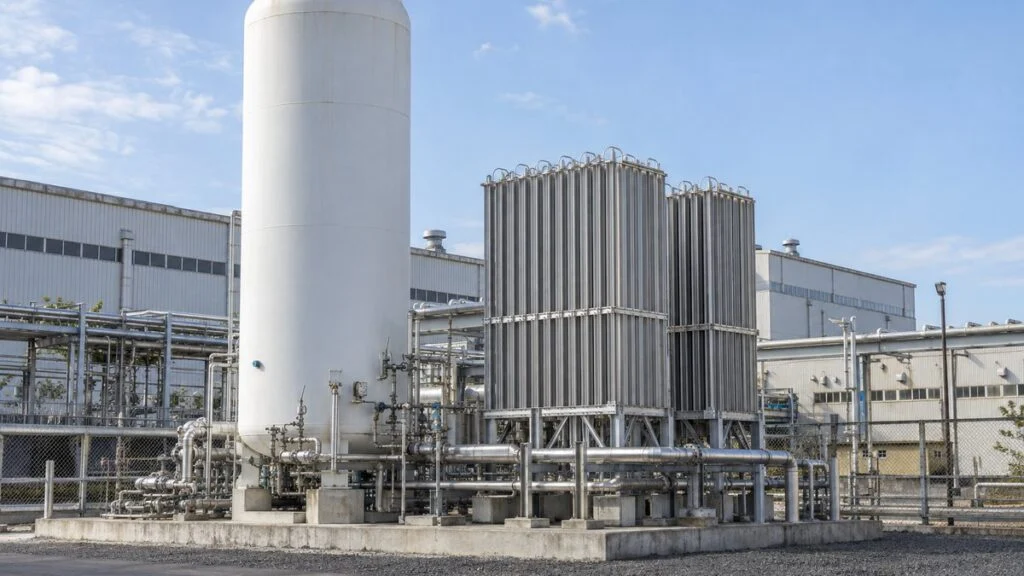
Some Japanese plants beyond the reach of gas mains use LNG satellite supply. Tank trucks deliver LNG to an on-site insulated tank, and a vaporizer turns it into gas as the plant needs it.
Figure 2: LNG Arrives as a Liquid and a Vaporizer Turns It Back into Gas
Concept of truck delivery and on-site satellite supply. The vaporizer's heat source depends on its type.
Vaporizing takes heat, usually drawn from air or water. Capacity depends on the vaporizer type and ambient conditions, so the specification should cover the coldest season and continuous operation. A satellite system must also meet the short-term peak load, not just the annual volume.
After vaporizing, the gas is regulated to the pressure the burners need, with heating-value adjustment and odorization added where required. The equipment the customer owns and manages also differs between on-site liquid storage and pipeline supply. When you compare options, compare who handles receiving, storage, vaporizing, and maintenance, not just the fuel price.
LPG: Propane and Butane Stored Under Pressure
LPG (liquefied petroleum gas) consists mainly of propane and butane. In Japan, household LPG is commonly called "propane gas" (puropan gasu), and the mix of components varies by use.
LPG does not come only from oil refining. Part of it is separated and recovered from gas produced at oil and natural gas fields, and part comes from refining crude oil.
Propane and butane are gases at room temperature but liquefy under moderate pressure. As a liquid, LPG takes up about 1/250 of its gas volume at ordinary temperature and pressure, so small cylinders and tanks hold a useful amount. This pressurized storage near ambient temperature is a very different setup from cryogenic LNG, and it calls for different equipment.
At the same temperature and pressure, propane and butane vapors are heavier than air, unlike methane-rich city gas. How a release actually behaves, though, also depends on its temperature and the surroundings.
LPG is supplied either by swapping cylinders or by bulk delivery from tank trucks into an on-site tank. Plan the arrangement around consumption, site space, delivery access, and inventory management, not only on whether a gas main is nearby.
In a container that supplies vapor, the liquid sits at the bottom and vapor fills the space above it. As vapor is drawn off, some liquid boils to replace it, taking heat from the surroundings.
Figure 3: Vapor Withdrawal Draws Gas from Above the Liquid
Simplified cross-section of vapor withdrawal. Systems that draw liquid and use an external vaporizer work differently.
This is why a container that still holds liquid may not deliver the gas flow you need. The rate of natural vaporization changes with outdoor temperature, LPG composition, liquid level, and draw rate. High-demand installations may instead draw liquid and use a suitably specified vaporizer, so keep the two withdrawal methods and their equipment distinct.
When planning a fuel change, compare the peak-load gas flow with what the supply system can vaporize and regulate at that condition. If capacity falls short, the fix is a properly specified supply system, not improvised heating or valve adjustments.
City Gas in Japan
City gas is gas supplied through utility facilities and pipelines to homes, businesses, and factories. In Japan, most of it is made from natural gas, typically by vaporizing LNG.
At the production terminal, the utility adjusts the heating value of the vaporized gas to its supply specification and adds odorant. Some utilities add LPG to adjust the heating value, but the composition and process are not the same nationwide.
Even when methane dominates, the proportions of ethane, propane, and butane change the heating value and specific gravity. Tokyo Gas Network, for example, lists a representative 13A composition of 89.60% methane, 5.62% ethane, 3.43% propane, and 1.35% butane, and notes that composition can vary by gas retailer. That is one utility's example, not a definition of 13A.
What "13A" on a Japanese Nameplate Means
In Japan, gas groups such as 13A classify gas by how it burns in an appliance. Each group is defined by a combination of Wobbe index (WI) and a burning-velocity index called MCP (maximum combustion potential). A group is not a fixed recipe such as "X% methane."
The letter is the burning-velocity class: A (slow), B (medium), or C (fast). The number comes from an older heat unit: it roughly equals the Wobbe index in kcal/m³ divided by 1,000. So "13A" does not mean a Wobbe index of 13 MJ/m³.
Japanese gas utilities publish the actual limits in their supply terms. The figures below come from one utility's published terms and show what a 13A specification looks like.
Figure 4: Example of a Published 13A Supply Specification
From the general supply terms of Saibu Gas Kumamoto (Japanese). Heating values are gross, per m³ of dry gas at 0°C and 101.325 kPa.
| Item | Value | What it means for you |
|---|---|---|
| Gas group | 13A | Appliances marked 13A are the ones designed for this supply |
| Wobbe index (WI) | 52.7–57.8 (MJ/m³ basis) | Range used to judge appliance compatibility |
| Burning velocity (MCP) | 35–47 | A Japanese index calculated from gas composition |
| Standard heating value | 46 MJ/m³ (minimum 44 MJ/m³) | Varies by utility; Tokyo Gas Network lists 45 MJ/m³ |
| Supply pressure at the gas outlet | 1.0–2.5 kPa gauge (about 4–10 in. w.c.) | Static pressure at the gas cock; it drops while appliances run |
Tokyo Gas Network lists the same 1.0–2.5 kPa range for 13A. Higher supply pressures are arranged case by case with the utility, so a large industrial burner in Japan may have been set up for a different inlet pressure. In every case, check that the pressure at the equipment inlet stays within range at the required flow, allowing for piping pressure loss.
Two other designations appear on Japanese equipment. 12A is another natural-gas group, with a lower Wobbe range than 13A (the lower number reflects that). Ask the manufacturer before assuming a 13A unit can run on 12A gas, or the reverse.
Equipment marked "LPG" (for LP gas) is built for LP gas, not city gas. Under Japanese LP gas technical standards, household-use LP gas must reach the burner inlet at 2.0–3.3 kPa (about 8–13 in. w.c.). City gas and LPG burners can look identical yet need different gas flows and combustion settings.
Wobbe Index: Definition and Calculation
The Wobbe index is the gross heating value per unit volume divided by the square root of the gas's specific gravity relative to air. It matters because two gases with the same heating value can deliver different heat through the same nozzle.
With the same orifice, the same pressure drop, and other conditions equal, a heavier gas flows at a lower volume rate. The Wobbe index combines heat per volume with that difference in flow, so it tracks the heat input a fixed burner actually receives.
Figure 5: Through the Same Nozzle, Specific Gravity Affects Flow
Concept of flow with the same pressure drop and orifice size. The Wobbe index uses both heating value H and specific gravity a.
As a worked example, assume a gross heating value H of 45 MJ/m³ and a specific gravity a of 0.64. The square root of 0.64 is 0.8, so the Wobbe index is 45 ÷ 0.8 = 56.25 MJ/m³.
Figure 6: Wobbe Index = Gross Heating Value ÷ √Specific Gravity
Assumed values to show the method. They are not the composition or guaranteed values of any actual gas supply.
The Wobbe index is only one measure of interchangeability. Burning velocity and supply pressure also decide whether a burner works safely, so match the supplier's gas group against the gas types the burner is approved for.
In any calculation sheet, record the heating-value unit, the reference conditions, and the definition of specific gravity. That makes differences traceable later. Never mix gross and net values, or plug in a heating value from a different reference volume.
Nm³ vs. Sm³ vs. scf: Converting Japanese Gas Data
Reference conditions are easy to mix up when comparing gas data across countries. Japanese gas data uses a cubic meter of dry gas at 0°C and 101.325 kPa, often written Nm³ ("normal" cubic meter), and gross heating value. Other markets use different bases.
- Japan (city gas): m³ at 0°C and 101.325 kPa, dry, gross heating value (so-hatsunetsuryo, 総発熱量).
- Europe (EN 437 gas families): m³ of dry gas at 15°C and 1013.25 mbar. European appliance standards such as EN 26 state heat input on the net heating value (Hi).
- United States: standard cubic foot (scf). The US Energy Information Administration (EIA) uses 60°F and 14.73 psia and reports an average of about 1,037 Btu per cubic foot for gas delivered to end users in 2025.
- India: standard cubic meter (SCM). Contracts commonly use 15°C, while some industry conversion tables use 15.56°C (60°F) at 1 atm. Check the reference stated in your CGD contract.
For quick work, treat the gas as ideal and scale heating value (and Wobbe index) by the ratio of absolute temperatures and pressures. Specific gravity does not change with the reference condition, so the Wobbe index scales by the same factor as the heating value.
Applying these factors to the published 13A figures gives the values below. Use them as approximate translations, not as an official specification.
Figure 7: 13A Figures Restated on Other Reference Bases (Approximate)
Gross heating value basis throughout. Converted from the Japanese values with the ideal-gas factors above.
| Value | Japan: 0°C, 101.325 kPa | 15°C, 101.325 kPa | 60°F, 14.73 psia |
|---|---|---|---|
| Standard heating value (Tokyo Gas Network) | 45 MJ/m³ | about 42.7 MJ/m³ | about 1,145 Btu/scf |
| 13A Wobbe index, minimum | 52.7 MJ/m³ | about 50.0 MJ/m³ | about 1,341 Btu/scf |
| 13A Wobbe index, maximum | 57.8 MJ/m³ | about 54.8 MJ/m³ | about 1,471 Btu/scf |
For comparison, the EIA's 2025 US average of about 1,037 Btu/scf restates to roughly 40.7 MJ/m³ on the Japanese 0°C basis. Average heating value alone does not tell you the Wobbe index; you also need the specific gravity.
Worked Example: Checking Local Gas Against 13A
Suppose your gas supplier's analysis sheet (fictional values) shows a gross heating value of 39.5 MJ/m³ at 15°C and a specific gravity of 0.58. The Wobbe index on that basis is 39.5 ÷ √0.58 = 39.5 ÷ 0.762 ≈ 51.9 MJ/m³.
Compared directly with 13A's 52.7–57.8, that looks out of range. Restated on the Japanese 0°C basis, it becomes 51.9 × 288.15 / 273.15 ≈ 54.7 MJ/m³, which sits inside the 13A Wobbe range.
That result is a reason to ask the manufacturer, not a green light. The Japanese burning-velocity index (MCP) still has to be checked from the gas composition, and so do supply pressure, the burner's approvals, and local code requirements.
Gross vs. Net Heating Value
Gross heating value (HHV) includes the heat released when water vapor in the flue gas condenses; net heating value (LHV) does not. For natural gas the net value is roughly 90% of the gross value, a planning figure also used in Indian industry conversion tables.
Japanese gas supply data is gross. European appliance ratings are usually net. If a Japanese datasheet gives a gas consumption in kW, ask which basis it uses before you compare it with a local quotation or permit form.
How Japanese Gas Groups Compare with EN 437 Gas Families
There is no official cross-reference between Japanese gas groups and the European gas families in EN 437. The table shows only what can be compared once the reference conditions are aligned.
Figure 8: Japanese Gas Groups and EN 437 Gas Families
Overlapping Wobbe ranges do not mean the designations are equivalent. Appliance approval in each region uses its own test gases and criteria.
| Japan | Japanese basis | Closest EN 437 family (dry, 15°C, 1013.25 mbar) | Notes |
|---|---|---|---|
| 13A | WI 52.7–57.8 MJ/m³ at 0°C (about 50.0–54.8 at 15°C); MCP 35–47 | Second family (natural gas), WI 39.1–54.7 MJ/m³; group H about 45.7–54.7 MJ/m³ | 13A sits in the upper part of the group H range. Its maximum is slightly above the second-family upper limit, and MCP has no EN equivalent. |
| 12A | Lower Wobbe range than 13A | Second family | Range not covered here; ask the supplier for the limits. |
| LPG (LP gas) | LP gas (often called propane gas in Japan); household burner inlet 2.0–3.3 kPa | Third family (LPG), WI 72.9–87.3 MJ/m³; groups B/P, P, B | EN test gases: G31 (propane, WI about 76.8 MJ/m³) and G30 (butane, about 87.3 MJ/m³). Confirm the propane/butane mix the equipment was set for. |
EN 437 group limits come from secondary sources that reproduce the standard. Check the current edition of EN 437 before relying on them. For US and Indian equipment, check the rating plate and the applicable listing.
For reference, pure methane (EN test gas G20) has a Wobbe index of about 50.7 MJ/m³ at 15°C. That is about 53.5 MJ/m³ on the Japanese 0°C basis, inside the 13A range, which is consistent with 13A being a natural-gas group.
From Required Heat to Gas Flow
To compare fuel use, start from the useful heat the equipment must deliver. Take a textbook case: 1,000 kW of useful heat output and 90% efficiency on a gross heating value basis.
One hour of 1,000 kW is 3,600 MJ of useful heat, so the fuel heat input is 3,600 ÷ 0.90 = 4,000 MJ/h. With gas at 45 MJ/m³ gross, that is 4,000 ÷ 45 ≈ 88.9 m³/h at the Japanese reference condition.
If the LPG gross heating value is taken as 50 MJ/kg, the same 4,000 MJ/h needs 80 kg/h. One figure is a gas volume and the other a mass, so 88.9 and 80 say nothing about which fuel uses "less."
The same burner on US pipeline gas at the EIA average of 1,037 Btu/scf would need about 4,000 MJ/h × 947.8 ÷ 1,037 ≈ 3,660 scf/h. That is about 98 m³/h on the Japanese 0°C basis, roughly 10% more volume than with 45 MJ/m³ gas, even though the heat delivered is the same.
Watch the efficiency basis as well. If the 90% is quoted on a net basis, the gross-basis input is about 4,000 ÷ 0.9 ≈ 4,440 MJ/h, about 11% more gas. Efficiency also changes with fuel and load, so confirm that both fuels can be assumed to run at the same value.
Finally, these are standard-volume flows. Do not use them directly as the actual volume flowing in a pressurized pipe. When sizing piping or meters, convert using the actual pressure and temperature, with a compressibility correction where needed.
Comparing Fuel Cost on the Same Basis
There is no blanket rule that city gas (or pipeline natural gas) is cheaper than LPG. Prices depend on the supplier, contract, volume, and who pays for which equipment, so compare cost for the same period and the same useful heat.
- Divide each price per volume or per mass by its heating value to get a price per MJ of fuel, then apply efficiency to get a price per MJ of useful heat.
- Add fixed charges, receiving equipment, the vaporizer's heat source, maintenance, and statutory inspections.
- Compare a pipeline connection and an on-site tank on the same quotation scope.
- Give suppliers the peak hourly demand and load swings, not just annual consumption, and check the turndown range the combustion controls need, together with fuel-air ratio control.
A higher price per m³ for LPG does not by itself make it more expensive, because LPG carries far more heat per m³ of vapor.
After the Switch: Combustion and Flue Gas
Unlike oil, gaseous fuels need no atomization; they burn after mixing with air. Even so, a fuel change affects combustion and flue-gas handling in several ways.
- Excess air: less air reduces stack loss, but too little worsens combustion. Manage the air ratio and flue-gas O₂ within the range suited to the fuel and burner.
- NOx and incomplete combustion: mixing and load conditions affect both. When comparing NOx readings before and after a switch, correct them to the same O₂ reference.
- CO₂: LNG, LPG, and city gas all contain carbon. Compare emission reductions at the same useful heat and the same emission scope.
- Condensation: gas is low in sulfur, but flue gas cannot be cooled without limit. Below the dew point, condensate contacts materials and needs drainage and treatment, and fuel quality also needs checking. Condensing heat recovery has different design conditions from sensible-heat recovery, so evaluate an economizer together with flue-gas temperature, feedwater conditions, and corrosion protection.
- Flue-gas volume: whether water vapor is counted changes the figure. Keep dry and wet flue-gas volumes separate.
Checklist: Can This Japanese Equipment Run on Your Gas?
Work through these items before you request a quote, sign a purchase order, or plan commissioning.
- Gas group on the nameplate: 13A, 12A, or LPG, and whether the unit is a single-gas model or has a factory option for other gases.
- Your gas data: gross heating value, specific gravity, and composition from your supplier, with the reference temperature and pressure stated.
- Same basis: Wobbe index and heating value converted to one reference condition and to gross or net, before any comparison.
- Burning velocity: whether the manufacturer has evaluated your composition, since the Japanese MCP index has no direct counterpart abroad.
- Supply pressure: inlet pressure range on the nameplate (13A household supply is 1.0–2.5 kPa) versus the pressure available at your connection under peak flow.
- Heat input and flow: rated gas consumption, its HHV or LHV basis, and the resulting flow in your units (scf/h, SCM/h, or kg/h).
- Burner certification: approvals or listings required where the equipment will be installed, and whether the Japanese unit holds them.
- Who decides: the manufacturer and a qualified gas engineer or installer approve any change of gas type, nozzle, or setting. Do not change them on site yourself.
Questions for the Japanese Manufacturer
Send these early, together with your gas supplier's analysis sheet. Written answers also help with local permitting.
- Which gas group or gas types is this model designed and adjusted for? Are other gas types available as a factory option?
- Has the burner been evaluated on our gas (composition attached)? On what basis do you confirm compatibility: Wobbe index, MCP, or test firing?
- What inlet pressure range does the equipment require, and at what flow?
- Is the rated gas consumption (kW) on a gross or net heating value basis, and at which reference conditions?
- If conversion is needed, which parts change (nozzles, orifices, gas valve, controls), and who is authorized to carry it out and re-adjust combustion?
- Which certifications or test reports does the burner hold, and are any valid in our country?
- Does the warranty remain valid when the unit runs on our gas?
Sample Inquiry Email
Adapt this to your project. Short, numbered questions are easier for a Japanese sales or engineering team to translate and answer.
Template: Gas Compatibility Inquiry
|
Subject: Gas compatibility check for [model number], [project name] Dear [Name], We are considering your [boiler / burner / water heater], model [model number], for our plant in [country]. The nameplate and catalog list the gas type as 13A. Our site is supplied with [pipeline natural gas / PNG from a CGD network / regasified LNG]. The supplier's analysis sheet is attached. Gross heating value: [value] [MJ/m³ or Btu/scf] at [reference temperature and pressure] Could you please confirm the following? 1. Can this model operate on our gas as delivered, or does it require a different specification? Best regards, |
Limits of This Guide
- The 13A figures come from one utility's published supply terms. Wobbe and MCP limits are set per gas group, but each utility's heating value and pressure can differ.
- Conversions use the ideal-gas approximation. Contract and custody-transfer values follow ISO 6976 or the supplier's own method.
- EN 437 ranges are quoted from secondary sources. This guide does not cover national gas categories under EN 437 or US and Indian appliance listing rules in detail.
- Wobbe range overlap is only a first screen. Approval of a burner for a different gas is the manufacturer's decision, and installation must meet local codes.
- Supply pressures shown are for household-level supply. Industrial burners in Japan often use other pressures agreed with the utility.
FAQ
What Is 13A Gas?
13A is a Japanese city gas group for natural-gas-based supply, used by major utilities such as Tokyo Gas. It is defined by a Wobbe index of 52.7–57.8 MJ/m³ (gross, 0°C and 101.325 kPa) and a burning-velocity index (MCP) of 35–47, not by a fixed composition.
Is 13A the Same as Natural Gas?
13A is natural-gas-based, but it is a specification range, not the gas itself. A local natural gas may or may not fall inside it once you convert its Wobbe index to the Japanese basis and check burning velocity and pressure.
How Do You Calculate the Wobbe Index?
Divide the gross heating value per unit volume by the square root of the gas's specific gravity relative to air. For example, 45 MJ/m³ ÷ √0.64 = 56.25 MJ/m³. Keep the heating value and specific gravity on the same reference conditions.
Are LNG and City Gas the Same Thing?
No. LNG is natural gas in liquid form, and city gas is the name for gas delivered by pipeline. In Japan, utilities vaporize LNG, adjust its heating value, and add odorant to make city gas.
If the Wobbe Index Matches, Can the Fuel Be Swapped?
Not on the Wobbe index alone. Burning velocity, supply pressure, gas type, and the equipment's own specification all affect safe combustion. Any change of fuel should be confirmed by the manufacturer and carried out by qualified personnel.
Sources
- 13A gas group limits (WI 52.7–57.8, MCP 35–47), Wobbe index formula, heating value basis, and supply pressure: Saibu Gas Kumamoto, general gas supply terms (Japanese)
- 13A standard heating value, reference conditions, example composition, and supply pressure: Tokyo Gas Network, city gas types, heating value, pressure, and composition (Japanese)
- Standard heating value basis (gross, 0°C, 101.325 kPa): Tokyo Gas FAQ (Japanese)
- Meaning of the number and letter in gas group names: Tokai Gas FAQ (Japanese)
- City gas vs. LP gas: The Japan Gas Association (Japanese)
- City gas production from LNG: The Japan Gas Association (Japanese)
- LPG sources: Japan LP Gas Association (Japanese)
- LPG properties and natural vaporization: Japan LP Gas Association (Japanese)
- LPG properties and supply: LP Gas Safety Committee Q&A (Japanese)
- LP gas pressure at the burner inlet (2.0–3.3 kPa for household use): Saitama Prefecture, form on LP gas technical standards (Japanese)
- LNG satellite supply: Daigas G&P Solution (Japanese); Daigas Energy (Japanese)
- EN 437 gas family Wobbe ranges and reference conditions: Certifico, gas classification and Wobbe index (Italian)
- Group H range (reproduction of the EN 437 table): National Aviation University, Ukraine (document reproducing the classification table)
- Wobbe index and heating values of G20, G30, G31 at 15°C: Kiwa, Useful Gas Information Leaflet
- Heat input expressed on net calorific value in EN 26: GlobalSpec, NEN-EN 26 summary
- US average heat content and pressure base: US Energy Information Administration, FAQ
- Indian SCM conversion basis and NCV/GCV ratio: Bharat Petroleum, natural gas conversions
- Latent heat recovery and corrosion in condensing boilers: Ministry of the Environment, Japan, SHIFT (Japanese)
- Air ratio by fuel and combustion equipment: Ministry of the Environment, Japan (Japanese)
Original article in JapaneseThis guide is adapted from a MONOSCOPE article written for readers in Japan: LNG・LPG・都市ガスの違いとは?成分・液化・熱量とウォッベ指数
About the editor
 MONOSCOPE EditorFOUNDER & EDITOR
Spent about ten years at a plant equipment maker and a plant engineering company, proposing, designing, and commissioning equipment, then moved into web marketing. Now a web consultant for B2B manufacturers, helping them explain their products and technology. Licensed in Japan as an Energy Manager and a Third-Class Chief Electrical Engineer.
Has run an engineering blog since 2017 (500+ articles) and a Japanese YouTube channel with about 20,000 subscribers. Each English guide is written from the Japanese shop-floor point of view and checked against the cited standards.