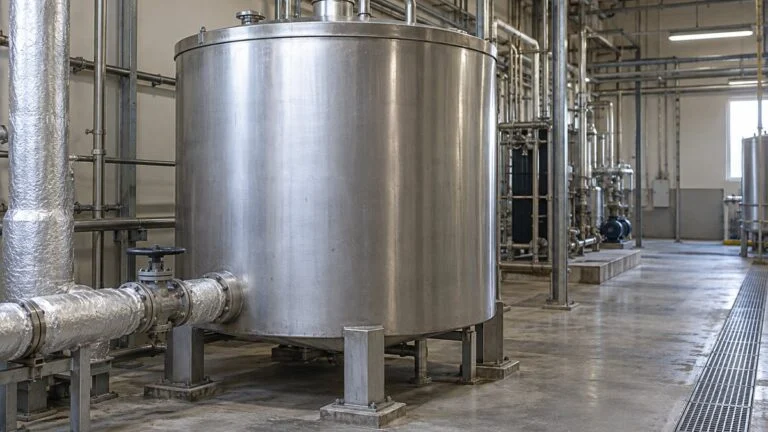
NPSHa vs NPSHr: Calculation Examples and Margin Explained
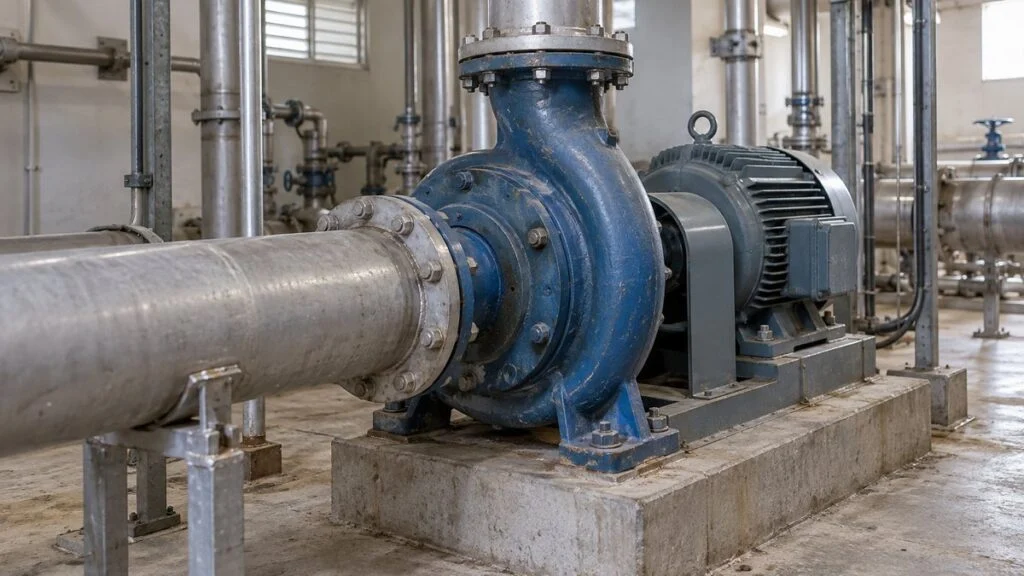
A Japanese pump supplier sends a datasheet with a value labeled 必要NPSH (hitsuyo NPSH, "required NPSH"). Their inquiry form asks you to fill in the NPSH your system can deliver. To answer, you need to calculate NPSHa for your own tank, piping, and liquid, then decide how much margin is enough.
This guide explains what NPSH means, shows how to calculate NPSHa, and works through three examples: a flooded suction, a suction lift, and a pressurized tank of saturated water. It then covers how to think about the NPSHa vs. NPSHr margin, what the Hydraulic Institute's ANSI/HI 9.6.1 guideline says, and what to ask the pump supplier.
Contents
What Is NPSH?
NPSH stands for net positive suction head. It expresses, as a height of liquid in meters, how far the total pressure of the liquid entering a pump stays above the liquid's vapor pressure at that temperature. Total pressure here includes both the static pressure and the velocity of the flow.
NPSH is a head, not a pressure in Pa, and it does not simply mean the pump's installation height. Engineers use it to judge whether the suction side of a pump keeps the liquid from boiling inside the pump.
Why Suction Pressure Matters: Cavitation
A pump raises pressure on the discharge side, but pressure drops locally near the impeller inlet. If it falls to the liquid's vapor pressure there, vapor bubbles form. The bubbles can then collapse when they reach the higher-pressure region downstream.
This is cavitation. As it develops, it can cause noise, vibration, loss of performance, and damage to pump parts.
Air drawn in from outside has a different cause, so investigate the two problems separately.
NPSHa vs. NPSHr
Two values are compared when you select a pump:
- NPSHa (NPSH available): what the system, including the tank and suction piping, actually delivers to the pump. You calculate it from liquid level, pressure, temperature, and flow rate, so the same pump sees a different NPSHa whenever operating conditions change. Japanese documents call it 有効吸込ヘッド (yuko suikomi head).
- NPSHr (NPSH required): what the manufacturer states the pump needs to deliver its specified performance. It applies to a specific flow rate, speed, and liquid. You may also see it written as NPSHreq, or in Japanese as 必要吸込ヘッド (hitsuyo suikomi head). Read it from the manufacturer's performance curve and specification.
NPSHr is not one fixed number per pump. It changes with flow rate and speed. If you check only the rated point, you can lose the margin you need at higher flows after startup or at other operating points.
The general direction is simple: a higher NPSHa and a lower NPSHr make it easier to secure suction margin. The difference alone, however, does not decide discharge performance or minimum flow, so evaluate it together with the pump's operating range.
What NPSH3 Means
NPSH3 is a test value: the NPSH at which cavitation reduces the pump's total head by 3%. For multistage pumps, the 3% refers to the head of the first stage, not 3% of the whole pump's discharge pressure.
The figure below shows the test concept: suction conditions are varied while flow rate and speed stay constant.
Figure 1: NPSH3 Is Where Head Has Already Dropped, Not Where Bubbles Start
Concept of a test that varies suction conditions at constant flow and speed. Not test data for any specific pump.
Staying above NPSH3 does not remove every effect of cavitation, including noise and damage.
Some manufacturers publish NPSHr as NPSH3, but do not assume the two are always the same. In a March 18, 2025 article, the Hydraulic Institute explains that the 2024 edition of ANSI/HI 9.6.1 bases NPSH margin on the manufacturer-supplied NPSHr. That NPSHr must be equal to or greater than the tested NPSH3.
How to Calculate NPSHa
For a large tank, you can calculate NPSHa from the pressure on the liquid surface, the height difference to the pump, and the suction line losses. The method assumes steady, single-phase liquid flow, negligible velocity at the tank surface, and no other energy input, such as a booster pump, along the way.
Use absolute pressure in the formula. Convert pressure to head with the density of the liquid at operating temperature. If you start from gauge pressure, add the local atmospheric pressure first, then subtract the vapor pressure.
There are two forms of the formula, depending on where you start:
Figure 2: Two Ways to Calculate NPSHa: From the Tank Surface or From the Pump Inlet
A pressure measured at the inlet already reflects the upstream losses. Do not subtract those losses again.
Sign of the Height Term and the Pump Datum
The height z is positive when the liquid surface is above the datum and negative when it is below. That is why the sign flips between a flooded suction and a suction lift.
The examples here use a horizontal pump, with the datum at the impeller centerline. Vertical pumps and some other designs use a different reference, so match your drawing to the NPSH datum the manufacturer specifies. Do not plug in the pump's height above the floor or the height to the tank bottom as the level difference.
What to Include in Head Loss
Head loss covers more than straight-pipe friction. Include losses at the entrance, bends, valves, and strainers. These losses change with flow rate and viscosity, so do not reuse the value from normal flow at every operating point.
A smaller inside diameter raises velocity and loss, so pipe schedule matters. Use the actual inside diameter of the pipe you will install, not the nominal size, when you calculate velocity and loss.
When you convert between pressure and head, keep the conventional "meters of water column" conversion separate from head in the actual liquid at operating temperature. The final calculation should use the real density.
NPSHa Calculation Examples
All three examples below use assumed conditions for illustration. Water properties come from the IAPWS Industrial Formulation 1997 (IAPWS-IF97), with standard gravity g = 9.80665 m/s².
Example 1: Flooded Suction (Oshikomi)
In a flooded suction, called 押込み (oshikomi) in Japanese, the supply tank's liquid level sits above the pump datum, so the height adds to NPSHa. In this example, an open tank feeds 60°C (140°F) water, and the lowest operating level is 3 m (9.8 ft) above the datum.
The surface pressure is 101.325 kPa absolute (14.7 psia), and the suction line loss is 1 m. At 60°C, water has a vapor pressure of about 19.946 kPa and a density of about 983.2 kg/m³.
Figure 3: Flooded Suction: Add the Height From the Lowest Liquid Level
The pressure term gives about 8.44 m. Adding the 3 m height and subtracting the 1 m loss gives about 10.44 m (34.3 ft). This is the NPSHa the system delivers; compare it separately with the candidate pump's NPSHr at this flow rate plus the margin you need.
The effective height comes from the difference between the datum and the liquid level as it falls during operation, not from the tank's installed height. If you evaluate only the normal level, the real margin will be smaller than calculated whenever the pump keeps running at low level.
If a low-level interlock stops the pump, include the setpoint and the further level drop before the pump actually stops. Surface swirl and vortex air entrainment are separate problems, so the NPSHa value alone cannot address them.
Temperature has a large effect. At the same atmospheric pressure, raising the water to 80°C (176°F) increases the vapor pressure to about 47.415 kPa. With a density of about 971.8 kg/m³ and everything else unchanged, NPSHa falls to about 7.66 m (25.1 ft).
If a strainer protects the inlet from debris, evaluate its loss when clogged, not only right after cleaning. Choose the mesh by weighing capture performance against pressure loss.
Example 2: Suction Lift (Suiage)
In a suction lift, called 吸上げ (suiage) in Japanese, the tank's liquid level is below the pump datum, so the height term is negative. This example keeps the same 60°C water, atmospheric pressure, and 1 m loss, but the lowest level is 3 m below the datum.
Figure 4: A 3 m Suction Lift Goes Into the Formula as −3 m
Subtracting the 3 m lift and the 1 m loss from the 8.44 m pressure term leaves about 4.44 m (14.6 ft). Because the level difference swings from +3 m to −3 m, NPSHa is 6 m lower than in Example 1.
Looking only at the theoretical water column that atmospheric pressure can support, and concluding "the pump can lift this high," is not enough. In practice, you must subtract the vapor pressure and the piping loss, and still leave the pump's required NPSH plus margin.
A longer suction line or a higher flow rate increases loss and eats into the margin. Choose the pipe route and diameter with the relationship between velocity and pressure loss in mind.
Even with enough NPSHa on paper, the pump can fail to deliver water properly if it loses its prime or draws in air. A suction lift also depends on an airtight suction line and on the pump's priming method, following the instruction manual. Priming is 呼び水 (yobimizu) in Japanese.
When you measure suction pressure, watch the difference between the vacuum scale on a compound gauge, called 連成計 (rensei-kei), and absolute pressure. Do not subtract vapor pressure directly from a negative gauge reading; add atmospheric pressure first to convert it to absolute.
Example 3: Pressurized Tank of Saturated Water
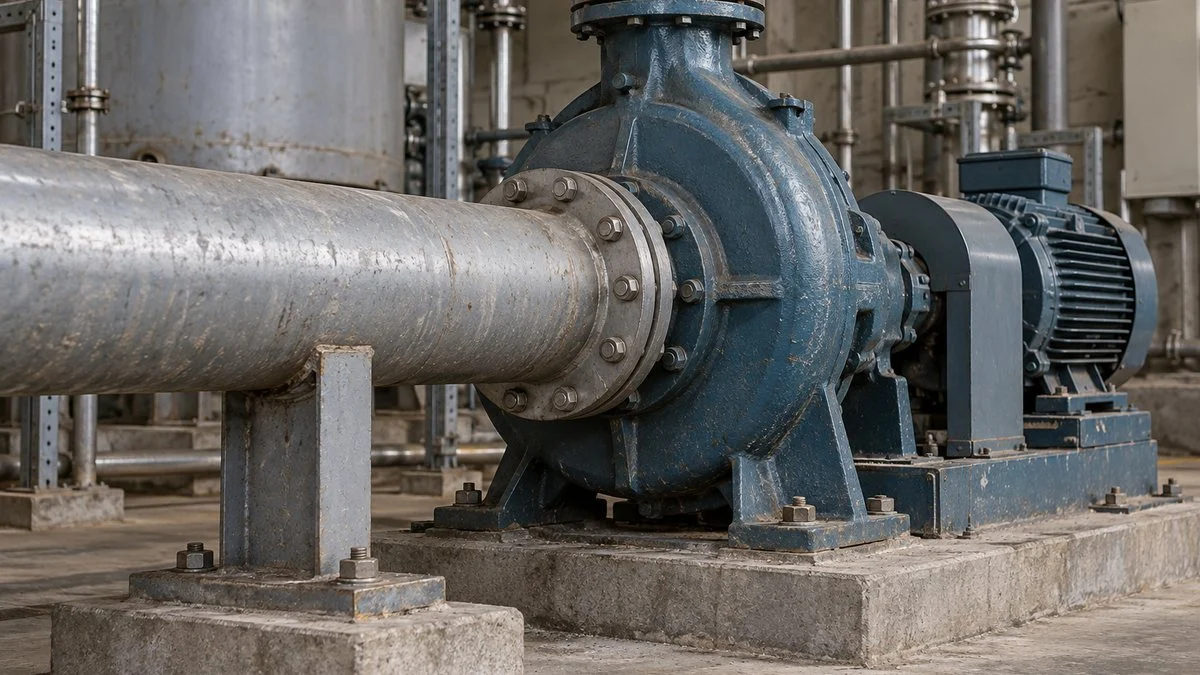
In a closed tank, the surface pressure can be above atmospheric or close to a vacuum. The formula stays the same: take the difference between the absolute surface pressure and the vapor pressure at the liquid temperature.
In this example, a tank at 0.5 MPaG (72.5 psig) holds water saturated at that pressure, and the lowest level is 3 m above the datum. With an ambient pressure of 0.101325 MPa, the absolute surface pressure is 0.601325 MPa (87.2 psia). Japanese specifications often mark gauge pressure with a trailing "G," as in MPaG or kPaG.
Under these conditions, saturated water is at about 158.9°C (318°F), and its vapor pressure equals the absolute surface pressure of 0.601325 MPa. The pressure term becomes zero, so NPSHa is simply the level difference minus the head loss.
Figure 5: With Saturated Water, Tank Pressure and Vapor Pressure Cancel Out
A high tank pressure does not all count toward NPSHa. In a saturated system, the temperature rises with the pressure, and the vapor pressure term rises by the same amount and cancels it.
Pressurizing with an inert gas while holding the liquid temperature constant is different: it does increase the gap above vapor pressure. That approach changes pressure-vessel and process conditions, so it needs a review of the design conditions and safety before anyone implements it.
In systems handling saturated liquid, also watch for flashing when pressure drops suddenly and for heat gain or loss in the suction line. Showing that surface pressure and vapor pressure cancel at steady state does not cover transient operation or two-phase flow.
Vacuum vessels also use absolute pressure, and a lower surface pressure reduces NPSHa. Treat the equipment that pulls the vacuum and the pump that transfers the liquid as two separate functions.
The Three Examples Side by Side
The table shows how each term of the formula behaves in the three examples.
| Flooded suction | Suction lift | Pressurized saturated water | |
|---|---|---|---|
| Liquid level | 3 m above datum | 3 m below datum | 3 m above datum |
| Height term | +3 m | −3 m | +3 m |
| Pressure minus vapor pressure | About 8.44 m (atmospheric minus 60°C vapor pressure) | About 8.44 m (same as flooded) | Zero (surface pressure and vapor pressure cancel) |
| Head loss | 1 m | 1 m | 1 m |
| NPSHa | About 10.44 m | About 4.44 m | 2 m |
| Main ways to add margin | Keep the minimum level up; cut losses | Lower the pump; review the suction piping | Secure the level difference; cut losses |
Cross-Checking NPSHa From a Suction Gauge Reading
To get NPSHa from a pressure measured at the pump inlet, add the velocity head to the static pressure the gauge shows. Unlike the tank-surface method, you do not subtract the piping loss up to the gauge again.
Suppose the water is at 60°C, an inlet gauge level with the datum reads −20 kPa (about −2.9 psig), and the inlet velocity is 2 m/s. With atmospheric pressure at 101.325 kPa, the absolute inlet pressure is 81.325 kPa. Subtract the 19.946 kPa vapor pressure from that.
Even with negative gauge pressure, the absolute pressure is positive, and NPSHa works out to about 6.57 m (21.6 ft). A vacuum reading by itself does not tell you whether the pump can run. Compare this value with the manufacturer's NPSHr and margin requirement.
If the gauge is above the datum, add its height; if below, subtract it. Subtract the loss between the gauge and the pump inlet only when you measure upstream of the inlet. Losses upstream of the gauge are already in the reading.
NPSHa vs. NPSHr: How to Think About Margin
The basic rule: NPSHa must exceed NPSHr, with additional margin suited to the application. The Hydraulic Institute calls the difference between the two the NPSH margin.
What ANSI/HI 9.6.1 Covers
ANSI/HI 9.6.1, Rotodynamic Pumps Guideline for NPSH Margin, is the Hydraulic Institute's guideline on this topic. The 2024 edition supersedes the 2017 edition. The Hydraulic Institute's published summaries confirm the following points:
- The 2024 edition determines margin from the manufacturer-supplied NPSHr instead of NPSH3, partly because not every manufacturer publishes NPSH3. NPSHr must be equal to or greater than the tested NPSH3.
- Recommended margins depend on the market segment and application. The guideline also lists factors such as the liquid (temperature, dissolved gas, solids), pump design, speed, wear, operating region, inlet conditions, transients, recirculation, and parallel operation.
- A pump running in its preferred operating region (POR) around the best efficiency point needs less margin than one running in the wider allowable operating region (AOR).
- Use the lowest NPSHa in the system analysis, and review NPSHa and NPSHr across the full operating range.
The specific margin values are in the standard itself, which is a paid document; this article does not quote them. Get the applicable figure from the standard or confirm it with the pump supplier.
Margin as a Difference or a Ratio
Margin can be stated as a difference (NPSHa − NPSHr, in meters) or as a ratio (NPSHa ÷ NPSHr). A margin in meters and a margin as a ratio are different criteria, so confirm which basis the manufacturer or your project specification uses. Also confirm whether the baseline is NPSHr or NPSH3.
Do not set one fixed margin in meters for every pump. Agree on it with the manufacturer based on the liquid, the operating range, and the reliability you need.
Find the Worst Case Across the Operating Range
Do not check only one normal operating point. List the combinations of level, temperature, pressure, and flow rate that will actually occur. The lowest level, the highest temperature, the lowest surface pressure, and the highest piping loss all push NPSHa down.
Not every extreme will happen at once, so use the process and control logic to find realistic combinations. Splitting operation into normal running, startup, shutdown, cleaning, and switching supply sources helps you catch conditions you might otherwise miss.
Figure 6: Conditions That Reduce NPSHa, and Where to Look
Calculate NPSHa for each state and compare it with NPSHr at the same flow and speed, plus the margin the manufacturer requires.
Several other conditions change the picture:
- Multiple pumps on a common suction line: the total flow in the shared line changes as pumps start and stop. Match each pump's share of flow to the loss in the common line.
- Running at higher speed: the pump's NPSHr changes along with flow, so do not reuse the value for the original speed. Evaluate power and suction conditions together.
- Viscous liquids: suction loss and pump performance change, so selection data for water may not transfer directly. State the liquid's temperature and properties in the specification.
- Liquids other than water, or mixtures: do not use water's vapor pressure and density tables. Define the composition, concentration, and operating temperature, and link the supplier's property data and the manufacturer's application limits to your calculation sheet.
- Dissolved or entrained gas: a single-phase NPSH calculation may not explain the pump's behavior. Include gas sources and separation in the specification, and do not confuse cavitation with gas entrainment.
When the Margin Is Too Small
Compare options such as lowering the pump, holding the liquid level higher, and reducing suction line losses. Changing liquid temperature or vessel pressure also affects the process, so choose based on the plant's conditions, not on which option raises the number most.
Avoid on-the-spot fixes such as removing the strainer, lowering protection settings, or throttling the suction valve. Work on improvements that match the root cause and the manufacturer's operating conditions while keeping the required protection and minimum flow.
When Measurements and Calculations Don't Match
Work through the checks in this order:
- Record everything at the same time: gauge zero, gauge mounting height, liquid temperature, flow rate, and tank level. Mixing the lowest level from one moment with the normal pressure from another produces a condition that never existed.
- Compare both methods on the same datum: the value from inlet static pressure and the value from the tank surface minus losses. Once velocity head, height correction, and pressure units agree, both methods describe the same suction condition.
- If the gap is still large, check items one by one: valve positions, strainer clogging, actual pipe inside diameter, and instrument error. Do not lock onto one cause while the pump keeps running, and follow the plant's procedures for shutdown or isolation during abnormal conditions.
- Keep the normal readings: after inspection, record normal pressures and differential pressures so you can compare changes at the same flow and temperature later.
When modifying existing piping, check for flow area lost to rust or deposits and for any change in inside diameter after pipe replacement. Corrosion and internal surface treatment also affect how the suction line holds up over time.
Checklist and Inquiry Template
Use the items below when you build an NPSH calculation sheet or review a Japanese supplier's pump proposal. Unknowns at the quotation stage should stay on the list as open items, rather than being covered by simply adding a large margin. Settling items such as the maximum liquid temperature and the strainer's allowable differential pressure helps you avoid both oversized equipment and too little margin.
NPSH Calculation Sheet Checklist
- One row per operating state (normal, startup, shutdown, cleaning, switchover, maximum flow), with flow rate, level, temperature, pressure, loss, and NPSHa on the same row
- NPSHr and the required margin for the same state entered to the right of NPSHa
- Pressures converted to absolute; gauge readings corrected with local atmospheric pressure
- Vapor pressure and density of the actual liquid at the temperature of each operating state, including the maximum
- Height measured from the lowest operating level (including the drop before a low-level stop) to the manufacturer's NPSH datum
- Head loss including entrance, bends, valves, and a clogged strainer, calculated at each flow rate with the actual pipe inside diameter
- Pump curve matched to the actual speed, impeller, and liquid, not just the model name
- Margin basis recorded: difference or ratio, and NPSHr or NPSH3 as the baseline
- Both the test method (from the applicable standard or guideline) and the installed operating conditions written into the specification; if the supplier gives NPSH3 test results, the conditions for using them as required NPSH and the margin to be added stated explicitly
- Pressure and level fluctuations right after switchover checked against the planned range, with steady-state and transient behavior evaluated separately
- Selection conditions carried forward into operating procedures and stop setpoints
- Minimum NPSHa and maximum NPSHr kept as pairs at the same operating point, not only as separate extremes
- Low-level and high-temperature alarm setpoints traced back to the calculation row they protect, so they can be reviewed when piping or liquid changes
Questions for the Pump Supplier
- Is the stated 必要NPSH (NPSHr) the tested NPSH3, or a value with margin already added?
- Can you provide the NPSHr curve across the full flow range, at our actual speed and impeller diameter?
- What margin do you recommend for this application and operating range, and on what basis (difference or ratio, and which standard or edition)?
- Where is the NPSH datum for this pump (impeller centerline, suction nozzle, or another point), and what is its elevation on the outline drawing?
- What is the minimum continuous flow, and does NPSHr rise at low flow?
- For a suction lift: what priming method do you specify, and what airtightness is required on the suction line?
- For liquids other than water: which property data did you use, and are there application limits for viscosity, dissolved gas, or solids?
Inquiry Email Template
Edit the bracketed items before sending.
Where This Guide Does Not Apply
- The calculations assume steady, single-phase liquid flow. Transients such as sudden pressure drops, flashing, and two-phase flow need separate evaluation.
- The three examples use assumed values for water. Real projects need the actual liquid's properties, the actual piping losses, and the manufacturer's data.
- This article does not give recommended margin values. They depend on the application, the pump, and the standard or project specification that applies, and the pump supplier or the responsible engineer decides them.
- Datum conventions differ for vertical and other pump designs. Always use the datum the manufacturer specifies.
- Pressurizing a vessel with inert gas requires a review of the equipment's design conditions and safety, and changing liquid temperature or vessel pressure affects the process. This article describes what to check, not how to carry out those changes.
FAQ
Which Do I Calculate, NPSHa or NPSHr?
You calculate NPSHa for your system from level, pressure, temperature, and piping loss. NPSHr comes from the manufacturer's data. Compare the two at the same flow rate and speed, and add the margin the application requires.
Are NPSHr and NPSH3 the Same?
Not necessarily. NPSH3 is the test value at a 3% head drop, while NPSHr is the value the manufacturer states the pump needs for its specified performance. Some documents give them as the same number, but check the specification's acceptance criteria before treating them as equal.
If NPSHa Is Positive, Will the Pump Run?
A positive value is not enough. NPSHa must exceed NPSHr at that operating point plus the required margin. The pump must also meet other conditions, such as minimum flow, priming, and keeping air out.
Does Pressurizing a Saturated-Water Tank Increase NPSH Margin?
Not if the water stays saturated at the new pressure: surface pressure and vapor pressure still cancel. Pressurizing while holding the temperature constant behaves differently, so define the exact temperature and pressure combination before you evaluate it.
How Much NPSH Margin Is Enough?
It depends on the liquid, the pump, the operating range, and the reliability the application requires. Use the margin the manufacturer specifies and the guideline that applies, such as ANSI/HI 9.6.1, and check that it holds at the most severe operating condition.
Sources
- Pump cavitation basics (total pressure vs. vapor pressure, head drop, first-stage basis): Ebara Corporation, "Basic Knowledge of Pump Cavitation, Part 1" (Japanese)
- NPSH reference point, formulas, losses, and test criterion: KSB, "NPSH," Centrifugal Pump Lexicon
- 2024 edition of ANSI/HI 9.6.1 and NPSHr-based margin: Hydraulic Institute, "Understanding the 2024 Updates to ANSI/HI 9.6.1"
- NPSH3, POR, and AOR: Hydraulic Institute, "Reliability Basics: Understanding NPSH, POR, and AOR"
- Atmospheric pressure, height, losses, and vapor pressure: Grundfos, "Pump Hydraulics" course material
- Saturated water properties: IAPWS, Industrial Formulation 1997 (IAPWS-IF97)
Original article in JapaneseThis guide is adapted from a MONOSCOPE article written for readers in Japan: NPSHとは?NPSHa・NPSHrの違いと計算方法、押込み・吸上げ・飽和水の例
About the editor
 MONOSCOPE EditorFOUNDER & EDITOR
Spent about ten years at a plant equipment maker and a plant engineering company, proposing, designing, and commissioning equipment, then moved into web marketing. Now a web consultant for B2B manufacturers, helping them explain their products and technology. Licensed in Japan as an Energy Manager and a Third-Class Chief Electrical Engineer.
Has run an engineering blog since 2017 (500+ articles) and a Japanese YouTube channel with about 20,000 subscribers. Each English guide is written from the Japanese shop-floor point of view and checked against the cited standards.