Direct Steam Injection Calculation: Mass and Heat Balance
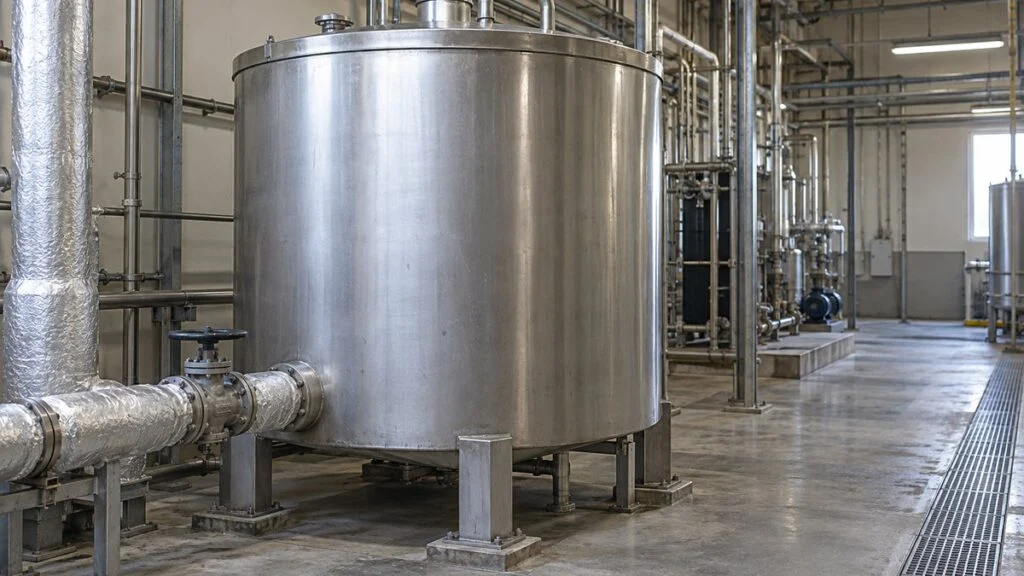
A process datasheet from a Japanese supplier lists a hot-water tank as chokusetsu kanetsu (直接加熱, direct heating), with steam at "0.3 MPaG" and a steam consumption figure. Before you size the control valve or the steam header, you want to check that number yourself. Two shortcuts give the wrong answer: assuming the tank still holds the same mass of water after heating, and dividing the heat load by the total enthalpy of the steam.
In direct steam injection (also called steam sparging), the steam condenses inside the water and becomes part of it. That means you need a mass balance and a heat balance together, not a heat load alone.
This guide works through one example, heating 10,000 kg (about 22,050 lb) of water from 10°C to 60°C (50°F to 140°F), in two ways. It then compares the result with indirect coil heating, shows how batch and continuous balances differ, and ends with a checklist and questions to send to the equipment supplier.
Contents
- How a Direct Steam Injection Tank Works
- Worked Example: Heating 10 t of Water from 10°C to 60°C
- Shortcut: Divide the Heat Load by the Effective Enthalpy
- Direct vs. Indirect Heating: Same Tank, Different Steam Use
- Fixed Final Quantity vs. Fixed Initial Charge
- Batch and Continuous Balances Use Different Boundaries
- Before You Apply the Numbers to Real Equipment
- When Measured Steam Use Does Not Match the Calculation
- Checklist: Fix These Before You Calculate
- Questions for the Japanese Supplier or Process Team
- Limits of This Example
- FAQ
- Sources
How a Direct Steam Injection Tank Works
Consider a batch tank: fill it with water, then inject steam until the water reaches the target temperature. A typical setup uses a temperature sensor in the tank, a temperature controller, and a steam control valve that adjusts the steam flow.
As the water approaches the setpoint, the controller throttles the steam to avoid overshooting. With on-off control the valve simply opens and closes, while with modulating control it moves continuously, so the steam flow profile over time differs between the two.
Figure 1 shows what the calculation covers and how the control signals flow.
Figure 1: Measure the Temperature, Inject Steam Directly into the Water
Concept cross-section and control signals. Orange is steam, blue is water, and dashed lines are the temperature signal and the valve command.
Principle diagram only: safety shutoff, backflow prevention, drains, and vents are omitted. It shows what the calculation covers and what each signal does, not an installation or operating procedure.
Worked Example: Heating 10 t of Water from 10°C to 60°C
The example uses the conditions below. The steam is dry saturated, and all injected steam condenses and stays in the tank.
| Condition | SI | US units |
|---|---|---|
| Initial water mass | 10,000 kg | about 22,046 lb |
| Initial temperature | 10°C | 50°F |
| Final temperature | 60°C | 140°F |
| Steam supply pressure | 0.3 MPaG (0.401 MPa abs) | about 43.5 psig (58.2 psia) |
| Steam state | Dry saturated, 143.7°C | Dry saturated, about 291°F |
To show the basic relationships clearly, the example ignores the heat needed to warm the tank itself, heat loss to the surroundings, and evaporation from the water surface. Nothing is drawn off and nothing overflows during heating, and the water is well mixed, so its temperature is uniform.
Step 1: Write the Mass Balance
Let x be the mass of steam injected and y the mass of hot water at the end. No fluid leaves the tank, so everything that goes in stays in: when steam turns to water, its mass does not disappear but adds to the initial water.
Figure 2: Condensed Steam Adds to the Initial 10 t
If you set the final mass equal to the original 10 t, the calculation quietly assumes the condensed steam was thrown away somewhere. To hold the final quantity constant, you either reduce the initial charge or add an outlet stream to the balance.
Step 2: Write the Heat Balance
Next, the heat in the initial water plus the heat brought in by the steam must equal the heat in the final water. Use the same enthalpy reference for water and steam, and keep heat (kJ) separate from specific enthalpy (kJ/kg).
Here the specific heat of water is taken as 4.186 kJ/(kg·K), and the specific enthalpy of water is approximated as specific heat × temperature, with 0°C as the reference. For dry saturated steam at 0.3 MPaG, the example uses 2,738.2 kJ/kg, a rounded value from the IAPWS-IF97 steam property formulation.
Substituting the mass balance into the heat balance leaves only one unknown, as Figure 3 shows.
Figure 3: Substitute the Mass Balance and Solve for the Steam
The tank needs about 842 kg of steam, and the final hot water grows to about 10.84 t. Unlike indirect heating, where condensate leaves through a separate line, the condensate here stays on the product side at the final 60°C.
The Same Result in US Units
The same check in US customary units uses a specific heat of 1 Btu/(lb·°F) and enthalpies referenced to 32°F. The table converts the main figures; the steam enthalpy is the same IAPWS-IF97 value expressed in Btu/lb.
| Item | SI | US units |
|---|---|---|
| Heat to warm the initial water | 2,093,000 kJ (about 581 kWh) | about 1.98 million Btu |
| Steam enthalpy hs | 2,738.2 kJ/kg | about 1,177 Btu/lb |
| Enthalpy left in water at final temperature | 251.16 kJ/kg (60°C) | about 108 Btu/lb (140°F) |
| Usable enthalpy per unit of steam | 2,487.04 kJ/kg | about 1,069 Btu/lb |
| Steam required | about 842 kg | about 1,856 lb |
| Final hot water | about 10,842 kg | about 23,900 lb |
Reading the Steam Pressure Correctly
"MPaG" is gauge pressure, measured from atmospheric pressure, while steam tables are in absolute pressure. This example adds 0.101325 MPa to get 0.401325 MPa abs, looks up the properties there, and rounds the decimals.
For design work that needs more accuracy, replace the constant-specific-heat approximation and take the inlet and outlet water enthalpies from the same steam table. Do not mix values from different tables or different reference temperatures. As a check, using IAPWS-IF97 values for the water too (liquid at atmospheric pressure: 42.1 kJ/kg at 10°C and 251.2 kJ/kg at 60°C) gives about 841 kg of steam, within 0.1% of the approximation.
The 0.3 MPaG figure describes the steam on the supply side, used to fix how much heat each kilogram carries. It is not the water pressure in the tank, so keep the steam state at the control valve inlet separate from conditions inside the tank.
Throttling across a control valve is close to adiabatic with no work done, so the enthalpy at the outlet is roughly the same as at the inlet. If you look up a fresh dry-saturated value at the valve outlet pressure alone, it may not match the heat the supplied steam actually carries.
Shortcut: Divide the Heat Load by the Effective Enthalpy
A second method divides the heat needed by the initial water by the heat that 1 kg of steam can usefully deliver. It is the same heat balance rearranged, so under the same assumptions both methods give the same answer.
Heating the initial 10 t by 50 K takes 10,000 × 4.186 × 50 = 2,093,000 kJ. On the steam side, only part of the total enthalpy is available: the total minus the heat the condensate still holds as 60°C water.
Figure 4: Subtract What Stays in the 60°C Water from the Total Enthalpy
Even with direct heating, not all of the steam's total enthalpy goes into warming the initial water.
Dividing Q by the total enthalpy of 2,738.2 kJ/kg ignores the heat the steam still carries as water at the end. Using the effective enthalpy as the denominator accounts for the fact that the steam itself ends up as 60°C water.
This shortcut is handy for estimating steam demand for a batch with no outflow. When several streams enter or leave, or some water evaporates and escapes, build the calculation from full mass and heat balances instead.
Direct vs. Indirect Heating: Same Tank, Different Steam Use
Indirect heating keeps steam and water apart with a heat transfer surface, such as a coil, and passes heat through the wall. The condensate drains out separately, so unless there is a leak, the steam's mass never joins the tank water.
Figure 5: With a Coil, Condensate Leaves Through a Separate Line
Same 10 t of initial water. The inside of the coil never mixes with the tank water.
Assuming the coil also runs at 0.3 MPaG, indirect heating needs about 981 kg (about 2,163 lb) of steam, roughly 16.6% more than direct heating. Direct heating also uses the heat released as the condensate cools from saturation down to 60°C, so each kilogram of steam delivers more heat to the tank.
Expressed the other way, direct heating uses about 14.2% less steam than indirect heating; the percentage changes because the denominator changes. Also note that the final quantities differ, about 10.84 t for direct heating and 10 t for indirect, so this is not a comparison at equal product output.
Where an indirect system can return its hot condensate, that heat goes back to the boiler or another process. Once condensate and flash steam recovery are included, the difference in steam mass cannot be read directly as a fuel saving.
If the indirect side subcools the condensate to recover more heat, the usable heat is still the enthalpy difference between inlet and outlet. Match the heat exchanger capacity and the drain conditions, and use the same system boundary as the latent-heat-only case before comparing.
Fixed Final Quantity vs. Fixed Initial Charge
Starting with 10 t of water is a different problem from ending with 10 t of hot water. If the finished quantity is fixed at 10,000 kg, the initial water mass becomes a second unknown, solved together with the steam mass.
Under this condition, about 9,224 kg (about 20,335 lb) of initial water and about 776 kg (about 1,711 lb) of steam give 10 t of 60°C water. The steam mass changes from 842 kg not because the method changed but because there is less water to heat at the start.
If production is scheduled by finished quantity, the tank has to be charged with less water to allow for the condensate. Stating up front whether the problem fixes the initial or the final quantity keeps the steam required and the water charged from getting mixed up.
From Total kg to a kg/h Flow Rate
The 842 kg found so far is the total steam needed to heat one 10 t batch. To size a control valve or piping in kg/h, you also need the heating time available and the peak load at startup.
Under the same ideal conditions, heating within 30 minutes takes an average of 841.56 kg ÷ 0.5 h ≈ 1,683 kg/h (about 3,710 lb/h). That is an average only; it does not guarantee capacity for the startup flow while the water is still cold, or for the control range.
Batch and Continuous Balances Use Different Boundaries
A single batch charge and a continuous flow need different balances. Figure 6 contrasts the two.
Figure 6: Do Not Mix a Batch Charge with a Continuous Flow Rate
Units are kg; track the inventory before and after heating.
Check the final level and tank freeboard, including the added water.
Units are kg/h; track inputs, outputs, and accumulation.
At steady state ṁ_o = ṁ_w + ṁ_s; include the heat in each stream in the same balance.
Even when steam only keeps the tank warm, the water quantity grows as the injected steam condenses. Decide how the level is held constant and where the excess water goes.
In a system that feeds water continuously and draws off hot water, the outflow at steady state (no accumulation) equals the water plus the steam. The heat balance works the same way: the heat in the incoming water plus the heat in the steam equals the heat in the outgoing hot water plus losses.
A tank that is only held at temperature still gains water when steam is injected to make up for heat loss. If it runs at a constant level, include every real outflow in the balance, whether hot water use, drain-off, or overflow.
If water starts to overflow partway through heating, the overflow carries heat out of the system boundary as well. A batch formula that compares only the initial and final tank contents is then not enough; switch to a balance that tracks the quantity and temperature of the discharged water.
For continuous operation, flows in kg/h multiplied by specific enthalpy in kJ/kg give heat in kJ/h. Divide by 3,600 to convert to kW, and keep these rates separate from the kJ total for one batch.
During startup the heat stored in the tank rises, while at steady state the heat carried in by the streams balances the heat carried out plus losses to the surroundings. Even in the same tank, the accumulation term you keep differs between startup and continuous running.
Before You Apply the Numbers to Real Equipment
Is Direct Contact Acceptable for the Product?
Direct steam injection suits applications that can accept both dilution by added condensate and the quality of the steam itself. Where purified water, food, or similar products have water-quality requirements, manage the steam source and its treatment on the assumption that the steam ends up in the product.
Supply steam carries whatever quality the boiler and steam piping give it. Consider boiler water carryover, treatment chemicals, and debris in the piping; meeting the heat load alone does not make the steam fit for direct contact.
For liquids other than water, do not reuse the water specific heat; choose properties that match the actual concentration and temperature. Condensing steam also changes the concentration, so check that the final concentration and quality stay within the required range.
For example, adding 842 kg of water to 10,000 kg of solution containing 1,000 kg of solute lowers the solute mass fraction from 10% to about 9.22%. This is only a mass calculation of dilution by the added water; it is not a steam calculation for that solution, which would need the solution's own properties.
In reaction mixtures and blended liquids, this dilution can affect reaction rate and product concentration, so it becomes a deciding factor in choosing the heating method. Do not choose direct heating just because it uses less steam; settle the final concentration and water-quality requirements first.
Mass fraction and volume fraction are defined differently, so a percentage calculated from masses cannot be read as a volume percentage. Density also changes with heating, so confirm which concentration the product specification uses before doing the heat calculation.
Does All the Steam Actually Condense?
Even with a correct heat calculation, any steam bubbles that escape through the surface take their heat and mass out of the tank. Check the injector selection, liquid depth, temperature, and mixing against the manufacturer's data to confirm that the full-condensation assumption holds.
As the water gets hotter, the temperature difference between water and steam shrinks, and the conditions for complete bubble condensation change. Spirax Sarco notes that noise and vibration from incomplete condensation typically occur when the liquid is too hot, usually above 90°C (194°F). A flow calculation alone will not fix noisy or vibrating operation; the injection equipment needs to be inspected by qualified personnel with the system in a safe state.
What the Ideal Calculation Leaves Out
- Tank heat capacity: The tank walls and internals warm up too, so add the vessel's heat capacity to the real startup load.
- Insulation and heat losses: Evaluate insulation and heat loss, including losses from piping and the water surface, to see how far the real load exceeds the ideal one.
- Pressure drop: Delivering enough flow to the injector takes more than the supply pressure. Check steam velocity and pressure loss in the piping, allow for the control valve loss, and keep a margin over the tank pressure and the liquid head at the injection point.
- Steam state: Saturated, superheated, or wet steam each bring a different amount of heat per kilogram. Do not default to the dry-saturated value from pressure alone; distinguish main (boiler outlet) steam from process steam at the point of use.
- Wetness and line losses: Wet steam or high heat loss in the supply line means the same steam mass delivers less heat than the dry-saturated estimate. Record the steam state assumed in the calculation and the state actually reaching the injector.
The same mass-and-heat approach works for desuperheating, where water is sprayed into steam. Decide first which stream is the main flow, so that the words "heating" and "cooling" do not lead you to flip a sign in the equation.
When Measured Steam Use Does Not Match the Calculation
To compare measured and theoretical values, record the initial and final water quantity, temperatures, and totalized steam flow over the same heating period. If water was added or drawn off along the way, record that quantity and temperature too, and bring it inside the calculation boundary.
- Level rise used as steam mass: Water expands as it heats, so a level rise alone overstates the steam mass. Convert volume to mass with the density at the actual temperature.
- Sensor near the injector: A sensor close to the injection point may read a local hot spot and signal that the target is reached. Check that the whole tank is well mixed, and compare the sensor reading with a sample taken elsewhere.
- Totalized steam higher than theory: First check whether the estimate included vessel warm-up and heat loss. Then separate steam escaping through the surface, unrecorded inflows or outflows, and property differences.
- Steam close to theory but product too cool: Check the flowmeter's compensation settings and the temperature distribution. A reading compensated for a different pressure should not be compared directly with a mass calculation.
Checklist: Fix These Before You Calculate
Recording these assumptions before choosing an equation prevents one answer from being applied to a different operating case.
| Item to define | What to pin down |
|---|---|
| Water quantity | Initial or final quantity; mass or volume |
| Steam state | Gauge or absolute pressure; saturated, superheated, or wet; enthalpies from the same table |
| System boundary | Batch or continuous; accumulation; makeup and draw-off during heating |
| Heat load | Water temperature rise, vessel warm-up, heat loss, evaporation loss |
| Product conditions | Final temperature, concentration, acceptable added water, steam quality |
| Equipment capacity | kg per batch vs. kg/h; average vs. peak load |
Questions for the Japanese Supplier or Process Team
If a Japanese datasheet or calculation sheet gives a steam consumption figure, these questions help you reproduce it. Start by pinning down the assumptions behind the number.
- Is the steam pressure gauge (MPaG) or absolute (MPa abs), and at which point: header, control valve inlet, or injector?
- Which steam table or property formulation (for example, IAPWS-IF97) did you use, and what enthalpy value?
- Is the steam assumed dry saturated, superheated, or wet? If wet, what dryness fraction?
- Is the 10 t (or other quantity) the initial charge or the finished hot-water quantity?
- Does the steam figure include vessel warm-up, heat loss, and evaporation, or only the water temperature rise?
- Is the figure a total per batch (kg) or a flow rate (kg/h)? If a flow rate, average or peak, and over what heating time?
- How is the extra water from condensate handled: reduced initial charge, overflow, or drain-off?
- What steam quality is required for direct contact with the product, and how is it supplied?
A short request you can adapt:
"Thank you for the steam consumption figure for the direct-heating tank. To check it on our side, could you tell us whether the 0.3 MPa is gauge or absolute, which steam table and enthalpy value you used, whether the water quantity is the initial charge or the final quantity, and whether the figure includes vessel heat-up and heat loss? Please also confirm whether it is a total per batch or a flow rate in kg/h."
Limits of This Example
- The numbers assume dry saturated steam, full condensation, perfect mixing, and no vessel warm-up, heat loss, or evaporation. Real steam demand is higher.
- Water enthalpy uses a constant specific heat of 4.186 kJ/(kg·K). For other liquids, use their actual properties.
- The indirect-heating comparison uses latent heat only, with condensate leaving as saturated water at the same pressure. Systems that subcool or recover condensate need their own balance.
- The kg/h figure is an average for a 30-minute heat-up. Valve, piping, and injector sizing needs the peak flow and the manufacturer's data.
- Whether direct contact is acceptable depends on the concentration, water-quality, and steam-quality requirements set for the product.
FAQ
Why Does the Water Quantity Increase with Direct Steam Injection?
Because the steam condenses into liquid water and mixes with the water being heated. In a batch where all injected steam condenses and stays, the final hot water equals the initial water plus the steam injected.
Can I Divide the Heat Load by the Steam's Total Enthalpy?
No. The steam ends up as water at the target temperature and still holds that heat, so you must subtract it. Use the effective enthalpy, the steam inlet enthalpy minus the enthalpy of water at the final temperature, as the denominator.
Which Is Correct: the Heat Balance or the Effective-Enthalpy Method?
Both. With the same mass and heat assumptions, they are the same equation arranged differently. When more streams enter or leave, start from a full heat balance that lists every stream, since that makes missing terms easier to spot.
Is Direct Steam Heating Always More Energy-Efficient Than Indirect Heating?
Not necessarily. It needs less steam than the latent-heat-only indirect case in this example, but the final water quantity and condensate recovery differ. Compare the energy needed for the same job, accounting for plant-wide fuel, makeup water, recovered heat, and product conditions.
Does Water Still Need to Leave a Tank That Is Only Kept Warm?
If the steam used to keep it warm condenses and stays, the water quantity grows even though the steam only replaces heat loss. To hold a constant level, define in the mass balance which outflow takes the increase, such as hot water sent to users or drain-off.
Sources
- Direct steam injection: heat balance, mass increase, conditions for complete condensation, noise above about 90°C: Spirax Sarco, "Heating Vats and Tanks by Steam Injection"
- Coil and jacket heating and condensate drainage: Spirax Sarco, "Heating with Coils and Jackets"
- Steam quality, wetness, and debris in piping: Spirax Sarco, "Steam Quality"
- Direct and indirect steam heating: TLV, "Heating with Steam" (Japanese)
- Steam and water properties (steam pressure converted to absolute; values at 0.401325 MPa abs: saturation temperature 143.7°C, hg 2,738.2 kJ/kg, hfg 2,133.0 kJ/kg): IAPWS, "Revised Release on the IAPWS Industrial Formulation 1997 for the Thermodynamic Properties of Water and Steam (IF97)"
- Cross-check at 4 bar abs (143.61°C, hg 2,738.05 kJ/kg, hfg about 2,133 kJ/kg): Wikiversity, "Saturated Steam: Properties vs. Pressure (Bar)"
Original article in JapaneseThis guide is adapted from a MONOSCOPE article written for readers in Japan: 蒸気の直接加熱の計算方法は?質量増加と熱収支を水10トンの例で解説
About the editor
 MONOSCOPE EditorFOUNDER & EDITOR
Spent about ten years at a plant equipment maker and a plant engineering company, proposing, designing, and commissioning equipment, then moved into web marketing. Now a web consultant for B2B manufacturers, helping them explain their products and technology. Licensed in Japan as an Energy Manager and a Third-Class Chief Electrical Engineer.
Has run an engineering blog since 2017 (500+ articles) and a Japanese YouTube channel with about 20,000 subscribers. Each English guide is written from the Japanese shop-floor point of view and checked against the cited standards.