China Rare Earth Export Controls: Magnet Supply via Japan
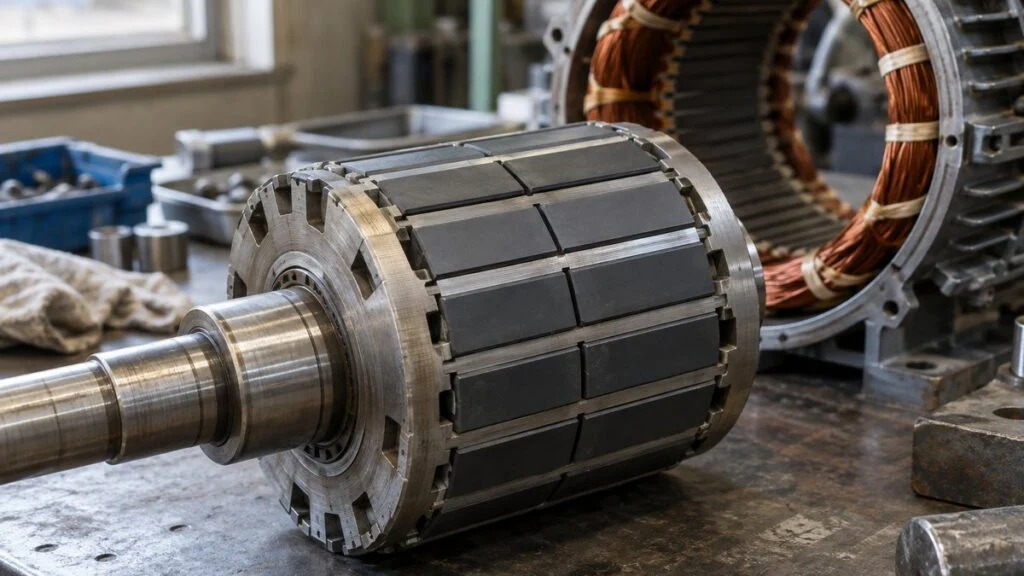
China's rare earth export controls mean that motor magnets and similar products cannot ship until an export license is granted. Suppose your Japanese motor supplier tells you the next shipment will be late because the Chinese maker of the magnets inside is still waiting for its license. Nobody can say when it will arrive, or whether the following shipment will face the same wait.
This guide is for buyers and design engineers in the US, India, and Southeast Asia who purchase motors or parts containing NdFeB (neodymium-iron-boron) magnets from Japanese manufacturers or their local subsidiaries, or who supply parts to Japanese customers. China currently runs three different export controls that affect these magnets. Each has a different scope and status, so mixing them up leads to the wrong procurement and design response.
Below, we walk through the three layers, what has actually happened to magnet supply, why heavy rare earths such as dysprosium and terbium are the choke point, and what you can do on the procurement and design sides. The content reflects public information as of September 30, 2026. We rechecked the status of the suspended measures on October 28, 2026.
Contents
- China's Rare Earth Export Controls: Three Layers at a Glance
- How the Controls Developed, 2023–2026
- Why a Japan-Only Measure Can Reach Your Plant
- What Has Happened to Magnet Supply So Far
- Why Magnets Are the Choke Point: The Role of Heavy Rare Earths
- Procurement: Licenses, Paperwork, and Alternative Sources
- Design: Ways to Reduce or Eliminate Heavy Rare Earths
- Checklist: Six Things to Check Now
- Questions for Your Japanese Supplier
- Limits of This Guide
- FAQ
- Sources
China's Rare Earth Export Controls: Three Layers at a Glance
The controls that matter for magnet supply fall into three groups: the April 2025 license requirement, the October 2025 additional measures, and the Japan-specific measures that started in January 2026.
The first layer requires an export license for items related to seven medium and heavy rare earth elements, including dysprosium and terbium. It applies to exports to every country, not just Japan, and it is still in force. This is why each shipment of NdFeB motor magnets containing these elements now needs its own license.
The second layer would extend licensing to products made outside China that contain Chinese rare earths when they are re-exported, but it is suspended. The third layer applies only to Japan. It bans exports of dual-use items (items with both civilian and military uses) to Japanese military users and military end uses.
Figure 1 summarizes the three layers and their status.
Each has a different scope and a different status (as of September 30, 2026).
*A US-China extension of the trade arrangement to January 10 was reported in September 2026; see the update below. Based on JETRO business news and reports and METI materials.
How the Controls Developed, 2023–2026
China's export controls on critical minerals did not start with rare earths. They began with gallium and germanium in August 2023, spread to graphite, antimony, tungsten, and others, and reached part of the rare earth group in April 2025.
Figure 2 shows the main steps.
The controls moved from minor metals to rare earths, then to measures aimed at Japan.
Based on JETRO business news and regional reports. Announcement numbers are those of China's Ministry of Commerce (MOFCOM); GACC is the General Administration of Customs.
April 2025: Seven Medium and Heavy Rare Earths Need a License
On April 4, 2025, MOFCOM and the General Administration of Customs issued Announcement No. 18 of 2025, effective the same day. It covers seven elements (samarium, gadolinium, terbium, dysprosium, lutetium, scandium, and yttrium) and their metals, alloys, oxides, compounds, and related items.
According to JETRO (the Japan External Trade Organization), the measure covers 97 items by HS code (the international product classification for trade). Samarium, dysprosium, and terbium hit Japanese companies hardest: samarium goes into samarium-cobalt magnets, and dysprosium and terbium go into neodymium magnets.
The measure is not a ban. An exporter can ship once it obtains a license for each transaction. In June 2025, MOFCOM said it was reviewing applications with civilian demand in mind, such as robots and new energy vehicles, and that it had already approved a certain number.
From the importing side, however, it is still hard to predict how long a license will take or whether the next application will be approved.
October 2025: Additional Measures, Then a Suspension
On October 9, 2025, MOFCOM issued several broader announcements. Announcement No. 61 would require a Chinese license even when a magnet or similar product made outside China is exported to a third country, if it contains Chinese-origin rare earth items worth 0.1% or more of its value.
Announcement No. 62 required licenses for exports of technology for mining, smelting and separation, metal refining, magnetic material manufacturing, and recycling.
Announcements Nos. 55–58, issued the same day, covered rare earth equipment, additional medium and heavy rare earth items, and more.
After a US-China agreement, MOFCOM and Customs issued Announcement No. 70 of 2025 on November 7.
It suspended the six October 9 announcements (Nos. 55–58, 61, and 62) until November 10, 2026.
This point is often confused: only the October measures were suspended. The April license requirement for the seven elements remains in force.
As of September 30, 2026, China had not published a formal announcement on what would happen to the suspended measures after the deadline, and a JETRO report from April 2026 said it was unclear whether, when, or in what form No. 61 would return.
Update (checked October 28, 2026): In late September 2026, US Treasury Secretary Scott Bessent said the two countries had agreed to extend the Busan arrangement, originally due to expire on November 10, to January 10. The report we found does not say whether this covers the rare earth suspension.
One compliance advisory reports that a MOFCOM official described the suspension as extended to January 10, 2027, but the same advisory notes that no announcement changing the date had been published as of October 11. We also could not find a new MOFCOM announcement changing the date in No.
70. Treat November 10, 2026 as the date on the record, and check MOFCOM's site and your trade-compliance adviser before relying on either date.
2026: Tighter Dual-Use Controls on Japan
On January 6, 2026, MOFCOM issued Announcement No. 1 of 2026, effective immediately.
It bans exports of all dual-use items to Japanese military users and military end uses. It also bans exports to any other end user or end use that helps enhance Japan's military capabilities.
A JETRO report describes the announcement as not a blanket ban on dual-use items. The rare earth items licensed since April 2025 count as dual-use items, but exports for civilian use are not prohibited as such.
The phrase "any other end user or end use that helps enhance Japan's military capabilities" has no published definition or criteria. The same report notes it could be read to include cases where an item, used as a component or in a production process, ends up in a military product, so the scope depends on how it is applied.
Re-transfers of Chinese-origin dual-use items to these end users through third countries are also controlled. On February 24, Announcements No. 11 and No.
12 put 20 Japanese companies and organizations on the Export Control List and 20 on the Watch List. On June 29, Announcements No.
27 and No. 28 added 20 more to each list.
Japan's government responded at the minister level. At a January 9, 2026 press conference, Minister of Economy, Trade and Industry Ryosei Akazawa said Japan had protested to China on January 6 and asked it to withdraw the measure. He added that much about the measure's scope was unclear and that the impact on industry was still being assessed.
Why a Japan-Only Measure Can Reach Your Plant
If you are in Texas, Pune, or Chonburi, the January 2026 measure might look like a Japan-only issue. In practice, it can reach you through two routes.
- Lead time: Many Japanese motor and component makers import magnets or magnet materials from China into Japan, build them into motors there, and then ship the motors to you. If reviews of exports to Japan get stricter or slower, your delivery date slips with them.
- Re-export and third-country routes: Re-transfers of Chinese-origin dual-use items to listed or military end users through third countries are controlled. One law firm notes that third parties, including Japanese subsidiaries in Southeast Asia or Europe, can be held liable if they help move such items to Japan in violation of the rules.
How strongly the 2026 measures affect a company depends on where it stands. Figure 3 shows the three positions described by JETRO.
Even companies on neither list may feel the effect through stricter reviews.
Based on JETRO, "China's Strengthened Export Controls on Dual-Use Items to Japan: Impact on and Responses for Japanese Companies" (April 2026, Japanese).
Figure 4 shows, as a fictional example, how a delay at the license stage in China can reach a plant outside Japan. Only the license and customs durations come from JETRO's reports; everything else is illustrative.
A buyer in Thailand orders servo motors from a Japanese maker that builds them in Japan with Chinese magnets.
Fictional example for illustration. Actual routes and durations vary by supplier and product; some makers import magnets already built into components, or produce outside Japan.
Like US tariffs, these controls are a trade-policy change that lands on procurement. The difference is that tariffs raise cost, while export controls make it uncertain whether parts will arrive at all, and that is not something price negotiation can fix.
What Has Happened to Magnet Supply So Far
The clearest evidence comes from the drop right after the April 2025 license requirement began. JETRO compiled China's trade statistics for rare earth magnet exports to Japan (Chinese HS code 85051110).
Exports fell from 92,214 kg in April 2025 to 25,719 kg in May, then began to recover in June. From July onward, they returned to roughly the level of the previous two years.
JOGMEC (Japan Organization for Metals and Energy Security) described this period in its 2025 review. Automakers struggled to source permanent magnets, and some plants stopped. Citing IEA (International Energy Agency) data, it also reported that prices in Europe rose to as much as six times the price in China.
For 2026, most figures so far come from news reports. On August 8, 2026, Nikkei reported that Japan-bound exports of the controlled rare earths fell by half year on year in January–June. On July 15, Jiji Press, citing Chinese customs data, reported that rare earth magnet exports to Japan stayed below 200 metric tons for three straight months from March, against a 2025 monthly average above 200 tons.
We could not check these reported numbers against the original statistics. Figures shift with the product scope and the comparison basis, so if you use them for decisions, confirm them with trade statistics and information from your suppliers.
Four Problems Companies Report
JETRO grouped the inquiries it received from Japanese companies into four types. The uncertainty of the process weighs on them more than the drop in volume.
- Classification: It is hard to tell whether a product is controlled, especially for parts with magnets built in or items that have been further processed.
- License processing: The time to approval is unpredictable. Many cases took about three months or more.
- Customs inspection: Even after a license is issued, inspection at customs can take several weeks to a month.
- Trade secrets: Exporters are sometimes asked for detailed information on supply chains outside China and on product composition.
The 2026 Japan measures add two more checks: whether the customer is on a list, and whether the end use involves the military.
Why Magnets Are the Choke Point: The Role of Heavy Rare Earths
"Rare earths" covers 17 elements, but the license requirement bites hardest on a small subset: the heavy rare earths. Why a shortage of them can halt magnet production comes down to a weakness of neodymium magnets.
Neodymium magnets are made mainly of neodymium, iron, and boron, and are considered the strongest permanent magnets in practical use. Their weakness is heat. According to a general-audience explainer by NIMS (Japan's National Institute for Materials Science), a neodymium magnet without heavy rare earths loses almost all of its magnetic strength at around 200°C (392°F).
As temperature rises, coercivity (the ability to resist losing magnetization) falls. The magnet then demagnetizes more easily under the reverse magnetic field inside a motor. Traction motors run hot in service, so a plain neodymium magnet will not work there.
That is why makers add dysprosium or terbium. These elements raise coercivity, so the magnet keeps its strength under heat and reverse fields.
NIMS says neodymium magnets for automotive motors have typically contained 5–8% dysprosium. A technical review by Daido Steel says magnets for hybrid and electric vehicle traction motors have contained around 10 wt% heavy rare earths.
In other words, an additive that makes up a few percent to about a tenth of the magnet by weight sets its usable temperature range. And the supply of these heavy rare earths is extremely concentrated: a February 2026 METI (Ministry of Economy, Trade and Industry) document shows Japan relied on China for 100% of its heavy rare earth imports (2023 data).
Figure 5 traces the supply chain and where it gets stuck.
A stoppage in one upstream step reaches a wide range of downstream products.
Applications from METI, "Issues and Direction for the Materials (Critical Minerals and Components) Sector" (February 2026, Japanese).
A motor uses only a small amount of magnet, but there is no quick substitute. Motors are designed around the properties of a specific magnet, so even switching to a different grade means redoing the demagnetization and thermal evaluations.
Demand is also rising. METI cites an IEA projection that rare earth demand for clean energy technologies will reach about 2.5 times the 2024 level by 2040. Electrification also increases the amount of magnet in each vehicle.
Procurement: Licenses, Paperwork, and Alternative Sources
Start with what can be done under the current rules. The first step is to understand how an export license gets issued.
Know the License Process and Prepare Documents Early
The Chinese exporter files the application, but part of the package comes from the importer. The main items are certificates of the end user and end use, submitted with a Chinese translation. If your Japanese supplier imports the magnets, it prepares these documents, and it may ask you for end-use information about your product.
Figure 6 shows the steps from application to shipment.
The statutory 45 working days count from MOFCOM's formal acceptance.
Based on JETRO, "China's Rare Earth Export Controls" parts 1, 2, and 4 (March 2026, Japanese).
According to JETRO, magnet applications are often decided during MOFCOM's own review, which in principle takes no more than 45 working days. Including the local review, however, many cases take about three months or more from application to license.
Applications also come back for formal errors. JETRO lists missing signatures or seals, mismatched numbers or amounts between the application and the contract, and inconsistencies between the English and Chinese descriptions of the end use.
As of February 2026, almost all licenses issued appeared to be individual licenses for a single export. General licenses covering multiple shipments were used only to a limited extent.
JETRO reports cases where exporters were asked for three or five years of export records, and cases where license quantities were cut because the application looked too large compared with past volumes. Its advice is to avoid large applications aimed at building inventory and to apply as needed for actual requirements.
Loose Magnets or Built-In Components?
According to a Q&A published by MOFCOM, motors and other parts that use permanent magnets, and motor components with magnets embedded in an iron core, are outside the controls. Some companies have therefore stopped importing loose magnets and instead have them built into components in China before import.
JETRO, however, describes this as a stopgap that adds cost for many companies. A pre-consultation answer from the authorities saying an item is not controlled has no legal force, so it does not guarantee that no license is needed.
Sources Outside China
Diversification has started. On October 30, 2025, Sojitz announced that it had begun importing into Japan heavy rare earths produced by Lynas Rare Earths, an Australian company it has invested in and lent to.
The material comes from Australian ore separated and refined in Malaysia. Sojitz had secured supply of dysprosium and terbium for Japan in 2023, and JOGMEC calls Lynas's output the first commercial-scale heavy rare earth production outside China. In March 2025, Iwatani and JOGMEC also joined a separation and refining plant under construction in France.
METI points out that material from alternative sources costs more than conventional supply, and switching materials adds its own cost. If price is the only purchasing criterion, diversification will not happen.
How much of a premium to accept in return for stable supply is a question that sits close to management, not just purchasing.
Design: Ways to Reduce or Eliminate Heavy Rare Earths
Procurement measures do not change where the raw material comes from. Over the medium to long term, the more fundamental answer is to move toward designs that use as little heavy rare earth as possible. There are five main options.
Figure 7 compares them.
Every option reduces something, and every option has a trade-off.
Compiled from company announcements and METI and NEDO materials.
Neodymium Magnets With Less or No Heavy Rare Earth
The first approach changes how the magnet is made. In grain boundary diffusion, an alloy containing heavy rare earths is applied to the magnet surface and heat-treated, so the heavy rare earths spread inward along the grain boundaries. Daido Steel's technical review says treatment at about 900°C (1,652°F) for around 10 hours raises coercivity while limiting the loss of magnetic strength.
Because the process strengthens only the surface layer of each grain, where magnetization reversal tends to start, it needs less heavy rare earth than mixing it through the whole magnet. It has become one of the main methods for raising coercivity in sintered neodymium magnets.
Magnets with no heavy rare earths at all are now appearing. On July 22, 2025, Proterial announced a heavy-rare-earth-free sintered neodymium magnet that it says can be used in EV traction motors. Of its two grades, one was already available as prototype samples from a mass-production plant, and the other was scheduled for prototype production at a mass-production plant in April 2026.
Daido Steel has achieved heavy-rare-earth-free magnets with hot-deformed magnets, whose grains are about one order of magnitude finer than those of sintered magnets. On May 13, 2026, it announced a traction motor rotor using these magnets, developed jointly with NHK Spring.
Toyota announced a magnet in February 2018 that uses no terbium or dysprosium and replaces part of the neodymium with lanthanum and cerium, which are mined in larger quantities. The magnet could cut neodymium use by up to 50%. At the time it was in development, and Toyota aimed to use it in traction motors within ten years.
Ferrite Magnets and Magnet-Free Motors
Ferrite magnets, made mainly of iron oxide, contain no rare earths. Their weakness is lower magnetic strength, and a December 2022 simulation by Proterial (then Hitachi Metals) put a number on the gap.
A traction motor with 110 kW maximum output designed with ferrite magnets weighed 1.3 times as much as one with neodymium magnets. Raising the maximum speed from 10,000 to 15,000 rpm, however, delivered 105 kW at almost the same weight. The idea is to make up for weaker magnets with higher speed.
Other motor types reduce magnet dependence further:
- Synchronous reluctance motors turn using differences in magnetic reluctance created by the shape of the rotor core.
- Wound-field motors put windings on the rotor to make it an electromagnet.
- Induction motors use no permanent magnets.
On October 27, 2025, Astemo announced two new motors: a 180 kW synchronous reluctance motor for main drive that uses ferrite magnets as an assist, and a magnet-free motor for secondary drive (up to 135 kW). It targets practical use around 2030.
Figure 8 lists the main official announcements. Check whether each is still at the development stage or in mass production.
Check the announcement date together with whether the item is in development or production.
Based on company and agency news releases; dates are announcement dates. Check each company's latest information for mass production and adoption.
Recycling and Design for Disassembly
Recovering heavy rare earths from used magnets is also under way. Since fiscal 2023, NEDO (New Energy and Industrial Technology Development Organization) has been developing technology to recover dysprosium and terbium from unused resources such as ore leach solutions and scrap magnets.
METI names securing volume and cutting cost as the challenges for magnet recycling. In automobiles, where magnet use is especially high, the labor needed to remove magnets from motors drives up recovery cost. The Daido Steel and NHK Spring rotor, which holds the magnets with leaf springs so it is easier to take apart, is an answer to this problem from the design side.
None of these options can be adopted overnight. Changing the magnet material or motor type means redoing durability testing and customer qualification, so completing at least the evaluation while supply is calm gives you more options the next time licenses stall.
Checklist: Six Things to Check Now
These checks apply even if you do not buy magnets or motors directly. JETRO also lists, as first steps for companies not on either list, checking whether purchased items are dual-use and whether downstream customers are listed.
Combine what purchasing, design, and sales each know.
Items 1–3 sit with purchasing and design, item 4 with sales, and items 5–6 with purchasing, design, and quality assurance.
The magnets most often missed are those inside purchased motors and units. Even if you never buy a magnet yourself, a stalled license at your supplier's magnet source still stops the part, so it pays to build a relationship where you can regularly ask how magnets are sourced and licensed.
Customer and end-use checks gained weight with the 2026 Japan measures. Because license applications require end-user and end-use certificates, the customer information your sales team holds now directly affects whether materials can be sourced at all.
Questions for Your Japanese Supplier
With export controls, the question is less how to share cost with suppliers and more how to share information. These questions cover the points above.
- Which parts we buy from you contain NdFeB or samarium-cobalt magnets? Do those magnets contain dysprosium or terbium?
- Where are the magnets made, and do they reach you loose or already built into components?
- Does your magnet supplier hold a Chinese export license for our parts? Is it an individual or a general license, and when does it expire?
- How many weeks or months of magnet or finished-part inventory do you hold for our orders?
- What end-user and end-use information do you need from us for license applications, and in what format?
- Have the January 2026 Japan measures changed your lead times or the documents you are asked for?
- Do you have a qualified heavy-rare-earth-free or non-Chinese magnet option? How long would evaluation and approval take on our side?
Template: Inquiry Email to a Japanese Supplier
You can adapt this email. Replace the bracketed parts with your own details.
Subject: Magnet supply and export license status for [part numbers]
Dear [Name],
We are reviewing supply risk related to China's rare earth export controls. For the parts listed below, could you please confirm the following by [date]?
1. Whether the parts contain NdFeB or SmCo magnets, and whether those magnets contain dysprosium or terbium
2. The country where the magnets are produced, and whether they are supplied loose or built into components
3. The status of the Chinese export license for these magnets (individual or general, and expiry date)
4. Your current inventory coverage, in weeks, for our orders
5. Any end-user or end-use documents you need from us
6. Any heavy-rare-earth-free or alternative-source options, and the expected qualification lead timePart numbers: [list]
Our product and end use: [brief description]If any of this information is confidential, a short summary is fine. Thank you for your help.
Best regards,
[Your name]
[Company]
Limits of This Guide
- Export controls can change with a single announcement. This guide reflects public information as of September 30, 2026, with the suspension status rechecked on October 28, 2026.
- It does not determine whether any specific transaction is controlled. Check the original MOFCOM announcements, JETRO business news, and METI releases, and consult a trade-compliance specialist where needed.
- The effect on your supply depends on your suppliers' routes, magnet grades, inventory, and customers, which differ by company and product.
- This guide covers China's controls only. It does not cover US, EU, or other countries' export rules that may also apply to your shipments.
- Product announcements are shown as of their release dates. Check each company's current status before planning a design change.
FAQ
What Are Heavy Rare Earths?
Heavy rare earths are a group within the 17 rare earth elements that includes dysprosium and terbium. Added to neodymium magnets, they help the magnets keep their strength at high temperature, which is why traction motor magnets depend on them.
Has China Banned Rare Earth Magnet Exports for Civilian Use?
No. Magnets for civilian use can still be exported once the Chinese exporter obtains a license for each shipment. Many cases take about three months or more, and reviews of exports to Japan are reported to be getting stricter and possibly longer.
Do Dysprosium and Terbium Magnets Need an Export License?
Yes. Since April 4, 2025, Announcement No.
18 of 2025 has required a license for NdFeB magnet materials containing dysprosium or terbium, along with the other listed items. This requirement was not part of the November 2025 suspension and remains in force.
Are Ferrite Magnets Affected by the Rare Earth Controls?
Ferrite magnets are made mainly of iron oxide and contain no rare earths, so the controls are much less likely to affect them. They are weaker, though, and the design has to compensate for a larger, heavier motor at the same output.
Does Buying Magnets Built Into Components Avoid the License?
MOFCOM's Q&A says motor components with magnets embedded in an iron core are outside the controls. However, answers from the authorities in pre-consultation have no legal force, and JETRO calls this a stopgap that adds cost. Whether a specific product is controlled is a question for a trade-compliance specialist or the authorities.
Sources
- January 2026 Japan measures: JETRO Business News, "China Tightens Export Controls on Dual-Use Items to Japan" (January 8, 2026, Japanese)
- Analysis and impact on companies: JETRO, "China's Strengthened Export Controls on Dual-Use Items to Japan: Impact on and Responses for Japanese Companies" (April 2026, Japanese)
- Third-party liability, including overseas subsidiaries: Greenberg Traurig, "China Imposes Escalated Export Controls on Dual-Use Items to Japan" (February 2026)
- List additions: JETRO Business News (February 26, 2026, Japanese); JETRO Business News (July 1, 2026, Japanese)
- October 2025 measures and suspension: JETRO Business News (October 14, 2025, Japanese); JETRO Business News (November 11, 2025, Japanese); China Briefing, "China's Rare Earth Export Controls"
- Truce extension to January 10: Hellenic Shipping News / Investing.com, "U.S., China agree to extend trade truce until January, Bessent says" (September 2026)
- Reported MOFCOM statement on the suspension: Mainrich International, "China Rare Earth Export Controls: Item Classification and MOFCOM Licensing"
- MOFCOM on civilian-use reviews: JETRO Business News (June 9, 2025, Japanese)
- Magnet exports to Japan and company issues: JETRO, "China's Rare Earth Export Controls (1): Magnet Exports to Japan and Issues" (March 10, 2026, Japanese)
- License process, classification, general licenses: JETRO, part 2 (license process); part 3 (classification); part 4 (predictability) (Japanese)
- Japanese government response: METI, Minister Akazawa press conference summary (January 9, 2026, Japanese)
- Heavy rare earth dependence, demand outlook, applications, recycling: METI Manufacturing Industries Bureau, "Issues and Direction for the Materials (Critical Minerals and Components) Sector" (February 19, 2026, Japanese)
- 2025 impact and supply diversification: JOGMEC, "Trends in Metal Mineral Resources in 2025" (January 13, 2026, Japanese)
- 2026 exports to Japan (news reports): Nikkei (August 8, 2026, Japanese); Jiji Press (July 15, 2026, Japanese)
- Australian heavy rare earth imports: Sojitz news release (October 30, 2025, Japanese)
- Neodymium magnets and dysprosium: NIMS, "Rare Metals" column (Japanese)
- Heavy rare earth content, grain boundary diffusion, hot-deformed magnets: Daido Steel, Denki-Seiko Vol. 92 No. 1, technical review on grain boundary diffusion in hot-deformed Nd magnets (2021, Japanese)
- Heavy-rare-earth-free sintered NdFeB magnet: Proterial news release (July 22, 2025, Japanese)
- Ferrite-magnet traction motor: Proterial (formerly Hitachi Metals) news release (December 9, 2022, Japanese)
- Rotor with hot-deformed magnets: Daido Steel news release (May 13, 2026, Japanese)
- Neodymium-reduced heat-resistant magnet: Toyota news release (February 20, 2018, Japanese)
- Synchronous reluctance motors: Astemo news release (October 27, 2025, Japanese)
- Government R&D: NEDO news release (July 25, 2024, Japanese); NEDO Web Magazine (October 22, 2025, Japanese)
Original article in JapaneseThis guide is adapted from a MONOSCOPE article written for readers in Japan: レアアース輸出規制の磁石への影響|対日措置の経緯と調達・設計の備え
About the editor
 MONOSCOPE EditorFOUNDER & EDITOR
Spent about ten years at a plant equipment maker and a plant engineering company, proposing, designing, and commissioning equipment, then moved into web marketing. Now a web consultant for B2B manufacturers, helping them explain their products and technology. Licensed in Japan as an Energy Manager and a Third-Class Chief Electrical Engineer.
Has run an engineering blog since 2017 (500+ articles) and a Japanese YouTube channel with about 20,000 subscribers. Each English guide is written from the Japanese shop-floor point of view and checked against the cited standards.