Perovskite Solar Manufacturing in Japan: Process and Makers
If you sell barrier film, encapsulants, coating equipment, or laser systems, you have probably seen headlines like "Japan starts perovskite mass production" or "perovskite cell hits 28%." They are hard to act on. Some refer to a small research cell, some to a factory that will not run until 2027, and some to a government target rather than a plan any company has committed to.
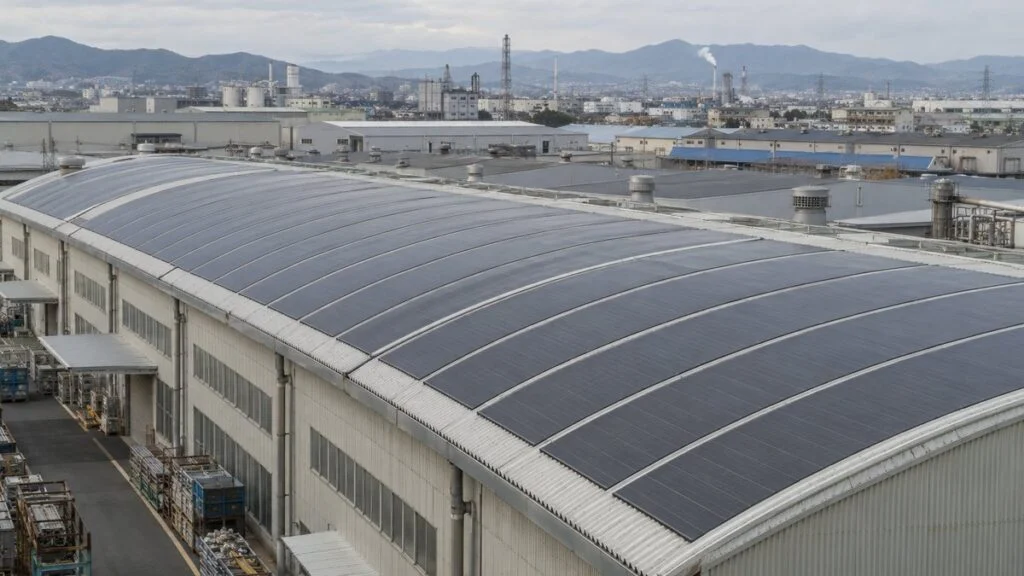
Here is where things actually stand. On March 27, 2026, Sekisui Chemical and its subsidiary Sekisui Solar Film announced that they would start selling SOLAFIL, a thin, flexible film-type perovskite solar cell. Output in fiscal 2026 is limited to what existing equipment can make, and the 100 MW production line is scheduled for fiscal 2027.
This guide explains how film-type perovskite modules are made (coat, scribe, encapsulate), which Japanese companies are at which stage, and how Japan's approach compares with China and Europe. It ends with a checklist and an inquiry template you can use when you contact a Japanese maker or supplier.
Contents
- Where Japan's Perovskite Mass Production Stands Today
- Why Japan Is Betting on Perovskite Solar Cells
- The Perovskite Solar Cell Manufacturing Process: Coat, Scribe, Encapsulate
- Four Barriers to Perovskite Mass Production
- Japanese Perovskite Solar Cell Companies and Their Plans
- Where the Supply Chain Opens to Outside Suppliers
- Checklist Before You Talk to a Japanese Maker
- Limits of This Guide
- Summary
- FAQ
- Sources
Where Japan's Perovskite Mass Production Stands Today
In short, Sekisui Chemical has begun commercialization, while the other Japanese companies are still developing and field-testing mass production technology. Sekisui's March 2026 announcement covers a business launch and the start of supply negotiations with customers. It does not mean the new mass production line is running.
Japanese companies usually plan by fiscal year, which runs from April to March. Sekisui's "fiscal 2027" line therefore means the period from April 2027 to March 2028. Its December 2024 release named April 1, 2027 as the planned start date for the 100 MW equipment and set a goal of a gigawatt-scale line by 2030 (1 GW = 1,000 MW).
The national plan follows the same timeline. In November 2024, a public-private council under Japan's Ministry of Economy, Trade and Industry (METI) published the Next-Generation Solar Cell Strategy. It sets production and generation-cost targets in three phases and aims for about 20 GW of installed perovskite capacity in Japan by 2040.
The plan scales up production while lowering the cost of the electricity generated, step by step.
Based on the roadmap in METI's Next-Generation Solar Cell Strategy (November 2024). All figures are targets, not results.
So the answer to "when" depends on the company and the scale. Commercialization based on limited production has already begun. Based on plans published as of September 2026, 100 MW-class lines are due in fiscal 2027 and gigawatt-class capacity around 2030.
Government support covers three areas at once: mass production technology, production capacity, and demand:
- Mass production technology: the Development of Next-Generation Solar Cells project under Japan's Green Innovation Fund (GI Fund), with a budget of JPY 105.1 billion (METI materials, May 2026)
- Production capacity: METI's GX (green transformation) supply chain subsidy program, which supports investment in film-type perovskite cells and laser processing equipment
- Demand: deployment support that began on September 4, 2025
Local governments have set their own targets too. According to METI, Tokyo aims for about 2 GW by 2040, Aichi Prefecture for 1.2 GW by 2040, and Osaka Prefecture for 530 MW by 2035.
Why Japan Is Betting on Perovskite Solar Cells
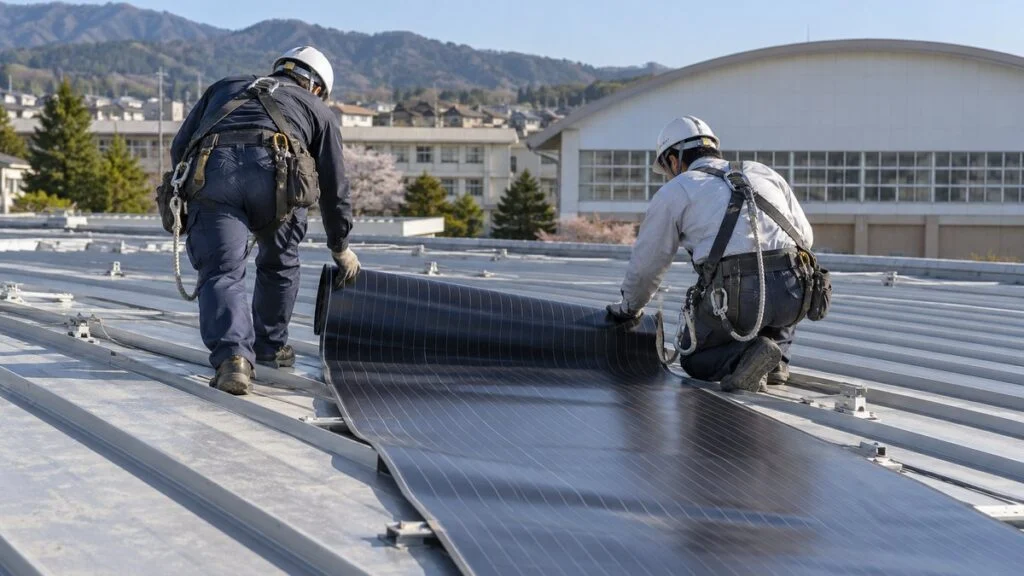
"Perovskite solar cell" is a general term for any solar cell whose light-absorbing layer is a material with the perovskite crystal structure. METI describes the structure as three kinds of ions, typically organic ammonium, lead, and iodide, arranged in an ABX3 pattern. The technology was first developed by Japanese researchers.
One reason for the push is space. According to Japan's Agency for Natural Resources and Energy (ANRE), 95% of solar cells in use today are silicon-based, and their weight limits where they can go. Japan already has one of the highest amounts of solar capacity per unit of flat land among major countries, and good new sites are getting scarce.
A perovskite layer is a film made of many small crystals, so it tolerates bending and can be made light. That opens up sites that could not carry conventional panels, such as factory and gymnasium roofs with low load limits and building walls. For manufacturers, it could add on-site solar as one more decarbonization option.
The other reason is raw materials. Japan is the world's second-largest iodine producer after Chile. ANRE put Japan's share at about 30% of world output (February 2024), and the US Geological Survey estimates 2025 production at 9,000 t for Japan and 23,000 t for Chile.
Japan can therefore source the main ingredient domestically, which policymakers also value for economic security.
The strategy also reflects a lesson from the past. METI notes that Japanese companies held about 50% of the world solar cell market around 2000 but less than 1% recently. The cause it identifies is that investment in production capacity was too small and too slow for a growing market.
Film, Glass, and Tandem Perovskite Cells
Perovskite cells come in three types, depending on what the active layer is built on. The applications and the maturity of each type differ, so first check which type a company's plan refers to.
The substrate and structure determine which market each type targets.
Based on METI's Next-Generation Solar Cell Strategy (November 2024).
The contrast with silicon is clearest on the manufacturing side. Silicon needs process steps above 1,400°C (2,550°F), while film-type perovskite can be made at about 150°C (300°F). The target manufacturing time is about one day, compared with three days or more for silicon.
Perovskite is made at low temperature in a short time, but results depend heavily on process know-how.
Based on the comparison table and the disposal and recycling materials in METI's Next-Generation Solar Cell Strategy (November 2024).
The row that matters most in practice is "nature of the process." With silicon, anyone who bought the latest equipment could mass-produce, and Japanese companies lost their edge.
With perovskite, know-how that is hard to build into a machine, such as ink formulation, coating method, and temperature and humidity control, decides performance. METI's strategy aims to turn that know-how into Japan's competitive advantage.
How Japan Compares with China and Europe
Overseas competitors are moving fast, mainly on glass-type and tandem products. According to METI's 2024 strategy, several startups were founded in China from around 2015, and companies there are working toward mass production of glass-type and tandem modules.
The table below summarizes the main differences. Overseas entries are based on company announcements and trade press, so treat them as reported plans rather than verified output.
| Japan | China | Europe | |
|---|---|---|---|
| Main focus | Film type first; tandem in development | Glass type and tandem | Perovskite-on-silicon tandem |
| Scale reported | Limited production now; 100 MW line due April 2027; GW class targeted for 2030 (Sekisui) | METI's strategy lists several companies with 100–200 MW of capacity that are building GW-class lines. GCL announced a GW-scale base in Kunshan (1 GW first phase, 2 GW planned) for 2.76 m² tandem modules (reported June 2025) | Oxford PV shipped its first commercial tandem modules, made on its pilot line in Brandenburg an der Havel, Germany, to a US utility-scale customer (reported September 2024) |
| Efficiency headlines | Product-size film: 15% (Sekisui, 30 cm wide, February 2024) | LONGi: 35.5% tandem cell, certified by the European Solar Test Installation (ESTI) (company announcement, July 2026) | Oxford PV: PV Tech reported 24.5% cell efficiency for the shipped modules (module-level figure not confirmed) |
METI's strategy assumes that mass production of glass-based tandem modules will advance overseas and says Japan will watch it closely. Japan's plan is to lead in film type while catching up in tandem.
The Perovskite Solar Cell Manufacturing Process: Coat, Scribe, Encapsulate
Perovskite cells are expected to be cheap to make because the layers can be coated or printed onto a substrate from inks. A cross-section shows a stack of layers on a transparent electrode: an electron transport layer, the perovskite layer, a hole transport layer, and a counter (back) electrode.
Light enters through the substrate and transparent electrode and is converted to electricity in the active layer.
Based on the layer structure in Ricoh's technical overview. In some designs the electron and hole transport layers are reversed, and materials and thicknesses vary by maker.
The process is easiest to understand in three stages: coat, scribe, and encapsulate. Each layer is coated and dried, lasers cut grooves that connect the cells in series, and the module is finally sealed against moisture.
Coating and laser scribing alternate, and encapsulation comes last.
P1–P3 follow the explanation by Japan's National Institute of Advanced Industrial Science and Technology (AIST). The steps before and after are the integration flow commonly used for thin-film solar cells. Order and methods vary by maker, and one approach prints all layers by inkjet and needs no laser scribing.
Coating Methods Differ by Company
Coating is where Japanese makers differentiate most. Even among companies selected for the GI Fund, whose solar projects are run by NEDO (New Energy and Industrial Technology Development Organization), the methods differ.
All of them "coat," but the equipment concepts differ.
Based on an ANRE article (February 2024) and company news releases and technical pages (2025–2026).
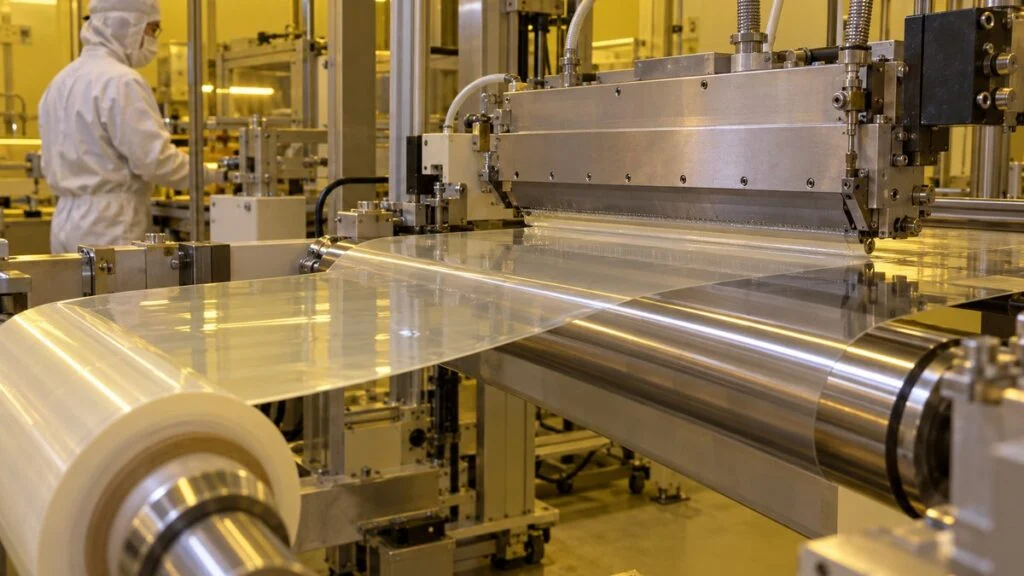
Roll-to-roll processing coats or prints on a film web carried by a series of rollers. Like a newspaper press, it runs without stopping, which gives high throughput in mass production.
According to ANRE (February 2024), Sekisui Chemical used a 30 cm (12 in) wide roll-to-roll process to make cells with a durability equivalent to 10 years and an efficiency of 15%.
Inkjet printing works like a desktop printer and places ink only where it is needed. Ricoh has published a technology that patterns all functional layers by inkjet, eliminating laser scribing and vacuum deposition steps. Panasonic Holdings combines inkjet coating with laser processing to make glass-type modules with flexible choices of size and transparency.
Laser Scribing and Dead Area
Scribing divides a large coated area into narrow strip cells and connects them in series on the substrate. Without it, one large cell would lose too much power to electrical resistance.
AIST describes three patterning steps: P1 cuts the transparent electrode, P2 cuts the active and transport layers, and P3 cuts the back electrode. The area spanning P1 to P3 produces no power and is called the dead area.
The narrower and more precise the scribes, the higher the module efficiency. The laser also must not heat-damage the surrounding film, so laser scribing systems are central to mass production. AIST's research uses near-infrared and green lasers with pulse widths from femtoseconds to picoseconds to reduce thermal damage, and the Japanese government also subsidizes production capacity for laser processing equipment.
Encapsulation and Barrier Film
Encapsulation is the last step, and it directly sets service life. Perovskite crystals degrade with even small amounts of moisture. Film-type modules have no glass cover, so they must be sandwiched in barrier film with very low water vapor transmission, which makes the film itself a critical component.
METI's materials divide the perovskite supply chain into five segments:
- Components, materials, and manufacturing equipment
- Substrate and electrode formation
- Device formation
- Encapsulation and coating
- Cell and module assembly
Chemical makers, film makers, and equipment makers all have plenty of room to take part.
Four Barriers to Perovskite Mass Production
If the cells can simply be coated, why isn't mass production easy? ANRE lists short life and low durability, the difficulty of scaling to large areas, and the need for higher efficiency. Adding cost and lead handling gives four barriers.
All four are hard to see in the lab and surface only in volume production.
Based on ANRE, AIST, and METI's Next-Generation Solar Cell Strategy.
Durability
AIST explains that perovskite is an ionic crystal, so it is sensitive to humidity and must be protected from moisture, heat, light, and oxygen. Solar power systems are built for long service; in Japan, for example, the feed-in tariff for commercial systems (10 kW and larger) runs for 20 years.
A shorter life raises the cost of each kWh generated. Among published figures, Sekisui Chemical's "durability equivalent to 10 years" (February 2024) is one reference point. For tandem cells, the national target is technology that achieves 20-year durability by FY2030.
Uniform Coating over Large Areas
In the lab, the standard method is spin coating, where the substrate spins to spread the liquid, combined with an antisolvent step that drips a second solvent to trigger crystallization. AIST notes that these methods are hard to use as-is in mass production, which needs continuous coating over large areas.
Volume production requires dense, smooth films without pinholes, made consistently over large areas. Small changes in drying speed or ambient humidity change how the crystals form. The process design must therefore cover the drying ovens and atmosphere control as well as the coater, which is classic production engineering work.
The central task is scale-up: reproducing lab-level performance over large areas as the process moves into mass production. It calls for engineers who understand both the materials and the coating and drying processes.
Reading Efficiency, Durability, and Certification Claims
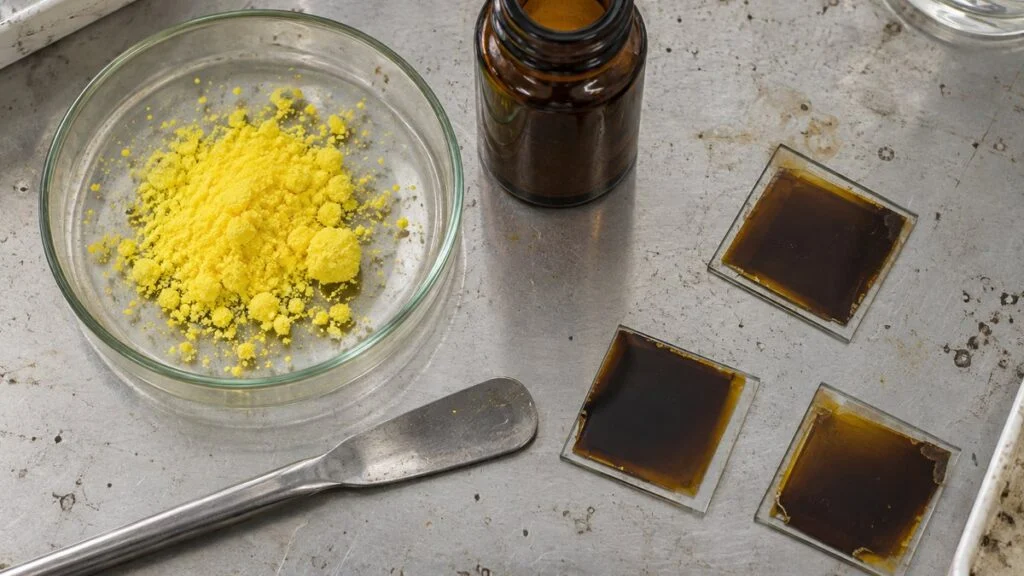
Efficiency figures change a lot depending on what was measured. METI reports that the best perovskite cell efficiency rose from 3–4% in 2009 to 26.7% as of November 2024, based on the Best Research-Cell Efficiency Chart maintained by the US National Laboratory of the Rockies (NLR, formerly NREL).
The record has moved since then. In the NLR data (updated August 14, 2026), the top single-junction perovskite cell is 28.0%, measured in February 2026 on a cell of about 0.05 cm². Product-size results are far lower: Sekisui Chemical reported 15% at 30 cm width (February 2024), and METI's 2024 strategy put overseas film-type products at about 12–15%.
Tandem records follow the same pattern. LONGi announced a 35.5% perovskite-on-silicon tandem cell certified by ESTI on July 14, 2026, without stating the cell area.
The LONGi entry in the NLR data is 35.2% on a cell of about 1 cm² (February 2026). These are research-cell records, not production module ratings.
Durability claims need the same care. A figure such as "equivalent to 10 years" tells you little until you know the test conditions behind it. Ask the following questions:
- Cell or module? Ask for the aperture or total area, and whether the figure is a lab record or a production rating.
- Independent or in-house? Ask which test lab measured it and under which standard.
- Which qualification standards has the product passed? IEC 61215 (design qualification and type approval of terrestrial PV modules) and IEC 61730 (PV module safety qualification) are the usual baseline for module buyers.
Researchers point out that IEC 61215 and IEC 61730 were developed around silicon modules and that silicon-oriented test sequences can give inconsistent results for perovskites. IEC TR 63228:2019 summarizes measurement practice for emerging devices, including perovskites, but it is a technical report, not a pass/fail qualification. We could not confirm from public sources whether the Japanese products in this article are certified to IEC 61215 or IEC 61730, so confirm this with each supplier.
Lead Content
The active layer contains lead. METI's strategy says the roughly 0.5 g of lead per m² must be properly treated and recovered. Recycling technology is still under development, and a NEDO project started in FY2025 to assess disposal and recycling systems, including the environmental impact of lead.
If you plan to sell in Europe, the EU RoHS Directive (2011/65/EU) limits lead to 0.1% by weight in homogeneous materials.
Article 2(4)(i) of the directive excludes PV panels intended for systems that professionals design, assemble, and install for permanent use at a defined location, but other products, such as consumer devices with built-in cells, may fall within scope. Ask the supplier for lead content per homogeneous material and for its end-of-life take-back plan, and have your compliance team decide which rules apply.
Japanese Perovskite Solar Cell Companies and Their Plans
The table below lists each company's officially announced plans and when they were announced. Read it in three groups: a company that has begun commercialization, a company building a mass production line, and companies developing and field-testing mass production technology.
Based on company and government materials available as of September 2026.
Based on company news releases, NEDO announcements, and materials from METI's public-private council (May 20, 2026). EneCoat Technologies, Panasonic Holdings, and Ricoh were selected as companies that envision mass production of 200–300 MW per year or more by FY2030. Plans are as announced and may change.
Sekisui Chemical and Sekisui Solar Film
Sekisui Chemical is furthest ahead. Its board approved mass production on December 26, 2024. The company is taking over buildings, power facilities, and cooling facilities at Sharp's headquarters plant in Sakai, Osaka, and installing production equipment there.
Sekisui Solar Film, the operating company set up in January 2025, was 86% owned by Sekisui Chemical and 14% by the Development Bank of Japan at the time of that announcement. Total investment for the building purchase and the 100 MW equipment is JPY 90 billion, including subsidies, and the equipment is scheduled to start operating on April 1, 2027.
Sekisui was also selected for the GX supply chain subsidy program. For production capacity of about 1 GW, eligible project costs total JPY 314.5 billion, with half covered by the subsidy.
On March 27, 2026, the company announced the business launch under the SOLAFIL brand. It said the production technology on existing equipment was established and that products and installation specifications for metal roofs were ready.
Supply talks started with projects selected under a Ministry of the Environment deployment program: Saitama City, Shiga Prefecture, West Nippon Expressway Company, Fukuoka Prefecture, and Fukuoka City. A Tokyo Metropolitan Government project to install the cells early on its own facilities is also included.
On September 14, 2026, Sekisui announced field tests of a lighter, lower-cost "sheet" version in Shibushi, Kagoshima Prefecture. The company is shipping products while it refines installation methods and specifications.
EneCoat Technologies
EneCoat Technologies, a Kyoto University spin-off, was selected for a GI Fund field demonstration in September 2025. According to METI, the consortium includes JGC, KDDI, Toyoda Gosei, YKK AP, Kyoto University, and Aoyama Gakuin University as contractors, with Toyota Motor and INPEX among the partners.
Nikkei and Jiji Press reported that the company held a completion ceremony for a new plant in Uji, Kyoto Prefecture, on September 26, 2026, with full operation for mass production planned as early as 2028.
Nikkei described a four-story building with a total floor area of about 5,000 m² that could produce somewhat more than 10 MW per year at full operation. We could not find an official company announcement about this plant at the time of writing.
Panasonic Holdings
Panasonic Holdings focuses on glass-type cells for building windows and walls. On November 14, 2025, it announced the start of a GI Fund project, "mass production technology development and field demonstration of glass-type perovskite solar cells," with AGC and Panasonic Environmental Engineering.
The project runs for up to five years, from FY2025 to FY2029. On March 2, 2026, Panasonic announced a long-term test using the windows of a new technology building in Kadoma, Osaka.
On September 24, 2026, it announced a demonstration with eight panels, each 900 mm × 1,300 mm (about 35 × 51 in), at a cruise boat terminal in Kobe. Both projects are meant to establish mass production technology and verify installation and performance on real buildings.
Ricoh, AISIN, and Toshiba
Ricoh applies its organic photoconductor and inkjet technologies. Its consortium, with Daiwa House Industry handling installation and NTT Anode Energy handling electrical design, was selected for the GI Fund in September 2025.
AISIN announced on August 21, 2026 that it had been selected for the GI Fund's next-generation single-junction solar cell demonstration. Using its own spray coating process, it plans to scale practical modules from 300 mm square to up to 500 mm square (about 12 to 20 in).
AISIN will run tests at Chubu Centrair International Airport and at its subsidiary in Indonesia, and it plans tests in the United States as well. Toshiba developed film-type cells with a meniscus coating method under a GI Fund commercialization project that ended in FY2025.
Kaneka and Choshu Industry (Tandem)
For tandem cells, NEDO selected Kaneka and Choshu Industry for a mass production technology demonstration on February 6, 2026. METI describes both as companies that envision mass production of 500 MW or more by FY2030.
Kaneka stacks a perovskite cell on the heterojunction crystalline silicon cells it already makes. The company plans to start product sales in FY2028 and has been running an outdoor test at Saitama City Hall since March 18, 2026.
Where the Supply Chain Opens to Outside Suppliers
Perovskite is not only a solar cell maker's business. METI's strategy calls for strong domestic production of raw materials such as iodine, components such as film, and manufacturing equipment such as laser systems. The areas most likely to involve suppliers are:
- Materials: iodine, perovskite precursors, transport-layer materials, electrode materials
- Components: substrate film, transparent conductive film, barrier film, encapsulants
- Manufacturing equipment: coating and printing equipment, drying ovens, laser scribing systems, inspection equipment
- Installation and building materials: integration with roofing and wall materials, mounting hardware, wiring and electrical work
The partnerships show how wide this is. Panasonic Holdings works with glass maker AGC, Ricoh with homebuilder Daiwa House Industry, and EneCoat with an engineering company and an automotive parts maker. Installation technology and cooperation from end users matter as much as manufacturing technology.
Keep in mind that Japan's policy explicitly aims to build domestic supply for these materials and tools. For an overseas supplier, openings are more likely to come from performance or cost advantages a Japanese maker cannot get locally, joint development, and support for projects outside Japan, such as AISIN's tests in Indonesia and the US.
What a maker needs from you also depends on its stage. Companies already selling may care most about stable supply and cost, while companies still in development and testing may value fast sample turnaround and help with evaluation. Matching your proposal to the stage in Figure 8 helps you target the right request.
Checklist Before You Talk to a Japanese Maker
Whether you want to buy modules or supply materials and equipment, settle these points early. The questions are written so you can paste them into an email or a meeting agenda.
| Topic | What to Confirm | Why It Matters |
|---|---|---|
| Product type | Film, glass, or tandem? Single-junction or tandem? | Plans, durability, and supply chains differ by type |
| Stage | Commercial product, pilot line, or field demonstration? Which fiscal year (April–March)? | Decides whether you can get volume, samples, or only test data |
| Efficiency | Cell or module? Area (aperture or total)? Measured by whom? | Research-cell records are far above module ratings |
| Durability | Test conditions behind "years equivalent"; any outdoor exposure data | Sets the real cost per kWh and warranty terms |
| Certification | IEC 61215 / IEC 61730 status, or the test plan and expected date | Required by many buyers, insurers, and grid operators |
| Lead | Lead per homogeneous material; take-back and recycling plan | EU RoHS and local disposal rules |
| Installation | Approved substrates (e.g., metal roofs), fastening or adhesive method, wind and load data | Sekisui's first products target metal roofs |
| Supply chain | Which layers or steps are in-house vs. outsourced; who supplies barrier film, encapsulant, lasers | Shows where a new supplier could fit |
| Export | Whether overseas sales or overseas tests are planned now | Several makers are focused on the Japanese market first |
Inquiry Email Template
Here is a short template you can adapt. Japanese companies tend to respond better to a specific, numbered request than to a general request for "cooperation." Replace the bracketed parts.
Subject: Inquiry about [film-type perovskite modules / supply of barrier film] – [Your Company], [Country]
Dear [Name / Sales Team],
I am [name], [title] at [company] in [country]. We [make / distribute / install] [product] for [application]. We read your announcement of [date] about [product or project] and would like to ask a few questions.
- Is the product available for [purchase / samples] in [country], and from which fiscal year?
- Please share the module efficiency (with area) and how it was measured.
- Has the product passed IEC 61215 and IEC 61730? If not, when do you expect results?
- What durability data do you have, and under what test conditions?
- What is the lead content per homogeneous material, and is there a take-back plan?
- [Supplier version] Are you evaluating outside suppliers for [barrier film / encapsulant / laser scribing / coating equipment]? If so, what specifications and sample sizes do you need?
We can sign an NDA if needed. A short online meeting would also work for us.
Best regards,
[Name]
[Company, address, phone]
Limits of This Guide
- Plans are as announced by each company or reported in the press up to September 2026. Subsidy results and field tests may change them, so check the latest news releases and METI public-private council materials before you rely on any date.
- The manufacturing flow in Figure 5 is a typical sequence. Each maker's actual process order, methods, materials, and layer thicknesses differ.
- Efficiency and durability numbers come from different test conditions and are not directly comparable.
- Overseas information comes from company announcements and trade press and has not been independently verified.
- Regulatory points (RoHS, certification) show what to check, not a compliance decision. Your compliance team or certification body decides what applies to your product and market.
Summary
- As of September 2026, Sekisui Chemical is the Japanese company that has begun commercialization, with limited production on existing equipment in FY2026.
- Its 100 MW line is due in FY2027 (operation from April 2027), and it targets GW-class capacity by 2030. Japan aims for about 20 GW installed by 2040.
- Manufacturing comes down to coat, scribe (P1–P3), and encapsulate. Coating methods differ by company: roll-to-roll, meniscus, spray, and inkjet.
- The four barriers are durability, uniform large-area coating, generation cost, and lead management.
- Panasonic Holdings, Ricoh, AISIN, EneCoat Technologies, Kaneka, and Choshu Industry are still developing and field-testing mass production technology.
- Japan leads in film-type development and is also pursuing tandem cells as overseas competition intensifies. Always check cell vs. module, test conditions, and IEC certification status.
FAQ
When will perovskite solar cells be commercially available from Japan?
Sekisui Chemical decided in March 2026 to launch its film-type SOLAFIL product, but FY2026 output is limited to existing equipment. Its 100 MW line is planned for FY2027, and GW-scale capacity is targeted for 2030.
How long do perovskite solar cells last?
Among published figures, Sekisui Chemical's film-type cell has a durability equivalent to 10 years (February 2024). The crystals are sensitive to humidity, so encapsulation and barrier film performance largely determine service life.
What is the efficiency of perovskite solar cells?
The single-junction research-cell record is 28.0% on a cell of about 0.05 cm². At product size, Sekisui Chemical reported 15% at 30 cm width. When you see a high number in the news, check whether it is a small research cell or a full-size module.
Do perovskite solar cells contain lead?
Yes. The active layer contains about 0.5 g of lead per m², and METI's strategy says it must be properly treated and recovered. Recycling technology is still in development, and a NEDO project to assess disposal and recycling systems began in FY2025.
Why is Japan investing in perovskite solar cells?
Japan is the world's second-largest iodine producer, so it can source the main raw material domestically. The cells are also light and flexible, so they can go on factory roofs and walls that cannot carry conventional panels.
Sources
- National strategy and targets: METI, Next-Generation Solar Cell Strategy (November 2024, Japanese)
- Strategy progress, company selections, local targets: METI, 10th public-private council on next-generation solar cells, May 20, 2026 (Japanese)
- Features, iodine share, challenges: ANRE, "Perovskite solar cells, part 1" (Japanese)
- Company development and roll-to-roll: ANRE, "Perovskite solar cells, part 2" (Japanese)
- World iodine production: USGS, Mineral Commodity Summaries 2026: Iodine
- GI Fund project overview: NEDO Green Innovation Fund, Development of Next-Generation Solar Cells (Japanese)
- Demonstration selections (September 2025): NEDO news release, September 10, 2025 (Japanese)
- Tandem selections (February 2026): NEDO, Next-generation tandem solar cell mass production demonstration (Japanese)
- Mass production decision, investment, new company: Sekisui Chemical, December 26, 2024 (Japanese)
- SOLAFIL launch: Sekisui Chemical and Sekisui Solar Film, March 27, 2026 (Japanese)
- Sheet version field test: Sekisui Chemical, September 14, 2026 (Japanese)
- EneCoat GI Fund selection: EneCoat Technologies press release, September 10, 2025 (Japanese)
- EneCoat new plant (press reports): Nikkei, September 26, 2026 (Japanese), Jiji Press, September 28, 2026 (Japanese)
- Panasonic glass-type project: Panasonic Holdings, November 14, 2025 (Japanese)
- Panasonic demonstrations: Panasonic Holdings, March 2, 2026, September 24, 2026 (Japanese)
- Inkjet printing technology: Ricoh, inkjet-printed perovskite solar cells (Japanese)
- Spray coating and module scale-up: AISIN, August 21, 2026 (Japanese)
- Tandem selection and sales plan: Kaneka, February 6, 2026, March 18, 2026 (Japanese)
- Laser scribing (P1–P3): AIST, Research Institute for Advanced Manufacturing Technology (Japanese)
- Durability and coating challenges: AIST, Perovskite Solar Cell Research Team (Japanese)
- Tandem cell efficiency: LONGi news release, July 14, 2026
- Research-cell efficiency records: NLR (formerly NREL), Best Research-Cell Efficiency Chart and data table (updated August 14, 2026)
- GCL GW-scale base: Perovskite-Info, June 26, 2025
- Oxford PV first commercial shipment: PV Tech, September 5, 2024
- IEC 61215 / IEC 61730 for perovskites: Nanoscale Advances (2025); IEC TR 63228:2019 preview
- EU RoHS scope: Directive 2011/65/EU, Article 2(4)(i)
Original article in JapaneseThis guide is adapted from a MONOSCOPE article written for readers in Japan: ペロブスカイト太陽電池の量産計画|製造工程と国内メーカーの現在地
About the editor
 MONOSCOPE EditorFOUNDER & EDITOR
Spent about ten years at a plant equipment maker and a plant engineering company, proposing, designing, and commissioning equipment, then moved into web marketing. Now a web consultant for B2B manufacturers, helping them explain their products and technology. Licensed in Japan as an Energy Manager and a Third-Class Chief Electrical Engineer.
Has run an engineering blog since 2017 (500+ articles) and a Japanese YouTube channel with about 20,000 subscribers. Each English guide is written from the Japanese shop-floor point of view and checked against the cited standards.