Japanese Machine Tool Industry: Builders, Dealers, Service
Your shop in Ohio, Chennai, or Rayong runs a Japanese CNC lathe or machining center. The spindle starts to make noise, or the plant wants a second machine, and the quote that arrives comes from a Japanese trading company rather than the builder. Who should you call: the builder's local office, a local dealer, the trading company, or whoever installed the line? The answer depends on how Japan's machine tool and industrial machinery industry is organized.
Machine tools (machines that cut metal to make parts) and other industrial machines often stay in service for more than 10 years. For that reason, maintenance, repair, and spare parts after delivery are a second business alongside selling the machine. Before a machine is built, foundries and steel suppliers provide the material, and component makers supply CNC controls and bearings. The finished machine then often reaches the factory through a trading company or dealer.
This guide explains who does what in that chain, how orders and money flow (what Japanese buyers call shoryu, 商流, the commercial flow), where the profit sits, and what this means when you buy, move, or maintain a Japanese machine outside Japan. It ends with a channel table, a checklist, and a sample inquiry email.
Contents
The Supply Chain at a Glance
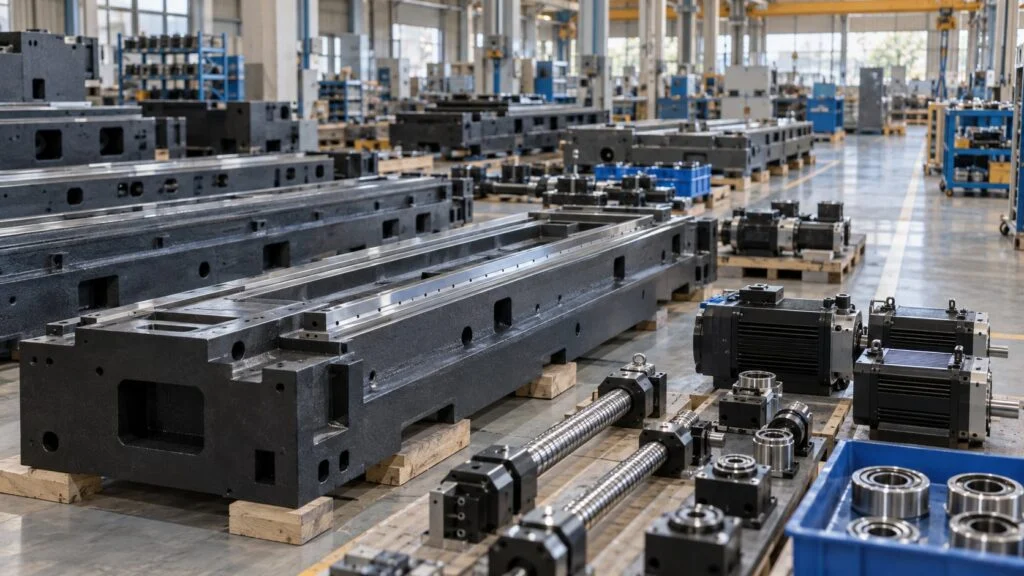
The chain runs materials → components and units → machine builder → sales → user → maintenance and replacement. Figure 1 shows the main players, from raw castings to the used-machine market.
Many companies take part, from raw material to replacing the machine.
Note: Roles often overlap. Some builders make their own components, and some trading companies take on machine modifications.
Two features set this industry apart. First, the chain does not end at delivery. Because machines run for 10 years or more, service and parts keep the builder, the dealer, and the user connected long after the sale.
Second, many machine tool users are themselves machine builders. In 2025, the general machinery sector placed about 40% of domestic machine tool orders in Japan, based on statistics from the Japan Machine Tool Builders' Association (JMTBA). Machines are used to build the next generation of machines.
Who Does What in the Chain
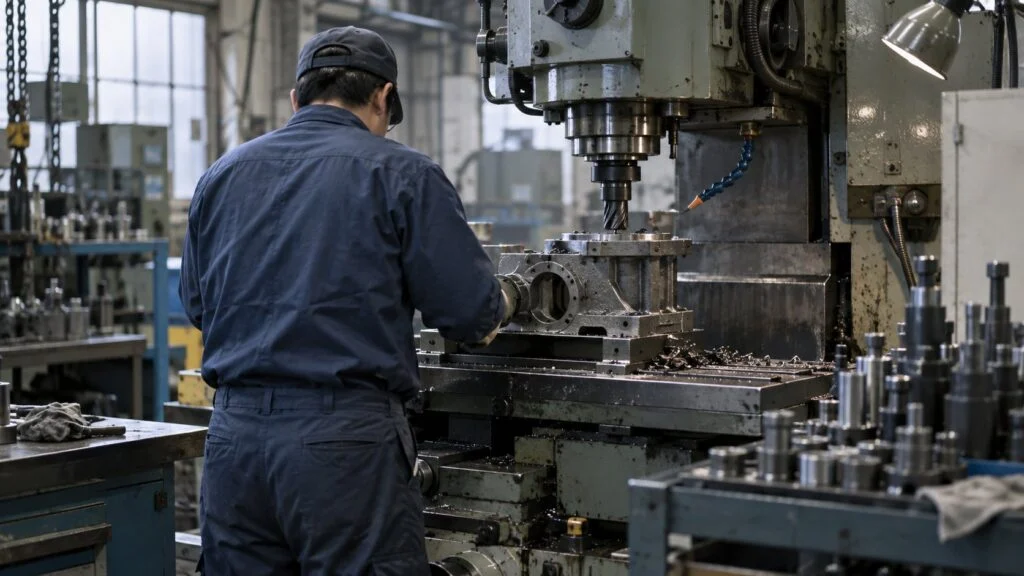
Japan's machinery industry has a few large builders surrounded by many small and mid-sized companies. Here are the positions you will run into as a buyer or maintenance engineer.
Material Suppliers and Subcontractors
Machine beds and columns, the frame of a machine tool, are often castings. Local subcontractors that specialize in casting, machining, sheet metal, and painting support the builders, and many have supplied the same builder for years. Some are small but hold skills that are hard to replace, such as machining very large parts or precision finishing.
Component and Unit Makers
This layer supplies the builders with parts such as:
- CNC controls (numerical control units)
- servo motors
- bearings
- linear guides
- hydraulic and pneumatic equipment
Because they sell the same product to many builders, these companies benefit from volume, and some hold high global market shares. Their business follows the builders' production with a short lag. When machine orders rise, component orders rise too, and lead times can stretch.
For you, this layer matters because the CNC control on a Japanese machine often comes from a different company than the machine itself. Control faults may be handled by the control maker's service network rather than the builder. For one example, see FANUC Business Model: What It Means for Buyers and Users.
Machine Tool and Industrial Machinery Builders
Builders design the machine, buy the parts, assemble it, and fine-tune its accuracy and performance. The largest have annual sales from hundreds of billions to trillions of yen, while many mid-sized and small builders focus on one type of machine. Much of the work is built to order, so builders typically handle design, assembly, and installation in one flow. They also feel swings in customers' capital spending more directly than anyone else in the chain.
In industrial machinery, large equipment accounts for much of the order value. According to the Japan Society of Industrial Machinery Manufacturers (JSIM), orders in fiscal 2025 (April 2025 to March 2026) totaled JPY 7.4951 trillion. Boilers and prime movers took JPY 2.7867 trillion and chemical machinery (including refrigeration machinery) JPY 1.8550 trillion. A single large order can turn into a project lasting several years.
Related: Japanese Machine Tool Manufacturers: Rankings and Strengths
Trading Companies and Dealers
Machinery trading companies (kikai shosha, 機械商社) and dealers (dairiten, 代理店) sit between builders and users. They sell machines together with cutting tools and peripheral equipment. They handle large sums but usually on thin margins, so they earn through volume and the quality of their proposals.
User Companies
At the user, the production engineering department (seisan gijutsu) chooses machines and decides how to use them, and the maintenance department (hozen) keeps them running. These engineers compare machines from several builders. Their choices shape productivity for years.
Builders of different sizes work in different ways.
Note: General tendencies. Some mid-sized builders sell mostly overseas, and some departments at large builders have small teams that cover a broad range of work.
For a buyer outside Japan, the difference matters most after delivery. A large builder usually has a local subsidiary, service engineers, and a parts warehouse in your region. A small builder may rely on a trading company or a local agent for both sales and service, so ask who will support the machine before you order.
How Orders and Money Flow
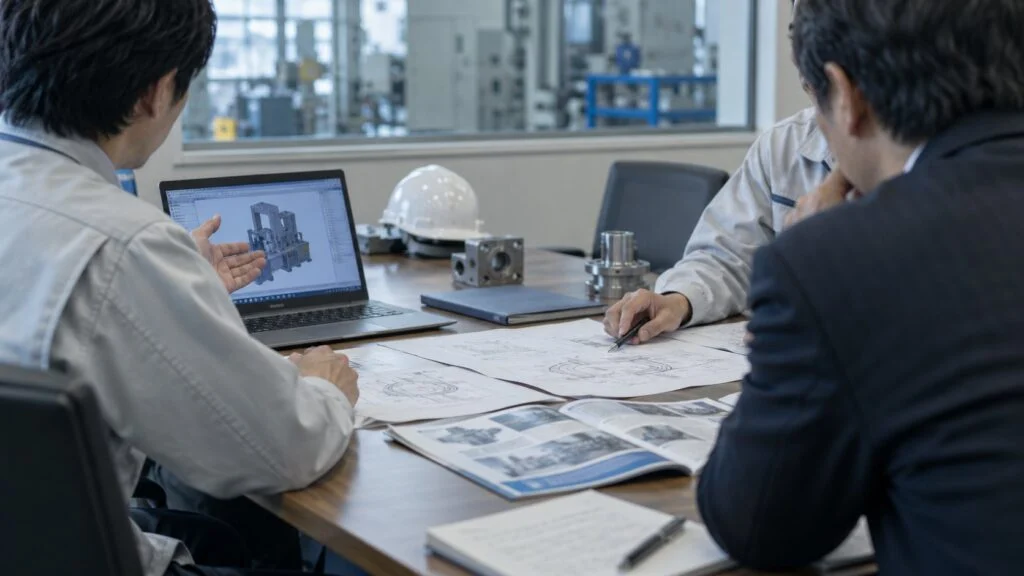
A machine purchase starts with the user's capital spending plan. A typical flow looks like this.
Three stages: winning the order, building and delivering, and after delivery.
Note: Payment terms and advance payments vary by project and company.
Step 03 often takes longer than buyers outside Japan expect, because a Japanese user's order goes through internal approval (ringi). Step 05 is usually a witnessed inspection at the builder's plant. See FAT and SAT with Japanese Suppliers.
What the Trading Company Does
In machine tools, sales through trading companies and dealers are common. The trading company does more than resell. It may propose a complete line, arrange installation, and take on the risk of collecting payment from the user.
Dealers also play a real part in industrial machinery. JSIM's figures show JPY 432.2 billion of orders placed through dealers in fiscal 2025. Large equipment for plants, on the other hand, is usually sold directly by the builder to the user.
Public-sector buyers are also large customers for industrial machinery, with JPY 1.0854 trillion of domestic orders in fiscal 2025. Equipment for water, sewage, and waste treatment is generally awarded through tenders and similar procedures, unlike private orders.
How Prices Are Set
The price starts from the machine's standard price. Optional specifications, peripheral equipment, installation, and warranty terms are added on top. In practice, the final price for the same model varies from project to project, depending on the specification and the negotiation. When you compare quotes, check that each one includes the same options, installation scope, and warranty.
Relationships between builder, trading company, and user tend to last. Once operators and maintenance staff know a builder's machines, the user tends to choose that builder again, so a builder's track record of installed machines becomes a strong advantage in the next sale. For a Japanese-owned plant abroad, this is often why the parent company specifies the same builder it uses in Japan.
Where the Profit Sits
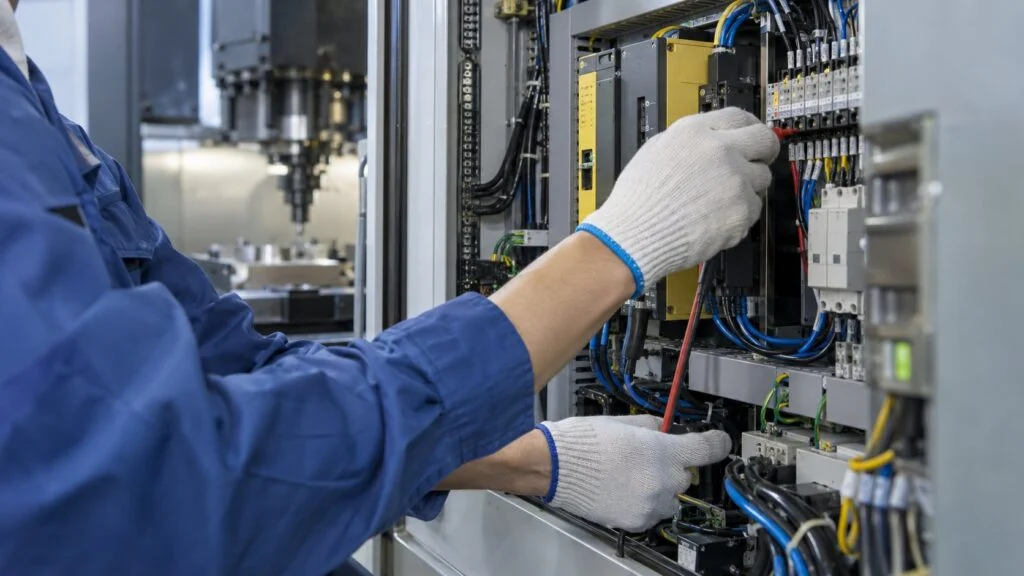
The "smile curve" helps explain where the money is made. Core components and controls upstream and service downstream add the most value, while assembly in the middle tends to earn thinner margins.
On the same machine, profit depends on which part you supply.
Financial results show the pattern. FANUC, whose CNC controls go into machines from many builders, posted an operating margin of 21.4% in the fiscal year ended March 2026. Builders of the machines themselves see margins vary widely, depending on how strong their models are and which regions they sell in. Trading companies work on much thinner margins, but they carry inventory and collection risk and reach small users that a builder cannot serve alone.
Service is a large share of the business. At FANUC, the service division accounted for JPY 141.1 billion, or 16.5% of consolidated sales of JPY 857.8 billion, in the same fiscal year. The more machines are running in the field, the more maintenance and parts revenue builds up. Many machine tool builders also sell parts, repairs, retrofits, and overhauls for machines they have delivered, and that income supports them when new orders fall.
For you, this has two sides. The builder has a strong reason to keep supporting your machine for its whole life. But that support usually runs through its official service network and authorized parts channels, which is why the next section matters.
Buying and Servicing Japanese Machines Outside Japan
Outside Japan, the same chain exists, but the doors you knock on are different. Large Japanese builders sell through local subsidiaries, independent distributors, or both, and the model differs by builder and country. Okuma, for example, sells in the Americas through a distributor network that it lists as 45 locations, with a "Find Your Distributor" search on its website. Other builders sell directly through their own subsidiaries and technical centers. Check the builder's local website instead of assuming.
| What you need | Where to start | Watch out for |
|---|---|---|
| A new standard machine (lathe, machining center, grinder) | The builder's local subsidiary or its authorized distributor for your area | Ask who provides installation, training, and service locally |
| A new machine for a Japanese-owned plant | The trading company or builder your Japanese parent already uses, if it has a local branch | Confirm who handles warranty claims and service visits in your country |
| Spare parts or repair for an installed machine | The builder's local service center or authorized distributor, with the machine's serial number | Parts from unofficial sources may not be covered by warranty |
| CNC control faults (alarms, drives, motors) | The builder first; it may refer you to the control maker's local service | Have the control model and alarm number ready |
| A custom or special-purpose machine, or a machine built into a line | The builder or the engineering company that delivered it | Drawings and programs may belong to the builder; check the contract |
| A used Japanese machine, or moving one to another site or country | The original supplier, or the builder if you cannot reach the supplier | Export control consent and relocation detection (see below) |
Moving or Reselling a Machine: Export Control
Machine tools are subject to security export controls based on international regimes and Japanese law. Advice published by JMTBA for users of Japanese machine tools says that some cases require individual consent from Japan's Ministry of Economy, Trade and Industry (METI) before a machine is transferred, resold, or exported, whether it is new or used. JMTBA asks users to contact the supplier before any of these steps, and the builder if the supplier cannot be reached.
Some builders also fit devices that detect when a machine is moved. DMG MORI, for example, says it equips all its machines with GPS-based relocation detection. A machine is activated only after the installation site is registered and checked on site, and it stays deactivated if moved without authorization. If you plan to move a machine between plants, buy one used, or sell one, talk to the supplier first. If you signed an end-use assurance when you bought the machine, re-export or resale may need the supplier's prior agreement.
This is an outline of what to check, not legal advice. Your company's export control or legal team, together with the supplier, decides what is required for a specific machine.
Voltage and Local Requirements
A machine built for Japan may be set for Japanese supply voltage and frequency, and its documentation may not cover the certifications your site requires. When you buy a machine originally delivered in Japan, confirm these points with the builder's local office. See Japan Industrial Voltage and Japanese Machine Control Panels: UL 508A, NFPA 79, and CE.
How the Structure Is Changing
The industry's structure has been shifting in three ways in recent years.
Consolidation Through Acquisitions
Acquisitions have reshaped the industry, led by Nidec, a motor maker that entered machine tools from outside. Nidec bought Mitsubishi Heavy Industries Machine Tool in August 2021 (now Nidec Machine Tool), OKK in February 2022, Italy's PAMA in February 2023, and TAKISAWA later in 2023. In 2023, DMG MORI also agreed to acquire Kurashiki Machinery. With many small builders facing succession and investment challenges, more deals are likely.
For owners of older machines, a change of ownership can change the service contact, the parts channel, or the brand name on the quote. If your machine's builder has been acquired, confirm who now supplies parts and service in your country.
Demand Shifting Overseas
In 2025, foreign orders made up 72.5% of Japanese machine tool orders, based on JMTBA statistics. China (JPY 390.1 billion) and North America (JPY 360.0 billion) were the two largest markets, and India accounted for JPY 71.6 billion. Most large builders run production, sales, and service bases abroad, so a common pattern is design and manufacture in Japan, then sales and service overseas.
From Selling Machines to Selling Solutions
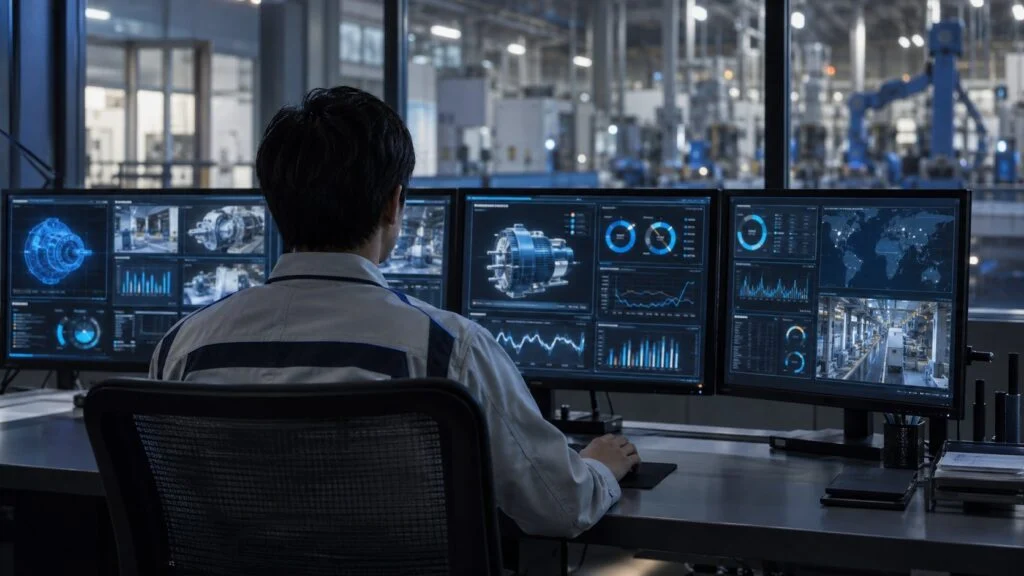
As the performance gap between machines narrows, builders are adding value around the machine: proposing automation systems and using operating data for maintenance. Predictive maintenance, which detects signs of failure remotely, is one example. Builders now need software and system skills as well, and the industry's scope is widening from single machines to whole production systems. When you evaluate a Japanese builder, look at its automation, monitoring, and service offering, not only the machine. For older machines, see Retrofit Machine Monitoring on Older Japanese Machines.
Checklist: Before You Buy or Move a Japanese Machine
Use these questions with the builder's local office, the distributor, or the trading company, depending on the purchase.
- Who is the authorized seller and service provider for this builder in our country or region?
- Where are the nearest service engineers and parts warehouse, and what response time do they offer?
- Does the warranty apply to machines bought through this channel, and who handles claims?
- Which company made the CNC control, and who services it locally?
- Is the machine set up for our supply voltage and frequency, and does it carry the certifications our site requires?
- Are manuals, parts lists, and alarm lists available in English?
- Does the quote include the same options, tooling, installation, training, and inspection scope as the other quotes?
- For a used machine or a move: has the supplier confirmed any export control consent, and does the machine have relocation detection that must be reset?
- If the builder has been acquired: who now supplies parts and service, and under which brand?
Sample Inquiry Email to a Builder's Local Office
The example below is fictional. Replace the bracketed items.
Subject: Service and parts support for [machine model], serial [number], [plant name]
Hello,
Our plant in [city, country] operates the following machine made by your company:
Model: [model from the nameplate]
Serial number: [number]
CNC control: [control model]
Year installed: [year]
Purchased through: [trading company or distributor]Could you tell us:
1. the authorized service provider and parts source for our location;
2. whether the machine is still supported, and the lead time for [part name or number];
3. whether the warranty or service contract can be transferred to us;
4. what we need to do before moving the machine to [new location], including any export control or relocation detection steps.We can send nameplate photos and the alarm history if needed.
Best regards,
[Name, title, company, phone]
For a formal quote request, see RFQ to a Japanese Manufacturer.
Limits of This Guide
- This describes typical patterns in Japan. Sales routes, payment terms, and service models vary by builder, machine, and project.
- Sales channels outside Japan differ by builder and country. Check the builder's local website for its current authorized distributors.
- Export control requirements depend on the machine, the destination, and the end user. Confirm them with the supplier and your own export control team.
- This guide does not rank builders or compare their market shares. For company profiles, see our guide to major Japanese machine tool companies.
FAQ
Do Japanese machine tool builders sell through dealers or direct?
Both, depending on the builder and the country. Okuma, for example, sells through distributors in the Americas, while other builders sell through their own subsidiaries. In Japan, trading companies and dealers handle a large share of machine tool sales.
Why did my quote come from a Japanese trading company?
Many Japanese-owned plants abroad buy through the trading company their parent uses in Japan. The trading company may also arrange installation and take on payment collection risk. Confirm who will provide service locally.
Can I move a Japanese machine tool to another plant or country?
Contact the supplier first. JMTBA says some transfers, resales, and exports require individual consent from METI, and some machines have relocation detection that keeps them deactivated if they are moved without authorization.
Who services the CNC control on a Japanese machine?
Start with the machine builder. The control is often made by a separate company, and the builder may refer you to that company's local service network.
Sources
- Machine tool orders by sector and region (2025): Japan Machine Tool Builders' Association, order statistics, final figures for December 2025 (Japanese)
- Industrial machinery orders, dealer and public-sector orders (fiscal 2025): Japan Society of Industrial Machinery Manufacturers, industrial machinery orders, March 2026 (Japanese)
- FANUC sales, operating profit, and service division: FANUC, consolidated financial results for the fiscal year ended March 2026 (Japanese)
- Export control guidance for users: JMTBA, "For Users of Machine Tools made in Japan" (2024)
- Relocation detection: DMG MORI, Export Control
- Okuma distribution in the Americas: Okuma America, Distribution
- Machine tool acquisitions: M&A Online, September 2023 (Japanese); Business Wire, "Nidec Completes the Acquisition of the Shares of Italian Machine Tool Manufacturer PAMA"
Original article in JapaneseThis guide is adapted from a MONOSCOPE article written for readers in Japan: 産業機械・工作機械業界の構造をわかりやすく解説|サプライチェーン・商流・利益構造
About the editor
 MONOSCOPE EditorFOUNDER & EDITOR
Spent about ten years at a plant equipment maker and a plant engineering company, proposing, designing, and commissioning equipment, then moved into web marketing. Now a web consultant for B2B manufacturers, helping them explain their products and technology. Licensed in Japan as an Energy Manager and a Third-Class Chief Electrical Engineer.
Has run an engineering blog since 2017 (500+ articles) and a Japanese YouTube channel with about 20,000 subscribers. Each English guide is written from the Japanese shop-floor point of view and checked against the cited standards.