CBAM: Answering Steel and Aluminum Emissions Data Requests
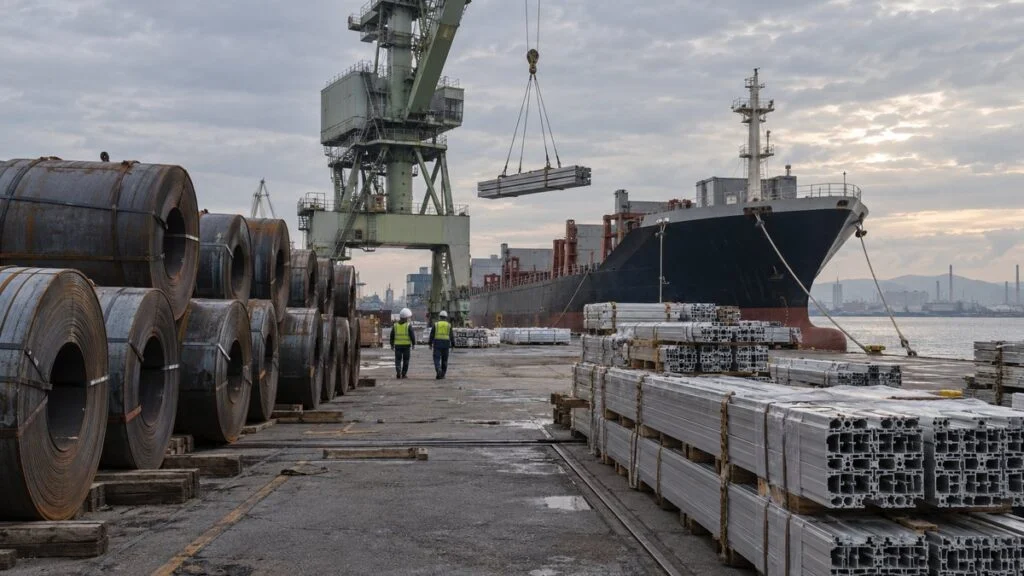
An email arrives from your EU customer. They want the "embedded emissions" of the steel or aluminum parts you ship them, in tonnes of CO2 equivalent per tonne of product, listed by eight-digit CN code, "for our CBAM declaration." The request may come straight from the EU importer, through a trading company, or from a Japanese group company's EU subsidiary.
The reason is the EU's Carbon Border Adjustment Mechanism (CBAM), which entered its definitive period on January 1, 2026. The EU importer carries the legal obligation, but only the plant that made the product can supply the emissions data.
This guide is for quality and environmental staff at suppliers in India, Southeast Asia, and Japan. It explains why the request comes, how to check whether your product is covered, what to count, and how to choose between actual emissions and EU default values. It ends with a checklist and an email template you can reuse.
We checked the regulatory status on November 4, 2026.
Contents
- Why Your EU Customer Is Asking for Emissions Data
- Step 1: Check Whether Your Product Is Covered
- What "Embedded Emissions" Covers
- Actual Emissions or Default Values?
- How to Respond: Seven Steps
- Timeline and Open Issues
- Common Mistakes
- Checklist Before You Reply
- Email Template: Replying to an Importer's Request
- Where This Guide Does Not Apply
- FAQ
- Sources
Why Your EU Customer Is Asking for Emissions Data
CBAM puts a carbon price on certain goods imported into the EU. The price matches what EU producers pay for their emissions under the EU Emissions Trading System (EU ETS), so imported goods and goods made in the EU face the same carbon cost.
The legal basis is Regulation (EU) 2023/956. A simplification amendment, Regulation (EU) 2025/2083, entered into force on October 20, 2025 and revised parts of the procedure, including a new 50-tonne exemption explained below.
During the transitional period, from October 1, 2023 to December 31, 2025, importers only filed quarterly emissions reports and paid nothing. In the definitive period, importers must buy and surrender CBAM certificates in proportion to the embedded emissions of the goods they import. Your emissions figure now turns directly into a cost for your customer.
Figure 1 compares the two periods.
CBAM has moved from reporting only to a stage where emissions translate into cost.
Based on Regulation (EU) 2023/956 as amended by Regulation (EU) 2025/2083, and JETRO's summary.
The EU Importer Carries the Legal Obligation
Under Article 4 of the CBAM Regulation, only an "authorized CBAM declarant" may import covered goods into the EU customs territory. Importers established in the EU apply for this status before importing (Article 5). If the importer is not established in the EU, its indirect customs representative takes on the status instead.
This means exporters and manufacturers outside the EU have no direct declaration obligation under CBAM. However, the importer cannot calculate the embedded emissions for its declaration without data from the installation that made the product. In CBAM terms, your plant is the "installation" and your company is its "operator."
The request reaches you whatever the sales route:
- Your group's own EU subsidiary is the importer, so a group company carries the obligation.
- You sell through a trading company that imports into the EU.
- You supply material to a customer that makes CBAM goods for the EU.
The European Commission has published guidance for non-EU operators that supply CBAM goods to the EU, and it encourages them to prepare emissions monitoring early.
Figure 2 shows who does what.
Data flows from the manufacturer to the importer. Declarations and certificates flow from the importer to the authorities.
If the importer is not established in the EU, its indirect customs representative becomes the authorized CBAM declarant.
Step 1: Check Whether Your Product Is Covered
When a request arrives, start with the product's CN code. The Combined Nomenclature (CN) is the EU's eight-digit product code, and its first six digits match the international HS code. Covered goods are listed in Annex I of the CBAM Regulation; where Annex I lists a four-digit heading, every code starting with those four digits is covered.
CBAM covers six sectors: iron and steel, aluminum (spelled "aluminium" in EU texts), cement, fertilizers, electricity, and hydrogen. According to JETRO's analysis, most of Japan's CBAM-relevant exports to the EU fall under iron and steel (Chapter 72), articles of iron or steel (Chapter 73), and aluminum and its articles (Chapter 76).
Coverage Includes Some Fabricated Parts
For iron and steel, Annex I goes beyond the material itself (Chapter 72, excluding certain ferroalloys and scrap). It also covers tubes, fittings, structures, and tanks, plus 7318 (screws, bolts, nuts, washers, and similar) and 7326 (other articles of iron or steel).
For aluminum, the list runs from unwrought aluminum (7601) through extrusions, plate, foil, and tubes to 7616 (other articles of aluminum). Fastener makers and metal fabricators often miss this if they assume CBAM only affects mills and smelters.
Figure 3 summarizes the main steel and aluminum headings.
Annex I lists processed goods as well as raw materials.
Based on Annex I of Regulation (EU) 2023/956. Not every code in Chapters 73 and 76 is covered. Check coverage with the eight-digit CN code.
The 50-Tonne Threshold Is Counted per Importer
The simplification amendment added a de minimis exemption in Article 2a. An importer whose CBAM goods total no more than 50 tonnes net mass in a calendar year is exempt from CBAM obligations. If the importer crosses 50 tonnes during the year, all goods it imported that year become subject to CBAM.
The key point is that the 50 tonnes are counted per importer, across all CN codes combined. You may ship only a few tonnes a year, but if your customer's imports from all suppliers exceed 50 tonnes, you will still be asked for data. The exemption does not apply to electricity or hydrogen.
JETRO reports that the threshold is expected to remove about 90% of importers from the obligation while still covering about 99% of embedded emissions. The Commission's assessment published on September 30, 2026 found that the threshold exempts only 0.87% of embedded emissions.
Do not guess whether your customer is above the threshold; ask them. Note also that the European Parliament has proposed lowering the threshold for aluminum products to 5 tonnes as part of the pending downstream extension (see "Open Issues" below). That proposal is not law.
What "Embedded Emissions" Covers
CBAM asks for embedded emissions per tonne of product, not the emissions of your whole plant. Embedded emissions have three parts:
- Direct emissions from your own processes
- Indirect emissions from the electricity you consume
- Emissions embedded in your input materials ("precursors")
Figure 4 shows which of these count for steel and aluminum.
For steel and aluminum products, you track direct emissions and precursors.
Based on Article 7 and Annex II of Regulation (EU) 2023/956, and Commission guidance documents No. 2, No. 5d, and No. 5e.
Steel and Aluminum: Direct Emissions Only
Article 7(1) says that for goods listed in Annex II, only direct emissions are counted. Both iron and steel products and aluminum products are listed in Annex II, so in the definitive period you do not calculate indirect emissions from electricity. Both were reported during the transitional period, so this part of the workload has become lighter.
CBAM's terms differ slightly from the familiar Scope 1 and Scope 2. Emissions from steam or other heat bought from another company count as direct emissions under CBAM, and "indirect emissions" means electricity only.
Precursors Usually Dominate for Fabricated Parts
A precursor is an input material that is itself a CBAM good. For a screw it is wire rod or steel bar; for an aluminum extrusion it is ingot or billet. According to the guidance, there is no threshold below which a precursor can be left out.
The Commission's iron and steel guidance includes a worked example of an installation that makes screws and nuts from purchased steel bar. The installation's own emissions are small, and most of the embedded emissions come from the precursor.
Steel made in a blast furnace and steel made in an electric arc furnace carry very different emissions, so your choice of material drives the result.
Material yield matters too. Scrap from machining or stamping is counted as having zero embedded emissions, so the full emissions of the precursor you feed in end up in the product. The guidance gives an example: if 20% of the original mass is cut off, you count the emissions of 100 tonnes of precursor for 80 tonnes of product.
Some Finishing Processes Are Outside the System Boundary
Implementing Regulation (EU) 2025/2547 sets the calculation methods. For iron and steel products, the system boundary includes processes such as reheating, remelting, casting, hot and cold rolling, forging, pickling, annealing, coating, galvanizing, and wire drawing, but excludes plating, cutting, welding, and finishing. For aluminum products, processes linked to production are included, while cutting, welding, and finishing are excluded.
The regulation treats "plating" (excluded) and "galvanizing" (included) as separate terms, so check which one your coating process falls under. According to the Commission's Q&A, if you outsource a process that is inside the boundary and the goods come back to you, treat it as if it took place at your own installation.
A plant that only cuts or finishes may have no process emissions to count. Its product is still a CBAM good, though, so it must track the emissions and quantities of the precursors it uses. Confirm where your processes fall with the importer or a CBAM specialist.
Embedded emissions resemble a product carbon footprint (PCF), but CBAM covers only the production of the product and its precursors, not the full life cycle from raw material extraction to disposal. You cannot reuse a PCF figure as a CBAM value without recalculating it.
Actual Emissions or Default Values?
There are two ways to determine embedded emissions: actual emissions based on your installation's data, or default values set by the European Commission. Since the simplification amendment, the declarant may use either one; the Commission's Q&A describes default values as the route for cases where verified actual data is not available.
The importer makes the choice, but in practice it depends on whether you, the manufacturer, can provide the data. Figure 5 compares the options.
Either put in the work to report actual emissions, or accept default values with a mark-up.
Based on Articles 7–9 of Regulation (EU) 2023/956 and the Commission's Q&A. The fertilizer mark-up is 1%. The two approaches can be combined.
Default Values Get More Expensive Each Year
A default value is the average emission intensity for a given country and product, plus a mark-up. According to the Commission's Q&A (updated October 15, 2026), the mark-up is 10% in 2026, 20% in 2027, and 30% from 2028 onward.
Because default values are designed not to underestimate emissions, the Commission says using actual values should in most cases be more advantageous. Default values are set in Implementing Regulation (EU) 2025/2621, partly corrected by Implementing Regulation (EU) 2026/1740 in July 2026.
The table below shows selected values from the Commission's informational spreadsheet (version dated August 6, 2026). Values are before the mark-up and, for steel and aluminum, cover direct emissions only.
| Country of production | 7208 Hot-rolled flat products | 7213 Wire rod | 7318 15 Bolts and screws | 7601 Unwrought aluminum |
|---|---|---|---|---|
| Japan | 2.10 | 2.10 | 2.80 | 0.36 |
| Thailand | 1.92 | 1.92 | 2.41 | 0.36 |
| Vietnam | 2.35 | 2.35 | 2.75 | 0.36 |
| India | 4.28 | 4.27 | 5.72 | 1.87 |
| China | 3.19 | 3.17 | 6.38 | 3.00 |
| Indonesia | 8.23 | 8.23 | 8.23 | 1.70 |
| Country unknown (Annex IV) | 8.23 | 8.23 | 8.23 | 3.20 |
If the country where a precursor was made is unknown, the more conservative values in Annex IV of the same regulation apply. These are about 4 to 9 times Japan's values for semi-finished steel, hot-rolled steel, and unwrought aluminum.
In other words, recording which mill in which country supplied your material has a direct effect on your customer's cost. If no value is listed for a product from your country, the values for "other countries and territories" in Annex I apply.
Japan's Ministry of Economy, Trade and Industry (METI) published a calculation guideline for screws and bolts (3rd edition, March 2026, in Japanese) with an illustrative estimate. It shows how the gap grows over time:
- Product: CN 7318 15 42, with an assumed default value of 2.8 tCO2e/t and an assumed actual value of 1.79 tCO2e/t
- Assumptions: allowance price EUR 90, exchange rate JPY 185 per euro, no carbon price deduction
- Default value: cost per tonne of product rises from JPY 29,139 in 2026 to JPY 60,606 in 2034
- Actual value: cost stays roughly flat, at JPY 29,756 in 2034
These figures come from a calculation with assumed inputs. They do not predict actual costs.
Actual Emissions Require Accredited Verification
If actual emissions are used, Article 8 requires verification by an accredited verifier. Only national accreditation bodies in EU member states can accredit verifiers, but verification companies outside the EU can apply to any accreditation body that accepts them.
According to the Commission's timeline, accredited verifiers could register in the CBAM Registry and start the first verifications in September 2026. From January 2027, verifiers are expected to issue their first verification reports.
The Commission's state-of-play list (dated October 21, 2026) shows that 24 national accreditation bodies in the EU and EEA have agreed to provide CBAM accreditation. Seven of them already accept applications from verifiers outside the EU: France, Greece, Italy, the Netherlands, Poland, Slovakia, and Sweden.
JETRO reports that it is still unclear whether Japanese verification bodies will obtain accreditation. Verification is done per installation and normally includes a site visit.
The guidance recommends contracting a verifier early to avoid a shortage. While verification capacity is still being built up, a combination of actual emissions for your own processes and default values for precursors is a realistic option.
How to Respond: Seven Steps
The steps below follow Commission guidance No. 2, a quick guide for non-EU operators. Figure 6 lays them out in order.
The first three steps are checks. The rest are preparation and submission.
If you respond with default values only, steps 05 (monitoring plan), 06 (emissions report), and 07 (verification) are not needed.
What to Ask at the Start
Confirm the CN code the importer uses for EU customs clearance, not the HS code on your own export documents. Ask whether the importer is an authorized CBAM declarant, when they need the data, and whether they want actual emissions. A request email often does not say what level of accuracy is expected.
When deciding how to respond, weigh the cost of verification against the extra cost from the default-value mark-up. The importer pays for the certificates, but the difference may come back to you as price pressure or a switch to another supplier.
Monitoring Plan and Emissions Report
To report actual emissions, first prepare a monitoring plan that documents the installation boundary, the production processes, and how fuels and materials are measured. Reporting is by the calendar year in which the goods were produced, and the verifier will also need an English version.
After the year ends, compile emissions by process and by eight-digit CN code in the "operator's emissions report." According to the guidance, the implementing rules make this common template mandatory in the definitive period.
The Commission's website still has the communication template used during the transitional period. It includes a filled-in example for screws and nuts, which helps you see what the report must contain.
There are two ways to share the data. The Commission recommends registering in the CBAM Registry's portal for non-EU operators (O3CI): one upload can be shared with several importers, and you can limit what they see to a summary.
If you do not register, you send the full emissions report and verification report to each importer separately.
Worked Example: A Bolt Maker Receives a Request (Fictional)
This example is fictional and uses invented figures. Company A ships 120 tonnes of hex bolts a year to an import trading company in Germany and receives a request for embedded emissions.
The bolts fall under 7318. The trading company imports more than 50 tonnes a year from Company A alone, so it is an authorized CBAM declarant. Company A buys wire rod from a domestic mill, forms the bolts on cold headers, heat-treats them in a gas-fired furnace, and sends them out for electroplating before shipment.
Company A's process emissions are the direct emissions from fuel burned in the heat-treatment furnace. Electricity for the headers is an indirect emission and is not counted. Electroplating is outside the system boundary (hot-dip galvanizing would be inside it).
The wire rod is a precursor. If Company A uses 126 tonnes of wire rod to make 120 tonnes of bolts, it uses 1.05 tonnes per tonne of product (126 ÷ 120). The wire rod's embedded emissions multiplied by 1.05 carry over to the bolts.
If the mill cannot provide verified data, Company A could use the default value (with mark-up) for wire rod from the mill's country and report actual emissions only for its own heat treatment. Even then, it must keep records of the wire rod's CN code, country of production, and quantity used.
Company A then works back from the first declaration deadline and tells the trading company what it can deliver and by when.
Timeline and Open Issues
Goods imported in 2026 are declared, and their certificates surrendered, in 2027. The simplification amendment pushed back both the start of certificate sales and the declaration deadline. Figure 7 shows the dates.
The first declaration deadline is September 30, 2027.
Based on Articles 6, 20, and 22 of Regulation (EU) 2023/956 and the Commission's CBAM pages on certificate prices and verification. Status as of November 4, 2026. Verification dates are the Commission's planned schedule.
The certificate price follows the auction price of EU ETS allowances. For 2026 imports it is the average for the quarter of import; from 2027 it is a weekly average (Article 21).
The number of certificates to surrender is the embedded emissions minus an amount reflecting the free allocation that EU producers still receive. That deduction shrinks as free allocation is phased out, so the same emissions cost more each year.
Deduction for Carbon Prices Paid in the Country of Origin
Article 9 lets the declarant claim a reduction in certificates for a carbon price effectively paid in a non-EU country, such as the country of production. Any rebate or compensation received is subtracted from that amount.
The regulation also allows the Commission to publish default carbon prices for some countries from 2027; none had been published as of the sources we checked. The detailed rules on calculation and proof are to be set in an implementing act; the Commission published a draft on May 13, 2026 and took comments until June 10.
The Commission's Q&A (updated October 15, 2026) still says the act will be adopted in 2026. As of November 4, 2026, we could not find an adopted version on the Commission's legislation page.
Japan launched its emissions trading scheme (GX-ETS) in fiscal year 2026, but whether GX-ETS costs will qualify for the CBAM deduction has not been decided. JETRO lists three open questions: whether it counts as an effective carbon price, how free allocation is treated, and how payment is proven.
Similar questions apply to any national carbon pricing scheme. Do not build your plans on a deduction until the rules are final.
Extension to Downstream Products Is Still Under Negotiation
On December 17, 2025, the Commission proposed adding downstream products with a high steel or aluminum content, such as machinery parts, to CBAM (COM(2025) 989). The proposal covers about 180 products from January 1, 2028.
This is a proposal, not law. The Council agreed its general approach on June 12, 2026, covering about 200 product types. The European Parliament adopted its mandate on September 15, 2026, covering more than 450 product types (reports differ slightly on the exact count) and lowering the aluminum threshold to 5 tonnes.
Trilogue negotiations between Parliament, Council, and Commission have begun. Press reports say the first round on October 20, 2026 ended without agreement and that the next round is planned for November 30. The final scope and start date are not yet decided.
If the extension passes, requests could reach products that are not covered today, such as auto parts and industrial machinery components. Fabricators outside the current scope can save work later by making sure they can trace the source and weight of the steel and aluminum they use.
Common Mistakes
Suppliers that have started responding tend to trip over the same four points:
- Assuming you are exempt because you ship small volumes: The 50-tonne threshold applies to the importer's total. Small shipments still trigger requests.
- Sending whole-plant emissions: The importer needs values per tonne of product, by eight-digit CN code. Figures mixed with non-covered products cannot be used.
- Not recording where materials came from: If the precursor's country of production is unknown, much higher default values apply. Keep mill certificates and purchase records organized.
- Leaving verifier selection until late: Accredited verifiers are still few. If you plan to use actual emissions, start contacting verifiers early.
CBAM work is not something the environmental team can finish alone. Sales engineers handle communication with the customer, purchasing collects material information, and quality assurance makes sure the data is correct.
Checklist Before You Reply
Run through these items before you send any figures:
- Eight-digit CN code confirmed with the importer (not just your HS code)
- Product confirmed as listed in Annex I
- Importer's status known: authorized CBAM declarant, above or below 50 tonnes
- Importer's preference known: actual emissions, default values, or a combination
- Deadline agreed, working back from September 30 of the year after import
- Your processes sorted into inside and outside the system boundary (watch plating vs. galvanizing)
- Outsourced processes inside the boundary identified
- For each precursor: CN code, country of production, producing mill, quantity used per tonne of product
- Precursor suppliers asked whether they can provide verified actual data
- Yield losses (scrap) reflected in precursor quantities
- Indirect emissions left out (steel and aluminum)
- If using actual emissions: monitoring plan drafted, English version planned, verifier contacted
- Sharing method decided: O3CI registration or direct delivery to each importer
Email Template: Replying to an Importer's Request
You can adapt the email below for your first reply. Replace the bracketed parts.
Subject: CBAM embedded emissions data – [product name / part numbers]
Dear [Name],
Thank you for your request for embedded emissions data for your CBAM declaration. So that we can provide data that fits your needs, could you please confirm the following?
1. The eight-digit CN codes you use for customs clearance of our products
2. Whether you are an authorized CBAM declarant and expect to exceed the 50-tonne threshold this year
3. Whether you need actual verified emissions, or whether default values are acceptable for now
4. The format you need (for example, the operator's emissions report template, or registration in the CBAM Registry O3CI portal)
5. The date by which you need the dataIn the meantime, we can provide the country of production and CN codes of our main input materials by [date]. We are also reviewing whether to report actual emissions for our own processes, which would require verification by an accredited CBAM verifier.
Best regards,
[Name]
[Company]
Where This Guide Does Not Apply
- This guide covers iron, steel, and aluminum. Cement, fertilizers, electricity, and hydrogen follow different rules; for example, some of their goods count indirect emissions.
- The CBAM Regulation and its implementing acts were corrected and supplemented throughout 2026. Check the latest texts before you rely on any figure here.
- Default values vary by country, year, and eight-digit CN code. The table above is a sample, not a lookup tool.
- For your specific case, such as whether a product is covered and which processes fall inside the system boundary, confirm with the EU importer, a customs broker, or a CBAM specialist.
FAQ
Does CBAM Apply to Small Suppliers Outside the EU?
Not directly. The declaration obligation sits with the EU importer, so a non-EU manufacturer is never the declarant. But if you supply CBAM goods to the EU, the importer may ask you for embedded emissions data regardless of your company's size.
What Is the Difference Between CBAM and the EU ETS?
The EU ETS is a system in which companies inside the EU trade emissions allowances. CBAM applies an equivalent carbon price to goods imported from outside the EU. The two work together: the CBAM certificate price follows the EU ETS auction price.
Do Steel and Aluminum Suppliers Need to Report Electricity Emissions?
No, not in the definitive period. Both iron and steel products and aluminum products are listed in Annex II, so only direct emissions and precursor emissions are counted. Heat bought from outside still counts as a direct emission.
Can We Send Our Product Carbon Footprint Instead?
Not as is. A PCF often uses different system boundaries, such as the full life cycle. CBAM embedded emissions cover only the production of the product and its precursors, calculated by eight-digit CN code under Implementing Regulation (EU) 2025/2547.
Who Should We Ask About Our Specific Case?
Ask the EU importer, its customs broker, or a CBAM specialist about coverage and system boundaries. For an overview first, read the Commission's guidance for non-EU operators; Japanese suppliers can also use the JETRO and METI materials.
Sources
- CBAM Regulation, consolidated version of October 20, 2025 (amended articles, Annexes I, II, VII): EUR-Lex, Regulation (EU) 2023/956
- Simplification amendment (adopted October 8, 2025; published October 17; in force October 20): EUR-Lex, Regulation (EU) 2025/2083
- Calculation methods (system boundaries for steel and aluminum, operator's emissions report): EUR-Lex, Implementing Regulation (EU) 2025/2547
- Correction of default values (July 20, 2026): EUR-Lex, Implementing Regulation (EU) 2026/1740
- Overview of the definitive regime: European Commission, CBAM definitive regime
- Implementing acts, guidance No. 2, 5d, and 5e (August 14, 2026), default values spreadsheet (version of August 6, 2026; for information only), downstream proposal: European Commission, CBAM legislation and guidance
- 2026 quarterly certificate prices: European Commission, Price of CBAM certificates
- Verification timeline and state of play of accreditation (October 21, 2026): European Commission, Verification of CBAM emissions
- Q&A (updated October 15, 2026), communication template, de minimis threshold assessment (September 30, 2026): European Commission, CBAM communication and FAQs
- Portal for non-EU operators (O3CI): European Commission, CBAM Registry
- Draft implementing act on carbon prices paid in third countries (May 13, 2026): European Commission, Have your say
- Downstream extension proposal (December 17, 2025): European Commission press release
- Status of the downstream extension: European Parliament Legislative Observatory, 2025/0419(COD); European Commission news (June 12, 2026); Mayer Brown (October 7, 2026); cbamguide.com (October 23, 2026)
- Illustrative cost estimate for screws and bolts: METI, EU-CBAM calculation guideline for screws, bolts, etc., 3rd edition (March 2026, Japanese)
- Transitional vs. definitive period, share of importers exempted: JETRO (September 18, 2026, Japanese)
- Precursor data in practice, outlook for Japanese verifiers: JETRO (September 18, 2026, Japanese)
- Japan's CBAM exports to the EU, GX-ETS issues: JETRO (September 18, 2026, Japanese)
Original article in JapaneseThis guide is adapted from a MONOSCOPE article written for readers in Japan: EU CBAM本格適用|鉄鋼・アルミ製品の排出量データ要請への対応手順
About the editor
 MONOSCOPE EditorFOUNDER & EDITOR
Spent about ten years at a plant equipment maker and a plant engineering company, proposing, designing, and commissioning equipment, then moved into web marketing. Now a web consultant for B2B manufacturers, helping them explain their products and technology. Licensed in Japan as an Energy Manager and a Third-Class Chief Electrical Engineer.
Has run an engineering blog since 2017 (500+ articles) and a Japanese YouTube channel with about 20,000 subscribers. Each English guide is written from the Japanese shop-floor point of view and checked against the cited standards.