Why Japanese Auto Parts Makers Build in India: Toyoda Gosei
On September 24, 2026, Toyoda Gosei, a Toyota group Tier 1 supplier of plastic and rubber parts, announced its eighth site in India: a new plant in the Bidkin Industrial Area in Maharashtra. Toyota Kirloskar Motor (TKM) is building a new vehicle plant in the same industrial area, and both are scheduled to start production in the first half of 2029.
If you sell materials, components, molds, or services to automotive Tier 1s in India, this pattern matters. When a Japanese automaker adds capacity, its Japanese Tier 1s often build next door, and they then look for Tier 2 and Tier 3 suppliers who can meet Japanese quality and delivery expectations.
This article uses the Toyoda Gosei case to explain why big plastic parts are made next to the vehicle plant, how sequence delivery works, and where Japanese companies in India struggle with local sourcing. It ends with a checklist and an inquiry email you can use before you approach a Japanese Tier 1.
Contents
- What Toyoda Gosei Is Building in Bidkin
- Why Build Next to Toyota's New Plant?
- The Demand Behind It: India's Passenger Vehicle Market
- Japanese Automakers Are Adding Capacity
- Why Japanese Companies in India Still Rely on Imports
- What the New Plant's Equipment Tells Suppliers
- What Japanese Tier 1s Typically Ask of Local Suppliers
- Checklist Before Pitching a Japanese Tier 1
- Where This Does Not Apply
- FAQ
- Sources
What Toyoda Gosei Is Building in Bidkin
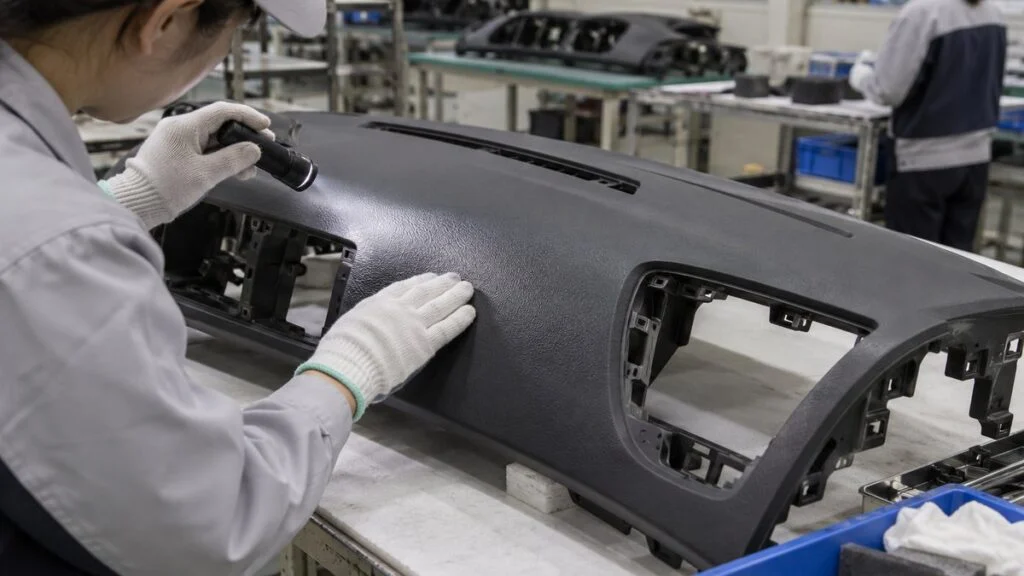
The new plant will be in the Bidkin Industrial Area, part of AURIC (Aurangabad Industrial City) near Chhatrapati Sambhajinagar in Maharashtra. Toyoda Gosei plans to invest about ₹575.8 crore (INR 5.758 billion, about JPY 9.3 billion) and start producing bumpers and instrument panels in the first half of 2029.
The product range is wider than exterior and interior trim. The plant will also make safety systems such as airbags and steering wheels, plus plastic fuel filler pipes (the tube that runs from the filler neck to the fuel tank).
The site covers about 78,400 m² of land with about 29,200 m² of buildings. Toyoda Gosei expects to employ about 570 people there by 2030.
A plant focused on large interior and exterior parts, in the same industrial area as Toyota's new vehicle plant.
Based on Toyoda Gosei's news release of September 24, 2026. The yen figure is the company's conversion.
The Second New Plant in Two Years
The plant will be run by Toyoda Gosei South India Pvt. Ltd., a subsidiary set up in Karnataka in 1998. It had 1,688 employees as of March 31, 2026.
In September 2024, Toyoda Gosei had already announced a plant in Harohalli, Karnataka, for about ₹205 crore (about JPY 3.5 billion), with production of airbags, steering wheels, and interior and exterior parts planned from January 2026. Two new-plant decisions about two years apart show that the company sees India as a growth market.
Why Build Next to Toyota's New Plant?
The direct trigger was Toyota's announcement on May 11, 2026. TKM will build a plant in the same Bidkin Industrial Area to produce a new SUV at 100,000 vehicles a year from the first half of 2029, and Toyoda Gosei cites this plan as background for its own investment.
Toyoda Gosei describes the purpose of the plant as supporting capacity expansion at Japanese automakers, its main customers. Neither company has said which parts will go to which models. What stands out is the timing: the parts plant is scheduled to start up alongside the vehicle plant.
Bumpers and Instrument Panels Are Costly to Ship
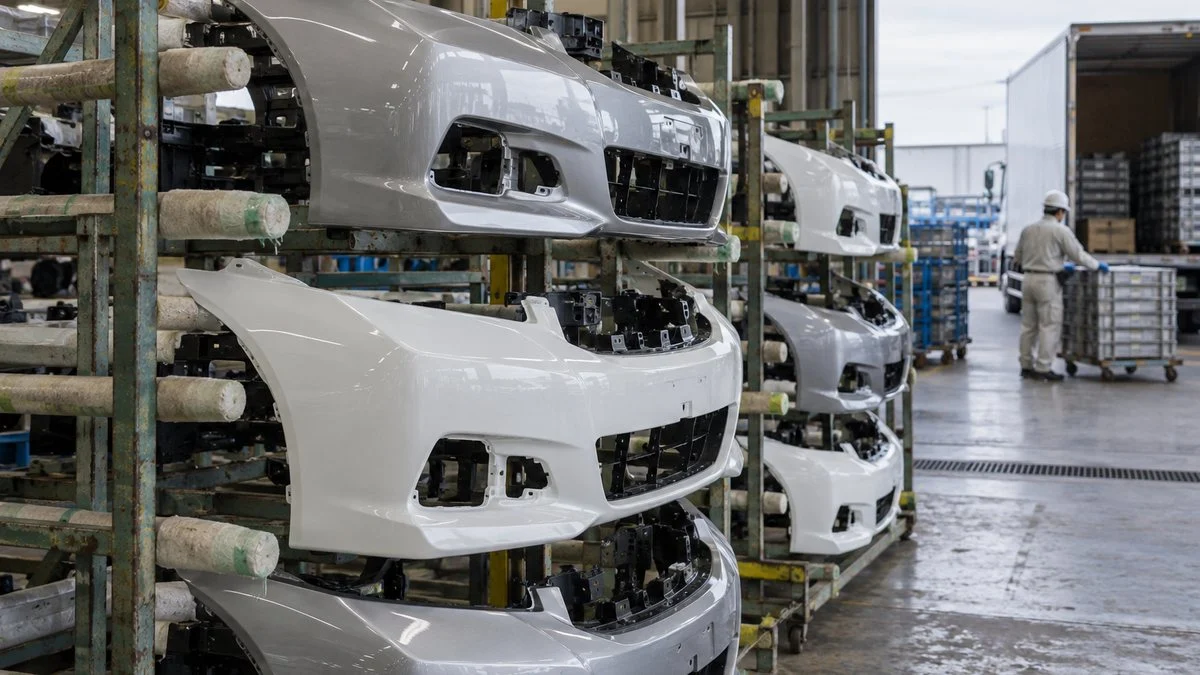
Bumpers and instrument panels are large and bulky but not heavy or expensive for the space they take up. When they come from a distant plant, only a few fit on each truck, so freight and storage costs climb quickly.
A painted bumper with a scratch is a reject, so packing and handling also take extra care. For these reasons, large interior and exterior parts are usually molded and painted close to the vehicle plant and delivered over a short distance.
Sequence Delivery Assumes a Short Distance
A vehicle assembly line runs cars of different colors and specifications one after another. Sequence delivery means bringing parts to the line in the exact order the vehicles are being built. According to the Japanese business news site Newswitch, the new Toyoda Gosei plant will support sequence delivery.
To deliver in line order, the parts plant has to be close enough to react quickly when the production schedule changes. This also fits the Toyota Production System (TPS), which avoids holding large parts inventories at the vehicle plant.
A note on terms, because the abbreviation can cause confusion when you deal with Japanese companies:
- JIS in English supply chain jargon means just-in-sequence, a form of just-in-time (JIT) delivery in line order.
- JIS in Japanese documents almost always means Japanese Industrial Standards, as in "JIS K 7161" or "JIS-compliant."
- The Japanese terms for sequence delivery are 順序納入 (junjo nonyu) and 順立て納入 (juntate nonyu). If a Japanese buyer uses either term, ask how much lead time and how many delivery runs per day they expect.
The larger the part, the more it pays to make it nearby and deliver it in build order.
Which models and parts will be supplied has not been disclosed. The benefits shown are the general logic for large parts.
The Demand Behind It: India's Passenger Vehicle Market
India's passenger vehicle market keeps growing. According to JETRO (Japan External Trade Organization), domestic passenger vehicle sales in FY2025 (April 2025 to March 2026) reached 4,643,439 units, up 7.9%, a record for the fourth year in a row.
Domestic sales and exports hit record levels, and utility vehicles (UVs) made up two-thirds of sales.
FY2025 = April 2025 to March 2026. Year-on-year change in parentheses. Based on JETRO's report on India's passenger vehicle market in FY2025 (June 19, 2026, Japanese).
Tax Cuts and Rising Incomes Lifted Sales
The GST reform that took effect on September 22, 2025, cut the rate on small gasoline cars and similar vehicles from 28% to 18%. JETRO attributes the growth to these tax cuts, monetary easing, rising incomes, and buyers trading up to higher-end models.
On a calendar-year basis, India is the world's third-largest new vehicle market after China and the United States, and it has stayed ahead of Japan for four years running.
SUVs Drive the Growth
UV sales reached 3,105,025 units, or 67% of all passenger vehicles. A bigger SUV body means bigger bumpers and instrument panels and often more parts, which helps interior and exterior parts makers on both price per part and volume.
Toyoda Gosei's own announcement notes that SUVs are becoming more popular in India alongside the compact cars that have long driven the market.
India as an Export Base
Passenger vehicle exports also set a record at 905,200 units, and Maruti Suzuki alone exported more than 440,000. Toyota says its new plant will serve customers in surrounding regions as well as in India.
When a vehicle plant also exports, its utilization depends less on the domestic economy. For parts suppliers, export volumes can help cushion a temporary dip in local demand.
Japanese Automakers Are Adding Capacity
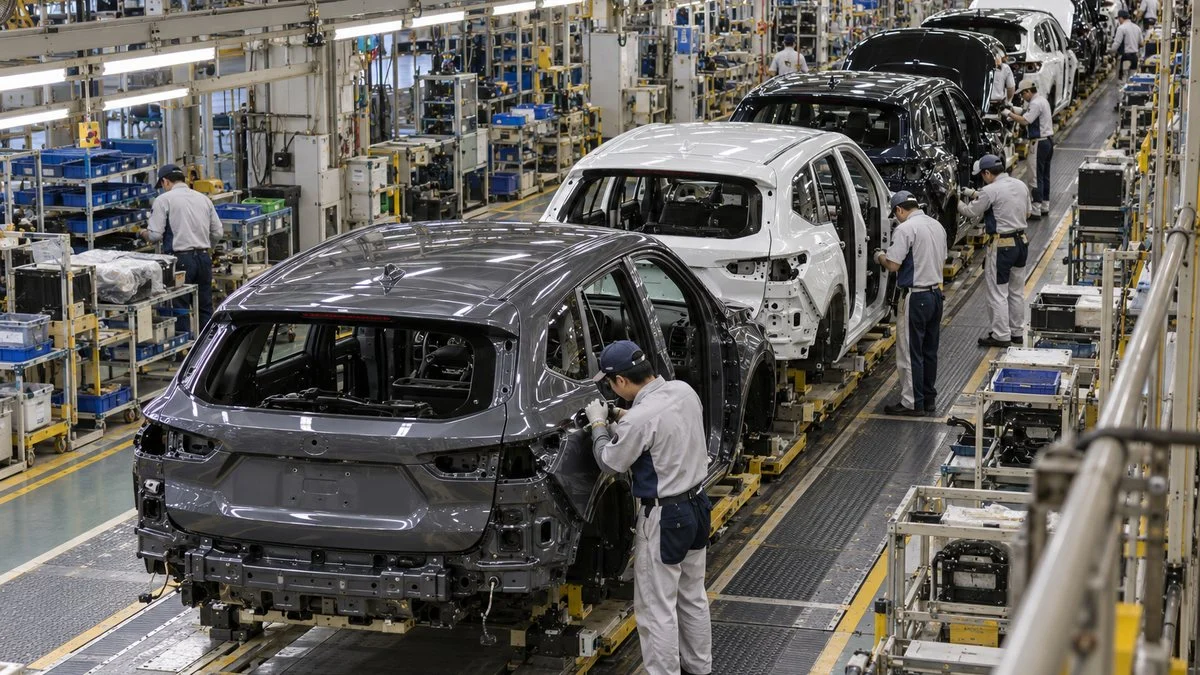
With the market growing, the Japanese automakers that hold large shares in India are raising capacity. Toyota and Suzuki are two key examples.
Toyota: A Fourth Plant at 100,000 Vehicles a Year
TKM runs two plants in Bidadi, Karnataka, and has been building a third there (₹3,300 crore, 100,000 units a year). The new Bidkin plant will add capacity of 100,000 vehicles a year and about 2,800 employees.
The Bidkin plant will cover the full process: stamping, welding, painting, and assembly.
Suzuki: Targeting 4 Million Vehicles a Year in the 2030s
In July 2026, Suzuki held the opening ceremony for its Kharkhoda plant in Haryana (500,000 units a year), bringing its four-wheeler capacity in India to about 2.65 million units.
Suzuki is also building a new plant in Sanand, Gujarat, which it aims to start up by 2029. The first line will have capacity of 250,000 units a year, with plant construction investment of ₹10,190 crore (INR 101.9 billion). The company aims to reach 4 million units a year in India in the 2030s.
Both plan to start new plants around 2029.
Based on announcements by Toyota (May 11, 2026) and Suzuki (March 24 and July 2, 2026), and JETRO statistics.
Tier 1s Follow, Then Tier 2 Demand Grows
When an automaker builds a new plant, Tier 1 suppliers (companies that deliver directly to the automaker) often set up plants around it. That in turn creates demand for Tier 2 materials and components, molds, and equipment.
Toyoda Gosei's Bidkin plant is one example of this chain.
Japanese parts makers have to choose among building in India, supplying from Japan or a third country, and partnering with a local company. US tariffs are also pushing companies to rethink where they produce, so regional supply chains will likely keep shifting. For local suppliers, each of these choices can open a different door: direct supply, contract manufacturing, or a technical partnership.
Why Japanese Companies in India Still Rely on Imports
JETRO's annual survey of Japanese companies abroad shows that Japanese firms in India are mostly profitable and keen to expand. In the 2025 survey, 75.5% expected an operating profit for 2025. That was down 2.2 points from the previous year but still the second-highest share on record.
Of those surveyed, 81.5% planned to expand in the next one to two years, the highest of the 20 countries and regions covered. Among them, 88.1% cited growing local demand, and among manufacturers, 52.7% planned to expand production of general-purpose products and 50.3% production of high-value-added products.
Among manufacturers in the FY2024 survey, 83.1% expected a profit, the highest share in ten years.
Profit takes time, though. In the FY2024 survey, more than 90% of manufacturers set up before 2005 expected a profit, compared with about half of those set up in 2020 or later. For newer plants still working toward profit, buying more locally is one way to lower costs and import exposure.
JETRO survey figures that matter to local suppliers.
Based on JETRO's Survey on Business Conditions of Japanese Companies Overseas (FY2024 and FY2025) and its report on Japanese manufacturers in India (February 2025), all in Japanese.
The Local Sourcing Gap
Although 68.1% of Japanese manufacturers in India want to source more locally, JETRO reports that their local sourcing rate has stayed roughly flat since the 2016 survey (excluding the COVID-19 period). The main reason, cited by 76.4%, is that local suppliers fall short on quality and technical capability.
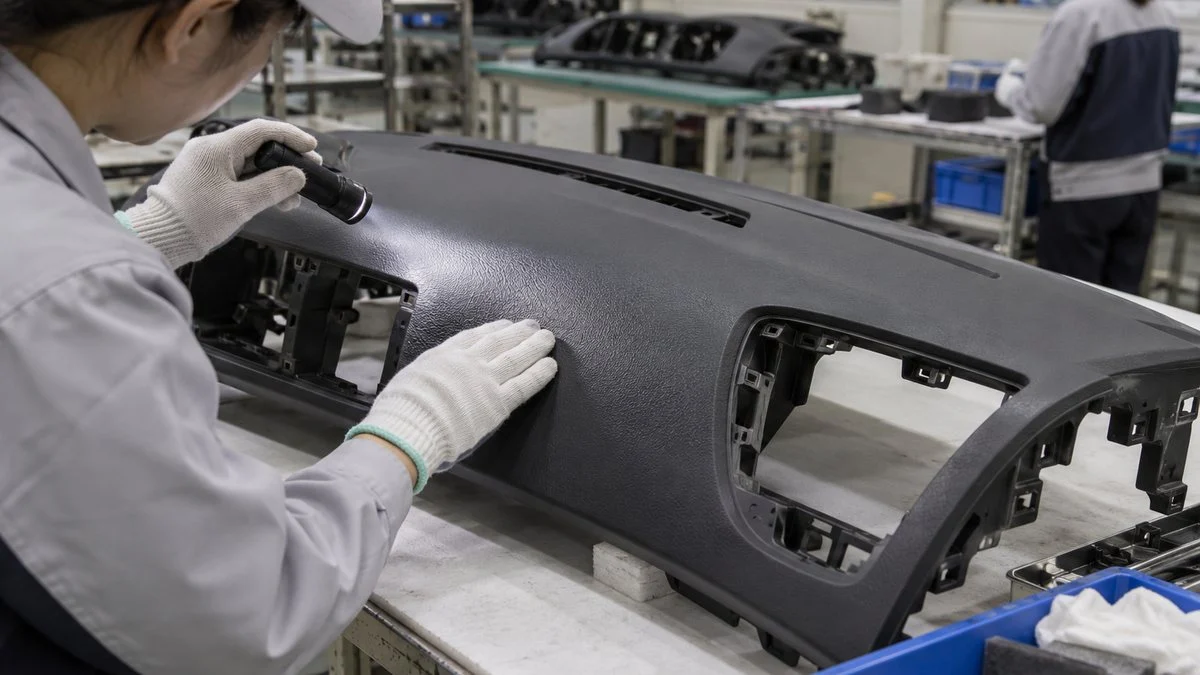
With plastic parts, the gaps tend to appear at specific points during the launch of mass production:
- Prototype stage: lot-to-lot variation in the resin causes dimensional and appearance variation.
- Process audits: mold maintenance or paint process control does not meet the customer's standard.
- After launch: a material or process changes without advance notice, and quality shifts. This is a change control problem.
As a result, Japanese companies often run two tracks: they import materials and parts from Japan or third countries while developing local suppliers. Imports also expose them to exchange rate and logistics risk, which is part of why they keep looking for capable local sources.
Paperwork and People Also Slow Launches
Among manufacturers, the most-cited risks are complex tax rules and procedures (57.5%), followed by administrative procedures such as permits (52.1%) and labor disputes and litigation (30.8%). If customs clearance for imported materials or permits for a new building take longer than planned, the start of mass production can slip. The customer's vehicle plant start date rarely moves, so delays on the parts side are hard to absorb.
Many parts of India still have lower wages than some ASEAN countries and China's big cities. JETRO's survey puts average monthly base pay for manufacturing workers at USD 418 in Karnataka and USD 341 in Tamil Nadu, against USD 957 in Shanghai.
Base pay increases are high, however, at 9.4% in 2025 and 9.2% expected for 2026. As more Japanese companies cluster in the same areas, poaching of experienced staff and turnover become real risks, and a supplier with stable, trained staff is easier for a Tier 1 to rely on.
What the New Plant's Equipment Tells Suppliers
Toyoda Gosei is using equipment to address some of these problems inside its own plant. Equipment cannot solve sourcing, though. That part depends on suppliers, and the plant's design hints at what it will need from them.
Automation reduces labor and process variation inside the plant. Material and component supply still has to be solved outside it.
Equipment is from Toyoda Gosei's announcement and reporting by Newswitch and Automotive World. The right-hand column shows general examples.
Low-Cost Automation With Karakuri
The plant will adopt low-cost automation that Toyoda Gosei first developed in Thailand. It pairs collaborative robots (robots that can work near people without safety fences) with karakuri, devices driven by springs, levers, gravity, and other mechanisms that need no electric power.
Karakuri is a long-standing technique on Japanese shop floors and is widely used in TPS and kaizen (continuous improvement) activities. It reduces handling and part-removal work without expensive equipment, which makes it a practical way to cut manual steps gradually where wages keep rising.
Automatic Mold Change and Electric Molding Machines
Each model of bumper or instrument panel needs its own mold, and those molds are large and heavy, so changeovers (switching molds and process settings) take time and skill. The new plant will use large electric injection molding machines that change molds automatically, with production tracked through IoT.
Automated changeovers reduce variation that depends on operator experience and make it easier to add models or change the build order. In a large-part plant that delivers in sequence, fast changeovers directly support stable delivery.
A supplier feeding such a plant is likely to face similar pressure: frequent, smaller deliveries and little room for late or nonconforming lots.
What Japanese Tier 1s Typically Ask of Local Suppliers
Requirements differ by customer, part, and program, so treat the list below as a starting point, not a specification. These are the areas where Japanese Tier 1s commonly probe a new supplier:
- Part approval documents: some customers use the AIAG PPAP (Production Part Approval Process) package, while many Japanese companies use their own initial sample (初品, shohin) approval forms. The contents often overlap: process flow, control plan, dimensional results, material certificates. Ask which format and which submission level apply.
- Quality system: whether certification such as IATF 16949 is required, or whether the customer runs its own supplier audit instead.
- Change control: Japanese customers usually expect advance notice and approval for any change in man, machine, material, or method, often called a 4M change (4M変更, yon-emu henko). Unannounced changes are one of the problems behind the quality gap described above.
- Delivery precision: quantity, time window, packaging, and labeling as specified. If the Tier 1 delivers in sequence, its tolerance for late or short deliveries from you will be low.
- Response to problems: how quickly you contain a defect, report the root cause, and confirm corrective action. Ask which report format the customer uses.
Checklist Before Pitching a Japanese Tier 1
Before you approach a Japanese Tier 1 in India, work through these checks in order, from demand to fit to your own capability.
Confirm the demand first, then whether your product fits, then whether you can deliver.
A general checklist. Requirements vary by customer, part, and program.
Customer timelines are long. Toyota's Bidkin plant and Suzuki's Sanand plant were announced about three years before their planned start, and parts suppliers work backward from the customer's start of production. Approaching a Tier 1 early in that window gives you time to pass sampling and audits.
If you are a parts maker outside India weighing your own plant there, add the checks Japanese companies use for that decision:
- Sourcing: whether materials and components are available locally, how much you would import, and your exposure to exchange rates and logistics.
- People and operations: whether you can hire local managers and maintenance staff, and what support your home plant can give.
- Investment and payback: expected utilization, years to profit, payback period, and slack for permit delays.
- Alternatives: supplying from an existing plant (for example, in Japan or Thailand), partnering with a local company, or licensing technology.
Questions to Ask the Japanese Side
These questions help you learn what the customer actually needs before you spend time on a quote.
| Topic | Question | Why it matters |
|---|---|---|
| Program | Which vehicle plant and model is this for, and when is SOP (start of production)? | Sets your sampling and capacity timeline |
| Volume | What are the expected annual volume and the ramp-up curve? | Sizes your tooling and capacity investment |
| Decision | Is the supplier selected in India or at the head office in Japan? | Tells you who needs your documents, and in what language |
| Specifications | Which drawing revision and material standards apply (JIS, ASTM, ISO, or the customer's own)? | Avoids quoting the wrong material or tolerance |
| Approval | Do you use AIAG PPAP or your own initial sample format? Which submission level? | Defines the paperwork before first shipment |
| Quality system | Is IATF 16949 required, or do you audit suppliers with your own checklist? | Tells you whether certification is a gate |
| Changes | How do you want 4M changes notified and approved? | Prevents one of the most common trust problems |
| Delivery | What delivery frequency, time windows, packaging, and labels do you require? | Shows whether your location and logistics can work |
Sample Inquiry Email
Adapt this short email to your company and product. Keep it specific, and send capability data rather than general claims.
|
Subject: Local supply of [part / material] for your Bidkin plant Dear [Name], We are [Company], a [product, e.g., injection-molded plastic parts] manufacturer in [city, state], about [distance] km from Bidkin. We currently supply [customer type or industry] with [products]. We understand that your new plant will start production in the first half of 2029, and we would like to be considered as a local source for [part / material]. Could you tell us:
We have attached our company profile, equipment list, and certifications. We would welcome a short online meeting or a visit to your team. Best regards, |
Where This Does Not Apply
The "build next to the vehicle plant" logic applies most strongly to large, bulky, or painted parts delivered in sequence. Small, dense parts can often be shipped from farther away, or from Japan or Thailand, and the decision on where to source may sit with the head office in Japan. Japanese companies also often export while volumes are small and localize production once orders are firm.
Keep in mind these limits as well:
- Neither Toyoda Gosei nor Toyota has disclosed which parts will go to which models.
- The JETRO figures cover Japanese companies in India across industries, not auto parts specifically, and they do not show the economics of any single company or product.
- Document formats, audit methods, and delivery rules differ by customer and program. Confirm them with each customer rather than relying on this article.
- The shift to electrified vehicles will change which parts are needed, so check whether your product fits the vehicles planned for 2029 and later.
FAQ
Where is Toyoda Gosei's new plant in India?
It will be in the Bidkin Industrial Area in Maharashtra, the same industrial area as Toyota Kirloskar Motor's new vehicle plant. Toyoda Gosei plans to invest about ₹575.8 crore and start production of bumpers and instrument panels in the first half of 2029.
What is sequence delivery (JIS) in the auto industry?
Sequence delivery, or just-in-sequence, means delivering parts to the assembly line in the exact order the vehicles are built. In Japanese it is called junjo nonyu or juntate nonyu. In Japanese documents, however, "JIS" usually means Japanese Industrial Standards.
Do Japanese Tier 1 suppliers require PPAP?
It depends on the customer. Some use the AIAG PPAP package, while many Japanese companies use their own initial sample approval forms with similar contents. Ask which format and submission level apply before you prepare samples.
What share of India's car market do Japanese automakers hold?
In FY2025, Japanese automakers held a combined 49.0% of domestic passenger vehicle sales, according to JETRO. Maruti Suzuki had 39.3% and Toyota Kirloskar Motor 7.9%.
How big is India's passenger vehicle market?
Domestic passenger vehicle sales reached 4,643,439 units in FY2025 (April 2025 to March 2026), up 7.9% and a record for the fourth straight year. By calendar year, India is the world's third-largest new vehicle market after China and the United States.
Sources
- New plant overview: Toyoda Gosei, "Toyoda Gosei to Establish New Plant for Automotive Interior & Exteriors in West-Central India" (September 24, 2026)
- Equipment and sequence delivery: Newswitch (Nikkan Kogyo Shimbun), report on Toyoda Gosei's new plant (Japanese)
- Japanese automaker customers: Response, report on Toyoda Gosei's Maharashtra plant (Japanese)
- Automation developed in Thailand: Automotive World, "Toyoda Gosei to build eighth Indian plant in Maharashtra"
- Harohalli plant: Toyoda Gosei, "Toyoda Gosei to Open New Plant in South India for Safety Systems and Interior & Exterior Products" (September 19, 2024)
- Toyota's new plant: Toyota, "Toyota to Build a New Vehicle Manufacturing Plant in India" (May 11, 2026), Toyota Kirloskar Motor news release
- TKM third plant: Autocar Professional, "Toyota Kirloskar Motor to invest Rs 3,300 crore in third plant at Bidadi"
- Bidkin and AURIC: NICDC, Shendra Bidkin Industrial Area, Maharashtra
- Suzuki capacity: Suzuki, Kharkhoda plant opening ceremony (July 2, 2026, Japanese), Suzuki, start date and investment for its second Gujarat plant (March 24, 2026, Japanese)
- India passenger vehicle market: JETRO, India passenger vehicle market in FY2025 (June 19, 2026, Japanese)
- World's third-largest market: Nikkei, India new vehicle sales in 2025 (Japanese)
- Profitability, expansion, sourcing, and wages: JETRO, FY2025 Survey on Business Conditions of Japanese Companies Overseas, Asia and Oceania (November 2025, Japanese)
- Manufacturers' profits, local sourcing, and risks: JETRO, report on Japanese manufacturers in India (February 25, 2025, Japanese)
Original article in JapaneseThis guide is adapted from a MONOSCOPE article written for readers in Japan: インドに自動車部品工場が増える理由|豊田合成8拠点目で読む進出Q&A
About the editor
 MONOSCOPE EditorFOUNDER & EDITOR
Spent about ten years at a plant equipment maker and a plant engineering company, proposing, designing, and commissioning equipment, then moved into web marketing. Now a web consultant for B2B manufacturers, helping them explain their products and technology. Licensed in Japan as an Energy Manager and a Third-Class Chief Electrical Engineer.
Has run an engineering blog since 2017 (500+ articles) and a Japanese YouTube channel with about 20,000 subscribers. Each English guide is written from the Japanese shop-floor point of view and checked against the cited standards.