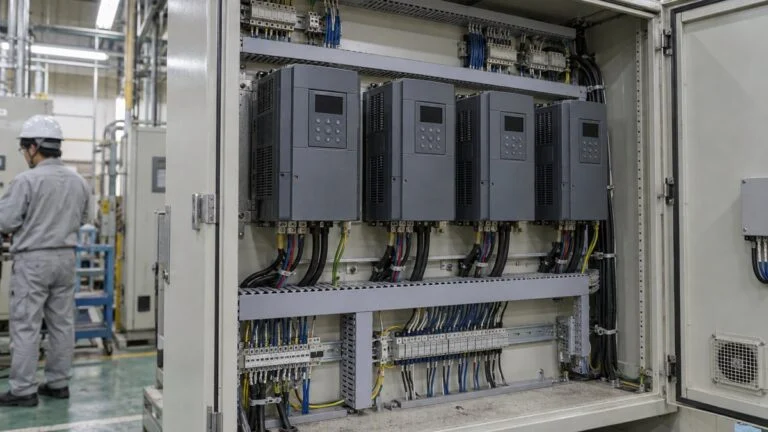
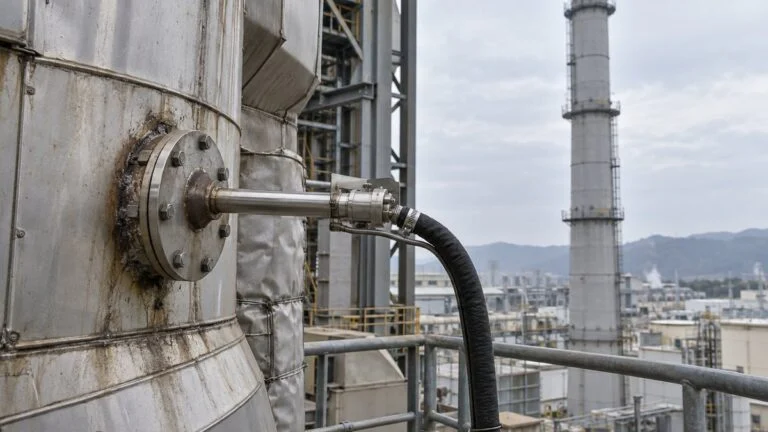
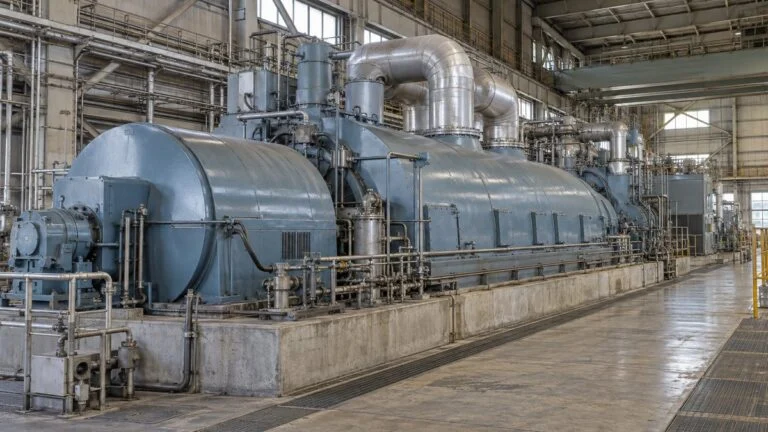
Why Power Plants Use Urea Solution: SCR, 40% vs. DEF 32.5%
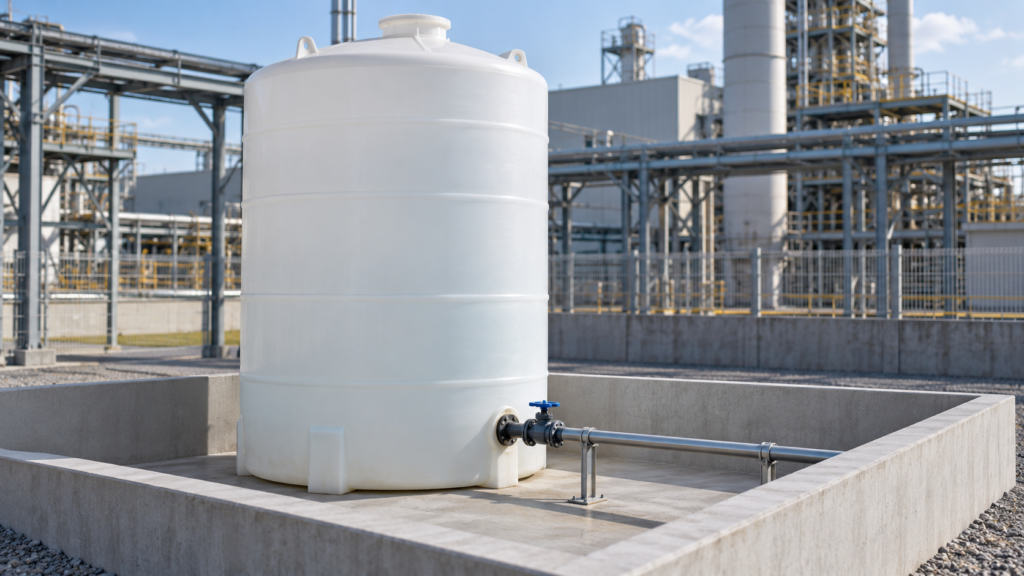
The equipment list from a Japanese SCR supplier calls for 尿素水 (nyososui, urea solution), and the data sheet says 40%. Your local buyer can easily get diesel exhaust fluid (DEF) at 32.5%, and the two look close enough. They are not interchangeable: they deliver different amounts of urea, crystallize at different temperatures, and can be made to different quality limits.
The short answer: power plants keep urea solution because it is the source of the ammonia that removes nitrogen oxides (NOx) from flue gas. On a selective catalytic reduction (SCR) catalyst, that ammonia converts NOx to nitrogen and water. Urea solution is neither a fuel nor process water for power generation.
This guide separates industrial 40% solution, DEF/AUS32, and marine AUS40, then shows how to convert between concentrations and how urea becomes ammonia. It ends with a checklist, a sample inquiry email, and a Japanese-English term table.
Contents
- Why Power Plants Store Urea Solution
- 40% Urea Solution vs. DEF 32.5% vs. AUS40
- How Urea Becomes Ammonia and Removes NOx
- Storage: Temperature, Materials, and Leaks
- Checklist: What to Confirm Before You Order or Substitute
- Questions for the Japanese Side
- Quick Reference: Japanese Terms on SCR Documents
- Limits of This Guide
- FAQ
- Sources
Why Power Plants Store Urea Solution
Japanese plant documents call this job 脱硝 (dassho, NOx removal or denitration). Urea solution feeds it as the raw material for the 還元剤 (kangenzai, reducing agent), which is ammonia. The same chemistry appears on boilers, gas turbines, waste incinerators, and diesel engines, not just at power stations.
An SCR system can also run on ammonia directly, so urea is a design choice. Yuken Kagaku's product sheet describes urea solution as easier to handle than liquefied ammonia or aqueous ammonia.
At the Salmisaari B plant in the city of Helsinki, Valmet reports that regulations restricted outdoor storage of aqueous ammonia and its transport through the city, so the plant combined urea storage with a hydrolyzer and catalytic reactor.
Easier to handle does not mean free of hazards. The ammonia made from the urea still has to be managed, and so does the solution itself, as the storage section below explains.
40% Urea Solution vs. DEF 32.5% vs. AUS40
"Urea solution" covers at least three kinds of product. The concentration is only the first difference, as the table shows.
| Item | Industrial 40% | DEF / AUS32 | AUS40 |
|---|---|---|---|
| Urea by mass | 40% nominal; get the tolerance from the product spec | 32.5% typical; 31.8–33.2% range | 40% nominal; 39.0–41.0% range |
| Quality standard | The supplier's product spec and the equipment requirement; may not meet an ISO grade | ISO 22241 series | ISO 18611 series |
| Written for | Boilers, gas turbines, waste incinerators | Diesel engines | Marine diesel engines |
| Biuret limit (example of a quality item) | Ask the supplier | 0.3% (m/m) max | 0.8% (m/m) max |
Concentration here always means mass percent. Figure 1 shows what that means for the same 1,000 kg of solution.
Figure 1: Same 1,000 kg, Different Urea Content
Each full bar represents 1,000 kg of solution. The comparison is by mass.
Illustrates mass ratios only. Application standards and impurity limits can differ even at the same concentration, so this comparison does not establish that two products are compatible.
Same Percentage, Different Product
A matching percentage does not make two products equivalent. Hokkaido Mitsui Chemicals states on its product page that its industrial 40% solution for denitration does not meet the AUS40 marine standard, even though both are 40%.
Japanese spec sheets may also list several concentrations from one maker. These four products show the range you may run into:
| Japanese supplier | How the product is described | What it shows |
|---|---|---|
| Yuken Kagaku (油研化学) | AUS 40, AUS 35, and AUS 32 at 40.0, 35.0, and 32.5 w/w%, for boiler, gas turbine, and waste incinerator DeNOx units | Industrial concentrations are not limited to one value |
| Taki Chemical (多木化学) | Urea solution for flue gas denitration, "40% and others" | Check the exact grade on your order |
| Hokkaido Mitsui Chemicals (北海道三井化学) | Industrial 40% solution for NOx reduction at incinerators and similar units; does not meet AUS40 | Same percentage, different standard |
| Taiki Yakuhin Kogyo (タイキ薬品工業) | 40% urea solution for denitration; SDS lists crystallization onset at 0°C | Low-temperature data belongs to the product |
When you order, match more than the name "urea solution." State the concentration basis, the application, the required standard, and the receiving-inspection items, and confirm that the product meets what the equipment specifies. Do not substitute a stronger or weaker grade on your own.
Convert Between Concentrations by Mass
If a plant needs the same mass of urea from a different concentration, the solution mass changes. This calculation answers the common question of how much 32.5% solution replaces 1,000 kg of 40%.
Delivering the 400 kg of urea in 1,000 kg of 40% solution therefore takes about 1,231 kg of 32.5% solution, or about 1.23 times the mass. The extra 231 kg is water that you must also transport and store.
| Solution | Solution mass | Urea | Water | Theoretical NH3 |
|---|---|---|---|---|
| 40% | 1,000 kg | 400 kg | 600 kg | about 227 kg |
| 32.5%, same solution mass | 1,000 kg | 325 kg | 675 kg | about 184 kg |
| 32.5%, same urea mass | about 1,231 kg | 400 kg | about 831 kg | about 227 kg |
The middle row is the one to watch. If the feed rate stays the same and only the concentration changes, the urea delivered falls by 75 kg per 1,000 kg of solution. When you estimate deliveries or tank inventory, be clear whether a figure refers to solution or to urea.
These numbers compare urea mass only and do not set an injection rate for real equipment. Actual NOx removal also depends on flue gas conditions and reaction efficiency.
Liters are a separate trap, because converting volume to mass needs a density for that concentration and temperature.
Published figures vary: one DEF data sheet gives 1.087–1.093 kg/L at 20°C, one Japanese 40% SDS gives a range of 1,105–1,177 kg/m³ at 20°C, and another Japanese product page lists a specific gravity of 1.14. Use the value on your own product's documents, and do not enter liters into the formula above as if they were kilograms.
How Urea Becomes Ammonia and Removes NOx
An SCR system has three parts to keep separate: storage of the liquid, generation and supply of the reducing agent, and treatment of NOx on the catalyst. Figure 2 shows the version with urea solution sprayed directly into the flue gas.
Figure 2: Urea Solution Feeds the Reducing Agent into the Flue Gas
Concept of a direct-spray layout.
A schematic of how the streams relate. The catalyst label shows products only; the reactions appear in the text. Catalyst position, reaction temperature, and the order of other flue gas equipment vary by plant.
NOx-bearing flue gas leaves the combustion unit, picks up the reducing agent before the catalyst, reacts on the catalyst, and passes through any other treatment on its way to the stack. In power plants, the DeNOx unit is arranged around a boiler or a heat recovery steam generator (HRSG). EPA's SCR fact sheet notes that combined-cycle gas turbines often place the reactor inside the HRSG.
From Urea to Ammonia: The Reactions
When urea solution is sprayed into flue gas, water evaporates from the droplets, the urea decomposes thermally, and the intermediate hydrolyzes. The ammonia from those two reactions mixes with the flue gas and reaches the SCR catalyst.
Figure 3: From Solution to Reducing Agent
The NH₃ from thermal decomposition stays as it is. Only the HNCO goes on to hydrolysis.
Blue branches collect the two NH₃ molecules. Gray shows evaporated water, the intermediate, and CO₂. This concept drawing separates the reactions; it does not mean each step happens in its own vessel.
Written as equations, the two steps add up to two ammonia molecules per urea molecule.
Direct Spray vs. Separate Decomposition Equipment
Not every plant sprays the solution straight into the flue gas. EPA's SCR cost manual chapter says urea is generally converted to ammonia before injection, and suppliers sell separate equipment for that step.
Two examples show the range. Fuel Tech's ULTRA process meters urea into a decomposition chamber, and a blower sends the dilute ammonia to the SCR through an ammonia injection grid. Valmet's Helsinki installation uses a hydrolyzer to turn urea solution into ammonia gas.
The difference matters when you read a Japanese document. Look at the system diagram (系統図, keito-zu) to see where ammonia is actually made in your unit, because that location determines which wetted parts and which hazards you are managing.
NOx Reduction on the Catalyst
The basic reaction for nitric oxide (NO) uses ammonia and oxygen. Nitrogen dioxide (NO2) follows a different route, and the mix of the two affects the reaction, so real flue gas does not follow a single equation.
Some catalysts use a titanium oxide support with vanadium and tungsten components, and honeycomb and plate shapes are both common. The fuel, flue gas properties, and temperature conditions decide which catalyst fits each unit, so ask the SCR supplier rather than assuming a type.
SCR or SNCR: How to Tell Which You Have
A urea tank on site does not tell you the DeNOx method, because selective non-catalytic reduction (SNCR) can use urea too. Check for a reactor and catalyst, and check the terms in the documents.
| Point to check | SCR | SNCR |
|---|---|---|
| Catalyst and reactor | Yes; the gas passes through a catalyst reactor | No catalyst |
| Reagent | Ammonia or urea | Urea solution or ammonia |
| Where it reacts | Downstream of the combustion unit, on the catalyst | In the hot gas inside the furnace or boiler |
| Temperature range | Lower and broader than SNCR | Higher and narrower; one Japanese incinerator system switches spray points based on gas temperature |
| Term in Japanese documents | 触媒脱硝 (shokubai dassho), SCR | 無触媒脱硝 (mushokubai dassho), SNCR |
Ammonia Slip and Uneven Mixing
Sending more urea is not a simple way to remove more NOx. Too little ammonia leaves NOx unreacted, while too much sends unreacted ammonia downstream. This is called ammonia slip, and EPA notes that it can form ammonium sulfates that plug or corrode downstream components and can end up in fly ash.
Slip limits come from your permit and design basis. EPA's 2003 fact sheet gives 2–10 ppm as typical U.S. permitted levels, and it also notes that slip rises as the catalyst loses activity. Treat those numbers as background, not as a limit for your site.
Total feed can be correct while the distribution is wrong. If ammonia concentration varies across the catalyst inlet, some areas run short and others run in excess at the same time, and a Yanmar technical review explains that evaporation and mixing strongly affect NOx removal performance.
Unevaporated droplets or liquid films can also leave deposits that disturb injection and gas flow, so evaporation matters as much as mixing. Temperature, spray, and mixing are designed together, so this article does not offer an injection temperature. Get those values from the equipment supplier.
To judge results, compare outlet NOx on a consistent basis. Correct for oxygen so that air dilution is not mistaken for removal, and use flue gas flow and concentration on the same wet or dry basis.
Storage: Temperature, Materials, and Leaks
Storage conditions belong to the delivered product and the equipment, so the numbers below are reference points, not settings. Read the latest SDS from your supplier and your plant procedures before handling.
Low-Temperature Limits: Do Not Borrow Another Grade's Number
Freezing and crystallization depend on concentration, so no single low-temperature limit covers all urea solutions. The 32.5% blend is the eutectic composition, which has the lowest freezing point of any urea-water mix. Stronger solutions start to crystallize at higher temperatures, as Figure 4 shows.
Figure 4: Take the Low-Temperature Limit from the Product's Own Documents
Do not apply the DEF freezing point to an industrial 40% tank.
Freezing point about −11°C (12°F)
Source: CumminsCrystallization onset 0°C (32°F)
Source: Taiki Yakuhin Kogyo SDSCrystallization 18°C (64°F)
Source: EPA SNCR cost manual chapterDo not carry these limits over from one product to another
The 0°C value appears in one 40% product's SDS; other suppliers may publish other values. None of these figures is a tank heating setpoint or an allowable storage temperature.
Freezing does not automatically ruin a eutectic solution. A white paper from OWI says freeze-thaw cycles do not affect DEF quality because the urea concentration is the same in the liquid and solid phases. That statement applies to 32.5% DEF, so check the product spec and the equipment instructions for any other concentration.
Long storage at high temperature is a separate risk. Heat slowly breaks urea down into ammonia and carbon dioxide, and water loss raises the concentration. The Taiki SDS calls for sealed containers in a cool, well-ventilated place out of direct sunlight.
Check the SDS storage conditions, manufacture date, and actual storage temperature and duration for each lot. Do not set one shelf life for all products; ask the supplier for yours.
If crystals appear, the cause could be concentration or contamination, and the response differs. Do not add water or change heating conditions on your own judgment. Check the state of the material against the supplier's and equipment maker's instructions.
Temperature readings have their own limits, since instruments differ in type, measurement point, and accuracy. Use the liquid temperature measurement the plant specifies, not the outdoor temperature.
Wetted Materials: Check the Whole Path
Material selection protects against two failures: corrosion that causes leaks, and metals or residues that contaminate the solution. Published lists do not all agree, because they were written for different products and purposes.
- Taiki 40% SDS (containers): polyethylene and polypropylene
- Cummins DEF bulletin (containers): polyethylene, polypropylene, and Grade 316 stainless steel recommended; carbon steel, copper and copper alloys, zinc, lead, aluminum alloys, and magnesium alloys listed as materials that may corrode
- EPA SNCR chapter (urea storage): plastic, steel, or stainless steel, but no copper, copper-based alloys, or zinc or aluminum fittings
Note the conflict on steel: EPA accepts it for SNCR urea storage, while the Cummins DEF bulletin warns against carbon steel. None of these lists guarantees compatibility at every concentration and temperature, so get the requirement for your system from the equipment supplier.
The review covers the tank, piping, pumps, valves, seals, and hoses. If the spec says stainless steel, confirm the grade, since SUS304 and SUS316 are different materials. Keep the original material conditions when you replace parts during maintenance.
A compatible material still will not protect the solution from residue left by another chemical or from foreign matter. Dedicated transfer equipment and clear labeling reduce that risk. The Taiki SDS also warns that contact with sodium or calcium hypochlorite produces explosive nitrogen trichloride, so ask how cleaning chemicals are kept apart from urea service.
Leaks, Spills, and Exposure
Leak prevention covers more than tank capacity. Figure 5 shows the range to check, from the receiving connection to the point of use.
Figure 5: The Scope Runs from the Tank to the Point of Use
Treat level, wetted materials, temperature, and quality as conditions of one system.
A schematic of the range to check. TI is a temperature indicator; the thin side tube represents a level gauge. It does not specify dike dimensions, instrument types, alarm settings, or operating and recovery procedures.
Overfilling during delivery is an inventory question as much as a hardware one, so the remaining volume and the delivery volume must be on the same basis. Check the relationship between tank capacity and level in the equipment documents. Routine inspection alone does not guarantee safety; the plant also needs a way to detect an abnormal condition and respond to it.
For spills, follow the delivered product's SDS and your site procedures, and keep the liquid out of rivers. Dilution does not settle the matter, because recovered liquid and contaminated tools must also be handled properly under local rules.
An SDS may show no GHS hazard classification and still ask for precautions. The Taiki SDS notes some irritation to skin and mucous membranes, lists protective gloves and eye protection, and calls for an eyewash and safety shower where the product is stored or handled. The SDS also calls for ventilation and warns that thermal decomposition releases ammonia gas.
Urea solution also does not solve every flue gas problem. Low-temperature corrosion from the sulfuric acid dew point, for example, is evaluated separately from NOx removal and heat recovery.
Checklist: What to Confirm Before You Order or Substitute
Use this list when a Japanese specification, a local supplier quote, and the installed equipment all need to agree.
- Method: SCR or SNCR, confirmed from the catalyst and reactor on the system diagram
- Ammonia generation: direct spray, decomposition chamber, or hydrolyzer, and where it sits in the system
- Concentration: the specified value in mass percent, with its tolerance
- Quality standard: which requirement applies (equipment spec, ISO 22241, ISO 18611, or the supplier's own spec), and its limits for items such as biuret and metals
- Amount basis: whether quantities are stated as solution or as urea, and in kg or liters
- Density: the figure and temperature for your product, for any volume conversion
- Low-temperature limit: freezing point or crystallization onset from your product's documents, not from another grade
- Wetted materials: tank, piping, pump, valves, seals, and hoses, including the stainless steel grade
- Contamination control: dedicated transfer equipment, labeling, and separation from cleaning chemicals
- Documents: latest SDS, spec sheet, and certificate of analysis or test report for each delivery
Questions for the Japanese Side
Send these to the SCR supplier or chemical supplier. Ask for written answers, especially if replies pass through a translator.
- Does this system use SCR or SNCR, and where is the ammonia generated?
- Which urea concentration and quality standard does the equipment require? Is a tolerance specified?
- Is a different concentration acceptable (for example, 32.5% instead of 40%)? If so, what changes are needed to the feed rate and controls, and who approves them?
- Is the product listed in your document the only approved product, or can an equivalent locally sourced product be used? What must its test report show?
- What are the freezing point or crystallization onset, the density, and the storage conditions for the specified product?
- Which materials are approved for each wetted part, including seals and hoses?
- What receiving inspection items do you recommend for each delivery?
- If crystals or contamination appear, who should we contact, and what information do you need?
Here is a short inquiry you can adapt. The names and equipment are placeholders.
Subject: Confirmation of urea solution specification for [Unit name] DeNOx system
Dear [Name],
Your specification [document no.] lists 40% urea solution (尿素水) for the DeNOx system on [Unit name]. We plan to source it locally and need to confirm the following before ordering:
1. Required concentration (mass %) and tolerance
2. Required quality standard and limits for impurities
3.Whether a 32.5% product is acceptable, and any changes it would require
4. Density, crystallization temperature, and storage conditions for the specified product
5. Approved materials for wetted parts, including seals and hosesPlease send the latest SDS and spec sheet with your reply. If any item depends on the system configuration, please tell us who can confirm it.
Best regards,
[Your name, company, plant]
Quick Reference: Japanese Terms on SCR Documents
These terms often appear on Japanese spec sheets, SDSs, and system diagrams. Readings are romanized without long-vowel marks.
| Japanese | Reading | English |
|---|---|---|
| 尿素水 / 尿素液 | nyososui / nyoso-eki | Urea solution |
| 脱硝 / 排煙脱硝 | dassho / haien dassho | NOx removal, DeNOx / flue gas denitration |
| 窒素酸化物 | chisso sankabutsu | Nitrogen oxides (NOx) |
| 還元剤 | kangenzai | Reducing agent |
| 触媒 / 脱硝触媒 | shokubai / dassho shokubai | Catalyst / DeNOx catalyst |
| 選択触媒還元 | sentaku shokubai kangen | Selective catalytic reduction (SCR) |
| 無触媒脱硝 | mushokubai dassho | Non-catalytic DeNOx (SNCR) |
| 熱分解 / 加水分解 | netsu bunkai / kasui bunkai | Thermal decomposition / hydrolysis |
| 質量分率, 質量% | shitsuryo bunritsu, shitsuryo pasento | Mass fraction, mass percent |
| 結晶開始温度 | kessho kaishi ondo | Crystallization onset temperature |
| 凝固点 | gyokoten | Freezing point |
| 接液部 | setsueki-bu | Wetted parts |
| 防液堤 | boekitei | Containment dike |
| 受入検査 | ukeire kensa | Receiving inspection |
| 安全データシート (SDS) | anzen deta shito | Safety data sheet |
| 試験成績書 | shiken seisekisho | Test report, certificate of analysis |
| 系統図 | keito-zu | System diagram |
| 排熱回収ボイラー | hainetsu kaishu boira | Heat recovery steam generator (HRSG) |
Limits of This Guide
This guide explains how to read and compare specifications. It does not give injection rates, injection temperatures, heating setpoints, storage temperatures, or recovery procedures, and none of its calculations should be used to set them.
Requirements vary by equipment maker, product, and country. The SCR supplier, the chemical supplier, your permit, and your local regulations decide what applies, and the product examples above are not endorsements or a complete list. ISO limits here come from supplier data sheets that cite the standards, so check the standard itself where a contract depends on it.
FAQ
Can Industrial 40% Urea Solution Replace DEF or AUS40?
Not as a direct swap. DEF is 32.5% with its own quality standard, and some industrial 40% products state that they do not meet AUS40 even at the same concentration. Choose a product that meets the concentration and quality the equipment specifies.
What Is the Difference Between AUS32 and AUS40?
AUS32 is a 32.5% urea solution for diesel engines under the ISO 22241 series, and AUS40 is a 40% solution for marine engines under the ISO 18611 series. Their concentrations and impurity limits differ, and supplier data sheets show this for items such as biuret. Neither one automatically matches a stationary plant's requirement.
Is Frozen Urea Solution Ruined?
Not necessarily for 32.5% DEF, which OWI's white paper says keeps its quality through freeze-thaw cycles. Do not extend that to other concentrations. For those, check the product spec and the equipment instructions.
Does Injecting More Urea Always Remove More NOx?
No. Excess ammonia can slip downstream, and uneven mixing can cause local shortage and excess at the same time. The feed is designed around flue gas flow, temperature, NOx concentration, and the catalyst.
Can I Compare 32.5% and 40% Solutions by Volume?
Not directly, because the percentages are by mass. Convert liters to kilograms first with the density for that concentration and temperature, and then compare urea mass. Equal volumes do not hold equal amounts of urea.
Sources
- SCR overview, ammonia slip, catalyst shapes, and advantages over SNCR: U.S. EPA, Air Pollution Control Technology Fact Sheet: Selective Catalytic Reduction (EPA-452/F-03-032)
- Urea conversion before injection in SCR: U.S. EPA, Air Pollution Control Cost Manual, Chapter 2: Selective Catalytic Reduction
- 50% urea properties and storage materials: U.S. EPA, Air Pollution Control Cost Manual, Chapter 1: Selective Noncatalytic Reduction
- DEF freezing point, containers, and corrosive materials: Cummins Emission Solutions, "DEF Quality and Maintenance"
- DEF eutectic point and freeze-thaw behavior: OWI, "DEF Heating and Cooling: Effect on Product Quality and Shelf Life"
- AUS32 limits: Irving, DEF data sheet
- AUS40 limits: Sinopec, Marine Grade Diesel Exhaust Fluid data sheet
- AUS40 standard scope: ISO 18611-1:2014
- Urea decomposition equipment: Fuel Tech, ULTRA systems
- Hydrolyzer at a power plant: Valmet, article on NOx control at Salmisaari B (Japanese page)
- SCR reactions, plate and honeycomb catalysts: Mitsubishi Heavy Industries, flue gas denitration systems (Japanese)
- Catalyst composition: IHI Engineering Review, NO2 reduction honeycomb catalyst (Japanese)
- Evaporation, mixing, and performance: Yanmar Technical Review, 2017
- SNCR without catalyst: Takuma, SNCR technology (Japanese)
- Industrial 40% vs. AUS40: Hokkaido Mitsui Chemicals, urea solution (Japanese)
- 40% SDS (composition, storage, materials, spills, crystallization onset): Taiki Yakuhin Kogyo, urea solution SDS (Japanese)
- Concentrations and applications: Yuken Kagaku, urea solution for denitration (Japanese)
- Urea solution for flue gas denitration: Taki Chemical, urea solution (Japanese)
Original article in JapaneseThis guide is adapted from a MONOSCOPE article written for readers in Japan: 発電所に尿素水がある理由は?脱硝の仕組み・濃度と保管の注意点
About the editor
 MONOSCOPE EditorFOUNDER & EDITOR
Spent about ten years at a plant equipment maker and a plant engineering company, proposing, designing, and commissioning equipment, then moved into web marketing. Now a web consultant for B2B manufacturers, helping them explain their products and technology. Licensed in Japan as an Energy Manager and a Third-Class Chief Electrical Engineer.
Has run an engineering blog since 2017 (500+ articles) and a Japanese YouTube channel with about 20,000 subscribers. Each English guide is written from the Japanese shop-floor point of view and checked against the cited standards.