SMC Corporation Pneumatics: Business Model and Buyer’s Guide
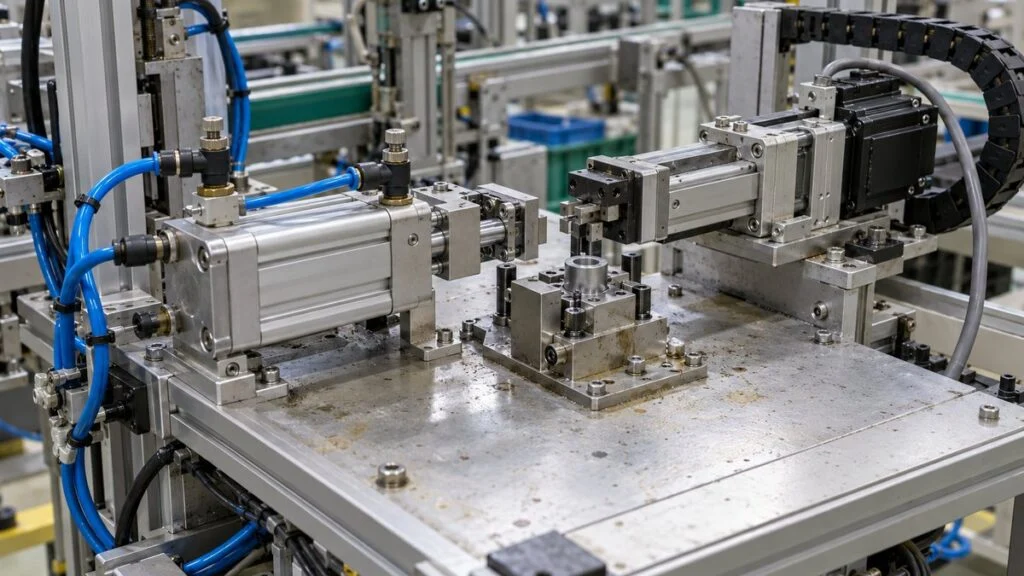
Open the side panel of an automated assembly machine and you will often find a familiar set of air components. There is a filter-regulator where the plant air comes in, solenoid valves on a manifold, tubing, and cylinders that push, clamp and lift. If a label on one of them reads "CDQ2B32-30DZ," you are looking at an SMC part number, in this case from the CQ2 compact cylinder series.
SMC Corporation, based in Tokyo, makes pneumatic equipment: the cylinders, valves, fittings and air preparation units that turn compressed air into motion on factory machines. In its Integrated Report 2025, SMC gives its global market share in pneumatic instruments as 36%. It is not a household name, and SMC itself says it remains relatively unknown to the general public.
This profile explains how a 1959 maker of sintered metal filters became the largest supplier in its field by its own account. It covers the catalog and part-number system, in-house production, the inventory strategy, local engineering support, the weak points SMC reports, and what to check when you specify SMC parts or alternatives. Unless another source is named, figures come from SMC's IR documents listed at the end.
Key numbers
Sources: SMC Corporation, Integrated Report 2025 (published February 2026); Presentation of Financial Results for the Fiscal Year Ended March 31, 2026 (May 14, 2026). SMC's fiscal year runs April to March; "FY2025" ends March 31, 2026.
Contents
What SMC Makes
SMC's IR materials describe its business as pneumatic control equipment, such as directional control valves, actuators and air line equipment. It also makes products outside classic pneumatics, including heat exchangers such as temperature-control chillers, electric actuators and sensors.
In the air path shown in the Integrated Report, a compressor makes compressed air, a dryer removes heat and moisture, and air line equipment (filters, regulators and lubricators) cleans it and sets the pressure. Solenoid valves then switch the flow, actuators move the workpiece, and the used air is exhausted to the atmosphere. SMC's catalog covers dryers, air line equipment, valves and actuators along this path.
The product mix follows that chain. Actuators such as air cylinders are the largest group, followed by valves, with air line equipment as the third-largest named category.
Figure 1: SMC Sales by Product (FY2024)
Actuators and valves together make up more than half of sales.
- Actuators30.2%
- Valves23.6%
- Air line equipment12.4%
- Fittings7.7%
- Heat exchangers7.3%
- Others18.7%
Source: SMC Corporation, Integrated Report 2025, "Sales Composition by Product" (fiscal year ended March 31, 2025). "Others" combines instrumentation 6.0%, other 6.9%, vacuum units 5.2%, filters 0.4% and hydraulics 0.2%. The published shares add up to 99.9% because of rounding.
SMC also reports where its products go. In FY2024 (the year ended March 31, 2025), semiconductor customers made up 19% of sales, automobiles 17%, electric equipment 11%, machine tools 10%, food 7% and medical 6%, with 30% in other industries. In its FY2025 results briefing, the company said semiconductor-related demand remained strong across all regions.
From Sintered Filters to a Global Pneumatics Supplier
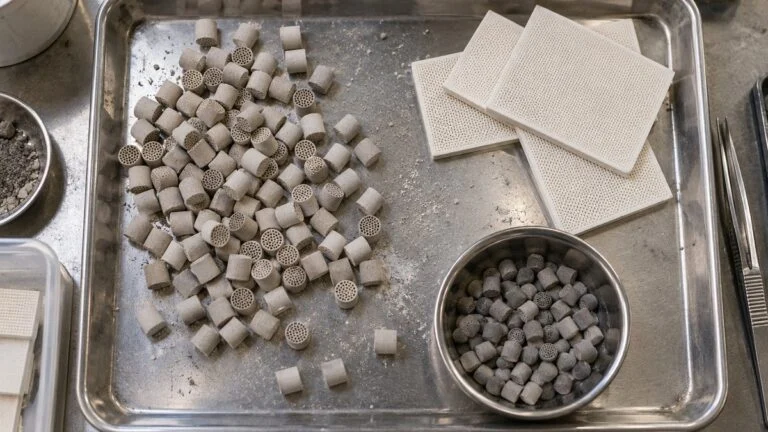
SMC was founded on April 27, 1959, as Shoketsu Kinzoku Kogyo Co., Ltd. It made sintered metal filter elements by powder metallurgy. The initials "SMC" come from "Sintered Metal Company," a brand name the company used abroad before it became the corporate name in 1986.
The filters led to air filters, and then to the rest of the air system. The timeline below shows the steps that matter most for the business model.
From one filter material to a full line of factory air components.
Source: SMC Corporation, Integrated Report 2025 (History), IR FAQ, and SMC Guide (CAT.E01-12F). Product names and descriptions are SMC's own.
The Integrated Report credits the late Honorary Chairman Yoshiyuki Takada, who died in 2024, with leading product development, manufacturing and sales over SMC's first 60 years. Yoshiki Takada became president in April 2021.
How the Business Model Works
SMC's Integrated Report 2025 includes a message from Masahiro Ota, the director in charge of finance, that sets out the model plainly. It rests on a few choices that reinforce each other.
Sell Components to Machine Builders, Not Machines
SMC's main direct customers are equipment manufacturers, the companies that build machines for factories. SMC rarely delivers directly to the end users who run those machines. It also generally does not make or sell equipment systems itself, so it does not compete with its own customers.
In SMC's view, customers care more about reliability than price or new features, because a failed component can stop a production line. Once a product becomes a customer's standard, the report says, the customer tends to order it again for new investments. SMC also says its customer base is spread across regions and industries, which limits the effect of a sharp drop at any one customer.
Turn Custom Requests Into Catalog Products
SMC describes a "market-oriented" approach to development: custom products made with customers are refined, standardized, and over many years grow into high-volume catalog lines. That is how the catalog reached 12,000 basic models and about 700,000 variations, according to the Integrated Report 2025. A newer company brochure, the SMC Guide (CAT.E01-12F), gives "over 880,000" variations.
For buyers, a broad catalog can reduce the number of suppliers needed for a machine's pneumatic parts, which SMC calls "one-stop" procurement. It also means that each part number carries a lot of information.
How SMC Part Numbers Work
SMC catalogs build part numbers from a "How to Order" chart: each position in the code selects one option. The example below follows a US How to Order chart for the CQ2 compact cylinder series.
It explains one configuration only: not all options can be combined, and codes differ by series, region and catalog revision. Treat it as an illustration of the logic, not an ordering guide.
Each block of the code selects one option. A blank position means the standard choice.
Based on an SMC "How to Order" chart for Series (N)CQ2, Double Acting, Single Rod, as published by a US distributor (smcpneumatics.com). A leading "N" selects North American mounting threads instead of metric. Always confirm codes in SMC's current catalog for your region.
Two lessons follow from the chart. First, the port thread and mounting thread are part of the number, so two cylinders with the same bore and stroke can still be different parts. Second, some part numbers carry extra suffixes after the main code, so copy the full string when you reorder and confirm any special options with the supplier.
Make the Parts In-House
The SMC Guide describes an integrated production system, with casting, machining, surface treatment, coating, assembly and inspection in SMC's own factories. SMC also works with outside suppliers, as the Tono project below shows.
A production control system issues work instructions automatically from incoming orders, which SMC says allows short lead times.
According to the Integrated Report, SMC has six domestic factories and mass-production bases in Japan, China, Vietnam, Singapore, India and the Czech Republic, plus regional factories. New and custom products usually get their production lines set up in Japan first. The lines move to overseas sites once a product reaches mass production.
SMC has also pulled its suppliers closer. The Tono Supplier Park in Iwate Prefecture, completed in 2025, houses about 20 suppliers on a site of about 177,000 m² (roughly 44 acres), with a listed total investment of about JPY 40 billion. The aim is to bring metalworking, resin processing, surface treatment and assembly onto one site and cut transport between processes.
Hold Inventory on Purpose
Many manufacturers aim to keep inventory lean. SMC treats a large stock as part of its strategy. Its Integrated Report says the company reached global share leadership partly through "strategic inventory that enables quick delivery," funded by its own capital.
The numbers are large. At March 31, 2026, SMC held JPY 506.6 billion in inventories, equal to 7.2 months of average monthly sales for FY2025 by SMC's own measure. This is a company-wide ratio; it does not tell you the stock or lead time for any particular part.
The SMC Guide gives an equity ratio of 91.5% at the same date, which means equity finances most of the company's assets.
SMC links this stock to its business continuity plan (BCP). Its stated target is to restore 90% of product supply capacity within two weeks after a disaster, first by shipping from inventory. That is a company target, not a recovery time for specific sites, parts or orders.
The Integrated Report also says that after the pandemic, ample inventory let SMC win customers it had never sold to before.
For more on how Japanese customers check suppliers' continuity plans, see Japanese customer BCP surveys.
Put Sales and Engineers Near Customers
SMC began selling abroad in 1967. Today it reports about 500 sales locations in more than 80 countries and regions, with around 6,000 sales staff. Most local companies are subsidiaries set up under local law and run by local managers, a strategy SMC says it uses to earn local customers' trust.
Engineering is spread out as well: SMC has technical centers in Japan, the US, China, the UK and Germany, with about 2,000 engineers in total. The Integrated Report says overseas centers can take over product design, development and technical support if the Japan Technical Center is disrupted. R&D spending was JPY 39.9 billion in FY2025.
Where SMC Sells
Japan is SMC's home market, but most sales are abroad. In the FY2025 results briefing, the finance director said Japan's share had fallen to 19%, with 81% overseas. The chart below uses the FY2024 breakdown by customer location in Integrated Report 2025.
Figure 4: SMC Sales by Customer Location (FY2024)
About four-fifths of sales come from customers outside Japan, and China is the largest single market.
- China27%
- Japan20%
- Asia (excl. China)19%
- Europe18%
- United States11%
- Other5%
Source: SMC Corporation, Integrated Report 2025, "Sales Composition by Customer Location" (fiscal year ended March 31, 2025). "Asia" excludes China.
China matters for two reasons. It is the largest market, and SMC says it has increased local production there to meet demand for China-made products. In FY2025, SMC reported a 15% rise in sales volume (not value) in Greater China, while volume fell in Japan and North America.
Market Share: What SMC Publishes
SMC's own documents are the main source for its share, and they do not always match. Read each figure with its source and date:
- Integrated Report 2025 (published February 2026, covering the year ended March 31, 2025): global market share in pneumatic instruments of 36%.
- SMC Guide, CAT.E01-12F (2025 edition; its corporate summary is dated March 2026, but the share figures carry no date): 62% in Japan and 36% globally on its opening pages. A later page in the same brochure says SMC holds "the largest global market share (39%)." The brochure does not explain the difference.
Neither document explains how the share is measured, such as which products count or which market-size estimate is used. This article uses 36%, the figure in the most recent integrated report, and treats it as SMC's own estimate.
SMC does have competitors. In the FY2025 briefing, the finance director mentioned lower-priced competitors, including some in Taiwan and China, and named Germany's Festo as another supplier. He said some Chinese customers that had switched to cheaper suppliers were returning to SMC and Festo after frequent minor stoppages on their lines.
That is SMC's account, not an independent finding, and no comparative test data was published. Buyers should compare suppliers against the same application requirements and acceptance criteria.
Weak Points and Criticisms
The model has costs, and SMC's own reports name several of them. Profit margins have fallen from their peak, as the chart shows.
Operating profit as a percentage of net sales. Darker bars mark the highest margins in the period shown.
Sources: SMC Corporation, Integrated Report 2025 (FY2020–FY2024); Presentation of Financial Results for the Fiscal Year Ended March 31, 2026 (FY2025). Each fiscal year ends March 31 of the following calendar year.
- Inventory risk: large stocks can lose value. SMC booked a JPY 10.3 billion inventory devaluation in FY2024, followed by a JPY 4.1 billion reversal in FY2025. The finance director wrote that SMC "is currently not meeting market expectations."
- Heavy investment: capital spending reached a record JPY 150.2 billion in FY2025, and SMC expects depreciation of about JPY 62 billion in FY2026. Higher depreciation is one reason SMC gives for lower margins.
- Cyclical demand: sales follow factory capital spending. In FY2024, weak investment in the semiconductor and automobile sectors led SMC to cut its forecast twice.
- Currency: about 80% of sales come from outside Japan, so a stronger yen can reduce the yen value of overseas sales. SMC names this as a financial risk.
- Price pressure: SMC reports price competition in China, and the finance director said it raised prices in Japan by 10% in FY2025, the first increase in several years.
Investors have also pressed management on profitability. In the FY2025 briefing, an analyst asked whether adding sales staff would really lift profits. President Takada replied that stable supply of good products at acceptable prices should bring profit over time.
What Overseas Buyers Should Know
If you maintain machines built in Japan or Asia, or you specify pneumatics for new equipment, SMC's model has practical effects. The cards below sum up the points to check before you order.
Check the configuration code carefully before you order.
Port Threads: Rc, NPT and G
In the 32 mm-bore CQ2 example above, a blank port-thread code means Rc; the chart lists M threads for bores of 12–25 mm instead. Rc is the internal taper pipe thread in JIS B 0203, in the same family as ISO 7-1 (often called BSPT). NPT uses a 60° thread angle, while the ISO 7 family uses 55°, so the two do not interchange even when the size names match.
G is a parallel pipe thread that seals with a gasket or O-ring rather than on the thread. If a fitting "almost" goes in, stop and check the code before you add more sealant.
Specifying Alternatives
Some SMC series, such as the CQ2 compact cylinder, are not sold as ISO-standard series, so check each catalog's standards listing. If you want the freedom to switch suppliers, specify a cylinder built to an ISO dimensional standard instead.
ISO 15552:2018 covers cylinders with detachable mountings, bores 32–320 mm, at up to 1,000 kPa (10 bar, about 145 psi). ISO 21287:2004 covers compact cylinders with bores of 20–100 mm.
SMC also makes ISO-standard series, such as the CP96, which its web catalog lists as an ISO 15552 air cylinder. The table compares the two routes.
A trade-off between options and the freedom to switch suppliers.
Standards: ISO 15552:2018 and ISO 21287:2004 (iso.org). An ISO standard fixes key dimensions; it does not make every feature identical between makers.
When you ask a distributor or an SMC office for an equivalent cylinder, give them:
- the full part number and the mounting drawing
- load, mounting orientation, stroke and cycle rate
- operating pressure, air quality and ambient conditions
- for valves and switches: voltage, wiring, connectors and the control system they connect to
Ask the supplier to list every difference in writing, including dimensions, functions and operating limits.
For more on the Japanese automation supply base, see Japanese factory automation companies and pneumatic speed controllers: meter-out vs. meter-in.
Limits of This Article
This profile relies on SMC's IR documents, its company brochure, a published How to Order chart, and public standards listings. We did not interview SMC, its customers or its competitors. Market share figures are SMC's own and are not independently verified, and the part-number example is for illustration only.
SMC's model fits a supplier with a large balance sheet and a very broad catalog. Holding about seven months of sales in stock takes a lot of working capital, and many smaller suppliers would find it hard to finance. Results also change quickly, so check SMC's latest quarterly materials before relying on any figure here.
FAQ
What Does SMC Stand For?
"Sintered Metal Company." SMC was founded in 1959 as Shoketsu Kinzoku Kogyo Co., Ltd., a maker of sintered metal filters. It used "SMC" as a brand name abroad and adopted SMC Corporation as its company name in 1986.
Is SMC a Japanese Company?
Yes. SMC Corporation is headquartered in Kyobashi, Tokyo, and is listed on the Tokyo Stock Exchange Prime Market. Most of its overseas sales companies are local subsidiaries run by local managers.
What Is SMC's Global Market Share in Pneumatics?
SMC's Integrated Report 2025 gives 36% for pneumatic instruments. Its SMC Guide (CAT.E01-12F) shows 36% globally and 62% in Japan, but also says 39% on a later page without explaining the difference. These are company figures, and the method is not stated.
Where Are SMC Products Made?
SMC's mass-production bases are in Japan, China, Vietnam, Singapore, India and the Czech Republic, with regional factories in other countries. New products are usually set up in Japan first and moved overseas at the mass-production stage.
Can I Replace an SMC Cylinder With Another Brand?
Often, but check the details first. Cylinders built to ISO 15552 or ISO 21287 share key mounting dimensions across makers, though other features can differ. For SMC's own series, compare bore, stroke, mounting, port threads, switches and rod end one by one, and confirm with the machine builder.
Sources
- SMC Corporation, Integrated Report 2025 (February 27, 2026)
- SMC Corporation, Presentation of Financial Results for the Fiscal Year Ended March 31, 2026 (May 14, 2026) and transcript
- SMC Corporation, SMC Guide (CAT.E01-12F)
- SMC Corporation, IR FAQ
- SMC Corporation, CP96 Series web catalog
- Series (N)CQ2 How to Order chart, via smcpneumatics.com (US distributor)
- ISO, ISO 15552:2018 and ISO 21287:2004
- Sumitomo Drive Technologies, Pipe Threads white paper
About the editor
 MONOSCOPE EditorFOUNDER & EDITOR
Spent about ten years at a plant equipment maker and a plant engineering company, proposing, designing, and commissioning equipment, then moved into web marketing. Now a web consultant for B2B manufacturers, helping them explain their products and technology. Licensed in Japan as an Energy Manager and a Third-Class Chief Electrical Engineer.
Has run an engineering blog since 2017 (500+ articles) and a Japanese YouTube channel with about 20,000 subscribers. Each English guide is written from the Japanese shop-floor point of view and checked against the cited standards.