Fujifilm Business Transformation: Film to Chip Materials
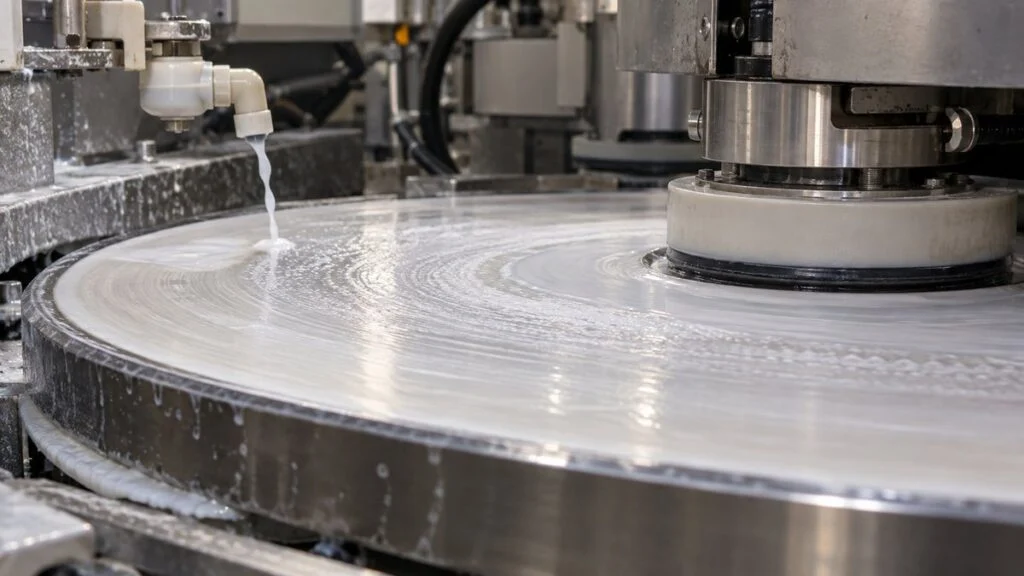
If you run a chemical mechanical polishing (CMP) tool in a fab, some of the slurry in the drums may come from Fujifilm. If you buy LCD polarizers, the clear protective film inside may also be a Fujifilm product. For many people, though, the name still means a green box of 35 mm film.
According to Fujifilm, photographic products made up about 60% of its sales and two-thirds of its profit in 2000. Demand for photographic film then fell sharply as digital cameras took over.
Kodak, its main rival, filed for Chapter 11 bankruptcy in January 2012. Fujifilm grew other businesses, both in-house and through acquisitions, and reported record group revenue of JPY 3,357.0 billion (about JPY 3.36 trillion) for the fiscal year ended March 2026.
This article looks at what Fujifilm did in between, based mainly on its investor relations materials and press releases. It then covers what the company supplies to fabs and plants today, and what engineers and buyers can take from the case.
Contents
- How Big the Film Problem Was
- What Fujifilm Kept: The Technology Inside a Roll of Film
- Display Materials: From Film Base to LCD Polarizers
- Semiconductor Materials: Slurries, Resists, and Process Chemicals
- Healthcare and Bio CDMO
- Where Fujifilm's Revenue Comes From Today
- Fujifilm vs. Kodak: What the Record Shows
- What Engineers and Buyers Can Learn
- Limits of This Article
- FAQ
- Sources
How Big the Film Problem Was
Fujifilm was founded in 1934 as Fuji Photo Film, under a government plan to build a domestic photographic film industry. For decades after that, film and photo paper were the core of the business.
The 60% figure for 2000 comes from a 2015 Fujifilm announcement promoting a book by Shigetaka Komori, its chairman and CEO at the time. The announcement does not say which profit measure it means.
PetaPixel, summarizing Komori's account, reports that worldwide film sales peaked around 2000–2001 and that by 2010 demand had dropped to less than a tenth of its earlier level. It says the decline started slowly and later reached 20–30% a year. We could not check these figures against an industry statistic.
Fujifilm's response came in steps rather than one bold move:
- February 2004: it set out a mid-term plan, VISION75, aimed at the company's 75th anniversary.
- January 2006: it announced about 5,000 job cuts in its Imaging Solutions segment, citing lower color film demand and slower growth in digital cameras. It planned restructuring costs of JPY 165 billion over two fiscal years.
- October 2006: it moved to a holding company structure under FUJIFILM Holdings Corporation.
The job cuts are part of the record, and they show the transformation had real costs. The timeline below shows the main moves from the company's own history pages.
Selected milestones. Some businesses, such as Fuji Xerox and medical imaging, started long before film demand fell; later acquisitions widened the group.
Sources: FUJIFILM corporate history and FUJIFILM Holdings history pages; Fujifilm press releases (June 2015, January 2006, September 2025, October 2026); FY2025 earnings presentation (May 2026). Fujifilm's fiscal year runs April to March.
What Fujifilm Kept: The Technology Inside a Roll of Film
Color film looks simple, but it combines light-sensitive chemistry with many thin layers on a clear plastic base. Making it takes precise coating and tight control of chemical properties.
Fujifilm describes the technologies it carried over as "precision coating, functional molecule, and membrane formation technologies developed in the photographic film field." It also mentions chemical synthesis, which it used for products such as color film pigments. These are process skills rather than products, so they can be applied in other markets.
The table below links each film skill to products Fujifilm sells today. Fujifilm names the skills, but matching each product to a skill is our simplification. It does not show how each product was developed, and some product lines came from acquisitions.
Each row starts with a skill used to make film and ends with current products.
Skill names follow Fujifilm's "Highly-Functional Materials" page. Product lists come from that page and Fujifilm's SEMICON West 2025 release (October 6, 2025). The mapping of individual products to skills, and the typical buyers, are our simplification.
Display Materials: From Film Base to LCD Polarizers
The clearest case is TAC (triacetyl cellulose) film. Photographic film used TAC as its clear base for decades. A 2005 conference paper by a Fuji Photo Film researcher notes TAC had served as a film substrate for more than 50 years.
An LCD polarizer is a stretched PVA (polyvinyl alcohol) film that needs protection on both sides. The 2005 paper says the features of TAC were found to suit this protective role best, and calls it an indispensable optical part of the polarizer at that time. Clarity, low birefringence, and good bonding to PVA are the usual reasons given.
Fujifilm sells TAC film under the FUJITAC name as a polarizer protective film. It also sells WV film, a protective film that widens the viewing angle. Fujifilm's product page says it makes the left-right viewing angle 1.8 times wider in twisted nematic LCDs; actual results depend on the display design.
Fujifilm was not the only film company to make this move. Konica Minolta, another former film maker, also turned its TAC film base into an LCD material.
The Fujifilm business that includes display materials, AF (Advanced Functional) Materials, had revenue of JPY 161.6 billion in the fiscal year ended March 2026. That figure also covers data storage tape, so display materials alone are smaller.
Semiconductor Materials: Slurries, Resists, and Process Chemicals
Fujifilm's semiconductor materials business grew through acquisitions as well as in-house work. In November 2004 it bought Arch Chemicals' microelectronic materials business and full ownership of FUJIFILM ARCH. In October 2023 it bought the electronic chemicals business of Entegris.
At SEMICON West 2025, Fujifilm listed what it supplies for wafer processing:
- Photoresists: EUV (extreme ultraviolet), ArF and KrF excimer laser, i-line, and legacy processes. The release also mentions PFAS-free formulations (free of per- and polyfluoroalkyl substances); buyers should confirm which grades these are and when they are available
- CMP materials: CMP slurries, buffing cleaners, and post-CMP cleaners
- Process chemicals: acids, bases, formulated cleaners, selective etchants, tetramethylammonium hydroxide developers, and high-purity solvents
- Thin-film materials: low-k dielectric precursors and tetraethyl orthosilicate
- Packaging materials: polyimides for protective coatings and redistribution layers
- Image sensor materials: color filter materials for CMOS sensors
Fujifilm has announced several CMP slurry capacity expansions in recent years. Copper interconnect slurry polishes wafer surfaces flat where copper wiring and insulating films of different hardness sit side by side. Fujifilm says it has a leading global market share in this product, but its releases do not name the research behind that claim.
As of February 2025, Fujifilm made CMP slurries in Arizona (USA), Hsinchu and Tainan (Taiwan), Cheonan (South Korea), and Kikuyo, Kumamoto (Japan). At the same time, it announced a sixth site in Zwijndrecht, Belgium, scheduled to start in spring 2026; we did not find a later report confirming that start.
On October 14, 2026, it announced a US$18 million (about JPY 3 billion) investment in Mesa, Arizona. The expanded copper slurry line is set to start in 2027.
The same Arizona project adds lines for a wider range of slurries. These cover front-end and middle-of-line steps and advanced packaging, including hybrid bonding (see our guide to the semiconductor back-end process and Japanese suppliers). For the wider supply chain, see our overview of Japanese semiconductor and electronic component companies.
In the fiscal year ended March 2026, Semiconductor Materials revenue rose 17.6% to JPY 294.6 billion. In its fourth-quarter commentary, Fujifilm pointed to AI-related chip demand, much higher CMP slurry sales, and strong sales of liquid polyimides for advanced packaging.
Healthcare and Bio CDMO
Healthcare also has roots in imaging. Fujifilm developed FCR (Fuji Computed Radiography), which it describes as the first system to digitize X-ray images; a Japanese medical physics journal dates its launch to 1983.
After 2000, acquisitions were a large part of Fujifilm's healthcare expansion. It took control of Toyama Chemical, a drug maker, in 2008. In 2017 it took control of Wako Pure Chemical, a lab chemicals maker, and in 2021 it bought Hitachi's diagnostic imaging business.
Bio CDMO (contract development and manufacturing of biopharmaceuticals) began in March 2011, when Fujifilm bought Diosynth RTP and MSD Biologics (UK) from MSD. It added Biogen's manufacturing plant in Denmark in 2019. The business now operates as FUJIFILM Biotechnologies.
A major project is a plant in Holly Springs, North Carolina. Fujifilm held its grand opening on September 24, 2025, with eight 20,000-liter cell culture bioreactors in the first phase; a second phase announced in 2024 will add eight more. Fujifilm describes the site as a planned US$3.2 billion investment.
The numbers show both growth and strain. In the fiscal year ended March 2026, Bio CDMO revenue rose 15.8% to JPY 254.1 billion. Healthcare segment operating income fell 20.3% to JPY 63.6 billion, and Fujifilm cited start-up costs at its new large U.S. bio plants among the reasons.
Where Fujifilm's Revenue Comes From Today
Fujifilm now reports four segments. The chart below shows revenue for the fiscal year ended March 2026, with selected businesses inside each segment.
Billions of yen. The four segments (dark bars) total JPY 3,357.0 billion. The businesses below the line (light bars) are already included in those segment totals, so do not add them.
Source: FUJIFILM Holdings, Financial Results for Q4 FY2025 (May 12, 2026). Dark bars are segments; light bars are selected businesses within them (Medical Systems and Bio CDMO in Healthcare, Consumer Imaging in Imaging, Semiconductor Materials and AF Materials in Electronics). AF Materials includes display materials and data tape.
Two points stand out. Film has not disappeared: Consumer Imaging, which includes instax instant photo systems, grew 12.2% to JPY 367.9 billion. Business Innovation, the former Fuji Xerox, is the largest segment, but its revenue fell 2.0%, with Fujifilm citing weaker sales in Office Solutions and lower demand for printing plates in Europe.
Fuji Xerox started in 1962 as a joint venture with Rank Xerox. Fujifilm made it a consolidated subsidiary in 2001 and took full ownership in November 2019. It was renamed FUJIFILM Business Innovation in April 2021.
Fujifilm vs. Kodak: What the Record Shows
The Fujifilm-Kodak comparison is popular in business writing, and much of it is simplified. Both companies faced the same collapse in film demand. Accounts of why Kodak declined differ, so we stick to dated facts from company filings.
| Item | Fujifilm | Kodak |
|---|---|---|
| Film's weight around 2000 | About 60% of sales and two-thirds of profit (Fujifilm, 2015) | No company figure used here |
| Chapter 11 or similar filing | None found in the sources cited here | Chapter 11 filed January 19, 2012; emerged September 3, 2013 |
| Imaging businesses | Kept an Imaging segment (instax instant photo systems, digital cameras, and other products) | Personalized Imaging and Document Imaging businesses sold in 2013 to the UK Kodak Pension Plan; Kodak still makes film |
| Latest annual revenue | JPY 3,357.0 billion (fiscal year ended March 2026) | US$1.069 billion (year ended December 2025) |
| Main businesses now | Office and printing, healthcare, imaging, electronic materials | Print ($715 million), Advanced Materials & Chemicals ($316 million, includes film), and Brand ($23 million) |
The Kodak figures come from its 10-K for 2013 and its full-year 2025 results release. "Kodak failed and Fujifilm succeeded" is too simple a summary of either company.
What Engineers and Buyers Can Learn
Fujifilm's case is one company's path, not a formula. Still, three lessons from the public record apply to suppliers and buyers well outside Japan.
- Sort capabilities from products. Fujifilm reused coating, molecule design, and film-forming skills, not the film itself. When you assess a supplier, ask which core processes they control in-house and which they buy.
- Expect new businesses to come from acquisitions too. Much of Fujifilm's healthcare, bio, and semiconductor business was bought (Arch Chemicals, Diosynth, Wako, Entegris). A product line with a long history may have changed owners, plants, or quality systems along the way.
- Check where your material is actually made. Fujifilm makes CMP slurry at several sites in Asia and the US and has announced one in Europe. For a qualified material, check the grade, the plant, and the change-control terms, not only the brand.
Questions to Ask a Materials Supplier
These questions apply to Fujifilm and to any chemical or film supplier serving a fab or plant:
- Which site makes the grade we use? Can a second qualified site supply it, and what requalification would a transfer need?
- Was this product line acquired? If so, when, and did the plant, formula, or raw material sources change?
- How will you notify us of a process change, and how far in advance?
- For PFAS-free resists or other new formulas, what qualification data exist for our process, and what would we need to change to adopt them?
- What support hours, languages, response times, and on-site help are available for our facility?
For more on how Japanese suppliers rank in materials and equipment, see where Japan holds global market share in materials and equipment.
Limits of This Article
This article relies on public sources: Fujifilm and Kodak filings, press releases, product pages, a conference paper, and press coverage. Figures cover the fiscal year ended March 2026, and announcements run through October 14, 2026.
We did not interview anyone at either company. Fujifilm's own description of its history naturally stresses what worked.
Some figures come from secondary sources. The film demand curve after 2000 is from PetaPixel's summary of Komori's account, not from an industry statistic we could check. Market share wording follows Fujifilm's releases, which do not name the research behind them.
Finally, Fujifilm's path does not prove that diversification works for every company. Other film makers took other routes, and results depend on timing, funding, and market conditions.
FAQ
Does Fujifilm Still Make Film?
Yes. Instant film for instax cameras is part of its Imaging segment, and Fujifilm cited strong instax sales in its results for the fiscal year ended March 2026. The Consumer Imaging business had revenue of JPY 367.9 billion that year, but that figure covers more than film.
What Semiconductor Materials Does Fujifilm Make?
Photoresists (EUV to i-line), CMP slurries and cleaners, process chemicals, thin-film precursors, polyimides for packaging, and color filter materials for image sensors. Semiconductor Materials revenue was JPY 294.6 billion in the fiscal year ended March 2026.
What Is Fujifilm's Largest Business Now?
By segment revenue, Business Innovation (office and printing, the former Fuji Xerox) was largest at JPY 1,174.8 billion, followed closely by Healthcare at JPY 1,098.9 billion, in the fiscal year ended March 2026.
Why Did Fujifilm Survive When Kodak Went Bankrupt?
No single reason explains it. Fujifilm cut costs, moved to a holding structure, reused film technologies in new materials, and bought businesses in healthcare and chemicals. Kodak filed for Chapter 11 in 2012 and emerged in 2013 as a company focused on business markets such as printing and advanced materials.
Sources
- Results: FUJIFILM Holdings, Financial Results for Q4 FY2025 (May 12, 2026); results release, May 12, 2026
- Film's share of the business in 2000: Fujifilm announcement of Komori's book, June 18, 2015 (via Printing Impressions)
- Film demand after 2000: PetaPixel, October 19, 2018
- VISION75 and job cuts: Fujifilm press release, January 31, 2006 (via Photography Blog)
- Company history: FUJIFILM corporate history (1934–2006); FUJIFILM Holdings history (2006 onward)
- Film technologies and materials: Fujifilm, "Highly-Functional Materials"; WV film product page (Japanese); Mori, IMID 2005 paper on TAC film; Konica Minolta, TAC film history
- Semiconductor materials: SEMICON West 2025 release, October 6, 2025; Belgium investment, February 5, 2025; Arizona CMP slurry expansion, October 14, 2026
- Healthcare: Fujifilm, Computed Radiography; Japanese Journal of Medical Physics, Vol. 41 No. 3; Holly Springs opening, September 24, 2025
- Kodak: Eastman Kodak Form 10-K for 2013; Kodak full-year 2025 results, March 12, 2026
About the editor
 MONOSCOPE EditorFOUNDER & EDITOR
Spent about ten years at a plant equipment maker and a plant engineering company, proposing, designing, and commissioning equipment, then moved into web marketing. Now a web consultant for B2B manufacturers, helping them explain their products and technology. Licensed in Japan as an Energy Manager and a Third-Class Chief Electrical Engineer.
Has run an engineering blog since 2017 (500+ articles) and a Japanese YouTube channel with about 20,000 subscribers. Each English guide is written from the Japanese shop-floor point of view and checked against the cited standards.