JGC and Japanese EPC Contractors: How Projects Are Run
An inquiry arrives from JGC India EPC in Chennai. A purchase order for an LNG project names the JGC Fluor joint venture as the buyer. A floating LNG package lists JGC France as the lead. Meanwhile, a Japanese contact says "Nikki" and means a different company again. All of these belong to one Japanese group, JGC Holdings, but each entity has its own role, and that affects who reviews your documents and who signs your contract.
JGC is a Japanese EPC contractor, meaning it takes on the engineering, procurement, and construction of a plant under one contract. For the owner, that means a single point of contact and a finished plant that delivers the agreed output and quality. JGC is best known for LNG (liquefied natural gas) plants: by its own count, it has worked on 48 LNG trains, and plants it designed and built account for more than 30% of the world's current LNG production. Unlike its Japanese peers Chiyoda and Toyo Engineering, JGC also runs a manufacturing business that makes catalysts and fine ceramics.
This guide uses JGC's published financial results, medium-term plan, and news releases as of October 2026 (English versions where available) to explain how the group is organized, how it runs large projects, what its recent results look like, and what to check before you quote to a JGC entity. For the general split of roles between EPC contractor, owner, and maintenance contractor, see Who Does What in a Japanese Plant: EPC, Owner, Maintenance.

Contents
JGC at a Glance: Which JGC Are You Dealing With?
JGC Holdings Corporation is a holding company. It moved to this structure in October 2019, when the former JGC Corporation renamed itself JGC Holdings. The operating work now sits in separate companies, and two of them cause most of the confusion:
- JGC Corporation runs the overseas EPC business. Its Japanese name is 日揮グローバル (Nikki Global).
- JGC Japan Corporation runs EPC and maintenance work in Japan. Its Japanese name is simply 日揮 (Nikki).
So when a Japanese colleague says "Nikki," they may mean the domestic company, not the one running your overseas project. JGC Corporation shares the holding company's head office address in Yokohama.
Under the holding company, separate companies handle overseas EPC, domestic EPC, and materials manufacturing.
Based on JGC Holdings, "JGC Group at a Glance" and "Group Companies." Only the five main operating companies are shown.
Outside Japan, the companies you are most likely to meet are these:
- JGC India EPC Private Limited (Chennai): set up in 2022, initially for detailed engineering on JGC's large overseas EPC projects. JGC's 2026 medium-term plan commits to building up "resources for EPC execution at JGC India."
- JGC France S.A.S.: the lead JGC entity on the Coral North floating LNG contract for Mozambique (2026).
- Project joint ventures: for example, the JGC Fluor joint venture that built LNG Canada in Kitimat, British Columbia. A joint venture can run its own procurement and supplier register (see the supplier section below).
- Overseas offices of JGC Corporation in Beijing, Bangkok, Taipei, Abu Dhabi, and Algiers (as listed on its company page).
From Japan Gasoline to Japan's First Engineering Firm
JGC traces its roots to Japan Gasoline Co., Ltd., founded on October 25, 1928. It first aimed to build and run its own refinery but gave up that plan. Its business then centered on licensing petroleum refining processes from Universal Oil Products (UOP) of the US, and in the 1930s it started an engineering business alongside the licensing work. JGC describes this as the birth of "the first engineering firm in Japan."
In 1956 it won the contract for Idemitsu Kosan's Tokuyama Refinery, Japan's first grassroots refinery, and from the 1960s it moved into plant exports, starting with a refinery in South America. The manufacturing side is almost as old: JGC began making catalysts in the 1940s and started its fine ceramics business in the 1980s.
How JGC Runs Large Projects
For suppliers, the most useful thing to understand about JGC is how its big projects move from study to handover. Three features stand out: lump-sum contracts often executed in joint ventures, modular construction, and a long run-up of FEED and owner decisions before the EPC contract takes effect.
Lump-Sum Contracts, Often in Joint Ventures
JGC calls its lump-sum business model "a major strength of the Group." Under a lump-sum (fixed-price) contract, the contractor agrees to a total price up front, so higher material costs, schedule delays, or security problems at the site generally come out of the contractor's margin, not the owner's budget.
JGC's first LNG plant was in Brunei, and by the 2000s it had become a leading LNG contractor. LNG plants are huge investments, often built in cold regions, deserts, or offshore, so owners prefer contractors that have already completed projects of the same scale. A long track record helps win the next order and makes the field hard for newcomers to enter. In BSP2030, JGC says LNG will keep growing in importance as a relatively clean and inexpensive energy source and that, with fewer players, the LNG market will remain important.
Large LNG projects are usually shared with partners. Recent examples:
- LNG Canada Phase 2 (Canada): JGC Fluor joint venture with Fluor Corporation (US). Primarily lump-sum turnkey, with some portions on a cost-plus basis.
- Coral North FLNG (Mozambique): JGC France and Technip Energies (France) handle topside engineering, procurement, and project management; Samsung Heavy Industries (South Korea) builds the hull and topside modules. Lump-sum turnkey.
- Papua LNG (Papua New Guinea): a JGC-Hyundai E&C joint venture selected as the EPC candidate.
In practice, that means your buyer may be a joint venture, your technical reviewer may sit with the partner company, and because the contractor has already fixed its price with the owner, you should expect firm positions on delivery dates and cost.
The Path from FEED to Handover
A large LNG project goes through several gates before anyone places firm equipment orders. LNG Canada Phase 2 shows the sequence: in August 2025 the JGC Fluor joint venture was awarded an update of the FEED (front-end engineering design) and EPC cost estimating; the owner then took its final investment decision (FID); and on September 29, 2026, the EPC contract took effect with a notice to proceed (NTP). JGC's share is about US$7.5 billion, and completion is scheduled for the first half of 2032.
Inquiries come at every stage, but only the later ones lead to firm orders.
Papua LNG sits at the earlier stage. In March 2026 the JGC-Hyundai E&C joint venture was selected as EPC candidate for the roughly 4 million tonnes per annum (MTPA) plant (three trains of 1.33 MTPA), operated by TotalEnergies. JGC says the final EPC contract award and NTP are expected after FID. The plant plans to use electric motors, instead of gas turbines, to drive its refrigerant compressors.
The lesson for suppliers: always ask which stage an inquiry belongs to. A FEED-stage request is a chance to get your product written into the specification, not a purchase order.
Modular Construction
Much of JGC's LNG work relies on modular construction. Instead of shipping materials to the site and building the plant piece by piece (stick-build), JGC assembles large modules, each containing steel structure, piping, and equipment, at a fabrication yard. The modules are then shipped and connected at the site. Module fabrication and site foundation work can run at the same time, which shortens the schedule and reduces exposure to site weather and labor shortages.
JGC highlights a few specific techniques:
- Single Weld Hookup: module pipe ends are aligned and welded directly to each other, instead of inserting a spool piece that needs two welds. JGC calculates pipe-end positions in advance, including thermal expansion during transport.
- Arctic logistics: experience moving large modules along the Northern Sea Route, supported by sea-ice forecasting.
- J-I-Module Concept: a method for optimizing module layout against budget, production volume, operating method, and site area.
If you supply equipment that goes into modules, your delivery point may be a fabrication yard rather than the plant site, and your interface and dimensional data need to be fixed early.
Floating LNG and Design Standardization
FLNG (floating LNG) units liquefy gas on a vessel offshore, which means fitting a liquefaction plant into a limited deck area. JGC says it has been involved in three of the world's four full-scale FLNG projects. These include Coral South off Mozambique, which shipped its first cargo in 2022, and two units for Malaysia's national oil company PETRONAS.
In June 2026, JGC France, Technip Energies, and Samsung Heavy Industries signed the EPCIC (engineering, procurement, construction, installation, and commissioning) contract for Coral North, a second FLNG unit for Mozambique with a capacity of about 3.6 MTPA. The total contract value is below US$5 billion, and the JGC Group's share is above US$1 billion.
JGC is also working with Honeywell on a standardized FLNG design package based on Honeywell's dual-mixed-refrigerant LNG process, targeted for completion in JGC's fiscal year 2026 (April 2026–March 2027). The companies say it could cut the time from order to delivery by more than a year, depending on project scope and customer requirements.
JGC by the Numbers: FY2025 Results
Japanese companies usually close their books at the end of March, and JGC labels each fiscal year by the calendar year in which it starts. In its reports, FY2025 means April 1, 2025 to March 31, 2026, and FY2026 is the current year ending March 2027. All figures below follow JGC's English-language reports.
In FY2025, JGC posted consolidated net sales of JPY 745.2 billion and operating profit of JPY 35.3 billion. The Total Engineering segment (EPC) brought in JPY 679.5 billion, or about 91% of sales. Functional Materials Manufacturing contributed JPY 56.9 billion, and other businesses, mainly consulting, JPY 8.6 billion.
Profit tells a different story. The EPC segment earned a 5.0% margin, while the materials business earned 13.5%. With less than 10% of sales, Functional Materials produced about 18% of total segment profit (JPY 7.6 billion of JPY 43.4 billion).
Plant construction brings in most of the sales; materials manufacturing earns the higher margin.
Sales to external customers. Segment profit totals JPY 43.4 billion; after JPY 8.0 billion in corporate expenses and eliminations, consolidated operating profit is JPY 35.3 billion. Amounts are shown as in JGC's presentation (JPY billion, fractions truncated). Source: JGC Holdings, Annual Financial Results FY2025 and Outline of Financial Results FY2025 (May 14, 2026).
Where the Sales Come From
By customer location, Japan accounted for JPY 190.9 billion, about 26% of sales, so roughly three-quarters came from outside Japan. The Middle East was the largest region at JPY 244.0 billion (Saudi Arabia alone: JPY 105.0 billion), followed by North America at JPY 115.7 billion and Southeast Asia at JPY 115.1 billion. Africa contributed JPY 54.6 billion.
By business, overseas LNG work brought in JPY 239.6 billion and overseas oil and gas JPY 183.5 billion. In Japan, the larger lines are healthcare and life sciences (such as pharmaceutical plants) and work for refineries and chemical plants, including maintenance.
Orders and Backlog Swing Widely
For an EPC contractor, sales and profit tell only part of the story. A large plant takes several years to build, and revenue is recognized gradually as engineering, procurement, and construction progress. So orders received (new contracts) and the order backlog (outstanding contracts) matter just as much.
Orders depend heavily on whether a single giant project closes. Total Engineering new contracts were JPY 922.5 billion in FY2024 but JPY 409.2 billion in FY2025. For FY2026, JGC targets JPY 1,740.0 billion. JGC has said it will recognize its US$7.5 billion share of LNG Canada Phase 2 in fiscal 2026.
At the end of March 2026, the order backlog was JPY 1,166.6 billion for the group and JPY 1,155.5 billion for Total Engineering. About 30% was LNG, and 45% was in the Middle East. JGC booked a contingency for the conflict in the region in its FY2025 results, which lowered the profit margin by about 1 percentage point, and it expects progress delays there to reduce FY2026 revenue by roughly JPY 60 billion.
A large backlog secures future work, but it does not lock in profit. Under lump-sum contracts, cost overruns reduce the contractor's margin. JGC posted operating losses in FY2023 and FY2024, mainly because profitability declined on some overseas EPC projects. After reviewing its project execution structure, JGC returned to an operating profit of JPY 35.3 billion in FY2025.
After two years of operating losses, JGC returned to profit in FY2025.
Bars show net sales in JPY billion; the hatched bar is JGC's forecast. JGC's FY2025 is the year ended March 31, 2026. Source: JGC Holdings, Outline of Financial Results FY2025 (May 14, 2026).
The Second Business: Catalysts and Fine Ceramics
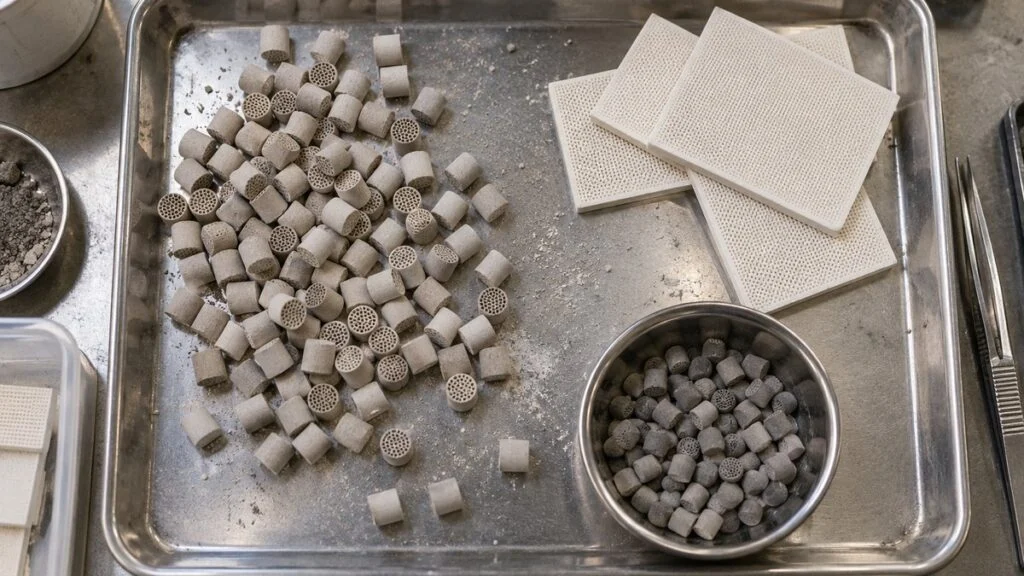
JGC's Functional Materials Manufacturing business is run mainly by JGC Catalysts and Chemicals and Japan Fine Ceramics. Both build on technology for controlling the shape and size of fine particles, and have developed products with high shares in niche markets. Its revenue works differently from EPC. Instead of a few big projects, it sells catalysts and components that refineries and semiconductor plants buy year after year, so demand builds up steadily. The 2026 medium-term plan describes it as having established itself as the group's second pillar.
These products serve markets outside plant construction, from refineries to semiconductor fabs and EVs.
Market shares are JGC's own figures. Source: JGC Holdings, "JGC Group at a Glance," Functional Materials Manufacturing pages, and Outline of Financial Results for 1Q FY2026 (August 2026).
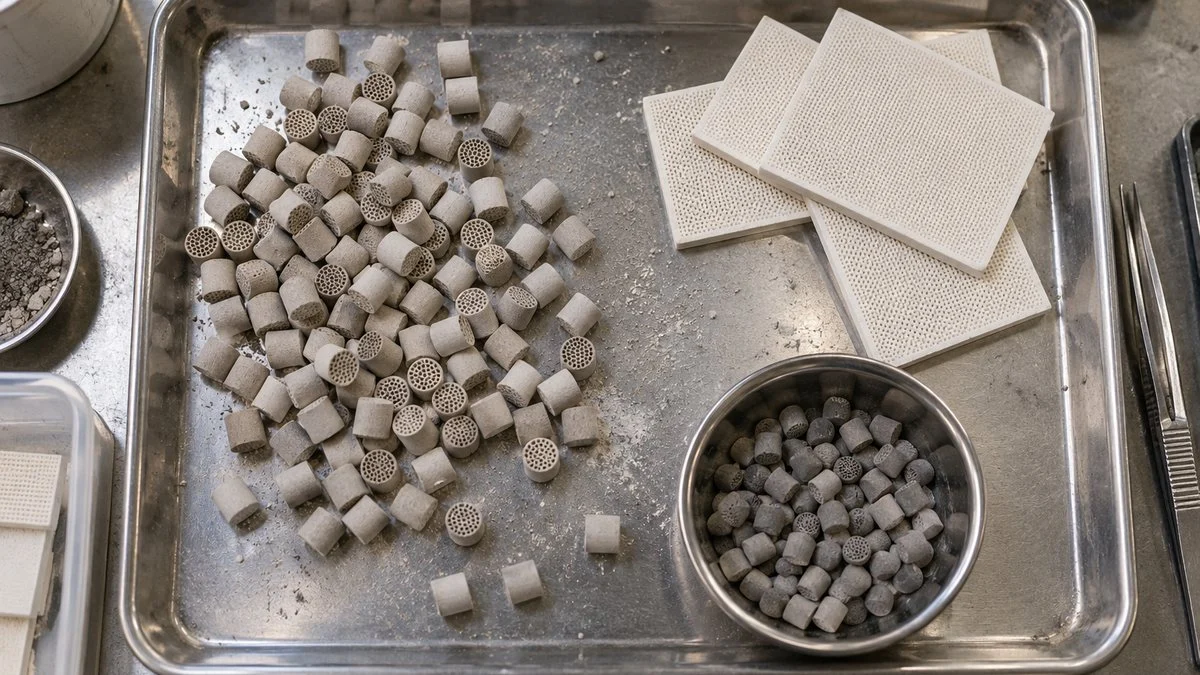
The current growth driver is semiconductors. In the first quarter of FY2026 (April–June 2026), JGC reported strong sales of products for semiconductor manufacturing equipment, driven by demand from generative AI and data centers. For silicon nitride substrates used in EV power units, JGC says its own process beats conventional methods on both performance and cost. Japan Fine Ceramics has started production at a new plant in Tomiya, Miyagi Prefecture, to raise output, and in the first quarter JGC reported recovering demand and rising utilization there. JGC Catalysts and Chemicals has also started developing additional sites in Kitakyushu and Niigata Prefecture to expand production of semiconductor-related fine chemicals.
Recent Projects and the BSP2030 Plan
Plant projects take a long time to move from selection to a signed contract, so it helps to sort the news by stage: what is contracted, and what is still under negotiation or development.
Confirmed contracts and handovers are listed separately from projects still in negotiation or development.
Sources: JGC Holdings news releases (December 8, 2025; March 31, May 26, June 8, and September 29, 2026) and Medium-Term Business Plan BSP2030 (May 14, 2026). Amounts are as stated in each release.
With Phase 2, LNG Canada adds liquefaction trains next to the Phase 1 site, doubling total capacity to about 28 MTPA, according to JGC's Japanese release. Coral North follows Coral South with the same three-company team.
BSP2030 Targets and Three Key Strategies
JGC announced its medium-term business plan, BSP2030 (FY2026–FY2030), on May 14, 2026. Its targets for FY2030 are operating profit of JPY 60 billion, net profit of JPY 50 billion, and ROE of 10% or higher. Over the five years, JGC plans about JPY 280 billion in growth investment, including M&A, while keeping an equity ratio of 50% or higher.
The plan has three key strategies:
- Total Engineering competitiveness. Stabilize earnings by strengthening risk management on lump-sum projects (dedicated review teams and committees), reducing EPC risk through FS and FEED work, standardizing EPC schedules, and expanding revamp and maintenance work. More EPC execution resources at JGC India are part of this.
- Functional Materials growth. Expand sales in semiconductor-related markets and develop overseas markets.
- Solution-based business. CO2 capture modules, CO2 batteries, digital plant maintenance, and biomanufacturing that uses microbes to make materials from CO2.
The aim is to depend less on a few large EPC projects and make earnings less volatile. Separately, domestic SAF (sustainable aviation fuel) made from used cooking oil has been supplied since FY2025 from a facility of a company JGC has invested in. BSP2030 also names a shortage of experienced engineers and the difficulty of passing knowledge to the next generation as issues. In the first quarter of FY2026, JGC started joint development of an automated engineering tool with UK-based Configuring Ltd., which digitizes veteran engineers' know-how to improve design efficiency. In Southeast Asia, JGC is targeting semiconductor and data-center projects with Exyte under the Nixyte brand.
JGC vs. Chiyoda vs. Toyo Engineering
JGC, Chiyoda Corporation, and Toyo Engineering are Japan's three major plant-focused EPC contractors, and all three depend on large overseas projects. JGC is the largest by sales and the only one with a manufacturing business. For a full profile of Toyo Engineering, including its urea technology and India center, see Toyo Engineering: Japanese EPC, Urea Tech, and Toyo-India.
JGC is the largest by sales; Chiyoda had the highest profit that year.
Consolidated figures from each company's results for the year ended March 2026 (JGC and Toyo call it FY2025). Chiyoda's net sales are its completed-construction revenue. Toyo's new contracts exclude equity-method affiliates.
Chiyoda is also strong in LNG. Its record profit came mainly from improved results on Golden Pass LNG in the US, but it forecasts sales of JPY 340 billion and operating profit of JPY 10 billion for the year ending March 2027, so its results swing with the progress of large projects just as JGC's do. Toyo Engineering's largest sales lines are petrochemicals (JPY 65.1 billion) and chemicals and fertilizers (JPY 44.2 billion), and a gas-fired power project in Brazil pushed it to an operating loss.
Working with JGC as a Supplier
For equipment makers, trading companies, and contractors, JGC is a large buyer that sources equipment and materials worldwide. Because it takes fixed-price risk, expect strict requirements on delivery dates and cost. Who you deal with, and which rules apply, depends on the entity and the project.
Project joint ventures can run their own supplier registers. For example, the JGC Fluor joint venture in Kitimat asks companies to fill out an introductory questionnaire for its contracting and procurement register. The joint venture states that registering does not prequalify a company and does not guarantee a request for quotation. So treat any registration as an introduction, and ask what prequalification the specific package requires.
Demand in Japan is steadier. JGC Japan handles maintenance and revamp work at refineries and chemical plants, as well as pharmaceutical and food plant construction. Much of the maintenance work centers on planned shutdowns; see Teishu (Plant Turnaround) in Japan.
Checklist Before You Quote to a JGC Entity
- Issuing entity: JGC Corporation, JGC Japan, JGC India EPC, JGC France, a project joint venture, or a partner company. Confirm which one will place the purchase order
- Project stage: FS or FEED, EPC candidate or bid, or after FID and NTP. Earlier stages usually mean budget pricing, not a firm order
- Owner and site: the end user, the plant location, and any owner vendor list or specifications that apply
- Contract basis: lump-sum or partly cost-plus, and how that affects price validity, escalation, and change orders
- Delivery point: plant site or module fabrication yard, and the transport route and constraints
- Technical review: where your documents will be reviewed (Yokohama, Chennai, a partner's office) and the review cycle
- Documents and inspection: project specifications and revisions, vendor document schedule, approval drawings, factory inspection and witness testing
Related guides: approval drawings (shonin-zu), deviation lists, and FAT vs. SAT checklists.
Questions to Ask the JGC Team
- Which entity will issue the purchase order, and who is our commercial contact?
- Is this inquiry for FEED or budget pricing, or for a firm purchase after FID?
- Is there a supplier register or prequalification process for this project, and is it run by JGC or by the joint venture?
- Does the owner have an approved vendor list for this package? Are we on it?
- Which project specifications, codes, and data sheets apply, and which revision is current?
- Will our equipment be delivered to a module yard or to the site, and when is the latest delivery date?
- Will factory inspection or witness testing be required, and who will attend?
Sample Email: Confirming Scope on a JGC Inquiry
Use this when you receive an inquiry and need to confirm the basics before quoting. Replace the bracketed parts.
Subject: [Inquiry no.] - [product category] for [project name]

Dear [Name],

Thank you for your inquiry [no.] for [product category] on
[project name]. Before we prepare our quotation, could you
please confirm the following:

1. The entity that will issue the purchase order
   (e.g., JGC Corporation, JGC India EPC, or the project JV)
2. The project stage (FEED / budget pricing, or firm purchase)
3. Whether the owner's vendor list or a JV prequalification
   applies to this package
4. The applicable specifications and data sheets, with revisions
5. The delivery point (module yard or site) and required date
6. Inspection and witness testing requirements

We will submit our quotation by [date] once we have this
information.

Best regards,
[Name], [Title]
[Company], [Phone], [Email]
Limits of This Guide
- Figures come from JGC's English-language reports for FY2025 (year ended March 31, 2026) and the first quarter of FY2026, its medium-term plan BSP2030, and news releases up to September 2026. Later results may differ. Amounts are in yen or US dollars as reported.
- Market shares and the "over 30% of world LNG production" figure are JGC's own claims.
- Chiyoda and Toyo figures come from those companies' results for the same year. The "main fields" descriptions are MONOSCOPE's summary.
- Procurement rules, supplier registers, and contract terms vary by project, joint venture, and owner. The checklist covers what to ask, not how any specific JGC entity operates.
- This guide is not investment advice.
FAQ
What Is the Difference Between JGC Holdings, JGC Corporation, and JGC Japan?
JGC Holdings Corporation is the listed parent company, created when the group moved to a holding company structure in October 2019. JGC Corporation is the operating company under it that runs overseas EPC projects. Domestic EPC and maintenance in Japan belong to a separate company, JGC Japan Corporation.
What Does JGC Corporation Do?
JGC Corporation designs, procures, and builds plants outside Japan, mainly LNG, oil and gas, and chemical facilities, and also works on pharmaceutical and infrastructure projects. It often works in joint ventures, such as the JGC Fluor joint venture for LNG Canada.
What Does JGC India Do?
JGC India EPC Private Limited is a JGC group company in Chennai, set up in 2022. It started with detailed engineering for JGC's large overseas EPC projects, and JGC's BSP2030 plan calls for strengthening its EPC execution resources.
Is There a JGC Vendor Registration?
Registration can be project-specific. The JGC Fluor joint venture for LNG Canada, for example, runs its own introductory questionnaire and states that being on its register does not prequalify a company. Ask the issuing entity which register or prequalification applies to your package.
Which Is Bigger, JGC or Chiyoda?
By sales, JGC is bigger: JPY 745.2 billion versus JPY 493.9 billion for Chiyoda in the year ended March 2026. That same year, however, Chiyoda's operating profit was higher, at a record JPY 82.1 billion against JGC's JPY 35.3 billion.
Sources
- Results, segments, and sales by region and business: JGC Holdings, Annual Financial Results FY2025
- Orders, backlog, Middle East impact, forecasts, and historical data: JGC Holdings, Outline of Financial Results FY2025 (May 14, 2026)
- First-quarter FY2026 developments: JGC Holdings, Outline of Financial Results 1Q FY2026 (August 2026)
- Medium-term plan: JGC Holdings, Medium-Term Business Plan BSP2030 (May 14, 2026)
- Company profile, group companies, and history: Company Profile, JGC Corporation, History
- LNG track record and material shares: JGC Group at a Glance, LNG
- Modular construction: JGC Group's Modular Construction Method
- LNG Canada: Train 2 handover (December 8, 2025), Phase 2 notice to proceed (September 29, 2026)
- Coral North FLNG: JGC news release (June 8, 2026)
- Papua LNG: JGC news release (March 31, 2026)
- FLNG standard design package: JGC news release (May 26, 2026)
- JGC India: LNG Prime, "Japan's JGC forms new unit in India"
- JGC Fluor supplier register: JGC Fluor BC LNG JV, Contractor/Supplier Registration Process
- Chiyoda results: Chiyoda Corporation, results summary for the year ended March 2026 (Japanese)
- Toyo Engineering results: Toyo Engineering, results summary for FY2025 (May 14, 2026) (Japanese)
Original article in JapaneseThis guide is adapted from a MONOSCOPE article written for readers in Japan: 日揮ホールディングスとは|LNGプラントに強いEPCの特徴と事業構造
About the editor
 MONOSCOPE EditorFOUNDER & EDITOR
Spent about ten years at a plant equipment maker and a plant engineering company, proposing, designing, and commissioning equipment, then moved into web marketing. Now a web consultant for B2B manufacturers, helping them explain their products and technology. Licensed in Japan as an Energy Manager and a Third-Class Chief Electrical Engineer.
Has run an engineering blog since 2017 (500+ articles) and a Japanese YouTube channel with about 20,000 subscribers. Each English guide is written from the Japanese shop-floor point of view and checked against the cited standards.