Japanese Sales Engineers and FAEs: Roles and Handoffs
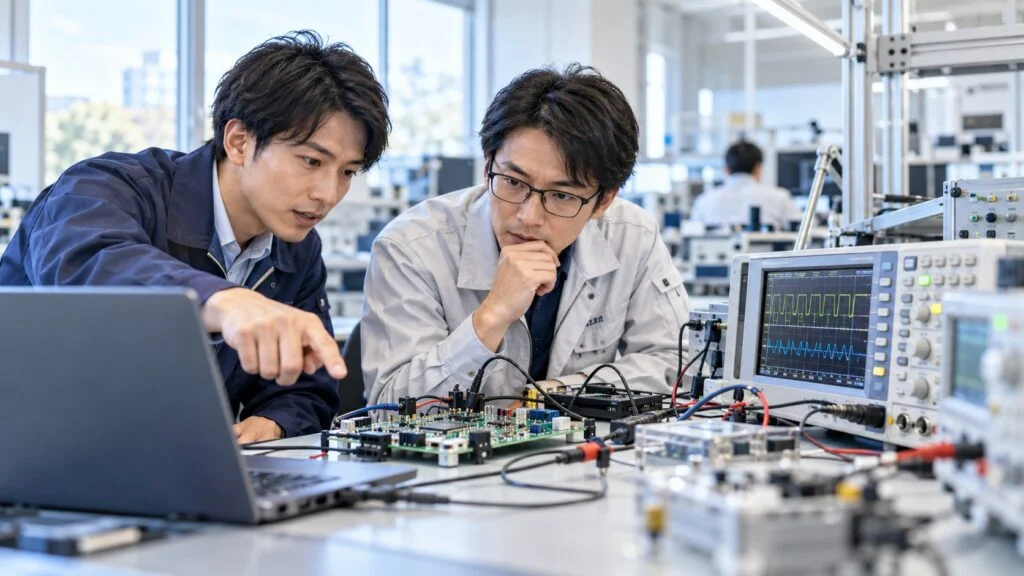
You asked your Japanese supplier whether a part could run at a higher temperature, or why a sensor kept failing on your line. Your contact answered quickly at first, then said, "I will check with our design team." Two weeks later, you are still waiting. That contact is usually a gijutsu eigyo (技術営業, technical sales), also called a sales engineer, or, at electronics and semiconductor suppliers, an FAE (field application engineer).
The short answer: a Japanese sales engineer or FAE is your technical front door, but often not the person who makes the final call. They turn your requirements into technical conditions, propose products, support evaluation, and carry your problems to design, quality assurance, and production. Knowing what they can handle alone, and what they must hand off, makes your requests faster to answer.
This guide covers what these roles do, what you can ask them for, how they hand work off inside the company, why answers take time, and how they differ from regular sales, design engineers, and service engineers. It ends with a checklist and an email template.
Contents
- What Gijutsu Eigyo and FAEs Are
- What You Can Ask a Japanese Sales Engineer or FAE For
- How They Bridge You to Design, QA, and Production
- Why Answers from a Japanese Sales Engineer Take Time
- FAE vs. Sales Engineer vs. Other Roles
- Checklist: Before You Contact Your Sales Engineer or FAE
- Email Template: Technical Request to a Japanese Supplier
- Where This Guide Does Not Apply
- FAQ
- Sources
What Gijutsu Eigyo and FAEs Are
A gijutsu eigyo, or sales engineer, uses product and technical knowledge to propose the company's products to customers and supports them through adoption. You will meet them at Japanese companies that sell industrial products: machine tools, factory automation (FA) equipment, measuring instruments, electronic components, and chemical materials. In all of these industries, customers buy only after someone explains performance and usage, and technical judgment often decides the purchase.
An FAE is a similar role, and the term is used mainly in semiconductors and electronic components. FAEs help the customer's design engineers use the parts and design their circuits, with the goal of getting the parts designed into the customer's product. Japanese job sites often treat "technical sales," "FAE," and "sales engineer" as near-synonyms, so check what your contact actually does rather than relying on the title.
Your contact may work for one of three types of company:
- A manufacturer that makes the product
- A technical trading company (gijutsu shosha) that sells products from several makers
- An electronics trading company (distributor) that handles semiconductors and electronic components
An FAE at a trading company sits between you and the engineers at the maker it buys from. That adds one more step to every technical question that the FAE cannot answer alone. For how Japanese FA makers, distributors, and system integrators split the work, see Japanese Factory Automation: Makers, Distributors, SIers.
Other titles you may see include "application engineer," "technical sales," and "pre-sales." The same title can also cover very different scopes depending on company size.
The same job title can cover a different scope depending on company size and type.
How work is divided varies by company. Use this as a rough guide.
At a large maker, you may talk to one person for the proposal and a different specialist team for technical support. At a smaller maker or trading company, one person often handles everything from the quote to startup. Neither is better. The large-maker contact goes deeper on one product line. The small-company contact covers more products and can pull a whole job together.
What You Can Ask a Japanese Sales Engineer or FAE For
The job does not end at the sale. A sales engineer moves back and forth between four kinds of work, from hearing your problem to following up after adoption. Each one is something you can ask for.
The role covers technical work before and after the proposal, not just the sale.
Turning Your Problem into Technical Conditions
The first job is to understand exactly what you need. A good sales engineer turns requests like "we want to machine faster" or "we need less noise" into technical conditions such as dimensions, accuracy, speed, and temperature. They often talk directly with your design and production engineers, not only with purchasing, and they ask questions at an engineer's level.
If conditions are missed at this stage, the proposed product can turn out to be unusable later. Expect questions about the operating environment, the surrounding equipment, and future production increases. Answer them fully, even when they seem early. They are not a stalling tactic.
Product Selection and Technical Proposals
Once the conditions are clear, the sales engineer selects products from the company's lineup and puts together a proposal and quote. A good proposal does more than list catalog specifications. It explains why the product will solve your problem, backed by calculations or past cases.
Quotes usually cover not only the product price but also peripheral equipment, installation, and maintenance. Compare offers on total cost, including costs after installation. On that basis, a higher-priced product can sometimes be the better deal.
If no standard product fits, the sales engineer may ask the in-house design department to study a custom specification. A good contact tells you early and honestly what can and cannot be done. For how a Japanese supplier handles an RFQ (hikiai) internally, see RFQ to a Japanese Manufacturer: The 7-Step Hikiai Process.
Evaluation and Startup Support
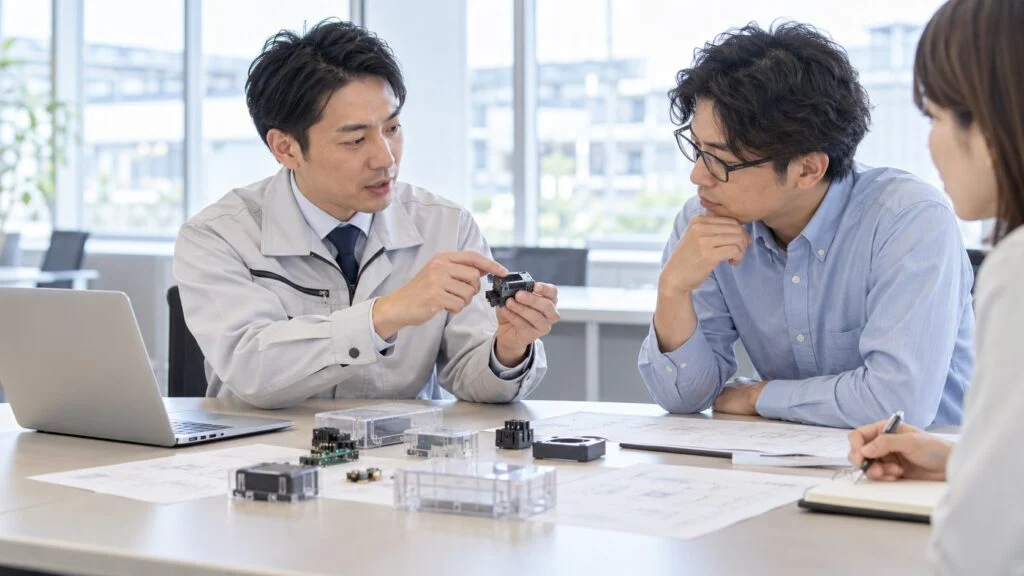
When you move to evaluation, you can ask for loaned samples or a demo on real equipment. An FAE will check with you whether the parts work as intended on your prototype board and advise on circuit or setting changes.
If results are poor, a good sales engineer works with you to find out whether the cause is the product itself or the way it is used and the surrounding conditions. Share your test setup and data so they can do this.
After adoption, many sales engineers also attend startup: equipment installation, initial settings, and operator instruction. This is when they spend the most time on your floor, and how they handle it often decides whether they win the next order.
Troubleshooting and Feedback to Development
When a problem appears after mass production or operation starts, the sales engineer is almost always the first person the customer calls. They gather the details, investigate the cause together with quality assurance (QA) or design, and explain the countermeasures to you.
Problem reports sometimes come in at night or on weekends. A good sales engineer first gets an accurate picture of the situation, then separates the interim action (keep your line running) from the permanent fix. Ask for both, with separate dates.
Your requests and complaints also matter beyond your case. The sales engineer brings customer feedback back to the company, and it feeds into the next product development. If you need a feature or change, telling your sales engineer is the most direct way to reach the product planners.
The balance between field and office work varies by company and season, but customer visits, document work, and internal coordination usually carry about equal weight. A sales engineer at an FA equipment maker might spend the morning in a meeting at one customer's plant about a new line, check sensor operation at another customer after lunch, and write quotes and technical documents back at the office in the evening. An FAE spends more time on evaluation and prototyping to fit customers' development schedules, and on some days reproduces a customer's problem in the company lab to investigate it.
How They Bridge You to Design, QA, and Production
Inside the company, the sales engineer is the link between you and the departments that can actually change a design, investigate a defect, or move a delivery date.
The sales engineer is your point of contact for the departments behind them.
Some makers deal with customers directly, without a trading company.
First, the sales engineer is the company's front line for winning business. Proposals backed by technical evidence keep the company out of price-only competition.
Second, think of the sales engineer as an interpreter. They turn your words into specifications the designers can work with, and they explain the company's technical limits in terms you can accept. They deal with mechanical design, QA, and quality control (QC) almost daily. On delivery dates, they work through the production schedule with production control (seisan kanri). For a map of Japanese departments and who handles what, see Japanese Factory Departments: Who Is Who and Whom to Ask.
Third, the sales engineer collects market information: how products are used and what competitors propose. That information can shape product planning and R&D. Your feedback reaches the company through this channel. Sales engineers are judged not only on sales targets but on customer satisfaction and technical trust, so being the person customers turn to for solutions is their real selling power.
Why Answers from a Japanese Sales Engineer Take Time
A slow answer often means your question has left the sales engineer's desk. Common reasons:
- Custom specifications need design. If no standard product fits, the design department has to study the request.
- Defects need QA. The sales engineer gathers the facts, then investigates the cause together with QA and design.
- Delivery dates need production control. The sales engineer has to adjust the production schedule with production control before committing.
- Promises must hold on both sides. An overcommitment burdens the company, and refusing too often loses orders. A careful sales engineer checks before promising.
- Trading companies add a step. An FAE at a trading company may need to go to the maker's engineers.
- Problems may need to be reproduced. An FAE may rebuild your issue in the lab before answering.
You can shorten the wait. Send complete conditions in one written list, say which decision depends on the answer, and ask for an interim reply with the expected date of the full answer. Approvals inside Japanese companies can add time as well; see Ringi in Japan: Why Approvals Are Slow and How to Help.
FAE vs. Sales Engineer vs. Other Roles
Because the role sits between sales and engineering, it is easy to confuse with three others. The table shows the difference in purpose and in how deeply each one deals with the technology.
Look at the purpose and how deeply each role deals with the technology.
At some companies, one person covers several of these roles.
Regular Sales
Regular sales staff focus on closing business by negotiating price, delivery, and terms. Sales engineers start from your technical problem and explain performance and usage. Many studied science or engineering, or moved over from design or development, though some from non-technical backgrounds also build strong product knowledge. Where regular sales tracks the number of accounts and visits, a sales engineer may spend months or years on one opportunity before the product is adopted.
Design and Development Engineers
Design engineers create the product from scratch and think about how to build it. A sales engineer selects existing products for your application and helps you use them well, thinking about what the product can solve for you. Their technical depth may not match the designers', but they know many products and many customer cases across the board. When you need a design change, the sales engineer is the route to the designer, not a replacement.
Service Engineers
Service engineers (also called field engineers) maintain, inspect, and repair machines and equipment after delivery. They also visit your site, but their job is to keep installed equipment running. Sales engineers focus on proposals and evaluation before adoption, and usually hand after-sales work to the service department. At smaller companies, one person may do both. Information on defects and ease of use that service engineers gather in the field feeds directly into the sales engineer's next proposal, so the two teams ideally share it regularly even when they sit in different departments.
Checklist: Before You Contact Your Sales Engineer or FAE
Give your contact what the design, QA, or production team will ask for. This cuts out rounds of questions.
- Purpose: what problem you are solving and what decision depends on the answer
- Technical conditions: dimensions, accuracy, speed, temperature, and any other limits
- Operating environment and surrounding equipment
- Quantity now and expected future increases
- Drawings or specifications with revision numbers
- For evaluation: test setup, prototype details, and measured data
- For a problem: symptom, when it started, how often, lot or serial numbers, and photos
- For a problem: whether you need an interim action first, and by when
- Deadline for an interim reply and for the full answer
- Who on your side the design or QA team can talk to directly, if needed
Email Template: Technical Request to a Japanese Supplier
Adapt this template for a technical question or a problem report. Short, numbered items are easier to forward internally and to translate.
Subject: Technical request – [product/part number] – reply requested by [date]

Dear [Name],

Thank you for your support. We would like your help with the following.

1. Background
   [What we are trying to do / what happened, in 2-3 sentences]

2. Conditions
   - Application: [ ]
   - Dimensions / accuracy / speed / temperature: [ ]
   - Operating environment and connected equipment: [ ]
   - Quantity: [now] / [expected in the future]
   - Drawing or spec: [number, revision]

3. Questions
   (1) [ ]
   (2) [ ]

4. For problem reports
   - Symptom and when it started: [ ]
   - Lot / serial numbers: [ ]
   - Interim action needed by: [date]

5. Timing
   Please send an interim reply by [date] with the expected date
   of your full answer. If your design or quality team needs to talk
   with our engineers directly, please contact [name, email].

Best regards,
[Name]
[Company]
Where This Guide Does Not Apply
- Roles and scope vary by company. The same title can mean a proposal specialist at one company and a one-person team at another.
- Some makers sell directly, with no trading company or distributor in between.
- At smaller companies, one person may combine sales, sales engineering, and service.
- Who can commit to specifications, prices, and dates depends on each company's internal rules. Ask your contact who makes the final decision.
FAQ
What does gijutsu eigyo mean?
Gijutsu eigyo (技術営業) means technical sales. It is the Japanese term for a sales engineer: someone who uses technical knowledge to propose products and supports the customer through adoption.
What is the difference between an FAE and a sales engineer?
The roles overlap. "FAE" is used mainly in semiconductors and electronic components, where the job centers on helping the customer's designers use the parts so they are designed into the product. "Sales engineer" is the broader term used across machinery, FA, instruments, and materials.
Can a Japanese sales engineer commit to a custom specification?
Usually not on the spot. A custom specification goes to the design department for study, so expect the sales engineer to check before committing. Ask who will approve it and when.
Why is my Japanese supplier slow to answer technical questions?
The question often has to go to design, QA, production control, or, for a trading company, the maker's engineers. Sending complete conditions in one list and asking for an interim reply date speeds things up.
Who handles repairs after delivery?
Usually the service department and its service engineers. The sales engineer focuses on proposals and evaluation before adoption, though at smaller companies one person may handle both.
Sources
- FAE and technical sales as related job titles: doda, "Technical Sales (FAE)" job guide (Japanese)
- Role descriptions, work content, and comparisons with other roles: MONOSCOPE Japanese edition, "What Is Technical Sales / FAE?" (Japanese)
Original article in JapaneseThis guide is adapted from a MONOSCOPE article written for readers in Japan: 技術営業・FAEとは?仕事内容・役割・他職種との違いを実務目線で解説
About the editor
 MONOSCOPE EditorFOUNDER & EDITOR
Spent about ten years at a plant equipment maker and a plant engineering company, proposing, designing, and commissioning equipment, then moved into web marketing. Now a web consultant for B2B manufacturers, helping them explain their products and technology. Licensed in Japan as an Energy Manager and a Third-Class Chief Electrical Engineer.
Has run an engineering blog since 2017 (500+ articles) and a Japanese YouTube channel with about 20,000 subscribers. Each English guide is written from the Japanese shop-floor point of view and checked against the cited standards.