Japanese Carbon Fiber Manufacturers: How Japan Took the Lead
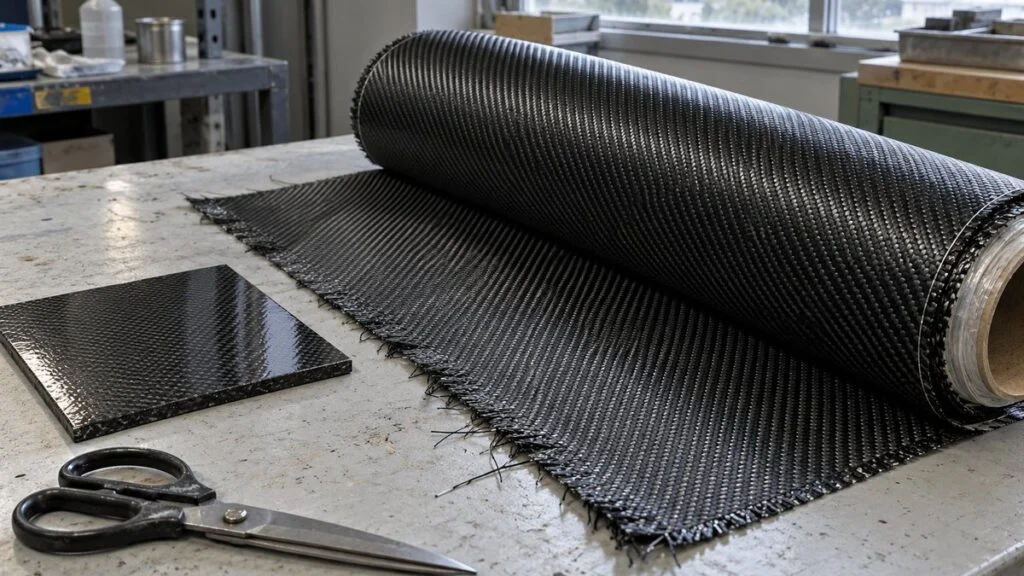
Carbon fiber shows up in golf club shafts, bicycle frames, and the wings and fuselage of the Boeing 787. This article covers carbon fiber made from PAN (polyacrylonitrile). Toray, Teijin, and Mitsubishi Chemical are among the best-known suppliers of it, and some of the fiber in those products may well have come from them.
This article explains how Japanese companies built that position, starting with a government lab in Osaka in 1959. It then walks through how the fiber is made, what grade names such as T700S and T800S mean, and where competition now comes from. It ends with what to check when you specify carbon fiber reinforced plastic (CFRP) for a part.
We did not interview anyone for this piece. It is based on company data sheets, investor materials, industry association pages, and press reports, all listed at the end. The grade examples focus on Toray and are not a comparison of the three suppliers.
Contents
- Where PAN Carbon Fiber Came From: Osaka, 1959
- From Fishing Rods to Primary Structure
- How PAN Carbon Fiber Is Made
- TORAYCA Grades Explained: T300, T700S, T800S, T1100G
- How Big the Japanese Makers Are: Reported Figures
- Competition From China and Others
- Why It Matters If You Specify CFRP
- Limits of This Article
- FAQ
- Sources
Where PAN Carbon Fiber Came From: Osaka, 1959
The first high-strength carbon fibers of the 1950s were made in the US from rayon. According to a WIPO case study, only about 20% of the rayon ended up as carbon, which made the fiber expensive.
In 1959, Dr. Akio Shindo, a carbon researcher at the Government Industrial Research Institute, Osaka (GIRIO), tried a different starting material: PAN, the polymer used in acrylic textile fiber. WIPO reports that he heated PAN fiber in air at about 250°C and then carbonized it at around 1,000°C, with a carbon yield of 50–60%.
GIRIO is now part of AIST Kansai, a branch of Japan's National Institute of Advanced Industrial Science and Technology.
Shindo filed a Japanese patent on September 7, 1959, which was granted in 1962. He published his results in a 1961 GIRIO report. In the UK, researchers at the Royal Aircraft Establishment developed a high-modulus PAN process in the early 1960s and filed a patent in 1964, so Japan was not the only country working on the idea.
Three Companies, Three Different Routes
It is easy to assume that Japan's carbon fiber makers all grew from Shindo's patent. The history published by the Japan Carbon Fiber Manufacturers Association (JCFA) shows a more mixed picture:
- Toray began carbon fiber research in 1961, licensed Shindo's patent in 1970, and started commercial production under the TORAYCA name in 1971.
- Toho Rayon (later Toho Tenax, now part of Teijin) started precursor and carbon fiber research in 1969, ran a pilot line from 1972, and began commercial production in 1975. The JCFA notes that it developed its process in-house.
- Mitsubishi Rayon (now Mitsubishi Chemical) started with intermediate materials made from imported fiber in 1976, brought in technology from Hitco in the US in 1977, and began carbonizing its own fiber in 1981. The JCFA notes that it did not license Shindo's technology.
Toray had made acrylic fiber, the starting material for PAN precursor, since 1959. Its first big carbon fiber market was not aircraft but sporting goods, as the next section shows.
Both of the older company names have since changed. Teijin took a stake in Toho Rayon in 1999 and merged Toho Tenax into Teijin Limited in April 2018; the fiber is still sold as Tenax. On April 1, 2017, Mitsubishi Rayon, Mitsubishi Plastics, and the old Mitsubishi Chemical merged into Mitsubishi Chemical Corporation, and the group's carbon fiber is sold under the PYROFIL brand.
Selected milestones in time order from company, association, and WIPO sources. Each company reached commercial production by a different route.
Sources: JCFA company history chart; WIPO "PAN Carbon Fiber" case study; Toray data sheet and Composite Materials Research Laboratories page; WIPO "PAN Carbon Fiber" case study; Boeing release (May 26, 2004); Toray CMA release on the 2015 agreement (November 10, 2015); CompositesWorld summary of the ATA 2025 market report; Mitsubishi Chemical Group release (December 15, 2025); Teijin Medium-Term Management Plan (May 11, 2026).
From Fishing Rods to Primary Structure
In Japan, early PAN carbon fiber found its first markets in sporting goods, where light weight sold well.
The JCFA chart records a carbon fiber fishing rod made with TORAYCA shown at a trade fair in 1972. WIPO notes that Gay Brewer won the Taiheiyo Club Masters in Japan in October 1972 using carbon shafts, that Toray launched a golf shaft line in 1973, and that Toray's monthly output had more than doubled by the end of 1974.
Aircraft took longer, because structural materials must be approved for each application. In general, approval covers a defined material system (fiber plus resin) and manufacturing process under the aircraft maker's specifications. Boeing says Toray has supplied it since 1977.
Toray states that its T800H/3900-2 prepreg (fiber already impregnated with resin) was the first carbon fiber material qualified, in 1990, for primary structure on Boeing's civil aircraft. Primary structure means parts that carry flight loads, such as the tail and wing. Boeing's 2004 release says the material had proven performance on 777 parts such as the empennage (tail assembly) and floor beams.
The Boeing 787
In May 2004, Boeing named Toray to supply TORAYCA prepreg for the primary structure of the 7E7, later renamed the 787 Dreamliner. A comprehensive supply agreement followed in November 2005. In 2015, the two companies extended it and added the 777X wing, with Toray said the expected value of prepreg supplied for both programs over the contract period would exceed JPY 1.3 trillion. (An earlier 2014 report of the preliminary agreement cited more than JPY 1 trillion.)
Boeing's history page says composites make up as much as 50% of the 787's primary structure, including the fuselage and wing. Toray's prepreg has been used for part of that structure from the start of the program, although the sources we used do not quantify its share. For Toray, that tied part of its business to a large, long-running aircraft program.
For a supplier, that kind of link can matter as much as fiber properties. Once a material system is approved on an aircraft, a change of fiber, sizing, resin, or production site can require additional testing and approval. The scope depends on the change and the customer's specification.
This approval process is one reason early positions in aerospace grades are hard for newcomers to take over.
Teijin has its own aerospace record. Its fact book says Airbus qualified Tenax thermoplastic consolidated laminates as a primary structural material for the A350 XWB in 2014, and Boeing qualified its carbon thermoplastic unidirectional tape for primary structural parts in 2019.
For quality systems in this supply chain, see our guide to JIS Q 9100 vs. AS9100 for Japanese aerospace suppliers.
How PAN Carbon Fiber Is Made
The basic steps are public and similar across makers. The JCFA describes them as polymerization, spinning, stabilization, carbonization, and, for some grades, graphitization. Toray's product pages add surface treatment and sizing at the end of the line.
Temperatures are general ranges given by the Japan Carbon Fiber Manufacturers Association. Detailed conditions vary by maker and grade and are not covered here.
Sources: JCFA, "How carbon fiber is made" (Japanese); Toray Composite Materials America, carbon fiber product page. The plain-language notes on why each step is needed are our summary.
For a buyer, the last two steps are easy to overlook. Toray's US arm says its fiber comes with different surface treatment levels and several sizing types for different resin systems. It notes that lower sizing amounts help the tow spread, while higher amounts suit demanding processing.
So two spools of the same grade can behave differently in your process. Check the supplier's data sheet and ordering documents for the grade's properties and for the filament count, twist, sizing, and surface treatment.
TORAYCA Grades Explained: T300, T700S, T800S, T1100G
Toray's grade names are widely used, so they make a useful reference. They are Toray product names, not universal carbon fiber classes. Its US technical manual (2020 revision) describes the main ones this way:
- T300: described as a baseline aerospace fiber with more than 20 years of service history as of 2020.
- T700S: described as "an industry standard" high-strength, standard-modulus fiber for filament winding, weaving, and prepreg, used in products such as natural gas vehicle tanks and breathing-air tanks.
- T800H and T800S: intermediate-modulus fibers used in primary structure of commercial aircraft. Toray describes T800S as a cost-effective option with higher tensile strength than T800H.
- T1000G and T1100G: very high-strength fibers. Toray lists uses such as pressure vessels, space, aircraft, and sporting goods.
The chart compares the tensile strength of selected TORAYCA grades. These are fiber values measured by the impregnated strand method, a test of resin-soaked fiber bundles; Toray says they are for material selection only.
Dark bars are data sheet values. The light T1200 bar is converted from the 1,160 ksi in Toray's 2023 development announcement, so its test basis and availability may differ.
Sources: TORAYCA yarn data sheet; Toray Composite Materials America carbon fiber page; Toray CMA release on T1200 (October 30, 2023). 1,160 ksi is about 8,000 MPa.
Tensile strength alone is not enough to choose a fiber. The table adds tensile modulus (stiffness) and the tow sizes Toray lists for each grade.
| Grade | Toray category | Tensile strength | Tensile modulus | Tow sizes listed |
|---|---|---|---|---|
| T300 | Standard modulus | 3,530 MPa | 230 GPa | 1K, 3K, 6K, 12K |
| T700S | Standard modulus | 4,900 MPa | 230 GPa | 6K, 12K, 24K |
| T800S | Intermediate modulus | 5,880 MPa | 294 GPa | 12K, 24K |
| T800H | Intermediate modulus | 5,490 MPa | 294 GPa | 6K, 12K |
| T1100G | Intermediate modulus | 7,000 MPa | 324 GPa | 12K, 24K |
Three points help when you read these numbers:
- Fiber values are not laminate values. Toray's 3900-series data sheet lists a 0° tensile strength of 3,006 MPa (room temperature) for a T800S-24K unidirectional prepreg laminate, compared with 5,880 MPa for the fiber alone. The two values come from different test specimens, so do not use their ratio as a conversion factor. For structural design, use laminate data for your material and process and, where required, approved design allowables.
- Tow size is a cost and handling choice. Toray lists common sizes from 1,000 to 36,000 filaments per tow. Small tows suit thin, fine woven fabrics. Larger tows lay down more material per pass. Toray entered large-tow fiber, which it described as 40,000 or more filaments, by buying Zoltek of the US in 2014, and supplies ZOLTEK PX35 for wind turbine blades.
- Twist and sizing matter. Toray offers twisted, untwisted, and never-twisted fiber, and says never-twisted fiber generally gives higher strength.
Teijin (Tenax) and Mitsubishi Chemical (PYROFIL) use their own grade names. Buyers often compare grades across makers by strength and modulus class, but similar numbers do not make two fibers interchangeable on a qualified part.
How Big the Japanese Makers Are: Reported Figures
Reliable company-by-company share data is hard to find in public sources, and capacity figures depend on how they are counted. Here is what the sources we checked say, with their dates:
- Toray: a WIPO case study (updated 2026) says that as of 2025 Toray was the world's largest carbon fiber manufacturer, with group capacity approaching 58,000 tons a year at sites in Japan, the US, France, and South Korea.
- Teijin: its fact book lists Tenax production sites in Japan, Germany, and the US. In its May 2026 mid-term plan, Teijin said it would optimize lines in Japan, the US, and Europe, including a North American plant suspension in January 2026, and focus on the aircraft business. The plan does not list affected grades or a restart date.
- Mitsubishi Chemical Group: in December 2025 it announced a phased plan to roughly double its production capacity for high-performance carbon fiber at its Tokai Plant in Toyohashi, Japan, and its Sacramento plant in California, in phases from 2025 to 2027.
The companies are not moving in the same direction. Mitsubishi Chemical is expanding high-end output, while Teijin is cutting fixed costs. Teijin's plan states that the supply-demand gap for carbon fiber is widening and that it expects prices to keep falling in recreational and industrial uses.
Competition From China and Others
The biggest change in the market is Chinese capacity. CompositesWorld, summarizing the 2025 global market report by Lin Gang of ATA Carbon Fiber Technology, reports that China's operating carbon fiber capacity reached 171,080 metric tons in 2025. That is 52.5% of a global total of 326,080 metric tons, and the first time China has passed half.
The Toray figure above comes from a different source and may use a different definition of capacity, so do not compare the two numbers directly.
Capacity is not the same as output, and it says little about grade or about how much Japanese supply is being replaced. Separately, Teijin's plan expects prices to fall in recreational and industrial uses, while it describes air passenger demand as still growing. In aircraft, a new fiber must first build an approval record for each material system.
Japan is not the only established source outside China. Hexcel makes its own PAN precursor in Alabama and HexTow fiber in Utah. SGL Carbon makes SIGRAFIL fiber in Moses Lake, Washington, from precursor made in Portugal.
Some composite material makers buy fiber instead: Toray's US arm, for example, supplies high-strength and intermediate-modulus fiber to Syensqo under a five-year agreement that started in January 2026.
For a wider view of materials where Japanese suppliers hold strong positions, see where Japan holds top global share in materials and equipment.
Why It Matters If You Specify CFRP
If you design or buy CFRP parts outside Japan, the history above has practical effects. Your fiber choice can tie you to a supplier for the life of a program, and a cheaper fiber with similar data sheet numbers may still need new testing and approval.
Supply of a given grade may also depend on only a few plants. A company plan, a price change, or a plant suspension at one maker can change lead times for a specific product form. Toray's 3900-series prepreg data sheet, for example, notes that product widths under 3 inches need additional lead time.
Checklist: What to Confirm Before You Specify
Use these questions with your fiber or prepreg supplier and your own quality team:
- Product form: dry fiber, fabric, prepreg, or a finished part? For prepreg, also confirm storage temperature, shelf life, out-time, and cure cycle.
- Grade and full product code: grade, filament count, twist, sizing type, and surface treatment level, not just "T700-class."
- Data basis: are the numbers fiber (strand) values or laminate values with your resin? At what temperature and moisture condition?
- Tow size: does it suit your process (weaving, filament winding, tape laying, pultrusion) and target cost?
- Qualification: which customer specifications or public specifications (such as SAE AMS) the material system is qualified to, and what a change of fiber, plant, or sizing would trigger.
- Producing plant: which site makes your grade, and whether a second site is qualified.
- Lead time and minimums: standard lead time, minimum order, and extra time for special widths or forms.
- Export controls: some high-performance carbon fibers and prepregs fall under export controls (for example, category 1C010 of the EU dual-use list). Ask the supplier for the product's classification and check the rules for your exporting country, destination, and end use.
- Change notification: how the supplier notifies you of process or site changes.
Limits of This Article
This piece relies on public sources. Company histories and press releases describe each company's own achievements, and we have attributed claims such as "first" and "largest" to their sources rather than stating them as our findings.
Capacity figures differ by source and by what is counted (nameplate, operating, or effective capacity). Fiber property values come from current Toray data sheets and may change. We did not compare Teijin or Mitsubishi Chemical grades in detail, so the grade section uses Toray only as a reference point, not as a ranking of makers.
FAQ
Who Invented PAN-Based Carbon Fiber?
Dr. Akio Shindo of the Government Industrial Research Institute, Osaka, filed a Japanese patent on a PAN-based process in 1959. Researchers at the UK's Royal Aircraft Establishment developed a high-modulus PAN process in the early 1960s, so both countries played a part.
Which Japanese Companies Make Carbon Fiber?
The main PAN-based makers are Toray (TORAYCA), Teijin (Tenax, formerly Toho Tenax), and Mitsubishi Chemical (PYROFIL, formerly Mitsubishi Rayon). The JCFA also lists Osaka Gas Chemical and Nippon Graphite Fiber among its regular members; both are known for pitch-based fiber, a different family.
What Is the Difference Between T700S and T800S?
Both are Toray grades. T700S is a standard-modulus fiber (230 GPa, 4,900 MPa) widely used in industrial products such as pressure vessels. T800S is an intermediate-modulus fiber (294 GPa, 5,880 MPa) used in commercial aircraft primary structure.
What Does 12K Mean in Carbon Fiber?
It is the tow size: 12,000 filaments in one bundle. Common sizes run from 1K to 24K or more, and large-tow products have tens of thousands of filaments.
Is Chinese Carbon Fiber Replacing Japanese Carbon Fiber?
China held 52.5% of world operating capacity in 2025, according to the ATA report as summarized by CompositesWorld. That figure does not show how much Chinese fiber is replacing Japanese fiber. In approved aerospace programs, a change of fiber requires additional testing and approval, so switching there is slower.
Sources
- Shindo, GIRIO, and Toray's early years: WIPO IP Advantage, "PAN Carbon Fiber: How One Patent Launched a Global Industry"
- Company histories: JCFA, history of PAN carbon fiber development by company (Japanese, PDF)
- Process steps and temperatures: JCFA, "How carbon fiber is made" (Japanese)
- Grades, tow sizes, sizing, and surface treatment: Toray Composite Materials America, carbon fiber; TORAYCA yarn data sheet (PDF); TORAYCA Technical Manual (PDF)
- 1990 Boeing qualification: Toray Composite Materials Research Laboratories
- Zoltek: Toray Carbon Fiber Composites, "Our Value"; PlasticsToday on the Zoltek purchase
- T1200: Toray CMA, October 30, 2023
- Laminate data and lead time note: Toray 3900 Prepreg System data sheet (PDF)
- Boeing: Boeing release, May 26, 2004; Boeing history, 787 (PDF); Toray CMA, November 2015 agreement with Boeing; Innovation in Textiles on the 2014 preliminary agreement
- Teijin: Teijin fact book (PDF); Medium-Term Management Plan 2026–2028, May 11, 2026 (PDF)
- Syensqo agreement: Syensqo and Toray release via Airframer, April 14, 2026
- Mitsubishi Chemical: release, December 15, 2025; 2017 merger: CompositesWorld
- Hexcel and SGL Carbon sites: Hexcel Salt Lake City; SGL Carbon, Moses Lake fiber (PDF)
- China capacity: CompositesWorld on the ATA 2025 market report
- Export controls: EU dual-use list, 1C010
About the editor
 MONOSCOPE EditorFOUNDER & EDITOR
Spent about ten years at a plant equipment maker and a plant engineering company, proposing, designing, and commissioning equipment, then moved into web marketing. Now a web consultant for B2B manufacturers, helping them explain their products and technology. Licensed in Japan as an Energy Manager and a Third-Class Chief Electrical Engineer.
Has run an engineering blog since 2017 (500+ articles) and a Japanese YouTube channel with about 20,000 subscribers. Each English guide is written from the Japanese shop-floor point of view and checked against the cited standards.