Metal 3D Printing in Japan: PBF, DED, Binder Jet Suppliers
A Japanese mold supplier tells you the new insert will be "made on a LUMEX." A machine-tool dealer suggests repairing a worn shaft on a DMG MORI hybrid instead of replacing it. A buyer at your Japanese parent company asks you to get a quote for a titanium bracket from a jutaku zokei (contract additive manufacturing) shop in Japan. All three are metal 3D printing, but each one uses a different process, and the process decides what tolerances, lead time, and post-processing you get.
Most industrial metal 3D printers fall into three methods: powder bed fusion (PBF), directed energy deposition (DED), and binder jetting. Japanese companies build machines for the first two and run contract services for all three. This guide compares the three methods, names the Japanese makers and service providers we could verify for each, and ends with a checklist and an inquiry template for ordering parts from a Japanese contract shop.
Contents
- The Three Main Metal 3D Printing Methods
- PBF: The Mainstream Method for Accuracy and Complex Shapes
- DED: Large Parts, Repair, and Cladding
- Binder Jetting: The Sintered Route Toward Volume Production
- How to Choose a Method: Five Questions
- Compare Post-Processing, Not Just the Printer
- Ordering From a Japanese Contract AM Shop
- Limits of This Guide
- FAQ
- Sources
The Three Main Metal 3D Printing Methods
The international standard ISO/ASTM 52900 sorts additive manufacturing (AM) into seven process categories. Japan issued JIS B 9441, based on that standard, in 2020 to align its AM terminology, so Japanese documents use the same seven categories in Japanese. Four of the seven categories handle metal: powder bed fusion, directed energy deposition, binder jetting, and sheet lamination. Most metal printers used in production belong to the first three.
You will often see these Japanese terms in quotes and catalogs:
- 積層造形 (sekiso zokei): additive manufacturing; literally "layered building"
- 付加製造 (fuka seizo): additive manufacturing, the formal JIS term
- 受託造形 (jutaku zokei): contract printing, a build service offered to outside customers
- 粉末床溶融結合: powder bed fusion (PBF)
- 指向性エネルギー堆積: directed energy deposition (DED)
- 結合剤噴射: binder jetting
They feed and bond the metal differently, so each one has clear strengths.
Performance depends heavily on the machine and material. Use this as a guide to general tendencies.
The key split: PBF and DED melt the metal as they build, while binder jetting glues the powder first and sinters it afterward. That difference drives accuracy, maximum part size, and the post-processing each method needs.
PBF: The Mainstream Method for Accuracy and Complex Shapes
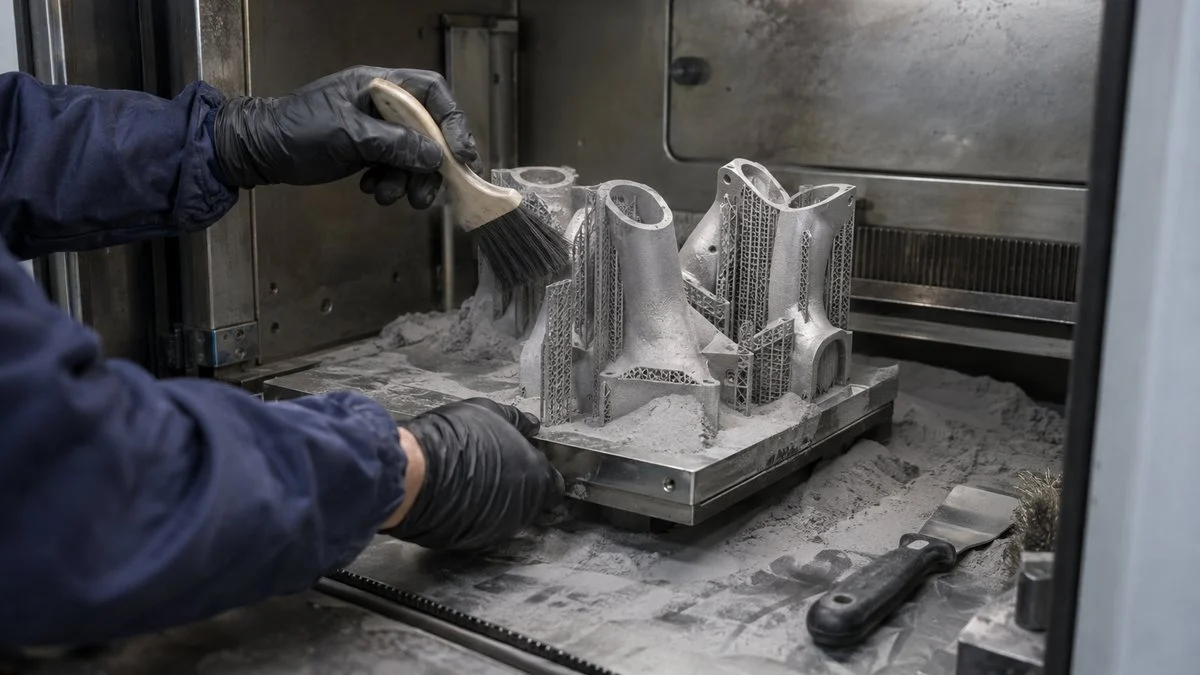
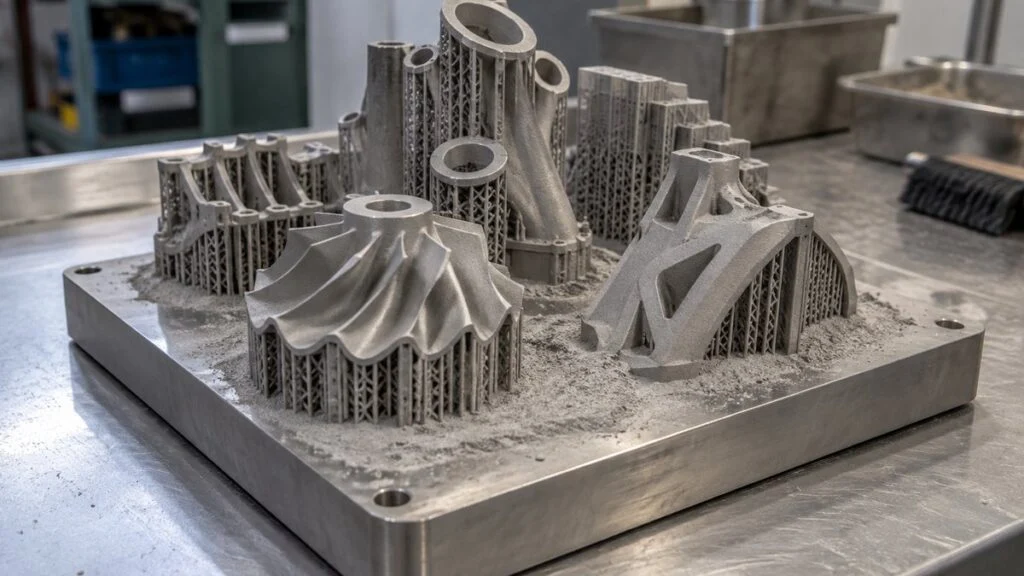
Powder bed fusion spreads a thin layer of metal powder on a build plate and melts only the areas that form the part. The plate then drops, a new layer of powder goes down, and the cycle repeats thousands of times. Because loose powder supports the part as it grows, PBF can produce internal channels and lattice structures that no cutting tool could reach. It is the most widely used metal printing method and has a long track record in aerospace and medical parts.
PBF machines use one of two heat sources, and the two behave quite differently.
Laser PBF (L-PBF)
A fiber laser melts the powder in a chamber filled with an inert gas such as argon. Fine powder (under 45 µm) is laid down in thin layers of about 20–50 µm, so L-PBF handles fine features and produces smooth surfaces. It also offers the widest choice of machine makers and materials.
The weakness is residual stress, the internal stress left as molten and solidified zones build up together. It causes warping and cracking, so the supports that anchor the part to the plate must be designed carefully. Build speed is slow.
Electron Beam PBF (EB-PBF)
An electron beam melts the powder in a vacuum. According to JEOL, the beam can quickly preheat the whole powder bed to several hundred degrees and up to about 1,000°C, which keeps residual stress low and reduces the need for supports. The vacuum suits titanium alloys, which oxidize easily. EB-PBF can also build pure copper, which reflects much of a laser's energy, and high-melting-point tungsten.
The tradeoff is that preheating lightly sinters the surrounding powder, which makes it hard to clear out of internal channels. Fine-feature accuracy and surface finish are slightly behind laser PBF.
Same powder bed, different heat source, different materials and finish.
Typical ranges from published material by JEOL and JAMPT (Japan Additive Manufacturing Process Technology). Values vary by machine.
Japanese PBF Machine Makers
Several of Japan's PBF makers are machine-tool builders, and some of their machines combine printing with milling in one setup.
- Matsuura Machinery (LUMEX series): Matsuura developed a hybrid machine that alternates laser sintering and milling in 2002. The LUMEX Avance-25 lays down powder about 0.05 mm per layer and runs an end mill over the contour every few layers. The company has published a case where conformal cooling channels cut a mold's cycle time by 33%. The main market is molds and dies.
- Sodick (OPM series): The OPM250L and OPM350L also combine laser sintering with high-speed milling and target mold making, especially inserts with conformal cooling.
- DMG MORI (LASERTEC SLM series): Laser PBF machines such as the LASERTEC 12 SLM for fine detail and the LASERTEC 30 SLM. DMG MORI also builds DED hybrids (see below).
- JEOL (JAM-5200EBM): Best known for electron microscopes, JEOL builds an electron beam PBF machine. The build volume is Ø250 × 400 mm (about Ø9.8 × 15.7 in), and the chamber can reach 1,100°C.
- Nikon: Nikon acquired the German PBF maker SLM Solutions, now Nikon SLM Solutions.
For the wider picture of these builders and how they sell through dealers, see Japanese Machine Tool Manufacturers: Rankings and Strengths.
Related: Japanese Machine Tool Manufacturers: Rankings and Strengths
Where PBF Fits, and Its Limits
Injection molds show PBF's strengths most clearly. Cooling channels that follow the shape of the cavity cool the part faster and shorten the molding cycle. (For how Japan's mold industry is organized, see Japanese Mold Makers and Machining Shops: Who Does What.)
The limits are size and speed. A part can be no larger than the build chamber, and because every layer means spreading powder over the whole bed, large parts and large quantities take a long time. Packing the chamber tightly with parts is the main way to cut time per part.
DED: Large Parts, Repair, and Cladding
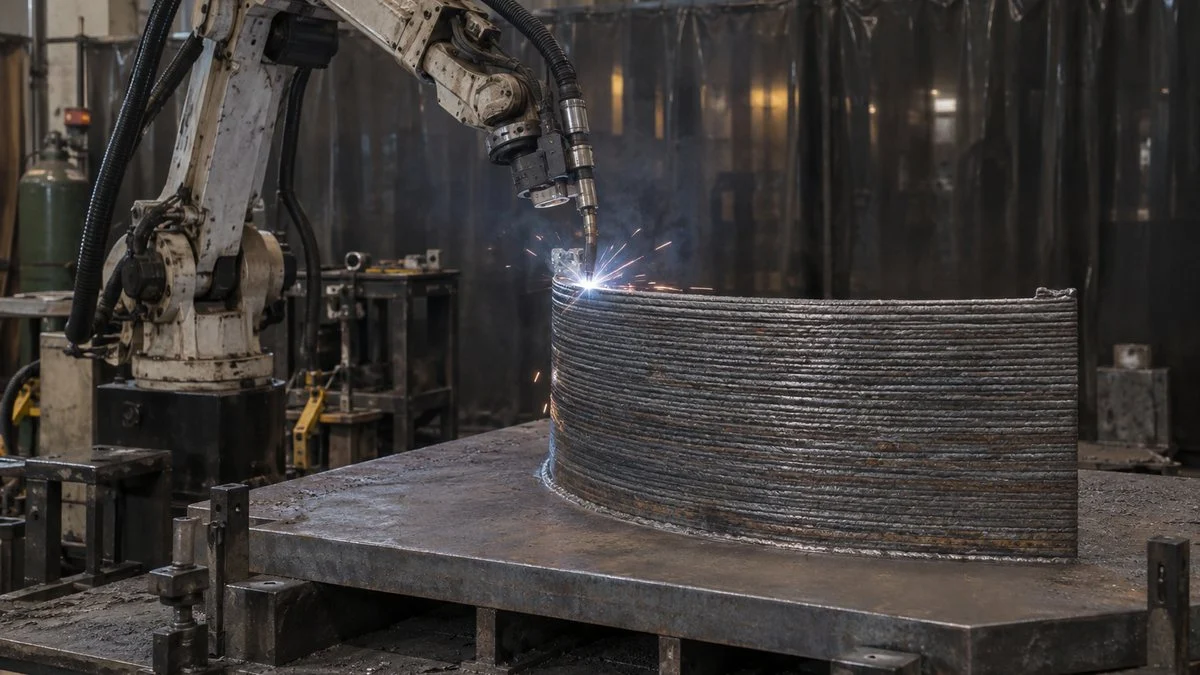
Directed energy deposition feeds metal powder or wire through a nozzle and melts it at the same spot as it arrives, building up bead by bead. It works much like weld overlay, and it needs no powder bed. A robot or the axes of a machine tool move the head, so the part size is limited only by the machine's travel. DED can handle parts several meters long and deposits metal quickly.
DED can also add material to a part that already exists. Rebuilding a worn mold or shaft, or cladding a hard alloy onto a low-cost base metal, are jobs that only DED does well.
Heat Source and Feedstock
DED machines differ by heat source (laser, electron beam, or arc) and feedstock (powder or wire). The choice comes down to accuracy versus speed and size.
The heat source and feedstock set the balance between accuracy and speed.
The arc version is called WAAM (wire arc additive manufacturing) and can be built from a welding wire, power source, and welding robot. A technical review by Daido Steel puts WAAM deposition at roughly 1–5 kg (2–11 lb) per hour, which makes it a candidate to replace large castings and parts machined from solid.
Hybrid Machines: Build and Machine in One Setup
DED leaves a rough surface and limited dimensional accuracy, so a DED part is rarely finished on its own. That is why hybrid machines are spreading. A laser DED head is mounted on a multi-tasking turn-mill machine, and the part goes from deposition to finish machining without a re-setup.
Japanese machine-tool builders report these results (vendor-published figures):
- At JIMTOF 2024, DMG MORI showed a part with about 1 mm of high-speed steel deposited on a carbon-steel base. A job that had taken more than two weeks took two hours.
- According to a March 2026 MONOist article, DMG MORI has data showing a 95% lead-time reduction on a shrouded impeller, which is hard to finish by cutting alone. Yamazaki Mazak moved a coupling for its own CNC lathes to a single machine that cuts, deposits, and grinds, and cut lead time from 14 days to 1.
Deposited metal is still less accurate and rougher than PBF output, so machining is never optional. Deciding how much to deposit and where to start cutting is a job for people with experience in machining, welding, and similar processes.
Japanese DED Machine Makers
- DMG MORI (LASERTEC DED hybrid series): Powder-nozzle laser deposition on turn-mill machines, including large models such as the LASERTEC 3000 DED hybrid, which handles parts up to about 3 m long.
- Yamazaki Mazak (INTEGREX AM): The INTEGREX i-400AM adds fiber-laser powder deposition to a multi-tasking machine, aimed at small lots of hard-to-cut alloys and repair of parts such as turbine blades.
- Okuma (LASER EX series): Multi-tasking machines such as the MU-6300V LASER EX that add laser metal deposition, hardening, and coating to cutting and grinding.
- Mitsubishi Electric (AZ600): A wire-laser DED machine launched in 2022 that uses commercial welding wire. The maximum workpiece is Ø500 × 500 mm.
- Nikon (Lasermeister series): Laser powder DED machines aimed at repair, such as the LM300A paired with a 3D scanner for turbine blade repair.
- Daihen (ArcBuilder 3D): A WAAM system built on Daihen's arc welding technology, announced in May 2026 for large structures in shipbuilding, energy, construction machinery, and aerospace.
Arc DED is also being tested outside factories. In January 2026, Daido Steel started a trial with Takenaka Corporation and Shimoda Flange to use its WAAM wire in construction.
Binder Jetting: The Sintered Route Toward Volume Production
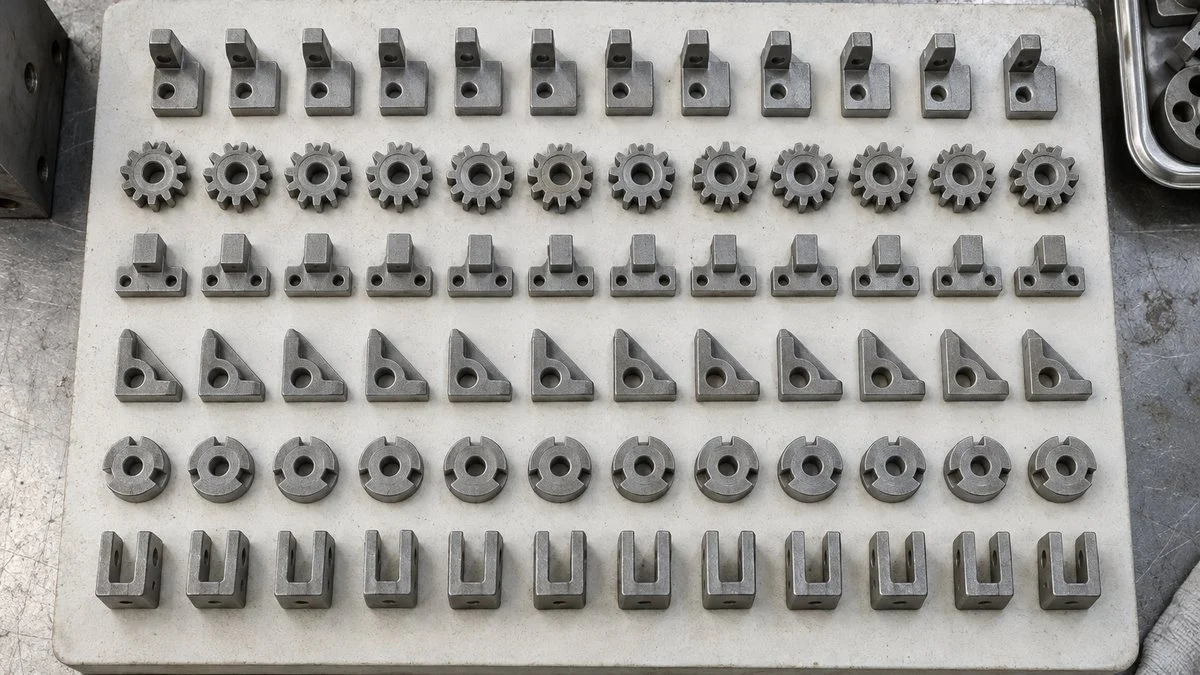
Binder jetting spreads powder layer by layer like PBF, but an inkjet head sprays a liquid binder instead of melting the metal. The printed part, called a green part, is just powder held together by binder and breaks easily. It becomes metal only after a furnace burns off the binder (debinding) and fuses the particles at high temperature (sintering).
The printer makes the shape; the furnace turns it into metal.
Unused powder can be reused. Shrinkage varies with material and sintering conditions.
With no high-temperature heat source during printing, residual stress is low and supports are usually unnecessary. Parts can be stacked in three dimensions inside the build box, so binder jetting is considered the closest of the three methods to volume production. It also suits small, detailed parts.
Shrinkage and Density
Parts shrink by about 20% in volume during sintering, so they are printed oversize. Shrinkage is not always uniform across a shape, and hitting target dimensions takes process development experience. Long, thin sections can sag under their own weight in the furnace. Density and strength also tend to be lower than PBF, which limits use on highly loaded parts.
The process resembles metal injection molding (MIM), which molds a mix of metal powder and plastic and then debinds and sinters it. HP launched its HP Metal Jet binder jetting system in 2018 together with powder metallurgy company GKN Powder Metallurgy, and companies with sintering know-how are the ones taking on production.
Binder Jetting in Japan
We could not confirm a Japanese maker of metal binder jet machines. Japan's activity is on the user side, and it comes from sintering companies. In July 2023, Sumitomo Electric Industries, a major producer of sintered parts, announced a project with Mitsubishi Corporation Technos to build a business making metal parts without molds on GE Additive binder jet machines. As of that announcement, Sumitomo Electric offered prototyping and development service, with volume production as the goal.
Outside Japan, Volkswagen opened an additive manufacturing center at its Wolfsburg plant in December 2018. In June 2021 it set a target of up to 100,000 printed parts a year there by 2025, and worked with Siemens software to optimize nesting (how many parts fit in one build box). As of September 2026, no results against that target had been published. In production, nesting and furnace operation affect cost as much as the printer itself.
Two other methods appear in quotes now and then. Metal FDM (material extrusion) extrudes a filament of metal powder in plastic and then debinds and sinters it. The machines are cheap and avoid handling loose powder, so some shops use them for prototypes and fixtures, but density remains a weakness. Like binder jetting, it needs debinding and sintering, and about 20% shrinkage must be allowed for. Sheet lamination bonds thin metal sheets, fits neither the melt-as-you-build nor the sinter-later group, and is rarely used.
How to Choose a Method: Five Questions
Start with the requirement your part cannot give up, then work down the list.
◎ = strongest, ○ = workable, △ = weak or needs extra work.
jet
General tendencies only. Material, machine, and post-processing change the ratings.
- How accurate must the part be as printed? If fine channels or thin walls will be used without machining, start with PBF, specifically laser PBF. If the part will be machined anyway, DED is a real option.
- How big is it? PBF stops at the chamber size; the JEOL JAM-5200EBM, for example, builds up to Ø250 × 400 mm. Larger parts, or parts that need tens of kilograms of deposited metal, point to DED, especially arc DED. Many small parts favor binder jetting on time per part.
- What material? Stainless steel, aluminum alloys, and nickel alloys have the widest choice. Pure copper and refractory metals absorb laser energy poorly and suit electron beam PBF, which also suits titanium alloys because it builds in a vacuum.
- How many? One to a few dozen prototypes or one-offs: PBF or DED. Small parts in volume: binder jetting. For production parts, compare cost per part against casting or MIM.
- New part, or adding to an existing one? Repair, cladding, or putting a different metal on the surface is essentially DED-only work.
Answer from the top down.
Before deciding, compare cost against conventional methods such as machining, casting, and MIM.
After choosing a method, suppliers commonly simulate warping and temperature distribution in advance and pre-distort the geometry to compensate. This cuts the number of trial builds.
Compare Post-Processing, Not Just the Printer
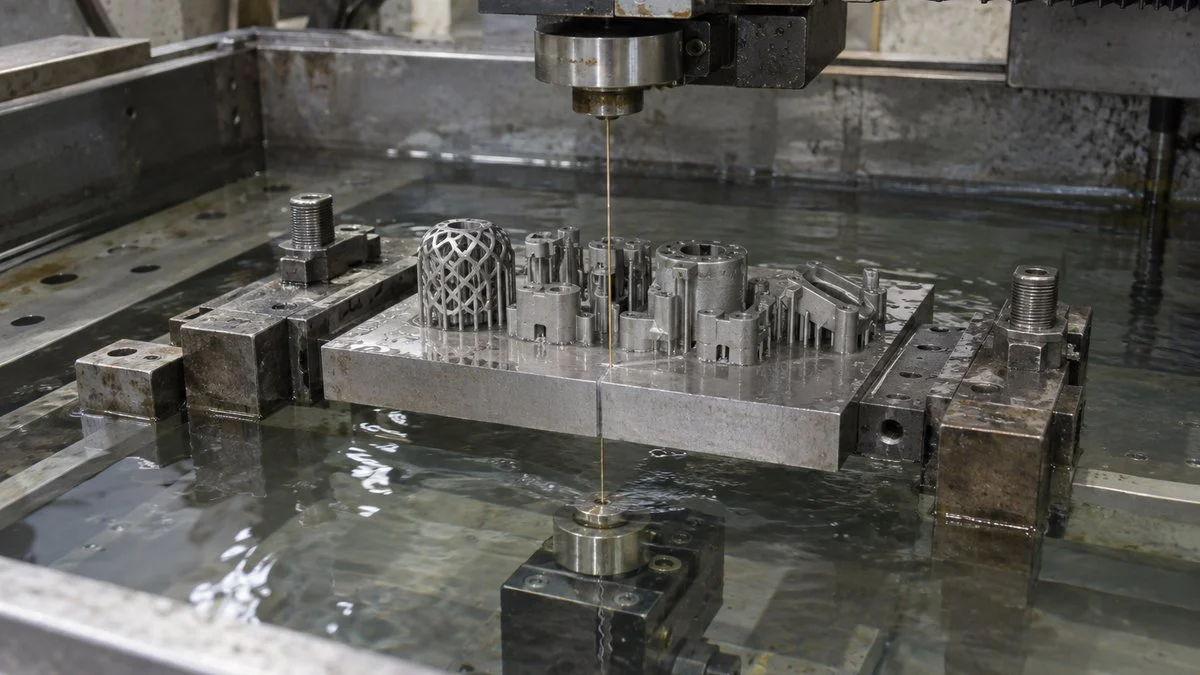
A part is not finished when the build ends. Powder removal, stress relief, separation from the build plate, and finish machining all follow, and each method needs different steps and equipment. When you compare quotes, check which of these steps each supplier includes.
For PBF, the shop removes leftover powder, heat-treats the part to relieve residual stress, cuts it off the plate (often by wire EDM), and removes the supports. Parts where small internal voids could reduce fatigue strength may also get HIP (hot isostatic pressing), which closes the voids with high temperature and pressure.
All three are "metal 3D printing," but the equipment needed after the build is very different.
Required steps vary with material, geometry, and quality requirements.
DED almost always needs machining after the build, and binder jetting cannot work without a sintering furnace. Comparing machine prices alone is misleading. Compare cost per part including post-processing equipment and labor, and decide early whether post-processing stays in-house or goes to an outside shop. Where surface roughness matters, blasting, polishing, or plating may be added.
Ordering From a Japanese Contract AM Shop
Japan has several companies that print metal parts for outside customers. Examples we could verify:
- JAMPT (Japan Additive Manufacturing Process Technology): Founded with Tohoku University's Institute for Materials Research; runs both electron beam and laser PBF machines for contract builds and development support.
- Mitsubishi Electric: Announced a contract build service on its AZ600 wire-laser DED machines in 2022, covering stainless steel, nickel alloys, and titanium alloys. Check whether it is still offered.
- Daihen: Offers paid WAAM build services for large metal parts alongside ArcBuilder 3D.
- Sumitomo Electric Industries: Binder jet prototyping and development service, as described above.
A practical approach is to have the same part built by more than one method or supplier and compare dimensions, surface, strength, and price. Two other points need attention alongside the choice of shop. On the customer side, this work usually falls to production engineering and mechanical design working together, from method selection through design changes.
- Design for AM (DfAM): Copying a machined or cast part as-is usually costs more than the original process. AM pays off when the design uses what only AM can do: combining several parts into one, lightening the interior with lattices, or routing cooling channels along the shape.
- Qualification plan: Metal AM parts built from the same data can vary with powder lot and build position. Agree in advance on tensile tests, CT inspection for internal defects, and powder control before using AM parts in production or safety-related applications. In certified fields such as aircraft parts, building this procedure is a major job in itself. See JIS Q 9100 vs AS9100: Japanese Aerospace Suppliers and Nadcap Accredited Suppliers in Japan.
Checklist Before You Request a Quote
| Item | What to confirm |
|---|---|
| Method and machine | Which process (L-PBF, EB-PBF, laser DED, wire DED, WAAM, binder jet) and which machine model |
| Material | Alloy name in both the JIS or maker designation and your standard (ASTM, UNS, EN); powder or wire supplier |
| Build size and orientation | Does the part fit the chamber or travel? Who decides the build orientation? |
| Post-processing scope | Powder removal, stress relief, plate removal, support removal, HIP, machining, surface finish: which are included? |
| Tolerances | As-built vs. machined tolerances; which faces will be machined |
| Shrinkage (binder jet) | How the shop compensates for sintering shrinkage and how many trial builds are planned |
| Inspection and records | Dimensional report, CT, tensile specimens built alongside the part, density measurement, material certificates |
| Repair work (DED) | Base-metal grade, inspection of the bond line, heat treatment of the base part |
| Data format | Accepted CAD formats (for example STEP or Parasolid) and whether they can scan a part with no CAD data |
| Lead time and shipping | Build time vs. post-processing time; export packaging and paperwork |
Inquiry Template
Many Japanese contract shops accept English inquiries, but a short, structured message gets a faster and more accurate answer. Adapt the template below; the bracketed items are placeholders.
Subject: Request for quotation: metal AM part [part name], qty [ ]
Dear [company name] team,
We would like a quotation for metal additive manufacturing of the part below. 3D data (STEP) and a drawing are attached.
- Material: [e.g., Ti-6Al-4V / 316L]
- Quantity: [prototype qty], with possible production of [qty/year]
- Process: [your proposal is welcome / we prefer L-PBF]
- Critical features: [internal channel, surfaces with tolerance ±0.05 mm]
- Post-processing required: [stress relief, plate removal, support removal, machining of faces A and B, HIP if recommended]
- Inspection: [dimensional report, CT scan, material certificate]
- Required delivery: [date], to [country]Please let us know which process and machine you would use, what is included in the price, and any design changes you recommend for AM.
Best regards,
[name, company, email]
Limits of This Guide
- The comparison tables show general tendencies. Actual accuracy, strength, and cost depend on the machine, material, parameters, and post-processing.
- The maker and service lists cover only companies we could confirm in public sources. Model names and services change; check each company's current information.
- Lead-time and cycle-time reductions are figures published by the makers or the press, not independent tests.
- Qualification requirements for aerospace, medical, and pressure-retaining parts are set by your customer, regulator, or certification body, not by the AM supplier.
FAQ
Which Japanese companies make metal 3D printers?
For powder bed fusion: Matsuura Machinery (LUMEX), Sodick (OPM), DMG MORI (LASERTEC SLM), JEOL (JAM-5200EBM, electron beam), and Nikon through Nikon SLM Solutions. For DED: DMG MORI, Yamazaki Mazak, Okuma, Mitsubishi Electric (AZ600), Nikon (Lasermeister), and Daihen (ArcBuilder 3D, WAAM).
What is a "hybrid" metal 3D printer?
A machine that both builds and machines the part in one setup. Matsuura and Sodick combine powder bed printing with milling, mainly for molds. DMG MORI, Mazak, and Okuma add a laser DED head to multi-tasking machine tools.
Is binder jetting strong enough for production parts?
It is the method best suited to volume production of small parts. Density and strength tend to be lower than PBF, and about 20% sintering shrinkage must be controlled, so highly loaded parts need careful evaluation. Compare against MIM and casting on cost per part.
Can a Japanese shop repair a worn part with metal 3D printing?
Yes. Repair is a DED job. Confirm the base-metal grade, the deposit material, heat treatment, and how the bond line will be inspected before you send the part.
What does "jutaku zokei" mean on a Japanese website?
受託造形 (jutaku zokei) means a contract build service: the company prints parts on its own machines for outside customers.
Sources
- Seven AM process categories: Wohlers Associates, "The Seven AM Processes" (ISO/ASTM 52900)
- JIS B 9441:2020: Japanese Standards Association, JIS B 9441:2020 (Japanese)
- Principles, strengths, and weaknesses of each method: JEOL, basics of metal 3D printers (Japanese)
- PBF powder size and layer thickness: JAMPT, metal 3D printing methods (Japanese)
- Binder jetting process and shrinkage: Kabuku Connect, binder jetting (Japanese)
- Conformal cooling cycle-time case: Matsuura Machinery, LUMEX processing technology (Japanese); development history: nippon.com, Matsuura Machinery (Japanese)
- LUMEX Avance-25: TCT Magazine, "Matsuura LUMEX Avance-25"
- Sodick OPM series: Sodick, metal 3D printers; MoldMaking Technology, Sodick EDM, milling, and additive
- DMG MORI LASERTEC SLM and DED hybrid: Metal AM, DMG MORI USA additive updates; 3D Printing Industry, DMG MORI hybrid AM
- JEOL JAM-5200EBM: JEOL product page (Japanese); Metal AM, JEOL releases JAM-5200EBM
- Nikon Lasermeister and SLM Solutions: 3D Printing Industry, Nikon Lasermeister LM300A
- Mazak INTEGREX i-400AM: Metal AM, Mazak hybrid machine
- Okuma LASER EX: Additive Manufacturing, Okuma LASER EX range
- Mitsubishi Electric AZ600 and contract service: MC Machinery, AZ600 brochure; Mitsubishi Electric, AZ600 contract build flyer (Japanese)
- WAAM deposition rate: Daido Steel, technical review of metal AM (Denki-Seiko Vol. 92 No. 1, 2021, Japanese)
- ArcBuilder 3D: Daihen news release, May 18, 2026 (Japanese); Metal AM, Daihen launches ArcBuilder 3D and contract service
- WAAM trial in construction: Daido Steel press release, January 27, 2026 (Japanese)
- DMG MORI hybrid case at JIMTOF 2024: ShareLab NEWS, November 26, 2024 (Japanese)
- DED cases from DMG MORI and Mazak: MONOist, March 24, 2026 (Japanese)
- Sumitomo Electric and Mitsubishi Corporation Technos binder jet project: MONOist, August 2023 (Japanese)
- JAMPT background: Tohoku University press release, November 2017 (Japanese)
- HP Metal Jet and GKN Powder Metallurgy: HP press release, September 10, 2018
- Volkswagen AM center: 3D Printing Industry, December 12, 2018; 2025 target and Siemens: 3Dnatives, June 22, 2021
Original article in JapaneseThis guide is adapted from a MONOSCOPE article written for readers in Japan: 金属3Dプリンターの方式比較|PBF・DED・バインダージェットの選び方
About the editor
 MONOSCOPE EditorFOUNDER & EDITOR
Spent about ten years at a plant equipment maker and a plant engineering company, proposing, designing, and commissioning equipment, then moved into web marketing. Now a web consultant for B2B manufacturers, helping them explain their products and technology. Licensed in Japan as an Energy Manager and a Third-Class Chief Electrical Engineer.
Has run an engineering blog since 2017 (500+ articles) and a Japanese YouTube channel with about 20,000 subscribers. Each English guide is written from the Japanese shop-floor point of view and checked against the cited standards.