Japanese Factory Departments: Who Is Who and Whom to Ask
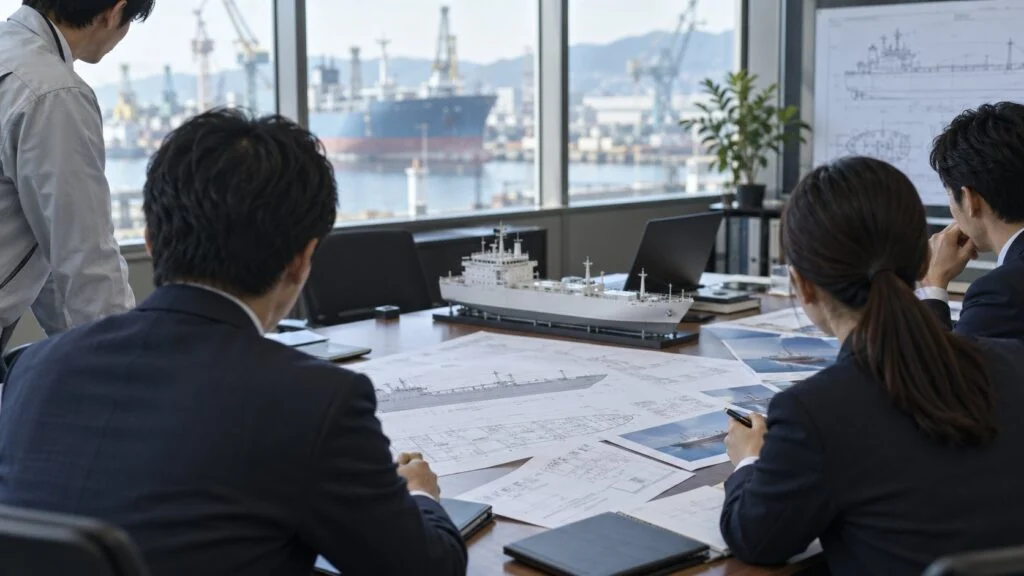
You report a dimension problem to your Japanese supplier's sales contact. The reply comes back with five people in CC: someone from the quality assurance department (品質保証部), someone from production engineering (生産技術課), a planner from production control, and a section manager you have never met. Each answers a different part of your question. The next time you need something, you are not sure whom to write to.
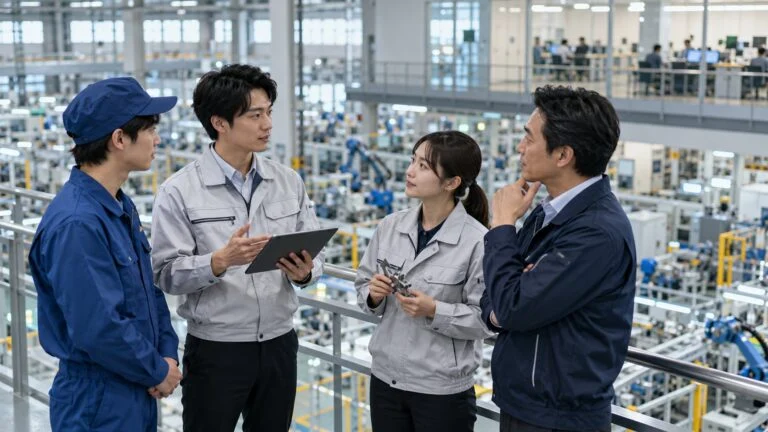
Japanese manufacturers split the work of making a product among specialist departments, and each one owns certain decisions. Once you know who owns what, you can send a question to the right person the first time, make sense of a CC list, and tell when an issue needs to go higher.
This guide is for buyers, supplier quality engineers, and engineers who work with a Japanese supplier, a Japanese customer, or a Japanese-owned plant. It maps 12 common roles in a Japanese manufacturer, grouped into four families, with a short description of each and what to ask them. Several of these roles have their own detailed guides, linked below. The guide ends with a quick reference table, a primer on department names and titles, a checklist, and an email template for asking the Japanese side who your counterparts are.
Contents
- How a Japanese Manufacturer Divides the Work
- Quick Reference: Who Handles Your Question
- Design and Development Roles
- Production Roles
- Quality and Technical Roles
- Management and Planning Roles
- Reading Department Names and Titles on a Business Card
- Checklist: Finding Your Counterparts
- Limits of This Guide
- FAQ
- Sources
How a Japanese Manufacturer Divides the Work
The easiest way to understand the roles is to follow a product from idea to shipment. Each role covers one part of that flow. Work starts with planning and research based on market and customer needs. The design department then turns the product's shape, circuits, and software into drawings and specifications. Once the design is fixed, production engineering prepares the processes and equipment for volume production, and purchasing arranges materials and parts.
When volume production starts, manufacturing makes the product to the production plan, and equipment maintenance keeps the line from stopping. Quality assurance and quality control check quality, and after shipment, technical sales handles proposals and support for customers. The plant manager and other managers oversee this whole flow.
No department works alone. Each one trades information constantly with the departments before and after it. When production engineering and quality assurance give input at the design stage, for example, they can head off problems that would otherwise appear in volume production. For you, this means a question about a drawing often pulls in production engineering and quality assurance as well, which is why replies come with long CC lists.
The 12 roles split the work at each stage of making a product.
Note: How roles are divided and named varies with company size and industry.
12 Roles in Four Groups
This guide sorts the main roles into four groups:
- Design and development: mechanical design, electrical and electronic design, software and embedded systems
- Production: production engineering, manufacturing and operations, equipment maintenance
- Quality and technical: quality assurance and quality control, research and development, technical sales and FAE
- Management and planning: purchasing and procurement, production control, plant manager
Real companies do not always split the work this cleanly. One person may cover several roles. At small and mid-sized companies in particular, it is common for a designer to also handle production engineering, or for one department to run both production control and purchasing.
Quick Reference: Who Handles Your Question
The table below shows which department usually owns each type of question. Your first contact is often sales (if you buy from the company) or purchasing (if you sell to it), and they route the question inside. Knowing the owner still helps: you can ask for that person to be included, and you can tell whether the answer came from the right place.
| Your question | Usually owned by | Notes |
|---|---|---|
| Drawing dimensions, tolerances, material, design changes | Design (設計, sekkei) | Often reaches you through sales or QA. See Approval Drawings (Shonin-zu). |
| Wiring, control panels, I/O lists | Electrical design (電気設計, denki sekkei) | See Reading a Japanese I/O List. |
| Firmware versions, software behavior | Software and embedded systems team | Usually through sales or an FAE. |
| Whether a part can be made, process changes, jigs, new equipment, line startup | Production engineering (生産技術, seisan gijutsu) | Main technical counterpart if you sell equipment to the plant. |
| Delivery dates, schedule changes, quantities, inventory | Production control (生産管理, seisan kanri) | Owns the production plan. |
| Quotations, prices, purchase orders, commercial terms | Purchasing (購買, kobai) if you are the supplier; sales (営業, eigyo) if you are the customer | See Purchasing Process at Japanese Manufacturers. |
| Defects, complaints, corrective action, supplier audits | Quality assurance (品質保証, hinshitsu hosho) | See Supplier Audit Checklist. |
| In-process variation, inspection data | Quality control (品質管理, hinshitsu kanri) | Data often reaches you through QA. |
| Breakdowns, spare parts, inspection schedules for equipment you supplied | Equipment maintenance (設備保全, setsubi hozen) | See Maintenance Workflow at Japanese Plants. |
| Product application questions, help designing a component into your product | Technical sales or FAE (技術営業, gijutsu eigyo) | Often your first technical contact as a customer. |
| Joint development, new materials or technologies | Research and development (研究開発, kenkyu kaihatsu) | Not the contact for problems with current products. |
| Conflicts between departments, holding shipments, spending beyond a department's authority | Plant manager (工場長, kojo-cho) | See Plant Manager Role in a Japanese Plant. |
Treat this as a typical pattern. Department names and the split of responsibilities differ from company to company.
Design and Development Roles
Design and development decide what goes into the product. Much of a product's performance, cost, and ease of manufacture is fixed at the design stage, so these roles carry a lot of weight upstream. Designers also share responsibility when a problem found in volume production traces back to the design, and they work with manufacturing and quality assurance on the fix.
Mechanical Design
Mechanical designers (機械設計, kikai sekkei) work out the shape, structure, and mechanisms of a product or machine and create drawings in 3D CAD. They set part dimensions and materials while weighing strength, motion, heat, and cost. Simulation with CAE (computer-aided engineering) is now a normal part of the work. Nearly every industry has them, from automotive to industrial machinery to home appliances.
Ask them about: the intent behind a dimension or tolerance, material substitutions, and design changes. See How to Read Japanese Engineering Drawings.
Electrical and Electronic Design
Electrical and electronic designers (電気・電子設計) design a product's circuits, control panels, and printed circuit boards. They lay out the power and signal paths, choose components, and deal with problems such as noise and heat. Their work touches every electrically powered product, including appliances, vehicles, industrial machinery, and factory automation equipment. Designing control panels for plant equipment also calls for knowledge of PLC programming and safety standards.
Ask them about: wiring diagrams, I/O lists, component substitutions, and which standards a control panel was designed to.
Software and Embedded Systems
Embedded software engineers (ソフトウェア・組込み) write the programs that run on the microcontrollers inside a product. Software now drives many product functions, from appliance controls to engine control in cars to robot motion. Unlike PC software, embedded code has to run reliably and in real time on limited memory and processing power. In automotive work, functional safety and cybersecurity also matter. Because more product defects can now be fixed with a software change, these engineers work closely with hardware designers.
Ask them about: firmware versions, software fixes, and how a function is supposed to behave. You will usually reach them through sales or an FAE.
Production Roles
Production roles turn the design into products that meet quality, cost, and delivery targets. They form the core of the plant and work closest to the shop floor, so their work directly affects productivity and safety. With labor shortages continuing in Japan, these teams are under pressure to use automation and data so the plant can run steadily with fewer people.
Production Engineering (Seisan Gijutsu)
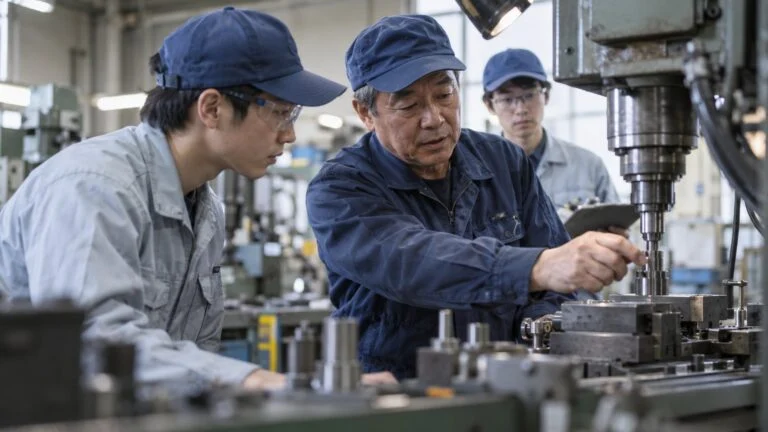
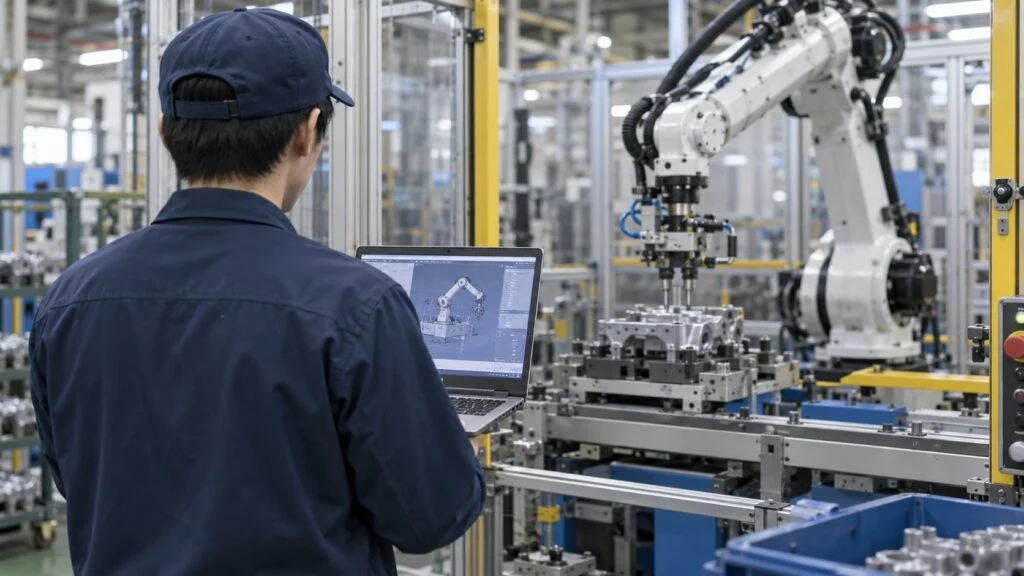
Production engineering (生産技術, seisan gijutsu) designs the processes, equipment, and jigs for efficient volume production and starts up production lines. Besides preparing for new products, the team improves and automates existing lines and brings in robots. During a new product launch, they meet repeatedly with the design department and equipment makers and work out problems on a trial line. They bridge design and manufacturing, so they need a broad base in mechanical, electrical, and control engineering.
Your counterpart when: you sell equipment or tooling to the plant, a process change is needed, or you want to know whether a part can be made as drawn. Details: Seisan Gijutsu: Japanese Production Engineering Explained.
Manufacturing and Operations
Manufacturing and operations staff (製造, seizo) process, assemble, and inspect products on the line, or run equipment at a chemical plant or similar facility. Besides following work procedures to make products of consistent quality, they take part in improvement activities on the floor. In highly automated plants, more of the job is running machines: changeovers, monitoring, and handling minor faults. Many workplaces run shifts. Experienced operators can move up to team leader roles such as hancho (班長) or shokucho (職長).
Where you meet them: rarely by email. You see them during audits, factory acceptance tests, and equipment installations. Questions about their work usually go through production engineering, production control, or quality assurance.
Equipment Maintenance (Setsubi Hozen)
Equipment maintenance (設備保全, setsubi hozen) keeps production equipment running through inspections, repairs, and part replacement. Besides fixing equipment after it fails (breakdown maintenance), many plants now do regular inspections and use data to catch early signs of failure (predictive maintenance). The work calls for a wide range of knowledge across mechanical, electrical, hydraulic, and pneumatic systems.
Your counterpart when: equipment you supplied breaks down, or the plant needs spare parts, manuals, or inspection support. Details: Maintenance Workflow at Japanese Plants: 8 Steps in 3 Phases.
These roles decide what goes into the product and make it in volume.
Quality and Technical Roles
These roles protect product reliability, develop future technology, or connect technology with customers. They are highly specialized and work with many people inside and outside the company. None of them is tied to a single process step. Each looks across the whole product or technology, and each depends on explaining specialist knowledge clearly to others.
Quality Assurance and Quality Control
Quality control (品質管理, hinshitsu kanri, QC) builds systems in the process that reduce variation and keep defective products from being made. Quality assurance (品質保証, hinshitsu hosho, QA) guarantees the quality of shipped products to the customer. QA answers customer inquiries, handles defects, and runs the quality management system, such as ISO 9001. Both often analyze process data with statistical methods.
Your counterpart when: you file a complaint, need a corrective action report, ask for inspection records, or plan a supplier audit. If you supply a Japanese customer, their QA team is the one that audits you. See Supplier Audit Checklist: How Japanese Customers Audit You.
Research and Development
Research and development (研究開発, kenkyu kaihatsu) studies new materials, technologies, and the principles behind future products. The work ranges from basic research to applied research aimed at products and to prototype development, and results often take years. R&D staff also write up results as patents and papers and work with business units to bring them to market. Joint research with universities, research institutes, and startups (open innovation) is now common, so R&D staff also coordinate with outside partners.
Your counterpart when: you discuss joint development or a new material or technology. For problems with products already in production, go to QA or production engineering instead.
Technical Sales and FAE
Technical sales staff (技術営業, gijutsu eigyo), also called sales engineers, use their technical knowledge to propose products to customers and support them through adoption. FAEs (field application engineers) work mainly in electronic components and semiconductors, giving technical support so customers design the company's parts into their products. Both visit customers' plants and development sites and pass customer feedback back to their own development teams. Many come from design or production engineering.
Your counterpart when: you buy from a Japanese supplier. Technical sales or an FAE is usually your first technical contact and the person who brings in design, QA, or production engineering when needed.
Management and Planning Roles
Management and planning roles organize the flow of people, materials, money, and information so the plant and the company run smoothly. They deal with suppliers and many internal departments, and much of their work involves reading numbers and making decisions from them.
Purchasing and Procurement (Kobai / Chotatsu)
Purchasing (購買, kobai) or procurement (調達, chotatsu) buys the materials, parts, and equipment the company needs, meeting quality, price, and delivery requirements. The team selects suppliers and negotiates prices, and it also plans for supply disruptions caused by disasters or international events. More companies now evaluate suppliers on environmental performance and human rights as well, which has widened the job. Buyers need to understand their suppliers' technology and processes.
Your counterpart when: you sell to a Japanese manufacturer. Purchasing sends the request for quotation, issues the purchase order, and evaluates you as a supplier. Details: Purchasing Process at Japanese Manufacturers: 8 Steps and RFQ to a Japanese Manufacturer.
Production Control (Seisan Kanri)
Production control (生産管理, seisan kanri, sometimes translated as production management) plans when, what, and how much to make based on orders and demand forecasts. The team also arranges materials, tracks progress, and manages inventory. Sitting between sales, manufacturing, purchasing, and other departments, it balances delivery dates against inventory. Dealing with sudden order changes, equipment trouble, and late parts is part of the daily job, as is running the production management system.
Your counterpart when: you need a delivery date, want to change a schedule or quantity, or need to know why a shipment is late.
Plant Manager (Kojo-cho)
The plant manager (工場長, kojo-cho) leads the whole plant and is responsible for its safety, quality, cost, delivery, and people. They work to meet sales and profit targets while driving equipment investment, staff development, and improvement on the floor. They also turn headquarters policy into action on the floor and report the floor's reality back to headquarters, which makes them something like the plant's chief executive. Most plant managers have come up through production engineering, manufacturing, or quality assurance.
Your counterpart when: departments disagree, a quality problem may require holding shipments, or a fix needs spending beyond a department's authority. Details: Plant Manager Role in a Japanese Plant: Duties and KPIs.
These roles protect quality and technology and keep the plant and company running smoothly.
Reading Department Names and Titles on a Business Card
Japanese department names usually end in a unit suffix. 部 (bu) is a department or division, 課 (ka) is a section inside it, and 係 (kakari) is a smaller team. So 品質保証部 (hinshitsu hosho-bu) is the quality assurance department, and 生産技術課 (seisan gijutsu-ka) is the production engineering section. Job titles follow the same layers.
| Title | Common English renderings | Typical scope |
|---|---|---|
| 部長 (bucho) | General manager, department head | Heads a department (bu) |
| 次長 (jicho) | Deputy general manager | Second in a department |
| 課長 (kacho) | Section manager | Heads a section (ka); often the first management level |
| 係長 (kakaricho) | Team leader, assistant manager | Heads a team (kakari) |
| 主任 (shunin) | Supervisor, senior staff | Experienced staff member, sometimes leading a small group |
| 班長 (hancho), 職長 (shokucho) | Team leader, group leader (shop floor) | Leads operators on the line |
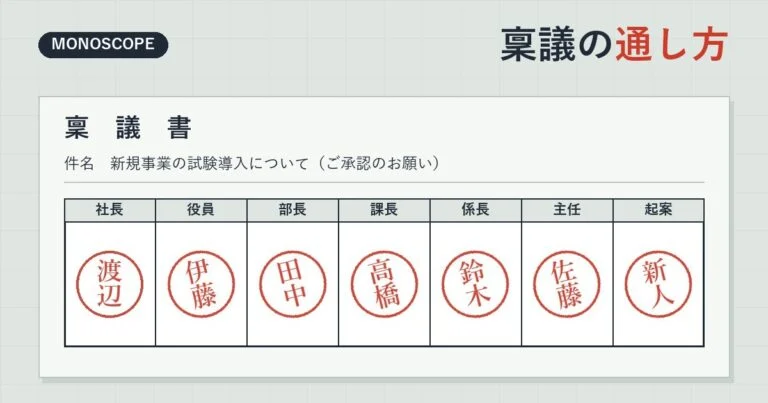
These titles have no legal definition, and each company sets its own meanings and English translations. Use the English title printed on the person's business card or email signature. As a rough guide, the higher the title, the wider the decisions the person can make, but actual approval limits are set by each company's internal rules. Decisions above those limits often go through ringi, the written approval process. See Ringi in Japan: Why Approvals Are Slow and How to Help.
Checklist: Finding Your Counterparts
Use this at the start of a project or a new supplier relationship, or whenever replies come from people you do not know.
| Check | Why it matters |
|---|---|
| Do you have a contact list with each person's department, title, and email? | You can see which department each answer comes from. |
| Is there one contact for commercial matters and one for technical matters? | Price and drawing questions usually go to different departments. |
| Who in QA handles complaints and corrective action for your part? | Quality problems move faster when they start with the owner. |
| Who in production control owns your delivery schedule? | Schedule changes are decided against the whole production plan. |
| Who approves drawings and design changes? | Design changes often need sign-off from design, production engineering, and QA. |
| Who can decide to hold or release shipments? | At many plants this goes to the plant manager or QA management. |
| Does one person cover several roles? | Common at smaller companies; it changes whom you ask. |
| Whom should you contact when your usual contact is out? | Avoids stalls during holidays and absences. |
Email Template: Asking for a Contact Map
Send this to your usual contact, often sales or purchasing. A short, numbered request is easy to translate and pass on internally.
Subject: Contact list for [project / part number]

Dear [Contact name],

To make sure our questions reach the right people, could you
share a contact list for [project / part number]?

For each item below, please give the person's name, department,
title, and email address:

1. Commercial matters (quotations, orders, prices)
2. Drawings and design changes
3. Quality (complaints, corrective action, inspection records)
4. Delivery schedule and quantity changes
5. Production processes and equipment
6. Backup contact when you are unavailable

If one person covers several items, that is fine; please just
let us know.

Best regards,
[Name]
[Company]
Limits of This Guide
The 12 roles and four groups are a general picture. How a company divides the work, what it calls each department, and how far each role reaches depend on the company's size and industry. At smaller companies one person often covers several roles. In process industries such as chemicals, manufacturing staff mainly operate equipment rather than assemble parts. When in doubt, ask for the organization chart and the contact list described above.
FAQ
What Is the Difference Between Production Engineering and Production Control?
Production engineering (seisan gijutsu) decides how a product is made: processes, equipment, and jigs. Production control (seisan kanri) decides when and how much is made: the production plan, materials, progress, and inventory. Ask production engineering about process changes and production control about delivery dates.
What Is the Difference Between QA and QC in a Japanese Company?
Quality control (hinshitsu kanri) works inside the process to reduce variation and prevent defects. Quality assurance (hinshitsu hosho) guarantees quality to the customer, handles complaints and defects, and runs the quality management system. As an outside customer or supplier, you usually deal with QA.
Who Should I Contact First at a Japanese Supplier?
Usually your sales or technical sales contact, who routes questions to the right department. For quality problems, ask them to include QA from the start. For delivery issues, ask for the production control contact.
What Does Kacho Mean?
Kacho (課長) is a section manager, the head of a section (ka) within a department. It is often the first management level. The exact scope and English title vary by company, so check the person's business card.
Sources
- Japanese job titles and their English renderings: Japan Dev, company positions and job titles in Japanese
- Variation of titles between companies: realestate-tokyo.com, Japanese job titles
Original article in JapaneseThis guide is adapted from a MONOSCOPE article written for readers in Japan: 製造業の職種一覧|12職種の仕事内容・向いている人・キャリアを解説
About the editor
 MONOSCOPE EditorFOUNDER & EDITOR
Spent about ten years at a plant equipment maker and a plant engineering company, proposing, designing, and commissioning equipment, then moved into web marketing. Now a web consultant for B2B manufacturers, helping them explain their products and technology. Licensed in Japan as an Energy Manager and a Third-Class Chief Electrical Engineer.
Has run an engineering blog since 2017 (500+ articles) and a Japanese YouTube channel with about 20,000 subscribers. Each English guide is written from the Japanese shop-floor point of view and checked against the cited standards.