Japanese Factory Automation: Makers, Distributors, SIers
Your plant in Thailand, Ohio, or Pune runs a line that a Japanese company built. The drawings call for a Mitsubishi Electric PLC, Omron sensors, and SMC cylinders, and now a servo amplifier has failed, or the Japanese parent wants a second line. Who do you call: the maker, a local distributor, the Japanese machine builder, or the trading company your parent company always uses? The answer depends on how Japan's factory automation (FA) industry is organized.
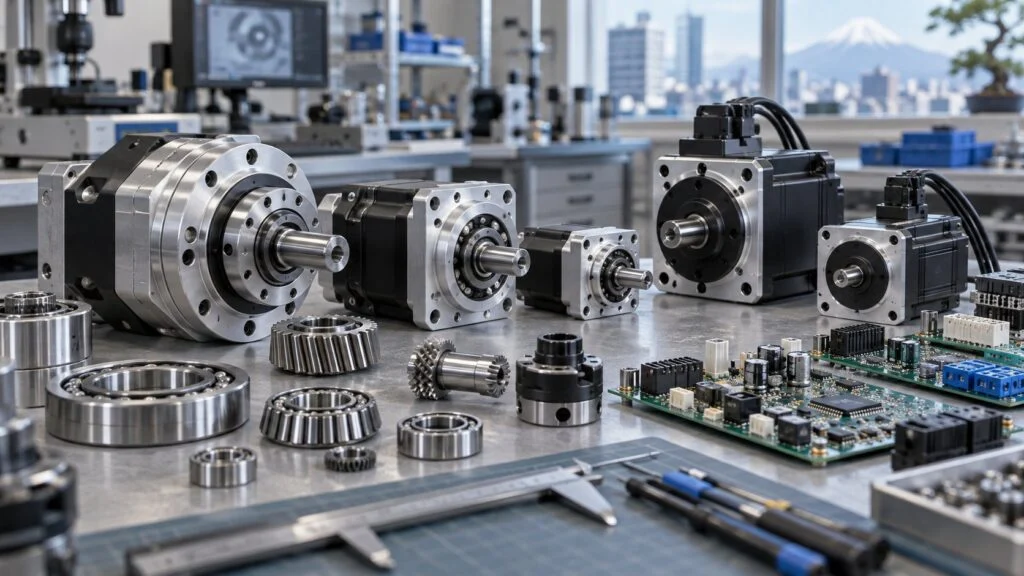
In Japan, an automated line passes through several companies before it runs. Equipment makers build catalog products such as PLCs (programmable logic controllers), servo motors, robots, and sensors. Trading companies stock and sell those products. System integrators, called SIers in Japan, combine them into a machine or line built for one customer. Further upstream, component makers supply parts such as speed reducers (gearboxes that slow a motor and raise its torque), bearings, and electronic components.
This guide explains who does what in that chain, how orders and money flow between them (what Japanese buyers call shoryu, 商流, the commercial flow), and where a buyer outside Japan should go for each type of purchase. It ends with a channel table, a checklist of questions to ask, and a sample inquiry email.
Contents
The Japanese FA Supply Chain at a Glance
The simplest way to picture the chain is components → equipment → distribution → machines → the running factory. Component makers sell to FA equipment makers. The equipment makers sell catalog products, through trading companies or direct, to SIers and machine builders. The SIers then deliver a finished machine or line to the user's factory.
Standard products become a one-off machine in several steps.
Note: The route varies by project. Large projects may skip the trading company.
The key split is between two kinds of business. Upstream and in the middle, companies sell the same product in volume. Downstream, SIers design and build to order for each customer. That difference explains most of what follows: how each player earns money, how prices are set, and who can actually help you when something breaks.
Five Players and What Each One Sells
Company size, profitability, and the kind of work differ a lot from one level to the next. Here are the five positions you will deal with.
Component and Material Makers
These companies make the precision speed reducers in robot joints, bearings, motor magnets, and the semiconductors inside control devices. They rarely appear on your purchase orders, but when their supply stops, equipment production stops too. Supply problems at this level affect equipment shipments across the whole industry.
FA Equipment Makers
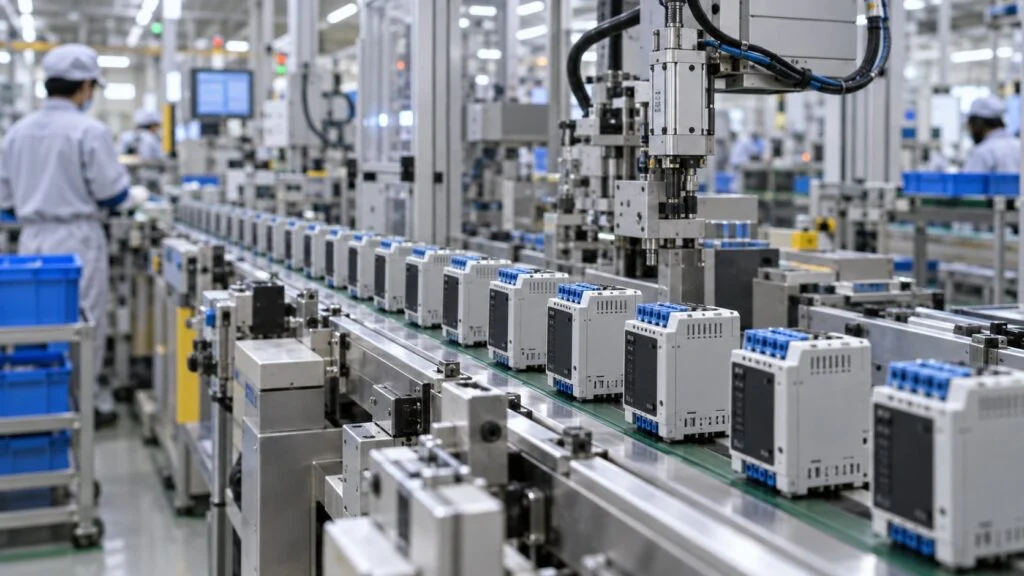
At the center are the makers of controllers, robots, sensors, and pneumatic equipment. The large ones handle development, production, technical sales, and service in-house and sell the same products worldwide, typically through subsidiaries in each region. For you, the maker's local subsidiary is the source of product data, technical support, and warranty service.
Related: Japanese Factory Automation Companies: Who Makes What
FA Trading Companies (Distributors)
FA trading companies (shosha, 商社, or dairiten, 代理店, for an appointed agent) buy equipment from many makers and resell it to SIers and factories. In Japan, many are mid-sized or small specialists that work closely with the plants and SIers in their region.
Their basic income is the margin between purchase and resale price, which on its own invites price competition. That is why more of them add technical services, such as help selecting models or building control panels.
SIers and Machine Builders
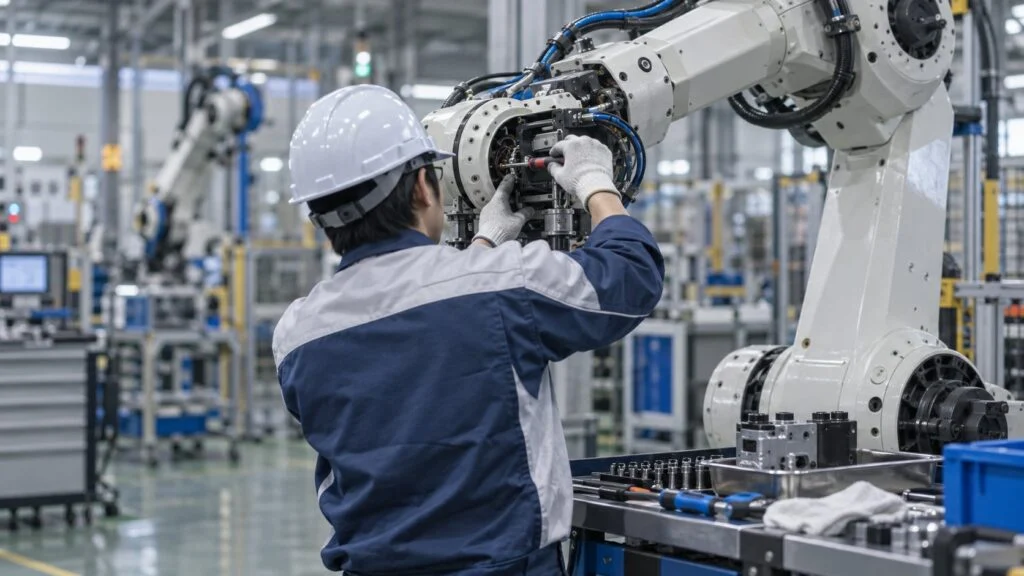
A SIer combines equipment into a machine or line built for one customer. Many Japanese SIers are small companies with a few dozen employees. Some specialize in one industry or process, and others take on a wide range of equipment for factories in their area.
Because the SIer handles each project from design to startup, one engineer often covers a wide scope. Profit per project depends heavily on how accurate the quote was and how long startup takes, so earnings are less stable than at an equipment maker.
For how to brief and compare Japanese SIers, see Japanese Robot System Integrators: RFP, Quotes, Acceptance.
The User's Production Engineering Department
At large automotive and electronics manufacturers, the production engineering department (seisan gijutsu) writes the equipment specifications and sometimes builds equipment in-house. Technically it is the customer, but it carries a lot of weight in the chain.
In many cases, the user company decides which equipment brands are standard. Once a brand is adopted, it is used across the plant for years, so getting onto a user's standard list is a major sales goal for makers. If you work at an overseas plant of a Japanese company, this is why your drawings often specify the same brands the parent uses in Japan.
Both are "FA companies," but their businesses work very differently.
Note: General tendencies. Many companies sit in between, such as large SIers and mid-sized makers of special-purpose machines.
How Orders and Money Flow
An automated machine reaches the factory through several layers of orders. In the typical case where a SIer wins the machine order, the flow looks like this.
Three stages: ordering the machine, buying the equipment, and after delivery.
Note: Routes vary. On large projects, the maker may sell directly to the user.
Who Orders From Whom
The basic relationship is simple: the user orders the machine, and the SIer receives the order. Large Japanese users keep several SIers they have worked with before and often pick one for each project through competing quotes (aimitsumori, 相見積り).
Payment usually comes after startup and acceptance (kenshu, 検収). It can take several months or more from order to payment, so cash flow is a real business issue for small SIers. If you are the buyer, expect a Japanese SIer to care a great deal about how acceptance is defined. See FAT and SAT with Japanese Suppliers.
Why Trading Companies Sit in the Middle
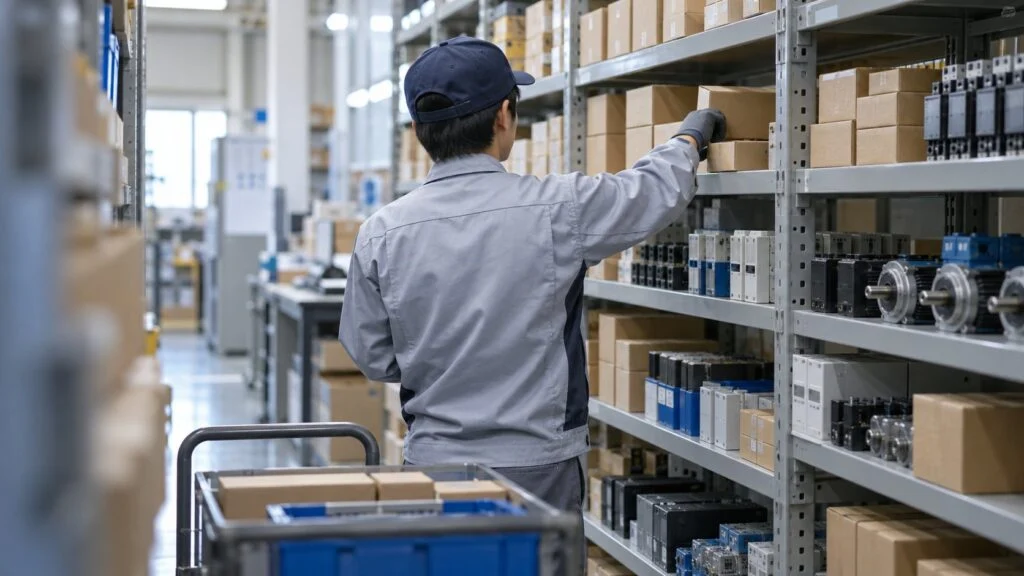
FA equipment comes in a huge number of part numbers, and a single machine can use equipment from dozens of makers. The trading company stocks and orders all of it in one place, which saves the SIer a lot of purchasing work.
For makers, trading companies are the sales network that reaches small customers across Japan. The maker, the trading company, and the SIer often support the same customer together, and this has become a long-standing business practice. It also explains why a Japanese SIer may route even a single spare part through its usual trading company.
How Prices Are Set
For catalog equipment, the maker sets a list price, and the discount depends on volume and on the sales route. Products chosen for performance and reliability are less exposed to price competition.
A machine is priced differently. The quote combines the equipment cost with the labor cost of design, fabrication, and startup. SIers compete on these quotes, so if a SIer underestimates the work, the project easily ends up losing money. When you compare quotes, a very low number can mean the scope was read differently.
Where the Margin Sits
Margins depend on position and business model. The companies with the highest margins tend to sell catalog products they designed themselves, matched to each customer's problem. A product developed once can be sold worldwide, so profit rises with volume. One-off machines and large system projects take more labor hours, so margins there tend to be lower. Margins at makers focused on robots or large material handling systems also swing from year to year with customers' capital spending and the project mix, so one year's figure says little on its own.
The "smile curve" often used for manufacturing applies here to some degree: development at one end and service and data at the other add the most value, while assembly in the middle earns roughly in proportion to hours worked.
After-sales service matters more than it looks. FA equipment often stays in use for more than 10 years, and spare parts, repairs, and retrofits over that period bring steady income even when capital spending falls. At FANUC, the service division accounted for JPY 141.1 billion, or 16.5% of consolidated sales of JPY 857.8 billion in the fiscal year ended March 2026. For you, this means the maker has a strong reason to keep supporting installed equipment, but the support runs through its official service network.
Where Should a Buyer Outside Japan Buy?
Outside Japan, the same chain exists, but the doors you knock on are different. Most large Japanese FA makers sell through a local subsidiary and its authorized distributors. Some Japanese trading companies also have branches abroad that serve the overseas plants of their Japanese customers. Use the table below as a starting point.
| What you need | Where to start | Watch out for |
|---|---|---|
| A catalog item (PLC module, servo, sensor, valve) as a spare | The maker's local subsidiary or its authorized distributor in your country | Confirm the exact model is sold and supported locally |
| A Keyence product | Keyence directly (it does not use distributors) | See Buying from Keyence |
| Machined parts, custom fixtures, or the PLC program of a Japanese-built machine | The SIer or machine builder that built it | Drawings and software may belong to the builder; check the contract |
| A model sold only in Japan | The maker's local subsidiary, to ask for a local equivalent | Voltage, certifications (UL, CE), and English manuals may differ |
| Many brands in one order for a Japanese-owned plant | The trading company your Japanese parent already uses, if it has a local branch | Prices include its service margin; confirm warranty handling |
| A new line or a major retrofit | A SIer (Japanese or local), working to your parent's equipment standards | Agree on brands and acceptance criteria before quotes |
Authorized Channels vs. Gray Market
Online resellers often list Japanese FA parts at attractive prices, but warranty and support usually depend on where you bought the part. Mitsubishi Electric's European 3-year warranty on PLCs, HMIs, and inverters, for example, applies only if the product was "purchased through an authorized Mitsubishi Electric sales channel," has a valid serial number, and is registered online. In the US, Mitsubishi Electric lists its authorized distributors (called Diamond Partners) on its website, searchable by location and product category.
Rules differ by maker and region, so check the authorized distributor list on the maker's local website before you buy, and ask any other seller where the unit came from.
Who Decides the Brand
If your plant belongs to a Japanese group, the brand choice may not be yours. The parent's production engineering team often fixes the standard brands, and the Japanese SIer designs to them. If local support for one of those brands is weak in your country, raise it before the machine is ordered, not after. For PLCs, see Mitsubishi vs Keyence vs Omron vs Siemens. For voltage differences on equipment built for Japan, see Japan Industrial Voltage.
How the Structure Is Changing
Over the past decade or so, three shifts have been reshaping the chain.
Chinese Makers in the Largest Market
According to the International Federation of Robotics (IFR), China took 54% of the world's industrial robot installations in 2024, and Chinese makers' share of their home market climbed to 57%, up from about 28% a decade earlier. With local makers stronger in the biggest market, Japanese makers have to compete more on reliability, service, and application support than on price.
Makers Bringing Integration In-House
Some large Japanese groups now deliver complete systems, not only equipment. Hitachi bought JR Automation, a US robotic system integrator, in 2019, and in September 2024 it completed the acquisition of MA micro automation in Germany, which JR Automation runs. The more users ask for "a working line" rather than parts, the more integration capability matters, and the line between maker and SIer is likely to blur further. For buyers, this means one Japanese group may now quote both the equipment and the integration.
Expansion Into Data and Security
As factories use more production data, competition is moving into software and services. In January 2026, Mitsubishi Electric completed its acquisition of Nozomi Networks, a US company that secures industrial control systems (OT security). When you evaluate a Japanese FA supplier, look at its service and software offering as well as its hardware.
Checklist: Before You Place the Order
Use these questions when buying Japanese FA equipment or spares outside Japan. Ask the maker's local office, the distributor, or the Japanese SIer, depending on the item.
- Is this exact model number sold and supported in our country, or is it a Japan-only model?
- Who is the authorized distributor for our location, and is the seller on that list?
- Does the warranty apply to units bought here, and does it need registration?
- Does the model have the certifications our site requires (for example UL or CE), and the right voltage and frequency?
- Are manuals and software available in English?
- Is the model current, or has the maker announced a discontinuation date? What is the recommended replacement?
- For a machine built in Japan: does the SIer provide a spare parts list with maker part numbers, and who owns the drawings and the PLC program?
- For a Japanese-owned plant: does the parent's standard require a specific brand or trading company?
- Who handles repairs locally: the maker's service center, the distributor, or the SIer?
Sample Inquiry Email to a Maker's Local Office
The example below is fictional. Replace the bracketed items.
Subject: Spare part availability for [model number], [plant name], [country]
Hello,
Our plant in [city, country] operates a machine built in Japan by [machine builder]. It uses the following item from your company:
Model: [full model number from the nameplate]
Quantity installed: [number]
Serial number: [if available]Could you tell us:
1. whether this model is sold and supported in [country], or what the local equivalent is;
2. the authorized distributor we should order from;
3. current lead time and whether the model is scheduled for discontinuation;
4. whether the warranty applies to units purchased locally.We can send nameplate photos and the machine's spare parts list if needed.
Best regards,
[Name, title, company, phone]
For a formal quote request to a Japanese supplier, see RFQ to a Japanese Manufacturer.
Limits of This Guide
- This describes typical patterns in Japan. Routes vary by project, and large users often buy direct from makers.
- Sales channels outside Japan differ by maker and by country. Always check the maker's local website for its current authorized distributors.
- Warranty terms quoted here are examples from one maker and region and do not apply to every product or country.
- This guide does not rank FA makers or compare their market shares.
FAQ
What is a SIer in Japan?
A SIer (system integrator) is a company that combines equipment from several makers, such as robots, PLCs, and sensors, into a machine or line built for one customer. In factory automation, the term usually means a machine or line builder rather than an IT company.
Can I buy Japanese FA equipment directly from the maker?
Sometimes. Large accounts often deal directly with the maker's local subsidiary, and Keyence sells only direct. Most smaller orders go through the maker's authorized distributors.
Why does a Japanese SIer buy through a trading company instead of from the maker?
A single machine can use equipment from dozens of makers. The trading company stocks and orders all of it in one place, which cuts the SIer's purchasing work. Many of these relationships are long-standing.
Is it safe to buy Japanese PLC parts from online resellers?
It carries risk. Warranty and support often depend on buying through an authorized channel, and Mitsubishi Electric's European 3-year warranty, for example, requires it. Check the maker's authorized distributor list first.
Sources
- FANUC consolidated sales and service division sales: FANUC, consolidated financial results for the fiscal year ended March 2026 (Japanese)
- Robot installations and Chinese makers' share: International Federation of Robotics, "Global Robot Demand in Factories Doubles Over 10 Years"
- Hitachi and MA micro automation: Hitachi, news release, October 1, 2024 (Japanese)
- Hitachi and JR Automation: The Robot Report, "Hitachi acquiring JR Automation for $1.43B"
- Mitsubishi Electric and Nozomi Networks: Business Wire, "Mitsubishi Electric Completes Full Acquisition of Nozomi Networks"
- Mitsubishi Electric 3-year warranty conditions: Mitsubishi Electric Europe, Factory Automation, 3-Year Warranty
- Mitsubishi Electric US authorized distributors: Mitsubishi Electric US, Industrial Automation, Distributors
Original article in JapaneseThis guide is adapted from a MONOSCOPE article written for readers in Japan: FA業界の構造をわかりやすく解説|サプライチェーン・商流・利益構造
About the editor
 MONOSCOPE EditorFOUNDER & EDITOR
Spent about ten years at a plant equipment maker and a plant engineering company, proposing, designing, and commissioning equipment, then moved into web marketing. Now a web consultant for B2B manufacturers, helping them explain their products and technology. Licensed in Japan as an Energy Manager and a Third-Class Chief Electrical Engineer.
Has run an engineering blog since 2017 (500+ articles) and a Japanese YouTube channel with about 20,000 subscribers. Each English guide is written from the Japanese shop-floor point of view and checked against the cited standards.