Ringi in Japan: Why Approvals Are Slow and How to Help
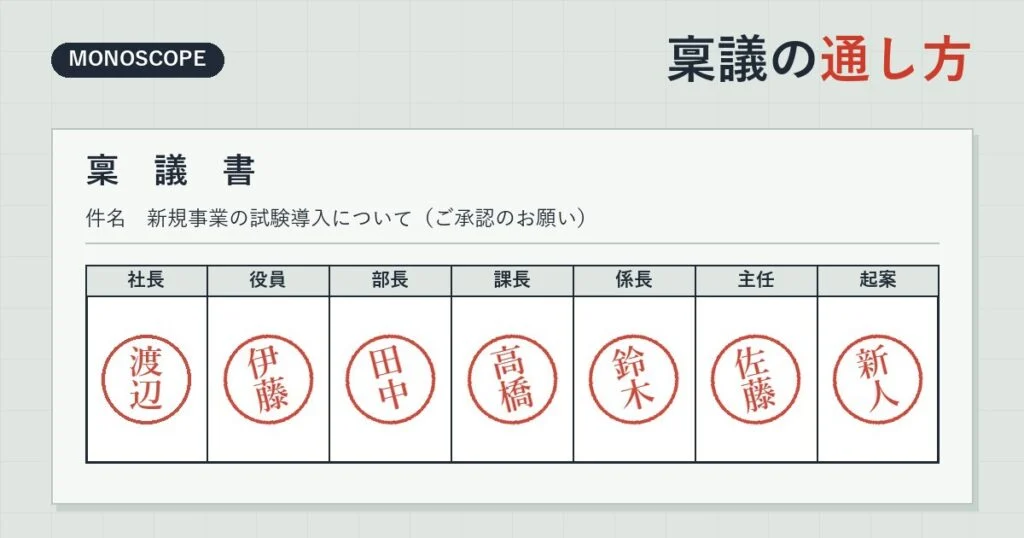
You sent a quote to a Japanese customer two weeks ago. Your contact liked the proposal, but says the purchase "has to go through ringi." Nothing happens for days. Then an email arrives: "My manager asks whether you have supplied this to any other Japanese company." If you work with a Japanese parent company, the same thing happens in reverse: a budget request you sent to headquarters seems to vanish, then comes back with one question.
What slows a ringi down is not one person sitting on your file. It is the process itself: several approvers check the same proposal one after another, and each one asks similar questions. Once you know what they ask, you can help your contact answer those questions before the document starts moving.
This guide explains how a ringi-sho (approval request document) moves through a Japanese company, why it takes time, and why approvers keep asking about precedent, track record, and risk. It ends with a checklist of material you can send to help a ringi pass, questions to ask your contact, and English email templates you can adapt.
- In one Japanese survey, the most common time from submission to approval was 1 to less than 3 days (37.6%), and about half of respondents said it took 3 days or more (ATLED, 2022).
- Five common causes: (1) many approvers in sequence, (2) send-backs that restart the route, (3) waiting for the final approver's schedule or a board meeting, (4) missing decision material (precedent, track record, risk, alternatives), and (5) other departments seeing the proposal for the first time.
- "Is there a precedent?" is usually a check, not a rejection. If there is none, a small trial with clear stop conditions is a common answer.
- As a supplier or partner, you can speed things up by sending a comparison table, reference cases, a risk list with countermeasures, and cost and benefit figures with the assumptions behind them.
Contents
- What Is Ringi? How Approval Works Inside a Japanese Company
- Five Reasons a Ringi Is Slow or Gets Rejected
- Why Approvers Ask "Is There a Precedent?"
- What a Ringi-Sho That Gets Approved Looks Like
- Nemawashi: Answering the Questions Before the Ringi Starts
- What You Can Send to Help a Ringi Pass
- English Email Templates
- Hanko and Electronic Approval: What Has Changed
- Where This Guide Does Not Apply
- FAQ
What Is Ringi? How Approval Works Inside a Japanese Company
Ringi (稟議) is the procedure in which an employee drafts a written proposal for something beyond their own authority and circulates it to superiors and related departments for approval. The person who drafts it is the kiansha (originator). The document is the ringi-sho. Each reviewer checks it in turn and stamps or approves it, and the person with final authority makes the decision. That final decision is called kessai (final approval).
In short, ringi is the whole route to a decision, and kessai is the decision itself. Some companies call the document a kessai-sho, kian-sho, or ukagai-sho. The name changes, but the flow is much the same.
Approvers check the proposal in turn. The larger the amount or the more important the matter, the more senior the final approver.
Note: The order of reviewers, how many there are, and the thresholds for each approver differ from company to company.
The final approver changes with the case because most companies have internal approval-authority rules that set limits by amount and type: up to a certain amount a section manager (kacho) can approve, above that a department manager (bucho), and above that an executive or the president. Japan's Companies Act adds a legal layer: at a company with a board of directors, decisions on important business matters, such as disposing of important assets or borrowing a significant amount, must be made by the board and cannot be left to individual directors.
So when a larger order passes through more desks, that comes from the company's rules, not from one person being overly cautious.
When a Ringi Is Needed in Manufacturing
At Japanese manufacturers, these are typical cases that need a ringi:
- Buying or replacing equipment, jigs and fixtures, measuring instruments, or tools
- Introducing software such as a production management system or CAD
- Outsourcing prototyping or machining, and contracting with a new supplier
- Trial use of a new process or material, and buying evaluation samples
- Exhibiting at trade shows, overseas business trips, and training
For purchases, the usual order is: the ringi is approved, a purchase request goes to the purchasing department, and only then come the formal quote and purchase order. For a supplier, this means a purchase order usually cannot be issued until the ringi is approved, and every week the ringi stalls pushes back the order, delivery, and start-up dates.
Related: Purchasing Process at Japanese Manufacturers: 8 Steps
Five Reasons a Ringi Is Slow or Gets Rejected
Start with the numbers. In 2022, the Japanese workflow software company ATLED surveyed 109 people at companies with 100 or more employees who had drafted at least three ringi in the previous six months. The most common average time from submission to approval was 1 to less than 3 days (37.6%), and about half said it took 3 days or more.
About half take 3 days or more, and roughly 1 in 10 respondents reported a week or longer.
Source: ATLED survey on ringi (March 2022; 109 people at companies with 100+ employees who drafted 3+ ringi in the past six months). The remaining 7.3% answered "don't know / can't say."
In the same survey, respondents who reported problems with ringi named "approval takes too long" (60.5%) and "hard to see where the ringi is" (55.8%) as their top two complaints. For originators, not knowing where the document is stuck seems to be even more stressful than the delay itself, so your Japanese contact may be just as frustrated as you are.
So why does it take so long? The common causes fall into five groups.
Delays come from the process itself and from what the document contains, often both at once.
Many Approvers, One at a Time
A 2024 survey of 312 users of the Japanese e-contract service CloudSign, run by Bengo4.com's research unit, found that the most common problem with ringi was "too many people involved before approval" (41.0%).
Approvals usually run in sequence, not in parallel. Each review may take only minutes, but the wait before each person opens the document adds up with every approver. Large companies with more layers of management tend to have more stops on the route. At smaller manufacturers, a proposal can reach the president within days, while at a large company the same amount may pass through many more desks.
A Send-Back Often Means Starting Over
If any approver has a question, the document goes back to the originator. Many companies then require the revised version to be checked again by everyone who already approved it. One send-back can add almost the full time the document had already spent in circulation.
The Final Approver's Calendar Sets the Pace
Department heads and executives spend much of their time traveling or in meetings. Large investments are usually reviewed at a scheduled management meeting or board meeting, so even a perfect document waits for the next meeting date. Ask your contact early which meeting the proposal needs to reach, then work backward from its submission deadline.
The Document Does Not Give Approvers What They Need to Decide
This is the most common cause, and the one that you and your contact can fix. "We want to buy this because it makes the work easier" gives an approver nothing to decide on. Is the benefit worth the cost? Were other options considered? What happens if it does not work? Anything the document leaves out comes back as a question, and the route stops each time.
Why Approvers Ask "Is There a Precedent?"
When the question "Is there a precedent?" (zenrei wa?) comes back, it can feel like resistance to anything new. From the approver's side, there is a reason for it. Approving a ringi means sharing responsibility for the decision.
A section manager has to explain the proposal to the department manager, and the department manager to the executives. Each one asks the question first to make sure they can answer it when their own boss asks. Think of these questions as a rehearsal for what the final approver will ask at the end.
Once you know the intent behind each question, it can be answered in the ringi-sho before anyone asks.
Note: The wording varies by company and manager, but what approvers want to confirm usually comes down to these six points.
Precedent: A Way to Explain the Decision If It Fails
In manufacturing, a problem with a change that affects quality or safety can spread to customers and to the whole production line. With a precedent, the approver can say, "We did it this way before without problems," and approve with more confidence.
If there is no precedent, there is no need to hide it. A plan such as "This is new to us, so we will trial it on one line for three months and decide based on the results" shrinks the risk the approver takes on. As a supplier, you can make this easy by offering a trial, a demo unit, or a staged order.
Track Record: Evidence for the Expected Benefit
An estimate like "labor hours should go down" gives the approver no reason to trust the number. Supplier case studies, results measured on a demo unit or free trial, and measurements from a similar process make the proposal far more convincing.
A small number the team measured itself is often stronger evidence than a big number from another company. If you can support a short on-site test, it gives your contact exactly this kind of evidence.
Risk: The Worst-Case Loss and How to Stop It
Answering "no particular risks" backfires. Approvers are not looking for zero risk. They want to see that the risks are understood and handled.
For new equipment, list risks such as operator safety, impact on quality, delivery delays, and cost overruns, and write a countermeasure for each. Ranking the risks by likelihood and impact and addressing the top ones is often enough to make a ringi-sho much more persuasive.
Related: Risk Assessment in Japanese Plants vs. JHA, HSE, ISO 12100
What a Ringi-Sho That Gets Approved Looks Like
Approvers handle many ringi, so each one gets limited time. A good ringi-sho is built so that the approver can decide from the first page alone. Even when the company has a fixed form, filling each field in this order and with this content makes it easier to follow. Knowing this structure tells you what material your contact needs from you.
The conclusion comes first, and each section answers the approver's next question.
Note: Items without a field on the company's form go in the remarks or attachments.
Subject and Opening: Say What Needs to Be Decided
The first thing an approver wants to know is what they are being asked to decide. A subject like "Purchase of a measuring instrument" says little. "Purchase of a CMM to reduce inspection hours" with the amount shows its importance the moment it lands on the desk. The first one or two lines state the request and the date by which a decision is needed.
Benefit: Numbers Plus the Assumptions Behind Them
The benefit is stated in numbers, not as "the work gets easier." For example: each inspection gets X minutes shorter, there are Y inspections a month, so the team saves X × Y minutes a month. Converted to labor cost, the saving can be compared with the investment to show a payback period.
The assumptions behind the calculation matter as much as the result. When approvers can see them, they can point to a specific item, such as "isn't the monthly volume lower than that?", and more often the document needs only a correction instead of a send-back. If your quote includes an ROI estimate, show your inputs so your contact can replace them with their own data.
For capital investments, noting in the cost section whether a subsidy can be used also tends to win support from accounting and senior approvers.
Options: Put the Alternatives Side by Side
With only one option, the approver will ask whether there is a cheaper way. A strong ringi-sho compares quotes from several suppliers, other approaches such as modifying existing equipment or leasing, and a "postpone this time" option by cost, benefit, and risk. Comparing against doing nothing makes the case for acting now. Your quote will likely be one column in that table, so be ready to provide information in a form that is easy to compare.
The figure below compares a ringi that tends to be sent back with one that tends to pass. The content is a fictional example.
Same project, different writing, and a very different number of questions from approvers (fictional example).
Note: All figures are fictional and only illustrate how to write the document.
Risk: Write What Happens If It Goes Wrong
The risk section lists possible problems, and for each one a countermeasure and an exit condition. Examples: "If the saving is below 40 hours a month, we will not proceed with full rollout," and "During the trial, we will keep the current method running in parallel." With these criteria set, the approver can see that even if it fails, the loss is limited.
Nemawashi: Answering the Questions Before the Ringi Starts
Nemawashi (根回し) is often described in English as behind-the-scenes deal making. In the context of ringi, it simply means asking the people involved about their questions and concerns before drafting, and building the answers into the ringi-sho.
In the 2024 survey cited above, "consultation and nemawashi before drafting take time" was also a top problem (35.9%), a sign of how much effort this step takes in practice. Doing the steps in the right order can shorten even this stage.
When the questions are raised before drafting, fewer documents are sent back during circulation.
The Direct Superior Comes First
Before writing anything, the originator usually talks to their direct superior: "This is what I want to do." The superior often knows the internal details better: which rule applies and who the final approver is, which meeting to aim for, and whether a similar ringi was approved before. Once the superior is on board, they can help explain the proposal during circulation.
Bring Other Departments In Early
Ringi at manufacturers often include reviews by accounting (budget and capitalization), quality assurance (impact on quality), IT (network and security), and health and safety (operator safety). A department that first hears about a proposal after submission starts its review from zero. If it has been consulted in advance, its review during circulation is just a confirmation of what it already knows. This is where you can help most: these departments often need documents that only the supplier has.
While It Circulates, Follow Up With Answers, Not Pressure
When a ringi has been sitting for several days, an approver may still have an open question. Inside the company, "Is there anything I can clarify?" works better than "When will you finish?" because it makes it easier for the approver to ask. The same applies to you: offer information rather than chasing a decision date.
What You Can Send to Help a Ringi Pass
You cannot write your customer's ringi-sho, and you should not try to. But the originator has to answer the approvers' questions, and many of the answers come from you. Sending the right material early, in a form that is easy to paste into a Japanese document, can save days or weeks.
- Comparison table: your option against alternatives, by cost, lead time, performance, and support. Keep it factual so it can be pasted in as-is.
- Precedent and references: similar installations, ideally at Japanese companies or in the same industry. If you have none, say so and propose a trial or staged order.
- Trial plan: scope (for example, one line), duration, what will be measured, and the conditions for going ahead or stopping.
- Cost and benefit with assumptions: total cost and breakdown, expected savings, and every input behind the calculation, so the customer can replace them with their own figures.
- Risk list: risks you can foresee (installation, quality, delivery, safety) and how you will handle each one.
- Material for other departments: safety data and certifications for the safety team, network and security details for IT, and quality documents for QA.
- Payment and schedule: payment terms and milestones, the quote's validity period, and the lead time counted from the purchase order date.
Questions to Ask Your Japanese Contact
These questions show that you understand their process, and they tell you what to prepare:
- Who is the final approver for this purchase, and is a management or board meeting involved?
- Is there a meeting or deadline we should aim for? When is the submission cutoff?
- Which departments will review it (accounting, QA, IT, safety)? Do they need anything from us?
- Has your company bought anything similar before? If not, would a trial or staged order help?
- Is this already in this year's budget, or does it need a new budget request?
- Does the quote need a specific format, currency, or validity period for your internal form?
- Do you need quotes from other suppliers for comparison?
English Email Templates
Many Japanese contacts read English more comfortably than they write it, so keep sentences short and put each request on its own line. Adapt these templates to your situation.
Subject: Material for your internal approval – [Project / Quote No.]
Dear Mr./Ms. [Name],
Thank you for considering our proposal. We understand that it needs to go through your internal approval (ringi) process.
To help, we can provide the following. Please let us know which items would be useful:
1. A comparison table of the options (cost, lead time, performance)
2. Reference cases from similar installations
3. A trial plan with success criteria
4. A cost and benefit estimate, with all assumptions listed
5. A list of risks and how we will handle them
6. Documents for your safety, IT, or QA teams
Could you also tell us the approval schedule, including any meeting dates we should keep in mind? We will prepare the material so it arrives in time.
Best regards,
[Your name]
Subject: Any questions from your approvers? – [Project / Quote No.]
Dear Mr./Ms. [Name],
We hope the approval process is going smoothly.
If any approver or department has raised a question, such as about past installations, risks, or cost, please let us know. We are happy to send additional information or join a short call.
For planning purposes, our current lead time is [X weeks] from the purchase order date, and this quote is valid until [date].
Best regards,
[Your name]
Note: Asking "Has anyone raised a question?" makes it easier for your contact to reply than asking "When will it be approved?"
Hanko and Electronic Approval: What Has Changed
On a paper ringi-sho, the approvers' hanko (personal seals) line up in a row of boxes. That has been changing since 2020. In June 2020, Japan's Cabinet Office, Ministry of Justice, and Ministry of Economy, Trade and Industry issued a Q&A on seals. It states that, unless there is a specific provision requiring one, a contract remains valid without a seal, and it encourages dropping unnecessary seals to support remote work. In September 2021, amendments to 48 laws took effect that remove seal requirements and allow electronic delivery for many procedures, except those needing a preparation period.
Internal ringi procedures are not set by law, but following these changes, more companies are moving internal approvals online. In the 2024 survey of CloudSign users, 67.6% used a workflow system for ringi and only 7.4% used paper and hanko. These respondents already use an e-contract service, so they are likely ahead of the average company. Even so, 73.5% said approval takes a day or more, and "too many people involved" and "nemawashi takes time" were still top problems.
Going digital removes the time spent moving paper. Decision time still depends on the content and the groundwork.
Workflow systems can also connect to production management and accounting systems so that approval flows directly into purchasing and asset registration. Even then, as Figure 8 shows, digital approval shortens routing time, not decision time.
Related: MES vs ERP in Japanese Plants: In-House Systems and Excel
Where This Guide Does Not Apply
- Every company is different. The number of approvers, the amount thresholds, the document names, and whether hanko or a workflow system is used all depend on each company's internal rules. Ask your contact rather than assuming.
- Size matters. At a small, owner-run company, the president may decide within days. At a large manufacturer, the same amount may need several departments and a management meeting.
- The survey numbers are from Japanese respondents. Both surveys cover limited groups (companies with 100+ employees in one, CloudSign users in the other). Treat them as indications, not as standard approval times.
- This is not legal advice. The Companies Act note in Figure 1 only explains why some decisions go to the board. How it applies to a specific decision is a matter for that company and its advisers.
FAQ
What Does Ringi Mean in English?
Ringi (稟議) is often translated as "approval request" or "request for approval," and the document is the ringi-sho. Because the procedure is specific to Japanese companies, English texts often just write "ringi" and explain it.
How Long Does Ringi Approval Take in Japan?
It depends on the company and the amount. In ATLED's 2022 survey, the most common average was 1 to less than 3 days (37.6%), and about half of respondents said 3 days or more. Large purchases that go to a management or board meeting wait for that meeting's date, so ask your contact for the schedule.
What Is the Difference Between Ringi and Nemawashi?
Ringi is the formal, written approval route. Nemawashi is the informal groundwork before it: talking to the superior and related departments, hearing their concerns, and answering them in the document. Good nemawashi means fewer questions and send-backs once the ringi starts circulating.
Is a Hanko Still Required for Ringi?
Internal ringi procedures are not set by law, so whether seals are needed depends on each company's rules. In a 2024 survey of CloudSign users, 67.6% used a workflow system and 7.4% used paper and hanko.
What Should I Do If My Customer's Ringi Was Sent Back?
Ask your contact which point the approver could not decide on, then send material that answers it directly. Because a resubmitted ringi often goes back to the first approver, also cover related questions, such as assumptions and alternatives, so the same issue does not come up at another desk.
Sources
- Ringi approval time and problems: ATLED, survey of ringi originators (March 28, 2022, Japanese)
- Approval time, methods, and problems: Bengo4.com, survey on internal ringi (January 16, 2025, Japanese)
- Board of directors' decisions: e-Gov, Companies Act, Article 362 (Japanese)
- Validity of contracts without seals: Cabinet Office, Ministry of Justice, and METI, Q&A on seals (June 19, 2020, Japanese)
- Amendments to 48 laws on seals and paper documents: Digital Agency, outline of the act on the development of related laws for forming a digital society (Japanese)
Original article in JapaneseThis guide is adapted from a MONOSCOPE article written for readers in Japan: 稟議が遅い・通らない5つの理由と通し方|「前例は?」への答え方と書き方のコツ
About the editor
 MONOSCOPE EditorFOUNDER & EDITOR
Spent about ten years at a plant equipment maker and a plant engineering company, proposing, designing, and commissioning equipment, then moved into web marketing. Now a web consultant for B2B manufacturers, helping them explain their products and technology. Licensed in Japan as an Energy Manager and a Third-Class Chief Electrical Engineer.
Has run an engineering blog since 2017 (500+ articles) and a Japanese YouTube channel with about 20,000 subscribers. Each English guide is written from the Japanese shop-floor point of view and checked against the cited standards.