Nm3 vs m3: Conversion Formula and Chart for Japanese Specs
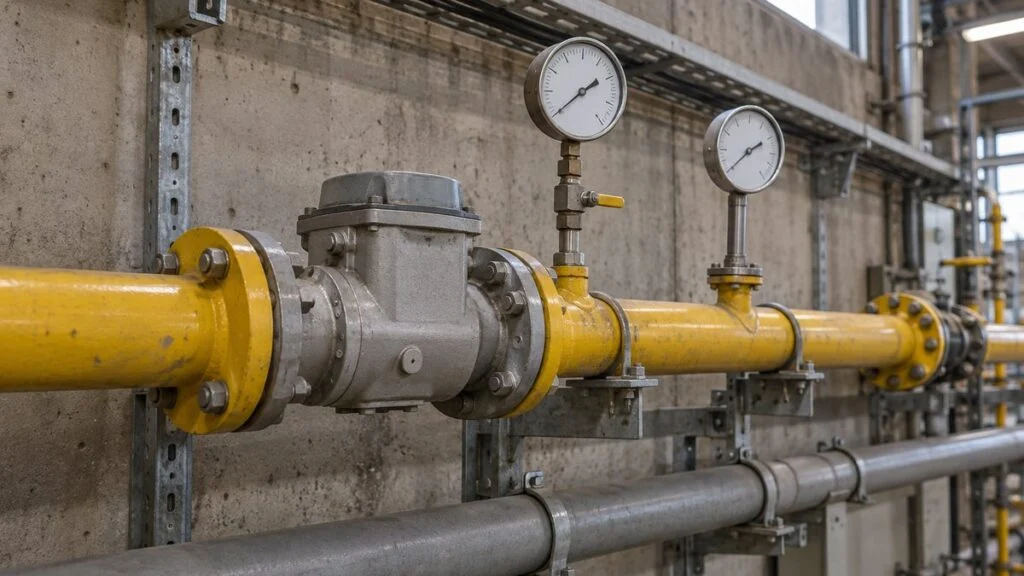
A burner package arrives from a Japanese supplier. The datasheet lists combustion air as 1,000 Nm3/h, the plant air header as 0.7 MPaG, and the instrument air consumption in L/min (ANR). Before you size a fan, a duct, or an air line, you need to know what those flow numbers mean at your actual temperature and pressure.
The short answer: Nm3 (normal cubic meter) is a gas volume converted to 0°C and 1 atm (101.325 kPa), so it measures how much gas there is. To get the actual volume in m3, multiply by a temperature ratio and a pressure ratio. Inside a 20°C, 0.5 MPaG (72.5 psig) air line, 1 Nm3 of air takes up only about 0.18 m3. Mix the two up and a pipe or compressor can be off by a factor of five or more.
This guide covers what Nm3 means and how Japanese engineers write it, the conversion formula and a quick-reference chart, how Nm3 differs from Sm3, ANR, and SCFM, worked examples for compressed air, combustion air, flue gas, and Japanese city gas, and a checklist and question list for the Japanese side.
Contents
What Is Nm3 (Normal Cubic Meter)?
Nm3 is a unit for the amount of gas: the volume the gas would occupy at atmospheric pressure and 0°C. The "N" stands for "normal," meaning a fixed reference state, and it is added to m3 (cubic meter).
On Japanese shop floors you will hear it read as norumaru-ryube (ノルマルリューベ). Ryube is the shop-floor reading of 立米, a short form of cubic meter, so the term simply means "normal cubic meter." There is no fixed way to write it: some documents use m3N (read ryube-norumaru) instead of Nm3. Flow rates are written Nm3/h (per hour) and Nm3/min (per minute).
A reference state is needed because gas volume changes with temperature and pressure. The ideal gas law shows the relationship, which is the same one behind Boyle's and Charles's laws:
Take 1 Nm3 of air. At atmospheric pressure and 0°C, it fills exactly 1 m3. Heat it to 100°C and it expands to about 1.366 m3. Double the pressure at 0°C instead, and it shrinks to 0.5 m3.
The amount of air never changes. Only the space it takes up does.
Ideal-gas values. Pressures are absolute.
In all three states the air inside is the same. That is the point of Nm3: it tells you how much gas there is, not how much space it fills right now. In amount-of-substance terms, 1 Nm3 is about 44.6 mol, because 1 mol of an ideal gas occupies about 22.414 L at 0°C and 101.325 kPa (CODATA value).
Nm3 is an amount. m3 is the space the gas fills where it is.
"Dry gas" follows the way fuel gas heating values are defined in Japan (per 1 m3 of dry gas at 0°C and 101.325 kPa). Some references, such as ANR for pneumatic equipment, include humidity.
Nm3 is an industry convention, not an SI unit. Strictly speaking, N is the symbol for the newton, so "Nm3" could be read as newton times cubic meter. SI style puts the measurement conditions on the quantity, not on the unit (NIST SP 811), and Japanese law, for example, writes out the condition in words ("converted to a temperature of 0°C and a pressure of 1 atm"). Even so, Nm3 is the common way to write it in industry.
Nm3 to m3 Conversion Formula
To convert between Nm3 and m3, multiply by a temperature ratio and a pressure ratio. Convert the temperature to absolute by adding 273.15 to °C, and convert gauge pressure to absolute by adding 101.325 kPa before you take the ratio.
The first line gives actual m3 from Nm3. The second gives Nm3 from actual m3. Decide which one you have before you pick a line. Rounding 101.325 to 101.32 or 101.3 barely changes the result.
If the direction is confusing, think about what happens physically: a higher temperature increases m3, and a higher pressure reduces it. The same formula works for flow rates. Enter Nm3/h and you get m3/h; enter Nm3/min and you get m3/min.
Check the reference state and the pressure type before you touch the formula.
A pressure gauge reads zero at atmospheric pressure. On the vacuum side (negative readings), add the reading to 101.325 kPa in the same way to get absolute pressure.
The most common mistake is forgetting to add atmospheric pressure to the gauge pressure. Here are three ways to calculate the pressure ratio for air at 0.5 MPaG:
Skip the pressure correction entirely and you overestimate the compressed-air volume about sixfold, which means an air line far larger than it needs to be.
The chart below gives ready-made factors from the same formula. Multiply a flow rate by the factor to convert it.
The three columns on the left give the actual m3 for 1 Nm3. The three on the right give the Nm3 in 1 actual m3 at each condition.
| Gauge pressure | 1 Nm3 → m3 | 1 m3 → Nm3 | ||||
|---|---|---|---|---|---|---|
| 0°C (32°F) | 20°C (68°F) | 40°C (104°F) | 0°C (32°F) | 20°C (68°F) | 40°C (104°F) | |
| 0 (atmospheric) | 1.000 | 1.073 | 1.146 | 1.000 | 0.932 | 0.872 |
| 0.1 MPa (14.5 psig) | 0.503 | 0.540 | 0.577 | 1.987 | 1.851 | 1.733 |
| 0.3 MPa (43.5 psig) | 0.252 | 0.271 | 0.289 | 3.961 | 3.691 | 3.455 |
| 0.5 MPa (72.5 psig) | 0.169 | 0.181 | 0.193 | 5.935 | 5.530 | 5.177 |
| 0.7 MPa (101.5 psig) | 0.126 | 0.136 | 0.145 | 7.908 | 7.369 | 6.898 |
| 0.8 MPa (116 psig) | 0.112 | 0.121 | 0.129 | 8.895 | 8.289 | 7.759 |
| 1.0 MPa (145 psig) | 0.092 | 0.099 | 0.105 | 10.869 | 10.128 | 9.481 |
Calculated as an ideal gas with atmospheric pressure at 101.325 kPa, rounded to three decimal places. Humidity is ignored. Example: 100 Nm3/h at 0.5 MPaG and 20°C is 100 × 0.181 ≈ 18.1 m3/h.
Reading the chart: in compressed air at 0.7 MPaG and 20°C, every 1 m3 of pipe volume holds about 7.37 Nm3. Pressure drives the factor. Temperature matters much less: a 20°C difference shifts it by about 7%. If you first check how many atmospheres the absolute pressure is, you will not be off by an order of magnitude.
Worked Examples: Compressed Air
Say 100 Nm3/h of compressed air flows through a line at 40°C and 0.5 MPaG (500 kPaG). The actual volumetric flow is:
Because the air is compressed, its actual volume is about one-fifth of the Nm3 figure. Use 19.3 m3/h when you calculate the velocity in the pipe.
Now the reverse. A line at 25°C and 0.7 MPaG (700 kPaG) carries an actual flow of 5 m3/min:
Brought back to 0°C and 1 atm, those 5 m3/min become 36.2 Nm3/min, about 7.2 times as much. Use this value when you compare the supply against the air consumption of equipment rated in Nm3/min.
Nm3 vs Sm3, ANR, and SCFM
Nm3 uses 0°C and 1 atm, but Sm3 (standard cubic meter) often uses 15°C or 20°C at 1 atm. The reference temperature depends on the industry, the company, and the manufacturer.
Osaka Gas's unit conversion table, for example, sets N at 0°C and S at 15°C. On that basis, 1 Nm3 = 1.055 Sm3 (288.15 ÷ 273.15). A 15°C difference in the reference changes the number for the same gas by about 5%, and a 20°C difference by about 7%. Two values can both say "standard" and still use different conditions. To convert to Sm3, use the same formula with that reference temperature and pressure in place of 0°C and 101.325 kPa. If the reference includes humidity, the water vapor creates a further difference.
Japanese pneumatic catalogs often use a third basis, ANR. SMC defines ANR as air at 20°C, 100 kPa absolute, and 65% relative humidity, citing ISO 8778 and JIS B 8393, and writes it after the unit, as in L/min (ANR).
Compressor free air delivery is usually stated at inlet conditions, too. Anest Iwata, a Japanese compressor maker, uses 20°C, 0.1013 MPa, and 65% relative humidity as its inlet condition. In the same material, it multiplies a demand of 500 NL/min (0°C, dry) by a company factor of 1.079 and selects a compressor rated at 540 L/min or more.
US readers will meet SCFM (standard cubic feet per minute), which has the same problem. "Standard" may mean 60°F or 68°F, among other temperatures, and the pressure may be 14.696 psia (1 atm), 14.73 psia, or 1 bar. Some definitions also fix a humidity. As a calculated reference, 1 Nm3/h equals about 0.622 SCFM at 60°F and 14.696 psia, or about 0.632 SCFM at 68°F and 14.696 psia (dry, ideal gas). Confirm which definition your compressor or flowmeter vendor uses.
Each is called "standard" by someone, but the temperature, pressure, and humidity all differ.
ANR from SMC, inlet conditions from Anest Iwata, S from Osaka Gas, gas meters from J-Net21 (Organization for Small & Medium Enterprises and Regional Innovation, Japan). The same name can carry different conditions in different documents.
When you compare catalog or datasheet values, confirm which reference each number uses. Look for "(ANR)" after the unit, an N or S prefix or suffix, and a temperature in the notes. For duct velocity, always convert to actual volume first.
When to Use Nm3 and When to Use m3
When you design or select ducts, fans, or air compressors, the choice is not always obvious. The rule: use m3 when you need volume, and Nm3 when you need the amount (mass) of gas.
Air velocity in a duct, for example, depends on the actual temperature and pressure of the air passing through it, so you calculate it in m3. Combustion is different. The oxygen a burner needs depends on the amount of air, not its volume, so combustion air is calculated in Nm3, and so is the flue gas it produces.
Even for the same air, size equipment in m3 and count gas in Nm3.
Compressor free air delivery is often stated at the maker's inlet conditions (20°C, 65% RH, etc.), which differ from Nm3 by a few percent.
For the same reason, commercial and regulatory figures in Japan are usually on an Nm3 basis. City gas heating values are given per 1 m3 of gas at 0°C and 101.325 kPa, and Japan's soot, dust, and NOx emission standards are per 1 m3 of flue gas converted to 0°C and 1 atm.
Worked Examples: Combustion Air, Flue Gas, and City Gas
The same steps apply beyond compressed air. Near atmospheric pressure, you can treat the gauge pressure as zero and correct for temperature only.
Combustion Air at 30°C
A boiler burner needs 1,000 Nm3/h of air, and the forced-draft fan draws in air at 30°C (86°F). The volume the fan actually moves is:
Compared with 0°C, the fan must move about 11% more volume for the same Nm3. That is why the load on the fan changes between summer and winter as the intake temperature changes.
Flue Gas at 200°C
Now 1,000 Nm3/h of flue gas flows through the flue at 200°C (392°F):
Hot flue gas takes up about 1.7 times its normal volume, so size flues and ducts on the actual m3/h.
Same amount of gas, but compressed air and hot flue gas differ in actual volume by more than ten times.
Ideal-gas values. The 0.7 MPaG, 20°C value uses the chart factor 0.136.
Japanese City Gas Meter Readings
If you review energy data from a plant in Japan, note that the m3 on a Japanese city gas bill is the volume that passed through the gas meter, not Nm3 at 0°C and 1 atm. According to J-Net21, a low-pressure gas meter reads volume at 15°C and 103.325 kPa (2 kPa gauge), and a medium-pressure meter reads volume at 15°C and 102.306 kPa. The factors to convert to Nm3 are therefore 0.9667 for low-pressure meters and 0.9571 for medium-pressure meters. The J-Net21 explanation assumes Tokyo Gas's heating value definition, so for other gas utilities, check the meter conditions in the utility's own documents.
These factors match the conversion formula. For a low-pressure meter:
Suppose a low-pressure meter records 1,000 m3 in a month. The standard heating value of 13A city gas, 45 MJ, is per 1 m3 of gas at 0°C and 101.325 kPa (Tokyo Gas).
Multiplying the meter reading directly by 45 MJ gives 45,000 MJ, an overestimate of about 3%. To get heat input or energy intensity right, convert to Nm3 before you apply the heating value. Japanese reporting forms differ on whether they expect the raw meter reading or the converted value, so follow the notes on each form.
Multiply the billed m3 by a factor to get Nm3, then by the standard heating value.
Factors from J-Net21; heating value from Tokyo Gas. Heating values and meter conditions can differ by gas utility and contract, so check the utility's documents.
Checklist for Japanese Datasheets and Catalogs
Use this list when a Japanese datasheet, flowmeter, or catalog gives a gas or air flow:
- Datasheet: the flow unit (Nm3/h, m3/h, Sm3/h) and the operating temperature and pressure fields
- Pressure: gauge (MPaG, kPaG) or absolute (MPa abs)
- Flowmeter: the nameplate or manual says whether it is temperature- and pressure-compensated (reads Nm3/h) or uncompensated (reads actual flow)
- Pneumatic catalog: "(ANR)" after the unit, or a note such as "converted to inlet conditions"
- Compressor rating: the inlet temperature, pressure, and humidity behind the free air delivery figure
- Sm3 or SCFM: the reference temperature and pressure used
- Gas meter data: low-pressure or medium-pressure meter (pressure correction or not)
If the conditions are not written down, do not compare the numbers as they are; ask the issuer. A 2–7% difference can push a compressor or blower selection up or down one size. Fans, blowers, and compressors also work over different pressure ranges and state airflow in different ways.
Questions for the Japanese Supplier
- Is this flow stated in Nm3 (0°C, 101.325 kPa, dry) or on another basis, such as Sm3 or ANR? What temperature, pressure, and humidity does it use?
- Is the pressure on the datasheet gauge or absolute?
- What are the actual operating temperature and pressure at the inlet and outlet of the equipment?
- Does the flowmeter compensate for temperature and pressure? If so, what reference conditions does it use for the displayed flow?
- Is the compressor capacity free air delivery at inlet conditions? What inlet conditions?
- Can you give the same flow in actual m3/h at the design conditions, or in SCFM at our reference?
A short inquiry you can adapt:
Subject: Flow basis for [equipment tag] datasheet
Your datasheet lists the combustion air flow as 1,000 Nm3/h and the supply pressure as 0.7 MPa. Please confirm (1) the reference conditions for Nm3 (temperature, pressure, and whether dry or humid), (2) whether 0.7 MPa is gauge or absolute pressure, and (3) the actual inlet temperature and pressure at the design point. If possible, please also give the flow in actual m3/h at those conditions.
Limits of This Guide
- The formula and chart treat the gas as ideal and dry. Humidity, high pressure, and gases close to condensing need corrections (see the FAQ).
- Reference conditions for Sm3, ANR, compressor ratings, and SCFM vary by company, industry, and document. The examples here come from the sources listed below; always use the definition on your own datasheet.
- The SCFM factors are our own calculations at the stated conditions, not values from a standard.
- The city gas factors and heating value are J-Net21 and Tokyo Gas values. Other utilities and contracts can differ.
- Equipment sizing and emission compliance follow the project specification and the applicable codes. This guide only explains the unit conversion.
FAQ
How Do You Convert Nm3/h to m3/h?
Use the same formula as for volume: multiply by (273.15 + T) / 273.15 and by 101.325 / (101.325 + P), with T in °C and P in kPa gauge. At 0.5 MPaG and 20°C, m3/h = Nm3/h × 0.181, and Nm3/h = m3/h × 5.53. For other conditions, use the chart above.
What Is the Difference Between Nm3 and Sm3?
The reference temperature. Nm3 is at 0°C and 1 atm; Sm3 is often at 15°C or 20°C, depending on the company or industry. With S at 15°C, 1 Nm3 = 1.055 Sm3. To convert to Sm3 or ANR, replace 273.15 and 101.325 in the formula with the absolute temperature and absolute pressure of that reference.
How Do You Convert Nm3 to kg?
Multiply the molecular weight of the gas (g/mol) by 44.6. That gives the mass in grams per Nm3, because 1 Nm3 is about 44.6 mol. For dry air (average molecular weight 28.97), that is about 1.29 kg/Nm3, so 100 Nm3/h of air is about 129 kg/h. For humid air or other gases, recalculate with their molecular weight.
What Is the Difference Between NL/min and L/min (ANR)?
NL/min is flow at 0°C and 1 atm on a dry basis. L/min (ANR) is flow at 20°C, 100 kPa, and 65% RH. Using the saturation vapor pressure of water at 20°C (about 2.34 kPa, NIST), we estimate that 1 m3 (ANR) contains about 0.91 Nm3 of dry air. So for the same air, the ANR number is about 10% larger. Makers treat humidity differently (Anest Iwata's compressor selection uses a factor of 1.079, for example), so follow the catalog notes when selecting equipment.
Does the Conversion Formula Work at High Pressure?
Yes, for typical plant compressed air up to about 1 MPa. The formula assumes an ideal gas. Using NIST data, the compressibility factor Z of nitrogen at 20°C and 0.7 MPa absolute is 0.9984, within 0.2% of an ideal gas. For gases at much higher pressure, or gases that liquefy easily such as propane, correct with the compressibility factor Z.
Sources
- Molar volume of an ideal gas at 0°C and 101.325 kPa: NIST, "Molar volume of ideal gas (273.15 K, 101.325 kPa)" (CODATA 2022)
- Stating conditions on the quantity rather than the unit: NIST SP 811, Guide for the Use of the SI, Chapter 7 (7.4, 7.5)
- Flue gas volume converted to 0°C and 1 atm in Japanese emission rules: e-Gov, Enforcement Regulations of the Air Pollution Control Act, Articles 4 and 5 (Japanese)
- Standard heating value of 13A and its reference state: Tokyo Gas, "Types, heating values, pressures, and components of city gas" (Japanese)
- Gas meter conditions and conversion factors to the normal state: J-Net21 (SMRJ), Q&A on differences in city gas heat totals (Japanese)
- City gas use converted to the normal state: Tokyo Gas FAQ, crude oil equivalent of city gas use (Japanese)
- m3(N) at 0°C and m3(S) at 15°C: Osaka Gas, Annual Report 2013, unit conversion table
- ANR (20°C, 100 kPa, 65% RH; ISO 8778, JIS B 8393): SMC, Energy Saving Program Ver. 4.1, glossary (Japanese)
- Compressor free air delivery and conversion from the normal state: Anest Iwata, "Basics of compressed air" (Japanese)
- Range of SCFM reference conditions: Wikipedia, "Standard cubic feet per minute"
- Nitrogen density (compressibility factor) and saturation pressure of water: NIST Chemistry WebBook, Thermophysical Properties of Fluid Systems
- Mean molecular weight of air (28.97 g/mol): NASA, Earth Fact Sheet
Original article in JapaneseThis guide is adapted from a MONOSCOPE article written for readers in Japan: Nm3(ノルマルリューベ)とは?m3との違いと換算式・早見表・都市ガスの計算例
About the editor
 MONOSCOPE EditorFOUNDER & EDITOR
Spent about ten years at a plant equipment maker and a plant engineering company, proposing, designing, and commissioning equipment, then moved into web marketing. Now a web consultant for B2B manufacturers, helping them explain their products and technology. Licensed in Japan as an Energy Manager and a Third-Class Chief Electrical Engineer.
Has run an engineering blog since 2017 (500+ articles) and a Japanese YouTube channel with about 20,000 subscribers. Each English guide is written from the Japanese shop-floor point of view and checked against the cited standards.