Is a Vacuum Vessel a Pressure Vessel? Japan’s Legal Classes
A Japanese supplier quotes a vacuum dryer or a jacketed mixing tank for your plant in Japan. The spec sheet says "−0.1 MPaG," and somewhere in the cover letter is a line like 第一種圧力容器 非該当 (dai-isshu atsuryoku yoki higaito), meaning "not a Class 1 pressure vessel." Your EHS team asks whether that is right, and whether the tank is safe to pull a vacuum on.
The short answer: a vessel does not become a pressure vessel under Japan's Industrial Safety and Health Act just because it runs under vacuum. The classification depends on what the vessel does (heating, reacting, separating, or holding hot liquid), the highest positive gauge pressure it sees, and its size. A steam jacket, a nitrogen pressure-transfer step, or steam sterilization can bring part of the equipment into a regulated class even when the product side only ever sees vacuum.
The legal question and the strength question are separate. A tank that is outside the regulations still has to resist the atmosphere pushing in from outside, so a sealed tank built for atmospheric service cannot simply be pumped down. This guide walks through the Japanese classes, then the external-pressure side, and ends with what to send the supplier and a sample RFQ request.
Contents
- Gauge vs. Absolute Pressure on Japanese Drawings
- How Japan Classifies Pressure Vessels
- Jacketed Vessels: Classify the Jacket and the Inner Vessel Separately
- Hidden Positive-Pressure Steps in a "Vacuum" Process
- Vacuum Strength Is Not the Same as Pressure Rating
- What to Send the Japanese Supplier
- Where This Guide Does Not Apply
- FAQ
- Sources
Gauge vs. Absolute Pressure on Japanese Drawings
Before applying any definition, put every pressure on the same basis. Gauge pressure uses the surrounding atmosphere as zero; absolute pressure uses a perfect vacuum as zero. Japanese drawings write gauge pressure as "MPaG" and absolute pressure as "kPa abs" or "MPa abs." The same vacuum gives two different numbers, and the legal thresholds below are all positive gauge pressures, so mixing the two leads to the wrong class.
Figure 1: One Vacuum, Read in Absolute and Gauge Pressure
With the surroundings at 101.3 kPa, an inside pressure of 20.0 kPa abs reads −81.3 kPa gauge.
On small screens, scroll the figure sideways.
Scale is for illustration. Actual atmospheric pressure varies with altitude and weather.
With the surroundings at 101.3 kPa (14.7 psi) and the vessel at 20.0 kPa abs (about 2.9 psia), the gauge reading works out as follows. A negative gauge pressure only means "below atmosphere." Absolute pressure never goes below zero.
When one document says "−0.08 MPaG" and another says "20 kPa abs," convert both to the same unit and basis before comparing them. Also check the gauge's measuring range in its spec, and make sure the reading suits the gauge type and how it measures.
How Japan Classifies Pressure Vessels
In Japan, "pressure vessel" in the legal sense means the classes defined in the Order for Enforcement of the Industrial Safety and Health Act (Article 1, items 5–7). A vessel's class is set by these definitions, not by what the catalog calls the product. The four terms you will see on Japanese documents are:
- Dai-isshu atsuryoku yoki (第一種圧力容器): Class 1 pressure vessel
- Kogata atsuryoku yoki (小型圧力容器): small pressure vessel, a smaller subset of Class 1 with lighter requirements
- Dai-nishu atsuryoku yoki (第二種圧力容器): Class 2 pressure vessel, for gas under pressure
- Kan'i yoki (簡易容器): "simple vessel," a vessel outside Class 1 and Class 2 that meets the specific conditions in Article 13, paragraph 3, item 26 or 27 of the Order. It is not a catch-all term for every unregulated vessel.
Boilers, which supply steam or hot water to other equipment, are classified separately and are not covered here. The Japan Boiler Association publishes an overview of how boilers and pressure vessels are classified (in Japanese).
Class 1: Defined by What Happens Inside
Class 1 starts from the vessel's function, not from a pressure number. The Order lists four types (labeled i, ro, ha, and ni in Japanese, the equivalent of a, b, c, d), then removes small vessels from the list.
Figure 2: The Four Class 1 Types and Their Pressure Conditions
Types (a)–(c) require the inside to be above atmospheric pressure. Type (d) is defined by the liquid's temperature.
| Type | What happens in the vessel | Condition in the definition |
|---|---|---|
| (a) Heating | Takes in steam or another heating medium (or generates steam) to heat a solid or liquid | Inside pressure above atmospheric; excludes (b) and (c) |
| (b) Reaction | A reaction inside the vessel generates vapor | Inside pressure above atmospheric |
| (c) Separation | Heats a liquid to generate vapor and separate its components | Inside pressure above atmospheric |
| (d) Hot liquid | Holds liquid hotter than a set temperature (other than (a)–(c)) | Liquid temperature above its boiling point at atmospheric pressure |
Summary of the Order for Enforcement of the Industrial Safety and Health Act, Article 1, item 5. The size and pressure × volume exclusions apply separately after this check.
For type (d), compare the liquid's temperature with its boiling point at atmospheric pressure, not its boiling point at the operating pressure. For a mixture, the composition matters. Whichever type applies, the size exclusions below decide the final class.
Size Exclusions and Small Pressure Vessels
A vessel that fits one of the four types is still excluded from Class 1 if it is small enough. The exclusions include:
- gauge pressure of 0.1 MPa (about 14.5 psi) or less and internal volume of 0.04 m³ (40 L) or less
- gauge pressure of 0.1 MPa or less and a shell inside diameter of 200 mm or less with a length of 1,000 mm or less
- maximum gauge pressure in MPa × internal volume in m³ of 0.004 or less
This is why a type (d) vessel used only under vacuum is not Class 1. If the highest gauge pressure in service is 0 MPa, the pressure × volume product is also 0, which falls under the 0.004 exclusion. Do not plug in the size of the vacuum (for example, 0.08 MPa) as if it were a positive pressure. Any separate jacket or positive-pressure step is assessed on its own conditions.
Within Class 1, a small pressure vessel (kogata atsuryoku yoki) is one that meets either of these:
- gauge pressure of 0.1 MPa or less, and either an internal volume of 0.2 m³ (200 L) or less, or a shell inside diameter of 500 mm or less with a length of 1,000 mm or less
- maximum gauge pressure (MPa) × internal volume (m³) of 0.02 or less
The second condition stands on its own; the vessel does not also need to be at 0.1 MPa or less. For example, a Class 1 type vessel with a maximum gauge pressure of 0.20 MPa and a volume of 0.080 m³ gives a product of 0.016, so it falls in the small range.
Small pressure vessels and simple vessels have lighter procedures than full Class 1 vessels, but they still have their own requirements. Small pressure vessels need individual examination (kobetsu kentei). Certain heating vessels that drop out of Class 1 can fall under item 26 as simple vessels, which are covered by the Structural Standard for Simple Boilers and Related Equipment (簡易ボイラー等構造規格). Item 26 has its own exclusion limits, which differ from the Class 1 limits above, so do not reuse the 0.04 m³ and 0.004 figures there. "Lighter inspection" does not mean "no design rules."
Class 2: Gas Held at 0.2 MPa Gauge or Higher
A Class 2 pressure vessel holds gas at a gauge pressure of 0.2 MPa (about 29 psi) or higher and is not Class 1. It also has to meet a size condition: an internal volume of 0.04 m³ or more, or a shell inside diameter of 200 mm or more with a length of 1,000 mm or more. Either size condition is enough.
A room-temperature tank that holds gas only under vacuum never reaches the 0.2 MPa condition. But an air receiver that is not Class 1, runs at 0.20 MPa gauge, and holds 0.050 m³ does meet both conditions. If a normally evacuated tank is pressurized to push product out, that step counts.
Gas vessels outside Class 2 can still be simple vessels under item 27, which covers gas above atmospheric pressure with conditions that include an internal volume of more than 0.1 m³. So "below 0.2 MPa" does not automatically mean "unregulated." On the other hand, a large volume alone does not bring a room-temperature, vacuum-only air tank under item 27; the positive-pressure condition comes first. The Order also excludes some equipment that falls under other laws, such as the High Pressure Gas Safety Act or the Electricity Business Act, as well as ship and vehicle fuel equipment. For anything in that gray zone, ask the supplier which law and which item they applied.
Jacketed Vessels: Classify the Jacket and the Inner Vessel Separately
A jacket is an outer shell around the vessel that carries steam or hot water. The product side can be under vacuum while the steam side is under positive pressure, so calling the whole unit "vacuum equipment" does not settle the classification.
Figure 3: Vacuum Inner Vessel With a Pressurized Steam Jacket
The shared wall carries the difference between the absolute pressures on the steam side and the product side.
Illustration assuming ambient pressure of 0.1013 MPa. The legal class, the volume to assess, and the design temperature for real equipment depend on its construction and use.
In this example, the jacket is at 0.4013 MPa abs (0.30 MPaG, about 43.5 psig) and the product side is at 0.0200 MPa abs. The shared wall is pushed inward by 0.3813 MPa (about 55 psi), which is a larger load than the atmosphere alone would put on it.
Give the supplier the pressure, temperature, and volume for the inner vessel and the jacket separately, including the case where only one side is pressurized. Ask them to report the legal classification and the strength check for the shared wall as separate items. That makes the scope of the quote clear.
Hidden Positive-Pressure Steps in a "Vacuum" Process
The steps that most often get missed are breaking vacuum with nitrogen, pressure transfer, cleaning, and sterilization. When the nitrogen or steam supply is at high pressure, the spec should say whether the vessel only returns to atmospheric pressure or is held above it, and how pressure is reduced, shut off, or limited.
Lowering the relief valve setting does not, by itself, change a vessel's class. The Ordinance on Safety of Boilers and Pressure Vessels defines maximum allowable working pressure (saiko shiyo atsuryoku) as the highest gauge pressure the structure can be used at, not the valve set point. Match the MAWP on the nameplate and data sheet to the relief valve setting and capacity, and treat valve sizing as a separate check alongside the vessel's strength.
Related: Safety Valve Sizing in Japan: JIS B 8210 vs API 520
Vacuum Strength Is Not the Same as Pressure Rating
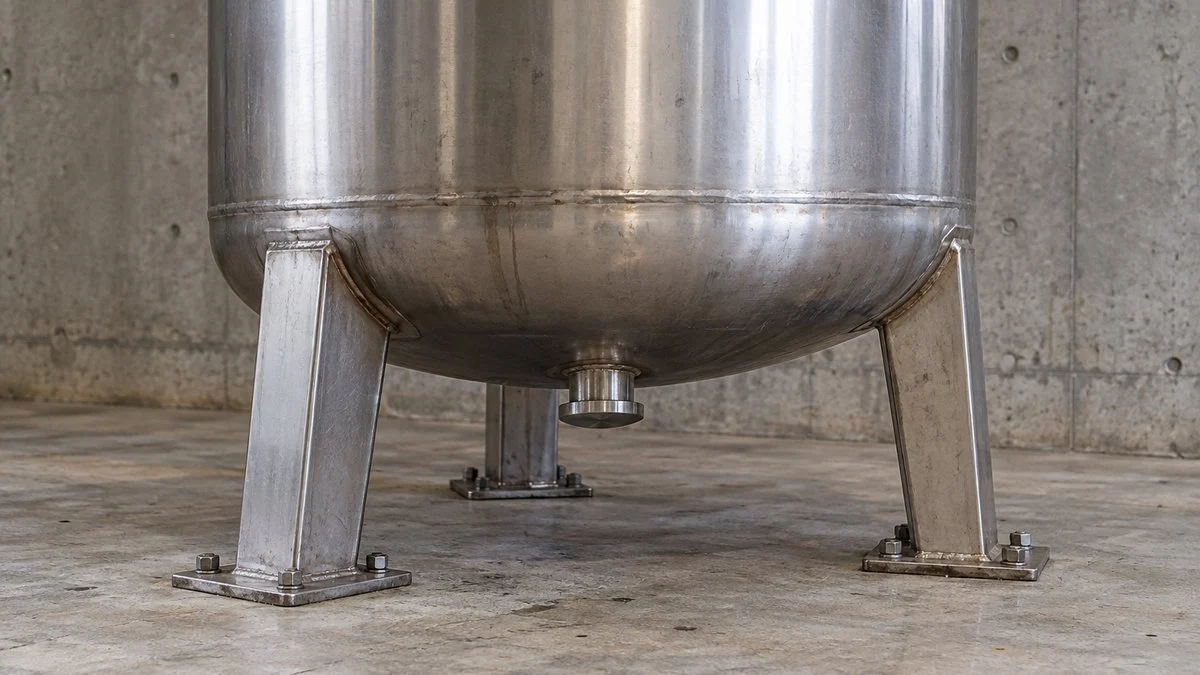
Under vacuum, atmospheric pressure pushes inward on the walls. A thin cylindrical shell under that compression can suddenly collapse at a certain load. This is buckling, and it is a different failure mode from bursting under internal pressure.
A rating of 0.2 MPa internal pressure does not prove a vessel can take vacuum. Resistance to external pressure depends on shell diameter, length, wall thickness, and the placement of stiffening rings, so check the design calculations or spec sheet for the stated vacuum rating.
The shell is not the only concern. Flat covers deflect and sealing faces distort. Even if the vessel body holds, a deformed cover or nozzle can leak and the vessel will not reach the vacuum you specified.
Figure 4: A 600 mm Cover Carries About 23 kN Inward
The 81.3 kPa pressure difference multiplied by the cover area. This is not a thickness or buckling calculation.
Left: front view. Right: section through the cover. Dimensions and pressures are illustrative; not to scale.
A round cover 0.600 m (about 23.6 in) across has an area of about 0.283 m². Multiply by the 81.3 kPa difference between outside and inside, and the total inward force is about 23.0 kN (roughly 5,200 lbf). The larger the area, the larger the force.
Near a perfect vacuum, the force on the same cover approaches about 28.6 kN (roughly 6,400 lbf). With atmosphere outside, the pressure difference can never exceed about one atmosphere, but that difference acts on the whole area, and the structure has to carry it.
Vacuum does not only come from a pump. When steam in a closed vessel cools and condenses, the inside pressure drops, the same effect a condenser uses to hold low pressure. A tank that is steamed out and then sealed can pull a vacuum on its own.
Where unintended vacuum must be prevented, equipment uses a vacuum breaker (vacuum relief valve) that lets air in. On a vessel that is supposed to hold vacuum, the protection has to match the process conditions; fitting a valve that leaves the vessel permanently open to atmosphere would defeat the process.
An implosion is still dangerous. Fragments and contents can scatter, especially from glass vessels and sight glasses. "It collapses inward, so nothing flies out" is not a reason to skip shielding or damage checks.
What to Send the Japanese Supplier
List the operating conditions step by step, not just the normal vacuum level. Laying out the whole cycle, from charging to cleaning, on one sheet makes short pressurization or temperature spikes hard to miss and shows the supplier which pressure combinations to design for.
Figure 5: From Process Steps to Spec Sheet Items
Record the inner vessel and jacket separately, and note whether conditions occur at the same time.
| Step or state | Conditions to record | Documents to request |
|---|---|---|
| Degassing / drying | Lowest absolute pressure, highest temperature, and contents of the inner vessel | External-pressure design conditions and strength calculations |
| Steam heating | Maximum jacket pressure and temperature, plus inner-vessel conditions at the same time | Drawings, volumes, and legal class for both spaces |
| Nitrogen break / pressure transfer | Supply pressure, upper limit in the vessel, and how it is limited or shut off | P&ID and safety device specifications |
| Cleaning / cooling | Cleaning temperature, steam condensation, venting during draining | Operating manual and procedures |
| Maintenance / reassembly | Specified covers, seals, and sight glasses, and how they are fitted | Parts list, inspection records, inspection documents |
Fill in the numbers from each unit's specification. If it is unclear which law applies, give the conditions to the manufacturer and the competent authority and let them decide.
The drawings should show the vacuum and nitrogen line connections, isolation valves, pressure gauges, and safety devices, with tag numbers that match the step list. A piping and instrumentation diagram (P&ID), not just a process flow diagram (PFD), is the document that shows this level of detail. Replacement covers and gaskets should keep the original vacuum-rated combination. A matching nominal size does not prove they are interchangeable; check the connection type (threaded or flanged) and bolting against the specified parts and drawings.
Related: Socket Weld vs Butt Weld: SW/BW on Japanese Piping Specs
Related: PFD vs P&ID on Japanese Projects: Contents and Drawing Order
In the RFQ, ask for the legal classification and the internal/external design conditions as separate line items. If the purchase specification also lists the documents to submit and the inspection scope, you will not be hunting for proof of vacuum rating after delivery. The same items are worth checking again when the approval drawings (shonin-zu) come back.
Questions for the Supplier
- Which class did you apply to the inner vessel and to the jacket (Class 1, small, Class 2, simple vessel, or none), and under which item of the Order?
- What maximum gauge pressure and internal volume did you use for that decision?
- What is the external design pressure: full vacuum (FV) or a stated limit? At what design temperature?
- Is the external-pressure rating based on the shell only, or does it also cover covers, nozzles, sight glasses, and seals?
- Have you checked the case where the jacket is pressurized while the inner vessel is under vacuum?
- What limits the pressure during nitrogen break, pressure transfer, and sterilization?
- What is the MAWP on the nameplate, and what are the relief valve set pressure and capacity?
- Does any other law (for example, the High Pressure Gas Safety Act) apply?
Sample RFQ Wording
You can paste and adapt this (all values are fictional):
Please quote the jacketed vacuum tank based on the attached operating-step list. In your quotation, state separately: (1) the legal classification under the Industrial Safety and Health Act for the inner vessel and the jacket, with the maximum gauge pressure and internal volume used; (2) the internal and external design pressures and design temperatures for each space, including the case of 0.30 MPaG in the jacket with the inner vessel at full vacuum; and (3) the documents you will submit to show the vacuum rating (strength calculations, drawings, and inspection records), including covers, sight glasses, and nozzles.
Where This Guide Does Not Apply
- Equipment installed outside Japan. The classes above come from Japanese law. A Japanese-built vessel shipped to the US, India, or Southeast Asia must meet the rules where it is installed. In the US, for example, ASME Section VIII Division 1 has a scope paragraph on low-pressure vessels (U-1(c)(2)(h)) that is often cited for vacuum-only vessels; confirm the exact wording in the edition your jurisdiction uses.
- Who decides. This article explains how to read the classification, not how to make it. When it is unclear which provisions apply to real equipment, give the conditions to the manufacturer and the competent authority (in Japan, the local Labour Standards Inspection Office) and have them confirm it.
- Boilers and other laws. Boilers, high-pressure gas equipment, and equipment covered by the Electricity Business Act follow different rules.
- Thresholds can change. Check the current text of the Order before relying on any number.
FAQ
Is a Vacuum Tank a Class 2 Pressure Vessel in Japan?
Not if it holds gas at room temperature under vacuum only, because Class 2 requires gas at 0.2 MPa gauge or more. If a step such as nitrogen pressure transfer reaches 0.2 MPa gauge, check first whether the vessel fits a Class 1 type, then apply the size conditions.
Does a Vacuum Vessel Need Pressure Vessel Inspection?
It depends on the vessel's function and class, not on its name. If the product side is under vacuum but a heating jacket runs at positive pressure, each space is assessed on its own conditions, and the required documents should be agreed with the manufacturer.
Can I Pull a Vacuum on a Sealed Atmospheric Tank?
Not on that basis. Being able to seal a tank at atmospheric pressure does not show it can take vacuum. Use equipment the manufacturer rates for vacuum, and make sure covers, sight glasses, and connections are rated for the same pressure and temperature.
What Does "Full Vacuum" Design Mean?
It generally means the vessel is designed for the external pressure difference when the inside is close to a perfect vacuum. The rating also needs the ambient pressure and design temperature, and for a jacketed vessel, the jacket conditions that occur at the same time should be stated in the spec.
Will a Relief Valve Stop a Vessel From Collapsing Under Vacuum?
No. A relief (safety) valve releases excess positive pressure; a vacuum breaker lets gas in under vacuum. The first line of defense is a structure designed for vacuum, combined with pressure limits and protective devices that suit the process.
Sources
- Definitions of Class 1, small, and Class 2 pressure vessels and simple vessels: e-Gov, Order for Enforcement of the Industrial Safety and Health Act, Article 1, items 5–7, and Article 13, paragraph 3, items 26–27 (Japanese)
- Definition of maximum allowable working pressure: Ministry of Health, Labour and Welfare, Ordinance on Safety of Boilers and Pressure Vessels, Article 1, item 6 (Japanese)
- Overview of each class: Tokyo Labour Bureau, license requirements under the Industrial Safety and Health Act (Japanese)
- Classification of boilers and pressure vessels: Japan Boiler Association (Japanese)
- External pressure, buckling, covers, and sealing faces: Pfeiffer Vacuum, "3.4 Vacuum chambers" (structural content only; European regulatory classes are not applied to Japan)
- Atmospheric-seal lids vs. vacuum service: MONOVATE, lid types FAQ (Japanese)
- Role of vacuum breakers: TLV, high-capacity vacuum breaker (Japanese)
- Hazards of glassware under vacuum: University of Pennsylvania EHRS, "SOP: Glassware Under Vacuum"
- ASME Section VIII Division 1 scope and vacuum vessels: Fermilab ES&H Manual, Chapter 5033 "Vacuum Vessel Safety"
Original article in JapaneseThis guide is adapted from a MONOSCOPE article written for readers in Japan: 真空容器は圧力容器になる?法的区分と外圧強度の見方
About the editor
 MONOSCOPE EditorFOUNDER & EDITOR
Spent about ten years at a plant equipment maker and a plant engineering company, proposing, designing, and commissioning equipment, then moved into web marketing. Now a web consultant for B2B manufacturers, helping them explain their products and technology. Licensed in Japan as an Energy Manager and a Third-Class Chief Electrical Engineer.
Has run an engineering blog since 2017 (500+ articles) and a Japanese YouTube channel with about 20,000 subscribers. Each English guide is written from the Japanese shop-floor point of view and checked against the cited standards.