Tap Plates on Japanese Specs: Bolting Equipment to Steel
You are reviewing the specification for a pump skid, fan, or panel from a Japanese supplier, and one line reads "タッププレート、ボルト、ナットを付属する" — tap plates, bolts, and nuts to be supplied. Your structural team asks what a "tap plate" is, and nobody can say who is supposed to weld it to the steel.
A tap plate (タッププレート) is a metal plate with tapped (threaded) holes. When equipment sits on structural steel, the tap plate is welded to the steel and serves as the base for the mounting bolts. Japanese job sites also call it a "tap base" (タップベース) or "tapping plate" (タッピングプレート).
This guide explains what the plate does, how it compares with other ways of fixing equipment to steel, how installation on steel differs from a concrete foundation, and what to check in the specification and on site. It ends with a checklist, questions to send your Japanese supplier, and an FAQ on similar parts and the English name.
Contents
What Is a Tap Plate?
In general, a tap plate is any metal plate with tapped holes. On construction and installation sites, the term mostly refers to a plate used to mount equipment on top of structural steel.
A tap is the tool that cuts internal threads inside a hole. Once a hole is tapped, a bolt screws straight into it, so the plate itself does the job of a nut.
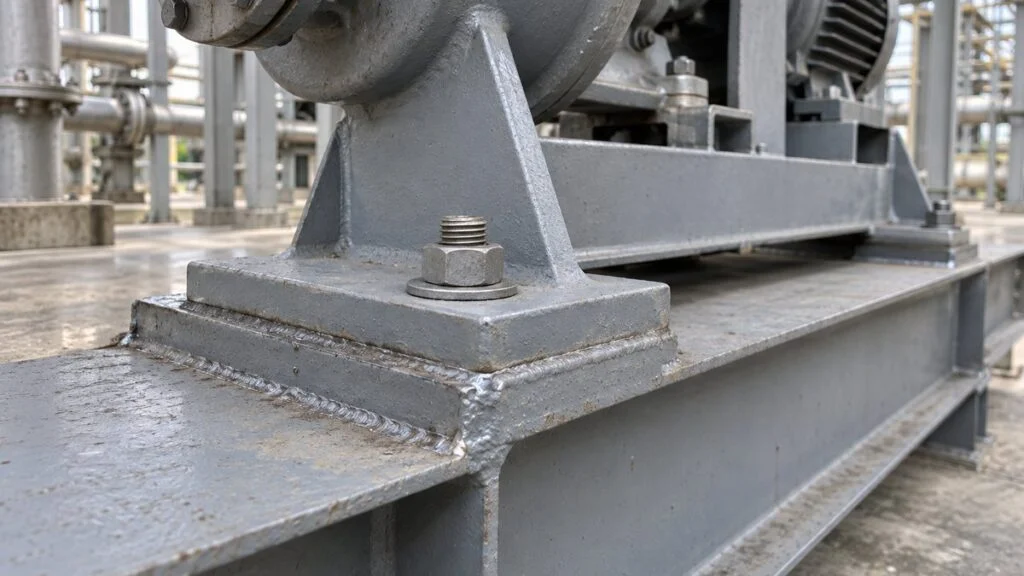
Bolts screw into the tapped holes of plates welded to the steel. The equipment foot sits over the bolts, and nuts tighten it down from above.
This is the same arrangement as the steel installation steps below. How the bolts are fixed depends on the size and design of the equipment.
Tap plates are also used as parts inside machines, but this article covers only tap plates used to install equipment.
Why Use a Tap Plate? Three Ways to Fix Equipment to Steel
The purpose of a tap plate is to bolt equipment to structural steel. There are three common ways to fix equipment to steel, and the reason for choosing a tap plate is easiest to see side by side.
A tap plate lets you bolt equipment down without drilling the steel, and you can still remove it later.
The right method depends on the equipment weight and the design conditions of the steel. This table compares general differences only.
The main topic is installation on steel. For comparison, the next section first walks through a typical concrete foundation.
Installation Steps: Concrete Foundation vs. Steel
On a concrete foundation, a common method uses chemical anchors (resin capsules that bond the anchor bolt into a drilled hole). On steel, the welded tap plate takes the place of the anchor. Figure 3 shows both sequences step by step.
The last step is the same: set the equipment and tighten the nuts. What differs is how the bolt is held.
A general outline only. Actual steps change with the size of the equipment and the project.
Related: Cast-In vs Post-Installed Anchors: Methods and When to Use
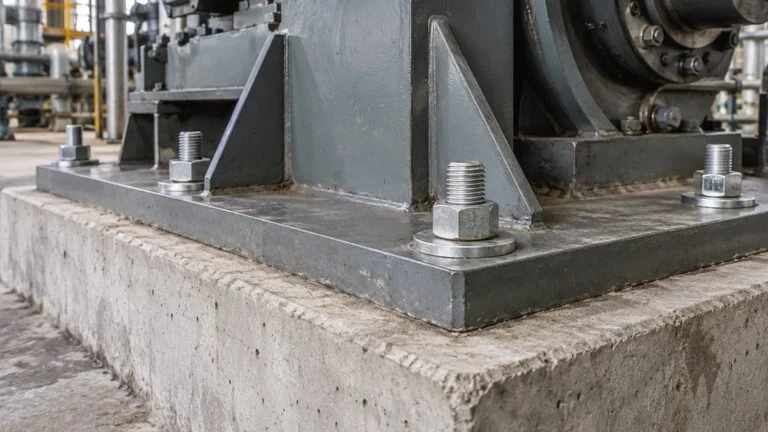
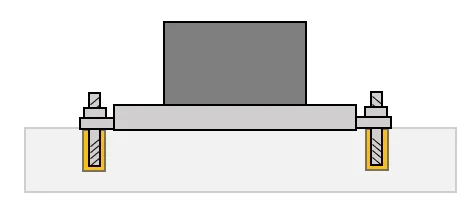
The finished installations look like this. On concrete, the anchor bolts are set in resin:
On steel, the welded tap plate holds the bolts, so you do not have to drill the steel itself:
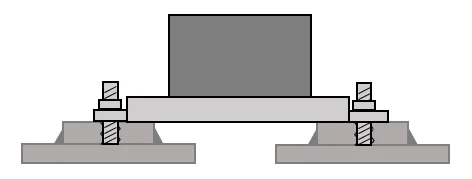
You could weld the equipment directly to the steel, but a tap plate keeps the equipment removable, which pays off when it needs maintenance. To actually benefit from that, workers need room to reach the nuts with a wrench. Where piping and support frames crowd around the equipment, check the clearance at the layout stage.
What to Check When a Spec Calls for Tap Plates
A tap plate is a small part, but if nobody decides the details, work stops on site. The checks fall into two groups: what to confirm in the specification and drawings, and what to confirm during installation.
Check the first two in the specification and drawings, and the last two on site.
Actual plate thickness and thread size come from the equipment and support-frame design. This article does not give typical values.
In the Specification and Drawings
Start with scope of supply — shosho (所掌) in Japanese specs. If the spec says tap plates, bolts, and nuts are "supplied" (付属, fuzoku), the equipment supplier provides the parts. That sentence alone does not say who welds the plates to the steel.
The split of work differs from contract to contract. Write down who does the welding and who does the painting at the quotation-specification stage (mitsumori shiyosho, 見積仕様書) so that no task falls between the two parties. For how Japanese specs define scope, see our guides to the equipment purchase specification and to who supplies the mating flange.
Next, check the plate thickness and thread size. Because the plate replaces the nut, a plate that is too thin leaves too few threads engaged with the bolt. Component maker Elesa+Ganter states in its catalog that, for its plates with tapped holes, the plate thickness equals the minimum thread engagement depth. The designer chooses the bolt size and strength, along with its property class and tightening torque.
Related: JIS Bolt Grades 8.8 vs 10.9 vs 12.9: Strength and Torque
During Installation
On site, check the hole positions first. The tap plate is placed to match the equipment's mounting holes and then welded, so compare it against the equipment dimensions before welding.
Then check the threads. Weld spatter (small drops of metal thrown off during welding) or paint in the threads makes the bolts hard to screw in. Crews therefore mask the tapped holes before welding or painting — yojo (養生) in Japanese — or check the threads after the work.
Tap Plate Checklist and Questions for Your Japanese Supplier
Use the following lists when a Japanese specification or drawing mentions tap plates (タッププレート), tap bases (タップベース), or tapping plates (タッピングプレート).
Checklist
- Spec: Does the scope of supply list tap plates, bolts, and nuts? Is each one supplied by the equipment supplier or by you?
- Spec: Is it written who welds the plates to the steel, and who paints or touches up afterward?
- Drawings: Do the drawings show plate thickness, thread size, and hole positions as dimensions?
- Drawings: Has the person responsible for the steel design confirmed where the plates sit on the beam?
- Layout: Is there enough clearance around the nuts for a wrench, considering nearby piping and frames?
- Before welding: Have the plate positions been checked against the actual equipment mounting holes?
- Welding and painting: Are the tapped holes masked?
- Before setting the equipment: Do the bolts screw in freely, with no spatter or paint in the threads?
Questions to Send the Supplier
- Are the tap plates, bolts, and nuts included in your scope of supply?
- Who is responsible for welding the tap plates to the structural steel, and for painting afterward?
- Please show the plate thickness, material, thread size, and hole layout on the drawing.
- Please provide a dimensioned drawing of the equipment mounting holes so we can position the plates before welding.
Sample Inquiry Email
Subject: Tap plates for [equipment name] – scope and drawing details
Hello [Name],
Your specification states that tap plates, bolts, and nuts will be supplied with [equipment name]. To prepare the steel work, could you confirm the following?
1. Who will weld the tap plates to our structural steel, and who will paint them afterward?
2. Plate thickness, material, thread size, and hole layout (please show these on the drawing).
3. A dimensioned drawing of the equipment mounting holes.
Thank you,
[Your name]
Limits of This Guide
- Plate thickness and thread size are set by the design of the equipment and its support frame. This guide gives no typical values; confirm them with the designer and the supplier.
- Whether to weld, through-bolt, or use tap plates depends on equipment weight and the steel's design conditions.
- The names "tap plate," "tap base," and "tapping plate" are not defined by a standard, and usage varies by company and site. Identify the part by its shape and dimensions, not its name.
- The installation steps above are a general outline, not a work procedure. Follow the project's approved procedures and the instructions of the people responsible for the steel and the equipment.
Tap Plate FAQ
They look alike, but they differ in where they go and what they hold.
What Is the Difference Between a Tap Plate, a Tap Base, and a Tapping Plate?
All three are names sometimes used for plates with tapped holes. They are not names defined by a standard, and usage varies by company and site.
For example, a Japanese piping contractor lists a "weld tap base" (溶接タップベース) among its fabrication jobs, which shows that a plate welded on as a base is sometimes called a "base." On drawings and specs, confirm what the part is from its shape and dimensions.
Is a Tap Plate Related to a Tapping Screw?
No. The names are similar, but the parts are different. A tapping screw forms its own internal thread as it is driven in, so it fastens into a plain pilot hole without a tap or a nut.
Tapping screws are mainly used in thin sheet steel. A tap plate works differently: its threads are cut with a tap in advance.
What Is a Tap Plate Called in English?
People sometimes search for "tap plate" and "tapping plate," but there does not appear to be an established English name. Catalogs from component makers outside Japan use terms such as "plate with tapped holes" and "threaded plate."
When you exchange drawings or specs across borders, do not rely on the name alone. State the plate thickness, nominal thread size, and hole positions as dimensions to avoid misunderstandings.
How Is a Tap Plate Different from a Nut Plate?
A nut plate is a small plate with internal threads that sits on the back of a part in place of a nut. Hinge hardware, for example, is sold with pre-threaded nut plates as accessories.
Both have threads in a plate. The difference is that a nut plate clamps a part from behind, while a tap plate is welded to structural steel as a base for equipment.
How Is a Tap Plate Different from a Weld Nut?
Another method is to weld a nut behind a bolt hole in sheet steel or a support frame, so you can tighten the bolt without holding the nut. In Japan, weld nuts are covered by JIS B 1196, and maker catalogs group them into hexagon, square, and T-shaped types.
A tap plate has the threads cut into the plate itself, so there is no nut to weld.
How Is a Tap Plate Different from a Control Panel Mounting Plate?
Inside a control panel, devices mount on a steel plate that Japanese panel makers call a kiban (基板, mounting plate). For example, Nitto Kogyo's steel mounting plate BP22 is 2.3 mm thick.
Holes are drilled in the mounting plate to suit the devices, and breakers, terminal blocks, and 35 mm DIN rails (called "IEC rails" in Nitto Kogyo's catalog) are screwed to it. This plate is a separate part from a tap plate used for installation. However, if you mount the panel or a junction box (JB) itself on a steel support frame, the method in this article is one option.
Related: Junction Box (JB) on Japanese Drawings: Terminal Box Guide
For the signals between panels and field devices, see DI/DO, AI/AO, PI/PO: Reading a Japanese I/O List.
Sources
- Taps (tools that cut internal threads): MonotaRO, "Types and uses of taps" (Japanese)
- Plate thickness and thread engagement; "plates with tapped holes": Elesa+Ganter, GN 7247.4 Plates, Stainless Steel, with Tapped Holes
- How tapping screws work: MISUMI technical data, "Features, types, and use of tapping screws" (Japanese)
- "Weld tap base" as a name: B.W.W., fabrication example "SUS304 HL weld tap base" (Japanese)
- Nut plates: Sugatsune, "Nut plate 218-09XX" (Japanese)
- Weld nuts (JIS B 1196): Shinjo Manufacturing, "Weld nuts and weld flange nuts" (Japanese)
- Panel mounting plate and IEC rail: Nitto Kogyo, "[BP22] Steel mounting plate" (Japanese); Nitto Kogyo, "[TB-DR] IEC rail (35 mm wide)" (Japanese)
Original article in JapaneseThis guide is adapted from a MONOSCOPE article written for readers in Japan: タッププレート(タップベース)とは?鉄骨への機器据付で使う目的と手順
About the editor
 MONOSCOPE EditorFOUNDER & EDITOR
Spent about ten years at a plant equipment maker and a plant engineering company, proposing, designing, and commissioning equipment, then moved into web marketing. Now a web consultant for B2B manufacturers, helping them explain their products and technology. Licensed in Japan as an Energy Manager and a Third-Class Chief Electrical Engineer.
Has run an engineering blog since 2017 (500+ articles) and a Japanese YouTube channel with about 20,000 subscribers. Each English guide is written from the Japanese shop-floor point of view and checked against the cited standards.