Quenching, Tempering, Annealing, Normalizing on JIS Drawings
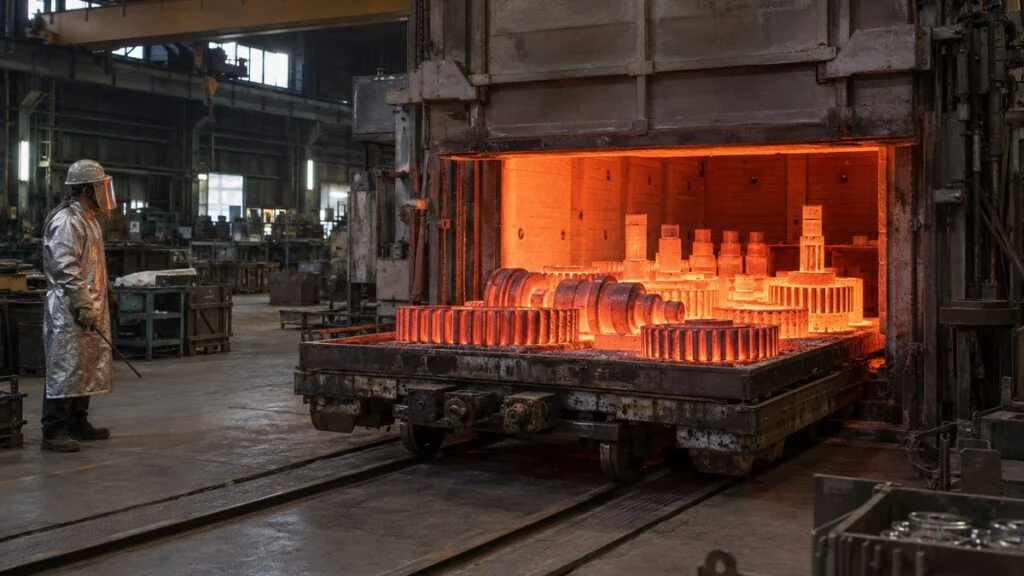
Picture a typical case (fictional): a Japanese drawing for a shaft lists the material as S45C and adds a short note, HQ-HT, HRC 50–55. Another drawing just says 調質 (choshitsu). If you are sourcing the part locally, checking an incoming lot, or quoting the job to a heat treater, you need to know exactly what those marks ask for.
They are heat treatment callouts. HQ, HT, HA, and HNR are the JIS (Japanese Industrial Standards) process symbols for quenching, tempering, annealing, and normalizing, the four basic heat treatments for steel. This guide gives you a quick-reference table of the symbols and Japanese terms, explains what each treatment does and when it is used, and ends with a checklist and a sample inquiry you can send to your Japanese supplier or heat treater.
Contents
- Heat Treatment Symbols on Japanese Drawings
- What Heat Treatment Does to Steel
- Quenching vs. Tempering vs. Annealing vs. Normalizing
- Quenching (Yakiire, HQ): Rapid Cooling to Harden
- Tempering (Yakimodoshi, HT): Toughness After Quenching
- Annealing (Yakinamashi, HA): Softening for Machining
- Normalizing (Yakinarashi, HNR): Refining the Grain
- Where Heat Treatment Fits in the Process
- What to Confirm with Your Japanese Supplier or Heat Treater
- Limits of This Guide
- Summary
- FAQ
- Sources
Heat Treatment Symbols on Japanese Drawings
JIS B 0122 (Symbols of Metal Working Processes) assigns heat treatment the letter H, followed by letters for the specific process. Japanese drawings and process sheets use these symbols, and they chain them with hyphens to show the sequence. "HQ-HT" means quench, then temper. The standard also allows the leading H to be dropped when it cannot be confused with another process symbol.
| Symbol | Japanese term | English term | What it does |
|---|---|---|---|
| HQ | 焼入れ (yakiire) | Quenching (hardening) | Heat above the transformation temperature, then cool fast to harden the steel |
| HT | 焼戻し (yakimodoshi) | Tempering | Reheat hardened steel below the transformation temperature to trade some hardness for toughness |
| HA | 焼なまし (yakinamashi) | Annealing | Heat, then cool slowly in the furnace to soften the steel or relieve stress |
| HNR | 焼ならし (yakinarashi) | Normalizing | Heat above the transformation temperature, then cool in air to refine and even out the structure |
| HQ-HT | 焼入れ焼戻し (yakiire yakimodoshi) | Quench and temper (Q&T) | The usual pair: harden, then temper |
| (word only) | 調質 (choshitsu) | Thermal refining (quench and high-temperature temper) | Quenching followed by tempering at a relatively high temperature for strength plus toughness |
Variants add a third letter. Supplier handbooks that reproduce the JIS B 0122 table list, for example, HAF (full annealing), HAS (spheroidize annealing), HAR (stress relief annealing), HQI (induction hardening), HQF (flame hardening), HNT (nitriding), and HSZ (sub-zero treatment). Symbols for surface hardening are covered later in this guide.
Two more Japanese terms show up next to these symbols. 熱処理 (netsu shori) simply means heat treatment, and 硬さ (katasa) means hardness, usually followed by a range such as HRC 50–55. If you are new to Japanese drawings in general, see how to read Japanese engineering drawings.
What Heat Treatment Does to Steel
Heat treatment changes the internal structure and properties of a metal by heating, holding, and cooling it, without changing its shape. Unlike machining or stamping, it leaves the part looking almost the same, so you can only judge the result through hardness testing and inspection for cracks.
Steel responds to heat treatment because the arrangement of its iron crystals changes with temperature. At room temperature, carbon steel consists of soft ferrite and pearlite, a layered mix of ferrite and cementite (an iron-carbon compound). Heat it above the transformation temperature (変態点, hentaiten; often called the critical temperature in US texts) and it turns into austenite, a structure in which the carbon is dissolved in the iron.
What happens next depends on how fast you cool it. Cool it slowly and it returns to soft ferrite and pearlite. Cool it fast and the carbon has no time to escape, so it is trapped in hard martensite. That is the basic rule of heat treatment: the faster the cooling, the harder the structure.
Whether the steel is heated above the transformation temperature, and how fast it is cooled, decide which treatment it is.
Note: The transformation temperature depends on the carbon and alloy content. For S45C it is about 780°C (1,436°F).
Placing the four treatments on these two axes, as in Figure 1, keeps them apart. In Japanese, annealing (yakinamashi) and normalizing (yakinarashi) differ by a single syllable, and the main difference between them is how the steel is cooled.
Quenching vs. Tempering vs. Annealing vs. Normalizing
Figure 2 compares the four treatments side by side. The temperatures are typical values for a medium-carbon steel for machine structural use such as S45C, which is commonly listed as the counterpart of AISI 1045 and EN C45. The heat treater sets the actual conditions based on the grade, the part size, and the hardness required.
They split into two groups: quenching and tempering harden the steel, and annealing and normalizing condition it.
Note: Temperatures are general guide values from the Tobu Metal Heat Treatment Industrial Association, Keyence, and heat treaters' technical pages. Symbols follow JIS B 0122.
Hardening Pair and Conditioning Pair
The four are easier to remember as two pairs. Quenching and tempering work together to give a part the hardness and strength it needs. Quenched steel alone is too hard and brittle, so it is almost always tempered afterward.
Annealing and normalizing, by contrast, correct the uneven structure and stress left by forging or welding and prepare the material for the next step. Their main job is usually to put the material in an easy-to-work condition during production rather than to set the final hardness. The sections below take each treatment in turn.
Quenching (Yakiire, HQ): Rapid Cooling to Harden
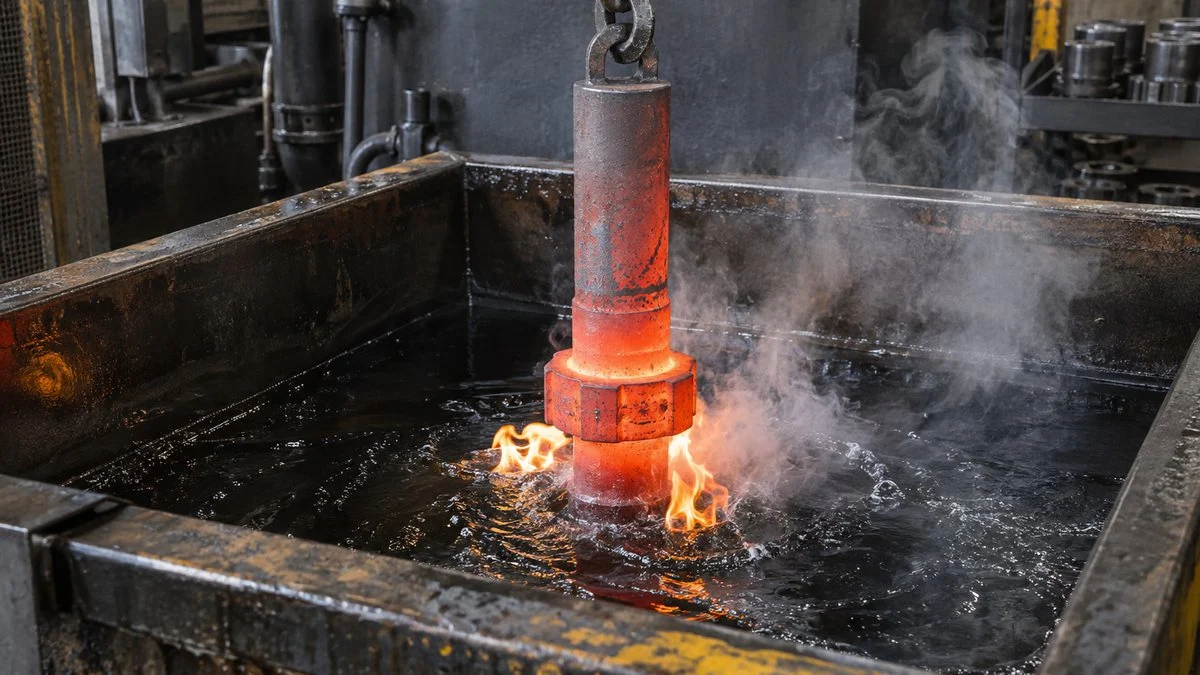
Quenching heats steel above the transformation temperature to form austenite and then cools it rapidly in water or oil. JIS G 0201 defines it as cooling a steel product faster than in still air. The goal is to make the steel hard and strong.
With rapid cooling, the carbon dissolved in the austenite has no time to move out and stays trapped in the crystal, which turns into hard martensite. Gears, shafts, cutting tools, and dies, along with many other parts that must resist wear or carry high loads, go through this process.
Heating forms austenite, quenching forms martensite, and tempering turns it into a tougher structure.
Note: Slow cooling does not form martensite. The steel returns to ferrite + pearlite (annealing, normalizing).
Quenching Temperature: Just Above the Transformation Point
Hotter is not better. According to the Tobu Metal Heat Treatment Industrial Association, the ideal quenching temperature for S45C is 820–870°C (1,508–1,598°F), or 30–50°C above its transformation temperature of about 780°C. For large parts, or when the quenchant has a lower cooling capacity, a temperature toward the high end makes the steel easier to harden.
Overheating, on the other hand, coarsens the grains and produces coarse martensite, which makes quench cracking (cracking during quenching) more likely. The same source lists quenching S45C from 950°C (1,742°F) as an unsuitable condition.
Quenchants, Mass Effect, and Hardenability
The quenchant sets the cooling rate. Cooling capacity is generally ranked water, then salt bath, then oil. Faster cooling, however, raises the temperature difference between the surface and the core, and with it the risk of distortion and cracking. Choosing a quenchant that balances hardness against crack resistance for the grade and shape is where the heat treater's skill shows.
Mass effect matters just as much. JIS G 0201 defines it as the degree to which the depth of hardening changes with the mass or cross-section of the part. In practice, a thick part cools more slowly at the core and does not harden as deeply.
Steels with high hardenability (how readily the steel transforms to martensite) make up for this. A section size that a carbon steel such as S45C cannot harden through to the core can be hardened in a chromium-molybdenum alloy steel such as SCM435, which supplier tables commonly list against AISI 4135 or 4137. That is one reason Japanese drawings specify alloy steel for large-diameter, high-strength parts.
Quench Cracks and Distortion
Quenching changes the volume of the steel and leaves high internal stress. Abrupt steps, sharp corners, or large differences in wall thickness concentrate that stress and raise the risk of quench cracks or warping.
Parts that will be quenched should therefore be designed with rounded corners and minimal differences in wall thickness. If a part is left standing after quenching, internal stress can also make cracks grow or distortion worsen, so the basic rule is to temper as soon as possible after quenching.
Tempering (Yakimodoshi, HT): Toughness After Quenching
Tempering reheats quenched steel to a temperature below the transformation temperature, holds it there, and then cools it. JIS G 0201 defines it as a heat treatment, usually after quench hardening, in which the steel is soaked one or more times at a specific temperature and then cooled at a suitable rate.
As-quenched martensite is very hard, but it is also brittle and carries internal stress. Tempering lowers the hardness to the required level and gives the steel toughness in return. The higher the tempering temperature, the lower the hardness and tensile strength, and the higher the elongation and reduction of area.
Low temperatures keep hardness, high temperatures favor toughness, and a range in between is best avoided.
Note: Guide values from Keyence, the Tobu Metal Heat Treatment Industrial Association, and Kotobank (temper embrittlement). The right temperature depends on the grade. 150–200°C = 302–392°F; 300°C = 572°F; 500–650°C = 932–1,202°F.
Low-Temperature Tempering for Parts That Must Stay Hard
Low-temperature tempering is done at about 150–200°C (302–392°F). It barely lowers the hardness but eases the brittleness and crack sensitivity left by quenching. It is used for parts where hardness comes first, such as cutting tools, tools, and wear-resistant parts. Carbon tool steels (JIS SK grades), for example, are usually tempered at 150–200°C.
SKD11, a die steel widely used in die and press work and commonly listed against AISI D2, is tempered at 150–200°C when wear resistance is the priority and at 500–550°C (932–1,022°F) when toughness is. The same grade can be tempered at very different temperatures depending on the application.
In high-alloy tool steels such as SKD11, some retained austenite (austenite that did not transform to martensite) always remains after quenching. It can cause dimensional change over time, so heat treaters stabilize it with a sub-zero treatment that cools the steel to 0°C (32°F) or below before low-temperature tempering, or by repeating high-temperature tempering two or more times.
High-Temperature Tempering and Choshitsu
Steels for machine structural use are normally tempered at a high temperature of 500–650°C (932–1,202°F). In Japan, quenching followed by high-temperature tempering is called 調質 (choshitsu). JIS G 0201 gives its English term as "thermal refining" and defines it as tempering at about 400°C (752°F) or higher after quenching. In English-language specifications, the closest everyday term is "quenched and tempered" (Q&T).
Thermally refined steel is not as hard as as-quenched steel, but it has an excellent balance of strength and toughness and stands up well to impact and repeated loads. The structure obtained by tempering at around 550°C is called sorbite and is considered the standard structure of thermally refined machine structural steel. Many high-strength parts, such as shafts, gears, and bolts, are made from quenched and tempered material.
Temperature Ranges to Avoid
Hardness does not simply fall in a straight line as the tempering temperature goes up. When carbon steel is tempered around 300°C (572°F), low-temperature temper embrittlement makes it more vulnerable to impact, so temperatures between the low and high tempering ranges are generally avoided.
There is also high-temperature temper embrittlement at around 450–550°C (842–1,022°F), attributed to impurities collecting at the grain boundaries. Adding molybdenum is known to reduce it, which is one of the reasons for choosing a Mo-bearing alloy steel.
Annealing (Yakinamashi, HA): Softening for Machining
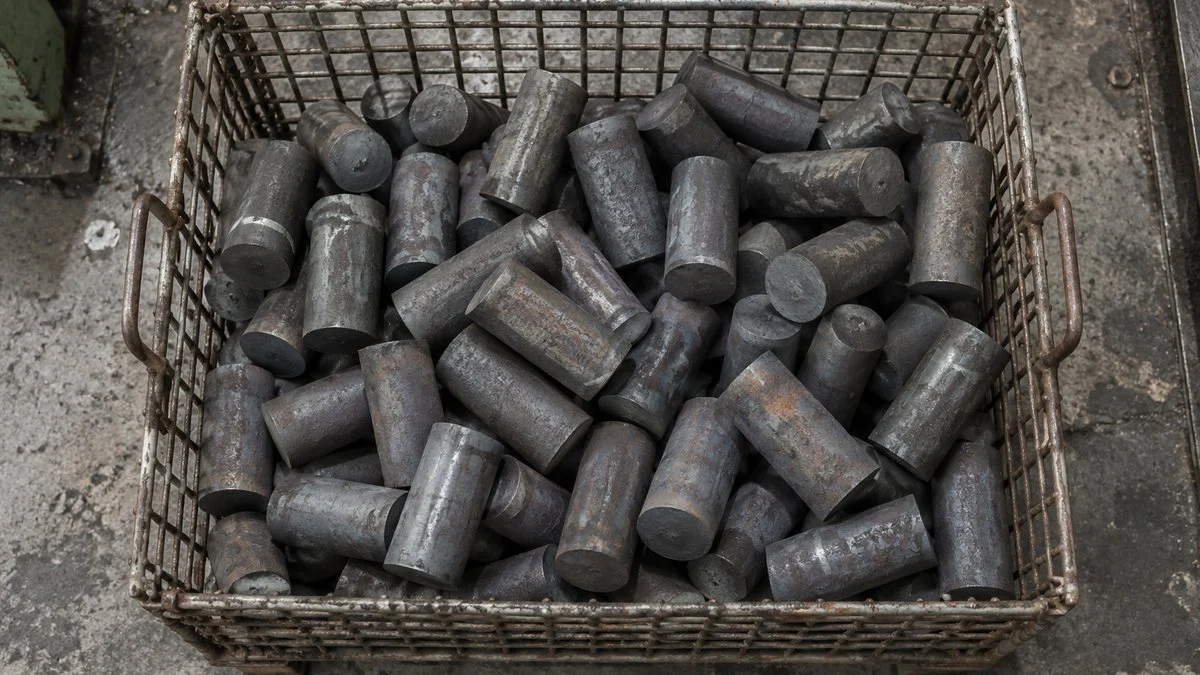
Annealing heats steel, holds it, and then cools it slowly, typically inside the furnace. It is the opposite of quenching: its main purpose is to soften the steel so it is easier to machine, or to remove internal stress. On drawings it carries the symbol HA.
There are several types of annealing for different purposes, and their heating temperatures range from above the transformation temperature to below it. A note that says only 焼なまし (annealing) does not tell the heat treater what you want, so state which type of annealing you mean.
All three are called annealing, but the heating temperature and the goal differ widely.
Full Annealing
Full annealing heats steel 30–50°C above the transformation temperature to form austenite and then cools it slowly. As a guide, carbon steel is furnace-cooled and alloy steel is cooled at 20°C (36°F) per hour or less. Once it reaches 500°C (932°F) or below, it can be air-cooled.
The result is a soft structure of evenly distributed ferrite and pearlite. Full annealing is used, for example, to turn a hard, uneven forging into material that machines easily.
Spheroidize Annealing
Spheroidize annealing holds steel near the transformation temperature for a long time so the carbides in it gather into rounded particles. Carbides left in layers or networks wear cutting tools quickly and make the steel prone to cracking in cold forging or bending.
With spheroidized carbides, the same steel machines and forms much better and responds more consistently to later quenching. The process is especially common for high-carbon tool steels and bearing steels.
Stress Relief Annealing
Stress relief annealing heats steel to a temperature below the transformation temperature and cools it slowly to reduce residual stress. It removes the stress from welding, rough machining, or cold working without much change to the structure.
If a part still holds residual stress when it is finish-machined, it can warp after cutting or change dimensions in service. For welded structures and parts with tight tolerances, a stress relief anneal before finishing prevents this kind of dimensional drift.
Normalizing (Yakinarashi, HNR): Refining the Grain
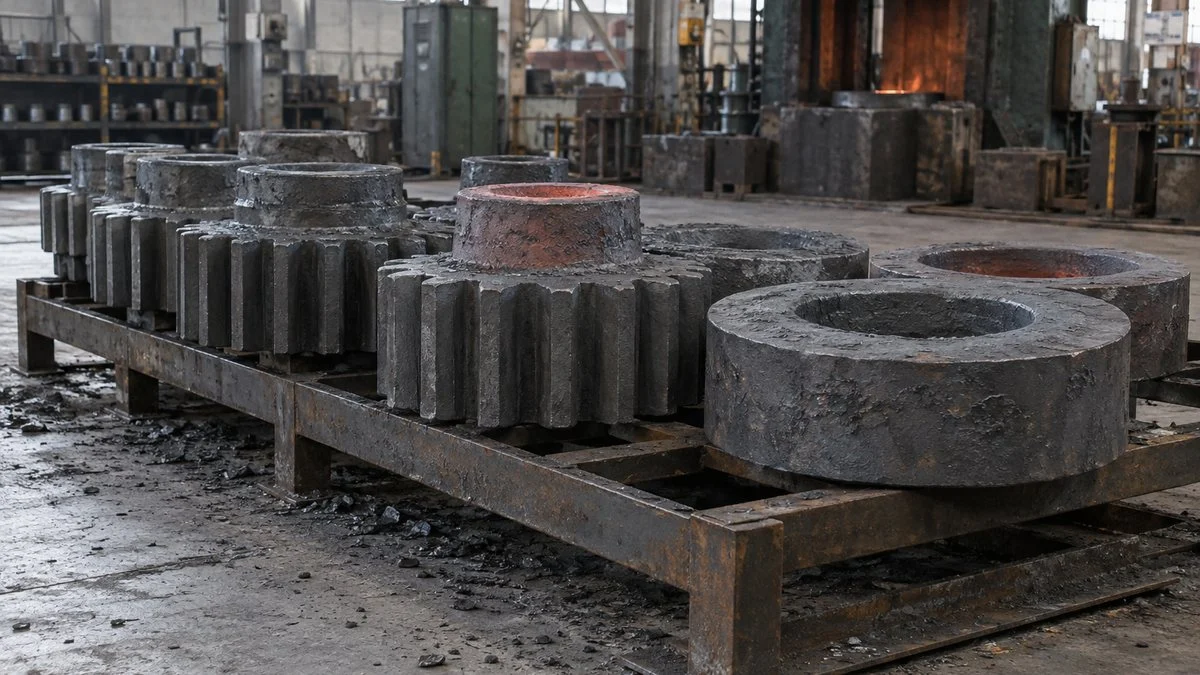
Normalizing heats steel above the transformation temperature to form austenite and then cools it in air. JIS G 0201 likewise defines it as a heat treatment in which the steel is air-cooled after austenitizing. On drawings it is written HNR.
Steel that has been forged or rolled at high temperature has coarse grains, and its structure varies from place to place. Normalizing refines that into a fine, uniform structure and returns the steel to a "standard" condition. One heat treater gives 900–930°C (1,652–1,706°F) followed by air cooling as an example condition.
The Japanese names differ by one syllable, but the cooling method changes the final hardness and where each one is used.
Note: Hardness after normalizing depends on the carbon content.
When to Choose Normalizing Over Annealing
Because normalizing cools in air, it cools faster than full annealing in the furnace and leaves a finer structure. As a result, normalized steel is harder than fully annealed steel and has a good balance of strength and machinability.
In practice, annealing is the usual choice when ease of machining comes first. Normalizing is used when you want a refined structure so the later quench gives consistent results, or when the part needs some strength but not full quench hardening. Since the steel does not have to cool in the furnace, normalizing also takes less process time and furnace capacity.
Normalizing as a Pre-Treatment for Quenching
If a forging with a coarse structure goes straight to quenching, the hardness can vary and quench cracks or distortion become more likely. A common sequence is to normalize the forging first, machine it, and then quench and temper it.
Normalizing can be the final heat treatment, but more often it serves as preparation that helps the next step go smoothly.
Where Heat Treatment Fits in the Process
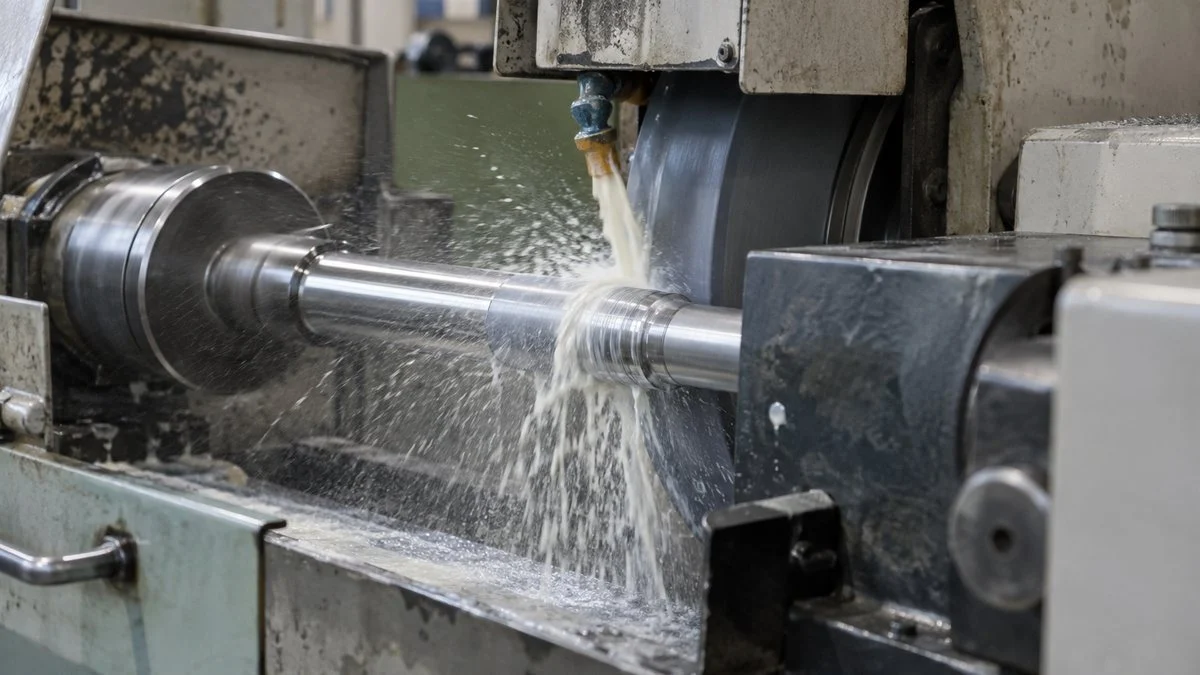
A single part often goes through more than one of these treatments. A forged shaft or gear, for example, is normalized or annealed as raw material, quenched and tempered after rough machining, and finished by grinding. Each treatment does its own job at a different stage, as Figure 7 shows.
Treatments that condition the material and treatments that create performance come at different stages.
Note: Welded structures and precision parts may get a stress relief anneal before finishing. The order of steps varies by part and by company.
Quenching distorts a part slightly and makes it hard to cut. The standard approach is to leave finishing stock on surfaces that need tight tolerances and grind them to size after heat treatment. Which dimensions are finished before heat treatment and which after is something the manufacturing engineers and the designers agree on.
How Heat Treatment Is Specified on the Drawing
Heat treatment is usually called out with symbols on the drawing or process sheet, using the JIS B 0122 symbols in the table at the top of this guide. Along with the symbol, most drawings give the hardness range required after heat treatment, such as HRC 50–55. The reason is simple: the final hardness, more than the method used to reach it, is what the receiving inspection checks.
Related: How to Read Japanese Engineering Drawings (JIS B 0001)
Surface Hardening Is a Separate Callout
The four treatments in this guide are through (bulk) heat treatments that heat the whole part. When only the surface needs to be hard, such as gear tooth flanks or the sliding surfaces of a shaft, and the core must stay tough, the drawing calls for surface hardening instead: induction hardening, flame hardening, carburizing, or nitriding. JIS B 0122 gives these their own symbols, such as HQI for induction hardening and HNT for nitriding.
Surface hardening is sometimes treated as a branch of surface treatment, alongside plating and painting. Deciding first whether the whole part must be hard or only the surface avoids wasted cost and gives the right performance.
Related: JIS Plating Callouts (Ep-Fe/Zn8/CM2) and ASTM Equivalents
What to Confirm with Your Japanese Supplier or Heat Treater
Heat treatment is often outsourced to a specialist heat treater. Whether you are placing that order or receiving parts from a Japanese supplier, agreeing on the points below up front prevents disputes at inspection.
- Steel grade. The exact JIS grade (for example, S45C or SCM435). If you plan to use a local equivalent such as AISI 1045, get written approval, because the heat treatment response depends on the actual chemistry.
- Type of treatment. HQ-HT, HNR, or HA, and for annealing, which type (full, spheroidize, or stress relief). If the drawing says only 調質 (choshitsu), ask for the target hardness or tempering range.
- Required hardness range. The scale and range, such as HRC 50–55.
- Where hardness is measured. Because of mass effect, thick and thin sections harden differently. Specify which location must meet which HRC value.
- Areas where distortion or cracks are critical. Bores, sharp corners, and thin walls that the heat treater should take care with.
- Finishing stock. Which surfaces are ground after heat treatment, and how much stock is left.
- Records. Whether you need a hardness test record or heat treatment certificate with the shipment, in addition to the mill certificate for the material.
A sample inquiry you can adapt (the part, grade, and values are fictional):
Subject: Heat treatment for drawing No. XXX-1234 (shaft, S45C)
We are reviewing the heat treatment note "HQ-HT, HRC 50–55" on drawing XXX-1234. Please confirm the following:
- Where should hardness be measured (location and number of points)? Does the range apply at the large-diameter section as well?
- Which surfaces will be ground after heat treatment, and what finishing stock should we leave?
- Are there areas where distortion or cracking is a particular concern?
- May we use AISI 1045 in place of S45C if the hardness requirement is met?
- What inspection record do you require with each shipment?
Thank you for your help.
Limits of This Guide
- The temperatures here are general guide values, mostly for medium-carbon steel such as S45C. The right conditions depend on the grade, section size, furnace, and quenchant, and the heat treater sets them.
- This is not a work instruction. Heat treatment involves high temperatures, quench oils, and furnace atmospheres, and the heat treater's own procedures and safety rules apply.
- Grade equivalents such as S45C/AISI 1045, SCM435/AISI 4135 or 4137, and SKD11/AISI D2 are commonly listed counterparts, not identical specifications. Confirm substitution with the customer or designer.
- Symbol usage can vary by company. Some drawings use in-house abbreviations or words instead of JIS symbols, so check the drawing's notes or ask when something is unclear.
- Surface hardening, stainless steels, tool steels, and nonferrous metals have their own conditions and are only touched on here.
Summary
- On Japanese drawings, HQ = quenching, HT = tempering, HA = annealing, and HNR = normalizing (JIS B 0122). HQ-HT means quench and temper.
- Heat treatment changes the structure and properties of steel through the combination of heating temperature and cooling rate.
- Quenching hardens steel by cooling it rapidly from above the transformation temperature. Tempering then adjusts the hardness and adds toughness.
- Tempering is done at a low 150–200°C or a high 500–650°C (choshitsu, or thermal refining). Temperatures around 300°C are avoided.
- Annealing cools slowly in the furnace to soften the steel and relieve stress. Normalizing cools in air to refine the structure, often as a step before quenching.
- Confirm the grade, treatment type, hardness range, measuring location, and critical areas with the Japanese side before production.
FAQ
What does HQ-HT mean on a Japanese drawing?
HQ-HT means quench, then temper. HQ is the JIS B 0122 symbol for quenching (焼入れ, yakiire) and HT is the symbol for tempering (焼戻し, yakimodoshi). The drawing usually gives the required hardness range next to it, such as HRC 50–55.
What is choshitsu (調質) in heat treatment?
Choshitsu is quenching followed by tempering at a relatively high temperature, typically 500–650°C for machine structural steel. JIS G 0201 calls it "thermal refining." In English specifications, the nearest term is quenched and tempered (Q&T).
What is the difference between annealing and normalizing?
The main difference is the cooling. Annealing cools slowly in the furnace and gives the softest, most machinable steel. Normalizing cools in air, which gives a finer structure and higher hardness and strength than full annealing.
Why must steel be tempered after quenching?
As-quenched martensite is very hard but brittle and full of internal stress, and it can crack or distort if left. Tempering lowers the hardness to the required level and adds toughness, so it should follow quenching as soon as possible.
Is S45C the same as AISI 1045?
S45C is commonly listed as the counterpart of AISI 1045 and EN C45, but the standards are not identical. If you want to substitute local 1045 for S45C, get written approval and confirm that the specified hardness is still required and checked.
Sources
- Definitions of quenching, tempering, normalizing, annealing, thermal refining (choshitsu), mass effect, and hardenability: JIS G 0201:2000, Glossary of terms used in iron and steel (heat treatment) (Japanese)
- Heat treatment process symbols: JIS B 0122:1978, Symbols of metal working processes (Japanese); symbol table reproduced in Yura Sansyo, "Heat Treatment: Types and Symbols" (Japanese, PDF)
- S45C quenching temperature, quenchants, tempering temperature, and refined structure: Tobu Metal Heat Treatment Industrial Association, "Quenching and tempering of machine structural steel" (Japanese)
- Tempering ranges and types of annealing: Keyence, "Quenching, tempering, annealing, and normalizing" (Japanese)
- Full annealing vs. normalizing: MonotaRO, "The roles of full annealing and normalizing" (Japanese)
- Tool steel tempering, retained austenite, and sub-zero treatment: MonotaRO, "Structural changes in quenching and tempering" (Japanese)
- Heat-treated structures such as martensite: Proterial Specialty Steel, "Heat-treated structures" (Japanese)
- Conditions for refining, normalizing, and annealing: Nagato, "Thermal refining, normalizing, annealing" (Japanese)
- Why tempering follows quenching promptly, and tempering ranges: "Heat treatment of steel: tempering, basics" (Japanese)
- Temper embrittlement temperature ranges: Kotobank, "Temper embrittlement" (Japanese)
- S45C equivalents (AISI 1045, EN C45): Rapid Protos, "S45C carbon steel"
Original article in JapaneseThis guide is adapted from a MONOSCOPE article written for readers in Japan: 焼入れ・焼戻し・焼なまし・焼ならしの違い|鋼の熱処理の基本と使い分け
About the editor
 MONOSCOPE EditorFOUNDER & EDITOR
Spent about ten years at a plant equipment maker and a plant engineering company, proposing, designing, and commissioning equipment, then moved into web marketing. Now a web consultant for B2B manufacturers, helping them explain their products and technology. Licensed in Japan as an Energy Manager and a Third-Class Chief Electrical Engineer.
Has run an engineering blog since 2017 (500+ articles) and a Japanese YouTube channel with about 20,000 subscribers. Each English guide is written from the Japanese shop-floor point of view and checked against the cited standards.