Fuel Oil A, B, C in Japan: JIS K 2205 Grades Compared
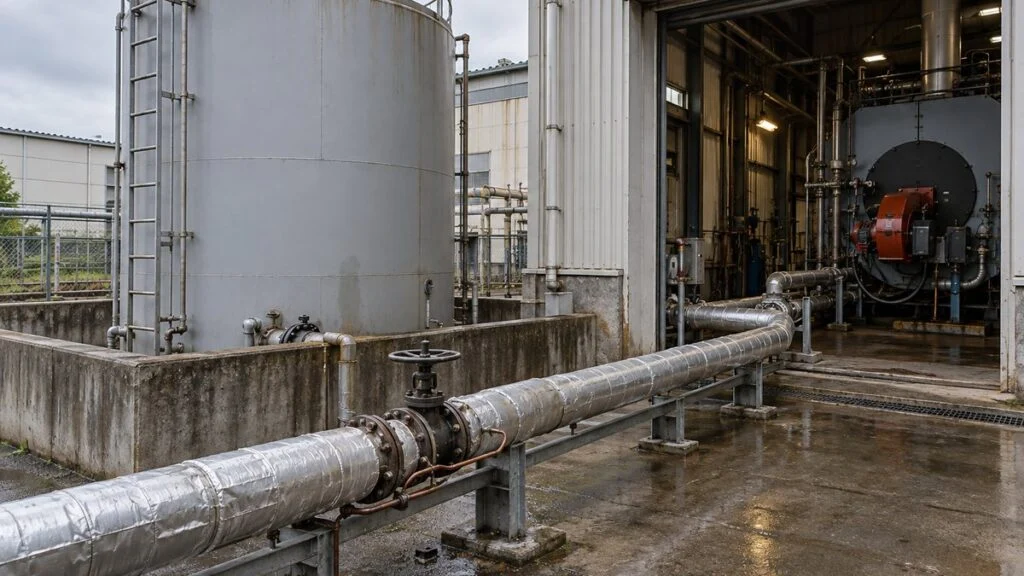
A packaged boiler from a Japanese maker lists its fuel as "A重油" or "A heavy oil." A fuel delivery note from a Japanese plant reads "JIS K 2205 1種2号." A spec from your Japanese parent company asks whether your site can switch to "C重油." Each of these points to the same Japanese fuel oil system, and the letters do not mean what US readers might expect.
The short answer: Japan's fuel oil (juyu, 重油) comes in three grades, A, B, and C, defined by kinematic viscosity in JIS K 2205. Fuel oil A (A-juyu) is mostly gas oil (a light distillate) and burns without preheating. Fuel oil C (C-juyu) is mostly residue, costs less, and needs heated tanks, traced piping, and an oil heater before the burner. Fuel oil B sits in between and is rarely produced today.
This guide covers how the grades are made, the full JIS K 2205 property table, how the grades compare with ISO 8217 and ASTM D396, what changes in equipment and cost when you move from A to C, and a checklist and sample email for the Japanese side.
Start with two questions: how thick is the oil, and does it need heating?
Color Brown
Typical use Small and mid-size boilers, building heating, fishing boats
Availability Very limited
Typical use Formerly ships and ceramic kilns
Color Black-brown
Typical use Power plants, large boilers, large ships
Viscosity is kinematic viscosity at 50°C (122°F). Limits from JIS K 2205. Color and uses from the Petroleum Association of Japan (PAJ) and the ENEOS Petroleum Handbook. Blend ratio for fuel oil B from the JOGMEC glossary.
Contents
- What Japanese Fuel Oil (Juyu) Is
- JIS K 2205: Six Types Across Three Classes
- How the JIS Grades Compare With ISO 8217 and ASTM D396
- Fuel Oil A vs. Fuel Oil C: Properties and Equipment
- Cost: Compare per GJ, Not per Liter
- Where Each Grade Is Used
- Storage Rules in Japan: What to Check
- Checklist Before You Specify or Accept Fuel Oil
- Limits of This Guide
- FAQ
- Sources
What Japanese Fuel Oil (Juyu) Is
Refineries split crude oil by boiling point in a distillation column. The heaviest fraction stays at the bottom of the column as residue (zanyu, 残油), which is too thick to use as fuel on its own. Japanese fuel oil is residue blended with gas oil (keiyu, 軽油) to bring it to a usable viscosity.
The share of gas oil sets the grade. According to the JOGMEC oil and gas glossary, fuel oil A is mostly gas oil with about 10% residue added, and fuel oil B is roughly 50% of each. Less gas oil means a thicker oil, and the thickest is fuel oil C.
The amount of gas oil blended into the column bottoms decides whether the product is A, B, or C.
Blend ratios are approximate values from the JOGMEC glossary. In practice, refiners combine straight-run gas oil, cracked gas oil, vacuum residue, and other streams, and adjust viscosity, sulfur, pour point, and other properties to meet the standard (ENEOS Petroleum Handbook).
Despite the name "heavy oil," all grades are lighter than water. For marine fuel under the 2020 sulfur limit, the Ministry of Land, Infrastructure, Transport and Tourism (MLIT) listed density limits at 15°C (59°F) of 0.991 g/cm³ for fuel oil C and 0.890 g/cm³ for fuel oil A, both below water (about 1.0). That is why spilled fuel oil floats as a black slick. PAJ describes fuel oil A as brown and fuel oil C as a thick, black-brown liquid.
Some fuel oil C stops flowing at room temperature, so sites that burn it need heating and insulation. Cold oil does not atomize into a fine mist and burns poorly. The oil is therefore heated to thin it and then sprayed through the burner as a mist. The viscosity section below covers how hot it needs to be.
JIS K 2205: Six Types Across Three Classes
JIS K 2205 (Fuel oil) is the Japanese Industrial Standard that defines the grades. In JIS terms, fuel oil A is Class 1 (1種, isshu), B is Class 2, and C is Class 3. Class 1 is further split into No. 1 and No. 2 by sulfur content, and Class 3 into No. 1, No. 2, and No. 3 by viscosity. That makes six types in all, and a Japanese document will usually name the type as "1種2号" (Class 1 No. 2) or similar.
Japanese sources often rank quality as A > B > C. That order means more gas oil and less ash and sulfur, not "better fuel." In practice, the grade is better read as a statement about what equipment the fuel needs. Of the six types, Class 2 (fuel oil B) is still in the standard but almost no longer produced, so the market is essentially fuel oil A and fuel oil C.
Arranged from thinnest (left) to thickest (right). Scroll sideways to see the whole table.
| Property | Class 1 No. 1Fuel oil A | Class 1 No. 2Fuel oil A | Class 2Fuel oil B | Class 3 No. 1Fuel oil C | Class 3 No. 2Fuel oil C | Class 3 No. 3Fuel oil C |
|---|---|---|---|---|---|---|
| Kinematic viscosity50°C, mm²/s | 20 max. | 20 max. | 50 max. | 250 max. | 400 max. | Over 400, 1000 max. |
| Sulfurmass % | 0.5 max. | 2.0 max. | 3.0 max. | 3.5 max. | – | – |
| Flash point°C | 60 min. | 60 min. | 60 min. | 70 min. | 70 min. | 70 min. |
| Pour point°C | 5 max.* | 5 max.* | 10 max.* | – | – | – |
| Carbon residuemass % | 4 max. | 4 max. | 8 max. | – | – | – |
| Watervol % | 0.3 max. | 0.3 max. | 0.4 max. | 0.5 max. | 0.6 max. | 2.0 max. |
| Ashmass % | 0.05 max. | 0.05 max. | 0.05 max. | 0.1 max. | 0.1 max. | – |
| Reaction | Neutral | Neutral | Neutral | Neutral | Neutral | Neutral |
* Winter grades of Classes 1 and 2 have a pour point of 0°C max.; the summer grade of Class 1 has 10°C max.
Values are limits in the standard. Check the actual values of the oil you buy on the supplier's property sheet (certificate of analysis). "–" means no limit. The Class 3 No. 2 viscosity is shown as written in JIS ("400 max.").
Source: JIS K 2205:1991 (current edition, Amendment 1 in 2006), checked against an excerpt published by Chiba Prefecture and the ENEOS Petroleum Handbook; edition confirmed in the contents of the JSA JIS Handbook (2023).
Viscosity separates all three grades. The numbered subtypes are assigned differently: by sulfur content in Class 1 and by viscosity range in Class 3. Class 1 No. 1 is known as LSA (low-sulfur A) and Class 1 No. 2 as HSA (high-sulfur A). Delivery slips and quotes in Japan use these names more often than the JIS numbers.
Separately from JIS, a mandatory standard under Japan's fuel quality law (hinkakuho) caps sulfur at 3.5 mass % (ENEOS Petroleum Handbook). Class 3 No. 2 and No. 3, which have no sulfur limit in JIS, must still meet that cap.
You can order fuel by class and number, for example "JIS K 2205 Class 1 No. 1." When the supplier provides a property sheet, compare its values with the limits in Figure 3 to confirm the oil meets the standard.
How the JIS Grades Compare With ISO 8217 and ASTM D396
We found no official one-to-one mapping between JIS K 2205 and the international or US fuel oil standards. The comparisons below are the ones we could confirm in published sources, plus a comparison by fuel type. Treat them as "comparable," not "equivalent," and specify the grade and property limits you need in writing.
Close by type, but the standards set different limits and sometimes measure viscosity at different temperatures.
ISO 8217 counterparts from MLIT's 2017 paper on marine fuel properties for the 0.50% sulfur limit (Japanese). ISO viscosity limits from published reproductions of ISO 8217:2017 tables; check the edition named in your contract. ASTM comparisons are by fuel type only; we could not verify a numerical mapping, so confirm limits against the ASTM D396 edition you specify.
The name trap matters when you write purchase specs. In US usage, Bunker A, B, and C are old names for No. 4, No. 5, and No. 6 fuel oil. Japanese fuel oil A is a different product defined by a different standard, so do not assume the two match. If a document says only "A oil," confirm whether the writer means the JIS grade.
For ships, the comparison is closer because both sides use the ISO grades in practice. For an onshore boiler or burner, use the maker's fuel specification (viscosity at the stated temperature, sulfur, ash, water) rather than a grade name.
Fuel Oil A vs. Fuel Oil C: Properties and Equipment
The rest of this guide compares the two grades on the market, fuel oil A and fuel oil C. For every property, fuel oil B falls between them. B was once used in ship diesel engines and ceramic kilns, but demand moved to A and C, and it is now rarely produced in Japan (PAJ; National Federation of Petroleum Commercial Associations).
Fuel oil C costs less, but it adds heating, ash removal, and flue gas concerns.
Heating values are the standard values in the list of calculation methods and emission factors for Japan's GHG reporting system (Ministry of the Environment and METI). Heating temperatures from the ENEOS Petroleum Handbook and Miura Co., Ltd.
Of these properties, viscosity, ash, and sulfur have the biggest effect on equipment and combustion.
Viscosity and Preheating
Kinematic viscosity is given in mm²/s; the higher the number, the thicker the oil. Older documents use centistokes (cSt), and 1 cSt equals 1 mm²/s. Because viscosity changes sharply with temperature, JIS compares grades at 50°C (122°F).
At the JIS limits, fuel oil A is 20 mm²/s max. and even Class 3 No. 1 is 250 max., so fuel oil C is more than 10 times as viscous. Fuel oils A and B atomize at the burner without special heating, but fuel oil C must be heated to lower its viscosity, or it will not form a fine mist and will not burn well.
The ENEOS Petroleum Handbook says fuel oil C needs heating to 40–70°C (104–158°F) just to handle it, and then to a higher temperature right before the burner to reach the viscosity the burner needs. A Miura service bulletin for marine boilers gives these oil heater settings as a guide by viscosity grade:
- 380 cSt grade: about 135–140°C (275–284°F)
- 280 cSt grade: about 130°C (266°F)
- 180 cSt grade: up to about 125°C (257°F)
These are guide values for that equipment and that oil, not settings that apply to every installation. The actual temperature is decided with the burner maker, based on the oil's viscosity and the burner specification.
The temperature rises in stages to bring the viscosity down.
Temperatures are examples from the ENEOS Petroleum Handbook (handling) and Miura Service News Vol. 15 (oil heater settings for marine boilers). Heating above the flash point calls for additional safety precautions.
Hotter is not always better. In the Miura cases, oil that was too cold atomized poorly and caused black smoke and combustion oscillation, while oil that was too hot gave off vapor and made the oil pressure fluctuate. Fuel oil C also thickens in transfer lines as it cools, so its piping needs steam or electric tracing, especially for winter. The pour point in Figure 3 is a guide to how low a temperature the oil will still flow at.
Ash
Ash content is the amount of ash left after combustion. The JIS limit is 0.05 mass % for fuel oil A and 0.1 mass % for fuel oil C, so fuel oil C leaves more ash. Actual products run about 0.00–0.03%, rising from A to B to C (ENEOS Petroleum Handbook).
Ash sticks to boiler heat transfer surfaces and lowers efficiency, so it has to be removed regularly with soot blowers. Vanadium and sodium oxides in the ash also cause high-temperature corrosion in hot sections such as superheaters, a problem known as vanadium attack.
Sulfur
Sulfur affects both emissions and energy cost. The JIS limit is 0.5 mass % for Class 1 No. 1 (fuel oil A) and 3.5 mass % for Class 3 No. 1 (fuel oil C). Higher sulfur means more SOx (sulfur oxides), an air pollutant, in the flue gas, and a higher risk of low-temperature corrosion in equipment that recovers heat from the exhaust.
The corrosion happens because sulfur trioxide in the flue gas combines with moisture and condenses as sulfuric acid on cool surfaces. The temperature at which this starts is the acid dew point, and it rises with sulfur content. Boilers that burn fuel oil C are therefore designed not to cool the flue gas too far. When you compare flue gas SOx or NOx readings with regulatory limits, first correct them to the same reference oxygen concentration.
Cost: Compare per GJ, Not per Liter
Fuel oil A is clearly easier to handle. Fuel oil C stays in use because it is cheaper; the JOGMEC glossary calls it the cheapest fuel among petroleum products. Comparing the two takes some care.
In the Agency for Natural Resources and Energy (ANRE) petroleum product price survey, the only industrial prices published monthly are for gas oil and fuel oil A. Fuel oil C is not covered, so there is no public price series in the same form. For August 2026, ANRE reported fuel oil A at JPY 131.2/L delivered by small tank truck and JPY 120.3/L by large tank truck (national average, excluding consumption tax; small means under 8 kL capacity). That is about JPY 131,000 per kL. The same survey shows about JPY 66/L in July 2017, so the price roughly doubled over nine years. In 2026 alone, it rose from JPY 108.6/L in February to JPY 139.0/L in April, about 28% in two months. Prices move with crude oil and the yen, so check the latest ANRE release before using these figures.
When you compare fuel prices, use cost per unit of heat, not per liter, because fuel oil C carries about 7% more heat per liter than fuel oil A.
This is a break-even calculation ("at what price does C match A?"), not a real price comparison.
Fuel cost only; boiler efficiency, heating equipment, and maintenance are not included. Heating values (fuel oil A 38.9 GJ/kL, fuel oils B and C 41.8 GJ/kL) and carbon emission factors from the list of calculation methods and emission factors for Japan's GHG reporting system (Ministry of the Environment and METI). Heating values are gross (higher) heating values.
For example, a plant that burns 500 kL of fuel oil A a year uses about 19,450 GJ of heat and emits about 1,380 t of CO2. Supplying the same heat with fuel oil C takes about 465 kL and emits about 1,440 t. The fuel volume drops, but CO2 rises by about 5%.
Check which heating value a number uses before you compare. The values above are gross (higher) heating values, which include the heat of condensing the water formed in combustion. Other Japanese sources may use different values; our guide to Japanese boiler classes and fuels quotes 36.7 MJ/L for fuel oil A from an industry guideline for boiler catalog ratings. For converting kcal/h and other Japanese units on boiler specs, see kcal/h to kW, BTU/h, and tons.
Where Each Grade Is Used
The differences in price and handling decide where each grade ends up. Based on PAJ and the ENEOS Petroleum Handbook, the main uses are as follows.
Fuel oil A goes to smaller equipment; fuel oil C goes to large equipment that burns a lot of fuel.
Fuel oil A: small and mid-size, burned as delivered
Fuel oil C: large equipment burning large volumes
Uses from the PAJ FAQ on fuel oil quality, the ENEOS Petroleum Handbook, and the National Federation of Petroleum Commercial Associations. Whether a fuel can be used depends on the equipment specification, the fuel's properties, and local emission rules.
Fuel oil C makes sense in large equipment, where the fuel savings outweigh the extra handling. The cost of heating, insulation, and purifying equipment per kL falls as fuel volume rises. In small and mid-size boilers, burning fuel oil A as delivered is usually more practical than adding that equipment.
Marine fuel has its own rules. Since January 2020, fuel used outside emission control areas has been capped at 0.50% sulfur under IMO (International Maritime Organization) rules, except on ships fitted with exhaust gas scrubbers. The cap fell from 4.5% to 3.5% in 2012 and to 0.5% in 2020 (PAJ). Ships have been moving from high-sulfur fuel oil C to low-sulfur fuel oils, and compliant low-sulfur fuel oil C tends to have lower viscosity at 50°C than older products. Onshore boilers in Japan are instead covered by emission standards under the Air Pollution Control Act, and switching from fuel oil to gas is another option for them.
Storage Rules in Japan: What to Check
If you are planning or reviewing a Japanese site, storage is part of the fuel decision. Under Japan's Fire Service Act, fuel oil is listed by name as a hazardous material in Category 4 (flammable liquids), Class 3 petroleums (dai-san sekiyu-rui). Its designated quantity is 2,000 L (about 528 US gal). Facilities that store or handle that amount or more need a permit from the municipal mayor or other authority.
Below the designated quantity, local fire prevention ordinances apply, and many municipalities require notification from one-fifth of the designated quantity (400 L) up. Confirm the storage and notification requirements with the local fire department through the Japanese site's safety staff rather than relying on this summary.
Checklist Before You Specify or Accept Fuel Oil
Choosing a fuel on the cost-per-GJ figure alone misses too much. Work through these items in order:
- Equipment rating: fuel types and viscosity range allowed in the boiler and burner specification, including the temperature the viscosity is stated at
- Grade on paper: JIS class and number (for example, Class 1 No. 1 / LSA), or the ISO 8217 or ASTM D396 grade and edition, written into the purchase spec
- Actual properties: viscosity, sulfur, ash, water, and pour point from the supplier's property sheet, compared with Figure 3
- Heating and storage equipment: tank heating, pipe tracing and insulation, oil heater, purifier, and the stored volume under hazardous-material rules
- Maintenance and emissions: soot and ash removal, corrosion inspection, and local SOx and dust limits
- Total cost: cost per GJ plus boiler efficiency, equipment operating cost, and maintenance cost
Sample Email to a Japanese Supplier
Use or adapt this when a Japanese equipment spec or fuel document names a grade without enough detail:
Subject: Fuel specification for [equipment / project name]
Hello [name],
Your document lists the fuel as "A重油 (fuel oil A)." To source fuel locally, could you confirm the following?
- The JIS K 2205 class and number assumed in the design (for example, Class 1 No. 1 or No. 2)
- The allowable viscosity range at the burner, and the temperature it is stated at
- Maximum sulfur, ash, and water content, and the minimum flash point
- Whether an ISO 8217 or ASTM D396 grade is acceptable, and if so, which grade and edition
- Whether any preheating or fuel treatment equipment is required or included in your scope
Best regards,
[your name]
Limits of This Guide
- The JIS values are the limits in JIS K 2205:1991 (with the 2006 amendment). Real deliveries vary; always use the supplier's property sheet.
- The ISO and ASTM comparisons are by type, except the ISO counterparts stated by MLIT for marine use. They are not equivalence statements.
- Heating temperatures are examples for specific equipment. Set actual temperatures with the burner and boiler makers.
- Prices are Japanese domestic prices for a single month and change quickly. Fuel prices and availability outside Japan differ.
- Storage and emission rules described here are Japanese. Sites in other countries follow local codes.
FAQ
Is Japanese "A heavy oil" the same as diesel?
No. Fuel oil A is mostly gas oil, but it contains some residue, so it is heavier and higher in sulfur than diesel fuel. The standards differ too: diesel (keiyu) is JIS K 2204, and fuel oil A is JIS K 2205. Diesel carries a separate fuel tax in Japan, and fuel oil A and kerosene contain a marker, coumarin, to deter tax evasion by blending them into diesel for sale (National Federation of Petroleum Commercial Associations).
Is fuel oil A the same as Bunker A?
No. In US usage, Bunker A is No. 4 fuel oil, which is defined by ASTM D396, not JIS K 2205. Only the letter is shared, so compare the actual property limits. Japanese fuel oil C and US Bunker C (No. 6) are both residual oils that need preheating, but their limits are set by different standards.
Is fuel oil B still available?
Hardly. Fuel oil B (JIS Class 2: 50 mm²/s max. at 50°C, 3.0% sulfur max.) is still in the standard, but demand moved to fuel oils A and C, and it is now rarely produced in Japan.
What is the viscosity of fuel oil A and fuel oil C?
The JIS limits at 50°C (122°F) are 20 mm²/s for fuel oil A, 50 for fuel oil B, and 250 to 1000 mm²/s for fuel oil C, depending on its number. Fuel oil A's limit is less than one-twelfth of the limit for Class 3 No. 1. Because viscosity drops as temperature rises, fuel oil C is heated to the viscosity the burner needs.
Can a burner rated for fuel oil A burn fuel oil C?
It depends on the burner specification and on whether the site has the heating and fuel treatment equipment fuel oil C needs (tank heating, traced piping, an oil heater, and a purifier). Confirm with the boiler and burner makers before changing fuel.
Sources
- JIS K 2205 limits: Chiba Prefecture, excerpt of JIS K 2205-1991 in its Air Pollution Control Act guide (Japanese)
- Manufacture, grades, properties, heating temperatures, and uses: ENEOS Petroleum Handbook, Part 2, Chapter 1, Section 6 "Fuel Oil" (Japanese)
- Blend ratios and fuel oil C as the cheapest product: JOGMEC oil and gas glossary, "Fuel oil" (Japanese)
- Color, uses, and IMO sulfur limits: Petroleum Association of Japan, FAQ "Fuel oil quality" (Japanese)
- Fuel oil A as a distillate product; fuel oil B rarely produced: Petroleum Association of Japan, definitions of oil products (English)
- LSA and HSA, fuel oil B production, fuel oil C uses, coumarin: National Federation of Petroleum Commercial Associations, "Types of petroleum products," in Okinawa Prefecture statistics (Japanese)
- Marine fuel density, viscosity, and ISO 8217 counterparts: MLIT, properties needed for marine engines under the 0.50% sulfur limit (Japanese, 2017)
- ISO 8217 viscosity limits: Dan-Bunkering, ISO 8217:2017 specification tables
- ASTM D396 grade descriptions: ASTM, D396 Standard Specification for Fuel Oils
- Bunker A, B, C and No. 4, 5, 6 fuel oil: Wikipedia, "Fuel oil"
- Low-sulfur compliant fuel oil and scrubbers: JXTG Nippon Oil & Energy, IMO 2020 compliant fuel oils, JRTT seminar material (Japanese)
- Fuel oil C heating temperatures and troubleshooting cases: Miura, Service News Vol. 15 "Heating fuel oil C" (Japanese)
- Fuel oil A prices: ANRE, petroleum product price survey, industrial prices (Japanese)
- Heating values and emission factors: Ministry of the Environment and METI, calculation methods and emission factors for the GHG reporting system (Japanese)
- Hazardous material listing: Fire Service Act, Appended Table 1 (e-Gov, Japanese)
- Designated quantity: Cabinet Order on the Regulation of Hazardous Materials, Appended Table 3 (e-Gov, Japanese)
- Notification from one-fifth of the designated quantity (example): Chiba City Fire Bureau (Japanese)
- JIS K 2205 edition: Japanese Standards Association, JIS Handbook Petroleum 2023, contents (Japanese)
Original article in JapaneseThis guide is adapted from a MONOSCOPE article written for readers in Japan: A重油・B重油・C重油の違いとは?JIS比較表で見る重油の種類・粘度・価格
About the editor
 MONOSCOPE EditorFOUNDER & EDITOR
Spent about ten years at a plant equipment maker and a plant engineering company, proposing, designing, and commissioning equipment, then moved into web marketing. Now a web consultant for B2B manufacturers, helping them explain their products and technology. Licensed in Japan as an Energy Manager and a Third-Class Chief Electrical Engineer.
Has run an engineering blog since 2017 (500+ articles) and a Japanese YouTube channel with about 20,000 subscribers. Each English guide is written from the Japanese shop-floor point of view and checked against the cited standards.