Boilers in Japan: Legal Classes, Operator Licenses, Fuels
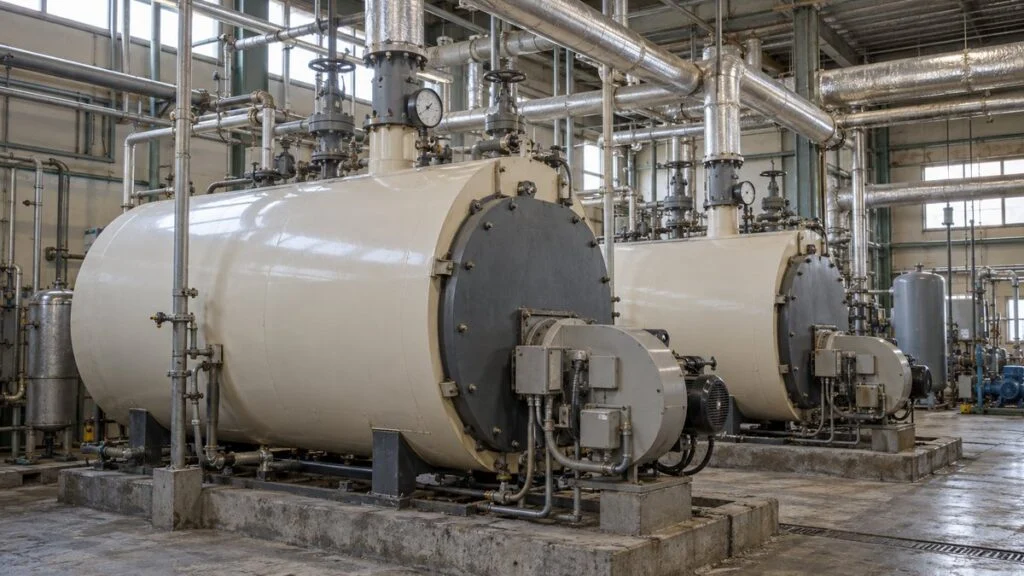
A Japanese customer asks whether the steam boiler you are quoting is a "kogata boiler." A plant manager at your Japanese parent company says a new boiler must be run by a licensed "boiler gishi." Or a packaged once-through boiler from a Japanese maker arrives at your site with a nameplate full of terms like 伝熱面積 and 最高使用圧力. Each of these situations comes back to the same question: how does Japan classify boilers, and what does each class require?
The short answer: Japan's Industrial Safety and Health Act sorts steam and hot-water boilers into three classes by pressure and heat transfer area: boiler, small boiler (kogata boiler), and simple boiler (kan'i boiler). A full "boiler" needs a manufacturing permit, government inspections, and an inspection certificate that is normally renewed every year, and its operators need a license (with an exception for small-scale units). A small boiler needs individual certification and operators with special training. A simple boiler needs no inspection and no qualified operator, but it must still be built to a government construction code.
This guide covers the basics first: how a boiler works and the boiler types you will see in Japanese documents. It then turns to the three legal classes with their full thresholds, the inspections and licenses each class triggers, and what to check when a boiler is exported to or imported from Japan. It ends with a checklist and a sample email for the Japanese side.
Contents
- What Counts as a Boiler in Japan
- Boiler Types You Will See in Japanese Documents
- The Three Legal Classes: Boiler, Small Boiler, Simple Boiler
- Inspections and Paperwork by Class
- Who May Operate, Weld, and Maintain a Boiler
- Exporting a Boiler to Japan or Importing One from Japan
- Fuels and Reading Japanese Capacity Ratings
- Water Quality Limits: JIS B 8223
- Checklist: What to Confirm with the Japanese Side
- Limits of This Guide
- FAQ
- Sources
What Counts as a Boiler in Japan
Japan's Ministry of Health, Labour and Welfare (MHLW) describes a boiler as a vessel that heats water with fire or another heat source to make steam or hot water above atmospheric pressure and supplies it somewhere else. Japanese law splits them into steam boilers and hot-water boilers. The heat can come from a fuel flame, electricity, or hot exhaust gas from other equipment, so electric boilers and waste-heat boilers count too.
What separates a boiler from a kettle is pressure. The water is heated in a closed vessel, and the steam or hot water is piped to the point of use. That pressure is also what makes a boiler dangerous, which is why the law regulates it by size and pressure.
Heat from the flame passes through the tube or shell wall into the water, which leaves as steam or hot water.
Scroll sideways to see the whole figure.
In a water-tube boiler, water flows inside the tubes. In a fire-tube boiler, hot gas flows inside the tubes. Both pass heat through a wall.
The wall area that takes heat from the flame or hot gas and passes it to the water is the heat transfer area (dennetsu menseki, 伝熱面積). A larger area moves more heat, so Japanese law uses it, together with pressure, to classify boilers and to decide who may run them.
Inside a closed vessel, water boils at a higher temperature as pressure rises: 100°C (212°F) at atmospheric pressure, but about 170°C (338°F) at 0.7 MPa gauge (about 102 psig). This steam is saturated steam, and its temperature is fixed by its pressure. Set the pressure and you get heat at the temperature you need, which is one reason plants use steam to move heat.
Boiler Types You Will See in Japanese Documents
By construction, Japanese references sort boilers into four groups. The packaged once-through boilers common in small and mid-size Japanese plants belong to the water-tube group.
- Shell boilers (maru boiler, 丸ボイラー): vertical, fire-tube, furnace (flue), and furnace fire-tube boilers
- Water-tube boilers (suikan boiler, 水管ボイラー): natural-circulation, forced-circulation, and once-through (kanryu, 貫流) boilers
- Special boilers (tokushu boiler, 特殊ボイラー): waste-heat, thermal-fluid, special-fuel, and electric boilers
- Sectional cast-iron boilers (chutetsu-sei kumiawase boiler, 鋳鉄製組合せボイラー)
Construction is only one of three separate axes. A boiler also makes either steam or hot water, and it falls into one of the three legal classes. Japanese engineers combine them, as in "a once-through steam boiler that is a small boiler under the law."
More water inside means steadier pressure. Less water means faster startup.
Scroll sideways to see the whole table.
(furnace fire-tube)
cast-iron
General tendencies only; pressure and capacity ranges vary widely by model. Cast-iron limits are from Article 88 of Japan's Construction Code for Boilers. "Water-tube" here means natural- and forced-circulation designs; once-through boilers are also classed as water-tube boilers.
A few points matter when you read Japanese specifications:
- Once-through boilers hold little water, so they start producing steam quickly and take up little floor space. They also get lighter treatment under Japanese law, covered below.
- Thermal-fluid boilers (tokushu netsubai boiler) heat thermal oil instead of water. They reach temperatures above 200°C (392°F) at fairly low pressure, where water would need a much higher pressure.
- Electric boilers make steam or hot water directly from electricity and produce no flue gas. For legal classification, Japan converts their power to an equivalent heat transfer area: 60 kW of electrical capacity counts as 1 m².
- Cast-iron boilers may not be used for steam above 0.1 MPa, or, as a rule, for hot water above 0.5 MPa or 120°C (248°F). That limit keeps them mainly in building heating and hot-water service.
Related: Small Once-Through Boilers in Japan: Multi-Unit Control
The Three Legal Classes: Boiler, Small Boiler, Simple Boiler
Japan regulates boilers under the Industrial Safety and Health Act, with the details in its Enforcement Order and in the Ordinance on Safety of Boilers and Pressure Vessels. Boilers in power plants that fall under the Electricity Business Act are handled separately (see below).
The Enforcement Order defines a "boiler" as any steam or hot-water boiler except the smallest units listed in Article 1, item 3. The smaller boilers within the "boiler" category are small boilers (item 4). The units excluded altogether are informally called simple boilers. MHLW ranks the three by hazard and makes the rules lighter at each step down.
The class is set by numbers (maximum gauge pressure, heat transfer area, and so on), not by what the product is called.
- Everything not small or simple
- Manufacturing permit, government inspections, inspection certificate renewed by yearly performance inspection
- Operated by licensed boiler engineers (skill-training graduates for small-scale units)
- Self-inspection at least once a month
- e.g., steam at 0.1 MPa or less with 1 m² or less
- e.g., once-through at 1 MPa or less with 10 m² or less
- Individual certification (kobetsu kentei)
- Operators need special training; self-inspection at least once a year
- e.g., steam at 0.1 MPa or less with 0.5 m² or less
- e.g., once-through at 1 MPa or less with 5 m² or less
- No inspection or certification (must meet the construction code)
- No license or training required to operate
Pressures are gauge pressures. 0.1 MPa ≈ 14.5 psig; 1 MPa ≈ 145 psig; 1 m² ≈ 10.8 ft². Representative examples only; Figure 4 lists all the criteria. Boilers under the Electricity Business Act are treated separately.
Each class has several criteria, set separately for steam, hot-water, and once-through boilers. The full set as of October 2026 is below.
A boiler that meets any one simple-boiler criterion is a simple boiler. Otherwise, one that meets any small-boiler criterion is a small boiler. Everything else is a full "boiler."
Scroll sideways to see the whole table.
(excluded from "boiler")
Areas are heat transfer areas calculated by the Japanese method (Ordinance on Safety of Boilers and Pressure Vessels, Article 2). "Open vent pipe or U-tube": a steam pipe of 25 mm ID or more open to the atmosphere, or a U-shaped standpipe of 25 mm ID or more on the steam space at 0.05 MPa or less. Once-through rows exclude multi-tube designs with headers over 150 mm ID. A further simple-boiler criterion covers tiny once-through boilers with no header or separator (volume ≤ 0.004 m³ and pressure × volume ≤ 0.02). Source: Enforcement Order of the Industrial Safety and Health Act, Article 1, items 3 and 4.
The wood-biomass rows changed on March 1, 2022. MHLW's stated reason is useful background for exporters: Japan's classes for hot-water boilers differed from how Europe regulates them at the point of sale, and that gap was one of the obstacles to wider use of biomass boilers. After a technical review, larger wood-biomass hot-water boilers were moved into the simple-boiler class, with added requirements in the construction code such as automatic temperature control that keeps the water at 100°C or below.
Two practical points when you classify a boiler:
- Use the Japanese heat transfer area, not a catalog "heating surface." Article 2 of the Ordinance defines how to measure it for each design. For once-through boilers, it is the gas-side tube area from the furnace inlet to the superheater inlet. For electric boilers, use the 60 kW = 1 m² conversion.
- Use the maximum gauge pressure, not a typical gauge reading. Take it from the nameplate or specification sheet (maximum allowable working pressure), as you would for a Japanese pressure vessel.
To find the class of a boiler that is already installed in Japan, go in this order:
- Is there a boiler inspection certificate (boiler kensa-sho)? If so, it is a full "boiler."
- From the nameplate, specification sheet, or manual, is it a steam, hot-water, or once-through boiler?
- From the same documents, what are the maximum gauge pressure and the heat transfer area?
- If it is still unclear, ask the manufacturer or the local Labour Standards Inspection Office.
Pressure vessels that are not boilers, such as steam-heated exchangers and air receivers, have their own classes under the same law. See Class 1 vs Class 2 Pressure Vessels in Japan: PV Value Chart.
Inspections and Paperwork by Class
A full "boiler" is "specified machinery" (tokutei kikai) under the Act. It is inspected at every stage, from design to use, with the steps split between the manufacturer and the user.
Steps for the manufacturer (or importer) and for the company that installs and uses the boiler.
Ordinance on Safety of Boilers and Pressure Vessels, Articles 3–38. The welding inspection does not apply to once-through boilers without a steam separator, among other exceptions. Depending on the inspection result, the certificate may be renewed for less than one year or for up to two years.
Other rules for a full "boiler" that often show up in plant layouts and contracts:
- A boiler with more than 3 m² (32 ft²) of heat transfer area must sit in a dedicated building or a room separated by walls, the boiler room (Article 18). Mobile and outdoor-type boilers are exempt.
- The monthly self-inspection covers the boiler body, burner and fuel system, automatic controls (flame detector, fuel shutoff, water level and pressure controls), feedwater equipment, steam piping and valves, air preheater, and water treatment equipment (Article 32).
- Safety valves must be set at or below the maximum allowable working pressure. With two or more valves, the others may be set up to 3% higher (Article 28).
- The inspection certificate and the operating chief's name and qualification must be posted in the boiler room (Article 29).
The lighter classes need much less:
- Small boiler: individual certification (kobetsu kentei) by a registered body when it is made or imported, an installation report to the Labour Standards Inspection Office, special training for operators, and a self-inspection at least once a year with records kept for three years. Safety valves are set at 0.1 MPa or less, or at the maximum operating pressure for a small once-through boiler (Articles 90-2 to 94).
- Simple boiler: no inspection or certification, and no qualification to operate it. It still has to meet the Construction Code for Simple Boilers, etc.
For how Japanese plants schedule statutory inspections inside planned shutdowns, see Teishu (Plant Turnaround) in Japan.
Who May Operate, Weld, and Maintain a Boiler
Three Japanese national licenses relate directly to boilers. Which one is needed depends on the work.
Operating, welding, and maintenance each need their own license.
(boiler gishi)
(boiler yosetsu-shi)
(boiler seibi-shi)
Ordinance on Safety of Boilers and Pressure Vessels, Articles 9, 23, and 35. The welder and maintenance licenses also cover certain work on Class 1 pressure vessels.
Operating a full "boiler" is limited to licensed boiler engineers (Article 23). The exception is small-scale boilers (shokibo boiler), a sub-group within the "boiler" class, which people who have completed the boiler handling skill-training course may also operate. Small-scale boilers include steam boilers with a heat transfer area of 3 m² or less, or a shell of 750 mm ID or less and 1,300 mm long or less; hot-water boilers with 14 m² or less; and once-through boilers with 30 m² or less (Enforcement Order, Article 20, item 5).
Each site must also appoint a boiler operating chief (boiler toriatsukai sagyo shunin-sha). The license grade required depends on the total heat transfer area of the boilers handled (Article 24):
- 500 m² or more: special grade (does not apply when only once-through boilers are handled)
- 25 m² to under 500 m², or once-through boilers only at 500 m² or more: special or first grade
- Under 25 m²: special, first, or second grade
- Small-scale boilers only: any grade, or a skill-training graduate
The total is not a simple sum. Once-through boilers count at one-tenth of their area, boilers heated by hot gas other than a flame (waste-heat boilers, for example) count at half, and small-scale boilers are left out. Boilers with an approved automatic safety-shutdown system may be left out too, except the largest one.
Here is how that plays out. Take a fictional plant with five once-through boilers of 40 m² each. Each one is above the 30 m² small-scale limit, so its operators need a boiler engineer license. For choosing the chief, though, the total counts as 5 × 40 × 1/10 = 20 m², under 25 m², so a second-grade boiler engineer can serve as operating chief. Keep this in mind when you see several packaged once-through boilers installed side by side, a common setup in Japanese plants.
The chief's duties include watching pressure, water level, and combustion; not letting pressure exceed the maximum allowable working pressure; keeping safety valves working; checking the water-level gauges at least once a day; and inspecting and adjusting automatic controls such as the low-water fuel cutoff and flame detector (Article 25). The daily check may drop to once every three days for boilers with an approved automatic control system.
These licenses are Japanese qualifications for work in Japan. A plant outside Japan follows its own national or state boiler operator rules, even when the boiler and the operating manual come from Japan.
Power Plant Boilers
Boilers covered by the Electricity Business Act, mainly those in power plants, are outside the Industrial Safety and Health Act's specified-machinery rules. They are managed under that Act's technical standards and inspections. A thermal power plant operator generally has to appoint a chief boiler and turbine engineer (first or second class), whose certificate is granted on the basis of education and work experience rather than an exam.
Exporting a Boiler to Japan or Importing One from Japan
Supplying a Boiler for Use in Japan
If your boiler will be installed in Japan, the Japanese class applies no matter where it was built:
- Full "boiler": the importer must have a registered body carry out a use inspection (shiyo kensa) instead of the structural inspection. The foreign manufacturer may apply for the use inspection itself, and then the importer does not need to. The application may include a statement from an MHLW-designated organization outside Japan confirming that the design meets the Japanese construction requirements (Article 12). After that come the installation notice, completion inspection, and yearly performance inspections, the same as for a Japanese-built boiler.
- Small boiler: individual certification at import. A foreign manufacturer may apply for it directly.
- Simple boiler: no certification, but it must meet the Construction Code for Simple Boilers, etc.
A boiler may be used in Japan only if it meets the structural part of the Japanese construction requirements (Article 26). An ASME or EN design is not automatically accepted. Agree with the importer early on how conformity will be shown. The same question comes up for pressure vessels; see the pressure vessel guide for background on foreign inspection agencies.
Receiving a Japanese-Built Boiler Outside Japan
If a boiler built in Japan is installed at your plant in the US, India, or Southeast Asia, Japan's classes and licenses do not carry over. Your local boiler code, registration, and operator rules decide what is required. A Japanese "simple boiler" label does not mean it is exempt where you are.
You will still meet Japanese terms in the documents:
- 最高使用圧力 (saiko shiyo atsuryoku): maximum allowable working pressure, in MPa gauge
- 伝熱面積 (dennetsu menseki): heat transfer area, calculated by the Japanese method
- 換算蒸発量 / 相当蒸発量 (kansan / soto johatsu-ryo): equivalent evaporation, the catalog capacity rating (see the next section)
- 都市ガス13A (toshi gasu 13A): a grade of Japanese city gas made mainly from natural gas (LNG). Confirm burner settings for your local gas supply.
Check the electrical supply as well. Japanese equipment is often built for 200 V at 50 or 60 Hz; see Japan Industrial Voltage: 200 V, 50/60 Hz.
Fuels and Reading Japanese Capacity Ratings
Japanese references group boiler fuels into four types. The heating values below are the standard values that an industry guideline specifies for once-through boiler catalog ratings.
The fuel form decides how it is stored, burned, and cleaned up after.
Heating values are the standard values in Japan Boiler Association JBAS-R3:2016, as cited in the Japan Society of Industrial Machinery Manufacturers (JSIM) once-through boiler performance guideline. m³N is volume at 0°C and 1 atm; see Nm³ to m³ Conversion.
Japanese catalogs often rate steam boilers by equivalent evaporation (kansan johatsu-ryo, also soto johatsu-ryo): the steam the boiler would make from 100°C water into 100°C steam at atmospheric pressure. The JSIM guideline converts it to heat output using 2,257 kJ/kg, the latent heat of evaporation at atmospheric pressure. The same guideline sets the conditions behind catalog efficiency: 15°C feedwater, 35°C supply air, and a stated operating pressure (for example, 0.49 MPa for a boiler with a 0.98 MPa maximum, or otherwise 80% of the maximum). Keep those conditions in mind before you compare a Japanese efficiency figure with one from another market.
Starting from the catalog's equivalent evaporation, estimate heat output, actual steam flow, and fuel use.
Rough estimate only. Real fuel use changes with load swings, blowdown, and start-stop cycles, so use measured data or the manufacturer's figures for equipment selection or contracts. Steam table values from IAPWS-IF97.
For your own equipment, substitute the equivalent evaporation from the nameplate or catalog, your actual steam pressure and feedwater temperature, and your fuel's heating value and efficiency. Multiply fuel use by operating hours and unit price for a rough annual fuel cost. On efficiency, a Japanese Ministry of the Environment document puts a boiler without flue-gas heat recovery at about 88%, and a calculation example with a feedwater economizer at 92.6%.
Water Quality Limits: JIS B 8223
Japan sets boiler water limits in JIS B 8223, the standard for boiler feedwater, boiler water, and steam quality. The limits vary with boiler type, pressure, and water treatment method. The main parameters are pH, dissolved oxygen, conductivity, and components such as chloride, phosphate, sulfite, hydrazine, silica, iron, copper, and hardness.
As one example, the boiler water in a multi-tube special-circulation boiler (normal operating pressure 1 MPa or less, softened feedwater) is kept at pH 11.0–11.8 (at 25°C), per a Ministry of the Environment summary of JIS B 8223:2021. When a Japanese boiler is installed elsewhere, ask which JIS B 8223 table the supplier's warranty assumes and how it maps to your local water treatment practice.
Checklist: What to Confirm with the Japanese Side
Whether you are buying, specifying, or supplying the boiler, confirm these items before purchase or design freeze:
- Steam, hot-water, or once-through boiler, and the fuel or heat source
- Maximum allowable working pressure (MPa, gauge) and safety valve set pressures
- Heat transfer area (m²) calculated by the Japanese method (Article 2 of the Ordinance), or electrical capacity (kW) for an electric boiler
- Shell inside diameter and length, and steam separator size, if the boiler is near a class boundary
- The class the Japanese side expects (boiler, small-scale boiler, small boiler, or simple boiler), and who confirmed it
- Whether the Electricity Business Act applies instead
- Required documents: inspection stamps, boiler specification sheet (boiler meisai-sho), inspection certificate, or individual certification record
- For boilers going to Japan: who applies for the use inspection or individual certification, and how conformity with Japanese construction requirements will be shown
- For boilers leaving Japan: which local code, registration, and operator rules apply at your site
- Catalog rating basis: equivalent evaporation, efficiency test conditions, and the heating value used
- Water quality basis (which JIS B 8223 table) and the fuel or gas type the burner is set for
You can carry these items into your purchase specification. See Equipment Purchase Specification: Items, Checks, Template.
Sample Email to a Japanese Customer or Supplier
Edit the bracketed parts to fit your case:
Subject: Boiler classification for [tag no. / model]
Hello [name],
To confirm how this boiler is classified under the Industrial Safety and Health Act, could you check the values below?
1. Type (steam / hot water / once-through): [value]
2. Maximum allowable working pressure (MPa, gauge): [value]
3. Heat transfer area per the Ordinance on Safety of Boilers and Pressure Vessels, Article 2 (m²), or electrical capacity (kW): [value]
4. Shell inside diameter and length, and steam separator size (mm, m³), if any: [value]
5. Applicable law (Industrial Safety and Health Act or Electricity Business Act): [value]Based on these values, we understand the boiler to be a [boiler / small boiler / simple boiler]. Please let us know if your understanding differs, and which inspections, certifications, and documents you will need from us.
Best regards,
[your name]
Limits of This Guide
- This guide summarizes Japan's boiler rules as of October 2026. It is not a substitute for the law or for a ruling from the authorities.
- Figure 4 condenses the legal text. Borderline cases, such as how heat transfer area is measured for a particular design, need confirmation from the manufacturer, the local Labour Standards Inspection Office, or a registered inspection body.
- Boilers under the Electricity Business Act, and marine boilers, follow other rules not covered here.
- Outside Japan, your local boiler code and regulator apply, whatever class a Japanese document gives the boiler.
- Rules for imported boilers and foreign inspection organizations change over time. Confirm the current route with the importer and the inspection body.
FAQ
What Is a Small Boiler (Kogata Boiler) in Japan?
It is a legal class for smaller boilers, such as steam boilers at 0.1 MPa or less with 1 m² or less of heat transfer area, or once-through boilers at 1 MPa or less with 10 m² or less. A small boiler needs individual certification and operators with special training, but no boiler engineer license, no inspection certificate, and no yearly performance inspection. It still needs a self-inspection at least once a year.
Do You Need a License to Operate a Boiler in Japan?
For a full "boiler," yes: a boiler engineer license (special, first, or second grade), or the skill-training course for small-scale boilers. Small boilers need special training only, and simple boilers need no qualification. These are Japanese qualifications; outside Japan, local operator rules apply.
How Does Japanese Law Treat Multiple Once-Through Boilers?
The heat transfer area of once-through boilers counts at one-tenth when the site chooses its operating chief, so several units can often run under a second-grade boiler engineer. At 1 MPa gauge or less, units of 5 m² or less are simple boilers and units of 10 m² or less are small boilers. Larger units up to 30 m² are full "boilers" but count as small-scale boilers, which skill-training graduates may operate.
Can a Boiler Built to ASME Be Used in Japan?
Not on the strength of the ASME stamp alone. A full "boiler" imported into Japan needs a use inspection by a Japanese registered body and must meet the structural part of Japan's construction requirements. A statement from an MHLW-designated organization outside Japan can be attached to the application. Settle the route with the importer before fabrication.
Why Is a Boiler Rupture So Dangerous?
Hot water under pressure flashes to steam the moment the vessel opens to the atmosphere. Saturated water at 0.7 MPa gauge (about 170°C) turns about 13% of its mass into steam at once. At atmospheric pressure, steam takes up about 1,600 times the volume of the same mass of water, and that sudden expansion drives the explosion. This is why Japan controls boilers by pressure and size, and why the operating chief's core job is managing pressure and water level.
Sources
- Boiler definition and classes: MHLW, "Boilers and Pressure Vessels," study group paper No. 4, 2006 (Japanese)
- Class criteria (boiler, small boiler, simple boiler), small-scale boilers: e-Gov, Order for Enforcement of the Industrial Safety and Health Act, Articles 1 and 20 (Japanese)
- Heat transfer area, inspections, boiler room, operating chief, licenses, small boilers: e-Gov, Ordinance on Safety of Boilers and Pressure Vessels, Articles 2–38 and 84–94 (Japanese)
- Special training for small boilers: e-Gov, Ordinance on Industrial Safety and Health, Article 36 (Japanese)
- Rules by class and the 2022 wood-biomass change: MHLW, outline of the amendment to the Enforcement Order, January 17, 2022 (Japanese)
- Small-scale boiler criteria: Kagoshima Labour Bureau, boiler handling skill-training course (Japanese)
- Chief boiler and turbine engineer: e-Gov, Electricity Business Act, Articles 43 and 44 (Japanese)
- License exams: Anzen Eisei Gijutsu Shiken Kyokai (national license exam body), second-grade boiler engineer (Japanese)
- Equivalent evaporation, heat output, heating values, efficiency conditions: JSIM, once-through boiler performance display guideline, 2017 (Japanese)
- Actual evaporation: SMRJ J-Net21, steam boiler evaporation (Japanese)
- Boiler efficiency examples: Ministry of the Environment, combustion air preheating with boiler flue gas (Japanese)
- Water quality: Ministry of the Environment, boiler feedwater quality management (Japanese); JSA, JIS B 8223:2021 preview (Japanese)
- Cast-iron boiler limits: MHLW, Construction Code for Boilers, Article 88 (Japanese)
- Boiler types: Kawasaki Thermal Engineering, how boilers work (Japanese); Maeda Tekkosho, boiler types and uses (Japanese)
Original article in JapaneseThis guide is adapted from a MONOSCOPE article written for readers in Japan: ボイラーとは?仕組みの図と種類の比較表、法令の3区分・燃料・資格まで
About the editor
 MONOSCOPE EditorFOUNDER & EDITOR
Spent about ten years at a plant equipment maker and a plant engineering company, proposing, designing, and commissioning equipment, then moved into web marketing. Now a web consultant for B2B manufacturers, helping them explain their products and technology. Licensed in Japan as an Energy Manager and a Third-Class Chief Electrical Engineer.
Has run an engineering blog since 2017 (500+ articles) and a Japanese YouTube channel with about 20,000 subscribers. Each English guide is written from the Japanese shop-floor point of view and checked against the cited standards.