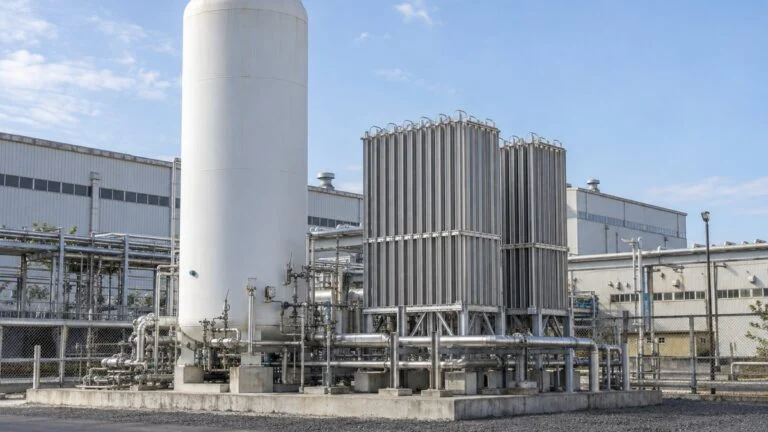
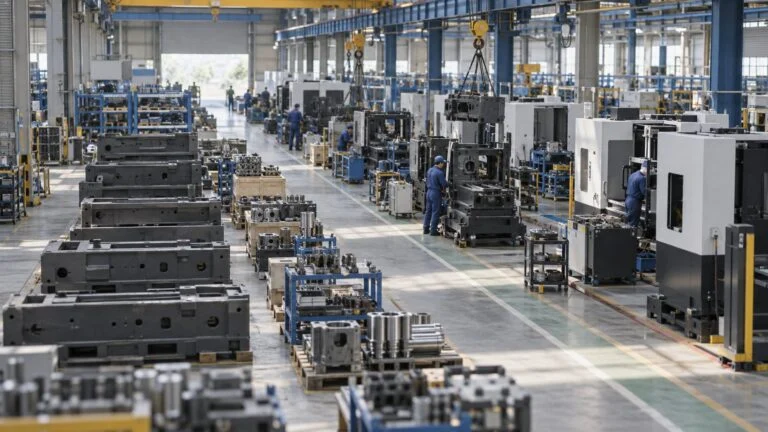
Japan Industrial Voltage: 200V 3-Phase and 50/60 Hz Guide
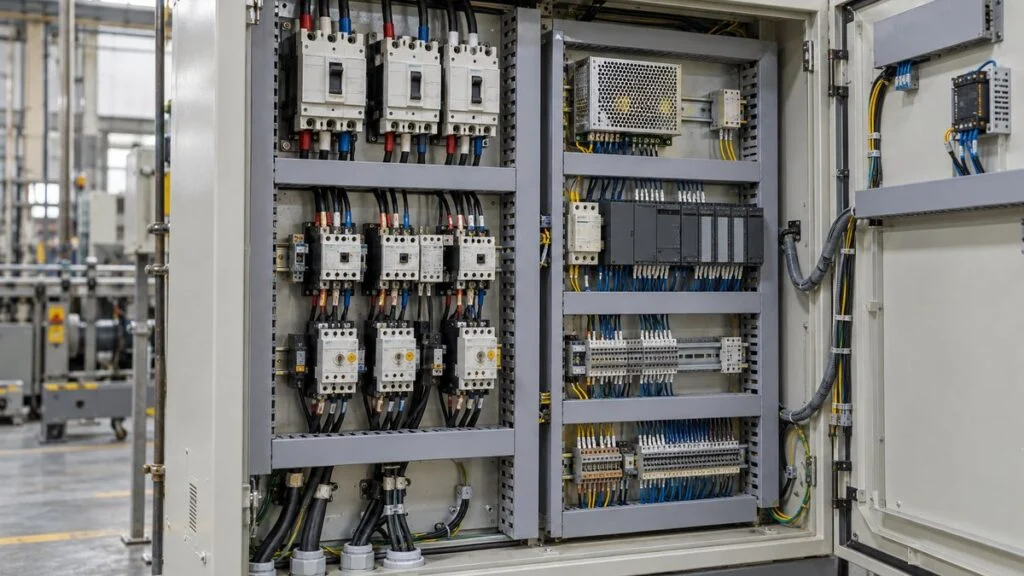
The nameplate on a machine from Japan reads "3φ AC 200 V 50/60 Hz." Your plant runs on 480 V, 60 Hz in the US, or on 415 V, 50 Hz in India. Before anyone connects it, you need answers to three questions: does the machine need a transformer, will its motors behave the same at your frequency, and which of its internal voltages (200 V, 100 V, 24 V DC) are actually your problem?
The short answer: Japanese factories commonly run motors on 3-phase 200 V (and larger loads on 400 V-class), lighting and small equipment on single-phase 100 V, and controls on 24 V DC. The grid is 50 Hz in eastern Japan and 60 Hz in western Japan. A machine built for 200 V will usually need a step-down transformer, or a different voltage version from the supplier, before it can run on a 380–480 V plant supply. Frequency is a separate check, because it changes motor speed and how motors and AC coils are loaded.
This guide explains the Japanese voltages you will see on drawings and nameplates, compares them with typical plant supplies in the US, India, and Southeast Asia, shows why the same motor draws half the current at 400 V, and ends with a checklist and a ready-to-send inquiry for the Japanese supplier. It lists what to confirm. It is not an installation procedure.
Contents
- The Voltages Inside a Japanese Factory
- Japan vs. Your Plant: Typical Supply Voltages and Frequencies
- Why Voltage Changes Current and Cable Losses
- What 50 Hz vs. 60 Hz Changes
- Do You Need a Transformer?
- Check the 24 V DC Circuit at the Far End
- Checklist Before You Order or Connect
- Questions for the Japanese Supplier
- Where This Guide Stops
- FAQ
- Sources
The Voltages Inside a Japanese Factory
A Japanese plant does not run everything on one voltage. It picks the supply by load and by the factory's own design standard. Large pumps and fans are candidates for 3-phase 400 V-class supply, and general motor loads also run on 3-phase 200 V. Lighting, outlets, and small equipment use single-phase 100 V, while sensors, PLC I/O, and relays typically run on 24 V DC.
"400 V-class" is not one number. Equipment in this class can be rated 400 V, 415 V, or 440 V, so two items that are both called "400 V" are not necessarily interchangeable. One machine can also use several voltages at once: a motorized valve, for example, may take 200 V for its motor but a different voltage for its open/close command and status signals.
Figure 1: Power and Control Run on Separate Supplies
One typical arrangement in a Japanese plant. A role diagram only: terminals and protective devices are omitted, and this is not a wiring diagram.
Some power supply units accept AC 200 V (or similar) directly, so this two-step path is not always needed.
The 24 V DC supply is not just a smaller transformer. Electronics such as PLCs and computers run on stable, low DC voltages, which require rectification and regulation in addition to any AC step-down.
For an overseas plant, the split matters. The 24 V DC control circuit is usually generated by a power supply unit in the machine's panel, so only that unit's input rating has to suit your grid. The 3-phase motor supply and anything wired to single-phase 100 V depend on it directly. Japan's 100 V is unusual elsewhere: the US uses 120 V, and India and Southeast Asia mostly use 220–240 V, so every 100 V load in the machine needs to be identified.
50 Hz in the East, 60 Hz in the West
Japan's grid is split in two. Eastern Japan, including Tokyo, runs at 50 Hz, and western Japan, including Osaka, runs at 60 Hz. The boundary runs roughly from the Fuji River in Shizuoka Prefecture to Itoigawa in Niigata Prefecture, and it is not a straight line. The split dates back to the 1890s, when Tokyo installed German 50 Hz generators and Osaka installed American 60 Hz generators.
This is why Japanese nameplates and spec sheets so often list both frequencies. A supplier in Nagoya or Osaka may test a machine at 60 Hz, while one near Tokyo tests at 50 Hz. Do not assume that "made in Japan" tells you which frequency the machine was set up and tested for. Ask.
Figure 2: Japan's Two Grid Frequencies
Near the boundary, the frequency can differ from one district to the next. The local utility is the reference.
| Eastern Japan | Western Japan | |
|---|---|---|
| Frequency | 50 Hz | 60 Hz |
| Examples | Tokyo area, Tohoku, Hokkaido | Nagoya, Osaka, Hiroshima, Kyushu |
| Boundary | Roughly the Fuji River (Shizuoka) to Itoigawa (Niigata); not a straight line | |
| What it means for you | A Japanese machine may have been set up and tested at either frequency. Check which one, and whether it was also tested at yours | |
"Teiatsu" (Low Voltage) Does Not Mean Safe
Japanese documents use three legal voltage categories from the national Ministerial Ordinance on Technical Standards for Electrical Equipment (Article 2). Both 200 V and 400 V AC fall under teiatsu (低圧, low voltage). For example, 3,300 V and 6,600 V AC fall in the koatsu (高圧, high voltage) category and are handled differently from 200 V and 400 V low-voltage power. So when a Japanese document says "high voltage," it does not mean 400 V.
Figure 3: Japan's Legal Voltage Categories
From Article 2 of the ordinance. Note the difference between "or less" and "over."
| Category | AC | DC |
|---|---|---|
| Low voltage (teiatsu, 低圧) | 600 V or less | 750 V or less |
| High voltage (koatsu, 高圧) | Over 600 V up to 7,000 V | Over 750 V up to 7,000 V |
| Extra-high voltage (tokubetsu koatsu, 特別高圧) | Over 7,000 V | Over 7,000 V |
These are Japanese legal terms. Your local code uses its own categories and limits.
The legal name is not a safety rating. For a resistive load, Ohm's law (V = RI) says current rises with voltage at constant resistance, but the human body cannot be reduced to one fixed resistance or one current threshold that separates safe from dangerous. Shock severity depends on where a person touches, the current path, contact time, and moisture, and even 100 V carries a real shock hazard. Lower voltage does not remove the need for guarding of live parts, proper grounding and protection, and lockout procedures.
Japan vs. Your Plant: Typical Supply Voltages and Frequencies
The table below puts Japan next to the countries most readers work in. Treat it as a starting point. Published nominal values and what you measure at the plant can differ, and older networks in some countries still run at 380 V or 415 V even where the official nominal is 400 V.
Figure 4: Typical 3-Phase Plant Supplies by Country
Nominal values from published references. Always confirm the actual voltage, frequency, and system type at your site.
| Country | Common 3-phase voltages | Frequency | Notes |
|---|---|---|---|
| Japan | 200 V; 400 V-class (400/415/440 V) for larger loads | 50 Hz east / 60 Hz west | Single-phase 100 V for lighting and small loads |
| United States | 480 V (277/480 V), 208 V (120/208 V), 240 V | 60 Hz | Motor nameplates use utilization voltages: 460 V on 480 V systems, 200 V on 208 V, 230 V on 240 V |
| India | 415 V (240/415 V) in common use | 50 Hz | IS 12360 lists 230/400 V, but an amendment put the changeover from 240/415 V on hold |
| Thailand | 400 V | 50 Hz | |
| Vietnam | 400 V nominal; 380 V (220/380 V) still widely quoted | 50 Hz | Confirm with the local distribution company |
| Indonesia | 400 V | 50 Hz | |
| Malaysia | 400 V officially; often 415 V in practice | 50 Hz | |
| Philippines | 400 V | 60 Hz | One of the few 60 Hz countries in the region |
Sources are listed at the end of the article. Where sources disagree, both values are shown.
Two patterns stand out. First, a Japanese 200 V machine is a voltage mismatch almost everywhere outside Japan. The one partial exception is a US 208 V system, which is close to Japan's 200 V but still needs confirmation against the machine's rated range. Second, most of Southeast Asia and India is 50 Hz, the US and the Philippines are 60 Hz, and Japan has both, so the frequency question depends on where the supplier is as well as where you are.
Why Voltage Changes Current and Cable Losses
For the same power, a higher supply voltage means a lower current. That is why plants run large motors at 400 V-class or 480 V rather than 200 V. Power is the rate at which electrical energy is used, measured in watts (W) or kilowatts (kW). For DC, it is voltage times current. For AC, you also account for the number of phases and the power factor.
At the same real power and power factor, doubling the voltage halves the current. This compares two motors, each designed for its own voltage. It does not mean you can put 400 V on a 200 V motor.
Example: Line Current of a 7.5 kW Motor at Different Voltages
The kW on a motor nameplate is normally the rated shaft output, not the electrical input. Efficiency is shaft output divided by electrical input, and power factor is real power divided by apparent power. To get current from shaft output, you need both.
Take a hypothetical 3-phase motor: 7.5 kW shaft output, 90% efficiency, 0.80 power factor. For illustration, assume the same efficiency and power factor in every voltage version. Real rated currents come from each product's datasheet.
Figure 5: Same Shaft Output, Each Motor at Its Own Rated Voltage
Hypothetical example: 7.5 kW, 90% efficiency, 0.80 power factor. Two separate motors, not one motor on two voltages.
At 90% efficiency, both motors take about 8.33 kW of electrical input. Moving to 400 V does not halve energy use. It halves current. The same formula gives the following for the voltages you are likely to meet:
Figure 6: Line Current for the Same Hypothetical 7.5 kW Motor
Same assumptions as above (90% efficiency, 0.80 power factor), calculated at each voltage. Not datasheet values.
| Rated voltage | Where you see it | Line current | Cable I²R loss vs. 200 V (same cable) |
|---|---|---|---|
| 200 V | Japan | about 30.1 A | 100% |
| 208 V | US 120/208 V systems | about 28.9 A | about 92% |
| 400 V | Japan 400 V-class, Southeast Asia | about 15.0 A | 25% |
| 415 V | India, Malaysia | about 14.5 A | about 23% |
| 460 V | US 480 V systems (motor nameplate) | about 13.1 A | about 19% |
Loss ratio = (200 / V)². Real motors at different voltages have different efficiencies and power factors. Use datasheet currents for cable and breaker sizing.
Lower Current Cuts Resistive Cable Losses
Heat lost in a cable is proportional to the square of the current. With the same conductor material, length, and cross-section, halving the current cuts resistive cable loss to a quarter.
Figure 7: Half the Current, a Quarter of the Cable Loss
Relative values with 200 V = 100. Same power, power factor, and cable resistance.
Lower current may allow a smaller cable, but after downsizing, the loss is not necessarily a quarter of the original. Choose the size that meets ampacity, voltage drop, short-circuit withstand, and installation conditions, then re-evaluate with that cable. Voltage drop also depends on current and on cable resistance and reactance, so a higher voltage helps there too. Do not halve a cable size from the voltage ratio alone without checking the circuit type, power factor, and run length.
What 50 Hz vs. 60 Hz Changes
Matching the voltage is only half the job. An induction motor's speed follows the supply frequency: synchronous speed is 120 × f / poles, so a 4-pole motor turns at 1,500 rpm synchronous speed on 50 Hz and 1,800 rpm on 60 Hz. Actual speed is a little lower because of slip.
A Japanese catalog shows how this looks on a rating plate. Mitsubishi Electric's SF-PR 400 V-class, 4-pole, 5.5 kW motor is rated for four voltage and frequency combinations, each with its own current and speed:
Figure 8: One Motor, Four Ratings (Catalog Example)
Mitsubishi Electric SF-PR, 400 V-class, 4-pole, 5.5 kW, as listed in the maker's online specifications.
| Voltage | Frequency | Rated current | Rated speed |
|---|---|---|---|
| 400 V | 50 Hz | 11.3 A | 1,465 rpm |
| 400 V | 60 Hz | 10.4 A | 1,760 rpm |
| 440 V | 60 Hz | 10.0 A | 1,765 rpm |
| 460 V | 60 Hz | 9.9 A | 1,770 rpm |
Read the current and speed from the same row as your voltage and frequency. Do not mix values from different columns. Other models and makers differ; check the actual nameplate.
Two things follow. A pump, fan, or conveyor driven directly by the motor runs about 20% faster at 60 Hz than at 50 Hz, which changes its output and its load on the motor. Ask whether the supplier sized and tested the machine at your frequency. And a motor rated only at 60 Hz is not automatically fine at 50 Hz on the same voltage: the voltage-to-frequency ratio rises by about 20%, which increases magnetic flux and can overheat the motor. Its output capability also drops. Any derating or voltage adjustment has to come from the motor maker.
Other Frequency-Sensitive Parts
Motors are not the only parts to check. AC coils on contactors, relays, and solenoid valves are rated for specific voltages and frequencies, and AC and DC coils are not interchangeable. AC cooling fans in panels and anything timed from the line frequency also deserve a look. Many parts list "50/60 Hz," but confirm it item by item on the parts list rather than assuming it.
Inverters (VFDs)
A variable frequency drive, called an "inverter" in Japanese documents, changes the picture. Its output frequency is set by parameters, so a motor behind a VFD does not see your grid frequency directly. Two separate checks still apply.
- Input: the drive's voltage class (200 V-class or 400 V-class) must cover your supply voltage. A 200 V-class drive cannot be connected to a 400 V or 480 V supply.
- Output to the motor: the drive and motor must match in voltage. Mitsubishi Electric states that a 400 V inverter should not drive a 200 V motor, because the inverter's peak output voltage can exceed the motor's withstand voltage, even if the output setting is lowered. Use a 200 V inverter for a 200 V motor, and ask the maker about peak output voltage and motor insulation for any other combination.
If the machine has drives, list each one with its model and voltage class, and ask the supplier whether a 400 V-class version exists for your site.
Do You Need a Transformer?
Matching the machine to the supply avoids conversion equipment. If your plant has a 200 V supply and the machine is a 200 V model, you may not need any step-down transformer for the main supply. The same logic applies to small loads: choosing an AC 200 V device where AC 200 V is nearby can remove a dedicated transformer down to AC 100 V. In most plants outside Japan, though, you have to choose between two options: order the machine in a version that matches your supply, or keep the 200 V version and add a step-down transformer.
Figure 9: Transformer Decision at a Glance
A quick screen only. The final decision belongs to your electrical engineer and the machine supplier.
| Your supply | Machine as built | Likely outcome | Confirm |
|---|---|---|---|
| US 480 V, 60 Hz | 3-phase 200 V | Step-down transformer, or order a 400 V-class / 460 V version | Whether all motors and drives are offered at 460 V, 60 Hz |
| US 208 V, 60 Hz | 3-phase 200 V | May fall within the machine's rated range | Rated voltage range of every motor, drive, and power supply |
| India 415 V, 50 Hz | 3-phase 200 V | Step-down transformer, or a 400 V-class version | Whether 400 V-rated parts accept 415 V; 50 Hz ratings |
| Southeast Asia 380–415 V, 50 Hz | 3-phase 200 V | Step-down transformer, or a 400 V-class version | Measured site voltage vs. rated range; 50 Hz ratings |
| Any | Contains single-phase 100 V loads | Internal control transformer, or a separate 100 V supply | Which loads use 100 V, and whether the internal transformer has a tap for your voltage |
| Any | 24 V DC controls only | Not affected by grid voltage directly | Input rating of the 24 V power supply unit |
A transformer adds its own losses, space, protection, and kVA sizing (including motor starting). Those belong in the design review.
Even when a transformer looks simpler, it is not the only factor. Spare parts, a common control voltage across the plant, replacement when something fails, shock protection, and behavior during power loss all point toward following your plant's own electrical standard. When replacing a part, compare voltage, AC or DC, number of phases, frequency, output, allowable current, insulation, and protection, not just voltage. Some products can be switched between 200 V and 400 V, but terminal connections and conditions of use are set by that product's manual, not by the nameplate alone.
Voltage choice also does not settle everything else. Ride-through during a power outage needs its own UPS review, and signal isolation needs its own isolator review. Where a device comes in both 100 V and 200 V versions, such as some motorized valves, compare command signals, starting current, the need for power conversion, and maintenance spares as well as the main supply.
Related: Japanese Machine Control Panels: UL 508A, NFPA 79, and CE
Related: VA vs W: Apparent vs Real Power and How to Read UPS Specs
Check the 24 V DC Circuit at the Far End
24 V DC controls do not depend on your grid, but they have a limit of their own: voltage drop. When a Japanese machine is installed with longer field wiring than at the supplier's factory, a small drop can push a device below its minimum input. Check not only steady state but also the current when solenoid valves and similar loads switch at the same time, and count the full loop (out and back) from the supply to the device.
For example, assume a 24 V supply, 2 A load current, and 1 Ω total loop resistance. The wiring drops 2 V, so the device sees 22 V. Check that value against the device's minimum input voltage on its datasheet.
Figure 10: 24 V at the Supply Is Not 24 V at the Device
Assumes 2 A through 1 Ω total loop resistance (outgoing plus return). Do not count the return path twice.
A power supply with plenty of capacity can still leave the far end short because of wiring resistance or inrush current. Before raising the supply output, check wire size and distance, each device's allowed input range, and whether any device would then see overvoltage.
AC 24 V and DC 24 V are different supplies, and some DC devices are polarity-sensitive, so confirm both voltage type and polarity on the terminal diagram. A dry (voltage-free) contact supplies no voltage itself, so check the terminal diagram for the receiving input circuit and any external supply it needs. The machine's 200 V main supply tells you nothing about its signal conditions, so review the power specification and the I/O specification separately.
Related: Junction Box (JB) on Japanese Drawings: Terminal Box Guide
Checklist Before You Order or Connect
- Plant supply: measured voltage, frequency, number of phases, and system type at the connection point
- Machine main supply: rated voltage, frequency, phases, and full-load current from the nameplate and electrical drawings
- Every motor: voltage and frequency combinations listed, and the current and speed in the row that matches your supply
- Every drive (inverter/VFD): input voltage class vs. your supply, and motor voltage vs. drive output class
- Single-phase 100 V loads: which ones, and how they will be supplied
- Control transformer: primary taps available, and whether one matches your voltage
- AC coils, panel fans, and frequency-sensitive parts: 50/60 Hz rating on the parts list
- 24 V DC power supply: input rating, capacity, and the voltage at the farthest device
- Test conditions: the voltage and frequency at which the supplier ran the factory acceptance test
- Transformer (if needed): who supplies it, kVA including motor starting, and protection
- Local code: which standards and approvals the installation must meet, and who signs off
Questions for the Japanese Supplier
- Was the machine built and tested for 50 Hz or 60 Hz? Was it also tested at our frequency?
- Can you supply a 400 V-class (or 460 V, 60 Hz) version instead of 200 V? Which parts would change?
- Please list all motors and drives with model, voltage class, and rated voltage/frequency combinations.
- Which loads run on single-phase 100 V, and what is the total current?
- Does the control transformer have a primary tap for our supply voltage?
- If we use a step-down transformer, what kVA and voltage do you recommend, including starting current?
- Are any parts rated for one frequency only (coils, fans, timers)?
- What is the allowed supply voltage range for the whole machine?
Inquiry Template
Copy, fill in the brackets, and send. Short, numbered questions are easier for a Japanese engineer to answer and translate.
Where This Guide Stops
- The voltage table is based on published nominal values. Actual plant voltages, tolerances, and system types (grounding, wye or delta) vary by site and utility, and this guide does not cover them.
- Current and loss figures are for a hypothetical motor with fixed efficiency and power factor. Real motors differ by voltage version and maker.
- The Mitsubishi motor data is one catalog example. Other makers and models list different combinations.
- Motor derating at a non-rated frequency, transformer sizing, cable sizing, and protection settings are design decisions for your electrical engineer and the equipment maker.
- Inspection and replacement must follow the procedures set by the person responsible at your site for de-energizing, preventing re-energization, and verifying zero voltage, along with your local electrical code. Watch for separate supplies, UPS outputs, and stored energy inside power equipment, and make sure you have identified every supply that feeds the work area.
FAQ
What Voltage Do Japanese Factories Use?
Most commonly 3-phase 200 V for motors, 400 V-class (400, 415, or 440 V) for larger loads, single-phase 100 V for lighting and small equipment, and 24 V DC for controls. The frequency is 50 Hz in eastern Japan and 60 Hz in western Japan.
Can I Run a Japanese 200 V Machine on 480 V?
Not directly. Never connect a voltage above the rating unless the machine is explicitly specified for it. Use a step-down transformer sized by your engineer, or ask the supplier for a 400 V-class / 460 V, 60 Hz version, and confirm wiring, frequency, and protection settings from the maker's documents.
Will a 60 Hz Japanese Motor Work on 50 Hz?
Only if it is rated for 50 Hz. Many Japanese motors list both, with separate current and speed values. A motor rated only for 60 Hz runs about 17% slower on 50 Hz, and at the same voltage its flux rises and it can overheat, so get the maker's guidance before using it.
Is 400 V "High Voltage" in Japan?
No. Under Japan's electrical equipment ordinance, AC 600 V or less is teiatsu (low voltage), so 400 V is low voltage. The label does not mean it is safe to touch. Guarding and lockout still apply.
Is 24 V DC Safe From Shock and Fire?
Not automatically. Low voltage has advantages, but it does not make a circuit safe by itself. A short circuit can still drive a large current, so check the protection characteristics of the power supply and the protection on each branch circuit.
Does Switching From 200 V to 400 V Halve the Electricity Bill?
No. For the same work, efficiency, and power factor, current halves but the power delivered to the equipment does not. Cable losses drop, but the real cost effect depends on equipment efficiency, transformer losses, and your tariff.
Sources
- Japanese legal voltage categories (Article 2): e-Gov, Ministerial Ordinance on Technical Standards for Electrical Equipment (Japanese)
- Japan's 50/60 Hz split and its origin: Wikipedia, "Fuji River"; IEEE Milestone, Sakuma Frequency Converter Station
- Fuji River–Itoigawa boundary: Jackery Japan, 50 Hz/60 Hz mixed areas (Japanese); Joshin, frequency by region (Japanese)
- Three-phase voltage and frequency by country: WorldStandards, "Three-phase electric power"
- US system voltages vs. motor nameplate voltages: NEMA, "NEMA Motor Standards vs. IEC Motor Standards"; Power Transmission Engineering, Baldor Basics
- India nominal voltages: BIS, IS 12360:1988 Voltage Bands for Electrical Installations
- Motor rating example (SF-PR 400 V-class, 4-pole, 5.5 kW): Mitsubishi Electric, SF-PR specifications (Japanese)
- 400 V inverter with a 200 V motor: Mitsubishi Electric FA FAQ (Japanese)
- Power and power factor equations: HIOKI, PW4001 measurement equations (Japanese); Japan Electrical Engineers Association, two-wattmeter method (Japanese)
- AC-to-DC power supplies, ratings, and protection: OMRON, power supply glossary (Japanese); OMRON, S8VK-WA ratings (Japanese)
- AC/DC relay coils and polarity: OMRON, general relay technical guide (Japanese)
- Power supply vs. dry-contact inputs: OMRON, WT21 I/O specifications (Japanese)
- Electric shock factors and low-voltage accidents: Ministry of Health, Labour and Welfare, "Electric shock" (Japanese); MHLW, low-voltage work accident case (Japanese)
- Measures for work on de-energized circuits (a separate regulation from the voltage-category ordinance): MHLW, Ordinance on Industrial Safety and Health (Japanese)
Original article in JapaneseThis guide is adapted from a MONOSCOPE article written for readers in Japan: 400V・200V・100V・24Vの違いとは?工場の使い分けと電流・配線損失の計算
About the editor
 MONOSCOPE EditorFOUNDER & EDITOR
Spent about ten years at a plant equipment maker and a plant engineering company, proposing, designing, and commissioning equipment, then moved into web marketing. Now a web consultant for B2B manufacturers, helping them explain their products and technology. Licensed in Japan as an Energy Manager and a Third-Class Chief Electrical Engineer.
Has run an engineering blog since 2017 (500+ articles) and a Japanese YouTube channel with about 20,000 subscribers. Each English guide is written from the Japanese shop-floor point of view and checked against the cited standards.