JIS ERW vs Seamless Pipe: E, S, B Codes vs ASTM A53/A106
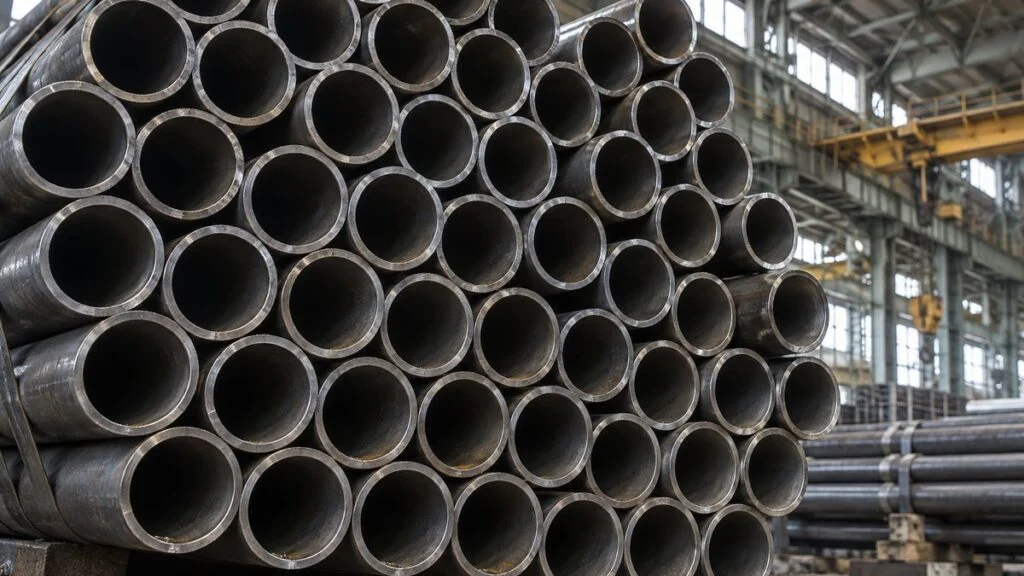
A mill certificate from a Japanese supplier lists the pipe as "STPG370-E-G 100A × Sch40." Your project spec calls for ASTM A106 Grade B, which is seamless only. Is the Japanese pipe seamless? The answer is in the short code after the grade: "-E-" means electric-resistance-welded (ERW) pipe, and "-S-" means seamless. So STPG370-E-G is ERW pipe in the as-welded condition, not seamless pipe.
This guide explains how to read the JIS manufacturing-process codes (S, E, B, and the finish codes H, C, G), how ERW and seamless pipe differ, how the codes line up with ASTM A53 Types E and S and with ASTM A106, and what to ask the supplier before you accept or order pipe.
- Process codes: S = seamless, E = electric-resistance-welded, B = forge-welded (Japanese tansetsu), A = arc-welded.
- Finish codes (after S or E): H = hot-finished, C = cold-finished, G = as-welded (ERW only).
- SGP (JIS G 3452) is never seamless. It is made only as E or B. For seamless carbon steel pipe, a Japanese spec uses STPG with "-S-" (for example STPG370-S) or STS.
- Grade strength does not change with the process. STPG370 must meet the same minimum tensile strength whether it is ERW or seamless.
- Closest ASTM counterparts: JIS "-S-" ≈ ASTM A53 Type S or A106 (seamless); JIS "-E-" ≈ ASTM A53 Type E. They are comparable, not identical.
Contents
- How to Read "STPG370-E-G"
- ERW vs. Seamless Pipe: How Each Is Made
- ERW vs. Seamless Pipe Compared
- Mapping JIS Codes to ASTM A53 and A106
- Which JIS Pipe Standards Allow ERW, Seamless, or Both
- Choosing and Specifying the Process
- Checklist: Reviewing a JIS Pipe Callout or Mill Certificate
- Questions to Ask the Japanese Supplier
- Limits of This Guide
- FAQ
- Sources
How to Read "STPG370-E-G"
A Japanese pressure pipe callout usually reads grade, then process code, then size. In "STPG370-E-G 100A × Sch40":
- STPG370 is the grade under JIS G 3454 (carbon steel pipe for pressure service), with a minimum tensile strength of 370 N/mm² (MPa).
- -E-G is the manufacturing process: E for electric-resistance-welded, G for as-welded (neither hot-finished nor cold-finished).
- 100A × Sch40 is the nominal size (100A = 4B = NPS 4) and the schedule.
Related: JIS Pipe Schedule & Thickness Chart vs ASME (Sch 40, 40S)
Read the process code in two steps. The first letter is how the tube was formed (S, E, or B), and the second letter is how it was finished (H, C, or G). Forge-welded SGP pipe carries only "-B," with no finish letter.
The items required by the standard are marked in a line on the pipe's outside surface. The process code comes right after the grade symbol.
Example 1: Carbon steel pipe for pressure service (ERW)
Mill IDManufacturer and worksJIS markCertification body and numberSTPG370Grade symbol-E-GProcess (E = ERW, G = as-welded)2024.8Year and month made100A×Sch40Nominal size and wallExample 2: Carbon steel pipe for ordinary piping (forge-welded)
Mill IDManufacturer and worksJIS markCertification body and numberSGPGrade symbol-BProcess (B = forge-welded)2024.8Year and month made50ANominal sizeBased on marking examples in JFE Steel's catalog of steel pipe for piping (example values). The standard does not fix the order of items, so it varies by manufacturer. The dashes may be replaced by spaces. Grooving-corrosion-resistant ERW pipe carries an added mark such as "MN."
| Code on pipe or mill cert | Manufacturing process | How to read it |
|---|---|---|
| STPG370-S-H | Seamless, hot-finished | S = seamless, H = hot-finished |
| STPG370-S-C | Seamless, cold-finished | C = cold-finished (for example, cold-drawn) |
| STPG370-E-G | ERW, as-welded | E = electric-resistance-welded, G = no hot or cold finishing after welding |
| STPG370-E-H / -E-C | ERW, hot-finished / cold-finished | Finished after welding |
| SGP-E-G | SGP (JIS G 3452) ERW pipe, as-welded | SGP ERW pipe also carries H, C, or G after the E |
| SGP-B | SGP forge-welded pipe | B = forge-welded; no finish letter |
Three things tell you the process, and they are not equally reliable. The pipe marking and the mill certificate (mill sheet in Japanese usage) are the evidence. Looking inside the pipe is only a supporting check.
- The marking: on STPG (JIS G 3454) and similar grades, the process code follows the grade symbol. "-S-" means seamless; "-E-" means ERW.
- The bore: ERW pipe has one straight weld line running the full length inside. Seamless pipe has none.
- The mill certificate: the manufacturer's certificate states the standard, grade, and manufacturing process. It is the record to rely on when a cut length no longer carries its marking.
The inside weld line can be hard to see. Mills trim the ERW weld bead, and on well-finished pipe the line may show only as a slight change in color or sheen. Don't decide the process from appearance alone; confirm it from the marking or the mill certificate.
ERW vs. Seamless Pipe: How Each Is Made
ERW pipe, written denpo-kan (電縫管) in Japanese, is formed from flat steel strip and welded along its length. Its full name is electric-resistance-welded steel pipe; the short form denpo means "stitched with electricity." ERW pipe is made in carbon steel and also in stainless and low-alloy steels. In Japanese, all pipe made by joining a seam is grouped as welded pipe (yosetsu-kan), and ERW pipe is a typical example.
Steel strip is formed into a tube continuously, and the meeting edges are welded with high-frequency current.
Based on the process in JFE Steel's catalog of steel pipe for piping. The weld bead is trimmed inside and out, and a sizing mill brings the tube to final dimensions.
The mill uncoils hot-rolled strip and forms it step by step through forming rolls into a round tube. A high-frequency current heats the two edges, and the edges are pressed together to make the weld. The weld bead is then trimmed, the tube is sized, and it is cut to length. The JIS G 3452 revision draft (for the 2026 edition) requires the outside and inside beads to be removed to follow the pipe contour, although the inside bead may stay as-welded where removal is difficult.
Because the process is continuous and covers small to large diameters, ERW pipe costs less. As examples of mill capability, JFE Steel lists STPG in ERW from 15A to 650A, and Nippon Steel from 10A to 600A.
Forge-welded pipe (tansetsu-kan, code B) is also made from strip, but the seam is joined by heat and pressure rather than by electric resistance. At JFE Steel's forge-welded pipe mill, the strip is heated to about 1,200°C (2,190°F) and the edges that form the seam to about 1,450°C (2,640°F); the strip is then formed into a tube, the seam is forged together, and the pipe is elongated to size. Forge-welded pipe is used mostly at 100A and below; larger sizes are mainly ERW. JFE Steel, for example, makes SGP as forge-welded pipe from 15A to 100A. Arc-welded pipe (code A), welded with an arc from electrode or wire, is used for large-diameter STPY pipe and for stainless pipe (SUS-TP).
This video from the official channel of Kumkang Kind, a Korean maker of steel pipe and construction formwork, shows the ERW pipe process.
Seamless pipe, called tsugime-nashi kokan (継目無鋼管) in JIS, is made without any weld. A heated round billet is pierced through the center to make a hollow shell, mostly by the Mannesmann piercing process, and is then rolled to size.
No welding: a heated round billet is pierced, then elongated into pipe.
Based on the seamless process in JFE Steel's catalog of steel pipe for piping. Pipe finished hot is -S-H; pipe further finished cold, for example by cold drawing, is -S-C.
With no seam, the material is the same all the way around the pipe, so there is no weld quality to worry about. That is its main advantage. A seamless piping system still has girth welds where pipes are joined; only the pipe itself has no longitudinal weld. Seamless pipe handles internal pressure and torsion well and can be made with heavy walls: JFE Steel's Chita Works lists seamless pipe up to 65.0 mm wall, and Nippon Steel up to 51.5 mm.
The trade-offs are size range, accuracy, and cost. Piercing and rolling tend to leave the wall slightly uneven, so tight dimensional accuracy is harder to achieve, and seamless pipe usually costs more than ERW. The OD range is also smaller: 25.4–426.0 mm at JFE and 27.2–426.0 mm at Nippon Steel. Typical uses are high-temperature, high-pressure piping in oil and gas production, power generation, and chemical plants. Tenaris, a pipe manufacturer, shows the process in its TenarisBayCity seamless pipe manufacturing video (YouTube).
ERW vs. Seamless Pipe Compared
The table below sums up the differences. The size ranges are examples of what mills make, not limits set by the standard.
Whether there is a seam drives the differences in size, wall, accuracy, and cost.
Sizes and walls from JFE Steel's catalog of steel pipe for piping and Nippon Steel's construction materials handbook. Tolerances are for walls of 3 mm (ERW) or 4 mm (hot-finished seamless) and over.
One point is easy to miss: the grade's strength requirement is the same for both processes. STPG370 must reach at least 370 N/mm² tensile strength whether it is ERW or seamless. Meeting the same grade values does not settle whether a pipe is acceptable for a given line, though. That depends on the wall margin for pressure, temperature, and corrosion, and on the code or regulation that applies, and the piping designer decides it case by case.
Dimensional accuracy shows the difference more clearly. Because hot-finished seamless pipe tends to have uneven walls, JIS G 3454 gives it a wider thickness tolerance. Figure 5 applies the JIS G 3454 thickness tolerances to a common size, 100A Sch40.
Applying the tolerances to the 6.0 mm nominal wall gives a 1.65 mm band for hot-finished seamless pipe and a 1.20 mm band for ERW pipe.
Assumes STPG370, 100A (114.3 mm OD), Sch40 nominal wall 6.0 mm (Nippon Steel dimension table). Tolerances are the JIS G 3454 wall tolerances for 4 mm and over (hot-finished seamless) and 3 mm and over (ERW and cold-finished seamless). The vertical line marks the nominal wall. Other standards and sizes have different tolerances.
The OD shows the same pattern. On 100A pipe (114.3 mm OD), the tolerance is ±1% (about ±1.1 mm) for hot-finished seamless and ±0.8% (about ±0.9 mm) for ERW. For comparison, ASTM A106 sets the minimum wall at no more than 12.5% under nominal, the same under-tolerance JIS allows for hot-finished seamless pipe of 4 mm wall and over.
For lower-pressure water, air, and steam lines that use SGP or STPG, either process is often acceptable on strength, so the choice often comes down to past practice or the plant owner's design standards. High-temperature, high-pressure lines, and lines where the process changes the inspection scope, are different: there the service conditions decide the process.
Power plants in Japan are one example. Under Japan's Electricity Business Act, welds on certain thermal power plant piping are subject to the operator's own weld inspection (yosetsu jishu kensa), and longitudinal seams on steam and similar piping fall into scope at a lower pressure than circumferential welds (for pipe of 150 mm OD and larger: 490 kPa for longitudinal seams vs. 980 kPa for other welds on that piping). Some designers therefore specify seamless pipe for lines of 150A and larger that would otherwise fall into scope, so that only the girth welds need inspection. The rules also have other categories and exemptions, and the actual scope follows guidance from Japan's Ministry of Economy, Trade and Industry (METI). This is a Japanese regulatory reason; if you see it in a spec, the Japanese side's piping engineer can explain how it applies to that plant.
Mapping JIS Codes to ASTM A53 and A106
ASTM uses the same idea with different labels. ASTM A53 covers welded and seamless pipe and names the process as a Type: Type F (furnace-butt-welded, continuous-welded, Grade A only), Type E (electric-resistance-welded, Grades A and B), and Type S (seamless, Grades A and B). ASTM A106 covers seamless pipe only, in Grades A, B, and C, for high-temperature service.
| JIS code | Process | Closest ASTM process designation | Notes |
|---|---|---|---|
| -S-H, -S-C | Seamless (hot- or cold-finished) | A53 Type S; A106 (seamless only) | JIS separates the finish (H or C). ASTM A53 and A106 do not use an equivalent finish code. |
| -E-G, -E-H, -E-C | ERW (as-welded or finished) | A53 Type E | Not acceptable where the spec calls for A106 or "seamless." |
| -B (SGP only) | Forge-welded | Similar in concept to A53 Type F (furnace-butt-welded) | Different standards and grades. Do not treat as interchangeable. |
| -A (STPY, SUS-TP) | Arc-welded | No A53 type | Check the specific ASTM product standard for the material. |
Matching the process does not mean the grades match. The minimum strengths sit close together but are not the same:
| Grade | Min. tensile strength | Min. yield strength |
|---|---|---|
| JIS G 3454 STPG370 | 370 MPa | 215 MPa |
| JIS G 3454 STPG410 | 410 MPa | 245 MPa |
| ASTM A53 Type E/S and A106, Grade A | 330 MPa (48,000 psi) | 205 MPa (30,000 psi) |
| ASTM A53 Type E/S and A106, Grade B | 415 MPa (60,000 psi) | 240 MPa (35,000 psi) |
STPG410 is often cited as the closest match to A53 or A106 Grade B, but its minimum tensile strength is 5 MPa lower, so it does not automatically meet a Grade B requirement. JIS G 3454 is based on ISO standards (ISO 9329-1 and ISO 9330-1, modified), not on ASTM. Dual-certified pipe (JIS and ASTM on one certificate) is sometimes available; ask the supplier rather than assuming an equivalence.
The process also matters in ASME design codes. In ASME B31.3, for example, the longitudinal weld joint quality factor for A53 Type E pipe is commonly listed as 0.85, against 1.00 for seamless, so ERW pipe needs a thicker wall for the same design pressure. Check the factor in the code edition your project uses.
Which JIS Pipe Standards Allow ERW, Seamless, or Both
The standard comes first: it limits which processes you can get. Figure 6 shows the processes allowed by the main JIS piping standards.
● = process allowed by the standard. SGP has no seamless (S) option, and STS is seamless only.
| Standard and symbol | Typical use | S Seamless | E ERW | B Forge-welded | A Arc-welded |
|---|---|---|---|---|---|
| JIS G 3452 SGP | Steam, water, oil, gas, and air at relatively low pressure | – | ● | ● | – |
| JIS G 3442 SGPW | Water piping for HVAC, fire protection, drainage, and similar | – | ● | ● | – |
| JIS G 3454 STPG | Pressure piping up to about 350°C | ● | ● | – | – |
| JIS G 3455 STS | Higher-pressure piping up to 350°C | ● | – | – | – |
| JIS G 3456 STPT | Mainly piping above 350°C | ● | ● | – | – |
| JIS G 3460 STPL | Low-temperature piping below freezing | ● | ● | – | – |
| JIS G 3458 STPA | Mainly high-temperature piping (alloy steel) | ● | – | – | – |
| JIS G 3459 SUS-TP | Stainless piping for corrosion, low- or high-temperature service | ● | ● | – | ● |
| JIS G 3457 STPY | Large-diameter, low-pressure piping | – | – | – | ● |
Based on the process column in JFE Steel's Q&A on JIS steel pipe uses and scope, and on JIS revision drafts published by the Japan Iron and Steel Federation. SUS-TP (JIS G 3459) also allows laser welding (L) in addition to S, A, and E. ● shows what the standard allows; the sizes a mill actually makes vary (for example, JFE makes STPT only as seamless, 20A–400A).
"Seamless SGP" is a common search, but it does not exist in the standard. JIS G 3452 allows only ERW (E) and forge-welded (B) pipe. If you need seamless carbon steel pipe from a Japanese source, specify the seamless version of STPG, such as STPG370-S.
For higher pressure, STS (JIS G 3455) is the usual candidate, and above about 350°C (660°F), STPT (JIS G 3456). Stainless pipe (SUS-TP, JIS G 3459) comes as seamless (S) and in welded forms: automatic arc-welded (A), laser-welded (L), and ERW (E). Note that A, the arc-welded code, is a different process from ERW (E).
Choosing and Specifying the Process
The receiving checks above confirm what arrived. This section covers what to decide and write down before ordering. The process is not chosen from the pipe alone: start from the service conditions, pick the standard, choose the process within that standard, and confirm it from the marking on delivery.
Deciding in the order conditions → standard → process → receiving check avoids guesswork and mix-ups.
The standard choices are guidelines based on each JIS scope (JFE Steel Q&A and catalog). For regulated equipment such as power plants and high-pressure gas facilities, the regulatory requirements take precedence.
For general plant water supply and drainage, compressed air, and low-pressure steam, SGP or STPG in ERW covers most cases. Seamless is the choice for high-temperature, high-pressure lines that need heavy walls, and for lines where you want fewer welds. The schedule series also differ by standard: JFE Steel lists STPG in Sch 10–80 and STS in Sch 40–160.
One ERW-specific risk in water service is grooving corrosion, where the weld seam corrodes into a groove along the pipe. Two causes are commonly given: the welding heat leaves a difference in microstructure at the seam, and manganese sulfide (MnS) inclusions there take on a shape that corrodes easily. For ERW pipe in services other than gas, JFE Steel recommends its grooving-corrosion-resistant ERW pipe, which in JFE's marking examples carries an added "MN."
JIS G 3452 (SGP) was revised on May 20, 2026, and the new edition adds a clause titled "Information to be supplied by the purchaser." JIS G 3454:2026 (STPG), issued the same day, has the same clause. For SGP, the revision draft lists:
- Manufacturing and finishing process (for example, E-G or B)
- Pipe ends (threaded or plain end)
- Galvanizing (black pipe or galvanized "white" pipe)
- Size (nominal size)
For STPG and similar grades, add the schedule and, where needed, weld inspection or heat treatment requirements. If the process matters for a line, write the code in full on drawings and purchase specifications, for example "SGP-E" or "STPG370-S-C," to avoid mix-ups on delivery.
Checklist: Reviewing a JIS Pipe Callout or Mill Certificate
- Standard number and grade (for example, JIS G 3454 STPG370)
- Process code: S, E, or B, and the finish letter H, C, or G
- Process on the mill certificate matches the marking on the pipe
- Process allowed by the standard (no seamless SGP; STS is seamless only)
- Your project spec: does it require seamless (for example, ASTM A106) or allow ERW (ASTM A53 Type E)?
- Grade strength against the project requirement (STPG410 vs. Grade B: 410 vs. 415 MPa minimum tensile)
- Nominal size and schedule, checked against the size range the mill can supply for that process
- Wall tolerance for that process (hot-finished seamless allows +15%/−12.5% at 4 mm and over)
- Hydrostatic test or nondestructive examination performed, and which one
- Weld-seam inspection or heat treatment, if your spec requires it for ERW pipe
- For ERW pipe in water service: grooving-corrosion-resistant pipe needed?
- Cut lengths without marking traced back to a mill certificate
Questions to Ask the Japanese Supplier
- What is the full grade and process code for each line item (for example, STPG370-S-H or STPG370-E-G)?
- Can you supply seamless pipe in this size, and from which mill?
- Can the pipe be dual-certified to ASTM A53 or A106, or only to JIS?
- Was each pipe hydrostatically tested or examined by ultrasonic or eddy current testing?
- For ERW pipe, is the inside bead removed, and is the weld seam heat-treated?
- For ERW pipe in water service, is it grooving-corrosion-resistant pipe?
- Which type of inspection document will you issue, and does it state the manufacturing process?
You can adapt this email when the documents don't make the process clear:
Subject: Manufacturing process for pipe on PO [number]
Hello [Name],
Thank you for the mill certificates for PO [number]. Our project specification requires seamless pipe (ASTM A106 Grade B or equivalent approved by our engineer) for lines [line numbers]. The certificate for item [number] shows "STPG370-E-G," which we understand is ERW pipe in the as-welded condition.
Could you please confirm the manufacturing process for each item, and let us know whether seamless STPG (-S-H or -S-C) or dual-certified ASTM A106 pipe is available in [size and schedule]? Please include the expected lead time.
Best regards,
[Your name]
Limits of This Guide
- Size ranges and wall limits are examples from JFE Steel and Nippon Steel. Other mills differ; confirm with the supplier.
- Tolerances are from JIS G 3454 and depend on wall thickness and size. Check the current edition for your size.
- JIS-to-ASTM mappings here are the closest comparable designations, not equivalences. Whether a JIS pipe can replace an ASTM pipe is decided by the project's piping engineer under the applicable code.
- Regulated equipment (power plants, high-pressure gas, and similar) follows its own rules, which take precedence over the standard.
- Marking order and format vary by manufacturer.
FAQ
What Does "E" Mean in STPG370-E-G?
E means electric-resistance-welded (ERW) pipe. The G that follows means as-welded, with no hot or cold finishing after welding. Seamless STPG is marked -S-H (hot-finished) or -S-C (cold-finished).
Is There Seamless SGP Pipe?
No. JIS G 3452 (SGP) allows only ERW (E) and forge-welded (B) pipe. If you need seamless carbon steel pipe, specify STPG with "-S-," such as STPG370-S, or STS for higher pressure.
Is STPG370 Equivalent to ASTM A106 Grade B?
No. A106 is seamless only, while STPG370 can be ERW or seamless, and STPG370's minimum tensile strength (370 MPa) is lower than Grade B's (415 MPa). STPG410 is closer, at 410 MPa, but still not identical; have your piping engineer approve any substitution.
What Is the Difference Between Forge-Welded and ERW Pipe?
Forge-welded pipe (B) is heated as a whole strip and the seam is forged together by pressure. ERW pipe (E) heats only the seam edges with electric current before pressing them together. JFE Steel, for example, makes SGP as forge-welded pipe up to 100A and as ERW pipe from 125A.
Is the Weld Seam on ERW Pipe Weaker?
Not as a rule. The grade requirements are the same as for seamless, and the pipe is tested before shipment. For SGP, the JIS G 3452 revision draft requires either a hydrostatic test at 2.5 MPa (about 360 psi) or ultrasonic or eddy current testing. Fitness for a given line depends on pressure, temperature, corrosion, and the applicable code. In water service, grooving corrosion at the seam is a bigger concern than strength.
Sources
- JIS G 3454:2026 issue date, scope, ISO basis, and purchaser-information clause: Japanese Standards Association, JIS G 3454:2026 preview (Japanese)
- JIS G 3452:2026 issue date, scope, and purchaser-information clause: Japanese Standards Association, JIS G 3452:2026 preview (Japanese)
- JIS G 3454 process codes, tolerances, and test options (older English translation): TubeSolution, "JIS G3454 Carbon Steel Pipes for Pressure Service"
- JIS G 3452 process, marking, hydrostatic test, and ordering information (revision draft, December 2025): Japan Iron and Steel Federation, JIS G 3452 revision draft (Japanese); JIS G 3454 revision draft (Japanese)
- Manufacturing processes, size ranges, tolerances, marking examples, and grooving corrosion: JFE Steel, steel pipe for piping catalog (Japanese); JFE Steel, building materials guide, Chapter 5 (Japanese); JFE Steel Chita Works, ERW pipe (Japanese)
- Process codes by standard: JFE Steel, Q&A "Uses and scope of JIS steel pipes" (Japanese)
- STPG sizes and mill size ranges: Nippon Steel, construction materials handbook 4-10 (Japanese); seamless process and sizes: Nippon Steel, steel pipe manufacturing process (Japanese)
- ASTM A53 types and grades: Federal Steel Supply, "ASTM A53"; Project Materials, "Carbon Steel Pipes: A53, A106, A333"
- ASTM A106 grades and wall tolerance: Totten Tubes, "ASTM A106 Seamless Carbon Steel Pipe"; Wermac, "ASTM A106"
- ASME B31.3 weld joint quality factors: Little P.Eng., "ASME B31.3 Quality Factors"
- Thermal power plant weld inspection in Japan: METI, weld self-inspection guide for thermal power equipment (Japanese)
Original article in JapaneseThis guide is adapted from a MONOSCOPE article written for readers in Japan: 電縫管とシームレス管の違い|JIS記号(E・S・B)早見表と見分け方・使い分け
About the editor
 MONOSCOPE EditorFOUNDER & EDITOR
Spent about ten years at a plant equipment maker and a plant engineering company, proposing, designing, and commissioning equipment, then moved into web marketing. Now a web consultant for B2B manufacturers, helping them explain their products and technology. Licensed in Japan as an Energy Manager and a Third-Class Chief Electrical Engineer.
Has run an engineering blog since 2017 (500+ articles) and a Japanese YouTube channel with about 20,000 subscribers. Each English guide is written from the Japanese shop-floor point of view and checked against the cited standards.