Delivery Specification (Nonyu Shiyosho): What to Check
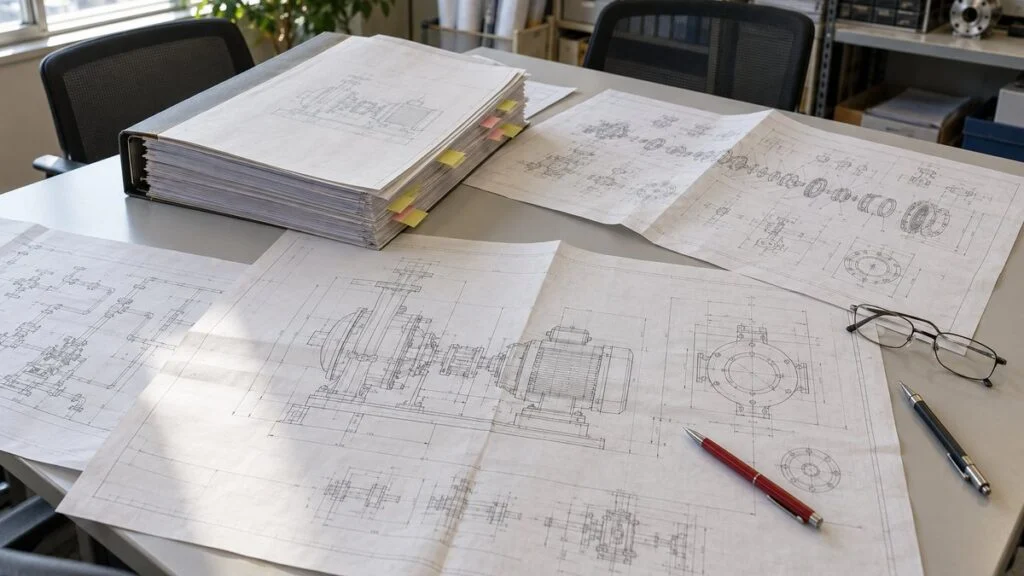
You placed an order with a Japanese equipment maker. A few weeks later, a thick PDF arrives titled 納入仕様書 (nonyu shiyosho), and the cover asks for your approval. At first glance it looks like the quotation specification you already agreed on. It is not. Once you return it approved, the supplier can start building the equipment exactly as shown.
This guide explains what a delivery specification is, how it differs from the purchase specification, the quotation specification, and the approval drawings, and what to check before you send it back. It is written for engineers and buyers outside Japan, whether you receive a nonyu shiyosho from a Japanese supplier or need to prepare one for a Japanese customer. For return codes, stamps, and return deadlines, see our guide to approval drawings (shonin-zu).
Contents
- What Is a Delivery Specification (Nonyu Shiyosho)?
- Where It Fits: Purchase, Quotation, and Delivery Specifications
- What a Delivery Specification Contains
- How It Differs From the Quotation Specification
- Four Things to Check Before You Return It
- Delivery Specification vs. Approval Drawing vs. As-Built Drawing
- If You Are the Supplier: Preparing One for a Japanese Customer
- Delivery Specification Review Checklist
- Where Practice Varies
- FAQ
- Sources
What Is a Delivery Specification (Nonyu Shiyosho)?
A delivery specification is a document set that the supplier (usually the equipment maker) submits after the purchase order is placed. It describes the specifications and drawings of the equipment that will actually be delivered. The approval drawings (shonin-zu, 承認図) are the drawings within this set that the buyer is asked to approve.
Strictly speaking, drawings submitted for approval are shonin-yo-zu (承認用図), and drawings the buyer has approved and returned are shonin-zu. Fabrication starts from the returned drawings. In practice, many people call both "shonin-zu."
Names vary by company and by customer. Some buyers approve and return the whole delivery specification as one package. Others return only the drawings, as approval drawings. The purchase specification or the purchase order usually says which way your project works.
Where It Fits: Purchase, Quotation, and Delivery Specifications
On a Japanese plant project, the documents usually move in this order. The plant designer writes a purchase specification (kobai shiyosho, 購買仕様書) that states the performance the equipment must meet, based on the designer's calculations. The supplier answers with a quotation specification (mitsumori shiyosho, 見積仕様書) for equipment selected under its own design standards. After a few rounds, once both sides agree on the specifications and the price, the buyer places the order.
The delivery specification comes after that. The many document names fall into three stages: quotation, after the order, and fabrication through delivery.
The delivery specification is submitted after the order and before fabrication. Once it comes back approved, its drawings become the approval drawings.
Document names and stages vary by company, industry, and buyer. Some suppliers submit the delivery specification and approval drawings together; others submit only the drawings for approval.
The table below compares the three specifications. Notice how the author moves from buyer to supplier, and the purpose moves from "tell" to "agree" to "get permission to build."
Same equipment, three documents, three different jobs.
(kobai shiyosho)
(mitsumori shiyosho)
(nonyu shiyosho)
Scope of supply (shosho, 所掌) means which party supplies or installs each item.
Related: Equipment Purchase Specification: Items, Checks, Template
Related: Quotation Specification (Mitsumori Shiyosho): Sample Format
What a Delivery Specification Contains
Contents depend on the equipment and on what the purchase specification asks for. A typical delivery specification includes the sections below. The right-hand column shows what the buyer checks in each one.
| Section | What to check |
|---|---|
| Equipment specifications, load conditions, and interface details | Whether the equipment fits the foundation and piping design |
| Guarantee conditions | Whether the guaranteed performance and warranty period match the contract |
| Assembly drawing and detail drawings of individual parts | Shape and dimensions; nozzle locations and orientation |
| Accessory specifications and detail drawings | Whether instruments, valves, and other accessories are within the scope |
| Performance (capacity) calculations | The basis showing the equipment meets the performance in the purchase specification |
| Spare parts and consumables | Quantities, and whether they were included in the quotation |
| Supporting documents, such as installation and insulation procedures | Whether the work can actually be done on site |
How It Differs From the Quotation Specification
The specifications are basically the same as in the quotation specification. What the delivery specification adds is content that only exists once detailed design has progressed, plus detailed drawings of the accessories. The quotation specification was for agreeing on price. The delivery specification is for permission to fabricate, so it deserves a closer look, down to the drawings.
Compare the model, materials, and accessory scope against the final revision of the quotation specification. Adjust small differences within the contract price. If a change would affect the price, discuss with the supplier whether it should be handled as an extra cost.
If you agreed on exceptions during the quotation stage, they are usually listed in a deviation list (debieshon risuto, often shortened to debikura in Japan). Check each item by its number to confirm it now appears in the delivery specification.
Here is a fictional example of a side-by-side check for a pump.
| Item | Quotation specification (final rev.) | Delivery specification | Action |
|---|---|---|---|
| Model | Model A-100 | Model A-100 | OK |
| Casing material | As per deviation list item 3 | Same as deviation list item 3 | OK |
| Pressure gauge | Included | Shown, but faces the wall | Mark up: ask to rotate toward the walkway |
| Companion flanges, bolts, gaskets | Supplier scope | Not listed | Ask: still in supplier scope? |
| Spare mechanical seal | 1 set | 2 sets | Ask: is the extra set included in the price? |
Four Things to Check Before You Return It
When you receive a delivery specification, you review it for four main purposes. All four are points to settle before you return it with approval, by checking the contents against your own documents and with the departments involved.
Check each one against your own documents and with the teams who will use the equipment.
1. Assembly Drawings and Accessories
The delivery specification includes equipment drawings (nonyu-hin-zu, 納入品図): an assembly drawing showing the equipment in detail and detail drawings of accessories such as instruments. Use them to picture how the equipment will sit and be used on site, then ask for orientation changes where needed.
For example, a pressure gauge facing away from the walkway cannot be read by operators. A valve handle on the wall side is hard to operate and inspect. Send the drawings to operations and maintenance staff, not just the designer, and fewer of these problems slip through.
2. Interfaces (Toriai)
Almost every piece of equipment connects to utilities such as water, power, and steam, or to other process lines. In Japanese these connection points are called toriai (取合い). Check that each interface matches the equipment or piping it connects to.
Where equipment connects upstream or downstream, confirm the location and type of each connection, and who supplies the bolts, nuts, and gaskets. The most reliable approach is to have the piping, electrical, and instrumentation designers each check their own connections.
The interface is the boundary where the supplier's equipment meets piping and cables installed by others.
Check who supplies the companion flanges, gaskets, bolts, and nuts against the scope of supply agreed in the quotation specification. Check electrical terminal boxes and instrument connections the same way.
If the flange standards or pressure classes differ, the bolt holes will not line up. A wrong interface leads to rework during construction and can delay the schedule, so this is the check that needs the most care.
Related: Process vs Utility Piping: How Japanese Plants Divide Them
Related: Mating Flange (Companion Flange): Who Supplies It?
3. Installation Procedures
If the supplier is not responsible for installation, it usually submits an installation procedure (koji yoryosho, 工事要領書) covering points to watch during installation and the welding method. Review it with your construction team to confirm the work can be done without difficulty.
If there is an installation drawing or foundation drawing, check the anchor bolt locations and loads with the foundation designers. Review the insulation procedure with the insulation contractor in the same way.
Related: Equipment Loading Data for Foundations: What to Submit, When
4. Release for Fabrication
If the delivery specification and equipment drawings have no problems, you return them with approval (shonin henkyaku, also called juryo henkyaku, 受領返却). This authorizes the supplier to build the equipment to those drawings. Work back from the delivery date and make sure you return the set before fabrication has to start.
Return decisions usually fall into three types: approved, approved with conditions, and resubmit. Conditional approval lets the supplier start fabrication on the understanding that the comments will be addressed. Record which condition, who fixes it, and by when, and close the record only after the revised drawing shows the fix. If something changes after approval, the supplier shows what changed and why, and the buyer approves it again. The approval drawings also serve as the acceptance basis when you witness the factory inspection. Our approval drawing guide covers return codes, stamps, and deadlines in detail.
Related: FAT and SAT with Japanese Suppliers: Steps & Free Checklist
Delivery Specification vs. Approval Drawing vs. As-Built Drawing
Several similar names show up around the delivery specification. They differ in the project stage they belong to and the state of the equipment they describe.
The full document set, the drawings that were approved, and the record of the finished equipment.
(nonyu shiyosho)
(shonin-zu)
(kansei-zu)
Names and boundaries vary by company and buyer. Many people also call the drawings "shonin-zu" before they are approved.
Delivery Specification vs. Approval Drawing
The delivery specification is a bundle that shows what will be delivered: specifications, calculations, and drawings. "Approval drawing" is the name for the drawings in that bundle that the buyer approves.
Approval is not always limited to drawings. A guideline from Japan's Acquisition, Technology & Logistics Agency (ATLA) defines the documents submitted for approval as including drawings, written documents, and photos. In other words, a written specification can also be the object of approval. Whether your project approves the whole delivery specification or only the drawings is set by the purchase specification or purchase order.
Delivery Specification vs. As-Built Drawing
An as-built drawing (kansei-zu, 完成図) shows the equipment as finished. In building and facility work it is also called shunko-zu (竣工図). The delivery specification and approval drawings, by contrast, are pre-fabrication documents that decide what will be built.
If dimensions or parts change during fabrication or installation, the as-built drawings reflect the result. Operation, maintenance, and future modifications rely on the as-built drawings. For equipment, they are often handed over at delivery as part of a completion document set (kansei tosho, 完成図書) with the instruction manual and test reports. For example, the common specification that Japan's Ministry of Land, Infrastructure, Transport and Tourism (MLIT) uses for purchasing telecommunications equipment requires the supplier to submit, by the end of delivery, a single delivery binder containing the instruction manual, test reports, and delivery photos.
Other Names: Nonyu-zu and Shiyo-zu
We found no definition of nonyu-zu (納入図, "delivery drawing") in the standards. In practice, treat it as roughly the same as the equipment drawings (nonyu-hin-zu) attached to a delivery specification: assembly drawings, outline drawings, and accessory details.
A shiyo-zu (仕様図, "specification drawing") puts specifications such as model, dimensions, and performance onto a drawing. For standard products, a supplier may send a single sheet combining specifications and an outline drawing under a name like nonyu shiyo-zu (納入仕様図). Whatever the name, you check the same content. Look at the cover page or transmittal to see whether the document is submitted for approval.
Japanese public-sector documents use yet another name. MLIT's common specification calls the detailed specifications and outline drawings submitted after the contract kakunin tosho (確認図書, "documents for confirmation"), which the supplier submits to obtain the agency's confirmation.
If You Are the Supplier: Preparing One for a Japanese Customer
If a Japanese customer asks you for a nonyu shiyosho, it expects the document set described above, submitted after the order and before fabrication. A few points make the review go faster.
- Check the purchase specification or purchase order for the number of copies, the format (paper or PDF), and the submission deadline, and whether the customer approves the whole set or only the drawings.
- Mark the cover page or transmittal clearly as submitted for approval.
- Show where each deviation list item is reflected, by item number.
- Keep the model, materials, and accessory scope consistent with your final quotation specification. Flag any difference that affects price instead of leaving it for the customer to find.
- Show the scope of supply at each interface: who supplies the companion flanges, gaskets, bolts, and nuts.
- Update the revision number and date on every resubmission so everyone can tell which version is current.
- For changes after approval, submit a revision that shows what changed and why, and wait for approval before building that part.
Delivery Specification Review Checklist
Use this list when you review a delivery specification from a Japanese supplier. If you are the supplier, it shows what your Japanese customer is likely to check.
| Check | Compare against / ask |
|---|---|
| Model, materials, and accessory scope | Final revision of the quotation specification |
| Every deviation list item reflected | Deviation list, item by item |
| Guaranteed performance and warranty period | Contract and purchase specification |
| Performance calculations meet the required duty | Purchase specification |
| Nozzle and instrument locations and orientation | Plant layout; operations and maintenance staff |
| Connection location, size, type, and standard at each interface | Piping, electrical, and instrument drawings |
| Who supplies companion flanges, gaskets, bolts, and nuts | Scope of supply in the quotation specification |
| Anchor bolt locations and loads | Foundation design |
| Installation, welding, and insulation procedures workable on site | Construction team; insulation contractor |
| Spare parts and consumables: quantities and price coverage | Quotation |
| Changes that affect price | Discuss whether to treat them as an extra cost |
| Return date | Fabrication start date worked back from delivery |
| Conditions on a conditional approval | Record what, who, and by when |
Questions to Ask the Japanese Supplier
- Is this document submitted for approval, or for reference only?
- Do you need the whole delivery specification approved, or only the drawings?
- Which revision of the quotation specification is this based on?
- Where is each deviation list item reflected in this submission?
- Who supplies the companion flanges, gaskets, bolts, and nuts at each nozzle?
- Does any change from the quotation affect the price or the delivery date?
- When do you need our return to keep the fabrication schedule?
- What will the completion documents include, and how many copies will you deliver?
Where Practice Varies
- Document names and stages differ by company, industry, and buyer. Many people call the drawings "shonin-zu" even before approval.
- Whether the whole set or only the drawings is approved depends on the purchase specification or purchase order.
- The contents listed here reflect plant equipment. Standard catalog products may come with only a single specification drawing.
- Return decision labels vary by company, and return deadlines are set in the purchase specification or purchase order. Confirm them for every project.
FAQ
Is a konyu shiyosho the same as a kobai shiyosho?
In most cases, yes. Konyu shiyosho (購入仕様書) and kobai shiyosho (購買仕様書) are two names for the same purchase specification: the buyer's document stating the performance, conditions, and standards the equipment must meet.
Is a nonyu shiyosho the same as a nohin shiyosho?
Both names are sometimes used for a document showing the specifications of delivered goods, and there is no fixed distinction between them. Use whichever name appears in the contract or in the customer's own documents.
How many copies of a delivery specification are required, and in what format?
The purchase specification or purchase order usually sets the number of copies, the format (paper or PDF), and the deadline. MLIT's common specification for telecommunications equipment, for example, leaves the number of copies of delivery documents to the project's special specification. Update the revision number and date on every resubmission so the latest version is clear.
What happens if something changes after approval?
The supplier submits a revision showing what changed and why, and builds that part only after it is approved again. ATLA's guideline calls this revised submission a "document for change approval" (henko shonin-yo tosho). If the buyer requested the change, discuss any extra cost and the impact on the delivery date as well.
Sources
- Documents for approval (including drawings, documents, and photos), start of fabrication after approval, and documents for change approval: Acquisition, Technology & Logistics Agency (ATLA), Guideline for Preparing and Submitting Documents and Samples for Approval (Japanese)
- Documents for confirmation (kakunin tosho) submitted after the contract, delivery documents, and number of copies: Ministry of Land, Infrastructure, Transport and Tourism (MLIT), Common Specification for Purchasing Telecommunications Equipment (March 2021, Japanese)
- Definition of completion drawings (shunko-zu): Shimane Prefecture, Guidelines for Handling Building Completion Drawings (Japanese)
Original article in JapaneseThis guide is adapted from a MONOSCOPE article written for readers in Japan: 納入仕様書とは?承認図・見積仕様書との違いと確認ポイント
About the editor
 MONOSCOPE EditorFOUNDER & EDITOR
Spent about ten years at a plant equipment maker and a plant engineering company, proposing, designing, and commissioning equipment, then moved into web marketing. Now a web consultant for B2B manufacturers, helping them explain their products and technology. Licensed in Japan as an Energy Manager and a Third-Class Chief Electrical Engineer.
Has run an engineering blog since 2017 (500+ articles) and a Japanese YouTube channel with about 20,000 subscribers. Each English guide is written from the Japanese shop-floor point of view and checked against the cited standards.