Buying from Keyence: Direct Sales and Same-Day Shipping
Say your line needs a laser displacement sensor or a vision system, and the spec calls for Keyence. You look for a local distributor and find none. Instead, a Keyence sales engineer calls, offers to visit your plant with a demo unit, and promises same-day shipping once you order. If you are used to buying automation parts through a distributor, this can feel unusual.
It is how Keyence is built. The Japanese maker of factory automation sensors, measurement instruments, and vision systems sells through its own sales force and ships from stock. That model also explains its profit: for the fiscal year ended March 2026, Keyence reported an operating margin of 51.0%, meaning more than half of its sales remained as operating income.
This guide explains the four parts of the Keyence business model, what they mean for you as a buyer, and what to prepare before you meet a Keyence sales engineer. All company figures come from Keyence's published financial reports and websites, listed at the end.
Contents
Keyence at a Glance
Keyence Corporation is headquartered in Higashiyodogawa, Osaka. It designs and sells electronic equipment for factory automation (FA), centered on sensors and measurement instruments. Its company profile lists sensors, measuring instruments, image processing equipment, control and measuring instruments, analytical instruments for research and development, and business information devices.
In its annual securities report (the Japanese equivalent of a 10-K), Keyence reports a single business segment: the manufacture and sale of electronic application equipment. It does not disclose sales by business division, so outsiders can only see company-wide figures.
Two-thirds of sales come from outside Japan, and the operating margin is above 50%.
Sources: Keyence earnings release (April 24, 2026), annual securities report (57th term), company profile, and recruiting site. Overseas share calculated from regional sales in the earnings release.
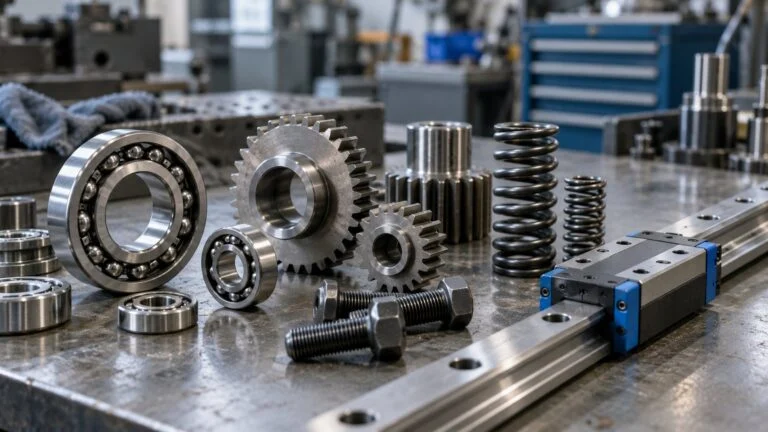
The core products are sensors that detect whether a part is present and where it is, instruments that measure dimensions and shapes, and image processing systems that inspect appearance with cameras. Keyence has since added digital microscopes and 3D measuring machines for R&D, code readers for logistics, and software for automating office work.
In short, Keyence has a product for almost every point on a line where something must be detected, measured, inspected, or recorded.
The lineup covers detection, measurement, inspection, control, and identification on the production line.
Grouped by MONOSCOPE from Keyence's product categories. Uses are general examples.
Keyence describes itself as a B2B company with factory automation at its core, selling sensors, measuring instruments, and vision equipment globally. Most customers run factories, research labs, or logistics sites.
Why You Can't Find a Keyence Distributor
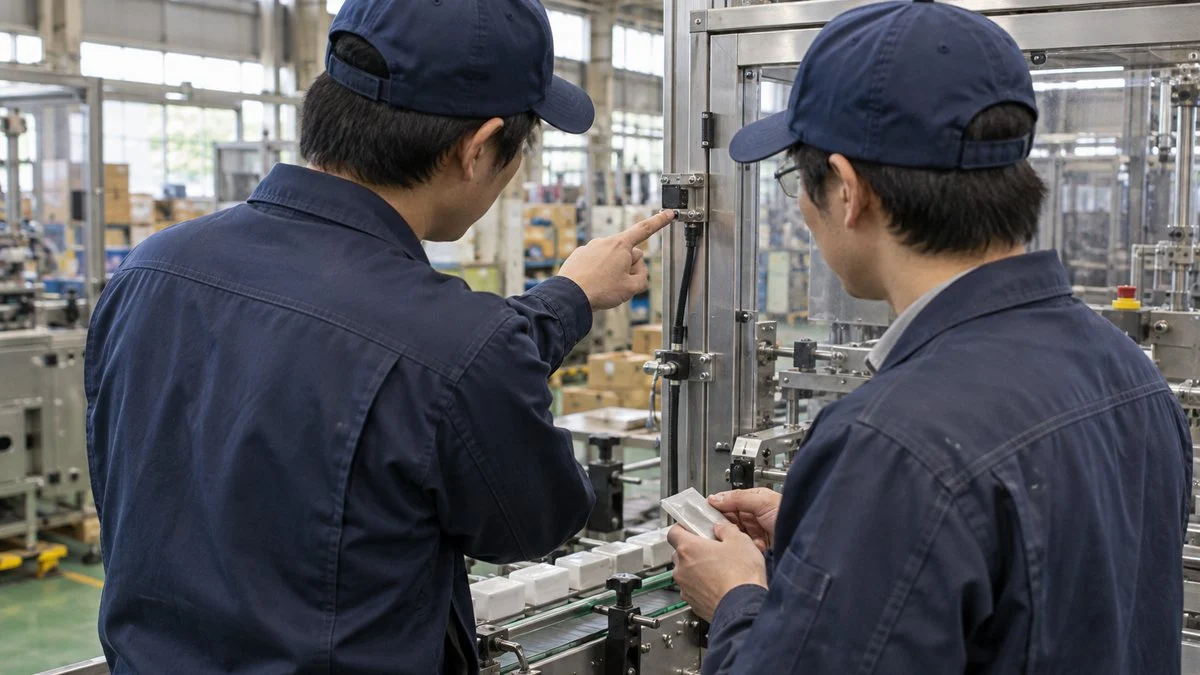
Factory automation equipment usually reaches the end user through distributors or trading companies. Keyence skips that layer. On its global site, it says it serves customers in its main markets directly, with no distributors in between, and its investor page describes a direct sales system in countries around the world without intermediaries.
According to Keyence, its sales engineers know the products in detail and propose the best application for each customer's site. In practice, if a line keeps missing defects, the conversation does not stop at which sensor to buy. The sales engineer works with you on where to mount it and how to detect the target so that results stay stable.
Related: Japanese Sales Engineers and FAEs: Roles and Handoffs
Direct sales serve a second purpose: customer problems reach the manufacturer without a filter. Feedback that tends to get diluted on its way through a distributor goes straight from the sales engineer back to product planning.
With direct sales, the person who hears your problem and the person who proposes the hardware both work for the manufacturer.
The distributor route varies by company and product. The Keyence column is based on the company's own description.
Keyence's own wording is "main markets." If your plant is in a country without a Keyence office, ask Keyence directly which office or channel covers your site before buying from a third party.
Related: Japanese Factory Automation Companies: Who Makes What
Four Pillars Behind a 51% Operating Margin
Keyence's investor relations site names four sources of competitive advantage: planning and development, direct sales, same-day shipping for all products, and fabless manufacturing (outsourcing production instead of running its own plants). The company presents these as one cycle rather than four separate policies: what sales engineers learn on customers' floors feeds the next round of product planning.
Problems found on the floor become products, and the sales team takes them back to the floor.
Based on Keyence's investor relations, sustainability, and recruiting websites.
Direct Sales Feed Product Planning
Direct sales cost money: sales engineers on salary, visits, and demos. In return, Keyence learns what customers struggle with first-hand, and that knowledge shapes what it develops next. The pillars below depend on this link.
About 70% of New Products Are World-First or Industry-First
Keyence says about 70% of its new products have world-first or industry-first functions or concepts at launch. Its annual securities report names products as the source of its added value and sets a goal of continuing to release such products through close work between development and sales.
A product with no direct competitor is less exposed to price competition. Based on the earnings release, Keyence's gross margin was about 83% in the fiscal year ended March 2026. One reading of that figure is that Keyence can price its products against the savings they deliver, such as fewer defects or fewer labor hours.
Fabless Production With Partner Factories
Keyence outsources most production to partner factories, mainly in Japan. By limiting investment in factories, it concentrates its resources on planning, development, production engineering, and sales.
It does not hand off production entirely, though. Keyence plans, develops, and designs its products and buys the production materials itself. Its production engineering, production planning, and quality control departments give partner factories the assembly drawings and supply the materials. A manufacturing subsidiary, Keyence Engineering Corporation, also builds Keyence products, according to the annual securities report.
Same-Day Shipping for In-Stock Products
Keyence promotes same-day shipping for all products. Orders go through the sales engineer directly to the distribution warehouse and ship that day. The system works because direct sales give Keyence a real-time view of orders, and it plans production from shipment forecasts.
The annual securities report notes that because Keyence ships immediately, orders roughly equal sales, so its order backlog is not material. For you as a buyer, the value is that a machine startup or a late design change does not have to stop while you wait for parts.
Check the conditions for your site, though. Keyence's English pages say in-stock products ship the same day depending on the order cutoff time, and some regional pages add "excluding certain products and regions." Same-day shipping also means the day the order leaves the warehouse, not the day it arrives at your plant. Cross-border shipments and customs clearance add time.
The pillars are Keyence's own description; the related figures can be read from its financial reports.
Ratios calculated by MONOSCOPE from the earnings release. Keyence does not claim a cause-and-effect link between these figures and the pillars.
Put side by side, the numbers show low cost of sales and a high gross margin, SG&A (driven by the sales force) of just over 30% of sales, and a small amount of property, plant and equipment because Keyence owns almost no factories. The high gross margin covers the cost of a hands-on direct sales force.
Who Keyence Sells To
Keyence does not depend on any one industry. In the second half of the fiscal year ended March 2026, automotive and transportation was the largest share of sales at 25%, according to its earnings presentation. Electrical and precision equipment followed at 15%; semiconductors and LCDs, metals and machine tools, and food and pharmaceuticals each accounted for 10%; and other industries made up 30%.
"Other" is 30% of sales by industry; overseas is two-thirds by region.
By industry (second half of FY ended March 2026, in 5% steps; same mix in Japan and overseas)
By region (full year ended March 2026)
Sources: Keyence FY2025 earnings presentation (by industry, local-currency basis) and earnings release for the year ended March 2026 (by region). In the fourth quarter, overseas sales split into Asia 41.2%, the Americas 36.1%, and Europe and other 22.7%.
Keyence states that no single customer accounts for 10% or more of its sales. Because the same sensors and instruments are used in car plants and food plants alike, a slump in capital spending in one industry can be offset by another.
By region, sales in Japan were JPY 390.0 billion (up 4.6% year on year) and overseas sales were JPY 779.2 billion (up 13.5%), giving an overseas share of about 67%. Asia grew 16.7%, the Americas 13.3%, and Europe and other regions 8.4%.
In its annual securities report, Keyence says its products are still not widely used in overseas markets and that it sees large room for growth. Extending the same direct sales model abroad is at the center of its growth strategy. If you work in the US, India, or Southeast Asia, this growth push is the context when a Keyence sales engineer reaches out to your plant.
Five-Year Financial Track Record
Net sales grew from JPY 755.1 billion in the year ended March 2022 to JPY 1,169.2 billion in the year ended March 2026, about 1.5 times in four years. In the year ended March 2024, sales rose but operating income fell 0.8%. Both have risen in each of the two years since.
The operating margin ranged from 51.0% to 55.4% over the five years.
Source: Keyence earnings releases for each year. Figures truncated to JPY 0.1 billion. Keyence's fiscal year closes on March 20.
The margin likely stays near 50% because the gross margin changes little even when sales rise and fall with the business cycle. It did slip from 51.9% to 51.0% in the year ended March 2026: the gross margin fell from about 83.8% to about 83.0%, and SG&A grew about 11%, slightly faster than sales (10.4%).
Keyence does not publish earnings forecasts. Its annual securities report says that because it serves a wide range of industries and regions, it is difficult to calculate reasonable forecasts or targets. To gauge the outlook, track growth rates by industry and region in its quarterly results. Its equity ratio was 94.6% at the end of March 2026, and the earnings release describes its interest-bearing debt as not material.
Recent Moves: New Products, Overseas Staff, Logistics
Keyence's recent investments all strengthen the four pillars. Its FY2025 earnings presentation puts top priority on new product development, overseas expansion, the direct sales organization, and production and shipping capacity. It will also consider strategic M&A without fixing a timeline or amount.
- New products. For the year ended March 2026, Keyence highlighted a 3D printer for the factory floor and a line-type cylinder sensor and smart valve. The GX-1000 Series 3D printer aims to let anyone print high-quality parts in high-strength, heat-resistant functional resins, and Keyence says it can make jigs and parts at "1/10 the lead time and cost." A sensor maker moving into 3D printing shows how Keyence adds product lines from problems it sees on the floor. R&D spending for the year was JPY 32.8 billion.
- Overseas sales staff. Keyence has 250 locations in 46 countries and runs direct sales and same-day shipping overseas as well. In its latest earnings release, it named stronger training of overseas staff as a sales priority. A direct sales network takes longer to build than a distributor network, so developing local sales staff is a precondition for raising the overseas share of sales.
- Logistics. A new logistics center under construction in Takatsuki, Osaka Prefecture, will have about four times the floor area of the current facility. Completion is planned for November 2026 and operation for November 2027. It is a major part of the JPY 28.3 billion in capital spending for the year ended March 2026. For a company with almost no factories, a logistics center is one of its largest assets: it is the investment that keeps same-day shipping working as sales grow.
Starting with sensors, Keyence added overseas subsidiaries and logistics capacity step by step.
- Mar 1972Takemitsu Takizaki founds Lead Electric in Itami, Hyogo
- Apr 1973Starts developing, making, and selling sensors for factory automation
- May 1974Incorporated as Lead Electric Co., Ltd. in Amagasaki
- Mar 1985US subsidiary established; manufacturing subsidiary (now Keyence Engineering) set up that September
- Oct 1986Renamed Keyence Corporation
- May 1990German subsidiary established
- Sep 1990Listed on the First Section of the Tokyo and Osaka stock exchanges
- Aug 1994New headquarters and research lab completed in Osaka
- Sep 2001Chinese subsidiary established
- Nov 2007Logistics center opened in Takatsuki
- 2011Subsidiaries in Brazil and India, later also Indonesia, Vietnam, and the Philippines
- Apr 2022Moves to the Prime Market of the Tokyo Stock Exchange
- Nov 2026New logistics center due for completion (operation planned for November 2027)
Sources: Keyence annual securities report (57th term) and FY2025 earnings presentation. "Founded" refers to Lead Electric as a sole proprietorship; "incorporated" is the date it became a company.
Founder Takemitsu Takizaki served as director and honorary chairman until he stepped down from the board at the close of the annual shareholders' meeting on June 12, 2026. According to press reports, he left at his own request and remains honorary chairman. The board after that meeting has nine directors, including four outside directors. The current president is Tetsuya Nakano.
Working With a Keyence Sales Engineer
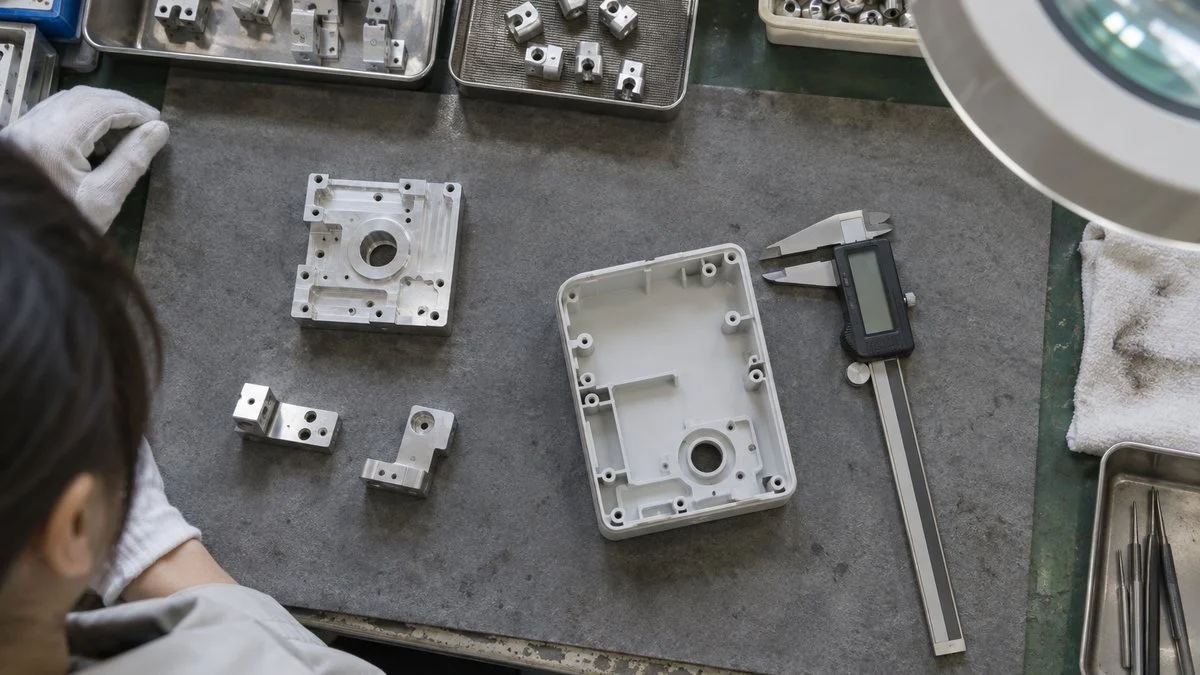
From the user's side, Keyence is a supplier whose sales engineers come to you, run demos, and help with installation questions. Because it ships the same day, it is also easier to get extra hardware right before a machine startup. Keep in mind that Keyence's annual securities report lists a ban on business entertainment and gifts among its workplace rules, so do not expect (or offer) hospitality as part of the relationship.
The quality of the proposal depends heavily on what you give the sales engineer. Prepare these points before the first meeting.
Pre-Meeting Checklist
- Target: what you need to detect or measure (material, color, and size of the part; types of defects you want to catch)
- Accuracy and pass/fail criteria: tolerances and where OK ends and NG (no good) begins
- Mounting conditions: available space, distance to the part, and exposure to oil, dust, or ambient light
- Line speed: takt time and part transport (conveyor) speed
- Connected equipment: PLC brand and communication protocol, and what data you want to log
- Samples: good parts and defective parts the sales engineer can test with
PLC connection deserves special attention. The effort depends on who made your existing equipment, and Keyence sells its own PLCs. Compare options that include your current PLC brand, not only an all-Keyence setup.
Related: Mitsubishi vs Keyence vs Omron vs Siemens: Choosing a PLC
Questions to Ask Keyence
- Which Keyence office covers our plant, and who supports us after startup?
- Is this model in stock for our region, and what is the order cutoff time for same-day shipping?
- Does it ship from a local warehouse or cross-border? How many days to our site, including customs?
- Has the model been tested with our parts and under our lighting and line speed? Can we see the test results?
- How does it connect to our PLC (brand and protocol)? Are sample programs or function blocks available?
- Which certifications and documents come with the product for our market (for example CE or UL marking, manuals in English)?
- How long is the quote valid, and what is the warranty and repair process in our country?
Sample Inquiry Email
Use this as a starting point when you contact Keyence through its website or local office. Replace the bracketed parts.
Subject: Application inquiry - [inspection/measurement task] at [plant name, city]

Hello,

We are looking for a solution to [detect / measure / inspect] [target]
on our [line or machine name] at [plant name, city, country].

- Part: [material, color, size]; defects to catch: [examples]
- Required accuracy: [tolerance]; pass/fail criteria: [description]
- Line speed: [takt time] s per part, conveyor at [speed]
- Mounting space and environment: [space, distance, oil/dust/ambient light]
- Existing PLC: [brand, model, protocol]; data to log: [items]

We can provide [number] good and defective samples for testing.
Could you propose suitable models, arrange a demo or sample test,
and tell us the stock status and delivery time to our site?

Best regards,
[Name], [Title]
[Company], [Phone]
Limits of This Guide
- The four pillars are Keyence's own description. The financial figures are real, but the link between them and the pillars is our reading, not a claim by Keyence.
- Financial results cover the fiscal year ended March 20, 2026, and earlier periods; amounts are in Japanese yen as reported. Later results may differ.
- Coverage, stock, cutoff times, and shipping times vary by country and product. Confirm them with the Keyence office that covers your site.
- This guide does not compare Keyence with other suppliers on price or performance.
FAQ
Can I buy Keyence products from a distributor?
In its main markets, no. Keyence sells directly through its own sales engineers, without distributors. To buy, contact Keyence through its website or local office. If your country has no Keyence office, ask Keyence which channel covers you.
Why is Keyence's profit margin so high?
Keyence's operating margin was 51.0% for the year ended March 2026. A gross margin of about 83%, supported by products that often have no direct competitor, covers selling and administrative costs of about 32% of sales. Fabless production also keeps fixed assets low.
Does Keyence have its own factories?
Mostly not. Keyence outsources most production to partner factories, mainly in Japan, but it buys the materials, supplies the drawings, and runs production engineering and quality control itself. Its subsidiary Keyence Engineering Corporation also manufactures products.
Does Keyence really ship the same day?
Keyence states same-day shipping for its products. Its English pages tie this to in-stock items and an order cutoff time, and some regional pages exclude certain products and regions. Ask your local office about the cutoff time and delivery days to your site.
Who founded Keyence, and who runs it now?
Takemitsu Takizaki founded Lead Electric, Keyence's predecessor, in Itami, Hyogo, in 1972. He left the board in June 2026 but remains honorary chairman. The current president is Tetsuya Nakano.
Sources
- Results, regional sales, and financial position: Keyence, consolidated earnings release for the year ended March 2026 (April 24, 2026) (Japanese)
- Past results: Keyence earnings releases for the years ended March 2022, 2023, 2024, and 2025 (Japanese)
- Sales by industry, capital allocation, new logistics center: Keyence, FY2025 earnings presentation (April 24, 2026) (Japanese)
- History, business, employees, R&D, workplace rules: Keyence, annual securities report for the 57th term (filed June 15, 2026) (Japanese)
- Founder leaving the board: Nikkei, report on Takemitsu Takizaki stepping down as director (Japanese)
- Business model: Keyence, "Business Model and Strengths"
- Direct sales in main markets: Keyence, "Consistent Support Worldwide Through Direct Sales"
- Same-day shipping conditions: Keyence, "Same-Day Shipping: Fast Delivery When Production Can't Wait", Keyence UK, Sensor Setting Guide
- Fabless production: Keyence, "Supply Chain Management" (Japanese)
- Company profile and locations: Keyence, company profile (Japanese), Keyence recruiting site, "Keyence in Numbers" (Japanese)
- Products: Keyence product information (Japanese), GX-1000 Series 3D printer (Japanese)
Original article in JapaneseThis guide is adapted from a MONOSCOPE article written for readers in Japan: キーエンスとは|直販と当日出荷で営業利益率5割を生む仕組みを読む
About the editor
 MONOSCOPE EditorFOUNDER & EDITOR
Spent about ten years at a plant equipment maker and a plant engineering company, proposing, designing, and commissioning equipment, then moved into web marketing. Now a web consultant for B2B manufacturers, helping them explain their products and technology. Licensed in Japan as an Energy Manager and a Third-Class Chief Electrical Engineer.
Has run an engineering blog since 2017 (500+ articles) and a Japanese YouTube channel with about 20,000 subscribers. Each English guide is written from the Japanese shop-floor point of view and checked against the cited standards.