Mitsubishi vs Keyence vs Omron vs Siemens: Choosing a PLC
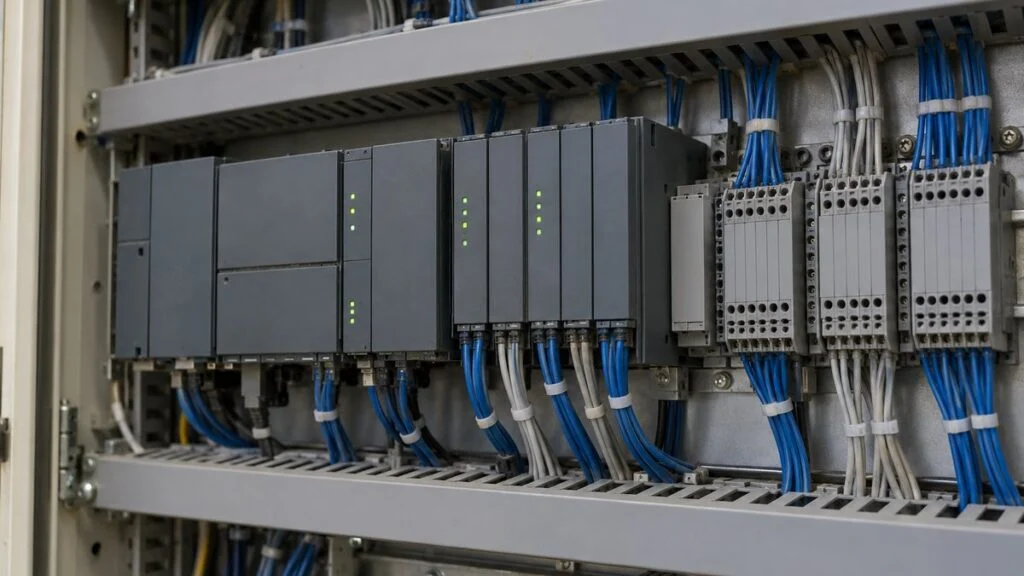
A new machine arrives from a Japanese builder. The control panel holds a Mitsubishi MELSEC PLC, the drawings call it a "sequencer," and your plant standard is Siemens or Allen-Bradley. Or you are about to order a line from Japan and the builder asks which controller you want. Either way, the question is the same: what are you actually signing up for when you pick a PLC brand?
The short answer: choosing a PLC maker means choosing a software package, an industrial network, the devices that can connect to it, and the people who can program and fix it. The CPU's performance matters less than that whole combination. The deciding questions are usually which brand your existing lines and customers already use, which network your servos and sensors speak, and who will write and maintain the program.
This guide compares four major PLC makers, three Japanese and one German: Mitsubishi Electric, Keyence, Omron, and Siemens. It covers current series, programming software, networks, and languages, based on each maker's official information as of October 2026. It then lays out six selection factors, three fictional scenarios, a step-by-step process, and a list of questions to send the Japanese builder.
Contents
- Why the Brand Matters More Than the CPU
- Mitsubishi vs. Keyence vs. Omron vs. Siemens at a Glance
- The Four Makers: Current Series and What to Know
- Networks and Languages: Where Brands Really Differ
- Six Factors for Choosing a PLC Maker
- Example Scenarios: Applying the Six Factors
- How to Run the Selection: Six Steps
- Questions to Ask the Japanese Machine Builder
- Limits of This Guide
- FAQ
- Sources
Why the Brand Matters More Than the CPU
A PLC (programmable logic controller) takes signals from sensors and switches and drives motors and valves according to its program. Every brand works the same basic way: it reads inputs, executes the logic, writes outputs, and repeats that scan cycle at high speed.
Related: How to Read Ladder Diagrams: Mitsubishi and Omron Basics
What differs between makers is everything that gets locked in along with the PLC. Once you pick a brand, you have largely picked the programming software, the network, the range of compatible devices, the engineers who know the platform, and how easily you can get spare parts.
The surrounding ecosystem drives the decision more than CPU performance does.
Which factors weigh most depends on plant size and where the equipment ships.
The international standard for PLC programming languages, IEC 61131-3, defines five languages, including ladder diagram and structured text (ST). All the major makers say their software complies with it.
Compliance does not mean you can move a program from one brand to another. Each software package has its own project format, instruction syntax, and way of configuring hardware, so switching brands effectively means rewriting the program. That switching cost is why compatibility with existing equipment carries so much weight.
Mitsubishi vs. Keyence vs. Omron vs. Siemens at a Glance
The table below lists each maker's current series, software, standard networks, and languages, based on information on their official websites as of October 2026.
Each maker pairs its series with its own software and network.
Summarized by MONOSCOPE from each maker's official website. Supported networks and languages vary by model, so check the catalog and manuals before you commit.
Narrowed down to what drives the decision, the four makers compare like this:
| Mitsubishi Electric | Keyence | Omron | Siemens | |
|---|---|---|---|---|
| Brand | MELSEC | KV Series | SYSMAC | SIMATIC |
| Main current series | iQ-R, iQ-F | KV-X, KV-8000 | NJ, NX | S7-1500, S7-1200 G2 |
| Software | GX Works3 | KV STUDIO | Sysmac Studio | TIA Portal |
| Core network | CC-Link IE | EtherNet/IP, EtherCAT | EtherCAT, EtherNet/IP | PROFINET |
| Often shortlisted when | Existing lines in Japanese plants already run MELSEC | Tracing the cause of machine faults is a priority | A multi-axis machine should be built in one software environment | The customer's corporate standard is SIMATIC |
All four offer a large-system line and a compact line, and all support both ladder and ST. The real differences are the standard network and the software. Mitsubishi centers on CC-Link IE, Omron on EtherCAT, and Siemens on PROFINET, while Keyence builds both EtherNet/IP and EtherCAT into the KV-X.
The next figure shows where each maker's strengths tend to come into play. Read it as "conditions under which a brand often makes the shortlist," not as a ranking.
All four cover a wide range of applications and are often chosen outside these scenarios.
General tendencies compiled by MONOSCOPE, not a ranking of any maker.
The Four Makers: Current Series and What to Know
This section covers each maker's current lineup, software, and network approach. Older and discontinued series often sit side by side with current ones in the field, so it also flags which is which.
Mitsubishi Electric MELSEC
Mitsubishi Electric sells its PLCs as the MELSEC series. In Japan the company calls them "sequencers" (shikensa, シーケンサ), so you will see that word on Japanese drawings, parts lists, and manuals. It means a PLC. Mitsubishi's official site lists the iQ-R series, the core of its new generation, and the compact iQ-F series, alongside the older Q, L, and F series. The QS/WS safety controllers and the long-running A series are classed as discontinued.
The iQ-R is a modular (building-block) system: you mount modules on a base unit and can choose motion CPUs and C-language controllers in addition to the standard PLC CPU. The iQ-F is an all-in-one unit that combines the power supply, CPU, I/O, Ethernet, and an SD card slot, with built-in high-speed counters and positioning.
The software is split by generation: GX Works3 for iQ-R and iQ-F, and GX Works2 for the Q, L, and F series. GX Works3 complies with IEC 61131-3 and supports modular, structured programming. Mitsubishi's core networks are CC-Link IE TSN and CC-Link IE Field. CC-Link IE TSN uses TSN (Time-Sensitive Networking) technology for time synchronization and bandwidth scheduling, and the CC-Link Partner Association (CLPA) promotes it as an open standard.
If your Japanese equipment runs a Q or L series PLC, check the discontinuation dates. Both series are still on Mitsubishi's site, but discontinuation has been announced model by model, mainly for CPU modules. According to Mitsubishi's Japanese discontinued-products list and its technical bulletin FA-A-0418-A, some Q series Universal models (such as Q03UDCPU and Q06UDHCPU) stopped taking orders on September 30, 2026, end production on October 30, 2026, and will be repaired until October 31, 2033. Models such as Q03UDVCPU are scheduled to end production in 2029. L series CPUs including L02CPU, L06CPU, and L26CPU are scheduled to end production on October 29, 2027. Mitsubishi lists iQ-R CPUs among the recommended replacements.
Dates can differ by region: a European end-of-life notice for the same Q series CPUs gives an earlier last-time-buy date. Confirm the dates that apply to your supply channel with your local Mitsubishi office or distributor.
Keyence KV Series
Keyence's PLCs are the KV Series, and the current mainstays are the KV-X and KV-8000. The KV-X uses a quad-core CPU, and Keyence states its scan time is about 7.8 times faster than the previous generation. The CPU lineup includes the KV-X550, X530, and X520, which differ in the number of axes they support, and the KV-X500, which has no EtherCAT.
The KV-X has EtherNet/IP and EtherCAT built in and supports OPC UA (a standard for connecting equipment to IT systems) as standard. It connects to CC-Link IE Field and PROFINET through the KV-XLE02 Ethernet unit. The KV-8000 has EtherNet/IP built in and reaches EtherCAT, PROFINET, and CC-Link IE Field through units such as the KV-XLE02.
The software is KV STUDIO, which supports ladder and IEC 61131-3 compliant ST. For the KV-8000, Keyence also lists extended ladder, KV Script, and mnemonic as programming languages. Keyence highlights features that shorten startup and maintenance, such as a drive recorder function that records and replays machine behavior before and after a fault.
Keyence also sells differently. The company says it runs a direct sales model worldwide without distributors, so purchasing and technical questions go to your Keyence sales rep. If your plant buys automation parts from several makers through one distributor, check early how ordering Keyence parts will fit into that process.
Omron SYSMAC
Omron's controllers carry the SYSMAC brand, and the current core is the NJ/NX series, which Omron calls machine automation controllers. The NJ (NJ5/NJ3/NJ1) is a modular controller, and the NX line includes the NX7, NX5, NX1, and compact NX1P. The number of EtherCAT slaves and synchronized axes varies by model. NJ/NX controllers have EtherCAT and EtherNet/IP ports as standard, and some models support OPC UA.
The software is Sysmac Studio. Beyond the controller, it configures and programs servos, inverters, HMIs, vision sensors, and safety devices in one environment. It complies with IEC 61131-3 and supports ladder, ST, and function blocks, and its motion instructions are based on PLCopen (the organization that standardizes motion control) specifications.
The compact CP series (such as the CP2E) uses the older software, CX-Programmer, which is part of the CX-One suite. Keep that split in mind when you decide which Omron family to standardize on.
Siemens SIMATIC
The German maker Siemens sells its controllers under the SIMATIC brand. The current core is the high-performance S7-1500 and the S7-1200 G2 for basic automation. Siemens also offers distributed controllers such as the ET 200SP CPU, the redundant S7-1500 R/H, software controllers that run on industrial PCs, and the S7-1500V virtual PLC. Siemens announced the S7-1200 G2 in April 2024 as its first new controller generation in ten years, with shipments planned from winter 2024.
Every S7-1500 CPU has built-in motion control and PROFINET. Supported languages are LAD (ladder), FBD, SCL (equivalent to ST), GRAPH (equivalent to SFC), and STL. The software is TIA Portal. Its PLC programming tool, STEP 7, comes in Professional, which covers every generation of SIMATIC controllers, and Basic, a lower-cost edition with fewer functions. Safety programming tools are integrated into the STEP 7 interface, and Siemens emphasizes handling controllers, HMIs, and drives in a single project.
Watch for older Siemens hardware too. Siemens announced the phase-out of the long-running S7-300 in October 2023, saying it could be ordered as a new product for about two more years before moving to spare-parts status. According to the notice as republished by a distributor, new-product orders ended on October 1, 2025, and spare parts will be supplied until at least October 1, 2033. Siemens's own product page also says the S7-300 is available until 2033. If imported equipment in your plant still runs an S7-300, plan its upgrade around that spare-parts deadline.
Other PLC Makers You May Meet
Many other makers are in use worldwide. Depending on North American plant standards, customer standards, PC-based control, or the lineage of existing equipment, the following often come up.
Customer standards or the equipment's destination can also dictate these makers.
Examples only. Panasonic states that programs are not compatible between FPWIN GR7 and FPWIN Pro7.
Related: Japanese Factory Automation Companies: Who Makes What
Networks and Languages: Where Brands Really Differ
As the comparison table shows, the industrial network is where the brands differ most. A PLC rarely works alone: it connects over a network to servo amplifiers, remote I/O, HMIs, and robot controllers to make up a machine.
The standards are open, but each maker decides which one to build in.
Adding a network unit or gateway can sometimes connect a PLC to a network it does not have built in. Check support for each model.
The network matters because it decides which devices you can connect. Engineers often work backward: they check which network their preferred servos, robots, and sensors support, then pick the PLC.
Related: Japanese Robot System Integrators: RFP, Quotes, Acceptance
For languages, every maker supports ladder and ST, but not every maker supports all five IEC 61131-3 languages in the same way. Siemens covers the equivalent of all five under its own names, such as SCL and GRAPH, and Fuji Electric and Panasonic's FPWIN Pro7 explicitly support all five. Others add their own syntax, such as Keyence's KV Script.
Even ladder diagrams are not universal. Instruction notation and the names for devices (memory areas) differ by maker. An engineer who reads ladder fluently will still need time to get comfortable with another maker's software, so plan for that.
Six Factors for Choosing a PLC Maker
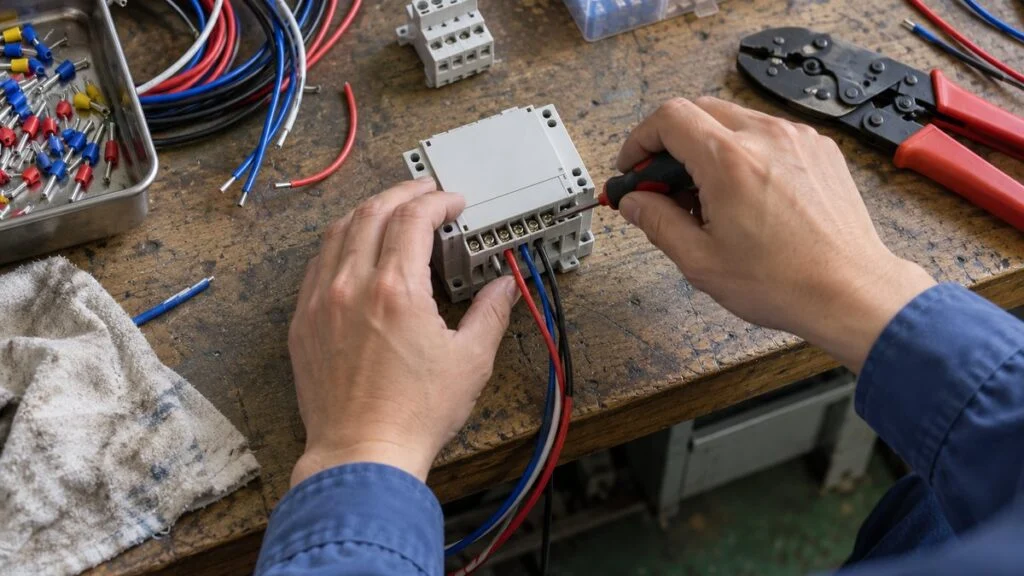
Building on the differences above, here are six factors to check when you choose a maker or decide whether to accept the brand a Japanese builder proposes. Which ones come first depends on your company and the machine.
The factors that never appear in a catalog spec table are the ones that drive effort after installation.
1. Existing Equipment and Customer Standards
Compatibility with existing equipment has the biggest impact. When the lines in a plant share one maker, it is easier to share spare parts, train maintenance staff, and reuse programs. In industries such as automotive, the ordering plant may name the PLC maker and network in the machine specification.
Machine builders and system integrators often have to support several makers to match each customer's specification. So the starting point is the customer's standard, not only the builder's own preference. If your plant has a standard, state it in the specification so the builder can plan for it.
2. Network and Device Compatibility
On machines that combine multi-axis servos, robots, and vision systems, choosing the network is almost the same as choosing the PLC. Devices from the same maker can usually be configured in one software package. When you mix in other makers' devices, the networks those devices support become the constraint.
For control panel design, the network type changes the wiring, cables, and module configuration. Once the peripheral device models are fixed, list their supported networks and cross-check them. That keeps you from having to add modules later.
3. Local Availability and Support
When equipment ships overseas, or a line is copied to a plant in another country, ask two questions: can parts be bought locally, and is there someone to talk to in the local language?
It is often said that PROFINET is common in Europe and EtherNet/IP in North America. In practice it varies by customer and facility, so confirm the network each plant actually uses.
Whether local service firms know the brand also affects how fast problems get fixed after startup. Decide up front who will handle breakdowns in the destination country.
4. Software Usability and Licensing
Engineers work in the programming software every day, and makers take different approaches to ease of programming, debugging, simulation, and team collaboration. The most reliable comparison is to have the engineers who will use it try trial versions or attend hands-on seminars.
Check the license model as well. Some packages, such as Omron's Sysmac Studio and Siemens's STEP 7, come in several editions depending on functions or number of users. Get a quote for the seats and renewal costs you need before you commit, so the budget does not fall short later.
5. Engineering Skills and Training
Engineers keep editing a PLC program long after installation, for modifications and troubleshooting. If your maintenance staff, integrator, or local service firms already know the brand, night-shift stoppages are easier to handle.
If you adopt a new brand, build time for training courses, training equipment, and manuals into the plan. How much support the maker's or distributor's technical staff and field application engineers (FAEs) will give is also part of the comparison.
6. Lifecycle and Parts Availability
Plant equipment often runs for 10 or 20 years, and the PLC model will likely be discontinued during that time. Many makers keep supplying spare parts for a period after sales end, as Siemens is doing with the S7-300, but that period differs by model.
At the selection stage, check how long ago the series was released and whether migration tools and procedures for a successor exist. For existing equipment, check each maker's published discontinuation notices on a regular schedule.
Example Scenarios: Applying the Six Factors
These three scenarios are fictional. They do not describe real companies or projects; they only show how the six factors play out.
"Choosing a PLC" means checking different things first depending on the situation.
All examples are fictional and do not represent actual selection results.
In scenario A, matching the existing lines does the most to cut maintenance work. If the existing model is already close to discontinuation, though, moving to the same maker's successor series may be the better call.
In scenario B, the customer's specification usually settles the question, and the builder has to follow it even for a maker it does not normally use. Plan for training time and secure the local support contact early. If you are the customer, this is why naming your standard in the spec matters.
In scenario C, you fix the devices and network first, then narrow the candidates by which software handles them best.
How to Run the Selection: Six Steps
Start from your constraints, not from a catalog comparison.
Start with your constraints and finish with hands-on testing and an update to your plant standard.
For small machines, steps 01 to 03 may be done together in a short time.
In step 4, talk to the maker's technical team, distributors or trading companies, and the group in your company that manages equipment standards. Production status, successors, and license prices change, so always confirm the latest information with the sales channel. This article summarizes official information as of October 2026 and does not replace that check.
Write down why you chose the maker. When someone replaces the equipment years later, being able to see the reasoning makes the next decision much easier.
Questions to Ask the Japanese Machine Builder
When a builder in Japan quotes a machine, these questions bring the PLC decision into the open before the design is fixed. You can copy them into your RFQ or kickoff agenda.
- Which PLC maker, series, and CPU model do you plan to use? Is the model current, and is any discontinuation announced?
- Can you build the machine with our standard PLC (maker and series) instead? How would that change the price and lead time?
- Which network connects the PLC to servos, remote I/O, HMIs, and robots? Can it connect to our plant network, and does that need an extra unit or gateway?
- Which software and version is the program written in? Will you deliver the full project file, with comments in English?
- Which spare parts do you recommend we stock, and can we buy them locally in our country?
- Who handles troubleshooting after startup: your team, the PLC maker's local office, or a local partner?
- If the PLC is discontinued, what is the successor and how much rework would migration need?
Quick Checklist Before You Accept the PLC Brand
- PLC maker and series match your plant standard, or the exception is approved
- Network checked against existing plant equipment and the devices on the machine
- Programming software licenses on hand, with the right edition and number of seats
- Engineers in-house or at a local integrator who can maintain the program
- Local parts supply and a support contact confirmed in your country
- Discontinuation status of the CPU and key modules confirmed for your region
- Program source, comments, and manuals included in the delivery scope
Limits of This Guide
- Series, software, and network information summarizes each maker's official websites as of October 2026. Support differs by model, so check the catalogs and manuals.
- Discontinuation dates for Mitsubishi's Q and L series come from Mitsubishi's Japanese information. Dates in other regions can differ.
- The "often shortlisted when" scenarios are general tendencies, not a ranking or recommendation.
- Which brand is best depends on your plant, the machine, and your customers' standards.
FAQ
What Is the Difference Between a PLC and a Sequencer?
There is none. "Sequencer" is the name Mitsubishi Electric uses for its PLCs in Japan, and Japanese shop floors often use the two words interchangeably. A "sequencer" on a Japanese drawing is a PLC.
Can a PLC Program Be Converted to Another Brand?
Not directly. Even when both makers comply with IEC 61131-3, each software package has its own project format, instruction syntax, and hardware configuration, so moving to another brand effectively means rewriting the program.
Is the Mitsubishi Q Series Still Available?
The Q series is still on Mitsubishi's site, but discontinuation dates have been announced model by model, mainly for CPU modules. Before you add or replace Q series equipment, confirm the production status and the recommended iQ-R replacement with your local sales channel.
What Does PLC Stand For?
Programmable logic controller. In Japanese it is often called a puroguramaburu kontorora (programmable controller). Some makers use other names: Omron, for example, markets its NJ/NX series as machine automation controllers.
Which PLC Brand Should I Learn First?
Start with the brand used at your plant or by your main customers, so you can apply what you learn right away. Every maker supports ladder and ST, so once you know the basics on one brand, the others are easier to pick up.
Sources
Maker and network pages were checked on October 1, 2026; the Mitsubishi bulletin and European notice, the Keyence KV-XLE02 page, and the Siemens press release were rechecked on October 22, 2026.
- Mitsubishi Electric MELSEC lineup, software, and discontinued models: Mitsubishi Electric FA, "Sequencer MELSEC" (Japanese); MELSEC iQ-R Series (Japanese); MELSEC iQ-F Series (Japanese); MELSOFT GX Works3 (Japanese); MELSEC-Q discontinued models and replacements (Japanese); MELSEC-L discontinued models and replacements (Japanese); Mitsubishi Electric FA FAQ, PLCs supported by GX Works2 (Japanese)
- Q series CPU discontinuation (English): Mitsubishi Electric technical bulletin FA-A-0418-A; Mitsubishi Electric Europe, end-of-life notice for QnUDCPU
- Keyence KV Series: Keyence, "KV-X Series" (Japanese); Keyence, "KV-8000 Series" (Japanese); Keyence, KV-XLE02 Ethernet unit; Keyence, "Business Model and Strengths" (Japanese)
- Omron SYSMAC: OMRON, "Machine Automation Controllers"; OMRON, "Sysmac Studio"; Omron Industrial Automation, "Programmable Controllers" (Japanese); Omron, "Sysmac Studio features" (Japanese); Omron FAQ, CX-Programmer versions for CP2E/CP1 (Japanese)
- Siemens SIMATIC: Siemens, "SIMATIC Controllers"; Siemens, "SIMATIC S7-1500"; Siemens, "STEP 7 (TIA Portal)"; Siemens press release, April 16, 2024; Siemens Blog, "The Simatic S7 product family is getting upgrades" (August 22, 2023); S7-300/ET 200M phase-out notice (republished by Conrad Automation)
- Other makers: Rockwell Automation, "CompactLogix 5380"; Beckhoff, "TwinCAT"; Fuji Electric, "SX-Programmer Expert (D300win)" (Japanese); Panasonic FAQ, differences between FPWIN GR7 and FPWIN Pro7 (Japanese)
- Networks: CC-Link Partner Association, "CC-Link IE TSN" (Japanese); EtherCAT Technology Group, "EtherCAT Technology"; ODVA, "EtherNet/IP"; PROFIBUS & PROFINET International
Original article in JapaneseThis guide is adapted from a MONOSCOPE article written for readers in Japan: PLCメーカー比較|三菱電機・キーエンス・オムロン・シーメンスの選び方
About the editor
 MONOSCOPE EditorFOUNDER & EDITOR
Spent about ten years at a plant equipment maker and a plant engineering company, proposing, designing, and commissioning equipment, then moved into web marketing. Now a web consultant for B2B manufacturers, helping them explain their products and technology. Licensed in Japan as an Energy Manager and a Third-Class Chief Electrical Engineer.
Has run an engineering blog since 2017 (500+ articles) and a Japanese YouTube channel with about 20,000 subscribers. Each English guide is written from the Japanese shop-floor point of view and checked against the cited standards.