Deviation List (Debikura): Format, Sample, and Checklist
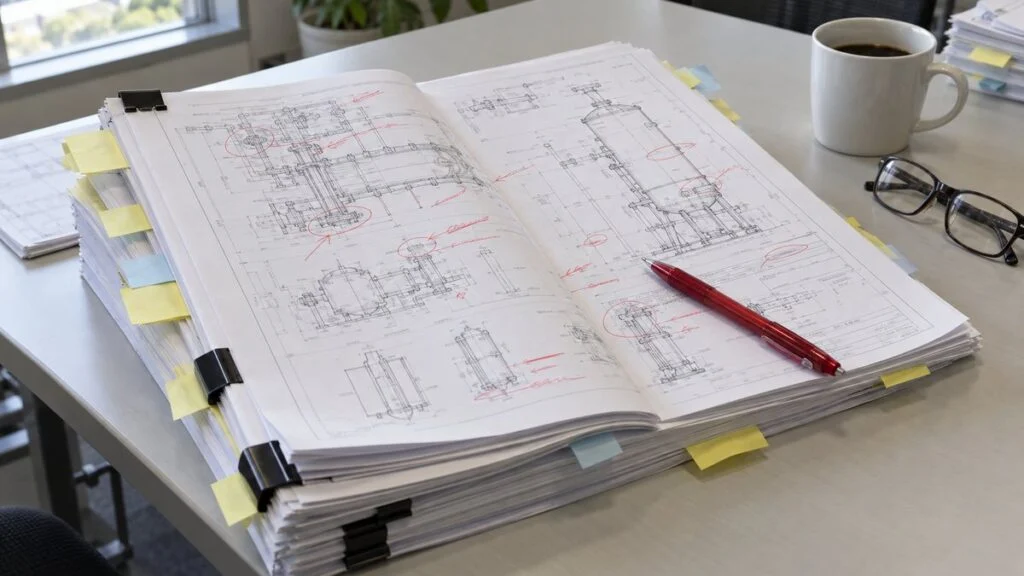
You send a quote to a Japanese plant contractor, and the reply asks for a "debikura" with your bid. Or you buy a package from a Japanese manufacturer, and their quotation arrives with a table titled デビエーションリスト next to the price. Both are the same document: a deviation list, the table where the supplier lists every point where its offer differs from the buyer's purchase specification, plus every point it needs clarified.
In Japanese plant and equipment projects, this list is requested almost every time a designer and a supplier work through a specification together. This guide explains what the deviation list is, what it prevents, how it moves from quotation to purchase order, and how to fill it in, with a sample format and a checklist you can reuse.
- A deviation is a point where the supplier's offer differs from the purchase specification. A clarification is a point where the supplier needs to confirm what the specification means or covers.
- One table that covers both and records what the buyer and the supplier agreed is the deviation and clarification list, called debikura in Japan.
- The supplier usually prepares it at the quotation stage and submits it with the quote. The buyer fills in the response column.
- Write one requirement per row: spec clause, original requirement, proposal or question, reason, impact (price, delivery, and so on), and response. See the sample in Figure 5.
- Its purpose is to prevent misunderstandings about scope of supply, inspection, and similar terms. Check that every agreed item reaches the purchase order, the approval drawings, and the delivery specification.
Contents
What Is a Deviation List (Debikura)?
For each requirement in the specification, the list pairs the supplier's proposal or question with the buyer's response, and records what was agreed.
Type codes (D and C) and column names vary by company.
A deviation is a point where the specification the supplier proposes differs from what the buyer's purchase specification (kobai shiyosho) requires. A clarification is a request to pin down a requirement that is vague or whose scope is unclear. The deviation and clarification list puts both in one table and records what the buyer and the supplier agreed. Japanese engineers shorten the name to debikura (デビクラ), from the first syllables of debieshon (deviation) and kurarifikeshon (clarification).
Put simply, it is the supplier's list of what it can and cannot do against the purchase specification, plus what it needs to confirm. Depending on the company or site, you may also hear "deviation list" (デビエーションリスト) or "debikura list." The name and format follow the buyer's instructions or the company's internal rules.
Deviation vs. Clarification
A deviation changes the specification. A clarification aligns how both sides read it.
In the World Bank's standard bidding documents, clarifications the purchaser requests after bid submission must be in writing and must not change the price or substance of the bid. In private-sector deviation lists, the answer to a clarification can change the scope and therefore the price.
The World Bank's standard procurement documents define a deviation as "a departure from the requirements specified in the bidding document." A deviation that would substantially affect the scope, quality, or performance of the goods, or substantially limit the purchaser's rights, counts as a material deviation, and the bid is then not considered substantially responsive.
Why Japanese Purchase Specifications Produce So Many Deviations
A plant contains a huge number of components, from piping to valves and instruments. To keep their specifications consistent, each plant has its own design standards, and the plant contractor applies them through a purchase specification for each piece of equipment.
Because the design standards are shared by all equipment, the purchase specification is detailed and often includes requirements that have nothing to do with the item being bought. It may, for example, specify post-weld inspection for a part that has no welds, or require a name tag on every small part. The deviation list is where the supplier and the buyer decide whether each of these requirements is really needed.
If the project goes ahead without one, the buyer may later complain that detailed requirements were not met. In the worst case, the disagreement can end up in court.
What a Deviation List Prevents
Unclear Scope of Supply
A deviation list spells out the scope of supply (shosho: who procures and who installs what) explicit. It prevents the common case where the buyer's engineer thought the purchase specification covered an item, but the supplier never included it in the quote.
Disputes usually start at the boundaries: the flanges and piping at the interface (toriai) with connected equipment, installation work, and witnessing during commissioning. List each of these on its own row with the party responsible. Anything that falls between the two scopes leads to extra cost or a revised schedule, so settle the boundaries in the list before the order. For flanges at the interface, see who supplies the mating (companion) flange.
Problems After Delivery
The list also heads off problems after delivery. When every departure from the specification or standards is recorded and handled up front, fewer problems appear once the equipment is in service, and you spend less time and money on rework after delivery.
The agreement only works once it appears in the approval drawings and the delivery specification. For what to check in the delivery specification, see Delivery Specification (Nonyu Shiyosho): What to Check.
Unclear Inspection and Test Requirements
A deviation list also makes inspection scope and acceptance criteria clear. Even when a common specification sets the inspection criteria, what each supplier's factory can actually do differs, so agree on the inspection scope and requirements in advance to avoid misunderstandings.
Typical inspection rows cover whether tests are witnessed, test conditions (pressure, duration, and so on), and which documents are submitted, such as inspection reports and mill certificates (called "mill sheets" in Japan).
With these points agreed, a later problem does not turn into an argument over how precise or how broad the inspection was supposed to be. For witnessed factory tests and on-site acceptance tests, see FAT and SAT with Japanese Suppliers.
How a Deviation List Moves From Quote to Order
Here is how the exchange over a single item typically runs, from the purchase specification to the order.
Item by item, the two sides decide whether the supplier can comply and whether it costs extra.
In practice, the two sides usually combine written answers in the response column with meetings.
Against a detailed specification, the two sides sort each item into what the supplier can and cannot do, then into what costs extra and what is included, and agree on each one. Once the agreement is in writing, responsibility is clear if something goes wrong later, and disputes are less likely. That is why the deviation list is needed.
Across the whole project, the list stays in use from the quotation through the order and into drawing review after the order.
What is agreed in the deviation list at the quotation stage carries over into the order conditions and the delivery documents.
New deviations sometimes come up at the approval drawing stage, and the supplier issues a revised list.
From the supplier's side, the deviation list is part of answering a request for quotation (hikiai). While judging whether it can build the equipment, the supplier picks out the deviations and the questions. For the full RFQ process, see RFQ to a Japanese Manufacturer: The 7-Step Hikiai Process. The deviation list is usually submitted with a quotation specification (mitsumori shiyosho), the supplier's own description of what it is quoting.
Related: Quotation Specification (Mitsumori Shiyosho): Sample Format
After the order, the supplier submits approval drawings (shonin-zu), and that is where you check that each agreed item actually appears.
Deviation List Format: A Sample
Many companies have their own manual or rules for preparing deviation lists, so check yours, or ask a senior colleague, before you start. If the buyer specifies a format, use it. Here is what a typical list looks like. Columns and layout vary by company.
One requirement per row. From left to right: requirement, proposal, reason, impact, and response.
Fictional example for illustration. Type: D = deviation, C = clarification. A real form also has fields for project name, equipment tag number, revision, date, and author. The test pressure multiplier and the pressure it is based on are set by the applicable regulations and codes.
SUS316 and SUS304 are Japanese (JIS) stainless steel grades. For their AISI/ASTM counterparts, see SUS304, SUS316, SUS430: JIS Grades and AISI/ASTM Equivalents.
Because purchase specifications are so detailed, many rows can only be judged by someone who knows the supplier's manufacturing methods well. If you are new to deviation lists, build yours with experienced engineers who know those methods; that helps prevent problems later. Expect the first few lists to take time. Plant work has many detailed rules because the facilities are large and hazardous.
How to Fill In Each Column
Figure 6 breaks the sample down column by column. The main goal is traceability: anyone should be able to see later which requirement each proposal addressed and how it was decided.
Copy the requirement close to its original wording, and always give a reason and an impact for each proposal.
Response categories (approved, approved with conditions, rejected, to be discussed, and so on) vary by company and project. Follow the buyer's categories if it specifies them.
If you are unsure whether to list something, always list deviations that affect performance, scope, price, delivery, or inspection. Group minor wording differences into a single row. When you cannot tell, list the item and ask. That is safer than leaving it out.
The reason column is also your case for the proposal, so write it for the person who has to approve it.
Between submission and agreement, settle these points as well:
- Writing "no deviation": whether to write "no deviation" against every clause or list only the clauses with deviations. Follow the buyer's format.
- Revision control: update the revision number and date every time an answer or meeting changes the content, so everyone knows which version is current.
- Official record: check the project rules for which document is the official record: the deviation list, the meeting minutes, or a revised specification.
- Final check: at the end, confirm that every agreed item appears in the purchase order, the approval drawings, and the delivery specification.
For the buyer answering the list, it is input for comparing quotes and deciding on the contract and the order.
Related: Purchasing Process at Japanese Manufacturers: 8 Steps
Checklist: Before You Submit or Answer a Deviation List
Use the first list if you are the supplier, the second if you are the buyer, and the third when you need to ask a Japanese counterpart about the list.
Supplier: Before Submitting
- Every clause of the purchase specification reviewed, including attached standards and general specifications
- Spec revision and date recorded on the list
- One requirement per row, quoted in its original wording
- Each row typed as D (deviation) or C (clarification), or in the buyer's own codes
- A reason and an impact (performance, price, delivery, installation, inspection) for every deviation
- Scope boundaries listed: interface flanges and piping, installation, commissioning support, witnessed tests
- Inspection and document scope listed: witnessed or not, test conditions, inspection reports, mill certificates
- Items that cost extra marked separately from items included in the price
- Price and schedule in the quote consistent with the list
- Reviewed by the engineers who know the manufacturing methods
Buyer: Before Answering
- Every row answered, using the agreed response categories
- Conditions written out for every "approved with conditions"
- Cost and delivery impact of each approval understood
- Decisions made in meetings copied back to the list with the record number
- Agreed revision of the list referenced in the purchase order
- Agreed items checked against the approval drawings and the delivery specification
Questions to Ask the Japanese Side
- "Do you have a required format for the deviation list (debikura), or may we use our own?"
- "Should we list only the clauses with deviations, or state 'no deviation' for every clause?"
- "Which response categories will you use, for example approved, approved with comments, or rejected?"
- "Which document will be the official record of agreed items: the deviation list, meeting minutes, or a revised specification?"
- "Will the agreed revision of the deviation list be referenced in the purchase order?"
- "Clause 5.1 specifies a hydrostatic test at 1.5 times. Please confirm which pressure this is based on."
Where Practice Varies
- Format and names: type codes, column names, and response categories differ by company and project. The buyer's format, if specified, takes priority.
- Who prepares it and when: usually the supplier at the quotation stage, but some buyers prescribe the format, and revised lists may be issued at the approval drawing stage.
- One list or two: some buyers want deviations and questions in separate lists.
- Public tenders: formal bidding documents may set their own forms and rules. Some tender forms, for example, state that deviations not listed on the deviation sheet will not be considered. Follow the bidding document, not this guide.
- Technical values: test pressures, materials, and inspection requirements depend on the applicable regulations, codes, and service conditions. The examples here are fictional and for illustration only.
FAQ
Who Prepares the Deviation List, and When?
Usually the supplier prepares it at the quotation stage and submits it with the quote and the quotation specification. The buyer fills in the response column. Practice varies by company and project: some suppliers issue a revised list at the approval drawing stage after the order, and some buyers prescribe the format and require its submission.
Are Deviation Lists and Clarification Lists Separate Documents?
Often not. A common format puts both in one table and uses a type column to separate deviations (D) from clarifications (C). That combined table is where the name debikura comes from. Some buyers' formats, however, ask for a deviation list and a question list separately.
What Is a Debikura Called in English?
English documents use the same words: deviation and clarification. In international tenders, bidders may be asked to list deviations in a form named "Deviation List" or "Schedule of Deviations." The World Bank's standard bidding documents define two more terms alongside deviation: reservation (setting limiting conditions on, or not fully accepting, the requirements) and omission (failing to submit some or all of the required information or documents).
Does "Deviation" Mean the Same Thing in Pharmaceutical Manufacturing?
No. The word still means "departure," but in pharmaceutical manufacturing it refers to a departure from an established manufacturing procedure. Japan's GMP Ministerial Ordinance (Article 15), for example, requires manufacturers to record a deviation when it occurs, assess its impact, and report it to the quality assurance unit. That is a different use from the procurement deviation list, which is agreed before the order.
Sources
- Definitions of deviation, reservation, and omission; clarification of bids; material deviations: World Bank, "Standard Procurement Document – Request for Bids: Goods (One-Envelope Bidding Process)," June 2021, ITB 27–29
- Example of a deviation form in a public tender: BHEL, tender documents, deviation sheet (technical and commercial deviations)
- Deviation control in pharmaceutical manufacturing: Ministerial Ordinance on Standards for Manufacturing Control and Quality Control for Drugs and Quasi-drugs (MHLW Ordinance No. 179 of 2004), Article 15, e-Gov (Japanese)
Original article in JapaneseThis guide is adapted from a MONOSCOPE article written for readers in Japan: デビエーションとは?デビクラ(デビエーションリスト)の書き方と目的・見本
About the editor
 MONOSCOPE EditorFOUNDER & EDITOR
Spent about ten years at a plant equipment maker and a plant engineering company, proposing, designing, and commissioning equipment, then moved into web marketing. Now a web consultant for B2B manufacturers, helping them explain their products and technology. Licensed in Japan as an Energy Manager and a Third-Class Chief Electrical Engineer.
Has run an engineering blog since 2017 (500+ articles) and a Japanese YouTube channel with about 20,000 subscribers. Each English guide is written from the Japanese shop-floor point of view and checked against the cited standards.