Japanese Robot System Integrators: RFP, Quotes, Acceptance
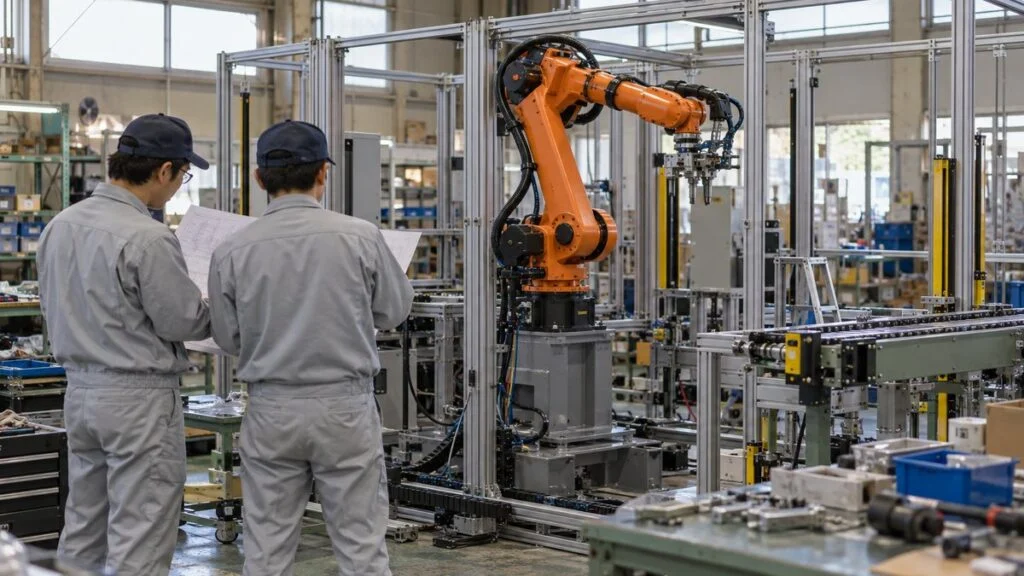
Your plant in Thailand, India, or the US needs a robot cell, and the Japanese side of the business suggests a Japanese robot system integrator. Before quoting, the integrator asks for an RFP, real sample parts, and a signed NDA. The quote then comes back as two documents, with several lines marked 一式 (isshiki, "lump sum") or 別途 (betto, "quoted separately").
These requests make sense from the integrator's side: a robot project succeeds or fails on the buyer's preparation as much as on the choice of integrator. When the goal and the parts to be handled are vague, each integrator quotes on different assumptions, and the quotes cannot be compared. When Japanese industry guidance traces robot projects that went wrong, it often finds the cause on the buyer's side.
This guide follows the process published by the Japan Robot System Integrator Association, in six steps: internal preparation, finding candidates, writing the RFP, comparing quotes, contract and acceptance, and startup. It ends with common failures, a checklist, and questions you can send to a Japanese integrator.
Contents
- What a Robot System Integrator (SIer) Does
- The Six Steps From SIer Selection to Production
- Step 1: Decide These Internally Before You Contact a SIer
- Step 2: Find and Shortlist Candidate SIers
- Step 3: Communicate the Specification With an RFP
- Step 4: Compare Proposals and Quotes
- Step 5: Contract, Final Specification, and Acceptance Criteria
- Step 6: Startup and Building an Operating Team
- Common Robot Project Failures and How to Prevent Them
- Checklist: Before You Send the RFP to a Japanese SIer
- Questions to Ask a Japanese SIer
- Where This Guide May Not Apply
- FAQ
- Sources
What a Robot System Integrator (SIer) Does
In Japan, a robot system integrator is usually called a SIer (short for "system integrator"). The SIer combines the robot arm with a gripper (end effector), a base, safety fencing, sensors, conveyors, and controls, and turns them into a robot system that works on your shop floor.
A robot is often called a "half-finished product." It does no useful work on its own and becomes production equipment only after the SIer designs, builds, and tunes the system around it.
Related: Japanese Robot Makers: Pendants, Service, and Safety Rules
The SIer search run by the Japan Robot System Integrator Association splits SIer services into categories such as concept planning, mechanical design, electrical design, PLC- or PC-based system control, and machine vision. Risk assessment and after-sales service and maintenance are categories too.
Not every SIer does all of this in-house. Ask each candidate which parts it handles itself and which it subcontracts.
The SIers' industry group started in 2018 as the FA/Robot System Integrator Association inside the Japan Robot Association (JARA). In April 2023, it became an independent general incorporated association, the Japan Robot System Integrator Association. In this guide, "the SIer Association" refers to that group.
Related: Japanese Factory Automation Companies: Who Makes What
Four Types of Japanese SIers
SIers differ in strengths and proposal habits depending on how they started. The four types below are not a strict classification, but they help you decide whom to approach.
A SIer's background shapes its strengths and what you should check.
These types are a rough guide. Many companies fit more than one type. A track record in the same application matters more than the type.
No type is better than the others. What matters most is whether the SIer has handled applications close to yours and will support the system to the end.
The Six Steps From SIer Selection to Production
Selecting a SIer looks like it starts with finding candidates. In practice, it is one continuous flow, from internal preparation before you call anyone to contract and acceptance after you choose. The SIer Association's training material for buyers lays out the stages as inquiry, proposal, contract, manufacturing, and maintenance, with the buyer and the SIer working through them together.
How well you handle the three steps before ordering largely decides whether the project succeeds.
Based on the basic flow in the SIer Association's "How to Run a Robot Implementation Project," arranged as the buyer's tasks.
Plan for the timeline too. The SIer Association's sample RFP shows an example schedule: site survey and interviews, 2 months; proposal and quote, 1 month; design, build, and tuning, 6 months; installation and on-site tuning, 1 month. Based on this, allow about a year from the first consultation to full production. Knowing this early makes it easier to keep the project clear of peak seasons and the fiscal year-end.
Step 1: Decide These Internally Before You Contact a SIer
As part of a study for Japan's Ministry of Economy, Trade and Industry (METI), the SIer Association published a robot implementation guide for organizations that support small and midsize manufacturers, along with a pre-implementation checklist. The checklist rates each item, such as the goal and the target products, on five levels. Reaching a certain level is the sign that you are ready to consult a SIer.
Put the other way, if you contact a SIer before reaching that level, the SIer has nothing to base a proposal on. Four preparations matter most.
Go beyond "we have a problem" to a state where you can state numbers and specific part names.
Based on the items in the SIer Association's "Robot Implementation Pre-Check List, with Commentary" (March 15, 2024 edition).
State the Goal in Numbers
"We can't hire enough people" or "we want higher productivity" does not tell the SIer where to automate, or by how much.
One sample answer in the checklist reads: we want to increase output by 20% within a year but cannot hire, so we want a job now done by three people to run with two. Take your goal that far, and express both the current state and the target in numbers.
If a number is hard to set, a specific qualitative goal also works, such as "eliminate manual lifting of heavy parts to reduce the strain on workers." The point is to give the SIer a yardstick for judging whether its own proposal is any good.
Narrow Down the Products and the Process
Shop-floor teams often call parts by nicknames. Give the SIer the official part names and model numbers. The checklist commentary warns that a single product name can turn out to cover dozens of variants once color differences and attached parts are counted.
More variants mean more gripper changes and more complex changeovers, and the cost grows with them. One approach is to avoid processes with many variants at first and start with parts of uniform shape. Your manufacturing engineers should lead the choice of process.
Involve the Approver and Set Up the Team
A robot cell brings changes that no single department can decide alone: layout changes in the processes before and after it, a new way of feeding parts, and operator training. That is why the checklist rates the involvement of the person with approval authority as a key item.
If everything is left to one project engineer, decisions on spec changes and extra costs stall, and the project drags on. In Japanese companies, those decisions often wait for a formal approval process (see how ringi approvals work). Assign contacts in advance for manufacturing engineering, production, safety, maintenance, and quality assurance.
Work the Budget Back From the Payback Period
According to an explainer from robot maker Epson's Japanese sales company, projects aimed at cost reduction or higher productivity often plan for payback in about two years. Some companies plan five to six years when the goal is stable quality, and longer still when the robot replaces dangerous or physically harsh work.
The acceptable payback period depends on the goal, so it makes sense to set the budget ceiling together with the goal.
Step 2: Find and Shortlist Candidate SIers
Once you are prepared, look for candidates. In a 2021 survey of its member SIers, the SIer Association found that the most common source of new inquiries was the SIers' own sales efforts and trade shows, followed by referrals from trading companies and then referrals from robot makers. For a buyer, those three routes are also the ways in.
There are several ways in, but you narrow the list to 2–3 SIers with the same three criteria.
In the SIer Association's 2021 survey, SIers' top sources of inquiries were their own sales and trade shows, referrals from trading companies, and referrals from robot makers, in that order.
Use the SIer Association's Search Tool
A good place to start is the SIer search the association publishes for its member companies (in Japanese). You can filter by head office and sales office location and by the areas where a SIer can deliver integration work. You can also filter by application, such as handling, welding, deburring, painting, packaging, and inspection, by advanced uses such as picking with 3D sensors, and by services such as mechanical design and machine vision.
Events such as the association's regional "SIer's Day" and robot trade shows also help. Talking with engineers in front of a live demo shows you what a company is good at and how clearly it explains things.
Three Criteria for the Shortlist
First, look for a track record in the same application with similar parts. "Handling" covers very different jobs: cardboard boxes, soft food, and oily metal parts each need a different gripper design and bring different difficulties. When a SIer shows you a past project, ask for the part material, weight, and cycle time.
Second, check the service area. Every robot cell needs adjustments and repairs after startup. Even if the head office is far away, confirm that the SIer has a local office or partner near your plant. For a plant outside Japan, ask who will come, from where, and how fast.
Third, check what the SIer does in-house. Which of mechanical design, electrical design, controls, installation, and maintenance it outsources affects who is responsible when something goes wrong and how quickly problems get fixed. If the cell must interlock with existing equipment through a PLC, it matters a great deal whether the SIer can write the control logic itself.
Expect SIers to Be Short of Engineers
In the same 2021 survey, more than 90% of SIers said they were "short" or "very short" of engineers. A poorly prepared request may be put off or turned down. On the other hand, a request with a clear goal and clear conditions is easier to quote and more attractive to take on, which is one more reason to write an RFP.
Step 3: Communicate the Specification With an RFP
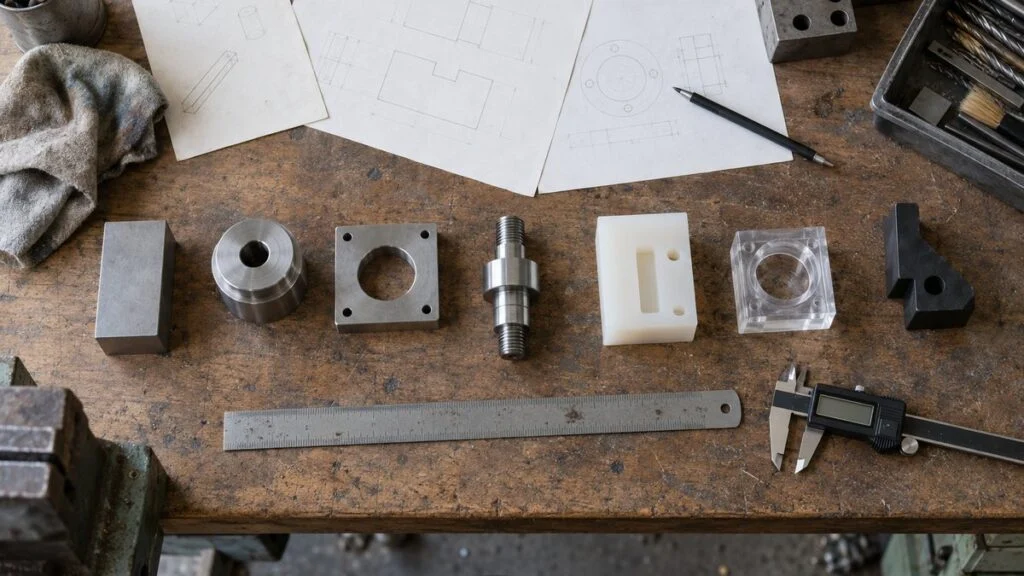
A request for proposal (RFP), or 提案依頼書 (teian irai-sho), is the document in which the buyer sets out what it wants the SIer to propose and the conditions behind it. The SIer uses it to sort out the requirements and then prepares a quote and a quotation specification. The SIer Association's training material states plainly that writing an adequate RFP is the buyer's job. For the general inquiry process with Japanese manufacturers, see RFQ to a Japanese manufacturer.
A document detailed enough for the SIer to write the specification from it directly is called a 要求仕様書 (yokyu shiyosho, requirements specification). You do not need to start there. First, use the RFP to put every SIer on the same conditions.
What to Put in the RFP
The SIer Association publishes a sample RFP in PowerPoint and PDF (in Japanese). Its contents fall into five parts: project goals, budget, schedule, requirements, and what you are asking the SIer to propose.
One document that answers why, what, under which conditions, and what you want proposed.
Based on the table of contents and fields in the SIer Association's sample RFP.
For a plant outside Japan, also state your local supply voltage and frequency and any local safety rules the cell must meet. A Japanese SIer cannot assume them (see Japanese industrial voltage for how plant power in Japan differs).
Send Real Parts, Not Mock-Ups
The SIer Association's training material describes a project where the buyer gave the SIer mock-up parts at the quoting stage. Once the system was installed and real parts ran through it, the robot could not grip them.
Surface oil or moisture, where the part may be gripped, and which faces must not be scratched all shape the gripper design, and often only the real part conveys that information.
Sign a non-disclosure agreement (NDA) before you hand over parts or drawings. The training material says the NDA is signed before sample parts are provided or the plant is visited. It binds both sides, so the know-how in the SIer's proposal is protected too.
Decide Early Whether the Cell Must Inspect Parts
In the throughput section, the sample RFP notes that you need to decide whether the equipment or your own staff will check quality. It also warns that asking for built-in quality inspection can make the system expensive. If you also want to automate vision inspection, list it as a separate requirement so the quotes stay comparable.
Step 4: Compare Proposals and Quotes
Give the same RFP to two or three SIers, and you get proposals built on the same assumptions. The common trap at this stage is comparing only the total price. Robot systems are usually custom-built for each site, so what a quote includes varies from one SIer to the next.
Know Where the Money Goes
Epson's explainer cites an example from a 2017 Japan Robot Association booklet: a system that loads and unloads workpieces on a machine tool, at a total of JPY 9.8 million. The largest share, JPY 5.2 million, is system integration: concept design, risk assessment, detailed design, manufacturing and assembly, installation, and tuning.
In this example of a machine-tool loading system (JPY 9.8 million total), more than half the cost is system integration.
Example from the Japan Robot Association booklet on robot basics (2017), as cited in Epson Sales Japan's explainer on robot implementation costs.
The same explainer lists other examples: a case-packing system with two parallel-link robots and a conveyor at JPY 50.5 million, and an assembly process with four robots at JPY 60 million. The number of robots and peripherals can change the price by an order of magnitude, so do not use another company's project cost as your budget.
How to Compare Proposals
A Japanese SIer's proposal usually comes in two parts: the 見積書 (mitsumorisho, quote) with the prices, and the 見積仕様書 (mitsumori shiyosho, quotation specification) with the layout, equipment list, process flow, intended operation, and schedule. Lay the quotation specifications side by side and compare them on the points below.
Before comparing prices, check that the assumptions and scope match.
The two-part structure of quote and quotation specification follows the SIer Association's "How to Run a Robot Implementation Project." The comparison points are arranged as a buyer's checklist.
Safety deserves special attention. Whether the cell needs fencing and whether people can work alongside the robot change both the cost and the way the cell is run.
Related: Risk Assessment in Japanese Plants vs. JHA, HSE, ISO 12100
Step 5: Contract, Final Specification, and Acceptance Criteria
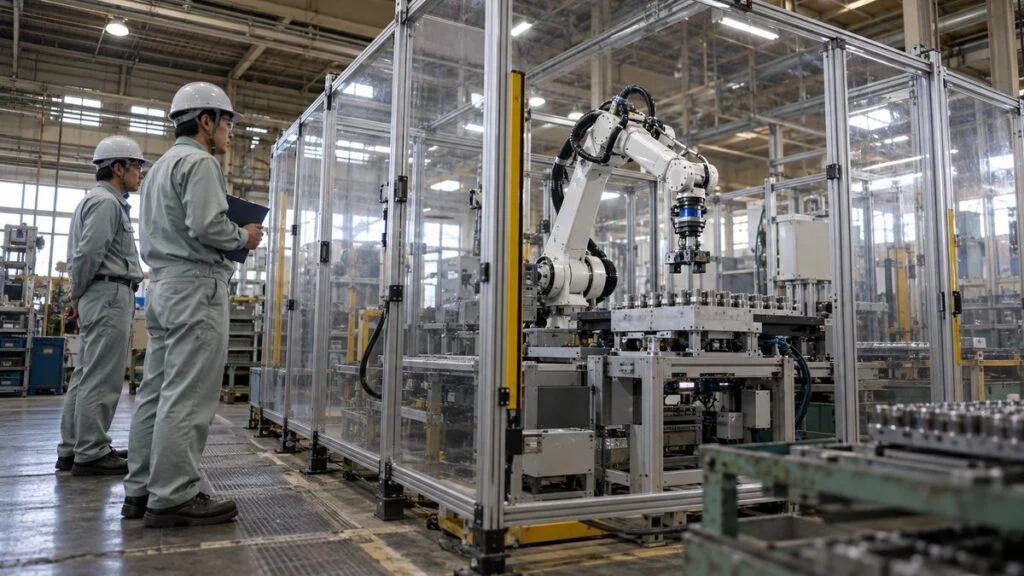
Once you choose a SIer, you sign a contract and finalize the specification. The SIer Association's training material says that building the system normally uses a 請負 (ukeoi) contract, in which the SIer is paid for delivering a defined result, because the deliverable is clear.
When the SIer helps with a plant assessment or with writing the RFP or requirements specification, there is no fixed deliverable, so the work uses a 委任 (inin) contract, in which the SIer is paid for the work itself. The material also notes that help with writing the RFP is normally paid work. How these contract types apply outside Japan depends on your contract law, so check with your legal or purchasing team.
Know the Documents You Will Exchange
After the order, the SIer expands the quotation specification into a 納入仕様書 (nonyu shiyosho, delivery specification). The system is built to this specification, and acceptance is judged against it. See what to check in a delivery specification.
As design progresses, the SIer submits 承認図 (shonin-zu, approval drawings; see how to review and return them). You then attend a witnessed inspection (tachiai) of the assembled system at the SIer's factory. After that, the system is installed and tuned at your site, and final 検収 (kenshu, formal acceptance) comes when it passes the user test. For how witnessed factory and site tests usually run with Japanese suppliers, see FAT and SAT with Japanese suppliers.
| Document (Japanese) | What it is | When |
|---|---|---|
| RFP / 提案依頼書 (teian irai-sho) | Buyer's goals, conditions, and what it wants proposed | Before quoting |
| NDA / 秘密保持契約書 | Confidentiality agreement binding both sides | Before sample parts or a plant visit |
| 見積書 (mitsumorisho) | Quote with prices | Proposal stage |
| 見積仕様書 (mitsumori shiyosho) | Quotation specification: layout, equipment list, process flow, intended operation, schedule | Proposal stage |
| 納入仕様書 (nonyu shiyosho) | Delivery specification: the spec the system is built to and accepted against | After the order |
| 承認図 (shonin-zu) | Approval drawings submitted for the buyer's review | During design |
| ユーザーテスト仕様書 | User test specification, paired with the delivery specification | Set together with the delivery specification |
| 検収完了書 | Record that acceptance is complete | After the user test passes |
The training material warns that major changes to the system after the order may cost extra, so review the proposal thoroughly before you order. Keep written records of what each meeting decides, so nobody can later say "we told you" or "we never heard that."
The material also presents a "W-model" process, in which each design stage is paired with a test: specification with the user test, basic design with the integrated test, and detailed design with the pre-shipment test. For the buyer, the key point is to decide what will be checked at acceptance, and how, while you finalize the delivery specification. Leave that for later, and you are likely to argue over what counts as a pass once the system is built.
Spend Time and Money on Verification
The training material recommends front-loading: putting effort into the early stages so fewer problems reach later ones. In practice, that means commissioning simulations and feasibility tests with real parts (yoso gijutsu kensho), even at extra cost, to confirm in advance that the robot can grip the part and meet the cycle time.
The material also describes an option of placing the work up to the delivery specification, including part tests and simulations, under a separate inin contract from the system build. Paying for verification can feel wasteful, but it costs far less than rebuilding the system after completion.
Step 6: Startup and Building an Operating Team
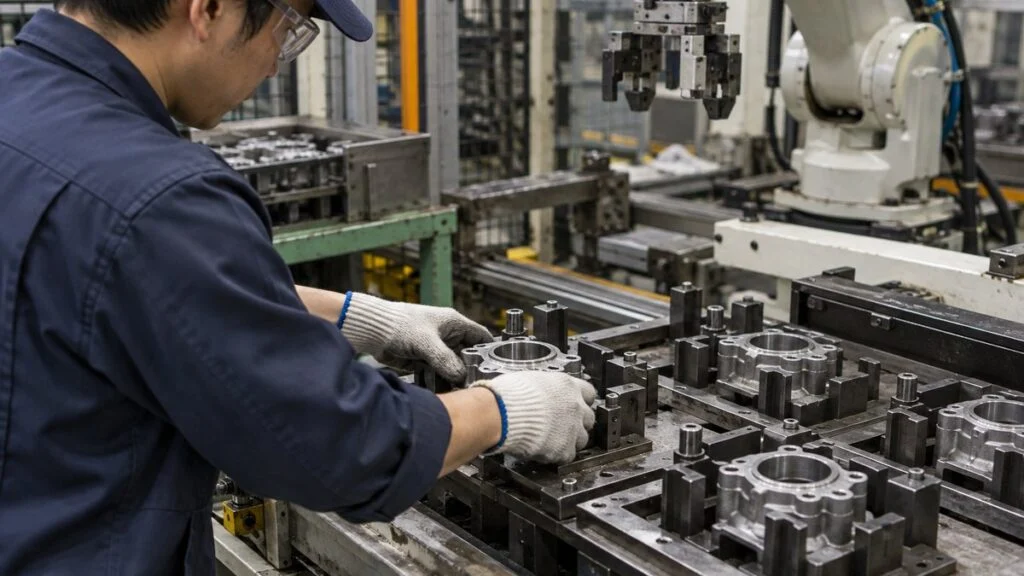
The project is not over when the robot is installed and accepted. After startup, your own shop-floor staff look after the cell, not the SIer.
Required Training and In-House Operators
In Japan, anyone who teaches (programs the motions of) or inspects an industrial robot must first complete special safety training under Article 36, items 31 and 32, of the Ordinance on Industrial Safety and Health. According to the Japan Robot Association, robot makers and regional robot centers offer this training. If the cell is installed outside Japan, check which local rules apply to robot programming and maintenance staff. In either case, build the training of named staff into the startup schedule.
The SIer Association's training material describes a plant that called the SIer every time the robot stopped briefly. The shop floor found this so tiresome that it went back to doing the job by hand. Whether you have operators who can correct a small position error or restart the cell themselves largely decides whether the robot stays in use.
If you plan to run a collaborative robot without fencing, you also need to understand the conditions for collaborative operation and how the risk assessment applies, in addition to the training.
Bring the Shop Floor In Early
The training material quotes a saying: a system built without shop-floor approval will be rejected even if it is 95% right, while a system built with the shop floor involved will be supported even if it is only 80% right. When only the project engineer and the SIer decide the specification, the shop floor tends to push back once operation starts.
The people who do the job every day know best how parts are placed and how changeovers go. Bring operators in from the RFP stage, and fewer requirements slip through the cracks and the new cell becomes part of daily work sooner.
Common Robot Project Failures and How to Prevent Them
The SIer Association's training material lists problems often seen in robot projects. Most stem from preparation and communication on the buyer's side, not from the SIer's technical skill.
- The specification and drawings looked right, but the finished system was nothing like what the buyer imagined.
- The buyer remembered a requirement after the build started and was charged a large extra fee.
- Quotes were based on mock-up parts, and the robot could not grip the real ones.
- Nothing was written down, so a requirement the buyer thought it had stated led to a "we told you" versus "we never heard that" dispute.
- When the parts changed, the robot could no longer handle them.
- The robot added ancillary tasks and lowered overall efficiency.
- Every short stop needed a SIer visit, so the plant went back to manual work.
What makes these problems costly is that the later they surface, the more they cost to fix. A conceptual chart in the training material puts the cost of fixing a problem at 1–5 at the requirements stage, 10 times or more at the build stage, and 100 times or more at the installation and operation stage.
A vague specification costs more the further downstream it goes.
Based on a conceptual chart in the SIer Association's "How to Run a Robot Implementation Project." The figures are indicative only.
The fixes mirror the six steps: describe the goal and parts with numbers and real samples, compare SIers on the same RFP, set acceptance criteria early, invest in verification, and involve the shop floor and operators from the start. All of these are tasks the buyer must lead.
The "more ancillary tasks" failure tends to happen when a plant automates one process without looking at the processes before and after it. Treat the robot as one way to reduce labor, and judge its effect on the flow of the whole line.
Related: Japan’s Manufacturing Industry: Strengths and Weaknesses
Checklist: Before You Send the RFP to a Japanese SIer
- Goal stated in numbers (people, output, cycle time) or as a specific qualitative target
- Target parts listed by official name and model number, with all color, size, and option variants
- Real sample parts and drawings ready, and an NDA in place before they leave your plant
- Process to automate chosen, with the upstream and downstream handoffs described
- Final approver involved, and contacts named for manufacturing engineering, production, safety, maintenance, and quality
- Budget ceiling and target payback period set, and what the ceiling covers (installation, startup, training)
- Site data: floor space, floor load, environment, local supply voltage and frequency, air supply, entrance size, move-in dates
- Decision on whether the cell must inspect parts
- Applicable local safety rules and company equipment standards attached
- Request that the SIer list deviations, exclusions, and anything marked 別途 or 一式
- Target timeline that allows roughly a year from first consultation to full production
Questions to Ask a Japanese SIer
- Which past projects match our application? What were the part material, weight, and cycle time?
- Which work do you do in-house, and which do you subcontract (mechanical, electrical, controls, installation, maintenance)?
- Who will service the cell at our plant, from which location, and how fast can they respond?
- Which items in the quote are lump sum (一式) or quoted separately (別途)? What is excluded?
- Will you test with our real parts, or run a simulation, before the specification is fixed? Is that a separate paid contract?
- How did you carry out the risk assessment, and what safety devices does the layout assume?
- What will the user test check, and what are the pass criteria?
- What training do you provide for operators and maintenance staff, and in which language?
- What is the warranty period, and what happens after it ends?
You can adapt this short request when you send the RFP:
Subject: RFP for robot cell – [process name], [plant name]
Dear [Name],
Attached is our RFP for automating [process] at our [city] plant. We aim to [goal in numbers, e.g., run the process with two operators instead of three at the same output]. Sample parts will be shipped once the NDA is signed.
In your proposal, please include a quote and a quotation specification (layout, equipment list, process flow, schedule). Please also list any RFP requirements you cannot meet, any alternatives, and all items that are excluded, lump sum, or quoted separately. We would also like your proposal for part tests or simulation before the specification is finalized, and your service setup near our plant.
We would appreciate your proposal by [date].
Best regards,
[Name]
Where This Guide May Not Apply
- The process, documents, and contract types here follow guidance from the Japan Robot System Integrator Association. Each SIer and each buyer uses its own document names and procedures.
- The cost and payback figures are examples published in Japan. They are not market prices and do not reflect your country, currency, or the current year.
- The ukeoi and inin contract types come from Japanese practice. For the contract that applies to your plant, follow your own legal and purchasing teams.
- Safety training and safety requirements for robots depend on the country where the cell is installed. This guide does not replace local rules or a risk assessment.
FAQ
What is a SIer in Japan?
A SIer (system integrator) is a company that builds a working robot system by combining a robot with grippers, fencing, sensors, conveyors, and controls. In Japan, SIers range from robot-maker affiliates and trading-company divisions to independent specialists and machine builders.
How much does a robot cell cost, compared with the robot itself?
The total is commonly several times the robot's price, according to Epson's explainer. In one published Japanese example, a machine-tool loading system cost JPY 9.8 million in total, of which the robot was JPY 3.0 million and system integration JPY 5.2 million.
How long does a robot system project take?
Allow about a year from the first consultation to full production. The SIer Association's sample schedule includes about six months for design, build, and tuning alone.
Why does a Japanese SIer charge for help writing the RFP?
The SIer Association treats writing the RFP as the buyer's job. When a SIer helps, there is no fixed deliverable, so the work is normally paid under a separate service-type (inin) contract.
How many SIers should I ask for quotes?
Two or three is typical. Give them all the same RFP, so you can compare deviations, scope, safety, and support, not just price.
Sources
- Project flow, common failures, documents, and contract types: Japan Robot System Integrator Association, buyer training course part 2, "How to Run a Robot Implementation Project" (Japanese)
- Implementation guide, pre-implementation checklist, and sample RFP: Japan Robot System Integrator Association, "Robot Implementation Support Guide and Checklist," March 15, 2024 edition, from a METI FY2023 survey (Japanese)
- Association founding and purpose: Japan Robot System Integrator Association, "About the Association" (Japanese)
- Association launch in 2018: Aperza News, launch of the FA/Robot System Integrator Association (Japanese)
- SIer search filters: Robot Katsuyo Navi, "Robot SIer Search" (Japanese)
- Inquiry routes and engineer shortage (2021 survey): Automation Shimbun, SIer Association robot SI survey (Japanese)
- Cost breakdown and payback periods: Epson Sales Japan, "Implementation Costs of Industrial Robots" (Japanese, PDF)
- Special training requirement and providers: Japan Robot Association, "Special Training for Robots" (Japanese)
Original article in JapaneseThis guide is adapted from a MONOSCOPE article written for readers in Japan: ロボットSIerの選び方|見積依頼前の準備から発注・検収まで6ステップ
About the editor
 MONOSCOPE EditorFOUNDER & EDITOR
Spent about ten years at a plant equipment maker and a plant engineering company, proposing, designing, and commissioning equipment, then moved into web marketing. Now a web consultant for B2B manufacturers, helping them explain their products and technology. Licensed in Japan as an Energy Manager and a Third-Class Chief Electrical Engineer.
Has run an engineering blog since 2017 (500+ articles) and a Japanese YouTube channel with about 20,000 subscribers. Each English guide is written from the Japanese shop-floor point of view and checked against the cited standards.