Renesas and the Automotive MCU Supply Chain
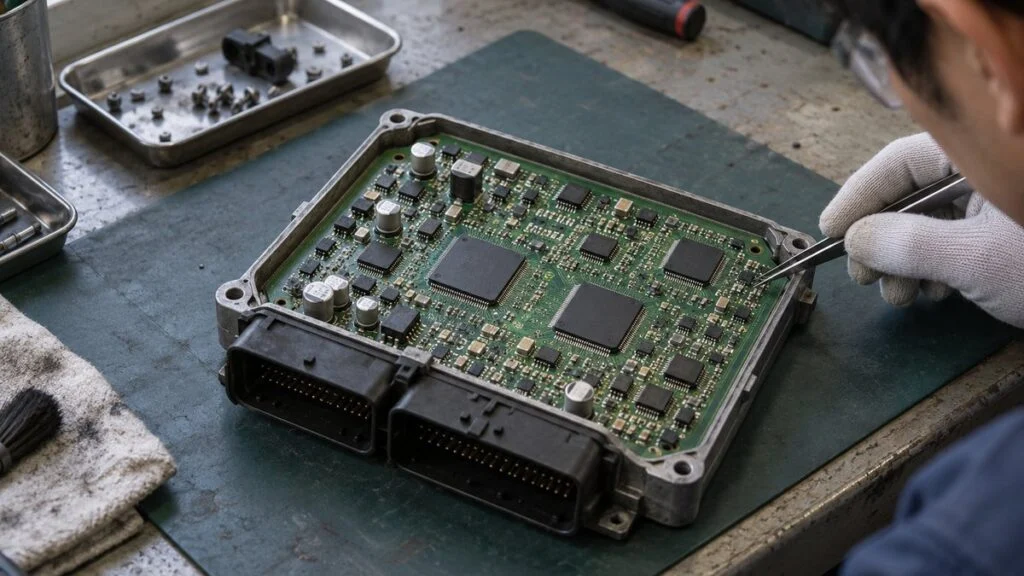
You are reviewing the bill of materials for an engine or body ECU at a Tier 1 plant in India or Thailand. The controller is a Renesas RH850 microcontroller, and the drawing from your Japanese customer says it must not be changed without approval. Then the news reports an earthquake in Kumamoto, where Renesas has two plants, and your purchasing team asks whether supply is at risk. To answer that, you need to know who Renesas is, where its chips are made, and how it sells.
The short version: Renesas Electronics is a Japanese chipmaker that only makes semiconductors, best known for automotive microcontrollers (MCUs). Roughly half of its revenue comes from automotive customers and half from industrial, infrastructure, and IoT customers, and about 80% of its revenue comes from customers outside Japan. It designs and manufactures its own chips, with front-end fabs in Japan and assembly and test sites in Japan, China, and Malaysia.
This guide covers the company's background, where its revenue comes from, which product families go where in a car or a machine, its strengths, recent results, and the supply-side events buyers watch, from the 2021 Naka fab fire to the July 2026 Kumamoto earthquake. It ends with a checklist, questions to ask your distributor, and a sample inquiry email. Figures come from Renesas's English-language investor relations (IR) documents, labeled by fiscal year; Renesas's fiscal year ends December 31. A few items come from Japanese trade press and are marked as such.
Contents
Renesas Electronics at a Glance
Renesas makes chips and sells them to equipment makers. It does not build cars or appliances itself. Its main products are MCUs (small computers that control a device), SoCs (systems-on-a-chip that put many functions on one die), analog semiconductors, and power semiconductors.
The company brings together the chip businesses of three Japanese electronics groups. NEC spun off its semiconductor business (except general-purpose DRAM) as NEC Electronics in November 2002. In April 2010, NEC Electronics merged with Renesas Technology, the chip venture of Hitachi and Mitsubishi Electric, and took the name Renesas Electronics.
In September 2013, Renesas raised capital through a share issue to Innovation Network Corporation of Japan (a public-private investment fund) and a group of its own customers, including Toyota, Nissan, Denso, Keihin, Canon, Nikon, Panasonic, and Yaskawa Electric. Its customers helped fund the rebuild, which shows how much Japanese automakers and electronics makers depend on its parts.
A chip-only maker built from the semiconductor businesses of NEC, Hitachi, and Mitsubishi Electric.
Sources: Renesas company overview; Annual Securities Report for FY2025 (English excerpt).
In industry terms, Renesas is an integrated device manufacturer (IDM): it designs chips and also runs its own fabs. Its annual securities report (the Japanese equivalent of a 10-K) adds that it uses foundries and other outside manufacturers when needed.
Related: Top Japanese Semiconductor and Electronic Component Makers
Where Renesas Makes Its Money
Renesas reports two segments: Automotive, and Industrial/Infrastructure/IoT. Management tracks them on a non-GAAP basis, which strips out acquisition-related amortization and other one-time items. In FY2025, non-GAAP revenue was JPY 1,318.5 billion: JPY 639.7 billion from Automotive and JPY 671.8 billion from Industrial/Infrastructure/IoT, roughly half each.
From FY2026, Renesas moved its timing business, which it agreed to sell, out of both segments and into "Other." FY2026 segment figures therefore do not line up directly with the full-year FY2025 numbers. On the new basis, the first half of 2025 (January–June) showed JPY 316.3 billion for Automotive and JPY 298.4 billion for Industrial/Infrastructure/IoT. In the first half of 2026, the order flipped: JPY 358.7 billion for Automotive and JPY 412.2 billion for Industrial/Infrastructure/IoT.
Industrial/Infrastructure/IoT overtook Automotive in the first half of 2026, and about 80% of revenue comes from outside Japan.
Bar length is scaled to the largest value in each group (= 100). Segment figures are non-GAAP revenue from external customers. H1 2026 uses the new basis, with the timing business moved to "Other," so it cannot be compared directly with full-year FY2025. B = billion. Sources: Renesas consolidated financial results for FY2025 and for the second quarter of FY2026.
Automotive
Renesas splits its automotive business into two categories. "Automotive control" covers chips that control engines and bodies. "Automotive information" covers chips for sensing systems such as cameras and radar, in-vehicle infotainment (IVI), and instrument panels. In practice, Renesas chips sit in many places in one car, from the engine ECU (electronic control unit) to driver-assistance systems.
Automotive revenue fell 9.0% in FY2025 as the market softened. It recovered in the second quarter of 2026 (April–June), rising 15.9% year over year to JPY 187.1 billion. Japanese trade press reported that Renesas linked the rebound to the ramp-up of its fourth-generation R-Car SoCs in Japan, and to some customers in Japan and China rebuilding inventory they had cut too far (EE Times Japan, August 3, 2026).
Industrial, Infrastructure, and IoT
This segment covers MCUs for factory machinery and home appliances, plus power management ICs and memory interface products used in data center servers. Revenue grew 5.5% in FY2025 on stronger infrastructure demand. In the second quarter of 2026, it jumped 40.0% year over year to JPY 216.3 billion, driven by demand for AI servers built around GPUs and ASICs (application-specific integrated circuits), according to Japanese trade press.
If you think of Renesas only as a car-chip company, you miss more than half of its current revenue.
About 80% of Revenue Comes From Outside Japan
By customer location, Japan accounted for JPY 269.1 billion in FY2025, only about 20% of the total. China was the largest market at JPY 409.5 billion, and China plus the rest of Asia made up more than half of revenue. That pattern follows the electronics assembly plants: Renesas ships parts to where boards and modules are built.
In Japan, Renesas sells mainly through authorized distributors (tokuyakuten). Outside Japan, it sells through sales subsidiaries and independent distributors. Its sales subsidiaries include Renesas Electronics America, Renesas Electronics Europe, Renesas Electronics India, Renesas Electronics Singapore, and Renesas Electronics Malaysia. One distributor alone, WT Microelectronics of Taiwan, accounted for JPY 225.4 billion in FY2025, more than 10% of revenue.
Renesas MCU and SoC Families and Where They Go
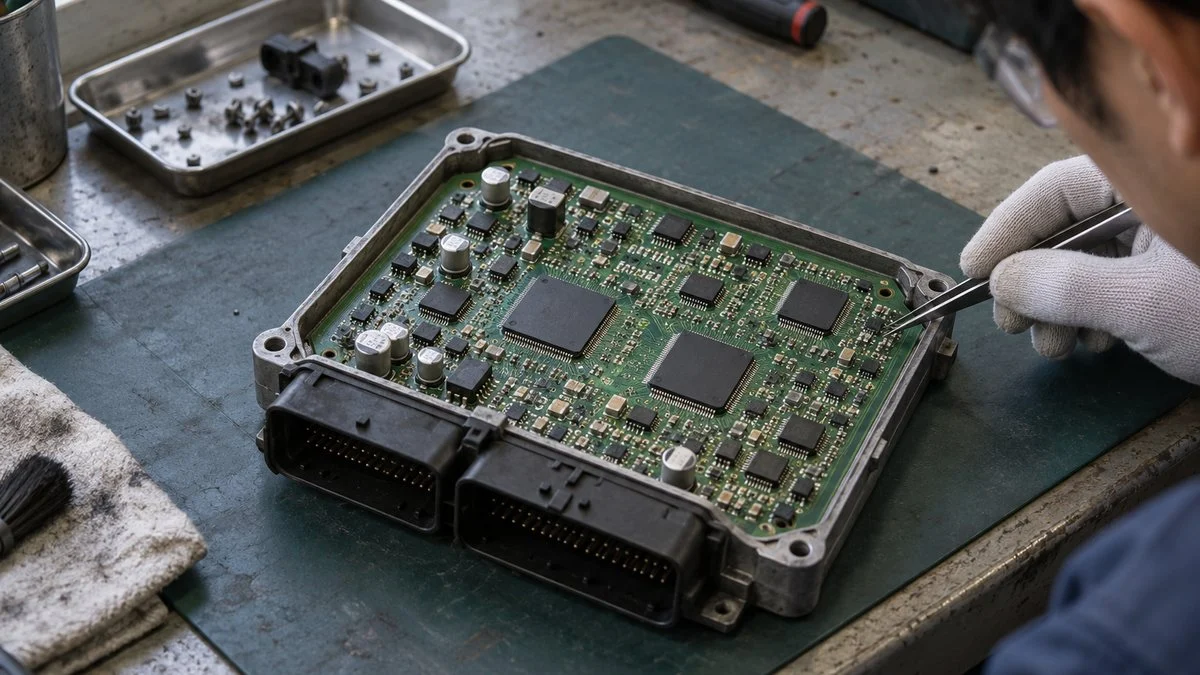
Put simply, Renesas sells two kinds of chips: MCUs and SoCs that "think" for a device, and analog and power chips that sense, condition, and drive electricity. Renesas says it ships 3.5 billion MCUs and microprocessors (MPUs) a year worldwide. Its MCUs come in families, each aimed at a different type of application.
RH850 is the automotive family: 32-bit MCUs built on Renesas's own CPU cores, with AEC-Q100 reliability and ISO 26262 functional safety support. RX is a 32-bit family, also on Renesas's own cores, aimed at industrial equipment, home electronics, and office automation. RA is a 32-bit family based on Arm Cortex-M cores. RL78 covers low-power 8- and 16-bit MCUs, and RZ covers 32- and 64-bit Arm-based MPUs for higher-performance work.
Each application area uses a different product family.
Selected examples. Sources: Renesas MCU and MPU product pages; Annual Securities Report for FY2025; EE Times Japan (August 3, 2026, Japanese).
An MCU does nothing without the software that runs on it, so the people who work most closely with Renesas parts are embedded software engineers and circuit designers. When they choose an MCU, they look at how easy it is to develop for and whether they can reuse the same code across product variants.
For automotive MCUs, ISO 26262 functional safety is a must. The standard requires the design to show that a fault will not leave the vehicle in a dangerous state. Automakers and their suppliers need safety documentation for their own safety case, and they ask the chip supplier for it too. That is why Renesas advertises ISO 26262 support for RH850.
Why Japanese Customers Specify Renesas
Renesas's public materials point to three strengths: a broad product range, analog and power parts it can pair with its MCUs, and design tools that keep its parts in front of engineers.
Renesas sells more than the MCU: it offers the surrounding parts and the design tools as well.
Sources: Annual Securities Report for FY2025; MONOist (June 30, 2026, Japanese).
A Full Range From Small MCUs to Automotive SoCs
Renesas offers 8-, 16-, and 32-bit MCUs and 32- and 64-bit MPUs, and it promotes dual sourcing (production at more than one site) for supply continuity. At an investor briefing in June 2026, it said it holds the No. 2 share in automotive MCUs and called itself the only maker covering processing chips from the low end to the high end, according to Japanese trade press (MONOist, June 30, 2026). CEO Hidetoshi Shibata acknowledged that one rival has been gaining share in automotive MCUs and said Renesas has taken steps to win it back.
Across all MCU markets, not just automotive, Infineon of Germany reported, based on Omdia data, that it became the world's No. 1 MCU supplier in 2024 for the first time. In short, Renesas competes head to head with large non-Japanese suppliers in MCUs, which matters if your design team is weighing alternatives.
Analog and Power Parts Added Through Acquisitions
Since 2017, Renesas has bought a string of non-Japanese chip companies to fill gaps in analog, power management, and wireless, areas where it was thinner than in MCUs.
An MCU-centered company has added analog, power, wireless, and design tools.
- Intersil (US)Power management ICs and precision analog
- IDT (Integrated Device Technology, US)Timing products and more. The source of the timing business sold in 2026
- Dialog Semiconductor (UK)Battery and power management ICs, low-power Wi-Fi and Bluetooth. About EUR 4.8 billion in cash
- Transphorm (US)GaN (gallium nitride) power semiconductors
- AltiumPrinted circuit board (PCB) design software
- Timing business sold to SiTimeDivestedThe IDT-derived timing business, for about USD 1.5 billion in cash plus about 3.56 million SiTime shares (roughly USD 3 billion in total, as reported), to focus resources on core areas
Dates are when the full share acquisition or transfer was completed. Sources: Annual Securities Report for FY2025 ("History"); Renesas second-quarter FY2026 results; Renesas press release on completing the Dialog acquisition (August 31, 2021); SiTime Form 8-K/A (2026).
Renesas calls these analog-plus-digital bundles "Winning Combinations." For a motor control design, for example, it can propose the MCU together with the power management IC and the analog parts around the sensors. Customers spend less time sourcing each part from a different vendor, and that makes Renesas easier to design in.
Design Tools: Altium and Renesas 365
Altium, acquired in 2024, makes PCB design software that is widely used in electronics design. Renesas and Altium announced "Renesas 365, Powered by Altium," a cloud platform that connects part selection, design, and product lifecycle management. Renesas describes it as an industry first. The aim is to make Renesas parts easy to pick inside the tools designers already use every day. Renesas has also said it expects software and digital to make up 15% of revenue by 2035 (MONOist, June 30, 2026).
Financial Results and the FY2025 Net Loss
Under IFRS (International Financial Reporting Standards), revenue climbed to JPY 1,500.9 billion in FY2022, when the chip shortage inflated demand, and then fell for three straight years to JPY 1,321.2 billion in FY2025.
Revenue peaked in FY2022. In FY2025, Renesas still made an operating profit but posted a net loss because of finance costs.
Fiscal years end December 31. Consolidated revenue under IFRS. B = billion. Source: Annual Securities Report for FY2025, "Main Financial Data."
Core Margins Stayed High
On the non-GAAP basis Renesas uses to explain its results, FY2025 gross margin was 57.6% and operating margin was 29.3%. Lower automotive sales cut fab utilization, but Renesas held down manufacturing costs, and gross margin actually rose 1.6 points from FY2024.
R&D spending was JPY 238.1 billion in FY2025, about 18% of revenue. Chipmakers have to develop products years ahead, and Renesas did not make deep cuts to R&D even as revenue fell.
The Net Loss Came From Wolfspeed, Not From Operations
Renesas posted an IFRS operating profit of JPY 201.2 billion in FY2025 but a net loss of JPY 51.8 billion. The gap came from a large charge under finance costs, outside its core business.
In June 2025, Renesas signed a restructuring support agreement with US silicon carbide maker Wolfspeed and its main creditors. Under the agreement, Renesas agreed to convert the deposit it had placed with Wolfspeed into Wolfspeed convertible notes, common stock, and warrants, and it recorded a loss of JPY 236.6 billion, including foreign exchange effects. The loss did not come from weak product sales or unprofitable fabs.
Back to Growth in 2026
For the first half of FY2026 (January–June), IFRS revenue rose 25.9% year over year to JPY 798.7 billion, operating profit was JPY 192.7 billion, and profit attributable to owners of parent swung back to JPY 217.3 billion. Non-GAAP operating margin was 33.2%.
Renesas gives guidance one quarter at a time. When it reported on July 31, 2026, it forecast non-GAAP revenue for the third quarter (July–September) of about JPY 430 billion, plus or minus JPY 7.5 billion, up about 28.7% year over year. The sale of the timing business to SiTime closed on July 1, 2026, and Renesas expects a gain of about JPY 443.3 billion on it. That one-time gain will lift FY2026 net profit.
Fabs, Capacity, and Supply Risk
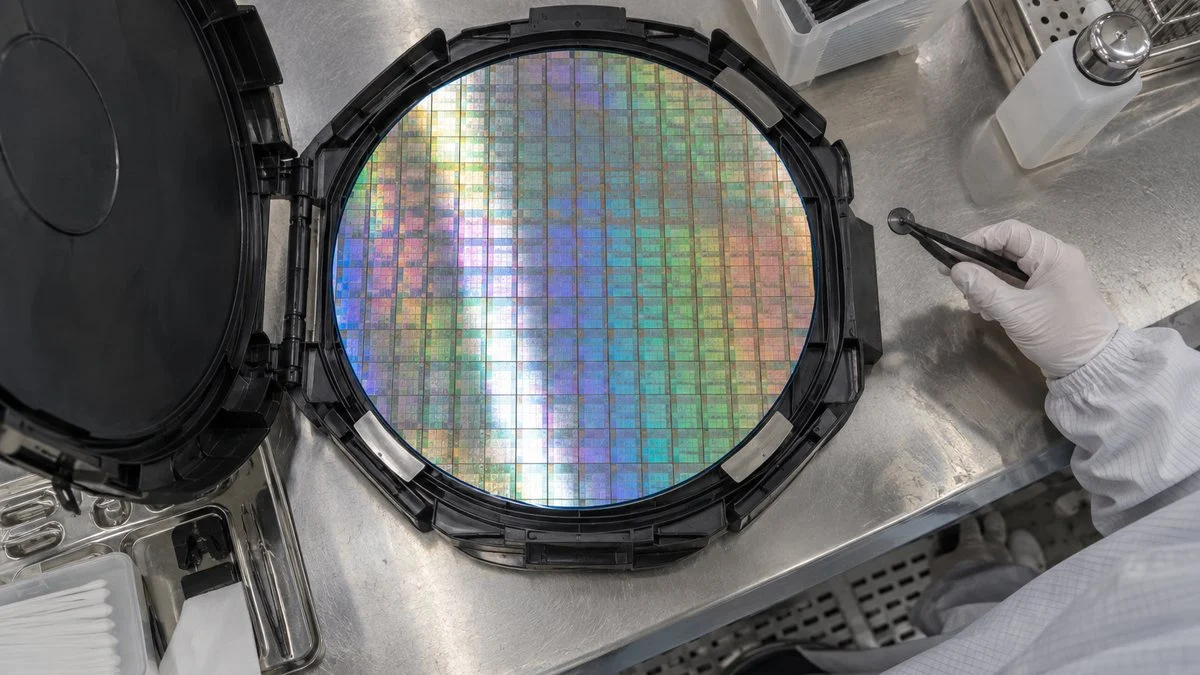
For buyers, the most important question about Renesas is often supply. Its main front-end fabs, where circuits are built on silicon wafers, are in Japan. They include the Naka Factory (Hitachinaka, Ibaraki) and the Kawashiri Factory (Kumamoto City), both run by its manufacturing subsidiary Renesas Semiconductor Manufacturing, plus plants in Kofu (Kai, Yamanashi) and Saijo (Ehime). Back-end assembly and test takes place at sites such as the Nishiki Factory in Kumamoto Prefecture and at subsidiaries in China and Malaysia.
Lessons From the 2021 Naka Fire
Automotive buyers remember March 19, 2021, when a fire hit part of the N3 Building, the 300 mm line, at the Naka Factory. Production restarted on April 17, and Renesas reported that the line was back to 100% of its pre-fire production level on June 24. The fire came in the middle of the global chip shortage, which is why many carmakers now ask chip suppliers about backup production and inventory.
The July 2026 Kumamoto Earthquake
On July 28, 2026, a major earthquake struck Kumamoto Prefecture, reaching the top level of 7 on Japan's seismic intensity scale. It affected two Renesas Semiconductor Manufacturing sites: the Nishiki Factory (back end, Kuma District) and the Kawashiri Factory (front end, Kumamoto City).
According to Renesas's updates, Nishiki began a phased restart on the evening of July 29 and was back to pre-quake production capacity on the morning of July 31. Kawashiri began a phased restart on August 4, one day ahead of plan. Renesas said it aimed to restore pre-quake wafer input capacity there about three weeks after the restart. Japanese trade press reported that Renesas called the impact on its results limited, and that a "die bank" (a stock of wafers that have finished front-end processing) and other inventory helped it recover quickly. Seismic isolation tables under some equipment and stocks of spare parts also helped, the reports said.
New Capacity for Data Center Power
With demand recovering, Renesas is adding capacity. Its FY2025 annual securities report said it planned to invest about JPY 85.0 billion (on an investment-decision basis) in the first quarter of FY2026, mainly to strengthen manufacturing, upgrade production equipment, and expand design and development. That compares with JPY 57.6 billion for all of FY2025, which went mainly to projects such as a new high-voltage MOSFET line.
Japan's Nikkan Kogyo Shimbun reported on April 28, 2026, that the capital expenditure Renesas actually approved in that quarter was JPY 94 billion, 7.4 times the year-earlier figure. The report said the money targets front-end capacity at Kofu, Naka, and Saijo to make digital power products for data centers in house, and that a shortage of test equipment was a supply bottleneck. We could not confirm the JPY 94 billion figure in Renesas's own disclosures.
Demand is strongest for digital power products that feed GPUs and other server processors, and for memory interface products that move data between processors and memory. At its August 2026 earnings briefing, CEO Shibata described supply as tight across the board and outlined a plan to raise capacity another step from the end of 2026 into 2027, according to Japanese trade press. In June 2026, Renesas also said it expects AI infrastructure to drive its growth through 2030 and to reach about 40% of revenue, and it says it ranks in the top three in memory interface products and in power devices for AI infrastructure.
Kofu: A Restarted 300 mm Power Fab
The Kofu Factory, one of the targets of the new investment, closed in October 2014 and restarted in April 2024 as a dedicated 300 mm wafer fab for power semiconductors such as IGBTs and power MOSFETs. Renesas said mass production would start in 2025 and double its power semiconductor capacity. It has also launched 650 V GaN power devices based on Transphorm technology, and it offers power solutions that combine several devices to support up to 800 V for the 800 V DC power distribution now being studied for AI data centers.
Completed events and announced plans that buyers track.
- Naka Factory fire and recoveryDoneFire on the 300 mm line on March 19. Production restarted April 17 and reached the pre-fire level on June 24
- Kofu Factory restartsDoneDedicated 300 mm power semiconductor line for IGBTs and power MOSFETs
- Wolfspeed restructuring agreementDoneDeposit converted to notes and stock. JPY 236.6 billion loss in FY2025
- Capacity investment decidedDecidedPlanned at about JPY 85.0 billion; JPY 94 billion reported by Japanese press. Front end at Kofu, Naka, and Saijo
- Timing business sale completedDoneSold to SiTime. Expected gain of about JPY 443.3 billion
- Restart after Kumamoto earthquakeDoneNishiki restarted July 29; Kawashiri restarted August 4
- Next step-up in capacityPlannedPlan outlined by the CEO at the August 2026 earnings briefing
Sources: Renesas press releases and IR documents; Nikkan Kogyo Shimbun (April 28, 2026, Japanese); EE Times Japan (August 3, 2026, Japanese).
Working With Renesas as a Customer
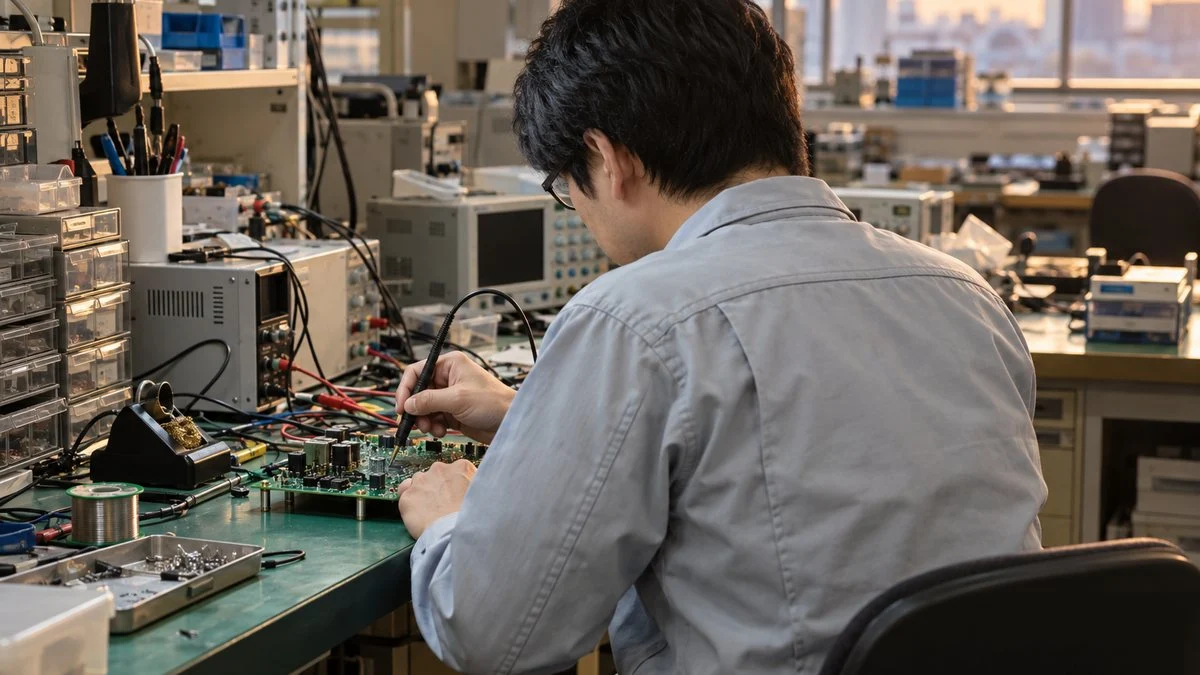
Equipment makers usually buy Renesas parts through a distributor or a Renesas sales subsidiary rather than from the Japanese parent. In Japan, the usual contact is an authorized Renesas distributor. Outside Japan, it is a local sales subsidiary or an authorized distributor. Business starts with the design-in, when a part is chosen for a new product during development. Once a part is designed in, the same part usually stays in use for the whole production life of that product.
Related: Japanese Sales Engineers and FAEs: Roles and Handoffs
That is why lifecycle and supply continuity matter so much. Renesas promotes dual-source production and inventory buffers because supply continuity is a condition for being designed in. On a Japanese customer's program, you may also find that the MCU part number is fixed in the customer's approved drawings or parts list, and any change needs the customer's approval. Clarify early who decides on alternatives.
Checklist Before You Design In or Buy a Renesas Part
Ask these through your distributor or Renesas sales office.
General guidance. Requirements differ by customer, product, and region.
Questions to Ask Your Distributor or the Japanese Customer
- Is this exact part number (including package and temperature grade) active, and is there a published longevity or supply commitment?
- Where is it made (front-end fab and assembly and test site)? Is a second production site qualified?
- Was this part affected by the July 2026 Kumamoto earthquake? If so, what is the current lead time?
- Is there a pin-compatible part in the same family that we could qualify as a backup?
- For the Japanese customer: Is the Renesas part fixed in your approved parts list, or can we propose an alternative? Who approves the change, and how long does approval take?
- Which ISO 26262 or AEC-Q100 documents can we receive, and under what NDA terms?
Sample Inquiry Email
Subject: Supply and lifecycle status for Renesas [part number]
Hello [Name],
We use the Renesas [part number] in an ECU we build for [customer] in [country], at about [quantity] units per month. Could you confirm the following?
- Current lifecycle status and any longevity commitment
- Current lead time and whether the part is on allocation
- Production sites (front end and back end), and whether the July 2026 Kumamoto earthquake affected this part
- Pin-compatible alternatives in the same family, if any
We would appreciate a reply by [date], as we are planning orders for [period].
Best regards,
[Your name]
[Company]
Limits of This Guide
- Financial figures come from Renesas's FY2025 and first-half FY2026 reports, in Japanese yen as reported. Non-GAAP and IFRS figures differ, and the 2026 segment figures use a new basis.
- The JPY 94 billion investment figure, the No. 2 automotive MCU share, the reasons for the second-quarter rebound, and the remarks about tight supply come from Japanese trade press, not from Renesas's own documents.
- Lead times, allocation, and lifecycle status vary by part number and change over time. Confirm them with your distributor or Renesas for each part.
- This guide does not compare Renesas parts with other suppliers' parts on price or performance.
FAQ
Is Renesas a Japanese company?
Yes. Renesas Electronics Corporation is headquartered in Tokyo and listed on the Tokyo Stock Exchange (6723). It was formed from the chip businesses of NEC, Hitachi, and Mitsubishi Electric, but most of its revenue now comes from outside Japan.
What is Renesas RH850 used for?
RH850 is Renesas's family of 32-bit automotive MCUs. It is used in vehicle control ECUs such as engine, body, and chassis controllers, and it supports ISO 26262 functional safety and AEC-Q100 reliability.
Where does Renesas make its chips?
Renesas runs front-end fabs in Japan, including Naka (Ibaraki), Kawashiri (Kumamoto), Kofu (Yamanashi), and Saijo (Ehime), and back-end sites such as Nishiki (Kumamoto) plus subsidiaries in China and Malaysia. It also uses outside foundries when needed. Ask your distributor which site makes a given part.
Did the 2026 Kumamoto earthquake affect Renesas supply?
The Nishiki and Kawashiri plants were affected but restarted within about a week: Nishiki from July 29 and Kawashiri from August 4, 2026. Japanese trade press reported that Renesas called the impact on its results limited. Check the status of your specific parts with your distributor.
Why did Renesas report a loss in 2025?
Because of a JPY 236.6 billion finance-cost charge tied to Wolfspeed's restructuring. Renesas still made an IFRS operating profit of JPY 201.2 billion in FY2025, and its core business stayed profitable.
Sources
- FY2025 results, segments, regions, Wolfspeed loss: Renesas, Consolidated Financial Results for the Year Ended December 31, 2025
- First-half FY2026 results, segment change, timing business sale, Kumamoto earthquake note: Renesas, Consolidated Financial Results for the Second Quarter Ended June 30, 2026
- History, subsidiaries, employees, facilities, capital expenditure, R&D: Renesas, Annual Securities Report for FY2025 (English excerpt)
- Product families and annual shipments: Renesas, Microcontrollers & Microprocessors
- Kumamoto earthquake restart: Renesas updates on the impact of the earthquake in Kumamoto (July 31, 2026, August 4, 2026)
- Kofu Factory: Renesas, "Renesas Commences Operations of Kofu Factory as Dedicated 300 mm Wafer Fab for Power Semiconductors" (April 11, 2024)
- Naka Factory fire: Renesas, "UPDATE 10: Notice Regarding the Semiconductor Manufacturing Factory Naka Factory Fire" (June 2021)
- Dialog acquisition: Renesas, "Renesas Completes Acquisition of Dialog Semiconductor" (August 31, 2021)
- Timing business sale terms: SiTime, Form 8-K/A exhibit (2026) and SiTime press release (February 2026)
- 2024 global MCU market: Infineon, "Infineon is the new market leader in the global microcontroller market" (March 2025)
- Second-quarter 2026 drivers, supply comments, Kumamoto recovery: EE Times Japan (August 3, 2026) (Japanese)
- Growth plan and automotive MCU share: MONOist (June 30, 2026) (Japanese)
- JPY 94 billion capacity investment: Nikkan Kogyo Shimbun, Newswitch (April 28, 2026) (Japanese)
Original article in JapaneseThis guide is adapted from a MONOSCOPE article written for readers in Japan: ルネサスエレクトロニクスとは|マイコン大手の事業・強み・増産投資を読む
About the editor
 MONOSCOPE EditorFOUNDER & EDITOR
Spent about ten years at a plant equipment maker and a plant engineering company, proposing, designing, and commissioning equipment, then moved into web marketing. Now a web consultant for B2B manufacturers, helping them explain their products and technology. Licensed in Japan as an Energy Manager and a Third-Class Chief Electrical Engineer.
Has run an engineering blog since 2017 (500+ articles) and a Japanese YouTube channel with about 20,000 subscribers. Each English guide is written from the Japanese shop-floor point of view and checked against the cited standards.