Top Japanese Semiconductor and Electronic Component Makers

Japanese company names turn up all over an electronics bill of materials: Murata and TDK passives, Renesas microcontrollers, Kioxia NAND flash. In a fab or test house, the etch tool may be from Tokyo Electron, the tester from Advantest, and the dicing saw from DISCO. Then there are the surprises. A part you have bought for years as an IDT or Intersil product now ships with a Renesas datasheet, and an old Elpida DRAM line now belongs to Micron.
This guide is a who's who of the major Japanese electronic component, semiconductor, equipment, and materials makers. It ranks the largest listed companies by revenue (with the fiscal year stated for every figure), explains what each one is known for, traces the mergers that changed familiar brand names, and ends with a checklist for reading a Japanese supplier's numbers.
The short version: by revenue for the fiscal year ended March 31, 2026, the four largest are TDK (¥2,504.8 billion), Tokyo Electron (¥2,443.5 billion), Kioxia Holdings (¥2,337.6 billion), and Kyocera (¥2,070.2 billion). Revenue alone is misleading, though: about 55% of TDK's sales come from energy application products, mainly batteries, and more than half of Kyocera's come from businesses outside components.

Contents
- Largest Japanese Electronics and Semiconductor Companies by Revenue
- Who Makes What: Japanese Companies by Field
- What Each Major Company Is Known For
- How Japanese Companies Compare With Global Leaders
- Mergers and Acquisitions: Why Familiar Brand Names Changed
- How to Read a Japanese Electronics Company's Numbers
- Checklist: Comparing Japanese Electronics Suppliers
- Limits of This Guide
- FAQ
- Sources
Largest Japanese Electronics and Semiconductor Companies by Revenue
Figure 1 ranks the main listed companies whose core business is electronic components, semiconductors, or semiconductor manufacturing equipment. The figures come from each company's English-language results filings or, where noted in the Sources, from financial data sites that reproduce them.
Four companies topped ¥2 trillion in their latest full fiscal year.
Consolidated net sales (revenue for IFRS reporters) for the fiscal year ended March 31, 2026; Renesas is the year ended December 31, 2025. Excludes companies whose main business is chemicals or other fields, and semiconductor divisions of diversified groups.
The top of the list mixes all three fields: a component maker (TDK), an equipment maker (Tokyo Electron), a memory maker (Kioxia), and a diversified group (Kyocera). Three points help when you read it:
- Business scope differs. TDK's energy application products segment, which includes its batteries, brought in ¥1,370.3 billion, about 55% of sales. At Kyocera, the Solutions segment (industrial tools, document equipment, communications, and other products) made up 51.7% of sales, while its Electronic Components segment was ¥363.5 billion.
- Size is not the same as influence. SCREEN Holdings (wafer cleaning), ROHM (power semiconductors), and DISCO (dicing and grinding) each report around ¥400–600 billion, yet each is a major global name in its own process or product.
- Some big chip businesses are not listed separately. Sony Group and Mitsubishi Electric, for example, make semiconductors inside much larger groups, so a company-level ranking does not show them.
Japanese fiscal-year labels also cause confusion. Most of these companies close their books on March 31, but they name the same year differently: Advantest and Kioxia call April 2025–March 2026 "FY2025," while TDK and Kyocera call it "fiscal 2026." Renesas and SUMCO use the calendar year. Check the end date, not the label, before you compare two companies.
Who Makes What: Japanese Companies by Field
The industry splits into four fields, and Japan has globally known companies in each. Figure 2 groups the companies by their core business.
Each field has its own set of leading Japanese companies.
Many more companies work in electronics manufacturing services (EMS) and electronics distribution. Categories reflect each company's core business and are approximate.
- Electronic components are one of Japan's strongest fields. The largest makers earn more than 90% of their sales outside Japan. For how MLCCs are made and why Japanese makers lead in them, see MLCC Manufacturing Process: Why Japanese Makers Lead.
- Semiconductor makers specialize: Kioxia in NAND flash memory, Renesas in microcontrollers, and ROHM in power semiconductors.
- Manufacturing equipment makers have strengths in different process steps: Tokyo Electron in front-end tools, Advantest in testers, SCREEN in cleaning, and DISCO in dicing and grinding. Testing, dicing, and grinding are back-end steps, covered in Semiconductor Back-End Process: Flow and Japanese Suppliers.
- Materials: Shin-Etsu Chemical and SUMCO are major silicon wafer suppliers. Shin-Etsu's sales for the year ended March 2026 were ¥2,574.0 billion, but it is left out of Figure 1 because it also sells a wide range of other chemicals. SUMCO's sales for calendar 2025 were ¥409.7 billion. For product-by-product share data, see Where Japan Holds Top Global Share: Materials and Equipment.
For how these layers connect, and how parts reach you through makers, Japanese trading companies, and distributors, see Japanese Electronic Components: Makers, Shosha, Distributors.
What Each Major Company Is Known For
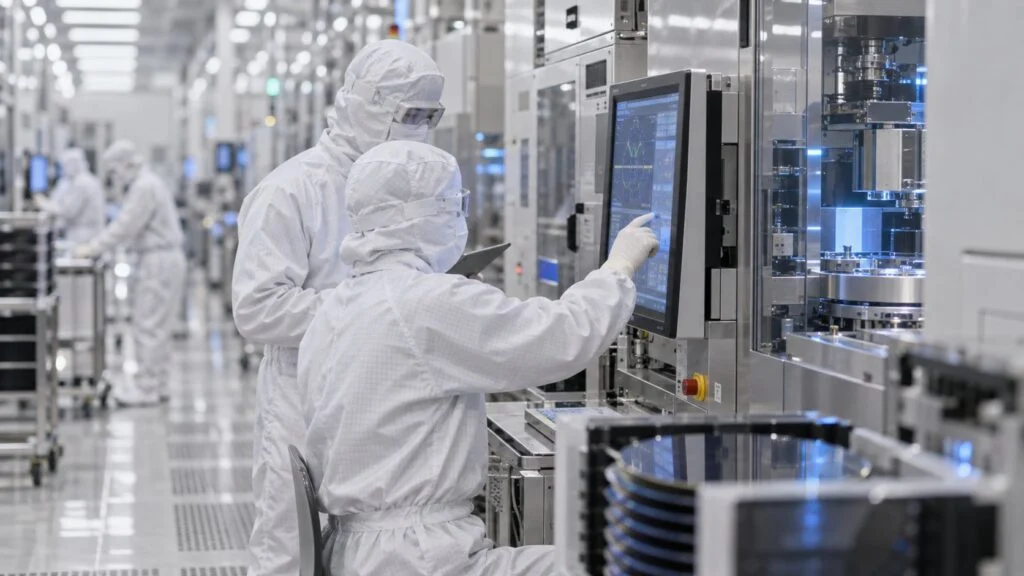
The profiles below use each company's results for its latest full fiscal year. Operating margins are calculated from reported revenue and operating profit.
Tokyo Electron (TEL)
Tokyo Electron is Japan's largest semiconductor equipment maker, with net sales of ¥2,443.5 billion for the year ended March 2026. It focuses on front-end processing, where circuits are built on the wafer, and supplies tools for many steps, including deposition, etching, and cleaning. Its operating margin was 25.6%.
Murata Manufacturing
Murata is best known for multilayer ceramic capacitors (MLCCs). For the year ended March 2026, revenue was ¥1,830.9 billion, and capacitors made up 51.1% of it. By application, communication accounted for 35.7%, mobility 25.9%, and computers 16.9%. Sales outside Japan were 92.7% of the total, and Greater China alone took 47.2%.
TDK
TDK had the largest revenue in this group: ¥2,504.8 billion for the year ended March 2026. Besides passive components, sensors, and magnetic products (including HDD heads), it has a large battery business that brings in more than half of its revenue. Operating profit rose 21.5% to ¥272.4 billion. About 93% of sales are outside Japan, and sales to China, about ¥1.38 trillion, make up roughly 55% of the total.
Kyocera
Kyocera reported revenue of ¥2,070.2 billion for the year ended March 2026. Its Core Components segment, which includes semiconductor components and industrial and automotive components, grew 10.4% to ¥653.4 billion. The Electronic Components segment, which includes capacitors from its Kyocera AVX group, brought in ¥363.5 billion. The rest comes mainly from the Solutions segment.
Kioxia Holdings
Kioxia is a major NAND flash memory maker that began as Toshiba's memory business. It took the name Kioxia in October 2019 and listed on the Prime Market of the Tokyo Stock Exchange in December 2024. Its results swing widely with the memory market: after an operating loss of ¥252.7 billion for the year ended March 2024, it reported revenue of ¥2,337.6 billion and operating profit of ¥870.4 billion for the year ended March 2026.
Renesas Electronics
Renesas is a semiconductor maker strong in microcontrollers (MCUs) for automotive and industrial equipment. Revenue for the year ended December 2025 was ¥1,321.2 billion (IFRS). It was formed in 2010 by merging NEC Electronics and Renesas Technology, and it has grown through overseas acquisitions: Intersil, IDT, Dialog Semiconductor, and the design software company Altium. For product families, fabs, and supply risk, see Renesas and the Automotive MCU Supply Chain.
Advantest
Advantest makes automatic test equipment that checks the electrical performance of chips. Net sales for the year ended March 2026 jumped to ¥1,128.6 billion from ¥779.7 billion the year before. Its 44.2% operating margin was the highest in this group. More advanced chips need longer and more precise testing, which drives demand for testers.
DISCO
DISCO makes the equipment that thins wafers by grinding and cuts them into individual chips (dicing). Net sales rose for the second year in a row to ¥436.9 billion for the year ended March 2026, with a 42.3% operating margin. It shows how a company that concentrates on a few process steps can earn high returns.
SCREEN Holdings and ROHM
SCREEN Holdings, known for wafer cleaning equipment, had net sales of ¥605.7 billion for the year ended March 2026. ROHM, a power semiconductor maker that has invested heavily in silicon carbide (SiC), had net sales of ¥481.1 billion. It returned to an operating profit of ¥10.9 billion after a ¥40.1 billion operating loss the year before, but impairment losses on its SiC equipment still left it with a large net loss.
Margins vary widely even within the same industry.
Operating profit divided by net sales (revenue) for the fiscal year ended March 31, 2026, calculated from each company's results.
How Japanese Companies Compare With Global Leaders
Globally, the largest chip companies are not Japanese. The world semiconductor market reached about $795.6 billion in 2025, according to WSTS, and most of it went to companies outside Japan. Equipment has large foreign players too: ASML (Netherlands), which makes lithography systems, reported 2025 net sales of €32.7 billion. Currency differences make direct comparisons rough, but several overseas companies match or exceed Japan's largest.
Japanese companies stand out in equipment, materials, and electronic components.
Positions are approximate, based on company disclosures and press reports.
In leading-edge logic and memory, overseas companies operate at a much larger scale. In equipment, materials, and components, however, Japanese companies are hard to replace, so new fabs built anywhere in the world tend to raise demand for Japanese tools and materials.
Japan is also adding chip production at home. JASM, a TSMC-majority joint venture, began volume production at its first fab in Kumamoto in late 2024, and Rapidus is targeting volume production of 2 nm logic chips in Chitose, Hokkaido, in 2027.
Mergers and Acquisitions: Why Familiar Brand Names Changed

Japan's electronics industry has gone through repeated restructuring over the past 15 years or so. If a part number, datasheet, or supplier name on an old drawing no longer matches what you buy today, one of these deals may be the reason.
The deals fall into three phases: consolidation and sell-offs, overseas acquisitions, and domestic production.
Years show when a merger or acquisition closed or a company was founded.
Until the early 2010s, the main story was Japanese chipmakers combining or selling off businesses. DRAM maker Elpida Memory went bankrupt in 2012 and became part of Micron Technology in 2013. In 2018, Toshiba sold its memory business for about ¥2 trillion to a consortium led by Bain Capital; that business is today's Kioxia.
After the early-2010s consolidation, Japanese companies increasingly became the buyers. Renesas completed its acquisitions of Intersil in 2017, IDT in 2019, Dialog Semiconductor in 2021, and Altium in 2024. More recently, economic security has driven a new phase: government-backed projects to attract foreign fabs and build leading-edge chips in Japan.
For sourcing, the practical result is a set of name changes worth knowing:
| Name you may see on older documents | Where the business is now |
|---|---|
| Intersil, IDT, Dialog Semiconductor | Part of Renesas Electronics |
| NEC Electronics, Renesas Technology | Merged into Renesas Electronics (2010) |
| Elpida Memory | Part of Micron Technology (2013) |
| Toshiba Memory | Renamed Kioxia (2019) |
| Alps Electric, Alpine | Combined as Alps Alpine (2019) |
A change of owner does not by itself tell you whether a part number, its datasheet, or its change-notification channel has changed. Confirm those with the current manufacturer or your distributor.
How to Read a Japanese Electronics Company's Numbers
Whether you are judging a supplier's staying power or comparing two vendors, revenue is only the starting point. Three other measures say more.
Operating Margin
A large company is not necessarily a profitable one. For the year ended March 2026, operating margins ran from 44.2% at Advantest down to 2.3% at ROHM (Figure 3). Margin reflects how competitive a company's products are and how much pricing power it has. Looking at several years of margins also shows how well the company rides out industry cycles.
Overseas Sales and Customer Mix
Overseas sales above 90%, as at Murata and TDK, are common among large Japanese component makers. Check the regional split too: Greater China took 47.2% of Murata's revenue, and China takes roughly 55% of TDK's, which makes both more exposed to that region's economy and policies. End markets matter as well. A company selling mostly to automakers rides a different cycle from one selling mostly into smartphones or data centers.
Business Concentration
Companies focused on one product grow fast in a boom and fall hard in a downturn. Kioxia swung from an operating loss for the year ended March 2024 to record sales and net profit two years later. ROHM posted a ¥40.1 billion operating loss for the year ended March 2025 before returning to a ¥10.9 billion operating profit the next year. Companies with several businesses tend to be more stable. Revenue by product and by application in the results filings shows how dependent a company is on any one market.
For warning signs in smaller suppliers, which often do not publish results in English, see Japanese Supplier Financial Health: Warning Signs and Checks.
Checklist: Comparing Japanese Electronics Suppliers
Use this list when you compare figures from different Japanese companies or review a supplier's status:
- Fiscal year end date: March 31 or December 31? Ignore the "FY" label and compare the end dates.
- Accounting basis: IFRS, Japanese GAAP, or US GAAP. Line items such as operating profit are not defined identically, so note which one each company uses.
- Segment mix: what share of revenue comes from the product line you actually buy (for example, TDK's passive components vs. its batteries).
- Operating margin over several years: not just the latest year.
- Regional and end-market exposure: share of sales to China and to your end market (automotive, smartphones, data centers).
- Current owner of the brand: legacy names (Intersil, IDT, Dialog, Elpida, Toshiba Memory) and whether part numbers, datasheets, and change notices moved with them.
- Source of the numbers: the company's English results filing or investor relations (IR) site first; aggregator sites only to cross-check.
If you need to ask a supplier or distributor, you can adapt this short message:
"We use [part number], originally from [legacy brand]. Please confirm the current manufacturer, the latest datasheet revision, and where we should register for product change and end-of-life notices."
Limits of This Guide
- The ranking covers listed companies whose core business is electronics or semiconductors. It leaves out chemical makers (other than as noted), semiconductor divisions of diversified groups, EMS providers, and distributors.
- Figures are for the fiscal years stated and will change. In the latest year alone, Kioxia's revenue rose 37% and Advantest's 45%.
- Companies use different fiscal year ends and accounting standards, so the comparison is approximate.
- Positions in Figures 2 and 4 are a rough guide, not market-share data.
FAQ
What is the largest Japanese semiconductor company?
It depends on what you count. Among listed companies whose main business is chips, Kioxia had the largest revenue (¥2,337.6 billion for the year ended March 2026), followed by Renesas (¥1,321.2 billion for calendar 2025). Counting equipment makers, Tokyo Electron was larger, at ¥2,443.5 billion. Semiconductor divisions inside larger groups, such as Sony Group's image sensor business, are not included in this comparison.
Which Japanese companies make capacitors and other passive components?
The best-known are Murata, TDK, and Kyocera (through its Kyocera AVX group). Capacitors made up 51.1% of Murata's revenue for the year ended March 2026.
Why does an IDT or Intersil part now have a Renesas datasheet?
Renesas acquired Intersil in 2017 and IDT in 2019, and it later added Dialog Semiconductor (2021). Their product lines now sit under Renesas, so check the current datasheet and change-notice channel with Renesas or your distributor.
Why do Japanese companies label the same year differently?
Most Japanese companies run April to March, but some name the year by its start (Advantest: "FY2025" for April 2025–March 2026) and others by its end (TDK and Kyocera: "fiscal 2026"). Always check the end date shown in the filing.
Sources
- StockAnalysis, Tokyo Electron
- Murata Manufacturing, Consolidated Financial Results for the Fiscal Year Ended March 31, 2026
- TDK, Consolidated Financial Results for Fiscal 2026
- Envalith, TDK segment data (energy application products)
- Kyocera, Financial Results for Fiscal 2026
- Jiji Press via Nippon.com, "Kioxia Enjoys Record Annual Sales, Profits amid AI Demand"
- Qatar Tribune, Kioxia fiscal 2025 operating profit
- Kioxia, Financial Results FY2023 (year ended March 2024)
- Renesas, Financial Results for the Year Ended December 31, 2025
- Advantest, FY2025 Consolidated Financial Results (year ended March 31, 2026)
- DISCO, financial results for FY2025 (year ended March 2026)
- FilingReader, SCREEN Holdings annual results
- MarketScreener, ROHM results for the year ended March 31, 2026
- StockAnalysis, Shin-Etsu Chemical income statement
- TipRanks, SUMCO results for 2025
- JEITA, WSTS Spring 2026 Semiconductor Market Forecast (Japanese)
- ASML, Q4 2025 and full-year financial results
- Rapidus, company overview
- Renesas, completion of the Dialog Semiconductor acquisition (Business Wire)
- Renesas, completion of the Intersil acquisition
- Tokyo Electron, FY2026 earnings release (Japanese)
Original article in JapaneseThis guide is adapted from a MONOSCOPE article written for readers in Japan: 電子部品・半導体業界の主要企業と勢力図|売上ランキング・各社の強み・再編動向
About the editor
 MONOSCOPE EditorFOUNDER & EDITOR
Spent about ten years at a plant equipment maker and a plant engineering company, proposing, designing, and commissioning equipment, then moved into web marketing. Now a web consultant for B2B manufacturers, helping them explain their products and technology. Licensed in Japan as an Energy Manager and a Third-Class Chief Electrical Engineer.
Has run an engineering blog since 2017 (500+ articles) and a Japanese YouTube channel with about 20,000 subscribers. Each English guide is written from the Japanese shop-floor point of view and checked against the cited standards.