E-Coat vs Powder Coat: Coating Callouts on Japanese Drawings
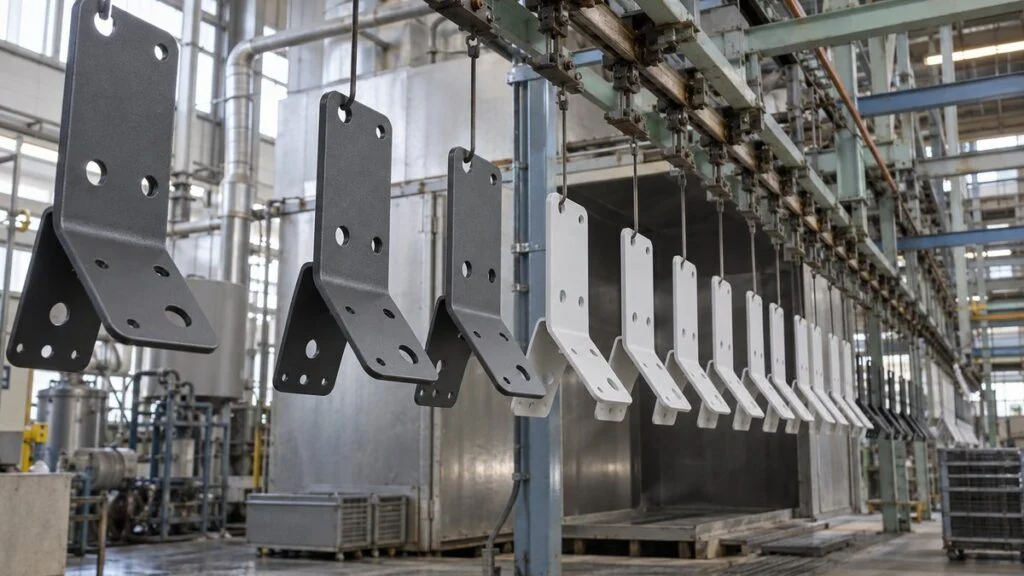
A Japanese drawing or purchase specification often gives the coating in one short note: 塗装 (toso, "coating" or "painting") followed by a process, a color, and sometimes a film thickness. You may see カチオン電着 (cationic electrodeposition, or e-coat), 粉体塗装 (funtai toso, powder coating), or メラミン焼付 (melamine baking finish), plus a color given as a Munsell value or a JPMA color code, and a test standard such as JIS K 5600. If the note says only "塗装:黒" ("coating: black"), the film thickness and corrosion performance you get will depend on whichever process the coater happens to use.
This guide explains what each part of a Japanese coating callout means, how the three common industrial processes (e-coat, powder coat, and solvent-borne liquid paint) differ in film thickness, corrosion resistance, color, and cost, and which ISO and ASTM methods correspond to the JIS test standards you will see. It ends with a checklist and a set of questions to send to your Japanese supplier or coater.
Contents
- Coating Terms You Will See on Japanese Drawings
- E-Coat vs. Powder Coat vs. Solvent Paint at a Glance
- How Each Coating Process Works
- Film Thickness and Coverage of Recesses
- Corrosion Resistance: Pretreatment and Salt Spray Tests
- Cost, Color, and Lot Size
- Choosing a Process: A Decision Flow
- Coating Test Standards: JIS, ISO, and ASTM
- What a Complete Coating Callout Includes
- Checklist: Before You Accept a Japanese Coating Callout
- Questions to Send Your Japanese Supplier
- Limits of This Guide
- FAQ
- Sources
Coating Terms You Will See on Japanese Drawings
The coating note usually sits in the drawing's notes area or in a separate purchase specification. The table below lists the terms that come up most often. The example callout after it is fictional and shows how they combine.
| Japanese | Romaji | English | What to check |
|---|---|---|---|
| 塗装 | toso | Coating / painting | Process and resin type, not just color |
| 電着塗装 / カチオン電着 | denchaku toso / kachion denchaku | Electrodeposition coating (e-coat) / cationic e-coat | Color range is narrow (mostly black or gray) |
| 粉体塗装 | funtai toso | Powder coating | Resin type (e.g., polyester) and thickness on fits and threads |
| 溶剤塗装 | yozai toso | Solvent-borne liquid paint | Number of coats (primer + topcoat) |
| 焼付塗装 / メラミン焼付 | yakitsuke toso / meramin yakitsuke | Baked finish / melamine baking finish | Whether the part can take the bake temperature |
| 膜厚 | makuatsu | Film thickness | Minimum, maximum, and where it is measured |
| 前処理 / 化成処理 | maeshori / kasei shori | Pretreatment / conversion coating | Degreasing and conversion coating type |
| マンセル / 日塗工 | manseru / nittoko | Munsell value / JPMA color code | Edition of the JPMA color book; physical color chip |
| つや (半艶 etc.) | tsuya (han-tsuya) | Gloss (e.g., semi-gloss) | A measurable gloss value instead of a word |
| 限度見本 | gendo mihon | Limit sample (boundary sample) | Who keeps it and which lot it represents |
| マスキング | masukingu | Masking | Threads, fits, ground faces, and weld areas |
For the rest of the drawing (title block, symbols, revision table), see our guide to reading Japanese engineering drawings. If the part is aluminum and the drawing says アルマイト (arumaito), the finish is anodizing rather than paint; our alumite (anodizing) guide covers those callouts.
E-Coat vs. Powder Coat vs. Solvent Paint at a Glance
The three processes differ in the form of the paint and in how it reaches the part. E-coat deposits waterborne paint from a tank using electric current, powder coat uses a dry powder that is melted and cured in an oven, and solvent paint is a liquid sprayed onto the part. The figure below compares them. Treat the numbers as general guidance: actual values depend on the paint and the coater's equipment.
How the paint is applied drives the differences in film thickness, coverage, and color choice.
Values are general figures from coaters' and paint makers' published information. Actual specifications depend on the paint and equipment.
| E-coat | Powder coat | Solvent paint | |
|---|---|---|---|
| Strength | Thin, even coverage everywhere | Thick, tough film | Color flexibility, quick changeover |
| Typical film | 15–50 µm (0.6–2.0 mil) | 40–100 µm (1.6–3.9 mil) | About 20 µm (0.8 mil) per coat |
| Recesses | Reaches inside closed sections | Hard to coat | Only where the spray reaches |
| Color choice | Narrow (mostly black and gray) | Wide, but hard to fine-tune | Widest |
| Best lot size | High-volume runs of the same part | Medium to large lots | Small lots, high part variety, short lead times |
| Typical parts | Steel parts with closed sections that need rust protection inside | Outdoor products such as guardrails | Prototypes, equipment covers, touch-up |
Coating is only one way to protect a part. If the goal is corrosion protection, alternatives include plating, anodizing (for aluminum), or a corrosion-resistant material.
Related: JIS Plating Callouts (Ep-Fe/Zn8/CM2) and ASTM Equivalents
How Each Coating Process Works

The real difference is how each process carries the paint to the surface and how it hardens. Knowing that makes the thickness and color limits later in this guide easy to predict.
E-Coat: Paint Deposited by Electric Current
In electrodeposition coating, the whole part is dipped into a tank of waterborne paint, and direct current flows between the part and electrodes. In cationic e-coat, today's mainstream type, the part is the negative electrode and attracts positively charged paint particles, which deposit on its surface.
As the film builds, it resists current, so deposition slows and stops where the part is already coated. Current then shifts to areas that are still bare, including recesses. This is why e-coat reaches the inside of closed sections and the gaps around welds, a property coaters call throwing power (つきまわり, tsukimawari).
Voltage and time control film thickness, and excess paint is recovered and returned to the tank.
E-coat grew up with the auto industry. Ford first used anodic e-coat as a primer on car bodies in 1963, and Japanese automakers adopted it from the 1960s. Cationic e-coat, which protects steel better, arrived in Japan in 1977 and is now the standard primer for car bodies. A car body is dipped whole and covered inside and out with an e-coat film of about 0.02 mm, roughly one-fifth the thickness of a human hair. Protecting the inside of doors and pillars, where a spray gun cannot reach, is e-coat's main value.
Powder Coat: Electrostatic Powder Cured in an Oven
Powder coating uses a dry powder of resin and pigment. In electrostatic powder coating, the most common method, the spray gun charges the powder with high voltage, and the powder clings to the grounded part. An oven then melts the powder so it flows into a continuous film.
Because powder contains no solvent, curing releases no volatile organic compounds (VOCs). Powder that misses the part can be collected and reused, so with a recovery system, material efficiency can reach about 95%.
Powder resins are either thermosetting or thermoplastic. Industrial parts usually use thermosets such as epoxy, polyester, or acrylic. Thermoplastics such as polyethylene are applied by fluidized-bed dipping of a preheated part, which can build films a millimeter or more thick.
Solvent Paint: Liquid Sprayed and Dried or Baked
Solvent-borne paint is the familiar method: liquid paint thinned with organic solvent is sprayed on and then air-dried or baked. It offers a wide choice of resins, including melamine, acrylic, urethane, epoxy, and fluoropolymer.
Because the paint is liquid, it can be tinted to match a color, and it can produce metallic and textured finishes. Changing color only means changing the paint, so solvent paint suits small lots, a wide variety of parts, and short lead times. The evaporating solvent, however, requires local exhaust ventilation, protective equipment, and other workplace controls.
The melamine baking finish (メラミン焼付) common on industrial parts is typically baked at 140–150°C (284–302°F) for about 20 minutes and gives about 20 µm per coat. It is widely used on steel furniture, building materials, and machine parts, mostly for products kept out of direct sunlight.
Film Thickness and Coverage of Recesses

Film thickness is usually the first factor in choosing a process. Film thickness directly affects rust protection and impact resistance, but too much thickness affects dimensions and fits. Each process has its own clear thickness range.
Powder coat builds thick films; e-coat and solvent paint work in thinner ranges.
Typical for industrial coatings using thermosetting resins. Thermoplastic fluidized-bed coatings can range from 200 µm to a millimeter or more. 25.4 µm = 1 mil.
Thick Films: Powder Coat
Powder coat's main advantage is a thick film in a single coat, reportedly about four to five times what one coat of solvent paint gives. A thick film resists scratches and impact, which is why powder coat is used for rust protection on guardrails and other outdoor products.
The flip side is that powder is hard to apply thin; films below about 35 µm (1.4 mil) are considered difficult. On parts with many threads or fits, the film thickness adds directly to the dimensions, so you either mask those areas or choose a thinner process. Decide how to handle tight-tolerance features at the design stage; our JIS B 0405 general tolerance guide covers how Japanese drawings handle tolerances.
Complex Shapes: E-Coat
E-coat clearly wins on parts with areas a spray gun cannot reach: the inside of tubes, box-section frames, and welded closed sections. As explained above, the coated surface resists current, so the film keeps building in recesses.
Powder coat and solvent paint cover outer surfaces well, but electrostatic force weakens in recesses and inside corners, so the film there tends to be thin. Rust usually starts in exactly those thin spots, so the more complex a steel part is, the more e-coat is worth.
Corrosion Resistance: Pretreatment and Salt Spray Tests

"Which coating rusts least?" is a common question, but the process alone does not decide it. Corrosion resistance depends on the combination of pretreatment, coating type and thickness, and number of layers. A car body's paint system shows how the layers divide the work.
The e-coat stops rust; the layers above handle appearance and weathering.
Car bodies typically have three to five layers in total, including e-coat, intermediate coat, and topcoat. Industrial parts often use e-coat alone or a two-coat system of e-coat plus topcoat.
Pretreatment Matters as Much as the Paint
Every process needs pretreatment: removing oil and rust and applying a conversion coating to improve adhesion. Poor pretreatment leads to under-film corrosion, where rust spreads beneath a coating that still looks fine, followed by early blistering or peeling.
When you compare quotes, check the pretreatment (whether degreasing and conversion coating are included, and which type) as well as the coating process. Price gaps often come from here, and a low quote that cuts back on pretreatment is not unusual.
As general tendencies, cationic e-coat protects steel well, and some coaters advertise passing 1,000 hours or more of salt spray testing. Powder coat relies on its thick film and is used on outdoor steel structures. Solvent paint goes on thin per coat, so applications that need rust protection normally use a primer plus topcoat.
How to Read Salt Spray Hours
Japanese specifications often rate corrosion resistance with the salt spray test of JIS Z 2371 or the cyclic corrosion test of JIS K 5600-7-9, which repeats salt spray, drying, and wetting. A typical spec line reads "塩水噴霧 ○時間 赤錆なし" ("salt spray, X hours, no red rust").
Testing laboratories themselves warn that salt spray hours cannot be converted into years of outdoor service. Real corrosion varies widely by region and environment, and the test does not reproduce every environmental factor. Use the hours to compare coating specifications tested under the same conditions, not to predict service life.
Cost, Color, and Lot Size

Alongside performance, cost, color, and lot size shape the decision in purchasing. The figure groups the factors a coater weighs when quoting.
Equipment and changeover affect the unit price more than the paint itself.
Efficiency figures are from Nippon Paint Holdings and Nordson published information. Unit prices vary widely with shape, lot size, pretreatment, and masking.
Why Lot Size and Color Change the Price
E-coat colors are mainly black and gray. Some coaters run a single color per tank, so changing color can mean replacing all of the paint. Think of e-coat as a process whose unit price falls the more identical parts you run through it.
Powder coat comes in many colors, but unlike liquid paint it cannot be blended to fine-tune a shade, so closing a gap to a color sample afterward is difficult. Solvent paint offers the most freedom to tint and is strongest for prototypes, touch-up, and small runs of custom colors.
VOC Rules and the Move Away from Solvents
Japan's Air Pollution Control Act regulates VOC emissions from spray coating facilities with an exhaust capacity of 100,000 m³/h or more and from coating drying facilities with a blower capacity of 10,000 m³/h or more. For spray coating facilities, the emission limit is 400 ppmC for new automotive facilities and 700 ppmC for others. Drying facilities for electrodeposition are excluded from the drying-facility category. Even plants below the thresholds are switching from solvent paint to powder or waterborne paint, for workplace reasons or because customers ask for it. If your Japanese supplier proposes a process change for environmental reasons, ask how film thickness and color limits will change.
Choosing a Process: A Decision Flow
The flow below narrows the choice based on the part. Work from the top, and treat the first "yes" as your first candidate.
Check material and heat tolerance first, then narrow down by shape, environment, and lot size.
Can the part not withstand the bake temperature?Assemblies with plastic parts, thin parts that warp with heat
Air-dry solvent paintAluminum part coated over anodizing?Aluminum window frames and other building products
Anodic e-coat, etc.Steel part needing rust protection inside closed sections?Tube frames, welded assemblies, high-volume stampings
Cationic e-coatOutdoor use needing a thick film or impact resistance?Guardrails, outdoor products
Powder coatMany colors, custom colors, small lots, or short lead times?Prototypes, equipment covers, touch-up
Solvent paintIf several conditions apply, a two-coat system (e-coat for rust protection, then powder or solvent paint for color) is also an option.
Aluminum and Plated Parts
Besides cationic e-coat, there is anodic e-coat, in which the part is the positive electrode. It cures at a lower temperature and can produce a clear film. It protects against rust less well than cationic e-coat but suits aluminum, so aluminum window frames and similar building products use anodic e-coat.
On aluminum parts, the alloy also affects which surface treatment works well; see our guide to JIS aluminum alloy designations. Leaving the part uncoated in a corrosion-resistant material is another option, covered in our guide to JIS stainless steel grades. For galvanized steel or other plated parts, the pretreatment for adhesion depends on the substrate, so compare plating and coating options side by side.
E-Coat Plus Topcoat
A common request is rust protection inside the part with a specified color outside. The usual answer is a two-coat system: e-coat as a rust-protective base, then powder or solvent paint for color. The car body layers in Figure 4 take this idea to its limit.
Two coats mean an extra process step and a higher unit price, but each layer does one job, so neither rust protection nor appearance is compromised. Forcing one process to do both can lead to excess thickness or uncoated spots, and fixing those problems can end up costing more than the second coat.
Coating Test Standards: JIS, ISO, and ASTM
Japanese coating specs cite JIS test methods. JIS K 5600 is a multi-part series titled "Testing methods for paints," and many of its sections were prepared from ISO methods. The table lists the ones you are most likely to meet, with the ISO basis stated in the JIS itself and the ASTM method a US shop would typically use. "Comparable" here means the same kind of test, not interchangeable results.
| What is tested | JIS standard | ISO basis (as stated in the JIS) | Comparable ASTM method | Watch for |
|---|---|---|---|---|
| Film thickness | JIS K 5600-1-7 | ISO 2808:2007, modified (MOD) | ASTM D7091 (dry film thickness with magnetic and eddy-current gauges) | Agree on measurement points and gauge type |
| Adhesion (cross-cut) | JIS K 5600-5-6 | Translation of ISO 2409:1992 | ASTM D3359, Method B | Scales run in opposite directions: JIS/ISO class 0 is best; ASTM 5B is best |
| Specular gloss | JIS K 5600-4-7 | Translation of ISO 2813:1994 (20°, 60°, 85°) | ASTM D523 | State the angle (usually 60°) |
| Neutral salt spray | JIS Z 2371 | ISO 9227:2012, modified (MOD); NSS at 35°C (95°F) | ASTM B117 | Hours do not convert to service years |
| Cyclic corrosion | JIS K 5600-7-9 | Not verified for this guide | No direct equivalent assumed | Ask for the cycle conditions in writing |
| Color | JPMA color code or Munsell value | None | ASTM D1535 (specifying color by the Munsell system) | Approve a physical chip; Munsell values in the JPMA book are reference only |
Cross-Cut Results: Class 0 Is Not a Failure
The cross-cut test in JIS K 5600-5-6 grades adhesion in six classes, from 0 (cut edges completely smooth, no flaking) to 5. ASTM D3359 also has six classes but runs the other way, from 5B (no coating removed) down to 0B. A Japanese report that says "分類0" (bunrui 0, class 0) is the best possible result, not a zero score. The cut spacing in the JIS method depends on film thickness (1 mm up to 60 µm on hard substrates, 2 mm for 61–120 µm, and 3 mm for 121–250 µm), so check that the report states it.
Color Callouts: JPMA Codes and Munsell Values
Japanese drawings give color in two ways. A Munsell value such as N7 or 5Y 7/1 describes the color by hue, value, and chroma. A JPMA code refers to the Standard Paint Colors book published by the Japan Paint Manufacturers Association (日本塗料工業会, Nihon Toryō Kōgyōkai, often shortened to 日塗工, nittoko). The book is revised every two years; the 2024-P edition has 600 gloss colors. Since the 1995 edition, only the first letter of a code changes between editions, so K15-90B in the 2019-K edition and P15-90B in the 2024-P edition are the same color.
JPMA lists a Munsell value for each color but states that these are not exact, and that colors should be identified by the JPMA code, not the Munsell value. Ordering paint outside Japan from a Munsell value alone can therefore produce a visible mismatch. We found no official cross-reference from JPMA codes to RAL or US federal color numbers. The safe path is to get a physical color chip or painted sample from Japan and approve the match against it.
What a Complete Coating Callout Includes
Most coating problems come from how the requirement is written, not from the choice of process. A drawing note or purchase specification that covers the items below prevents most misunderstandings with the coater.
Go beyond process and color: specify thickness, pretreatment, and areas to leave uncoated.
When a company or customer standard defines the coating spec, the drawing usually just cites that standard number.
Because the notes area of a drawing is small, Japanese companies often put the details in an in-house coating standard or purchase specification and cite its number on the drawing. If you see a reference such as a company standard number instead of a full callout, ask for that document; the drawing alone will not tell you the thickness or tests.
Common Gaps and the Problems They Cause
A few problems come up again and again. Each can be prevented with one conversation with the coater before ordering.
- Paint on fits or threads prevents assembly (masking not specified).
- With e-coat, paint or water trapped in a closed section drips out later (no drain holes designed in).
- Hanger marks appear on a cosmetic face (hanging points not specified).
- Color varies from lot to lot (color code given, but no limit sample).
- Paint on ground faces or areas to be welded blocks electrical continuity or welding (uncoated areas not specified).
E-coat in particular needs vent and drain holes planned at the design stage, because the part is dipped. Without vents, trapped air leaves areas uncoated; without drains, paint left inside runs or stains in the oven.
On the purchasing side, send the operating environment, required service life, and annual volume along with the drawing when you request a quote. The coater can then propose a process and pretreatment, and the earlier the spec is agreed, the less rework later. For receiving inspection, the basics are film thickness with a gauge, appearance, and cross-cut adhesion; build the frequency and criteria into your inspection plan and check the first lot closely. Our overview of the quality assurance process at Japanese plants shows where these checks fit.
Checklist: Before You Accept a Japanese Coating Callout
- Process and resin named (e-coat, powder, or solvent; e.g., polyester powder, melamine baked)
- Single coat or system (e.g., e-coat plus topcoat), with thickness per layer or total
- Film thickness minimum and maximum, measurement points, and gauge method (JIS K 5600-1-7 or ASTM D7091)
- Masked areas: threads, fits, ground faces, weld areas
- Pretreatment: degreasing and conversion coating type; substrate (steel, galvanized, aluminum)
- Color: JPMA code with edition letter, or Munsell value, plus an approved physical chip
- Gloss: a measured value and angle (e.g., 60°) instead of only a word such as 半艶
- Adhesion test and pass level, with the scale direction made clear (JIS class 0 = best; ASTM 5B = best)
- Salt spray or cyclic corrosion test: standard, hours or cycles, scribe or no scribe, pass criterion
- Vent and drain holes (for e-coat) and acceptable hanger mark locations
- Any company or customer coating standard cited on the drawing, and a copy of it
Questions to Send Your Japanese Supplier
You can adapt the questions below for an email to the Japanese supplier or coater.
- The drawing says "塗装:___". Which process and resin system does this mean (cationic e-coat, polyester powder, melamine baked, etc.)?
- What are the minimum and maximum film thicknesses, and where on the part do you measure them?
- What pretreatment do you apply before coating (degreasing, conversion coating type)?
- The color is given as ___. Which JPMA edition or paint maker code does this refer to? Can you send a physical color chip or painted sample for approval?
- What gloss level do you target, measured at what angle?
- Which adhesion and corrosion tests do you run, under which standard edition, and what are the pass criteria?
- Is the coating spec defined in a company or customer standard? If so, can you share it?
- If we coat this part locally, which conditions must stay the same for the part to remain acceptable to you?
Limits of This Guide
- Film thickness, efficiency, and bake values are typical figures from coaters' and paint makers' published information. Actual values depend on the paint, the coater's equipment, and the part.
- The ISO relationships come from the JIS forewords for the editions we checked; standards are revised, so confirm the edition in your contract. ASTM methods listed as comparable are not proven to give the same results.
- We did not verify an ISO counterpart for the JIS K 5600-7-9 cyclic corrosion test, or any official mapping from JPMA codes to RAL or other color systems.
- Many Japanese companies define coating in their own standards. When a company standard conflicts with this guide, the company standard governs.
- Environmental and workplace rules for coating differ by country and region; this guide does not cover them outside the brief note on Japan.
FAQ
Is powder coat or solvent paint better for rust protection?
Powder coat usually has the edge, because one coat gives a much thicker film than solvent paint. Corrosion resistance also depends on pretreatment and the layer system, though, and solvent paint with a primer and topcoat is used for rust protection too.
What does 焼付塗装 (baked finish) mean on a Japanese drawing?
It means the paint is cured in an oven so the resin hardens into a tough film. The common melamine baking finish (メラミン焼付) is typically baked at 140–150°C (284–302°F) for about 20 minutes, so confirm that the part can take that heat.
How many years of outdoor service do salt spray hours represent?
Salt spray hours cannot be converted into years. Testing laboratories warn that salt spray hours cannot be converted into outdoor service years, because real corrosion depends heavily on the environment. Use the hours to compare coating specs tested under the same conditions.
Can e-coat be done in colors other than black?
E-coat is mainly black or gray, and changing color means replacing the paint in the tank. When a specific color is required, the usual approach is e-coat for rust protection with a powder or solvent topcoat for color.
Is a Munsell value enough to match a Japanese paint color?
Often not. Japanese drawings do use Munsell values, but JPMA states that the Munsell values listed in its color book are not exact and that its colors should be identified by the JPMA code. Whichever notation the drawing uses, get a physical chip or sample from Japan and approve the color against it.
Sources
- E-coat principle, car body film thickness, material efficiency: Nippon Paint Holdings, electrodeposition coating technology (Japanese)
- Car body layer count and role of e-coat: Kansai Paint, automotive coatings (Japanese)
- History of e-coat and the shift to cationic: Murakami, "History and principle of electrodeposition coating," Journal of the Surface Finishing Society of Japan, Vol. 53, No. 5 (2002) (Japanese)
- Cationic e-coat process, thickness, colors: Hibara Corporation (Japanese)
- Cationic e-coat and salt spray results: Nippon Denka Koki (Japanese)
- Anodic vs. cationic e-coat; recommended thickness by process: Tama Kako, Tama Kako, film thickness (Japanese)
- Powder coating principle, efficiency, drawbacks: Nordson Japan (Japanese)
- Powder and solvent coating: Hibara Corporation, powder, Hibara Corporation, solvent (Japanese)
- Melamine baking conditions and thickness: Fujix, Okuma Kotoh (Japanese)
- VOC rules under Japan's Air Pollution Control Act: Toyota City (Japanese)
- Salt spray hours and service life: Kobe Material Testing Laboratory (Japanese)
- Cyclic corrosion test: Japan Paint Inspection and Testing Association (Japanese)
- JIS K 5600-5-6 (cross-cut, from ISO 2409:1992): JIS text (Japanese)
- JIS K 5600-1-7 (film thickness, ISO 2808:2007 MOD): JIS text (Japanese)
- JIS K 5600-4-7 (gloss, from ISO 2813:1994): JIS text (Japanese)
- JIS Z 2371 (salt spray, ISO 9227:2012 MOD): JIS text (Japanese)
- JPMA Standard Paint Colors, code structure and Munsell note: Japan Paint Manufacturers Association
- ASTM D3359 cross-cut classes: Centexbel, cross-cut test per ISO 2409 / ASTM D3359
Original article in JapaneseThis guide is adapted from a MONOSCOPE article written for readers in Japan: 粉体塗装・電着塗装・溶剤塗装の違い|膜厚・耐食性・コストで選ぶ工業塗装
About the editor
 MONOSCOPE EditorFOUNDER & EDITOR
Spent about ten years at a plant equipment maker and a plant engineering company, proposing, designing, and commissioning equipment, then moved into web marketing. Now a web consultant for B2B manufacturers, helping them explain their products and technology. Licensed in Japan as an Energy Manager and a Third-Class Chief Electrical Engineer.
Has run an engineering blog since 2017 (500+ articles) and a Japanese YouTube channel with about 20,000 subscribers. Each English guide is written from the Japanese shop-floor point of view and checked against the cited standards.