Small Once-Through Boilers in Japan: Multi-Unit Control
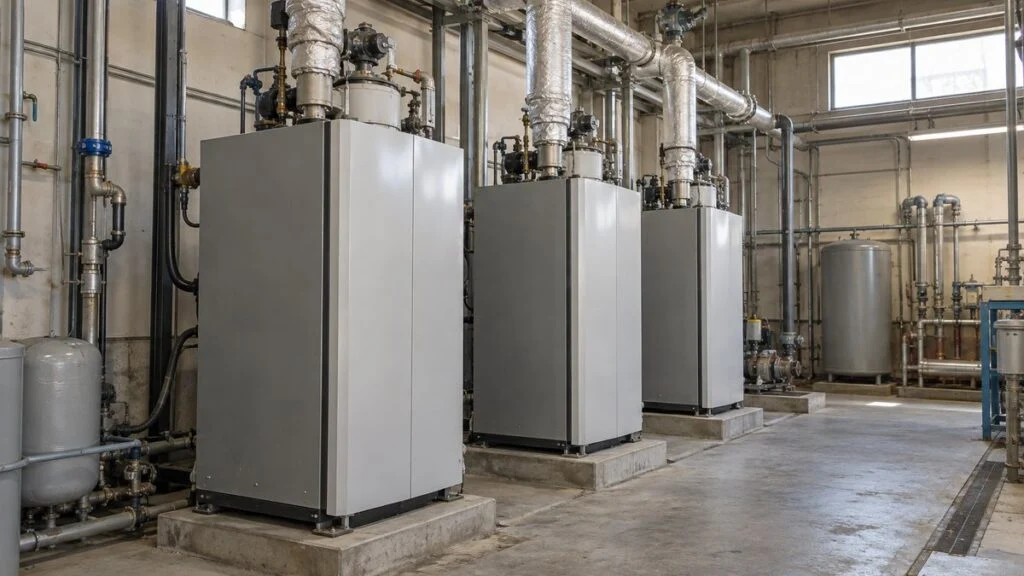
Your Japanese parent company sends the utility specification for a new plant in Thailand, India, or the US. Where you expected one large fire-tube boiler, it calls for "小型貫流ボイラー 2 t/h × 4 units, 台数制御": four small once-through boilers piped to one steam header and run by a multi-unit controller. This layout is common in Japanese factories, and Japanese makers such as Miura sell it as a packaged system. This guide explains how it works, how to read the Japanese ratings, and what to confirm before you accept the design.
The short answer: a small once-through boiler (kogata kanryu boiler) heats water as it passes once through a bank of tubes, holds very little water, and comes up to steam quickly. Japanese plants often install several of them side by side and let a controller start, stop, and modulate each unit to follow steam demand. The benefits are real, but they depend on your load profile, water treatment, and layout, not on the number of units alone.
Contents
- What Is a Small Once-Through Boiler?
- Why Japanese Plants Install Several Units Instead of One
- How Multi-Unit Control Works
- Low Water Content and Fast Startup
- Reading Japanese Efficiency Figures
- Floor Space: The Boiler Room Is More Than the Boilers
- Sizing the Units: Data to Collect First
- Checklist and Questions for the Japanese Side
- Limits of This Guide
- FAQ
- Sources
What Is a Small Once-Through Boiler?
In a once-through boiler, feedwater enters the water tubes at one end, picks up heat from the combustion gas flowing outside the tubes, and leaves the other end as steam. There is no large shell or drum full of water, which is the main difference from a fire-tube (shell) boiler.
Figure 1: Water and Heat Paths in a Small Once-Through Boiler
Conceptual cross-section. Water inside the tubes and combustion gas outside them exchange heat without mixing.
The number of tubes, flow path, and whether a separator is fitted vary by model. This is not a drawing of any product's tube layout or dimensions.
Some models have a steam separator (kisui bunriki) at the outlet to remove water droplets before the steam goes out. Because the tubes hold so little water, the control system has to keep feedwater flow matched to the firing rate at all times. That water is what keeps the tubes cool.
"Small" in the Japanese name has two meanings, and they are easy to confuse. It describes the physical size of a packaged unit, and it is also a legal class, "small boiler" (kogata boiler), under Japan's Industrial Safety and Health Act. A product sold as a "small once-through boiler" is not automatically a "small boiler" in the legal sense. The class depends on maximum pressure, heat transfer area, and separator size, as explained in Boilers in Japan: Legal Classes, Operator Licenses, Fuels.
Japanese catalogs rate these boilers by equivalent evaporation (soto johatsu-ryo, also kansan johatsu-ryo) in kg/h or t/h. Current gas-fired lineups include units rated at 2–3 t/h; Samson's SE series, for example, comes in 2,000, 2,500, and 3,000 kg/h ratings. Equivalent evaporation is a heat rating converted to standard conditions, so read it together with your steam pressure and feedwater temperature. At typical plant conditions, the actual steam flow is lower than the rating. The worked conversion is in the boiler classes guide above.
Why Japanese Plants Install Several Units Instead of One
Japanese engineers call this layout tasu setchi (multiple installation). Miura Co., Ltd., which began making small once-through boilers in 1960 and still treats them as its core product, markets its version as the MI (Multiple Installation) system. Samson Co., Ltd. is another Japanese maker of the same type of boiler. Miura also sells the MI system through subsidiaries in the US, Thailand, Indonesia, Malaysia, and other countries, so you may meet it outside Japan as well.
The usual reasons:
- Load following. Several small units can be switched on and off to track steam demand, instead of one large boiler running at low load at night or on weekends.
- High efficiency. Tube heat transfer design, combustion control, and economizers that preheat feedwater with flue-gas heat give high rated efficiencies, and each unit can be kept near its efficient firing range (see the efficiency section below).
- Fast startup. Little water means little heat to bring the boiler up to steam. Miura says its once-through units reach full pressure steam from a cold start in five minutes or less.
- Backup. One unit can be shut down for maintenance while the others keep running, provided the remaining units can carry the load.
- Floor space. Compact packaged units can be fitted into an existing boiler room or replaced one at a time while the plant keeps running.
- Lighter legal treatment in Japan. Under Japanese law, once-through boilers at 1 MPa gauge or less with up to 10 m² of heat transfer area are typically "small boilers" (those up to 5 m² are "simple boilers"), provided header and steam separator size limits are also met. Small boilers need operators with special training rather than a boiler engineer license, and simple boilers need neither. Once-through units up to 30 m² that are not small boilers are "small-scale boilers," which skill-training graduates or licensed boiler engineers may operate. When a site chooses its licensed operating chief, once-through boilers count at one-tenth of their heat transfer area. See the boiler classes guide for the full thresholds.
The last point applies only in Japan. If the boilers are installed at your plant in the US, India, or Southeast Asia, your local boiler code, registration, and operator rules decide what is required, whatever the Japanese documents say about legal class.
How Multi-Unit Control Works
All units discharge into a common steam header. A pressure transmitter on the header tells the controller whether the plant is drawing more or less steam than the boilers are making. The controller then decides how many units fire and at what rate. Japanese specifications call this daisu seigyo (multi-unit control); in US terms, it is boiler staging or lead-lag sequencing with modulation.
Figure 2: Three Boilers on a Common Header Under Multi-Unit Control
Conceptual layout and staging. ● = firing, ○ = off. In practice, the controller also sets each unit's firing rate.
Solid lines are steam; dashed lines are signals. The firing pattern is illustrative. The best number of running units depends on each model's efficiency curve, minimum firing rate, and how fast the load changes.
Miura describes its MI system this way: a master controller for the whole system, a terminal on each boiler, and a pressure sensor that turns steam consumption into a firing demand sent to each unit. Preset load patterns let the plant choose how units are staged, and an automatic rotation function spreads running hours evenly across the boilers. An optional central management system adds monitoring and automatic reporting.
Three points are worth understanding before you review the control philosophy:
- Fewest units at full fire is not always best. Some models have their best efficiency point at part load, and controllers may keep more units running in that range rather than fewer units at high fire. Ask the maker for the efficiency curve of the actual model.
- Short cycling costs energy and wear. If brief swings in demand make units light off and shut down repeatedly, startup losses and burner, valve, and ignition cycles add up. The pressure bands and time delays for adding or dropping a unit are the tuning knobs that balance steady pressure against efficiency.
- More units are not automatically more reliable. A shared feedwater system, fuel train, or power supply can still stop every boiler at once. Count the common equipment, not just the boilers.
If you have worked with pumps in parallel, the logic is similar: pressure on a common header decides how many machines run. See Centrifugal Pumps in Parallel: Why Flow Doesn't Double.
Low Water Content and Fast Startup
Before a cold boiler can make steam, it has to heat its own water and metal. The heat needed to warm water rises in direct proportion to its mass, so a boiler that holds less water needs less heat to get going. The example below uses assumed water volumes, not product data.
Figure 3: How Water Content Affects Warm-Up Heat
Sensible heat of the water only. This does not predict actual startup time.
Excludes latent heat, heating of the boiler metal, heat losses, firing rate, and safety checks. It does not mean startup takes one-fifth as long.
The difference shows up most in plants that start the boilers once each morning or have long idle periods between shifts. It does not shorten the startup sequence itself: feedwater, draft, pre-ignition purge, and safety interlock checks still run in order, and low water content is never a reason to skip them.
The flip side of low water content is sensitivity to feedwater problems. Hardness scale on the tubes slows heat transfer, which lowers efficiency and can overheat the tubes. Water softener condition, water quality, and blowdown need to be part of daily checks, just like combustion tuning. Ask the maker which water quality standard its warranty assumes (in Japan, the reference standard for boiler water quality is JIS B 8223).
Reading Japanese Efficiency Figures
Japanese brochures often quote very high efficiencies. Samson's SE-WPG series, for example, is rated at 99% boiler efficiency on a lower heating value (LHV) basis, at 0.49 MPa steam pressure, 15°C (59°F) feedwater, and 35°C (95°F) combustion air, with a tolerance of ±1%. The same document recommends feedwater at 55°C (131°F) or higher in actual use, so the 15°C value is a rating condition, not an operating recommendation.
Boiler efficiency is the share of the fuel's heat that ends up in the steam. Three things push these numbers up. An economizer recovers flue-gas heat into the feedwater. Condensing the water vapor in the flue gas recovers latent heat as well. And because LHV leaves that latent heat out of the fuel's energy content, efficiency on an LHV basis can approach or even exceed 100% without creating any energy. Many US data sheets use higher heating value (HHV), which gives a lower number for the same boiler. Compare boilers only on the same heating value basis, feedwater temperature, pressure, and load.
Even on gas, a low-temperature heat recovery section needs materials and condensate drainage designed for it. Check acid dew point corrosion, which depends on the sulfur in the fuel, together with the fuel composition and how low the recovery temperature goes. Excess combustion air carries heat up the stack, so air ratio control matters for keeping efficiency high after commissioning.
To estimate fuel savings, do not subtract one efficiency from the other. Compare the fuel needed for the same useful heat:
Vendor figures for whole-system savings are higher and less general. In an energy technology sheet published through Japan's ECCJ, Miura states that a multi-unit installation can cut energy cost by about 10–30% compared with one large boiler. Miura's US site cites about 20% average annual fuel savings. Treat these as manufacturer claims and ask for the load profile and measurement basis behind them.
Floor Space: The Boiler Room Is More Than the Boilers
The compact footprint is real, but the boiler room has to hold much more than the boilers: feedwater tank, feed pumps, softeners, a deaerator where needed, the fuel train, the steam header, and room to inspect and replace parts.
Figure 4: Boiler Footprint vs. Usable Boiler Room Area
Conceptual plan including auxiliaries and maintenance aisles. Not to scale and not showing any legal clearances.
Combustion air and exhaust, safety valve discharge, drains, pipe supports, and egress also have to be worked out in detailed design.
A common miss: the boilers fit facing forward, but a side inspection cover cannot open, so every service visit means moving other equipment. Draw the removal route for a whole unit and the access path for cleaning the feedwater tank onto the layout. A change of fuel also changes the fuel piping and storage, which can affect the building plan. When you compare quotes, split out installation, flue, water and drain piping, electrical, commissioning, and the maintenance contract, not just the boiler price.
Sizing the Units: Data to Collect First
The number and size of units should come from the plant's steam demand profile, not from a total capacity figure. Collect these before the design is fixed:
- Supply: required steam flow, pressure, and quality; feedwater temperature; condensate return volume
- Operation: operating hours, minimum load, sudden demand peaks, weekends and shutdowns
- Site: fuel, water, and power supply; delivery route; maintenance space; future expansion
- Management: local code and operator requirements, daily checks, water treatment, maintenance contract, spare parts
Then check what happens with one unit out of service. Here is a fictional example. A plant peaks at 4.5 t/h of actual steam at 0.7 MPa gauge (about 102 psig), with 20°C feedwater. The specification proposes four units rated at 2,000 kg/h equivalent evaporation. Converted to actual steam at those conditions, each unit makes about 2,000 × 2,257 ÷ (2,768 − 84) ≈ 1,680 kg/h, so four units give about 6.7 t/h, and three give about 5.0 t/h. The plant can still meet its peak with one unit down for maintenance. If it could not, you would need to decide which processes get steam first during maintenance.
For before-and-after comparisons, record where steam flow was measured. Losses between the boiler outlet and the point of use do not show up in boiler efficiency. Compare periods with similar products and operating hours, and track fuel per unit of useful steam as well as total fuel cost, so you can separate fuel price changes from real efficiency gains. Put steam demand, the local legal and operator requirements, and the layout with all auxiliaries into one specification so that every option is judged on the same basis. For a large, steady load running around the clock, a design with one or more larger boilers deserves a fair comparison on load swings, capacity during maintenance, and total cost.
Checklist and Questions for the Japanese Side
Use this list when you review a Japanese specification or quotation that calls for small once-through boilers with multi-unit control:
- Unit rating: equivalent evaporation or actual evaporation, and at what pressure and feedwater temperature?
- Number of units, and the plant's peak and minimum steam demand used to choose it
- Capacity with one unit out of service, compared with peak demand
- Control philosophy: staging order, pressure bands and time delays, part-load strategy, automatic rotation
- Each model's efficiency curve, minimum firing rate, and turndown
- Efficiency basis: LHV or HHV, feedwater and air temperature, pressure, and load
- Common equipment that can stop all units (feedwater, fuel train, power, controller) and any redundancy for it
- Water quality standard the warranty assumes, softener and blowdown requirements
- Layout drawing with maintenance aisles, removal route, and flue and safety valve discharge
- Which local boiler code, registration, and operator rules apply at your site, and who confirms them
- Local service support and spare parts availability for the maker
Sample Email
Edit the bracketed parts to fit your case:
Subject: Steam boiler configuration for [project name]
Hello [name],
Thank you for the utility specification. Before we finalize the boiler configuration ([number] units × [rating] kg/h), could you confirm the following?
1. Is the rating equivalent evaporation? What actual steam flow do you expect at [pressure] MPa gauge and [temperature]°C feedwater?
2. What peak and minimum steam demand did you use to choose the number of units?
3. With one unit out of service, can the remaining units cover peak demand?
4. How will the multi-unit controller stage the units (pressure bands, time delays, rotation)?
5. Is the efficiency figure on an LHV or HHV basis, and under what conditions?
6. Which feedwater quality standard does the warranty assume?
We will confirm the local code and operator requirements on our side.
Best regards,
[your name]
Limits of This Guide
- Control features, efficiency curves, and startup times differ by maker and model. The descriptions of Miura's MI system and Samson's ratings come from the makers' own materials.
- The calculations here are simplified examples with assumed values. Use the maker's data and measured plant data for equipment selection and contracts.
- Japanese legal classes are summarized only briefly, as of October 2026. For details, see the boiler classes guide. Outside Japan, your local boiler code and regulator decide what applies.
- This guide does not describe operating or startup procedures. Follow the maker's manual and your site's procedures.
FAQ
What Is a Once-Through Boiler?
A once-through boiler is a water-tube boiler with no steam drum: feedwater enters the tubes, is heated by the combustion gas outside them, and leaves as steam in a single pass. It holds little water, so it comes up to steam quickly, but it depends on good feedwater control and water treatment.
Can a Small Once-Through Boiler Be Operated Without a License?
In Japan, a once-through boiler that falls in the legal "small boiler" class needs no boiler engineer license, but the employer must give operators special training (at least 7 hours of classroom and 4 hours of practical instruction). Other classes have different requirements. Two units with the same steam rating can fall in different classes, because the class depends on pressure, heat transfer area, and steam separator size, not on evaporation or product name. Outside Japan, local rules apply.
Is It More Efficient to Run Fewer Boilers at Full Load?
Not always. The best number of running units depends on each unit's efficiency at part load, the losses from starting and stopping, and how quickly demand changes. Evaluate the whole system with the maker's efficiency curve and your load profile.
Does Low Water Content Make Water Treatment Easier?
No. Small water content makes the tubes more sensitive to scale and feedwater problems. Softener condition, blowdown, and water quality still need regular attention to prevent scale and corrosion.
How Does a Multi-Unit Boiler Controller Decide Which Units Run?
It reads pressure on the common steam header and adds, drops, or modulates units to hold that pressure. Pressure bands, time delays, and rotation settings decide the order, and some controllers favor several units at part load when that is more efficient.
Sources
- Multi-unit installation, master control, automatic rotation, 10–30% claim, Miura overseas affiliates: JASE-W (ECCJ), Miura, "Energy Saving by Multiple Installation System of High-efficiency Small Once-through Boilers," F-36
- MI system description: Miura America, How Does Miura's Multiple Installation (MI) System Work?
- About 20% fuel savings claim: Miura America, Optimize Without Oversizing
- Startup in five minutes or less (manufacturer claim): Miura America, Products
- Miura history (small once-through boilers since 1960) and subsidiaries: Miura Co., Ltd., annual securities report text via EDINET DB (Japanese)
- SE-WPG ratings, 99% LHV efficiency and test conditions: Samson Co., Ltd., SE series announcement, 2023 (Japanese)
- Legal classes for once-through boilers: e-Gov, Order for Enforcement of the Industrial Safety and Health Act (Japanese); e-Gov, Ordinance on Safety of Boilers and Pressure Vessels (Japanese)
- Scale and water treatment: Miura, service news on tube scale and water treatment (Japanese)
- Latent heat recovery and LHV-based efficiency: Miura, 2023 release on a hydrogen-fired boiler (Japanese)
Original article in JapaneseThis guide is adapted from a MONOSCOPE article written for readers in Japan: 小型貫流ボイラーとは?5つのメリットと資格・台数制御の見方
About the editor
 MONOSCOPE EditorFOUNDER & EDITOR
Spent about ten years at a plant equipment maker and a plant engineering company, proposing, designing, and commissioning equipment, then moved into web marketing. Now a web consultant for B2B manufacturers, helping them explain their products and technology. Licensed in Japan as an Energy Manager and a Third-Class Chief Electrical Engineer.
Has run an engineering blog since 2017 (500+ articles) and a Japanese YouTube channel with about 20,000 subscribers. Each English guide is written from the Japanese shop-floor point of view and checked against the cited standards.