Japanese Machine Tool Manufacturers: Rankings and Strengths

If you are comparing quotes for a machining center or CNC lathe, or planning a visit to JIMTOF in Tokyo, you will keep running into the same Japanese names: DMG Mori, Yamazaki Mazak, Okuma, Makino, Amada, and FANUC on many of the control panels. But if you look up a "ranking" of Japanese machinery companies, the top spots go to Komatsu and Kubota, which build excavators and tractors, not machine tools.
This guide sorts that out. It shows who makes what, how big each company is (with the fiscal year for every figure, taken from company results), why Japanese machine tools hold such a strong position in export markets, how recent acquisitions are reshaping the industry, and what to check before you buy from or rely on one of these makers.
Contents
- Who Makes What: Japanese Machinery Makers by Field
- Revenue Ranking: Machinery Makers vs. Machine Tool Builders
- Why Japanese Machine Tools Are Strong
- Machine Tool Builders: Company Profiles
- CNC, Component, and Heavy Machinery Makers
- Mergers and Acquisitions in Japanese Machine Tools
- How to Size Up a Japanese Machine Tool Maker
- Checklist: Before You Buy From a Japanese Machine Tool Builder
- Questions to Ask the Japanese Builder or Distributor
- Limits of This Guide
- FAQ
- Sources
Who Makes What: Japanese Machinery Makers by Field
In Japan, "industrial machinery" covers several quite different businesses. Machine tools (工作機械, kosaku kikai), the machines that cut or form metal into parts, are only one of them. Construction and farm machinery, injection molding machines, and the CNC systems and components inside other makers' machines are separate fields with their own leaders.
The leading companies vary considerably by field.
Only representative products are listed. Most of these companies work across several fields.
In machine tools, DMG Mori, Yamazaki Mazak, Okuma, and Makino are often called the big four, and Amada is a major player in sheet metal machines. Citizen Machinery is another name you will see on Swiss-type lathes; see Citizen Machinery: Cincom vs Miyano Lathes and LFV Explained.
FANUC and SMC rarely appear on the outside of a finished machine, yet they report large sales and high margins as suppliers of CNC systems and pneumatic parts to machine builders. Distributors such as Yamazen and Yuasa Trading connect machine builders with users; for how that channel works in automation, see Japanese Factory Automation: Makers, Distributors, SIers.
Revenue Ranking: Machinery Makers vs. Machine Tool Builders
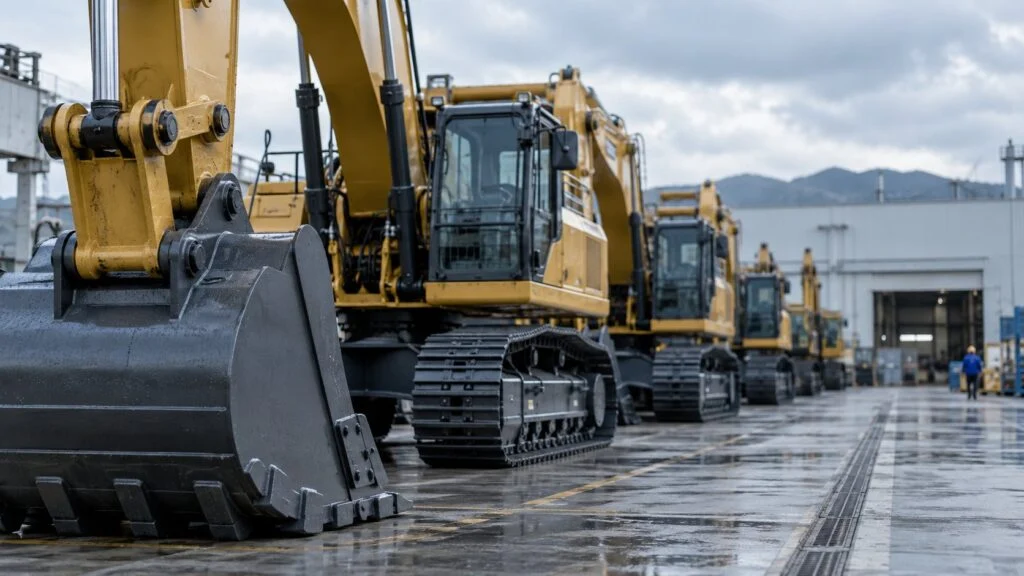
Ranked by consolidated revenue in their latest full fiscal year, the construction and farm machinery makers are far larger than the machine tool builders. Fiscal years differ by company, so each bar shows the year end.
Consolidated revenue, JPY billion. Fiscal year ends differ by company.
Based on company financial results (DMG Mori and Amada report "sales revenue" / "revenue"). Figures are company-wide and include businesses outside machinery and machine tools.
Komatsu and Kubota report revenue in the trillions of yen, while the companies that focus on machine tools report revenue in the hundreds of billions of yen. A revenue ranking is not a ranking of machine tool strength. Kubota also runs a water and environment business, and Sumitomo Heavy Industries sells gear reducers, injection molding machines, and construction machinery, among other products.
Yamazaki Mazak, one of the largest machine tool builders, is privately held and does not appear in this comparison. Treat the chart as a sense of scale only, since the fiscal years do not line up.
Why Japanese Machine Tools Are Strong
Three things explain why Japanese machine tools are so common in plants in the US, India, and Southeast Asia: export strength, the domestic supply of CNC systems, and an industry that publishes its own demand data and runs one of the world's largest machine tool shows.
Export Strength
According to JETRO, citing 2022 data, China was the largest producer of machine tools by value with a 28.1% share, followed by Japan at 13.1% and Germany at 12.7%. Exports tell a different story: Germany held 16.7% of world exports and Japan 16.6%, ahead of China at 14.4%. China builds the most, largely for its own market, while Japan and Germany lead in exports. China's output is generally seen as concentrated in lower-end models, with Japan and Germany stronger in mid-range to high-end machines.
CNC Systems Made in Japan
A machine tool is only as capable as its CNC (computer numerical control) system. Japan is home to FANUC, a leading global CNC maker, and Mitsubishi Electric also supplies CNCs. Some builders go further and develop their own controls: Okuma uses its OSP control and Mazak its MAZATROL. For buyers, the CNC brand matters almost as much as the mechanical design, because it decides who supports the control, the software, and the spare parts. For FANUC's business in detail, see FANUC Business Model: What It Means for Buyers and Users.
JMTBA Orders Data and JIMTOF
The Japan Machine Tool Builders' Association (JMTBA) publishes monthly machine tool orders, split into domestic and foreign demand. Analysts and suppliers watch it as a leading indicator of capital spending. For calendar 2025, orders totaled JPY 1,604.32 billion, up 8.0%. Domestic orders were JPY 440.86 billion and foreign orders JPY 1,163.46 billion, so about 72.5% of orders came from outside Japan.
JMTBA and Tokyo Big Sight also run JIMTOF (Japan International Machine Tool Fair), held every two years at Tokyo Big Sight. JIMTOF 2026 runs from October 26 to 31, 2026, Monday through Saturday. Builders often use it to launch new models, so it is a good place to compare Japanese makers side by side.
Machine Tool Builders: Company Profiles
DMG Mori
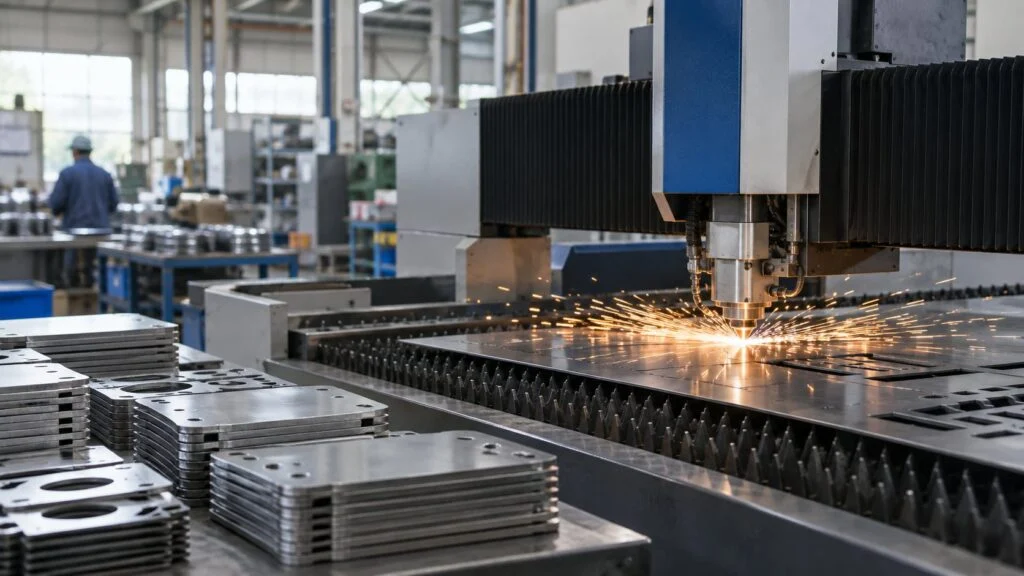
DMG Mori took its current shape through the combination of a Japanese machine tool builder (Mori Seiki) and a German one (Gildemeister). It offers a broad range of machining centers and multitasking machines. For FY2025 (January–December 2025), sales revenue fell 4.8% to JPY 515.0 billion, while consolidated orders rose 5.5% to JPY 523.4 billion.
By region, EMEA (including Germany) made up 55% of orders, the Americas 24%, Japan 10%, China 6%, the rest of Asia 5%, and India 2% (shares are rounded). About 90% of orders come from outside Japan, which gives DMG Mori a strongly international profile.
Yamazaki Mazak
Yamazaki Mazak is one of the largest machine tool builders in Japan, known for lathes, multitasking machines, and its MAZATROL control. Because it is privately held, it does not publish results the way listed companies do, and we do not give revenue figures here.
Okuma
Okuma builds lathes and machining centers and develops its own CNC, the OSP. For the fiscal year ended March 2026, net sales rose 14.1% to JPY 235.9 billion and operating income rose 5.8% to JPY 15.5 billion, helped by overseas growth: sales in China rose 55.0% to JPY 53.0 billion. Designing the machine and the control in-house is Okuma's distinguishing strength.
Makino
Makino Milling Machine is strong in machining centers and EDM (electrical discharge machining), and is known for high-precision work such as molds, dies, and aerospace parts. For the fiscal year ended March 2026, net sales rose 11.5% to JPY 261.2 billion and operating income rose 35.2% to about JPY 25.0 billion. Makino has also been at the center of recent consolidation, covered in the M&A section below.
Amada
Amada leads in sheet metal machines that cut and bend metal plate, including laser cutting machines and press brakes. For the fiscal year ended March 2026, revenue rose 10.3% to a record JPY 437.4 billion, and operating profit was JPY 44.8 billion. Demand for sheet metal used in data center server racks and air conditioning equipment in North America and Asia helped. In 2025 it announced the acquisitions of H&F (presses) and Via Mechanics (PCB drilling machines) to widen its range.
CNC, Component, and Heavy Machinery Makers
These companies are not machine tool builders, but they shape the market around them. We keep the profiles short here and link to fuller guides where one exists.
FANUC
FANUC makes CNC systems, industrial robots, and compact machines (ROBOMACHINE). For the fiscal year ended March 2026, net sales hit a record JPY 857.8 billion with an operating margin of 21.4%. Robots were 44.1% of sales, FA (factory automation, including CNCs) 24.3%, and service 16.5%. About 87% of sales came from outside Japan, with Asia (JPY 352.6 billion) and the Americas (JPY 232.2 billion) the largest regions, ahead of Europe (JPY 152.4 billion) and Japan (JPY 110.8 billion). See our FANUC guide for the details.
SMC
SMC leads in pneumatic components such as air cylinders and solenoid valves. For the fiscal year ended March 2026, net sales were JPY 842.5 billion with an operating margin of 22.6%, and about 80% of sales came from outside Japan (Japan about 20%, China about 28%, calculated from regional sales). It supplies a huge number of machine builders and plants, which makes it a typical example of a component maker. For SMC and other automation suppliers, see Japanese Factory Automation Companies: Who Makes What.
Komatsu
Komatsu is a global maker of construction and mining equipment. For the fiscal year ended March 2026, net sales rose 0.7% to JPY 4,132.8 billion, and operating income fell 13.7% to JPY 567.3 billion. The construction, mining, and utility equipment segment brought in JPY 3,796.1 billion, so results move with construction and mining investment, as well as with material and logistics costs. The industrial machinery and others segment, which includes large presses for automakers, had sales of JPY 236.1 billion.
Kubota
Kubota is a major maker of tractors and other farm machinery, along with compact construction equipment and water and environment systems. For the year ended December 2025, revenue was JPY 3,018.9 billion and operating profit JPY 265.5 billion. Overseas revenue was 77.3% of the total, and North America alone was about 40%, so the North American market drives its results.
Hitachi Construction Machinery and Sumitomo Heavy Industries
Hitachi Construction Machinery reported revenue of JPY 1,405.5 billion for the fiscal year ended March 2026. In 2022, Hitachi, Ltd. sold a 26% stake in the company to a joint venture of ITOCHU and Japan Industrial Partners, and the company plans to rename itself LANDCROS in April 2027. Sumitomo Heavy Industries reported net sales of JPY 1,066.9 billion for the year ended December 2025, across gear reducers, injection molding machines, construction machinery, and other products.
Mergers and Acquisitions in Japanese Machine Tools
Since 2021, acquisitions have been redrawing the Japanese machine tool industry. The main moves fall into three groups: Nidec's string of purchases, the fight over Makino, and deals by the established builders.
Nidec's acquisitions, the Makino takeover attempts, and other deals.
Based on company announcements and press reports. Dates show the announcement or the relevant step.
From 2021 to 2023, Nidec bought Mitsubishi Heavy Industries Machine Tool, OKK, and Takisawa in Japan, plus PAMA in Italy, and quickly built a machine tool business. In December 2024 it announced an unsolicited tender offer for Makino and launched it in April 2025. After the Tokyo District Court declined to block Makino's defensive measure, Nidec withdrew the offer in May 2025.
Makino then agreed to a tender offer from MM Holdings, a vehicle of the investment fund MBK Partners, announced in June 2025. On April 22, 2026, the Minister of Finance and the Minister of Economy, Trade and Industry recommended halting the deal under the Foreign Exchange and Foreign Trade Act (FEFTA), Japan's foreign investment screening law. The ministers pointed to Makino's high-performance machine tools, which are widely used by Japanese defense equipment makers. MBK accepted the recommendation on April 30, 2026, and dropped the offer. A legal commentary describes it as the first such recommendation in 18 years. The case shows that Japan now treats high-end machine tools as a national security matter.
The established builders are buying, too. DMG Mori acquired Kurashiki Kikai in 2023 to add horizontal boring and milling machines, a category it did not offer, and Amada announced the H&F and Via Mechanics deals in 2025. Buying technology and product lines they lack is likely to continue.
How to Size Up a Japanese Machine Tool Maker
If you are choosing a supplier, revenue is only the starting point. Three more things tell you how the company is likely to behave as a long-term partner.
Layer these three on top of the revenue ranking to see what kind of company you are dealing with.
Profit Margin
Margins differ widely even among companies of similar size. For the fiscal year ended March 2026, FANUC's operating margin was 21.4%, Makino's about 9.6%, and Okuma's about 6.6% (the last two calculated from company results). A higher margin leaves more room to invest in research, development, and people. Look at sales and profit over several years, not one.
Global Footprint
The large builders earn most of their money abroad: about 87% of FANUC's sales and about 90% of DMG Mori's orders. For a buyer, the useful question is narrower: does the maker have its own subsidiary, technical center, and parts stock in your country, or does it work through a distributor? A strong position in Europe does not guarantee fast service in Ohio, Pune, or Rayong.
Focus
A builder that focuses on machine tools rides the capital spending cycle directly, but its engineering depth in that field is usually high. Diversified groups such as Sumitomo Heavy Industries and Kubota can smooth out the cycle, though the division you deal with may have a very different strategy from the group as a whole. Look at the business unit that makes your machine, not just the company.
Checklist: Before You Buy From a Japanese Machine Tool Builder
- CNC brand and model on the machine (FANUC, Mitsubishi Electric, or the builder's own control) and whether your programmers and maintenance team already know it
- Local service: subsidiary or distributor, number of service engineers in your region, and typical response time
- Spare parts: which parts are stocked locally and which ship from Japan, with lead times
- Training: operator and maintenance training available in English or your local language
- Manuals, alarm lists, and electrical drawings in English
- Export control: whether the model needs a Japanese export license, and what that means for delivery dates and for moving the machine later
- Ownership changes: whether the builder or its distributor has been acquired recently, and whether support contracts carry over
- Results trend: several years of sales, profit, and order data from the company's English IR pages
Questions to Ask the Japanese Builder or Distributor
- Who provides service in our country: your own subsidiary, a distributor, or engineers from Japan?
- Which CNC does this model use, and can you supply the parameter backup and ladder (PLC) program at installation?
- Which spare parts do you recommend we stock, and what are the lead times for parts shipped from Japan?
- Does this model require an export license from Japan? If so, are there conditions on where the machine can be installed or relocated?
- How long will you support this model and its CNC after production ends?
- Is your next model being shown at JIMTOF, and would it change your recommendation?
Sample Inquiry Email
Subject: Service and parts support for [model name]
Hello [name],
We are evaluating your [model name] for our plant in [city, country]. Before we decide, could you confirm the following?
1. Who provides on-site service in [country], and what is the typical response time?
2. Which CNC and software version will the machine ship with?
3. A list of recommended spare parts, with prices and lead times for items shipped from Japan.
4. Whether the machine requires a Japanese export license, and any conditions on installation or relocation.
5. Availability of English manuals, electrical drawings, and operator training.Thank you for your help.
Best regards,
[Your name]
[Company]
Limits of This Guide
- Revenue figures are company-wide and cover different fiscal years. They give a sense of scale, not a precise ranking of machine tool sales.
- Private companies such as Yamazaki Mazak are not ranked because they do not publish comparable results.
- The production and export shares are 2022 figures cited by JETRO. Shares shift with exchange rates and demand.
- Service coverage, export control conditions, and support periods vary by model and country. Confirm them with the builder or its distributor in writing.
- Deals described here may change after publication. Check the companies' latest announcements.
FAQ
Who are the biggest Japanese machine tool manufacturers?
DMG Mori, Yamazaki Mazak, Okuma, and Makino are often called the big four, and Amada leads in sheet metal machines. Among listed builders, DMG Mori reported sales revenue of JPY 515.0 billion for FY2025 (January–December), Makino JPY 261.2 billion and Okuma JPY 235.9 billion for the fiscal year ended March 2026.
Why are Japanese CNC machines so widely used?
Japan is one of the two largest machine tool exporters, alongside Germany, and is strong in mid-range to high-end machines. It also has its own CNC makers, such as FANUC and Mitsubishi Electric, and builders like Okuma and Mazak design their own controls, so many machines ship with a Japanese-made control.
What is JIMTOF?
JIMTOF (Japan International Machine Tool Fair) is a machine tool show held every two years at Tokyo Big Sight, organized by JMTBA and Tokyo Big Sight. JIMTOF 2026 runs from October 26 to 31, 2026.
What are Japanese machine tool orders, and why do people watch them?
They are monthly orders data published by the Japan Machine Tool Builders' Association, split into domestic and foreign demand. Because companies order machine tools before they expand production, the data is watched as an early sign of capital spending. In 2025, foreign orders made up about 72.5% of the JPY 1,604.32 billion total.
Why did the Makino buyout by MBK Partners stop?
In April 2026, Japan's finance and economy ministers recommended halting the deal under the Foreign Exchange and Foreign Trade Act, citing national security concerns linked to Makino's high-performance machine tools used by defense equipment makers. MBK accepted the recommendation and did not launch the tender offer.
Sources
- Komatsu: Consolidated business results for the fiscal year ended March 31, 2026 (U.S. GAAP)
- Kubota: Consolidated financial results for the year ended December 31, 2025
- Sumitomo Heavy Industries: Consolidated Financial Report, January 1 to December 31, 2025
- Hitachi Construction Machinery: Results summary for the fiscal year ended March 2026 (Quartr); stake sale: International Rental News
- FANUC: Financial results for the fiscal year ended March 2026 (Japanese)
- DMG Mori: FY2025 financial results release (February 10, 2026); Kurashiki Kikai acquisition Q&A (September 2023)
- Makino: For Enhancement of Corporate Value (2026 update); Financial results for the fiscal year ended March 2026 (Japanese); Notice regarding the decision not to commence a tender offer (April 30, 2026)
- Okuma: Income statement, fiscal year ended March 2026 (Stock Analysis)
- Amada: Income statement, fiscal year ended March 2026 (Stock Analysis); AMADA EU, acquisition of H&F
- SMC and FANUC segment data: Japanese Factory Automation Companies: Who Makes What (company results cited there)
- Machine tool orders: JMTBA Notes, January 2026
- JIMTOF 2026: JIMTOF outline; Tokyo Big Sight news release
- Production and export shares: JETRO Business News, March 2023 (Japanese)
- Nidec acquisitions: Nidec, acquisition of PAMA; M&A Online (Japanese)
- Nidec's Makino offer: Nidec announces the withdrawal of the tender offer (Business Wire); Makino notice (May 2025)
- FEFTA recommendation: Akasaka International Law & Accounting (Japanese)
Original article in JapaneseThis guide is adapted from a MONOSCOPE article written for readers in Japan: 産業機械・工作機械業界の主要企業と勢力図|売上ランキング・各社の強み・再編動向
About the editor
 MONOSCOPE EditorFOUNDER & EDITOR
Spent about ten years at a plant equipment maker and a plant engineering company, proposing, designing, and commissioning equipment, then moved into web marketing. Now a web consultant for B2B manufacturers, helping them explain their products and technology. Licensed in Japan as an Energy Manager and a Third-Class Chief Electrical Engineer.
Has run an engineering blog since 2017 (500+ articles) and a Japanese YouTube channel with about 20,000 subscribers. Each English guide is written from the Japanese shop-floor point of view and checked against the cited standards.