Toyo Engineering: Japanese EPC, Urea Tech, and Toyo-India
Maybe a purchase inquiry has just arrived from Toyo Engineering India in Mumbai. Maybe your fertilizer or petrochemical project has named Toyo Engineering as its EPC contractor, or an FPSO package lists a TOYO-MODEC joint venture as the buyer. In each case you are dealing with the same Japanese group, even though the company name on the documents may differ.
Toyo Engineering Corporation (TOYO) is a Japanese EPC contractor, meaning it takes on engineering, procurement, and construction of a plant under one contract. It has built fertilizer and petrochemical plants around the world and owns its own urea fertilizer technology. Its other two strengths are an FPSO joint venture with MODEC and a large engineering center in India.
TOYO is also easy to misread. It posted a loss for the fiscal year ended March 2026, and because sales of its joint ventures are not included in consolidated sales, the consolidated number makes the business look smaller than it is. This guide uses TOYO's published reports to explain how the group is structured, how it compares with JGC and Chiyoda, and what to check before you quote or sign with a TOYO entity.
Contents
- Toyo Engineering at a Glance
- How TOYO Makes Money: Sales by Sector and Region
- Strength 1: ACES21 Urea Technology
- Strength 2: FPSO Joint Venture with MODEC
- Strength 3: Toyo-India, the Group's Engineering Center
- Toyo Engineering vs. JGC vs. Chiyoda
- Recent Results: Why TOYO Lost Money and the Recovery Plan
- Medium-Term Plan 2026–2030: Where TOYO Is Heading
- Working with TOYO as a Supplier or Partner
- Limits of This Guide
- FAQ
- Sources
Toyo Engineering at a Glance
TOYO was founded in May 1961, when the engineering department of Toyo Koatsu Industries (now part of Mitsui Chemicals) was spun off as a separate company. It started as the plant department of a chemical maker, which explains its depth in fertilizer and chemical processes.
The head office and main engineering center are at the Makuhari Technical Center in Chiba, east of Tokyo. TOYO also has a Tokyo office and a research facility called T-Labo!. The group had 5,672 employees on a consolidated basis as of March 31, 2026.
Outside Japan, TOYO has group companies in India, China, South Korea, Malaysia, Indonesia, the US, Brazil, and other countries. Its first overseas contract, in 1963, was a fertilizer plant in India.
| Item | Details |
|---|---|
| Company name | Toyo Engineering Corporation (TOYO) |
| Founded | May 1, 1961 (spun off from Toyo Koatsu Industries, now part of Mitsui Chemicals) |
| Head office | Makuhari Technical Center, Chiba, Japan |
| Employees | 5,672 (consolidated, as of March 31, 2026) |
| Main overseas group companies | Toyo Engineering India (Mumbai), Toyo Engineering Korea (Seoul), Toyo Engineering Corporation China (Shanghai), Toyo Engineering & Construction (Kuala Lumpur), IKPT (Jakarta), Toyo U.S.A. (Houston), Toyo Engineering Europe (procurement, Italy), TS Participações e Investimentos (São Paulo), Offshore Frontier Solutions (FPSO joint venture, Singapore) |
| Consolidated net sales | JPY 182.9 billion (fiscal year ended March 2026) |
TOYO differs from its peers in technology, business model, and location.
Sources: TOYO Medium-Term Management Plan (2026–2030), urea license press release (February 12, 2025), and TOYO FPSO solution page.
How TOYO Makes Money: Sales by Sector and Region
Japanese companies usually close their fiscal year at the end of March. For the year ended March 2026, which TOYO calls FY2025, consolidated net sales were JPY 182.9 billion. Petrochemicals and chemicals/fertilizers made up 60% of sales.
Petrochemicals, chemicals/fertilizers, and oil and gas account for more than 80% of sales.
Source: TOYO earnings summary for the fiscal year ended March 2026 (May 14, 2026). Excludes TOYO's share of sales at equity-method affiliates (JPY 135.3 billion).
By region, Japan contributed only JPY 31.2 billion, so more than 80% of sales came from outside Japan. Southeast Asia and South Korea brought in JPY 71.6 billion, and Southwest Asia, the Middle East, and Africa (including India and Nigeria) brought in JPY 36.3 billion.
The main projects behind that year's sales were all overseas: petrochemicals in Thailand, oil and gas in India, chemicals and fertilizers in China, and petrochemicals in Turkmenistan.
The Business You Don't See in Consolidated Sales
TOYO's financial reports show two sets of figures: consolidated, and "including equity-method affiliates." Under the equity method, TOYO books its share of a joint venture's profit, but none of the joint venture's sales appear in consolidated sales.
The gap is large. For the year ended March 2026, consolidated orders received were JPY 175.8 billion, but orders including equity-method affiliates were JPY 420.4 billion. Most of the difference comes from FPSO projects for Guyana and Brazil.
All three are plant work, but each shows up in a different place in the accounts.
Source: TOYO earnings summary for the fiscal year ended March 2026. The three categories are MONOSCOPE's grouping.
For the year ending March 2027, TOYO forecasts a gross margin of 14.7% and credits "high-margin non-EPC projects already in hand." So to judge earnings quality, look at the share of licensing and services, not only at the size of the EPC business.
Strength 1: ACES21 Urea Technology
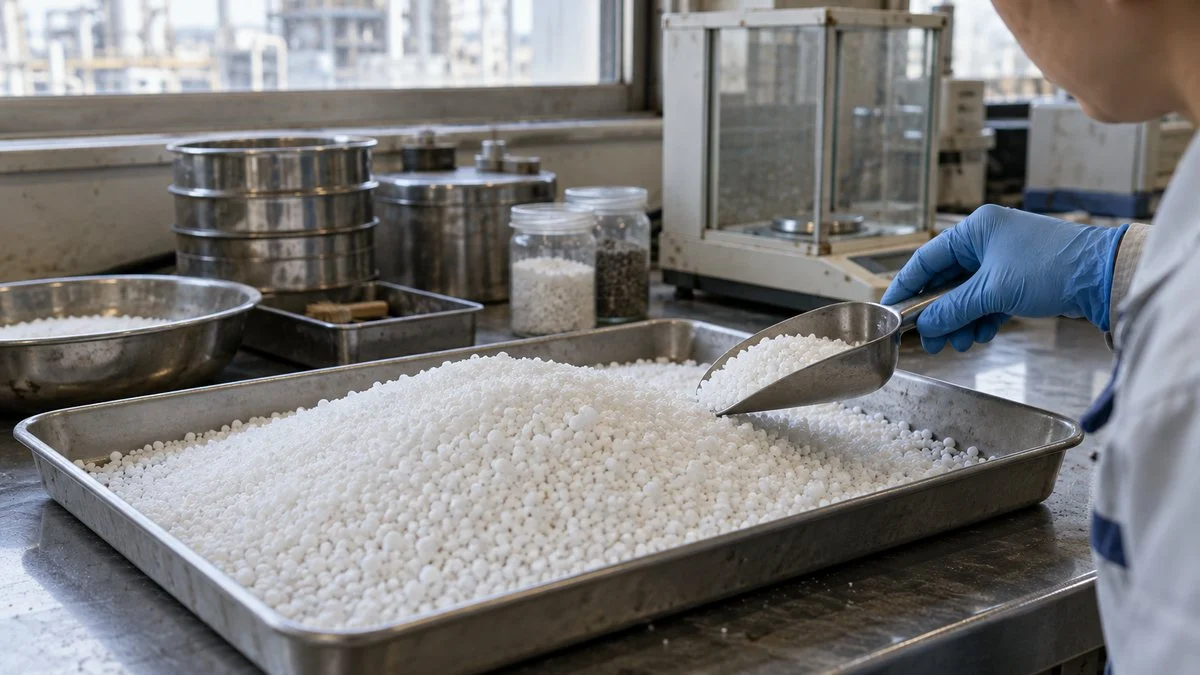
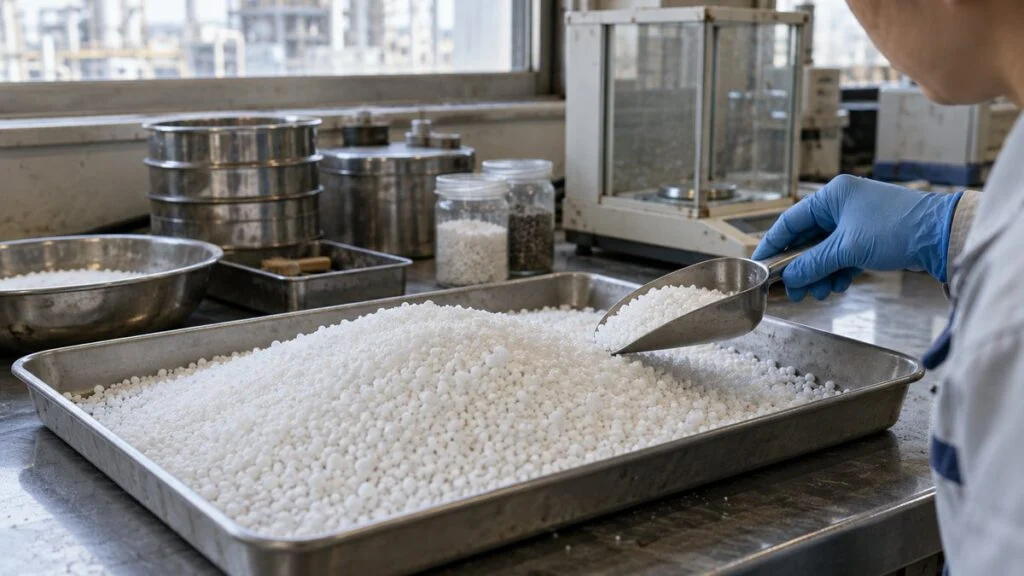
Urea is one of the most common nitrogen fertilizers. Plants make ammonia from natural gas, react it with carbon dioxide to synthesize urea, and then form the urea into granules for shipping.
TOYO owns both a urea synthesis process, ACES21, and a granulation technology for large urea granules. According to TOYO's February 2025 announcement, its urea technology has been used in more than 100 projects worldwide, counting both licenses and plants it built.
TOYO's own technology covers the steps after ammonia: urea synthesis and granulation.
Carbon dioxide from the ammonia unit feeds urea synthesis. In the Nigeria project, the ammonia unit uses KBR technology (US) and the urea unit uses ACES21.
Licensing Alone, or Licensing Plus EPC
A technology owner can take on only the license and the basic design. That is TOYO's role in Angola's first urea fertilizer plant (4,000 tonnes per day), awarded in February 2025: a Chinese company handles EPC for the whole complex, while TOYO supplies the license, basic design, proprietary equipment, and technical services.
In Nigeria, TOYO completed the third fertilizer train (production line) for Indorama in June 2026. Its urea unit also makes 4,000 tonnes per day. There TOYO went further: besides licensing the urea technology and doing the basic design, it handled detailed engineering and procurement for the entire plant.
TOYO completed the first two trains at the same site in 2017 and 2021. Winning repeat orders from the same customer shows how strong TOYO's position is in fertilizers.
Fertilizer investment continues, driven by population growth and food security. In its medium-term plan, TOYO expects demand for new plants and revamps in India, sub-Saharan Africa, Latin America, and Central Asia.
Strength 2: FPSO Joint Venture with MODEC
The FPSO joint venture decides what kind of projects TOYO can win; the India center (Strength 3) decides where the engineering gets done. The two are linked through TOYO's engineers in India.
An FPSO (floating production, storage and offloading unit) is a ship-shaped facility that processes oil and gas from subsea wells, stores the oil, and offloads it to tankers. TOYO has worked on FPSO topsides, the processing plant on deck, since 2005.
In August 2022, TOYO and MODEC, the world's largest FPSO company, set up a joint venture in Singapore: Offshore Frontier Solutions (OFS). OFS handles engineering, procurement, construction, and installation (EPCI) of both the topsides and the hull.
OFS won the Raia (Brazil) and Uaru (Guyana) FPSOs in 2023 and the Gato do Mato-Orca (Brazil) and Hammerhead (Guyana) FPSOs in 2025. The topsides are built onshore as large modules in parallel with hull construction, which shortens the overall schedule.
Because OFS is an equity-method affiliate, these FPSO orders are the main reason the "including equity-method" figures are so much larger than the consolidated ones.
Strength 3: Toyo-India, the Group's Engineering Center
Toyo Engineering India (Toyo-India) was established in 1976 and is headquartered in Mumbai, with 2,293 employees. It has completed more than 600 projects. TOYO's medium-term plan calls it "the group's largest source of profit and cash" through its EPC business.
Toyo-India does engineering for oil, petrochemicals, fertilizers, and FPSOs, and supports the group's overseas projects. OFS also has an Indian arm, TOYO MODEC OFS India, in Bengaluru, which does FEED, detailed engineering, and procurement support for FPSO topsides.
India is also a growing market for chemicals, pharmaceuticals, and fertilizers. TOYO now offers to support Japanese chemical makers that invest in India through Toyo-India, starting from the planning stage.
For suppliers and subcontractors, this means a TOYO project may be engineered or procured from Mumbai or Bengaluru rather than from Japan. Ask early which office owns your package (see the checklist below).
Related: Who Does What in a Japanese Plant: EPC, Owner, Maintenance
Toyo Engineering vs. JGC vs. Chiyoda
TOYO is usually named alongside JGC Holdings and Chiyoda Corporation as one of Japan's three major EPC contractors. All three are plant contractors whose core business is building plants.
By consolidated net sales for the fiscal year ended March 2026, JGC had about JPY 745.3 billion, Chiyoda about JPY 493.9 billion, and TOYO JPY 182.9 billion. TOYO is the smallest of the three on a consolidated basis, and its focus is different.
The two companies with large LNG projects are bigger; TOYO adds depth through licensing and its joint venture.
Sources: each company's earnings report for the fiscal year ended March 2026. Net income is profit attributable to owners of the parent. The profiles of JGC and Chiyoda are MONOSCOPE's summary.
JGC and Chiyoda built their track records on large LNG (liquefied natural gas) projects.
Related: JGC and Japanese EPC Contractors: How Projects Are Run
TOYO's difference is that it owns technology in fertilizers, a sector tied closely to food supply. Because it can earn license income without building the plant, it can take on more projects and serve a wider range of customers.
Recent Results: Why TOYO Lost Money and the Recovery Plan
For the fiscal year ended March 2026, TOYO reported net sales of JPY 182.9 billion (down JPY 95.1 billion from the previous year), an operating loss of JPY 19.0 billion, and a net loss of JPY 14.9 billion. It paid no dividend for the year, down from JPY 25 per share the year before.
The Main Cause: A Gas-Fired Power Project in Brazil
TOYO said the operating loss came mainly from a sharp deterioration in the margin of a gas-fired power plant project in Brazil. Equity-method income from its affiliates came in as planned, and orders met the full-year target.
In its first-quarter report (August 7, 2026), TOYO said the Brazil project was scheduled for completion in August 2026 and that its impact on the current year's results would be limited. Read the loss separately from TOYO's core businesses: it does not mean that its strengths in fertilizers, petrochemicals, and FPSOs have weakened.
Results fell in the year ended March 2026; TOYO plans to return to profit the following year.
Bars show consolidated net sales. Sources: TOYO earnings summaries for the fiscal year ended March 2026 (May 14, 2026) and for the first quarter of the year ending March 2027 (August 7, 2026). The forecast assumes USD 1 = JPY 150.
The Recovery Depends on Non-EPC Work
For the year ending March 2027, TOYO forecasts net sales of JPY 190.0 billion, net income of JPY 6.0 billion, and a dividend of JPY 25 per share. Sales stay about flat, but gross margin is planned to rise from 3.5% to 14.7%.
The first-quarter gross margin was 17.3%. TOYO said this was because several high-margin overseas projects, including service-type projects and large projects nearing completion, made faster progress early in the year. Once the loss-making project is finished, the question is whether TOYO can keep winning high-margin work.
Medium-Term Plan 2026–2030: Where TOYO Is Heading
TOYO published its medium-term management plan on June 19, 2026, under the theme "Supporting social infrastructure and driving the next phase of growth." Its targets are consolidated net income of JPY 10 billion in FY2030 and ROE (return on equity) of at least 12% every year.
The plan rests on two types of income. "Flow" income comes from EPC projects; "stock" income is recurring and comes from O&M (operation and maintenance), license fees, and similar work. TOYO aims for stock-type business to make up 10% of gross profit by FY2030.
TOYO plans to earn from today's strengths and invest the technology, people, and cash in new growth areas.
Source: TOYO Medium-Term Management Plan (2026–2030), June 19, 2026.
In O&M, TOYO wants long-term contracts covering operation support, periodic turnaround work, and revamps at plants it has built. It plans to build an operation and maintenance workforce in India and serve demand in Africa and Central Asia.
Related: Teishu (Plant Turnaround) in Japan: Cycles, Laws, Prep
Orders in the new areas have started. In July 2026, TOYO announced that its Korean subsidiary, Toyo Engineering Korea, had won a contract for a plant producing TMAH, a developer used to form circuit patterns in semiconductor manufacturing. The customer, HANTOK Chemicals, is a joint venture of Tokuyama and Lotte Chemical, and completion is planned for FY2027.
TOYO also promotes what it calls "co-creation EPC." It joins the customer at the planning stage, firms up the design while disclosing cost information openly, and moves to a lump-sum contract in stages. The aim is to avoid fixing a price before the design is settled, a lesson from past loss-making projects.
Working with TOYO as a Supplier or Partner

For equipment makers and trading companies, TOYO is a buyer of equipment for fertilizer, petrochemical, and FPSO projects. Its procurement is global, and on some projects the engineering and procurement are run by group offices such as Toyo-India or Toyo-Korea.
Under co-creation EPC, design conditions are set from the customer's planning stage. That makes the basic design (FEED, front-end engineering design) stage the point where a product gets written into the specification, and often the point that decides who wins the order.
Checklist Before You Quote to a TOYO Entity
- Issuing entity: which company sent the inquiry (TOYO in Japan, Toyo-India, Toyo-Korea, OFS, or another group company), and which one will place the purchase order
- Project and owner: the end user, plant location, and whether the owner has its own vendor list or specifications that apply
- Project stage: FEED, EPC bid, or execution. A FEED-stage inquiry may be for budget pricing, not a firm order
- Licensor scope: for urea units, which parts follow TOYO's process design and which follow other licensors (for example, the ammonia unit)
- Specifications and standards: which codes, project specifications, and document formats apply
- Engineering contact: where the technical reviewer sits (Japan, Mumbai, Bengaluru, or elsewhere) and which language and time zone to plan for
- Commercial terms: currency, delivery terms, inspection and testing requirements, and the document schedule
Questions to Ask the TOYO Team
- Which TOYO entity will issue the purchase order, and who is our commercial contact?
- Is this inquiry for FEED or budget pricing, or for a firm EPC purchase?
- Does the owner have an approved vendor list for this package? Are we on it, or how can we be added?
- Which project specifications, codes, and data sheets apply, and which revision is current?
- Which office will review our technical documents, and what is the review cycle?
- Will factory inspection or witness testing be required, and who will attend?
- What is the required delivery date at site, and are there penalties for late documents or equipment?
Related: Approval Drawings (Shonin-zu) in Japan: Review and Return
Sample Introduction Email to a TOYO Procurement Team
Use this when you want to introduce your company for a specific project or future work. Replace the bracketed parts.
Subject: Supplier introduction - [product category] for [project name or sector]

Dear [Name],

We are [company name], a manufacturer of [product category] based in
[city, country]. We understand that [TOYO entity] is working on
[project name / fertilizer, petrochemical, or FPSO projects].

- Products: [models, size and pressure range]
- Codes and certifications: [e.g., ASME, API, CE, ISO 9001]
- Reference projects: [plant type, end user, country, year]
- Engineering and service support: [locations, languages]

Could you tell us:
1. Whether this package is currently at the FEED or EPC stage
2. Which TOYO office handles procurement and technical review
3. Whether the owner's vendor list applies and how we can be considered

We would be glad to submit a budget quotation or prequalification
documents if helpful.

Best regards,
[Name], [Title]
[Company], [Phone], [Email]
Limits of This Guide
- Figures come from TOYO's and its peers' published earnings reports (fiscal year ended March 2026 and the first quarter of the following year), TOYO's medium-term plan and corporate profile, and project announcements. Later results may differ. Amounts are in Japanese yen as reported.
- The "three revenue types" and the comparison with JGC and Chiyoda are MONOSCOPE's summary, not categories TOYO uses in its segment reporting.
- Procurement rules, vendor lists, and contract terms vary by project and owner. The checklist above covers what to ask, not how any specific TOYO entity operates.
- This guide is not investment advice.
FAQ
What does Toyo Engineering do?
Toyo Engineering is a Japanese EPC contractor that designs, procures, and builds industrial plants, mainly petrochemical, chemical and fertilizer, and oil and gas facilities. It also licenses its own urea technology and, through its joint venture OFS, builds FPSOs with MODEC.
Is Toyo Engineering part of Toyota?
Despite the similar name, TOYO's roots are in the chemical industry. It was spun off in 1961 from the engineering department of Toyo Koatsu Industries, a chemical maker that is now part of Mitsui Chemicals.
What is the relationship between Toyo Engineering and Toyo Engineering India?
Toyo Engineering India (Toyo-India) is a TOYO group company founded in 1976 and based in Mumbai. With 2,293 employees, it handles engineering for oil, petrochemical, fertilizer, and FPSO projects, and TOYO calls it the group's largest source of profit and cash.
What is ACES21?
ACES21 is TOYO's own urea synthesis process. TOYO licenses it together with its urea granulation technology, and says its urea technology has been used in more than 100 projects worldwide, including plants in Nigeria and Angola.
How does Toyo Engineering compare with JGC and Chiyoda?
TOYO is the smallest of the three by consolidated sales: JPY 182.9 billion versus about JPY 745.3 billion for JGC and about JPY 493.9 billion for Chiyoda in the year ended March 2026. JGC and Chiyoda are known for large LNG projects, while TOYO stands out for urea technology and its FPSO joint venture.
Sources
- Company profile, history, and group companies: Toyo Engineering Corporation Information (as of June 25, 2026), TOYO company outline (Japanese)
- Results and orders for the year ended March 2026: TOYO earnings summary, FY2025 (May 14, 2026) (Japanese)
- First-quarter results: TOYO earnings summary, first quarter of FY2026 (August 7, 2026) (Japanese)
- Medium-term plan and Toyo-India: TOYO Medium-Term Management Plan 2026–2030 (June 19, 2026) (Japanese)
- Urea technology and Angola project: TOYO press release on the Angola urea license award (February 12, 2025) (Japanese and English)
- Nigeria project: TOYO press release on completion of the third fertilizer line in Nigeria (September 24, 2026) (Japanese and English)
- FPSO business and OFS: Toyo Engineering, "FPSO"
- TMAH plant: TOYO press release on the TMAH plant order in Korea (July 21, 2026) (Japanese and English)
- JGC results: JGC Holdings, consolidated financial results for the year ended March 2026 (Japanese)
- Chiyoda results: Chiyoda Corporation, consolidated financial results for the year ended March 2026 (Japanese)
Original article in JapaneseThis guide is adapted from a MONOSCOPE article written for readers in Japan: 東洋エンジニアリングの強みとは|尿素技術とFPSOで読む事業構造
About the editor
 MONOSCOPE EditorFOUNDER & EDITOR
Spent about ten years at a plant equipment maker and a plant engineering company, proposing, designing, and commissioning equipment, then moved into web marketing. Now a web consultant for B2B manufacturers, helping them explain their products and technology. Licensed in Japan as an Energy Manager and a Third-Class Chief Electrical Engineer.
Has run an engineering blog since 2017 (500+ articles) and a Japanese YouTube channel with about 20,000 subscribers. Each English guide is written from the Japanese shop-floor point of view and checked against the cited standards.