Approval Drawings (Shonin-zu) in Japan: Review and Return
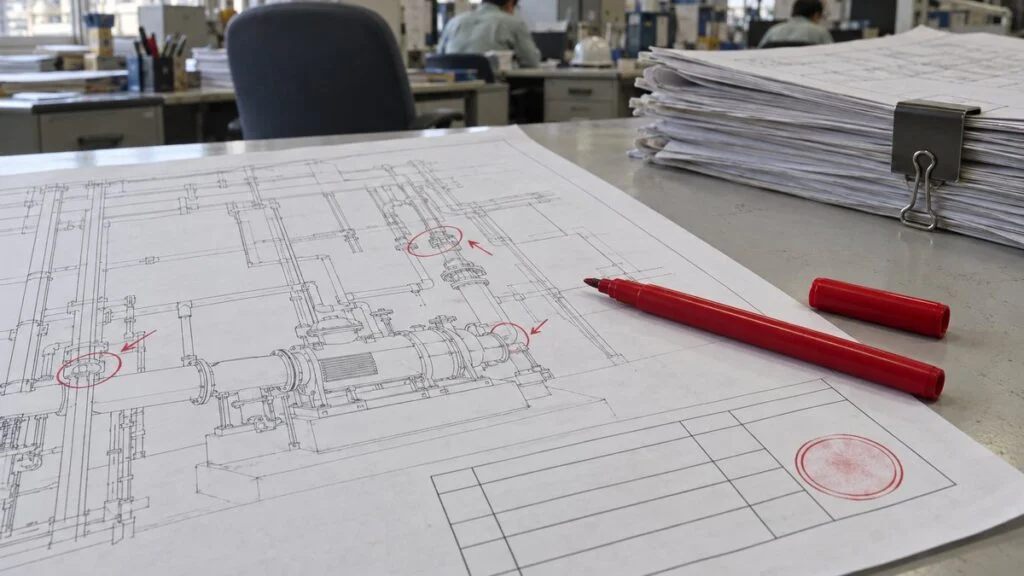
A Japanese supplier sends you a set of drawings marked 承認願 (shonin-negai, "request for approval"), and fabrication cannot begin until you send them back. These are approval drawings, or shonin-zu (承認図). In them, the supplier tells the buyer, "Here are the specifications and dimensions we will build to." The buyer checks the drawings, stamps them, and returns them. Only then does the supplier start fabrication.
This guide is for engineers and buyers on both sides of the exchange, whether you review drawings from a Japanese equipment maker or send your own drawings to a Japanese customer for approval. It explains what an approval drawing contains, how it differs from other Japanese drawing types, what the three return codes mean, how to read stamps and red markups, and how a late return affects your schedule. It ends with a checklist to run before you send a drawing back.
The terms and practices below are common in Japanese plant engineering and custom-built equipment, but details vary by company, industry, and project. Use it as a guide to what to ask, not as a description of the rules your supplier or customer actually follows.
Contents
- What Is an Approval Drawing (Shonin-zu)?
- Approval Drawings vs. Other Japanese Drawings
- How the Review-and-Return Process Works
- The Three Return Codes: Approved, Approved with Comments, Resubmit
- Late Returns and How to Set the Deadline
- Checklist Before You Return an Approval Drawing
- Who Is Responsible After Approval?
- Shonin-zu in the Japanese Auto Industry
- Approval Drawing Log Template
- Where Practice Varies
- FAQ
- Sources
What Is an Approval Drawing (Shonin-zu)?
An approval drawing is submitted by the supplier, usually the equipment maker, so the buyer can confirm the design before fabrication starts. In Japanese you may also see it called shonin-negai-zu (承認願図, drawing submitted for approval) or shonin-yo-zu (承認用図, drawing for approval). Kiki shonin-zu (機器承認図, equipment approval drawing) means the same thing. The maker prepares one for each piece of equipment, such as a pump, tank, or heat exchanger.
Some companies use these names to mark two stages: the submitted drawing is the shonin-negai-zu, and the approved drawing is the shonin-zu. Many people just call both "shonin-zu."
An approval drawing typically shows the equipment's overall dimensions, its interfaces with piping and wiring (the location, size, and standard of each connection), its materials, and its main specifications.
Each item is something the buyer wants to confirm before fabrication begins.
Example only. The content depends on the type of equipment and on the documents the purchase specification asks for.
Approval Drawings vs. Other Japanese Drawings
Japanese projects use several drawing and document names that look similar in English. The table below shows how approval drawings differ from the ones you are most likely to receive alongside them.
| Japanese term | English | Who prepares it | Role in the approval process |
|---|---|---|---|
| 計画図 (keikaku-zu) | Planning drawing: preliminary layout and main dimensions | Buyer or its designer | Input for the supplier's design |
| 承認図 (shonin-zu) | Approval drawing: the supplier's design, submitted for confirmation before fabrication | Supplier | Submitted for your approval. Fabrication waits for your return. |
| 参考図 (sanko-zu) | Reference drawing: sent for information | Either side | Usually not. Check with the other party whether it is contractually binding. |
| 納入仕様書 (nonyu shiyosho) | Delivery specification: the full set of specifications and drawings for the equipment actually delivered | Supplier | Often, together with the approval drawings |
| 製作図 (seisaku-zu) | Fabrication drawing: machining and assembly details based on the approved content | Supplier or its fabricator | Prepared from the approved content. Check whether your contract also asks to review it. |
| 完成図 (kansei-zu) | As-built drawing: reflects the actual condition after installation and commissioning | Supplier | Handed over at completion |
The delivery specification is the full document set. The approval drawings are the drawings within that set, such as the assembly drawing, outline drawing, and accessory details. Some companies call the whole submittal, specification included, the "shonin-zu." Reference drawings are different. Japanese public-works agencies, for example, keep contract documents separate from reference documents, so a drawing labeled "reference" is generally not something you approve. Whether that holds for your order depends on the contract, so confirm it with the other party.
On a plant project, the drawings usually appear in this order.
The supplier turns the planning drawing into a concrete design, and the buyer checks that design on the approval drawing before fabrication.
Names, and who prepares each drawing, vary by company and project.
If the supplier starts fabrication before approval and a mismatch turns up later, the equipment may have to be reworked or remade. That is why interface dimensions, materials, and nozzle orientation should be checked at the approval-drawing stage.
JIS Z 8114, Japan's standard for drawing terminology, defines the two stages separately. A drawing for approval is submitted to get approval of what a purchase order or similar document calls for. An approved drawing is one the customer or another party has signed off on.
Related: How to Read Japanese Engineering Drawings (JIS B 0001)
How the Review-and-Return Process Works
Returning an approval drawing (shonin henkyaku, 承認返却) means sending the supplier's drawings or specifications back to confirm that the content is acceptable as written. It is the last step in an exchange of documents that begins with the buyer's purchase specification. (A drawing can also come back with comments or a request to resubmit; see the return codes below.)
Each markup goes back to the supplier, and the loop repeats until both sides agree.
Simplified. Steps 2 and 4 can repeat several times.
When the buyer issues a purchase specification (kobai shiyosho, 購買仕様書), the supplier answers with a quotation specification (mitsumori shiyosho, 見積仕様書) that meets it. The buyer negotiates the price and marks up the quotation specification, and the buyer and supplier repeat this until they agree. Points where the supplier cannot meet the purchase specification are often recorded on a deviation list (debikura) and agreed by both parties.
Related: Quotation Specification (Mitsumori Shiyosho): Sample Format
Once the price is agreed, the buyer issues a purchase order, and the supplier prepares detailed drawings of the equipment it will deliver. These are the approval drawings. They are often submitted together with the delivery specification, though practice varies by company and project. Both parties keep exchanging comments until the detailed specification is agreed. The buyer then stamps the drawings and returns them, and the supplier can start building the equipment only after that.
Related: Delivery Specification (Nonyu Shiyosho): What to Check
The Three Return Codes: Approved, Approved with Comments, Resubmit
Names differ by company, but a returned approval drawing usually carries one of three return codes.
The return code determines whether, and when, the supplier may start fabrication.
承認 (shonin)
条件付き承認 / コメント付き承認
再提出 (sai-teishutsu) / 不承認
Code names, symbols, and stamp layouts vary by company and project. If the buyer has its own format, that format applies.
Reading the Stamps and Red Markups
A returned drawing carries an approval stamp (shonin-in, 承認印) or signature, so that the return code, the date, and the reviewer are clear. In Japan, a personal name seal (hanko) often takes the place of a signature. Reviewers write corrections on the drawing in red, a practice called shuki (朱記, "red marking"). Each red comment should tell the supplier what is wrong and what the drawing should say instead.
Many Japanese drawings also have small seal boxes in the title block for the supplier's own sign-offs, such as prepared by (作成 / 設計), checked by (検図), and approved by (承認). That 承認 box usually records the supplier's internal approval, not the customer's. Look for the customer's return stamp and code as a separate mark, and ask the supplier what each box or stamp means on its drawings.
For "approved with comments," record each condition, who will fix it, and the due date. Decide for each project whether red marks on the drawing are enough or whether you also need a separate comment sheet or meeting minutes. When the revised drawing arrives, confirm that every condition is resolved, then mark it closed.
Late Returns and How to Set the Deadline
The return deadline is the date both parties need to watch most closely. As a rule, the supplier cannot start fabrication until the drawing comes back approved, so a late return can push back the delivery date.
A late delivery means the buyer cannot install on schedule, and the delay carries through to the rest of the project. To save time, the supplier may start fabrication before the drawing is returned, but then it typically bears the cost of rework if a mismatch is found later.
In practice, the buyer and supplier sometimes agree on a conditional approval. The design is not fully agreed, but the buyer attaches specific conditions and lets fabrication start. Since this is an arrangement between the two companies, it is usually handled case by case.
Setting the Return Deadline
No law or industry-wide rule sets the deadline for returning approval drawings. Instead, the purchase order or purchase specification usually states two things in advance: when the supplier will submit the drawings, and how quickly the buyer will return them (for example, "within X days of receipt"). The deadline is calculated backward from the delivery date.
Count backward from the delivery date to find the latest date the buyer can return the drawings.
The result is the buyer's return deadline. When you set the submission date, also leave time for the supplier to revise and the buyer to recheck if the code is "resubmit."
Each day the return is late delays the start of fabrication by a day, which can affect the delivery date. Buyers should allow time for their own internal review, since a drawing may need to pass through design, electrical, instrumentation, and operations teams.
A resubmission adds time for the supplier's revision and the buyer's second review. Assume the first submission will not be approved, and leave room for at least one more round trip. That makes the deadline much easier to meet.
Step 03 is where factory inspection and buyer witness testing take place, such as a factory acceptance test (FAT).
Related: FAT and SAT with Japanese Suppliers: Steps & Free Checklist
Checklist Before You Return an Approval Drawing
Use this list when you review a drawing from a Japanese supplier. If you are the supplier, it shows what a Japanese customer is likely to check.
- Does the drawing meet the requirements in the purchase specification and the quotation specification?
- Does the drawing reflect the deviations agreed on the deviation list (debikura) during quotation?
- Do the interface locations and shapes match the upstream and downstream equipment and piping?
- Is there enough space for installation and maintenance?
- Do the number and mounting positions of accessories and instruments suit how the equipment will be operated?
- Has the internal review been completed (for example, by design, electrical, instrumentation, and operations)?
- Is the return code clear: approved, approved with comments, or resubmit?
- Is each red comment specific enough that the supplier knows what to change?
- For "approved with comments," are the conditions, the person responsible, and the due date recorded?
- Does the stamp or signature show the date and the reviewer?
- Are the drawing number and revision recorded in your log?
If you find a mismatch, do not just stamp the drawing. Mark on the drawing where and how it differs from the specification, and send it back with your question. If the specification itself changes, update the related documents too, such as the quotation specification and the deviation list.
Who Is Responsible After Approval?
Approval does not automatically shift responsibility to the buyer. The contract and specifications define what approval means, and this varies by project, so check each time. Two Japanese public-sector documents show how it can work in practice.
In a special specification for an equipment installation project, the Yokkaichi City Water and Sewerage Bureau requires the contractor to submit drawings for the owner's acceptance (shodaku-zu, 承諾図, a term close to shonin-zu) and to start work only after acceptance. If the installed system later has problems that would have been hard to foresee from the accepted drawings, the contractor is responsible for changing or repairing the system.
A guideline from the Acquisition, Technology & Logistics Agency (ATLA), part of Japan's Ministry of Defense, is explicit about the limits of approval. Items the specification states as fixed cannot be changed through approval unless the specification separately allows substitutes, and an approval that mistakenly changes such an item is void. The same guideline says that where a specification uses wording such as "approximately" or "as a standard," approval of the drawings settles those open points. The safe assumption is that approving a drawing is not the same as changing the specification.
Even so, changes the buyer requested in comments and dimensions the buyer approved remain the buyer's decisions. Keep a record of what you checked and approved, in the red markups or in meeting minutes.
Shonin-zu in the Japanese Auto Industry
If you work with Japanese automotive suppliers, you will also hear shonin-zu hoshiki (承認図方式). Here the term means something different: it describes how part design is divided between the automaker and the parts supplier, not a single drawing submitted for one order.
Research on Japanese automotive supply describes several patterns. Under taiyo-zu hoshiki (貸与図方式, "drawing-supplied parts"), the automaker prepares the detailed part drawings and lends them to the supplier. Under shonin-zu hoshiki ("drawing-approved parts"), the supplier develops the detailed design from the automaker's specifications and basic design, and the automaker approves the supplier's drawings. Catalog parts (shihan-hin, 市販品) are designed by the supplier entirely on its own.
In the auto industry, "shonin-zu" refers to a design-sharing model. In plant work, it refers to a drawing checked before fabrication.
Classification after Asanuma (1997) and others, as presented by Fujimoto and Ge (2000). Another pattern, "drawing-entrusted parts" (itaku-zu hoshiki, 委託図方式), divides design work as the drawing-approved pattern does, but the automaker holds the final drawings.
In both uses, the buyer approves drawings the supplier has prepared. The auto-industry term describes a sourcing model, while the plant term means a drawing issued for a specific order. Keep that distinction in mind when the same word comes up in both settings.
Approval Drawing Log Template
On projects with many pieces of equipment, keep a log of each drawing's submission date and return deadline. There is no standard format, but columns like these help prevent missed items.
One row per drawing number and revision, showing the deadline, the return code, and who acts next.
Fictional example for illustration. Drawing numbers and dates are made up. A real log may also have columns for the project name, equipment tag, reviewing department, and reason for revision.
The log should let anyone see which revision is current. Mark superseded revisions clearly and note what changed in each one.
Each week, check the log for drawings that are overdue or close to their deadline, and follow up on them. Decide at the start of the project whether purchasing or engineering owns the log.
Related: Japanese Procurement: QCD Negotiation and Supplier Ratings
Where Practice Varies
- Names: companies use shonin-zu, shonin-negai-zu, shonin-yo-zu, and shodaku-zu in different ways. Some call the whole submittal, specification included, "shonin-zu."
- Return codes and stamps: code names, symbols, and stamp layouts differ. A buyer's own format overrides the supplier's.
- Deadlines: no law or industry rule sets them. They come from the purchase order or specification for each project.
- Effect of approval: who is responsible after approval depends on the contract and specification, not on the stamp.
- Industry: in the auto industry, "shonin-zu" can mean a design-sharing model rather than a single drawing.
- An approval drawing (shonin-zu) is a drawing the supplier submits so the buyer can confirm specifications and dimensions before fabrication. Sending it back approved is called shonin henkyaku.
- Check it against the purchase specification, the quotation specification, and the deviation list, and confirm interfaces and installation space.
- Agree the return deadline when you place the order, calculate it backward from the delivery date, and allow time for a resubmission.
- When full agreement is not yet possible, use a conditional approval and track each condition, its owner, and its due date until it is closed.
- Track returns by drawing number and revision in a log so everyone can see the current revision and what is still open.
FAQ
What is the difference between shonin-negai-zu and shonin-zu?
Where companies distinguish them, the shonin-negai-zu (or shonin-yo-zu) is the drawing as submitted, and the shonin-zu is the drawing after approval. In everyday use, many people call both "shonin-zu." Japanese public documents also treat the stages separately: JIS Z 8114 uses "drawing for approval" and "approved drawing," and the ATLA guideline defines documents submitted for approval (shonin-yo tosho, 承認用図書) separately from approved documents (shonin tosho, 承認図書), with a request-for-approval form (shonin-negai-sho, 承認願書) attached to each submission.
Can a Japanese supplier start fabrication before the drawings are approved?
Generally, no. The supplier waits for the approved drawings. To protect the delivery date, a supplier may start at its own risk, in which case it typically pays for any rework if a mismatch appears later. When time is short, the two sides can agree on a conditional approval that lets fabrication start with specific conditions attached.
How long does the buyer have to return an approval drawing?
There is no fixed period set by law or by industry rule. The deadline is agreed in the purchase order or purchase specification, usually as a number of days after receipt, and is worked back from the delivery date. Allow for your internal review and for at least one resubmission.
Is an approval drawing the same as a delivery specification?
No, but they are closely related. The delivery specification (nonyu shiyosho) covers the full document set, and the approval drawings are the drawings within it. The two are usually submitted and returned together, and some companies call the whole package "shonin-zu."
Does my approval stamp make me responsible for the design?
It depends on the contract. In the Japanese public-sector examples above, approval did not alter fixed specification requirements, and the contractor stayed responsible for problems that were hard to foresee from the drawings. Changes you requested and dimensions you approved, however, remain your decisions, so keep a record of what you checked.
Sources
- Definitions of documents for approval and approved documents, the request-for-approval form, and the rule that approval cannot change fixed specification items: Acquisition, Technology & Logistics Agency (ATLA), Guideline for Preparing and Submitting Documents and Samples for Approval (Japanese)
- Submission of drawings for acceptance, starting work after acceptance, and responsibility for problems not foreseeable from the accepted drawings: Yokkaichi City Water and Sewerage Bureau, special specification for the Hinaga Purification Center sludge screen installation (FY2021, Japanese)
- Drawing-supplied, drawing-approved, and drawing-entrusted parts: Takahiro Fujimoto and Dongsheng Ge, CIRJE Discussion Paper CIRJE-J-34, University of Tokyo (2000, Japanese with English abstract)
- Drawing terms (drawing for approval, approved drawing): Miki Pulley, Technical Drawing Terminology (Excerpt from JIS Z 8114:1999)
- Contract documents vs. reference documents in Japanese public works: Kure City (Japanese)
Original article in JapaneseThis guide is adapted from a MONOSCOPE article written for readers in Japan: 承認図とは?図面の承認返却の意味と流れ、返却期限の決め方
About the editor
 MONOSCOPE EditorFOUNDER & EDITOR
Spent about ten years at a plant equipment maker and a plant engineering company, proposing, designing, and commissioning equipment, then moved into web marketing. Now a web consultant for B2B manufacturers, helping them explain their products and technology. Licensed in Japan as an Energy Manager and a Third-Class Chief Electrical Engineer.
Has run an engineering blog since 2017 (500+ articles) and a Japanese YouTube channel with about 20,000 subscribers. Each English guide is written from the Japanese shop-floor point of view and checked against the cited standards.