US Tariffs on Japanese Imports in 2026: Rates and Impact
Your Japanese supplier's latest quote has a new line for US duties. Their sales team asks who will be the importer of record. A Japanese customer asks your plant in Thailand or India to confirm the country of origin and the steel content of every part you ship. All of these requests come from the same source: US tariff policy toward Japan has changed several times since 2025, and Japanese manufacturers are reorganizing their supply chains in response.
This guide explains which US tariffs apply to Japanese imports as of September 2026, how the "12.5% including MFN" rate works, which industries are most affected, and how Japanese manufacturers are responding. It ends with a checklist of questions to ask your Japanese supplier and a short email template you can adapt.
Important: US tariff rules are still changing. This article summarizes published information as of September 2026. It is not legal or customs advice. Check the current rate for each HTS code (the product's classification in the US Harmonized Tariff Schedule) with your customs broker or with official CBP and USTR guidance before you price or ship.
Contents
- US Tariffs on Japanese Imports in 2026: The Short Version
- How US Tariff Rules on Japan Changed Since 2025
- How to Work Out the 12.5% Combined Rate
- Which Japanese Industries Are Hit Hardest
- Why Supply Chains Are Shifting: China Risk and Economic Security
- How Japanese Manufacturers Are Responding
- What This Means If You Work With Japanese Suppliers
- Checklist: Questions to Ask Your Japanese Supplier About US Tariffs
- Limits of This Article
- FAQ: US Tariffs on Japanese Imports
- Sources
US Tariffs on Japanese Imports in 2026: The Short Version
Since 2025, US tariffs on goods from Japan have rested on four different laws, and the rate has changed each time the legal basis changed. As of September 2026, two layers apply:
- Section 301 tariffs (most products): Since July 24, 2026, most goods from Japan face a combined rate of 12.5%, counting the normal most-favored-nation (MFN) duty. Products whose normal duty is already 12.5% or higher pay no extra Section 301 duty.
- Section 232 tariffs (specific products): Steel, aluminum, copper, autos and auto parts, and several other product groups have their own tariffs. Section 301 does not apply to these products.
The "reciprocal" tariffs of 2025, which were based on the International Emergency Economic Powers Act (IEEPA), no longer apply. The US Supreme Court ruled them unlawful on February 20, 2026.
Each time the legal basis changed, the rates and the products covered changed too.
Based on JETRO publications and US government announcements. Rates refer to imports from Japan.
How US Tariff Rules on Japan Changed Since 2025
Reciprocal Tariffs and Section 232 Tariffs in 2025
The 2025 tariffs fell into two groups. Reciprocal tariffs were based on IEEPA. They set an extra duty rate for each country, citing trade deficits and other reasons, and they applied to most goods from Japan.
Section 232 tariffs are based on Section 232 of the Trade Expansion Act of 1962. They target specific products on national security grounds. They started with steel and aluminum in March 2025 and later expanded to autos and auto parts, copper, trucks, lumber, and other products. Because they rest on a different law, the 2026 Supreme Court ruling did not affect them.
The 2025 US–Japan Agreement
Japan and the US reached an agreement in July 2025, and the US president signed an executive order to implement it on September 4, 2025. The main terms were:
- Reciprocal tariffs on Japanese goods were capped at 15%, including the existing duty. Products whose existing duty was already 15% or more got no extra duty.
- Section 232 tariffs on Japanese autos and auto parts were lowered to 15%, including the existing duty.
- Civil aircraft and aircraft parts were exempt from the additional duties.
In return, Japan committed to about USD 550 billion of investment in the US, more purchases of US rice, and about USD 8 billion a year of US farm products and other goods. Government-affiliated lenders such as the Japan Bank for International Cooperation (JBIC) are to support the investment through equity, loans, and loan guarantees, with energy and AI infrastructure among the expected targets.
The Supreme Court Ruling and IEEPA Tariff Refunds
On February 20, 2026, the US Supreme Court ruled that IEEPA does not authorize tariffs, so the additional tariffs imposed under it were unlawful. The reciprocal tariffs on Japan and other countries lost their legal basis, and the president announced the same day that IEEPA tariffs would stop.
Refunds of IEEPA duties already paid are now under way. As a rule, the refund goes to the importer of record, the party that paid the duty to US Customs and Border Protection (CBP). If a Japanese company's US subsidiary was the importer, it can file the claim itself. If you, the US customer, were the importer, the refund comes to you, and your Japanese supplier may ask how it should be reflected in prices. Your contract terms and Incoterms decide who carries the duty in the first place, so both sales and finance teams should know which side was the importer.
From the Section 122 Surcharge to Section 301 Tariffs
When the IEEPA tariffs stopped, the administration imposed a 10% import surcharge on most imports under Section 122 of the Trade Act of 1974. Section 122 is a temporary tool for balance-of-payments problems and is limited to 150 days, so the surcharge ran from February 24 to July 24, 2026.
Just before it expired, on July 23, 2026, the Office of the US Trade Representative (USTR) issued final action on new tariffs under Section 301 of the Trade Act of 1974. They cover 60 countries and regions, including Japan, that USTR found had not done enough to ban imports of goods made with forced labor. The new duties took effect on July 24, 2026.
For Japan, the Section 301 duty is set so that the normal MFN duty plus the Section 301 duty equals 12.5%. If a product's MFN duty is already 12.5% or more, no Section 301 duty applies. This is lower than the 15% cap in the 2025 agreement, but the rate could still change through later reviews or court rulings.
Section 232 Tariffs Still Apply
Section 232 tariffs were outside the Supreme Court case and still apply as of September 2026. Section 301 duties do not apply to products covered by Section 232. According to JETRO's summary as of July 27, 2026:
- Autos and auto parts from Japan: 15% including the existing duty, under the US–Japan agreement.
- Steel and aluminum products: generally 50%.
- Copper products: 25–50%, depending on the product.
- Other Section 232 products: medium and heavy trucks, lumber and wood products, certain semiconductors, and patented pharmaceuticals, among others.
The metals rules were revised several times in 2026, and derivative products and some types of equipment can carry different rates. Check the exact rate for each HTS code.
In short, the end of the reciprocal tariffs did not end tariff costs on Japanese goods.
Between the 2025 agreement and September 2026, the legal basis changed for most products.
Based on JETRO publications. Confirm the current rate for each HTS code with official sources.
How to Work Out the 12.5% Combined Rate
Because the 12.5% rate includes the MFN duty, the extra cost depends on each product's HTS code. A part with a 2.5% MFN duty gets 10 more percentage points. A part with a 0% MFN duty gets the full 12.5 points. The fictional parts below show how the same rule produces different results:
| Fictional part (made in Japan) | MFN duty | Section 301 duty | Total duty |
|---|---|---|---|
| Part A (example) | 0% | 12.5 points | 12.5% |
| Part B (example) | 2.5% | 10 points | 12.5% |
| Part C (example) | 14% | 0 | 14% (MFN only) |
| Steel or auto part covered by Section 232 | — | Not applied | Section 232 rate applies |
Two more points matter in practice. First, the rate follows the country of origin as determined under US customs rules, not the supplier's nationality. A part that a Japanese company makes in Thailand or Mexico is generally not taxed at Japan's rate. Second, check the HTS classification your supplier or broker uses. A different code can change both the MFN duty and whether Section 232 applies.
Which Japanese Industries Are Hit Hardest
The US is one of Japan's most important export markets. According to Japan's Ministry of Finance trade statistics, Japan's exports to the US fell 4.1% in 2025 to JPY 20.414 trillion, while total exports reached a record JPY 110.448 trillion. The US took about 20% of the total, so even a few percent drop means a change of hundreds of billions to about a trillion yen.
Autos and Auto Parts
Autos took the biggest hit. In 2025, US-bound exports of cars fell 11.4% and auto parts fell 10.7% from the previous year. Toyota reported that US tariffs reduced its operating income by JPY 1.38 trillion in the fiscal year ended March 2026.
Automakers are absorbing the cost through higher US prices and cost cuts, and part of the burden may reach parts makers as price-reduction requests. If automakers build fewer vehicles for the US, orders fall for their Tier 1, Tier 2, and Tier 3 suppliers in Japan. Even small companies that never ship to the US feel the tariffs through their customers.
Steel, Aluminum, Copper, and Derivative Products
High Section 232 tariffs still apply to steel, aluminum, and copper. Beyond the direct effect on exports, steel from many countries that used to go to the US may flow to other markets, which can affect prices in Asia and elsewhere.
The tariffs also cover derivative products made with steel or aluminum. Companies that ship machine parts or metal products to the US need to confirm whether their products count as derivatives and how to declare the steel and aluminum content. If you import such parts from Japan, your supplier may ask for, or provide, content data.
Machinery, Electronic Components, and Other Products
Since July 2026, machine tools, industrial machinery, and electronic components from Japan mainly fall under the Section 301 tariff (12.5% combined). US demand for capital equipment remains strong, and North American orders for Japanese machine tools have held up, led by the aerospace industry.
High-performance products that are hard to replace tend to keep selling despite tariffs. For commodity products with heavy price competition, the added duty directly weakens competitiveness. Within the same industry, the impact depends on how unique the product is and how much pricing power the supplier has.
Auto-related exports fell much more than total exports to the US.
Based on Japan's Ministry of Finance trade statistics (calendar 2025) as compiled by nippon.com.
Why Supply Chains Are Shifting: China Risk and Economic Security
US tariffs are only part of the story. US–China tensions are reshaping global supply chains, and Japanese manufacturers need to keep working with both countries.
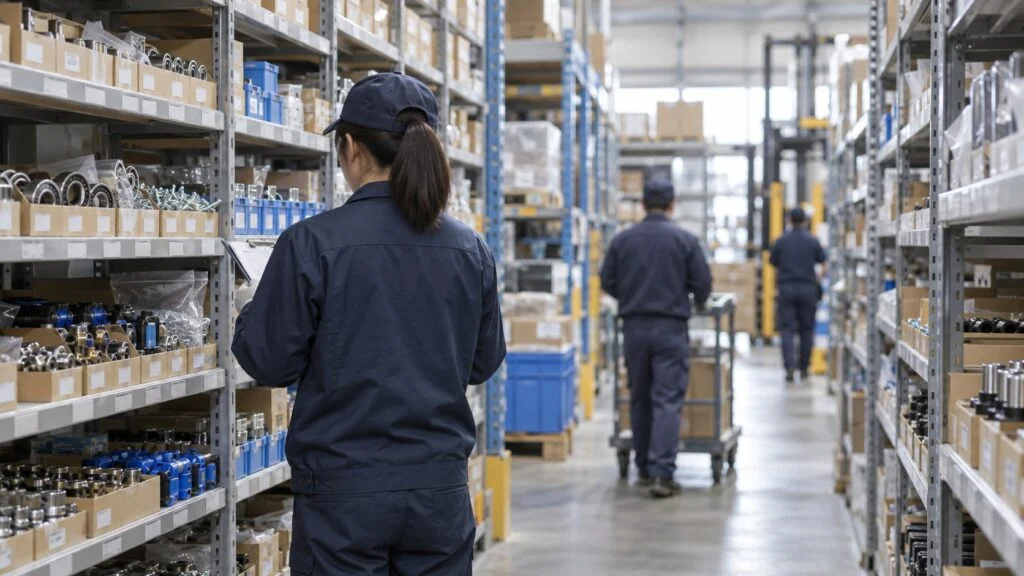
Japanese Companies Between the US and China
JETRO's survey of Japanese companies' overseas business (3,369 valid responses, released in February 2026) shows the tension clearly:
- 27.1% named the US as their most important export market for the next three years, the highest share since comparable data began in FY2018.
- Among companies that source key materials or components overseas, about 60% source from China.
- Just over a quarter of all companies are reviewing, or considering reviewing, their supply chains. Among companies with overseas sites, the share is about one-third.
- US–China relations were the most often cited risk factor. When choosing new suppliers, companies put "stability" and "geographic proximity" first.
China's Tighter Export Controls
The most concrete China risk is export control. Since 2023, China has added gallium, germanium, graphite, antimony, and other materials to its export controls. In April 2025, it added seven rare earth elements, including samarium and dysprosium.
JETRO reports that China's exports of rare earth permanent magnets to Japan dropped sharply in May 2025. They recovered as export licenses were granted, but Japanese companies still cite two problems: obtaining a license can take three months or more, and it is hard to tell whether a given item is controlled.
On January 6, 2026, China's Ministry of Commerce announced tighter controls on exports of dual-use items to Japan, banning exports to military end users and military end uses. The notice did not clearly define the end uses and end users covered, which makes compliance harder for companies.
The Japanese government, for its part, is working to strengthen supply chains for semiconductors, critical minerals, and batteries, both in Japan and abroad, from an economic security standpoint. With tariffs, export controls, and geopolitical risk all at play, Japanese companies now look for suppliers that can deliver without interruption, not only at the lowest cost.
Export controls and geopolitical risk push in the same direction as tariffs.
China's export controls also push companies toward the same changes.
How Japanese Manufacturers Are Responding
No single measure solves the problem. Japanese manufacturers combine several approaches and tune the mix for each product and customer.
Producing in the US
The most fundamental response is to make products in the US, where finished goods face no import duty. Japanese automakers already run many US plants, and some are increasing local production and local parts sourcing. US construction and labor costs are high, however, and skilled workers are hard to find. Parts and materials imported from Japan still pay duty, so companies need to plan local production together with local sourcing of parts. For the practical risks, see why new plants in the US stall.
Related: Warabeya’s Ohio Plant Halt: 4 Reasons New Plants Stall
Passing On Costs and Cutting Costs
In the JETRO survey, "gathering more information" was the most common response to US tariff risk, at about 40%, followed closely by "reviewing prices and passing on costs." Whether a supplier can add the duty to its price depends on how unique the product is and on the competition. When it cannot, it has to absorb the cost through higher productivity and lower production costs, so automation and kaizen (continuous improvement) now also serve as a hedge against tariffs.
Selling to More Markets
Some companies are reducing their dependence on the US market. In the same survey, about 40% of companies that named alternative markets to reduce US risk chose the EU, followed by ASEAN and Japan itself. The idea is to keep the US as a priority while building sales in Europe and Asia, so that one country's policy change hurts less. This takes time: each region has its own standards and certifications, and companies need local sales and service. Most treat it as a mid- to long-term plan rather than a reaction to each tariff announcement.
Diversifying Suppliers and Tightening Trade Compliance
Against China's export controls and rare earth risk, the basic response is to have more than one source. If the same material can come from several countries and companies, production continues when one source stops. Holding more inventory and developing alternative materials also help.
Because tariff and export control rules change often, companies also need people and systems that handle trade compliance accurately: origin determination, HTS classification, and export control classification. This is not just a big-company issue. Small and mid-size parts and materials makers in Japan are now often asked by customers for certificates of origin and material content data. Being able to show quickly which materials from which countries go into each product is becoming a condition for keeping the business.
Companies combine several measures and adjust them by product and customer.
What This Means If You Work With Japanese Suppliers
For engineers and buyers outside Japan, these changes show up in day-to-day work rather than in policy papers. Every tariff announcement can change the assumptions behind a quote, a production plan, or an inventory target.
- US buyers of Japanese equipment and parts: Quotes may state duty assumptions, Incoterms, and HTS codes more explicitly. Ask which rate the quote assumes and what happens if it changes before delivery. See also how Japanese manufacturers handle RFQs.
- Japanese-affiliated plants in India and Southeast Asia: As Japanese companies spread production and sourcing across more countries, your plant may take on new products or supply the US directly. Expect more requests for origin data, material content, and supplier information.
- Supplier quality engineers: New and alternative suppliers need evaluation and approval. Japanese customers may ask you to qualify a second source faster than usual.
- Design and process engineers: Material and component choices now include sourcing risk. A part that depends on a single country, or on a controlled material such as certain rare earths, may get flagged during design review.
Related: RFQ to a Japanese Manufacturer: The 7-Step Hikiai Process
Inside Japanese companies, procurement has expanded from a role focused on cost reduction to one that also manages the risk of supply disruption. Work with overseas sites is also growing: supporting US plant startups, auditing overseas suppliers for quality, and transferring technology to overseas sites.
JETRO's survey found that nearly 90% of Japanese companies are short of people to handle overseas business, or cannot find them. People who go beyond language skills, understand local business practices and regulations, and can connect Japanese headquarters with local operations are in demand. Knowing the basics of tariffs, origin rules, and export controls is useful in any role.
Checklist: Questions to Ask Your Japanese Supplier About US Tariffs
Use this list when you receive a quote, a price revision, or a request for origin data. Agree on the answers in writing.
| Topic | Question to ask | Why it matters |
|---|---|---|
| Country of origin | Where is each item made, and on what basis do you determine origin? | The tariff follows the origin, not the supplier's nationality. |
| HTS code | Which HTS code do you use for each item? | The code sets the MFN duty and whether Section 232 applies. |
| Tariff layer | Is the item under Section 301 (12.5% combined) or Section 232? | The two do not stack; the rates differ. |
| Metal content | Can you provide steel, aluminum, and copper content data if the item is a derivative product? | Derivative products need content declarations. |
| Importer of record | Who will be the importer of record, and under which Incoterms? | The importer pays the duty and receives any refund. |
| Rate assumption | Which tariff rate and date does this quote assume? | Rules may change between order and delivery. |
| Change clause | How will price change if the tariff rate changes? | Avoids disputes after a rule change. |
| IEEPA refunds | For past shipments, who paid the IEEPA duty, and how will any refund be handled? | Settles refunds tied to earlier price increases. |
| Sourcing risk | Do any materials come from a single country or fall under export controls? | Flags supply interruptions before they happen. |
Email Template: Asking a Japanese Supplier About Tariff Assumptions
Short, numbered questions are easier for a Japanese sales team to forward to their trade compliance or logistics department. Adapt this example to your situation:
Subject: Tariff assumptions for Quotation No. [number]

Dear [Name],

Thank you for your quotation. Before we place the order, could you please confirm the following points for each item?

1. Country of origin and the HTS code you use
2. Whether the item falls under Section 301 or Section 232
3. The tariff rate and effective date assumed in the price
4. The Incoterms and the importer of record
5. Steel, aluminum, or copper content data, if the item is a derivative product
6. How the price will be adjusted if the US tariff rate changes before delivery

A short table is fine. If any point needs to be checked with another department, please tell us the expected reply date.

Best regards,
[Your name]
Limits of This Article
- This article reflects published information as of September 2026. US tariff measures are still being reviewed and challenged, and the rates may change.
- Rates shown here are general. Actual duty depends on each HTS code, origin, and any exclusions. Confirm with your customs broker, CBP, and USTR, or with JETRO and Japan's Ministry of Economy, Trade and Industry (METI) on the Japanese side.
- Survey figures reflect all responding companies, not any one supplier. Your supplier's response depends on its industry, size, and customers.
- This article is not legal or customs advice. Contract and refund questions belong with your legal and trade compliance teams.
FAQ: US Tariffs on Japanese Imports
Are the reciprocal tariffs on Japan still in effect?
No. The US Supreme Court ruled on February 20, 2026, that IEEPA does not authorize tariffs, and the reciprocal tariffs stopped. Since July 24, 2026, most goods from Japan have instead been subject to Section 301 tariffs at a combined rate of 12.5%, including the MFN duty.
What is the US tariff rate on Japanese imports in 2026?
For most products, it is 12.5% combined (MFN plus Section 301), or the MFN rate if that is higher. Products under Section 232 follow their own rates instead: 15% including existing duty for Japanese autos and auto parts, generally 50% for steel and aluminum products, and 25–50% for copper products.
What is the difference between Section 232 and Section 301 tariffs?
Section 232 tariffs target specific products, such as steel, aluminum, and autos, on national security grounds. The 2026 Section 301 tariffs apply country by country and were imposed over forced labor import enforcement. Section 301 duties do not apply to products covered by Section 232.
Who can claim a refund of IEEPA tariffs?
As a rule, the importer of record that paid the duty to CBP. A Japanese company's US subsidiary can claim if it was the importer. If a US customer was the importer, the two sides may need to agree on how the refund affects prices.
Are Japanese companies that do not export to the US affected?
Yes. In industries with deep supply chains, such as autos, lower US-bound production cuts orders for Tier 1, Tier 2, and Tier 3 suppliers in Japan. Small and mid-size parts and materials makers are also getting more customer requests for certificates of origin and material content data.
Sources
- Supreme Court ruling: JETRO, "On the US Supreme Court ruling on additional tariffs under IEEPA" (May 2026, Japanese); Greenberg Traurig, "Supreme Court Invalidates Trump Administration's IEEPA Tariffs" (February 2026)
- IEEPA tariff stop and Section 122 surcharge: JETRO Business Short News (Japanese); National Law Review, "US Supreme Court Invalidates IEEPA Tariffs; Temporary Section 122 Surcharge Now..."
- Section 301 tariffs and the rate for Japan: JETRO Business Short News (Japanese); KPMG, "United States imposes Section 301 tariffs on 60 economies failing to address forced labor" (July 2026)
- Executive order implementing the US–Japan agreement: JETRO Business Short News (Japanese); S&P Global, "Trump cuts Japan auto tariffs to 15% while unlocking $550 billion in investments" (September 2025)
- Section 232 rates by product: JETRO, "Overview of US Section 232 tariffs (as of July 27, 2026)" (Japanese); C.H. Robinson, "Updates to Section 232 Tariffs on Steel, Aluminum, Copper" (June 2026)
- Japan's 2025 exports to the US: nippon.com, based on Ministry of Finance trade statistics (Japanese); Jiji Press via Adnkronos, "Japan Logs Trade Deficit of 2.6 T. Yen in 2025"
- Toyota tariff impact: Toyota Motor Corporation, FY2026 (fiscal year ended March 2026) financial results
- Survey of Japanese companies: JETRO, "FY2025 Survey on the International Operations of Japanese Firms" (Japanese release February 2026; English report March 2026)
- China's dual-use export controls on Japan: JETRO Business Short News (Japanese); Greenberg Traurig, "China Imposes Escalated Export Controls on Dual-Use Items to Japan" (February 2026)
- China's rare earth export controls and the impact on Japan: JETRO, "China's rare earth export controls (1)" (Japanese)
Original article in JapaneseThis guide is adapted from a MONOSCOPE article written for readers in Japan: 米国関税とサプライチェーン再編が日本の製造業に与える影響をわかりやすく解説
About the editor
 MONOSCOPE EditorFOUNDER & EDITOR
Spent about ten years at a plant equipment maker and a plant engineering company, proposing, designing, and commissioning equipment, then moved into web marketing. Now a web consultant for B2B manufacturers, helping them explain their products and technology. Licensed in Japan as an Energy Manager and a Third-Class Chief Electrical Engineer.
Has run an engineering blog since 2017 (500+ articles) and a Japanese YouTube channel with about 20,000 subscribers. Each English guide is written from the Japanese shop-floor point of view and checked against the cited standards.