Boiler Water Treatment: Softening, Deaeration, pH Control
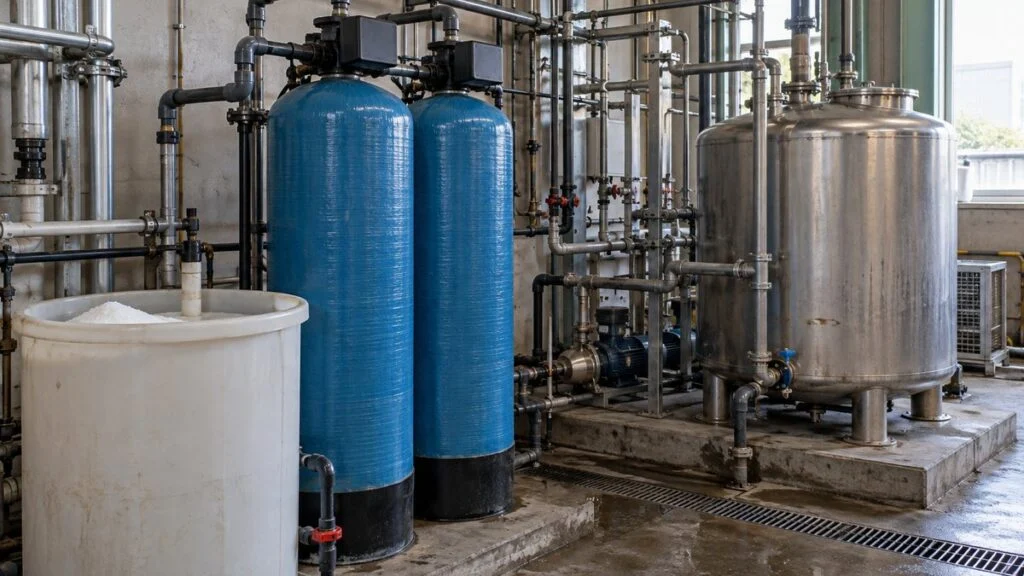
A packaged steam boiler arrives from Japan with a water-quality sheet that cites JIS B 8223. Conductivity is listed in mS/m, there is a line called "acid consumption (pH 8.3)," and the feedwater and boiler water have different pH ranges. Before the first firing, someone on site has to turn that sheet into a working water treatment program.
Boiler water treatment controls hardness, dissolved oxygen, pH, and the concentration of dissolved solids so that the boiler does not scale up or corrode. Stable steam output depends on water-side control as much as on combustion tuning.
This guide covers the three core treatments (softening, deaeration, and alkalinity control), how blowdown keeps concentration in check, and how to read a Japanese JIS B 8223 water-quality table next to the ASME and EN guidelines you may already use. It ends with a checklist, questions for the Japanese supplier, and an inquiry email you can adapt.
Contents
What Boiler Water Treatment Does
Municipal and industrial water carries dissolved minerals and gases you cannot see. Water that is clean enough to drink is not automatically fit for a boiler, which heats and evaporates the same water over and over.
Steam leaves the boiler as almost pure water, while the dissolved solids stay behind. Water treatment therefore manages two things: the quality of the water going in and how concentrated the water inside is allowed to become. Figure 1 shows where each type of water sits in the cycle.
Figure 1: Where Each Type of Water Sits in the Cycle
Look at makeup water, feedwater, boiler water, and returned condensate separately, not just at the softener outlet.
Conceptual diagram. Where the deaerator and chemical feed points sit depends on the treatment method and the boiler model.
The terms on a Japanese spec sheet follow the same cycle:
- Makeup water (hokyusui): fresh water added from outside the system
- Feedwater (kyusui): water pumped into the boiler
- Boiler water (boiler-sui, also kansui): water being heated inside the boiler
- Condensate (drain or fukusui): steam that has given up its heat and turned back into water; when recovered, it becomes part of the feedwater
Skip water treatment and two problems build up: solids deposit on heat-transfer surfaces, and metal corrodes. Deposits raise fuel use and cause local overheating, while corrosion thins the metal and leads to leaks. Either one can shut down production.
Treat the water treatment plant as equipment you monitor during operation, not as an accessory bolted onto the boiler.
Softening: Removing Hardness
Softening removes calcium and magnesium (hardness) from the water. As water heats and concentrates, these minerals precipitate and form scale on heat-transfer surfaces.
A typical softener passes the water through sodium-form ion exchange resin. The resin takes up calcium and magnesium and releases sodium in their place. Figure 2 shows the two modes of operation.
Figure 2: A Softener Exchanges Hardness and Is Regenerated With Brine
Where the water goes and what the resin does change between service and regeneration.
Actual regeneration also includes backwash and rinse steps. Regeneration waste is not sent to the boiler as feedwater.
The resin can only hold so much. Once it is exhausted, hardness starts to leak through to the outlet. Regeneration pushes brine through the bed to return the resin to the sodium form, which is why the salt tank has to be kept filled.
Softening is not the same as demineralization, which removes nearly all dissolved salts. Softened water still contains dissolved solids after the hardness ions are exchanged for sodium, so a low conductivity reading does not tell you whether the softener is working.
Check the softener outlet with a hardness test, and record raw water and treated water separately. Salt left in the tank is not proof of good performance. Watching regeneration cycles and throughput as well catches hardness leakage earlier.
If hardness shows up, first rule out the sample point and the test reagents, then work back through the softener history. Typical causes include:
- Not enough regeneration salt
- A faulty regeneration cycle
- Throughput beyond the softener's capacity
- Raw water leaking in through a bypass
Scale acts as thermal resistance on the water side and slows heat transfer from the metal to the water. Firing harder to hold the same steam output only puts more stress on the metal and can lead to local overheating and tube damage.
Figure 3: Even a Thin Deposit Blocks Heat Between Metal and Water
A layer that conducts heat poorly makes the metal run hotter.
Layer thickness and temperature difference are illustrative only. The diagram is not drawn to scale and does not show the temperature distribution in an actual boiler.
Sludge that settles loose in the water and scale bonded to a surface need different removal methods.
Water-side fouling also affects the economizer, which uses flue gas to preheat the feedwater. Manage every heat-transfer surface along the feedwater path, not just the boiler itself.
Deaeration: Removing Dissolved Oxygen
Deaeration reduces dissolved oxygen to limit corrosion in feedwater piping and inside the boiler. A softener does not remove oxygen, so softened water still needs to be assessed for oxygen removal.
Thermal deaeration heats the water to drive out dissolved gases and vents them from the system. Heating alone is not enough: how well the gases can escape, and how the vent is managed, also decide how well it works.
Figure 4 compares the three common methods and what to monitor for each.
Figure 4: Ways to Remove Oxygen and What to Check
Physical removal and chemical reaction work differently, so monitor them differently.
Do not choose between thermal and chemical methods on boiler size alone. Pick the combination that fits the required water quality, feedwater conditions, and how the plant runs.
A running chemical feed pump does not prove the right dose is going in. An empty chemical tank or a suction problem can keep the pump from delivering the required dose. Compare chemical consumption against operating hours, and tie it to the water analysis for the treatment you use.
Oxygen can dissolve again wherever deaerated water is exposed to air. Knowing the equipment layout and the sample points helps you tell undertreatment apart from re-contamination after treatment.
Your control boundary should cover the whole path to the boiler, not just the deaerator outlet.
Alkalinity Control: Holding pH in Range
Alkalinity control uses chemicals to adjust pH and related values so the water is less corrosive to metal. A higher pH does not automatically mean more protection.
Boiler water that drifts toward acidic causes corrosion, but alkali concentrated in one spot also causes damage. The goal is the control range for that boiler model and treatment method, not the strongest possible alkalinity.
Feedwater, boiler water, and returned condensate each have their own control values. Applying one pH target to "all the boiler water" means the reading and the corrective action no longer match.
Figure 5 shows one example from JIS B 8223 where the two ranges differ widely.
Figure 5: Feedwater and Boiler Water pH Are Controlled Separately
One condition from JIS B 8223:2021 for a multi-tube special-circulation boiler (takanshiki tokushu junkan boiler), as reproduced by Japan's Ministry of the Environment.
| Water sampled | pH at 25°C (77°F) | What it tells you |
|---|---|---|
| Feedwater | 5.8–9.0 | Limit for water before it enters the boiler |
| Boiler water | 11.0–11.8 | Limit for treated, concentrated water inside the boiler |
Normal operating pressure 1 MPa (about 145 psig) or less, softened makeup water, alkali treatment. Not a setpoint for every boiler type. Source: Japan Ministry of the Environment, "Proper control of boiler feedwater quality" (Japanese).
pH limits are stated at a reference temperature (25°C in JIS), not at operating temperature. Do not compare a hot sample reading with a 25°C limit. Cool the sample as the procedure specifies before you measure.
In practice, set your plant's control standard from the boiler manual and the water treatment specification, and record the measurement temperature and sample point with every result.
Condensate has a separate problem: carbon dioxide dissolves in it and makes it acidic. Raising boiler water pH with sodium hydroxide (caustic soda) does not solve this.
Sodium hydroxide does not readily pass into the steam, so adjusting the boiler water alone cannot be assumed to protect the condensate lines. Check condensate quality and where the steam is used, and select a compatible condensate treatment if needed.
Where steam contacts food or other products directly, the chemicals must also be acceptable for that end use. Choose the chemical type and dose to fit the steam application and the manufacturer's treatment specification, not water quality alone.
Reading a Japanese Water-Quality Spec: JIS B 8223
Japanese boiler makers and water treatment suppliers usually cite JIS B 8223 for water limits. The current edition, JIS B 8223:2021, covers feedwater, boiler water, and steam quality for land boilers and marine steam boilers. The 2015 edition it replaced covered feedwater and boiler water only.
The standard sets limits by boiler category, operating pressure, makeup water type (softened or ion-exchanged), and treatment method. To read the right column, you need all four. The table below shows the full column behind Figure 5.
Figure 6: One Column of a JIS B 8223:2021 Table
Multi-tube special-circulation boiler, operating pressure 1 MPa (about 145 psig) or less, softened makeup water, alkali treatment.
| Water | Item (as written in JIS) | Limit |
|---|---|---|
| Feedwater | pH at 25°C | 5.8–9.0 |
| Feedwater | Hardness, as CaCO3 | 1 mg/L or less |
| Feedwater | Iron, as Fe | 0.3 mg/L or less |
| Boiler water | pH at 25°C | 11.0–11.8 |
| Boiler water | Acid consumption (pH 8.3), as CaCO3 | 80–600 mg/L |
| Boiler water | Electrical conductivity at 25°C | 400 mS/m or less (4,000 µS/cm or less) |
| Boiler water | Chloride ion, as Cl | 400 mg/L or less |
| Boiler water | Phosphate ion, as PO4 | 20–40 mg/L |
| Boiler water | Sulfite ion, as SO3 | 10 mg/L or more |
| Boiler water | Hydrazine, as N2H4 | 0.1 mg/L or more |
Values as reproduced in the Ministry of the Environment document cited in Figure 5. Phosphate, sulfite, and hydrazine are chemical residuals; check the notes in the standard itself for when each one applies. Other boiler types, pressures, and treatments have different limits.
Three details trip up readers outside Japan:
- Conductivity in mS/m. JIS uses millisiemens per meter. 1 mS/m = 10 µS/cm, so 400 mS/m equals 4,000 µS/cm. Check the unit before comparing with a US meter reading.
- Acid consumption (sanshohiryo). "Acid consumption (pH 8.3)" is the amount of acid needed to bring the sample down to pH 8.3, expressed as CaCO3. Japanese references equate it with phenolphthalein alkalinity (P-alkalinity). Acid consumption to pH 4.8 corresponds to total (M) alkalinity, and some non-Japanese methods use a different endpoint, so confirm the test method (JIS B 8224:2022) before comparing results.
- Reference temperature. pH and conductivity limits are at 25°C. If your meter applies temperature compensation, confirm which reference temperature it uses.
How JIS B 8223 Compares With ASME, EN, and IS Guidelines
There is no one-to-one mapping between JIS B 8223 and the documents used in the US, Europe, or India. Each one groups boilers differently, so you cannot lift a number from one table and apply it to another.
The table below compares the documents themselves. It does not list ASME, EN, or IS limits because we could not verify them from the published standards; read those from the purchased documents or get them from your water treatment supplier.
Figure 7: Boiler Water Guidelines Side by Side
Use this to identify which document a spec refers to, not to convert limits.
| Document | Issued by | Covers | How limits are grouped |
|---|---|---|---|
| JIS B 8223:2021 | Japan's national standards (JIS), published by the Japanese Standards Association | Feedwater, boiler water, and steam for land and marine steam boilers | Boiler category, operating pressure, makeup water type, treatment method |
| ASME "Consensus on Operating Practices for the Control of Feedwater and Boiler Water Chemistry in Industrial and Institutional Boilers" (2021) | ASME Research and Technology Committee on Water and Steam in Thermal Systems | Feedwater, boiler water, and steam purity in industrial and institutional boilers | Seven boiler categories by design and application; limits vary with steam pressure and duty cycle |
| EN 12953-10:2003 | CEN (adopted nationally, e.g., BS EN, DIN EN) | Feedwater and boiler water for shell boilers | See the standard |
| EN 12952-12:2003 | CEN | Feedwater and boiler water for water-tube boilers (steam quality excluded) | See the standard |
| IS 10392 | Bureau of Indian Standards (BIS) | Feedwater and boiler water for low- and medium-pressure land boilers | See the standard; confirm the current edition with BIS |
ASME publishes this as a consensus guideline, not a code requirement. Editions checked in November 2026.
When a Japanese boiler goes into a plant that follows ASME or EN guidance, the two sets of limits may not agree. Ask the boiler maker which limits apply to their equipment and warranty, and whether a local water treatment program based on another guideline is acceptable to them.
Daily Water Checks
Daily checks work best when each reading points back to a piece of equipment:
- Hardness tells you about the softener
- Dissolved oxygen or scavenger residual tells you about deaeration
- pH tells you about chemical feed and concentration
Conductivity responds to dissolved ions, so plants use it to track concentration. It is not a hardness reading, though, and temperature and treatment chemicals also affect it, so do not mix up what each measurement tells you.
Comparing samples from different points can make a normal treatment difference look like a fault. Keep the water, the temperature, and the test method the same, and read the change from the previous result.
Expired reagents and dirty sample bottles also skew results. Log the sample point, reagent changes, regeneration, and chemical refills on the same timeline as the readings so you can trace causes later.
Drawing hot, pressurized water straight into a container can cause burns or a sudden release. Follow the site's cooling and depressurizing procedure and PPE rules for sampling, and do not modify piping or valves on your own.
Controlling Concentration With Blowdown
Even with treatment, dissolved solids in the boiler build up as water evaporates. Blowdown removes part of that water and replaces it with feedwater, and it does a different job from chemical treatment.
Too little blowdown lets concentration climb, while too much throws away heated water and the energy in it. Holding water quality within limits while blowing down only what is needed saves both water and fuel.
Figure 8: Finding Blowdown Rate From the Solids Left Behind
Illustrative calculation at steady state, constant water level, ignoring dissolved solids carried into the steam.
In this example, blowdown is 10% of feedwater but about 11.1% of steam flow. The same flow gives a different percentage depending on the base, so always state "percent of what" in logs and quotations.
Calculate cycles of concentration from a constituent that treatment does not add or remove. If you use a conductivity ratio, account for chemical and temperature effects, and do not change blowdown settings on a simple ratio alone.
Excessive concentration and foaming can also carry water droplets out with the steam. If you see dirty steam or an unstable water level, look into priming and foaming as well.
Matching Consumables and Inspections to Actual Operation
Salt and chemicals run down in proportion to use, so review them when output changes, not just on a fixed refill schedule. If production rises and makeup water increases, the load on the resin and the chemical consumption rise over the same number of days.
A drop in condensate return also brings in more makeup water and changes the load on the treatment plant. Log makeup water and steam flow alongside chemical purchases so you can see why consumption changed.
If you use a service contract, define who does analysis and equipment inspection, not just who refills salt and chemicals. Splitting daily operator checks from specialist inspections makes it clear whom to call when something goes wrong.
A water-quality trend catches changes that a fixed inspection interval can miss.
When water quality shifts, check for a change in raw water source, a regeneration, a chemical change, or a change in condensate return on the same day. Find the step that changed before you add more chemical to chase a single reading.
The cost of water treatment includes salt, water, wastewater, analysis, and maintenance as well as chemicals. Weigh those against repair costs and lost production from unplanned failures.
Tracking fuel use alongside water quality also helps you spot changes in boiler efficiency. Steady daily water management supports the plant's wider energy-saving and energy management work.
Checklist Before Commissioning a Japanese Boiler
Run through this list when a Japanese-built boiler or water treatment package arrives, or when you take over an existing one:
- Which JIS B 8223 edition, boiler category, pressure range, makeup water type, and treatment method the water limits are based on
- Separate limits for makeup water, feedwater, boiler water, and condensate
- Units checked (mS/m vs. µS/cm) and reference temperature for pH and conductivity
- Test method for acid consumption and how it relates to your alkalinity test
- Softener capacity versus expected makeup water flow, and regeneration settings
- Oxygen removal method (thermal, membrane, chemical, or a combination) and the residual to monitor
- Chemical names, local availability, and suitability for the steam end use (for example, direct food contact)
- Condensate treatment needs, separate from boiler water treatment
- Blowdown method, control basis (conductivity or a specific constituent), and how the rate is expressed
- Sample points, sample cooling, and the site's safety procedure for sampling
- Layup (wet or dry storage) procedure during shutdowns, from the manufacturer
- Who sets and approves the plant's control standard, and who decides when a reading is out of range
Questions for the Japanese Supplier
These questions cover the points that most often stay unclear on a translated water-quality sheet:
- Which table and column of JIS B 8223 (and which edition) do your water limits come from?
- Do your limits differ from JIS B 8223 for this model? If so, which items, and which limit governs the warranty?
- What makeup water quality did you assume (raw water analysis, softened or demineralized)?
- Which chemicals do you recommend, and are there local equivalents you accept?
- Will you accept a water treatment program based on ASME or EN guidance, and on what conditions?
- What is the recommended blowdown method and control basis for this boiler?
- What is the shutdown and layup procedure, and what must be done before restart?
Sample Inquiry Email
Adapt the wording below and attach your raw water analysis.
Subject: Water quality requirements for [model / serial number]
Dear [Name],
We are preparing the water treatment program for the [model] boiler delivered to [site]. Could you please confirm the following?
1. The edition, boiler category, and column of JIS B 8223 your feedwater and boiler water limits are based on.
2. Any model-specific limits that differ from JIS B 8223, and which limits apply to the warranty.
3. The units and reference temperature for conductivity and pH, and the test method for acid consumption (pH 8.3).
4. Your recommended chemicals, and whether locally available equivalents are acceptable.
5. The recommended blowdown method and the shutdown/layup procedure.Our raw water analysis is attached. We plan to use [softened / demineralized] makeup water with about [X]% condensate return.
Best regards,
[Name]
[Company]
Where This Guide Does Not Apply
The values in this article are examples for one boiler category and condition. Limits change with boiler type, pressure, makeup water, and treatment method, so set your control limits from the boiler's instruction manual and water treatment specification.
Higher-pressure boilers, boilers fed with demineralized water, and hot-water boilers have their own limits, which this article does not cover. Local regulations, insurers, and boiler inspectors may also set requirements, so confirm them with whoever is responsible for boiler compliance at your site.
FAQ
Does tap water need treatment before it goes into a boiler?
Being drinkable does not make water suitable for a boiler. Tap water still contains hardness and dissolved oxygen. Compare a raw water analysis with the boiler's water requirements and choose softening, oxygen removal, or other steps as needed.
If I have a water softener, do I still need chemicals and blowdown?
A softener alone does not settle that question. A softener exchanges hardness ions; it does not remove oxygen or all dissolved salts. Whether you need chemicals and blowdown depends on what remains in the water, how concentrated it gets, and the boiler's treatment method.
If pH is normal, is the boiler water OK?
Not necessarily. pH alone cannot show hardness leakage, dissolved oxygen, or concentration. At each sample point, measure the items the treatment specification sets for that point, and read the results together with the equipment's operating history.
What is the difference between softened water and demineralized water?
Softened water has mainly had its hardness removed, while demineralized (pure) water has had ions and other impurities removed much more broadly. Which one you need depends on boiler pressure and steam use; the name alone does not tell you whether it is suitable feedwater.
Does boiler water need attention during shutdown?
Yes. Corrosion continues while the boiler is idle because metal stays in contact with water and air. Follow the manufacturer's wet or dry layup procedure for the length of the shutdown, including the steps for restart.
Sources
- JIS B 8223:2021 limits for multi-tube special-circulation boilers and blowdown control: Japan Ministry of the Environment, "Proper control of boiler feedwater quality" (Japanese)
- JIS B 8223:2021 title and scope: Japanese Standards Association, JIS B 8223:2021 English edition preview
- ASME consensus guideline: ASME, "Consensus on Operating Practices for the Control of Feedwater and Boiler Water Chemistry in Industrial and Institutional Boilers"
- EN 12953-10 scope: BSI, "Shell boilers – Requirements for feedwater and boiler water quality"
- EN 12952-12 scope: Genorma, EN 12952-12:2003
- Acid consumption (pH 8.3) and P-alkalinity: MLIT Edogawa River Office, glossary entry on alkalinity (Japanese)
- IS 10392 listing: IS 10392 listing (Standards.ie)
- Dissolved oxygen, carbon dioxide, and condensate corrosion: Kurita Water Industries, corrosion damage in boilers (Japanese)
- Softening, demineralization, scale, and corrosion: Spirax Sarco, "Water for the Boiler"
- Feedwater and deaeration: Spirax Sarco, "The Feedtank and Feedwater Conditioning"
- Concentration and conductivity: Spirax Sarco, "Controlling TDS in the Boiler Water"
- Softeners and membrane deoxygenation: Miura, technical data on water treatment equipment (Japanese)
- Hardness testing at the softener outlet: Miura, why hardness indicators are needed (Japanese)
- Shutdown layup: Kurita Water Industries, preventing problems in low-pressure boilers during shutdown (Japanese)
Original article in JapaneseThis guide is adapted from a MONOSCOPE article written for readers in Japan: ボイラー水の水処理とは?軟水化・脱酸素・アルカリ化と管理の要点
About the editor
 MONOSCOPE EditorFOUNDER & EDITOR
Spent about ten years at a plant equipment maker and a plant engineering company, proposing, designing, and commissioning equipment, then moved into web marketing. Now a web consultant for B2B manufacturers, helping them explain their products and technology. Licensed in Japan as an Energy Manager and a Third-Class Chief Electrical Engineer.
Has run an engineering blog since 2017 (500+ articles) and a Japanese YouTube channel with about 20,000 subscribers. Each English guide is written from the Japanese shop-floor point of view and checked against the cited standards.