Mold Storage in Japan: Subcontract Act Rules and Checklist
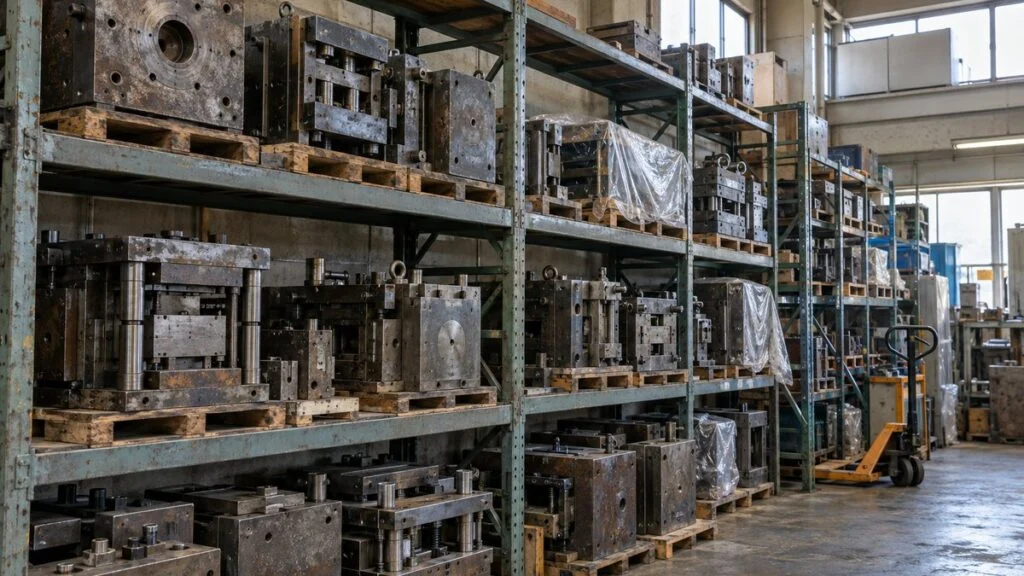
Production of a part ended years ago, but its mold is still sitting on a shelf at the supplier's plant. In Japanese manufacturing this is a common sight, and both buyers and suppliers have long treated it as normal.
Under Japanese law, though, it can be a legal problem. Japan's Subcontract Act (shitauke-ho) was amended and renamed on January 1, 2026. Its official English title is the Act Against Delay in Payment of Fees, etc. to Small and Medium-sized Entrusted Business Operators in Manufacturing and Other Specified Fields, and the Japan Fair Trade Commission (JFTC) shortens it to the Fair Transactions Act (toriteki-ho in Japanese). The Act prohibits buyers from making suppliers provide "unjust economic benefits," and keeping molds at a supplier for free, with no orders for a long time, can fall under that ban. It does not matter whether the supplier ever sent an invoice. In fiscal year 2025 alone, 26 of the JFTC's recommendations (published administrative findings that tell a company to correct a violation) involved tooling storage.
This guide is for procurement and engineering teams outside Japan whose molds, dies, or jigs sit at Japanese suppliers, and for anyone who holds tooling on behalf of a Japanese customer. It explains, from official Japanese sources, when free storage becomes a problem in transactions the Act covers, which transactions those are, and what the JFTC cases found. It then covers why the problem persists, how each side can deal with it, and ends with a tooling agreement checklist and English email templates you can use. It is not legal advice: whether the Act applies to your own contracts is a question for your legal team.
Contents
- When Free Mold Storage Becomes a Problem Under Japanese Law
- Which Transactions Does the Fair Transactions Act Cover?
- What the JFTC Recommendations Found
- Why Free Storage Persists
- Scrap, Return, or Keep: Deciding Each Tool's Fate
- For Buyers: Six Steps From Tooling Inventory to a Signed Agreement
- For Suppliers: Make the Tooling You Hold Visible
- Tooling Agreement Checklist: Ownership, Storage, Scrapping, Cost
- Email Templates
- Limits of This Guide
- Summary
- FAQ
- Sources
When Free Mold Storage Becomes a Problem Under Japanese Law
The Fair Transactions Act prohibits a buyer (the "entrusting business operator") from unjustly harming the interests of a smaller supplier (the "small and medium-sized entrusted business operator") by having the supplier "provide money, services, or other economic benefits for the buyer's own sake" (Article 5, Paragraph 2, Item 2). The problem is not handing tooling to a supplier. The problem is having the supplier store it without paying for the storage.
The official guide published by the JFTC and the Small and Medium Enterprise Agency (SMEA) puts it this way: when a buyer has, for example, not placed orders for a long time, having the supplier store the tooling without paying storage costs counts as a demand for unjust economic benefits.
The rule is not limited to metal molds. Molds, dies, wooden patterns, jigs, inspection gauges, and production equipment are all treated together as "tooling" (kata-to). The storage costs the guide lists include the equivalent of rent for the supplier's own warehouse space, fees for an outside warehouse, transport to a warehouse, and maintenance. Even idle tooling takes up floor space and needs rust prevention, so the question is who carries that cost.
What counts as "not placing orders for a long time"? The JFTC's online FAQ for the Act lists four circumstances found in past violation cases.
Free storage under any of these circumstances may be a violation.
Based on the JFTC FAQ for the Fair Transactions Act, Q119 (Japanese). The JFTC notes that circumstances differ case by case. The four do not all have to apply, and a case that matches none of them is not automatically fine.
Read the "one year" carefully. It is the period that appeared in past violation cases, not a grace period. Free storage for less than a year is not automatically allowed. The JFTC says some buyers believed they could have suppliers store tooling free for one year after its last use, and states that storage costs must be paid in line with the storage period.
Supplier-Owned Tooling Can Be Covered Too
The rule does not apply only to tooling the buyer owns and lends to the supplier. Tooling the supplier owns is treated the same way if the buyer controls it in practice. The example given is an agreement that the supplier may not scrap the tooling without the buyer's approval.
When the tooling cost is recovered through the piece price (amortized into the part price), the supplier may remain the legal owner. Buyers can easily miss that supplier ownership does not make the storage-cost issue go away.
Payment Is Due Even Without an Invoice
The second common blind spot is the invoice. In the same FAQ answer, the JFTC cites buyers who assumed that if the supplier did not bill them, they did not have to pay. According to the official guidance, storage costs must be paid in line with the storage period whether or not the supplier asks for them. The storage period here means the period during which no orders are placed for parts made with the tooling.
If tracking every tool's activity at all times would be too much work for both sides, the guidance allows another method: after discussion, the two sides check order activity once a fiscal year and the buyer pays for that year's storage period in a single payment.
Which Transactions Does the Fair Transactions Act Cover?
Whether the Act applies depends on the type of transaction and on the size of the buyer and the supplier. Tooling storage usually comes up in outsourced manufacturing of parts, and in that case a transaction is covered if it fits one of the combinations below.
If neither capital test applies, the employee-count test is used.
For outsourced manufacturing. The employee test was added in the January 2026 amendment and is used for transactions the capital tests do not cover. It can also apply to work re-outsourced through a subsidiary.
Because of the new employee test, a buyer with small capital but a large workforce can now be covered. "Our capital is small, so the Act doesn't apply to us" may no longer hold.
The amendment also widened the scope of outsourced manufacturing to cover more tooling. Before 2026, outsourcing the manufacture of metal molds was covered; now outsourcing the manufacture of wooden patterns, resin molds, jigs, and similar tooling is covered as well. (A wooden pattern is a mold made of wood; which type of tooling a part needs depends on the process, such as casting or molding.)
Note that this change concerns ordering tooling to be made. Storage is a separate question: free storage of patterns, jigs, and other tooling tied to outsourced parts production was already treated as a violation before the amendment. Don't confuse the two.
Transactions outside the Act are not entirely unregulated. Japan's government-issued Promotion Standards (shinko kijun), which cover a wider range of transactions, also ask buyers not to have suppliers store tooling for free. The 2026 amendment made other changes too, such as banning buyers from setting prices unilaterally without engaging in discussions; those are outside the scope of this guide.
Does It Apply to Buyers Outside Japan?
The source material for this guide does not address overseas buyers, and we do not give a yes-or-no answer. Some Japanese law firms note that the Act may reach a foreign company when the transaction has a substantial connection to Japan, such as a foreign company outsourcing production to a Japan-based supplier, and that Japanese subsidiaries of foreign groups can be covered. How that applies to your contracts, your entity structure, and the supplier's size is a question for your legal team or Japanese counsel.
Either way, clear written storage terms help both sides avoid disputes, so the checklist later in this guide is worth using whatever the legal answer.
What the JFTC Recommendations Found
The JFTC publishes summaries of its recommendations in a list for each fiscal year (April to March). In FY2025, 26 of its 39 recommendations involved tooling storage.
The findings read almost the same from case to case: the buyer had the supplier store tooling free of charge for the buyer's own benefit, even though it had not ordered products made with that tooling for a long time.
The cases are not limited to auto parts. The FY2025 list includes makers of heating and housing equipment, hydraulic equipment, agricultural machinery, injection molding machines, and power tools, as well as building materials, circuit breakers for wiring, heat exchangers, corrugated boxes and paper packaging, and payment terminals.
Scale varies widely, from one mold stored at one supplier to 19,461 items spread across 102 suppliers. The violations fall into several patterns.
Besides storage itself, the cases also cite work and costs that come with storage.
Based on the JFTC's report on enforcement of the Act in FY2025, Appendix 1, and the FY2026 recommendation list as of September 29, 2026 (both in Japanese).
In some cases the tooling belonged to the buyer's own customer or to a leasing company and was lent to the supplier. The buyer that had the supplier store it still received the recommendation. Not owning the tooling was not accepted as a reason to avoid paying for its storage.
Items other than tooling have been cited under the same provision. In some cases, buyers had suppliers store, free of charge, parts inventory produced in bulk, product samples from each lot, and quality records kept for a set period such as 20 years. In other words, the cost of "just keeping it for us" is under scrutiny for more than tooling.
What a Recommendation Requires
Recommendations are broadly similar. The buyer must promptly pay an amount equal to the storage costs, after confirming the amount with the JFTC. Its board of directors must formally resolve that the conduct was a violation and will not be repeated. It must improve internal systems, for example by training its purchasing staff. It must also inform its own staff of the measures taken and notify the affected suppliers.
As a rule, the JFTC publishes the company name and a summary of the violation. Some cases also disclosed the storage costs paid:
- An auto parts maker that had 16 suppliers store 3,733 items: JPY 29,140,951 in total
- Another auto parts maker that had 5 suppliers store 415 items: JPY 19,255,498
- A case involving industrial motor parts, with 600 items at 44 suppliers and stocktaking twice a year: JPY 18,124,480 in equivalent costs
Storage periods and tooling sizes differ from case to case, so do not divide these totals to get a "going rate per mold." Storage fees are set by building up actual costs item by item and agreeing on them between the parties.
A Sharp Rise in Cases
According to JFTC figures, recommendations involving free tooling storage rose from 1 in FY2022 to 3 in FY2023, 9 in FY2024, and 26 in FY2025. Each count is the number of recommendations that include tooling storage; a case that also involved another violation, such as forced returns of goods, counts as one.
For FY2026, we counted the 15 cases on the JFTC's recommendation list as of September 29, 2026: 9 of them include tooling storage, and 7 of those 9 were issued in July.
In FY2025, tooling storage accounted for two-thirds of all 39 recommendations.
Recommendations that include tooling storage. Japan's fiscal year runs from April to the following March (FY2025 = April 2025–March 2026). FY2022–FY2024: JFTC/SMEA leaflet; FY2025: JFTC report on enforcement in FY2025. FY2026 is our own count from the JFTC recommendation list as of September 29, 2026 (15 cases) and cannot be compared with full-year figures. An SMEA summary of the Promotion Standards revision gives 24 for FY2025; we use the 26 that the JFTC published in its annual enforcement report.
Most recommendations issued in 2026 still cite the old Subcontract Act (Article 4, Paragraph 2, Item 3), because transactions placed before the amendment took effect are governed by the old law. The ban on demanding unjust economic benefits carried over into the Fair Transactions Act.
For the whole category of "demanding unjust economic benefits," the amount returned to suppliers grew from JPY 189.59 million in FY2024 to JPY 1,280.26 million in FY2025. That total also includes other conduct, such as making suppliers handle transport or loading for free, but it shows how quickly corrective action in this category has grown.
Why Free Storage Persists
If the rules are this clear, why does free storage continue? Below are likely causes we identified from cases in the official material and from common practice in manufacturing supply chains. They are not statistically proven. The pattern looks less like bad intent than like a setup in which nobody is in a position to decide, so time simply passes.
1. Service parts. After mass production ends, nobody knows when an order for a repair part will come, so no one is willing to say the tooling can go. Nobody decides whether to keep a mold for a few parts a year or to make a final batch and scrap the tooling, and storage just continues.
2. The decision-maker and the tooling are far apart. The tooling owner, or the person who must approve scrapping it, may be the finished-product maker, while the tooling physically sits at a second-tier processor. The tier-1 parts maker in the middle cannot decide on its own. The JFTC's enforcement guidelines even list, as an example of a violation, a buyer that left a supplier's request to scrap tooling unanswered for a long time because "we cannot decide this on our own."
A parts maker in the middle both hands tooling out and holds it.
Whether each link in the chain is covered by the Act is decided separately using the tests in Figure 2. Waiting for an answer from upstream does not justify delaying payment of storage costs downstream.
3. No tooling register. If the buyer does not know which tooling sits at which supplier and since when, it cannot even start a conversation about cost. Many recommendations involve thousands of items, which suggests years of backlog that nobody cleaned up.
4. Suppliers hesitate to speak up. Some suppliers say nothing because they fear that billing for storage or asking to scrap tooling will hurt their next order. In the mold and machining trades, a supplier's sales are sometimes concentrated on one customer, which makes it even harder to raise the issue. The official position that payment is due even without an invoice fits this reality.
Scrap, Return, or Keep: Deciding Each Tool's Fate
The starting point is to decide what happens to each tool. There are three options: scrap it, return it (the buyer collects it), or keep storing it. Each option requires different decisions. The official material also says the buyer must discuss with the supplier whether to scrap, collect, or continue storing the tooling.
Confirm future use and who approves, then agree on one of the three.
The decision depends on future use. Can you name a specific date for the next order? How many years of service-parts supply are needed? Could you make a final batch, hold it as inventory, and release the tooling? Purchasing cannot answer these alone; sales, service, and design need to weigh in.
If the approver is outside your company, agree on who will ask and by when they must answer. If the tooling belongs to your upstream customer, settle with the processor holding it both your deadline for asking the customer and who pays for storage until the answer comes.
Deciding to "keep it for service parts" is not the end of it either. Record the reason for keeping it, the location, the period, the fee, and the next review date as separate items. Otherwise, a few years later, the same tooling drifts back into limbo.
For Buyers: Six Steps From Tooling Inventory to a Signed Agreement
The six steps below are our summary, based on the official guidance, of how a buyer's purchasing or procurement team can handle tooling at Japanese suppliers. They describe a general approach and do not guarantee compliance.
Work in three phases: find out, agree, and make it stick.
Our summary as a procedure, based on the JFTC/SMEA guide, the JFTC FAQ, and the Promotion Standards.
Build a Tooling Register Both Sides Can Match
The register is not only for the buyer's asset records. It is there to be checked against the supplier's own list, and when both sides track the same fields, the discussion moves faster. At minimum, include:
- Tool number, the part number it makes, and tooling type (metal mold, wooden pattern, jig, inspection gauge, etc.)
- Owner (you, the supplier, your customer, or a leasing company) and who approves scrapping
- The supplier holding it, its storage location, and its approximate size or floor area
- Last order date and last use date (track them separately, since they can differ)
- Planned future use (next order date, whether it is needed for service parts)
- Discussion history (when, with whom, what was decided) and the next review date
Check order history and plans against production planning's schedules and service-parts demand data. Do not keep the register inside purchasing only; let the other departments involved update it, so the backlog does not build up again.
Build the Storage Fee From Cost Items and Period
There is no official rate for storage fees. Start from the cost items the official guidance lists (equivalent warehouse rent, outside warehouse fees, transport, maintenance), ask the supplier about its actual costs, and negotiate. Before agreeing on an amount, settle which tooling is covered, the storage period, and the cost items to include.
Here is a fictional example of how to build up the fee: 120 tools at one processor, with no orders for 18 months. All unit prices are placeholders for illustration only, not market rates.
120 tools stored for 18 months. List quantity, period, and unit price for each cost item.
Fictional example. The floor areas and rates are not real cases or market rates; actual amounts depend on the supplier's actual costs and agreement between the parties. Keeping the supporting documents (warehouse rent, records of work hours, etc.) makes later reviews easier.
How to count the period and which costs to include can vary from case to case. If in doubt, check with the official consultation desks listed later or with a lawyer who knows the Act.
Written Agreements and the Promotion Standards
On June 24, 2026, Japan's Ministry of Economy, Trade and Industry (METI) revised the Promotion Standards issued under the Act on Promotion of Entrusted Small and Medium-sized Enterprises, effective the same day. The revision says that when a buyer has a supplier store tooling, the two sides should make efforts to agree explicitly in advance, for example in a written memorandum, on matters such as payment of storage fees.
The revision also says buyers should not demand free storage, including in the four circumstances in Figure 1, and that storage fees must be paid in line with the storage period whether or not the supplier asks.
The Promotion Standards are not prohibitions under the Fair Transactions Act. They are general standards the government sets for buyers and suppliers to follow. They cover a wider range of transactions than the Act and give the competent ministers grounds for guidance and advice.
When you review your master purchase agreement, or the flow from purchase order through inspection to payment, check the tooling storage terms at the same time so nothing is missed.
If You Find Past Free Storage
Your inventory may turn up tooling that has already been stored free for years. The JFTC has said it does not issue a recommendation in certain situations, for example when a buyer voluntarily reports a violation before any investigation begins and has taken steps to make up for the supplier's losses. In FY2025 there were 53 such voluntary reports (this count includes violations other than tooling storage).
How far back to go and how to settle are case-by-case judgments. Do not decide internally alone; work through the JFTC or SMEA consultation desks and legal counsel.
For Suppliers: Make the Tooling You Hold Visible
This section is for readers on the other side: you hold tooling for a Japanese customer, or you run a Japanese subsidiary or plant that does. What a supplier can do is show the real situation in numbers and put its requests in writing. Mold makers and machine shops are mostly small and mid-sized companies, and stored tooling takes floor space that could be used for production. Start by getting the full picture.
List the Tooling You Hold
For each customer, list the tool number, part number, date last used, location and floor area, and the time and money spent on upkeep. Using the same fields as the buyer's register above makes the two lists easy to compare. Showing floor area and labor, not just the number of tools, makes the storage-fee discussion concrete.
Make Requests in Writing and Keep Records
Send requests to scrap tooling, to have it collected, or to discuss a fee if storage continues by email or letter, not verbally. Include the tooling concerned, the last order date, how you want it handled, and when you need an answer. Keep the date you sent it and the customer's reply as they are.
A supplier's request to scrap or return tooling is one of the circumstances listed in the official material. That does not mean free storage is fine if you never asked; as noted above, payment is due even without a request or invoice.
If the customer does not reply, do not scrap tooling you are holding on your own judgment. It can create a separate dispute with the owner, so consult one of the desks below first.
Check Whether You Are Also a Buyer
Parts makers often hold a customer's tooling while also leaving their own molds and jigs with subcontractors. Where you meet the buyer tests in Figure 2, you carry the buyer's obligations toward those subcontractors. Check that you do for your own subcontractors what you ask of your customers.
Where to Get Help in Japan
If talks with the customer stall, or you cannot tell whether your situation is a problem, these public services can help (mainly in Japanese):
- Torihiki Kakekomi-dera: a consultation service run under contract with the SMEA, with 48 locations across Japan (called Shitauke Kakekomi-dera until December 2025). It handles business-to-business transaction issues and offers consultations with lawyers and out-of-court dispute resolution. Toll-free number within Japan: 0120-418-618.
- JFTC: consultation desks for the Fair Transactions Act, and a desk for reporting suspected violations.
- SMEA and regional METI bureaus: consultations on the Act.
Suppliers sometimes report violations to the JFTC or SMEA. The Act prohibits a buyer from cutting order volumes or ending the relationship because a supplier did so (Article 5, Paragraph 1, Item 7). Before consulting, prepare your tooling list, order history, and records of exchanges with the customer.
Tooling Agreement Checklist: Ownership, Storage, Scrapping, Cost
Whether or not the Fair Transactions Act applies to your transaction, these are the points to settle in writing with each Japanese supplier. Use it when you award new tooling, at end of production, and at your annual review.
Ownership
- Who legally owns each tool: your company, the supplier, your customer, or a leasing company
- How the tooling was paid for: a separate tooling PO or amortized in the piece price, and whether amortization is complete
- Whether ownership is marked on the tool (tag or plate) and recorded in both sides' asset registers
- Who may approve scrapping, transfer, or modification
Storage
- Storage location (supplier's plant, outside warehouse) and floor area
- What counts as the storage period: the period with no orders, and from what date
- Maintenance included (rust prevention, inspection) and how often
- Whether stocktaking or condition reports are separate paid work
- Insurance and responsibility for damage or loss
Scrapping and return
- The trigger for a scrap/return decision (for example, a set period with no orders, or end of service-parts supply)
- Deadline for the owner or approver to answer a supplier's request
- Who arranges and pays for disposal or return shipping, and who keeps scrap proceeds
- Records to keep: disposal certificate, photos, handover checklist
Cost and payment
- Cost items (space, maintenance, transport) and how each is calculated
- Payment timing (for example, once per fiscal year after checking order activity) and that payment does not depend on an invoice
- Handling of any past storage period
- Next review date and who owns the register on each side
Email Templates
Edit these to fit your situation. A short request that lists exactly what you need is easier to answer, especially for a supplier working in its second language. Have your legal team review any wording about fees or past periods before you send it.
Buyer to Japanese supplier: tooling inventory request
Subject: Request: Inventory of our tooling at your plant

Dear [Name],

We are reviewing all tooling (molds, dies, jigs, and gauges) that we have
placed with our suppliers. Could you send us a list of the tooling for
our parts currently at your site, with the following for each item?

1. Tool number and the part number it produces
2. Tool type and location (your plant or an outside warehouse)
3. Approximate size or floor area it occupies
4. Date it was last used for production
5. Any maintenance or inspection you have carried out, and its cost
6. Who owns the tool, if your records show this

Based on the list, we would like to agree with you, item by item,
whether to scrap, return, or keep each tool, and on the storage fee
for any tooling we ask you to keep.

Could you reply by [date]? Please let us know if an Excel template
would help.

Best regards,
[Name]
[Company]
Supplier to customer: scrap or return request
Subject: Request for decision: Stored tooling for [part numbers]

Dear [Name],

We are holding the tooling listed below for your parts. There have been
no orders for these parts since the dates shown.

[Tool number] / [Part number] / last order: [date] / floor area: [m²]

Could you let us know, for each item, whether you would like us to:
(a) scrap it, (b) return it to you, or (c) keep storing it?
If you would like us to keep it, we would like to discuss a storage
fee and the next review date.

We would appreciate your answer by [date]. Until we hear from you, we
will keep the tooling as it is.

Best regards,
[Name]
[Company]
Limits of This Guide
- This guide summarizes Japanese official material (JFTC, SMEA, METI) as of the dates in the sources. It is not legal advice, and whether a specific transaction violates the Act depends on its facts.
- Whether the Act applies to a buyer outside Japan, or to a transaction between your overseas entity and a Japanese supplier, is not settled here. Confirm with your legal team or Japanese counsel.
- The coverage tests in Figure 2 are for outsourced manufacturing only. Other transaction types are not covered in this guide.
- Figure 8 is fictional. Real storage fees depend on the supplier's actual costs and negotiation.
- Our FY2026 count is partial and based on the list as of September 29, 2026.
- Much of the official material is available only in Japanese. Ask counsel to confirm the original wording before relying on any specific point.
Summary
- Having a supplier store tooling without paying for it, when there have been no orders for a long time, may count as demanding "unjust economic benefits" under Japan's Fair Transactions Act (formerly the Subcontract Act)
- The rule covers wooden patterns, jigs, gauges, and equipment, not only metal molds. Supplier-owned tooling is treated the same way if scrapping it needs the buyer's approval
- According to official guidance, storage fees must be paid in line with the storage period, with or without an invoice
- The JFTC issued 26 recommendations involving tooling storage in FY2025, and our count of its list as of September 29, 2026 shows 9 so far in FY2026
- Buyers: take stock, agree with suppliers, sign a written agreement, and review every year. Suppliers: list your tooling and make requests in writing
Start by listing the tooling held at each supplier, confirming who can approve its disposal, and opening discussions on whether to scrap, return, or keep each item. Whether a specific transaction is a violation depends on the facts, so when in doubt, check with your legal team, the JFTC or SMEA desks, or a Japanese lawyer.
Related: Price Increase Requests in Japan: How Suppliers Negotiate
Related: Japanese Procurement: QCD Negotiation and Supplier Ratings
Related: Japanese Mold Makers and Machining Shops: Who Does What
FAQ
Who owns the tooling at a Japanese supplier?
It depends on the contract and how the tooling was paid for. Buyer-owned tooling lent to the supplier is common, but when the tooling cost is amortized into the piece price, the supplier may remain the legal owner. Under the JFTC guidance, supplier-owned tooling can still be treated like buyer-owned tooling for storage purposes if the buyer controls it, for example by requiring approval to scrap it.
Can a buyer keep molds at a Japanese supplier for free for one year?
Not as a rule. "One year" is the period that appeared in past violation cases, not a free-storage allowance. The JFTC states that storage fees must be paid in line with the storage period.
Does the buyer have to pay if the supplier never sends an invoice?
Under the official guidance for transactions the Act covers, yes. Storage fees are due in line with the storage period whether or not the supplier asks. The two sides can agree to check order activity once a fiscal year and pay for that year's storage in one payment.
Does Japan's Subcontract Act apply to companies outside Japan?
This guide does not answer that for your case. Coverage depends on the transaction and on the size of each party, and some Japanese law firms note that a foreign company can be covered when the transaction has a substantial connection to Japan. Confirm with your legal team or Japanese counsel.
What should a mold storage agreement include?
At minimum: ownership and who approves scrapping, storage location and period, maintenance, storage fee items and payment timing, the scrap/return procedure and who pays for it, and the next review date. See the checklist above.
Sources
- Text of the Act (Articles 2, 5(2)(ii), and 10): e-Gov Laws and Regulations, Act Against Delay in Payment of Fees, etc. to Small and Medium-sized Entrusted Business Operators in Manufacturing and Other Specified Fields (Japanese)
- Official English title and short name "Fair Transactions Act": JFTC statement, July 16, 2025
- How tooling storage is treated, examples of violations in the enforcement guidelines, voluntary reports, consultation desks: JFTC/SMEA, guide to the Fair Transactions Act (November 2025) (Japanese)
- Four circumstances found in violation cases, notes on paying storage fees: JFTC FAQ for the Fair Transactions Act, Q119 (Japanese)
- FY2022–FY2024 recommendations involving free tooling storage: JFTC/SMEA leaflet on stepped-up monitoring of free tooling storage (as of November 13, 2025) (Japanese)
- FY2025 recommendations, 26 tooling cases, amounts returned, voluntary reports, case summaries: JFTC report on enforcement of the Fair Transactions Act in FY2025 (June 10, 2026) (Japanese)
- FY2026 recommendations: JFTC list of recommendations, FY2026 (as of September 29, 2026) (Japanese)
- Cases with published storage-fee amounts: JFTC lists of Subcontract Act recommendations for FY2024 and FY2023 (Japanese)
- Promotion Standards revision (June 24, 2026): METI press release and SMEA, Promotion Standards (Japanese)
- Addition of wooden patterns, jigs, etc. to outsourced manufacturing: JFTC briefing material on the January 2026 amendment (Japanese)
- Torihiki Kakekomi-dera: program website (Japanese)
Original article in JapaneseThis guide is adapted from a MONOSCOPE article written for readers in Japan: 金型の無償保管はなぜ違反?取適法の勧告事例と発注側・受注側の対策
About the editor
 MONOSCOPE EditorFOUNDER & EDITOR
Spent about ten years at a plant equipment maker and a plant engineering company, proposing, designing, and commissioning equipment, then moved into web marketing. Now a web consultant for B2B manufacturers, helping them explain their products and technology. Licensed in Japan as an Energy Manager and a Third-Class Chief Electrical Engineer.
Has run an engineering blog since 2017 (500+ articles) and a Japanese YouTube channel with about 20,000 subscribers. Each English guide is written from the Japanese shop-floor point of view and checked against the cited standards.