Jishu Hozen 7 Steps: Autonomous Maintenance Guide for TPM
The request comes from the Japanese parent company: "Start jishu hozen on the model line. Step 1 by next quarter." A few weeks later, a slide deck arrives with words like shoki seiso, efu, and kari kijun, and a TPM consultant from Japan is booked to audit your first step. If you lead maintenance or production at a Japanese-owned plant in India, Thailand, the US, or elsewhere, this guide explains what is being asked of you.
Jishu hozen (自主保全) is the Japanese name for autonomous maintenance: operators keep their own equipment in good condition through cleaning, lubrication, tightening, and inspection. The Japan Institute of Plant Maintenance (JIPM), which proposed TPM in 1971, breaks the work into seven steps. Each step builds on the one before. Operators start by deep-cleaning their machines and end by running maintenance and improvement on their own.
Below you will find the seven steps, how to run Step 1 (initial cleaning) and the tagging that goes with it, the tools Japanese plants use to keep the steps moving, and why the program often stalls after the first push. The article ends with a Step 1 readiness checklist and a list of questions to ask the Japanese side.
- Jishu hozen (autonomous maintenance) is one of the eight pillars of TPM. Operators clean, lubricate, tighten, and inspect their own equipment.
- The 7 steps are: (1) initial cleaning, (2) countermeasures for contamination sources and hard-to-access areas, (3) tentative standards, (4) general inspection, (5) autonomous inspection, (6) standardization, and (7) full autonomous management. Steps 1–3 prevent deterioration, Steps 4–5 measure it, and Steps 6–7 make the team self-managing.
- Initial cleaning (Step 1) means removing all dirt from the equipment while lubricating and tightening, so that hidden defects such as oil leaks, loose bolts, and damage come to light and get fixed. The Japanese motto is "cleaning is inspection."
- Every defect found gets a tag called an efu (F-tag) with the date, the finder's name, and the problem. The tag comes off when the defect is fixed. Before any cleaning or inspection, the machine must be stopped and locked out under your site's safety rules and lockout/tagout (LOTO) procedure.
Contents
- What Is Jishu Hozen (Autonomous Maintenance)?
- The 7 Steps of Jishu Hozen at a Glance
- Before Step 1: Step Zero and Safety
- Phase 1: Prevent Deterioration (Steps 1–3)
- Phase 2: Measure Deterioration (Steps 4–5)
- Phase 3: Autonomous Management (Steps 6–7)
- Tools That Keep the Steps Moving: Step Audits, Activity Boards, and OPLs
- Why Jishu Hozen Stalls, and What Helps
- Step 1 Readiness Checklist
- Questions to Ask the Japanese Parent Company
- Limits of This Guide
- FAQ
What Is Jishu Hozen (Autonomous Maintenance)?
Jishu hozen literally means "self-directed maintenance." In English it is usually called autonomous maintenance (AM). The idea is that the people who run a machine every day are the first to notice when something is wrong, so they take over part of its care. To see why the seven steps are ordered the way they are, it helps to know where AM sits in TPM, what kind of deterioration it targets, and what kind of operator it aims to develop.
Where Jishu Hozen Fits in TPM
TPM stands for Total Productive Maintenance. JIPM proposed it in 1971 as an approach in which everyone, from top management to front-line employees, takes part. According to JIPM, Nippondenso (now Denso) developed and rolled out TPM with JIPM that same year and won the JIPM award for TPM excellence. JIPM's definition describes TPM as building systems on the shop floor that prevent every kind of loss before it happens, with goals such as zero accidents, zero defects, and zero breakdowns.
Here, "losses" are anything that lowers the efficiency of production. JIPM groups them into three broad categories and 16 detailed ones.
Related: OEE and the 7 Big Losses vs. Six Big Losses in TPM
TPM activities are organized into eight areas called pillars. Autonomous maintenance is one of the four pillars that reduce losses directly.
Autonomous maintenance is one of the pillars that cut losses directly.
Grouping based on JIPM's "What Is TPM?" page. Companies may add, rename, or regroup pillars.
In Japanese plants, TPM sits alongside the Toyota Production System and other kaizen (continuous improvement) activities.
Related: Kaizen in Japanese Companies: How Improvement Actually Runs
Forced Deterioration vs. Natural Deterioration
JIPM's basic guide for its Autonomous Maintenance Operator certification describes AM as production operators taking over part of the maintenance function for the equipment they use. The motto is "I protect my own equipment."
The key idea is the difference between two kinds of deterioration:
- Natural deterioration happens even when equipment is used and cared for correctly.
- Forced deterioration (kyosei rekka) is wear sped up by people who skip basic care, such as wear or seizure caused by missed lubrication.
The same guide splits maintenance into three activities: preventing deterioration, measuring it, and restoring equipment. For production, preventing deterioration is the most important part of AM. The operator's job is to stop forced deterioration through what JIPM calls "maintaining basic conditions": cleaning, lubrication, and tightening.
Autonomous maintenance centers on prevention but also covers part of measuring and restoring.
Compiled by the editors from JIPM's basic guide for the Autonomous Maintenance Operator certification and JMAC's glossary entry on planned maintenance. The actual split varies by company and equipment.
From the maintenance department's side, operators who handle daily prevention free up time that used to go to firefighting breakdowns. That time can go to preventive maintenance and to developing maintenance technology. AM is not a way to cut the maintenance department's workload. It is a division of labor that lets production and maintenance each focus on their own job.
Related: TBM vs CBM: Time-Based vs Condition-Based Maintenance
The Goal: Operators Who Know Their Equipment
JIPM calls the operator it wants to develop a setsubi ni tsuyoi operator, roughly "an equipment-savvy operator," and lists four abilities. JIPM's Autonomous Maintenance Operator certification (Jishu Hozen Shi), a private qualification JIPM established in fiscal 2001, is built around these same four abilities.
The seven steps are also a path for building these four abilities one by one.
Summarized from Figure 5 of JIPM's basic guide for the Autonomous Maintenance Operator certification.
The guide also assumes a workplace where abnormalities are easy to see. If 5S is not in place, especially the first three S's (sort, set in order, and shine), operators cannot notice problems in the first place.
Related: Why 5S Doesn’t Stick: Causes, Fixes, and the Japanese Terms
The 7 Steps of Jishu Hozen at a Glance
JIPM groups the seven steps into three phases: Steps 1–3 prevent deterioration, Steps 4–5 measure deterioration, and Steps 6–7 build autonomous management.
Each step builds on the foundation laid by the one before.
Compiled by the editors from JIPM's basic guide for the Autonomous Maintenance Operator certification and JIPM articles. Step names vary slightly between sources.
Japanese documents from your parent company will likely use the Japanese names. This table maps them to the English terms used in this article.
| Step | Japanese | Romaji | English |
|---|---|---|---|
| 0 | 事前準備 | jizen junbi | Preparation ("Step Zero") |
| 1 | 初期清掃(清掃点検) | shoki seiso (seiso tenken) | Initial cleaning (cleaning and inspection) |
| 2 | 発生源・困難個所対策 | hasseigen / konnan kasho taisaku | Countermeasures for contamination sources and hard-to-access areas |
| 3 | 自主保全仮基準の作成 | jishu hozen kari kijun no sakusei | Creating tentative AM standards |
| 4 | 総点検 | so-tenken | General inspection |
| 5 | 自主点検 | jishu tenken | Autonomous inspection |
| 6 | 標準化 | hyojunka | Standardization |
| 7 | 自主管理の徹底 | jishu kanri no tettei | Full autonomous management |
Names differ a little from source to source. Some documents call Step 1 just "initial cleaning," while others add "cleaning and inspection." Step 3 appears both as "creating tentative AM standards" and "creating the tentative AM standard document." JIPM's materials use "full autonomous management" for Step 7, while the glossary of JMAC (JMA Consultants, a Japanese consulting firm) describes its content as eliminating waste and cutting costs by making improvement routine. Rather than worrying about exact names, focus on the order: prevent, measure, then manage on your own.
The step count can differ too. JIPM's guide and JMAC's glossary both put a preparation stage before Step 1. JMAC calls it "Step Zero" and uses it for safety training and for explaining why the activity matters.
Before Step 1: Step Zero and Safety
If every line starts Step 1 at the same time, methods drift apart and each team ends up with its own cleaning scope and its own safety rules. JIPM's guide lists "preparation (model line activity)" as knowledge every autonomous maintenance operator needs.
The usual approach is to pick one machine or team as the model, run the steps there first, and then roll out what worked to other lines. Preparation also covers explaining the purpose, forming small teams, safety training, and setting up tools such as an activity board. One JIPM article describes an "overlapping small group" structure, where a team leader heads a circle of about five or six people.
Stop the Machine Before Cleaning or Inspection
Initial cleaning puts hands inside covers and near drive parts that operators normally never touch. So the first thing to teach is not how to clean but the safety rules. JIPM's guide includes "safety measures" in the learning items for both initial cleaning and tentative standards.
In Japan, the Ordinance on Industrial Safety and Health requires the machine to be stopped for cleaning, lubrication, inspection, repair, or adjustment when the work could put workers at risk (Article 107). The exception is work that must be done while the machine runs, with protective measures such as guards over the dangerous parts. Article 108 requires the same for cleaning, inspecting, repairing, replacing, or adjusting cutting blades, unless the design makes this safe, and requires tools such as brushes for removing chips or applying cutting fluid at running blades. When the machine is stopped, the starting device must be locked and tagged, or otherwise secured so that no one else can start it. These rules apply in Japan. At a plant outside Japan, your local regulations and your company's own LOTO procedure govern this work. In the US, for example, that is OSHA's lockout/tagout standard, 29 CFR 1910.147 (The Control of Hazardous Energy). Locking and tagging the start control so others cannot run the machine is the same idea as LOTO, and it is a precondition for cleaning and inspection.
Stop, isolate, secure, and verify before anyone reaches in.
A general outline compiled by the editors, not a work instruction. Follow your company's safety rules and LOTO procedure, which decide the actual steps.
Many Japanese plants pair this with kiken yochi (KY), a short hazard-spotting discussion before the work starts. See Kiken Yochi (KY) Training: Japan's Hazard Prediction Method.
Phase 1: Prevent Deterioration (Steps 1–3)
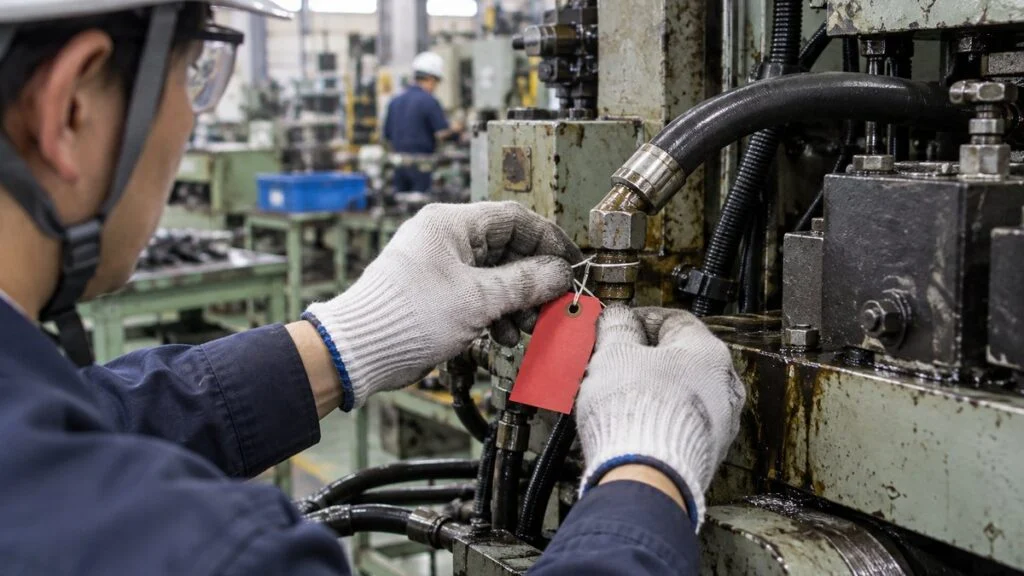
Phase 1 returns the equipment to the condition it should be in and keeps it there, so forced deterioration stops. JIPM describes this phase as building a system that prevents deterioration.
Step 1: Initial Cleaning (Cleaning and Inspection)
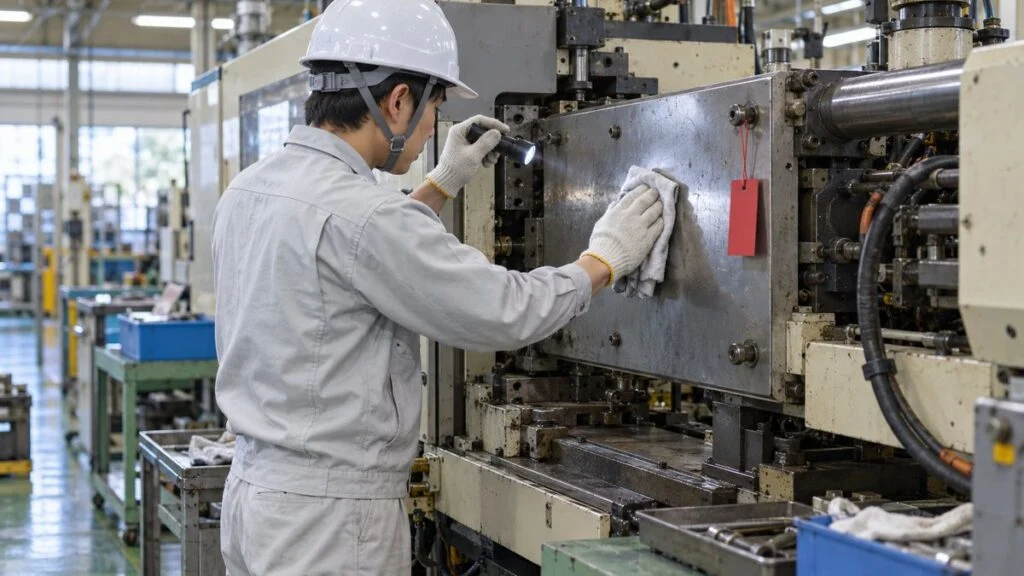
In Step 1, the team removes all dirt and debris, mainly from the equipment itself, while lubricating, tightening, and finding and fixing defects. JIPM stresses one idea above all: cleaning is inspection.
Once the dirt is gone, oil leaks, loose bolts, scratched piping, and cracked covers become visible. Wiping by hand can also reveal heat, vibration, or play. The goal is not to make the machine look clean. It is to bring every hidden defect to the surface.
Each defect gets a tag called an efu, often written "F-tag" in English. According to JIPM, the tag works like a shipping label: the finder writes the date, their name, and the problem. The tag makes the defect visible and makes it clear who will deal with it. Fixing the defect and removing the tag is called efu-tori (tag removal).
Using colors to show who fixes what, and how urgently, helps tags get cleared.
Example from a JIPM article (August 2025). Colors and categories vary by company. Confirm your parent company's tag rules before printing tags.
Teams post the number of tags attached and removed on the activity board to show progress. JIPM also describes sorting the tagged defects by type and marking them on a map of the equipment.
During cleaning, write down where dirt comes from and which spots are hard to clean. Those notes become the input for Step 2. JIPM also recommends listing the items to inspect while cleaning, because that list makes the Step 3 tentative standards more accurate. In other words, Step 1 is also where you collect material for Steps 2 and 3.
Step 2: Countermeasures for Contamination Sources and Hard-to-Access Areas
Even after a thorough initial cleaning, the machine gets dirty again fast as long as chips, oil, or dust keep coming out. Step 2 attacks the sources of contamination and improves "hard-to-access areas," the spots that are difficult to clean, lubricate, or inspect.
Typical source countermeasures include adding covers to stop chips from scattering, replacing seals and hoses that leak oil, and installing trays to catch dust. Typical access improvements include adding inspection windows, moving lubrication points, and making covers removable without tools.
JIPM's guide says the aim of this step is to learn how to approach equipment improvement, and its learning items include guidance and support from maintenance specialists. Modifications that operators cannot handle alone should be planned with maintenance or production engineering from the start.
Measure the time spent on cleaning and inspection before and after each countermeasure. That makes the results easy to show.
Step 3: Tentative Standards
Steps 1 and 2 restore the equipment a great deal, but left alone it will slide back. Step 3 sets and follows rules that keep the restored condition from slipping.
For cleaning, lubrication, tightening, and inspection, the standard states where, with what, what counts as normal, how often, and who does it. JMAC's glossary describes it as rules that let operators maintain cleaning, lubrication, tightening, and inspection reliably in a short time.
The standard has to fit into the time available. If it has too many items to finish in the daily routine, people stop following it and it becomes a formality. When that happens, going back to Step 2 to improve hard-to-access areas further is normal.
Lubrication standards usually list the oil type, amount, and interval for each point. Many plants combine them with visual controls, such as color marks on oil inlets and level gauges. For bolts, a match mark across the bolt and the part shows loosening at a glance.
Phase 2: Measure Deterioration (Steps 4–5)
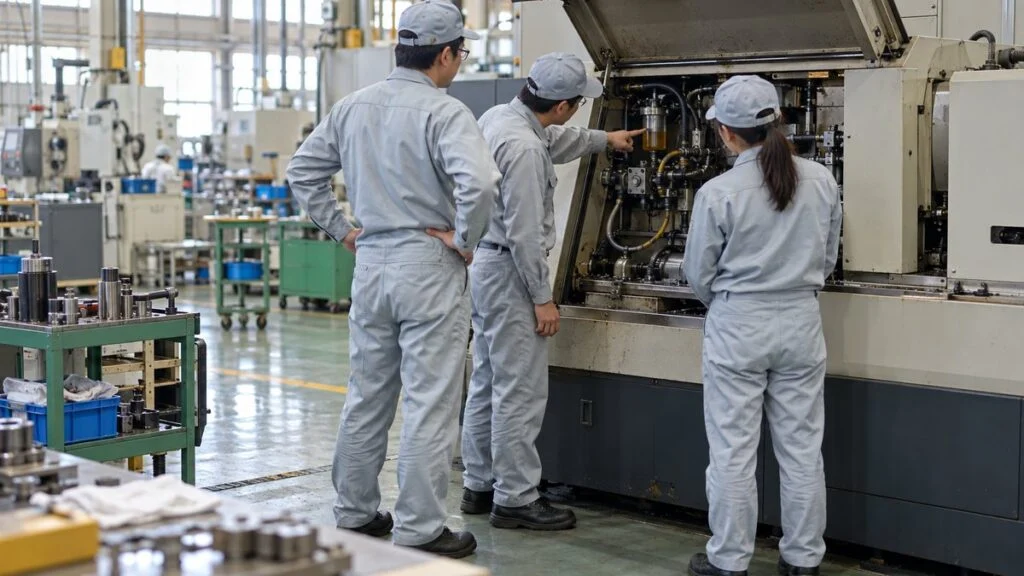
Phase 1 deals mostly with defects you can see from the outside. In Phase 2, operators learn how the equipment works and how it is built, and the activity shifts from preventing deterioration to measuring it. JIPM says this phase develops operators who truly know their equipment.
Step 4: General Inspection
In Step 4, operators receive training on inspection skills for each subsystem of the equipment, then use that knowledge to inspect it in full. As an editorial example, subsystems might be fasteners, lubrication, pneumatics and hydraulics, electrical, and drives. How to divide them depends on the company and the equipment.
JIPM's guide describes this step as going beyond spotting visible defects (Steps 1–3) to inspection backed by theory and reasoning.
JIPM recommends cascade training (dentatsu kyoiku). First the team leaders are trained. Each leader then adapts the content to their own area and equipment and teaches it to the team.
The main tool here is the one-point lesson (OPL): one topic per sheet, taught in a short session of about 5–10 minutes.
General inspection means inspecting with an understanding of why a part wears and what "normal" looks like. For pneumatic equipment, for example, the goal is for operators to check the normal pressure range, listen for air leaks, and see how much drain water has collected, and to know the reason for each check.
Small defects found in inspection are tagged and corrected, and the inspection items go into a tentative inspection standard.
Step 5: Autonomous Inspection
In Step 5, the team reviews the cleaning, lubrication, and inspection standards built in Steps 1–4, combines them into a single AM standard that operators follow, and puts it into practice.
The themes are faster inspection and a clear split of roles with maintenance. The team removes duplicate and unnecessary items to shorten inspection time. Operators and maintenance also agree on the boundary: which items operators check in daily inspection and which items maintenance covers in periodic inspection and diagnosis.
Once the split with maintenance, including predictive maintenance, is settled, the plant avoids both missed checks and double checks.
Related: Predictive Maintenance ROI: How Japanese Plants Justify It
Phase 3: Autonomous Management (Steps 6–7)
Phase 3 turns everything so far into a system, so the workplace can keep maintaining and improving on its own. The scope widens from the equipment to all work related to it.
Step 6: Standardization
Step 6 makes sure the activities from Steps 1–5 are maintained. JIPM's guide describes it as standardizing operator roles to cover work related to the equipment as well.
JMAC's glossary gives examples of what to standardize: in-plant material handling rules, data recording, rules for managing dies, jigs, and tools, and in-process quality assurance standards. What to standardize depends on the workplace. A practical approach is to start with the work that causes the biggest losses.
Step 7: Full Autonomous Management
Step 7 brings together everything from Steps 1–6. The goal is a workplace that runs its own maintenance and improvement in line with company policy and targets. JIPM's guide sums up the attitude as "there is no end to improvement."
In practice, the team sets its own targets (for example, breakdowns, minor stoppages, defects, and changeover time) and tracks progress with data. When a problem appears, the team picks its own improvement theme and works on it.
Finishing Step 7 is not an end point. It means AM has stopped being a special program and become part of the daily job.
Tools That Keep the Steps Moving: Step Audits, Activity Boards, and OPLs
The seven steps do not move forward just because the order is written down. AM has its own tools for pushing the activity along. JIPM's guide lists them as AM support tools: activity boards, one-point lessons, meetings, tagging and tag removal, and visual management.
Step Audits
AM uses a step-by-step system: each step has pass criteria, and the team moves on only after passing an audit (in Japanese, step shindan, "step diagnosis").
According to JIPM, the president or plant manager also runs "top audits," which let top management judge the work by the sangen principle: go to the actual place, see the actual thing, and check the actual facts. JIPM also says managers and supervisors should treat audits as a chance to develop their people.
To stop teams from passing on paper only, check whether the equipment is really in the required condition and whether team members can explain it, rather than whether the documents are complete.
Whether a team can move on depends on both its outputs and the condition of the equipment.
General examples compiled by the editors from the aims of each step in JIPM materials. Each company sets its own audit criteria.
Activity Boards and Meetings
The activity board shows the team's targets, step progress, the number of tags attached and removed, improvement examples, and upcoming plans. The point is that managers and other departments see the same information as the team.
The usual practice is to hold short, regular meetings in front of the board to share progress and problems. Checking the status of requests to maintenance (red tags) here keeps them from being forgotten.
One-Point Lessons (OPLs)
JMAC divides OPLs into three types: basic knowledge, lessons from problems, and improvement examples. Each sheet covers one point: knowledge needed for daily work, a recurrence-prevention point learned from a defect or breakdown, or a team improvement worth spreading to other areas.
The basic principle of the OPL is learning by teaching: preparing to teach forces the author to understand the topic. A full OPL cycle includes the author explaining it in their own words and following up to see whether the listeners can now actually do it.
Why Jishu Hozen Stalls, and What Helps
AM runs over a long period, and many workplaces stall partway through. The editors compiled the common problems below from issues that several Japanese sources point out.
Most come from people feeling forced to do it and from an unclear split with maintenance.
General tendencies compiled by the editors.
The biggest factor is cooperation with maintenance. If maintenance cannot respond to the red tags operators raise, people start to feel that "reporting it doesn't get it fixed," and the activity loses steam fast. When you launch AM, plan for maintenance's capacity to respond as well.
Here is a fictional example. A plastics molding line starts Step 1. Initial cleaning produces a large number of tags, but maintenance is short-staffed, red tags stay open for months, and the team loses interest. The team then sorts red tags into three priority levels, sets the order of response, and reviews progress in a weekly meeting. Tag removal starts moving again.
Another trap is managers who track only progress and never ask about problems on the floor. Providing time for the activity, support from maintenance, and a place to recognize results is the manager's job.
Points to Check When the Program Comes From Japan
The problems above occur in Japan too. When AM is introduced from a Japanese parent company, a few more points are worth checking early. These are editorial suggestions, not findings from a survey.
- What operators are allowed to do. AM asks operators to lubricate, tighten, and do minor servicing. Check whether your job descriptions, labor agreements, or internal rules allow this, and decide the boundary with maintenance in writing before Step 1.
- Whose safety rules apply. Your local law and your own LOTO procedure govern the work, not the parent company's slides. Make sure Step 1 training uses your procedure.
- Translated materials. F-tags, standards, OPLs, and board headings work only if operators can read them. Agree on the terms (for example, keep "efu" or use "F-tag") and translate forms into the local language.
- How cleaning is perceived. If cleaning is seen as janitorial work, explain from day one that the purpose is finding defects, and show the tags that cleaning produced.
- Red-tag capacity. Estimate how many red tags maintenance can close per week before you scale Step 1 beyond the model line.
- Audit criteria. Ask for the parent company's pass criteria per step in writing, so teams know what "done" means.
Step 1 Readiness Checklist
Use this list before the first initial-cleaning session on the model line. Adjust it to your site's rules.
- ☐ Model machine and team selected; team leader named
- ☐ Purpose explained: cleaning is inspection, and the output is a list of defects
- ☐ Cleaning scope defined (which machine, which areas, which covers may be opened, and by whom)
- ☐ Site LOTO procedure reviewed for this machine, including air, hydraulic, steam, and gravity energy
- ☐ Safety training done; PPE and cleaning tools ready
- ☐ Kiken yochi (hazard prediction) discussion planned before the work
- ☐ F-tag format agreed: fields (date, finder, problem), colors, and language
- ☐ Red-tag process agreed with maintenance: who receives tags, response deadlines, and where status is reviewed
- ☐ Activity board set up with tag counts (attached / removed)
- ☐ Sheets ready to note contamination sources, hard-to-access areas, and candidate inspection items
- ☐ Time for the activity built into the production schedule
- ☐ Step 1 audit criteria and auditor confirmed
Questions to Ask the Japanese Parent Company
Clear answers to these questions before the kickoff prevent rework later.
- Which step names and which source (JIPM, a consultant, or company-internal material) does the company follow?
- Is there a Step Zero? What should it include at our plant?
- What are the pass criteria for each step audit, and who audits: the parent company, a consultant, or our own managers?
- What F-tag colors and categories does the company use? Is there a tag template we can translate?
- Are there sample tentative standards, AM standards, or OPLs from a Japanese plant with similar equipment?
- What is the target timeline per step, and is it a target or a requirement?
- How should operator and maintenance roles be split at our plant, given our job descriptions and staffing?
- Will the parent company support red tags that need parts or engineering changes from Japan?
- Which KPIs (for example, breakdowns, minor stoppages, cleaning time) should we report, and how often?
A short email to start the conversation:
Subject: Jishu hozen rollout – questions before Step 1
Hello [Name],
We are preparing to start jishu hozen (autonomous maintenance) on [line/machine] as our model line. Before Step 1, could you share (1) the step definitions and audit criteria your company uses, (2) your F-tag format and color rules, and (3) any sample standards or one-point lessons from a similar line? We will run all cleaning and inspection under our local LOTO procedure. We would also like to agree on how operator and maintenance roles will be divided here.
Thank you,
[Your name]
Limits of This Guide
- Step names, the number of steps, tag colors, and audit criteria vary by company and consultant. Confirm which version your company uses.
- The safety flow in this article is a general outline, not a work instruction. Your local regulations, your company's safety rules, and your LOTO procedure decide how work is done, and your safety team decides who may do it.
- The Japanese law cited (Ordinance on Industrial Safety and Health, Articles 107 and 108) applies in Japan. It does not apply to plants in other countries.
- The role split between operators and maintenance depends on equipment, skills, and labor rules at each site.
- The molding-line example is fictional and shows a typical pattern, not data.
FAQ
What does jishu hozen mean?
Jishu hozen is Japanese for autonomous maintenance. Production operators keep their own equipment in good condition through cleaning, lubrication, tightening, and daily inspection. It is one of the eight pillars of TPM.
What are the 7 steps of autonomous maintenance?
Following JIPM, the steps are: initial cleaning, countermeasures for contamination sources and hard-to-access areas, tentative standards, general inspection, autonomous inspection, standardization, and full autonomous management. Some sources add a preparation step (Step Zero) before Step 1.
What is the difference between autonomous maintenance and planned maintenance?
Autonomous maintenance is done by production operators and centers on preventing deterioration through cleaning, lubrication, tightening, and daily inspection. Planned maintenance is done by the maintenance department, which handles periodic inspection, diagnosis, and planned repairs to measure deterioration and restore equipment.
Can you skip steps in jishu hozen?
Normally, no. Each step builds on the one before, so teams pass an audit before moving on. Going back is normal, though: if a standard cannot be followed, the team returns to Step 2 to improve hard-to-access areas.
How does jishu hozen relate to 5S?
5S is a precondition. Without the first three S's (sort, set in order, and shine), operators cannot notice abnormalities. Initial cleaning looks like the "shine" step of 5S, but its purpose is inspection: finding hidden defects, not just making the machine clean.
Do operators need the Jishu Hozen Shi certification?
No. The Autonomous Maintenance Operator certification is a private qualification created by JIPM, and it is not required to run AM. Because it is built around the four abilities of an equipment-savvy operator, it can serve as a reference for what operators should learn.
Sources
- Japan Institute of Plant Maintenance (JIPM), Autonomous Maintenance Operator Committee, basic guide for the Autonomous Maintenance Operator (Jishu Hozen Shi) certification (April 2015, Japanese): AM concept, forced deterioration, three maintenance activities, four abilities, aims of each step, support tools
- JIPM, tips for autonomous maintenance, part 1 (July 2025, Japanese): 7 step names and 3 phases, step audits, top audits, F-tags
- JIPM, tips for autonomous maintenance, part 2 (August 2025, Japanese): F-tag colors, "cleaning is inspection"
- JIPM, "Autonomous maintenance: protecting your own equipment," part 4 (July 2025, Japanese): overlapping small groups, cascade training
- JIPM, "TPM" (Japanese): TPM definition and awards
- JIPM, "What Is TPM?" (Japanese): eight pillars, Nippondenso and the 1971 award
- JIPM, "What Is TPM?" (April 2025, Japanese): loss categories
- JMA Consultants (JMAC), glossary entries "The 7 Steps of Autonomous Maintenance" and "Planned Maintenance" (Japanese)
- JMAC TPM Online, "TPM Rule 26: The Real Role of the One-Point Lesson Sheet" (Japanese)
- e-Gov Laws, Ordinance on Industrial Safety and Health, Articles 107 and 108 (Japanese)
- US Occupational Safety and Health Administration (OSHA), 29 CFR 1910.147, The Control of Hazardous Energy (Lockout/Tagout)
Original article in JapaneseThis guide is adapted from a MONOSCOPE article written for readers in Japan: 自主保全の7ステップとは|初期清掃(第1ステップ)のやり方から自主管理までの進め方
About the editor
 MONOSCOPE EditorFOUNDER & EDITOR
Spent about ten years at a plant equipment maker and a plant engineering company, proposing, designing, and commissioning equipment, then moved into web marketing. Now a web consultant for B2B manufacturers, helping them explain their products and technology. Licensed in Japan as an Energy Manager and a Third-Class Chief Electrical Engineer.
Has run an engineering blog since 2017 (500+ articles) and a Japanese YouTube channel with about 20,000 subscribers. Each English guide is written from the Japanese shop-floor point of view and checked against the cited standards.