Japanese Supplier Financial Health: Warning Signs and Checks
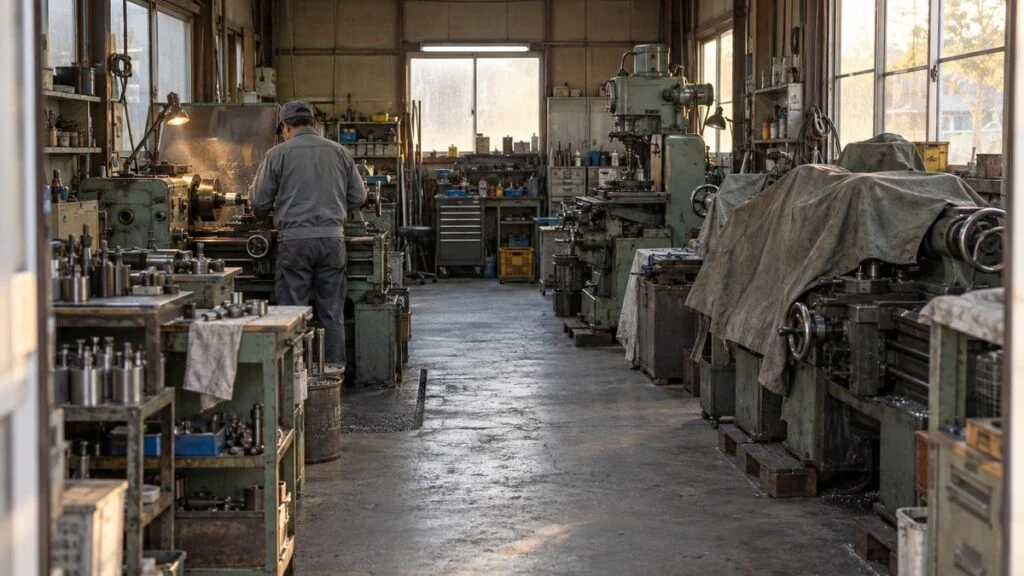
Picture a small plating shop in Japan that finishes a part you cannot source anywhere else. One month it asks to be paid sooner. The next month a shipment slips by a week, and the engineer who always answered your questions has left. None of this proves the company is in trouble. Taken together, though, it is a pattern worth checking, because corporate bankruptcies in Japan are rising and most of the companies that fail are small.
From April to September 2026, the first half of Japan's fiscal year 2026, Teikoku Databank (TDB) counted 5,362 bankruptcies and Tokyo Shoko Research (TSR) counted 5,373. Both reported that first-half bankruptcies rose year over year for the fifth consecutive year. Those figures will be outdated by the next release, so this guide uses them only for context. Its focus is how a buyer outside Japan can check a Japanese supplier's financial health: where to find information, which signs to watch, and which questions to ask.
It is written for buyers, supplier quality engineers, and supply chain managers in the US, India, and Southeast Asia who source parts or processes from Japan. It is not credit or legal advice.
Contents
- Japan's Bankruptcy Numbers in Brief (April–September 2026)
- Why Small Japanese Suppliers Are Under Pressure
- Where to Find Financial Information on a Japanese Supplier
- Warning Signs a Buyer Can Notice
- What Happens When a Japanese Supplier Fails
- Sort Suppliers by How Hard They Are to Replace
- Questions to Ask Your Japanese Supplier
- Supplier Financial Health Checklist
- Limits of This Guide
- FAQ
- Sources
Japan's Bankruptcy Numbers in Brief (April–September 2026)
Japan's two main credit research companies, TDB and TSR, publish bankruptcy totals every month and every half-year. Their reports for April–September 2026, both released on October 8, 2026, tell the same story with slightly different numbers.
Both agencies reported a fifth straight year-on-year rise for the first half of the fiscal year. Read each column on its own.
The two agencies classify industries and count labor-shortage and cost-inflation bankruptcies differently, so do not compare or add figures across columns. Sources: Teikoku Databank, Tokyo Shoko Research (both released October 8, 2026).
For buyers, the more useful number is company size. TSR found that 90.6% of the companies that went bankrupt had fewer than 10 employees, and only one listed company failed. In manufacturing, that size band includes many of the small subcontractors that machine, plate, or heat-treat parts. Your spend with them may be small, but they often run a process no other company in your supply chain can do.
Related: Japanese Automotive Supply Chain: Tiers, Keiretsu, Pricing
Out of every 10 companies that failed, 9 had fewer than 10 employees.
90.6% of bankrupt companies had fewer than 10 employees (TSR, April–September 2026)
Each figure represents one company. 90.6% is rounded to 9 out of 10.
Manufacturing itself saw slightly fewer bankruptcies than a year earlier. Even so, of TDB's 628 cost-inflation bankruptcies, 101 were manufacturers, the third-highest count after construction (176) and retail (140). A falling industry total tells you nothing about whether your own supplier is healthy.
Why Small Japanese Suppliers Are Under Pressure
TDB names weak sales as the main cause in 80.3% of first-half cases (4,305 bankruptcies). Behind that, three pressures keep showing up: costs that cannot be passed on, labor shortages, and the lack of a successor.
Costs They Cannot Pass On
TDB separately counts cost-inflation bankruptcies (bukkadaka tosan): companies that failed because they could not raise prices enough to cover higher material, energy, or labor costs. There were 628 in the first half, a record and up 28.7% from 488 a year earlier.
A TDB survey from July 2026 shows the gap. For every JPY 100 of cost increases, companies passed on JPY 39.9 to their customers on average. Labor and energy costs were the hardest to pass on.
Labor and energy increases are harder to pass on than raw material increases.
Pass-through rate: the share of a cost increase reflected in selling prices. Survey period July 17–31, 2026; 10,518 valid responses. Source: Teikoku Databank, survey on price pass-through (July 2026).
Manufacturers are especially exposed because time passes between buying material and delivering parts: if material or electricity costs rise in between, the supplier usually still delivers at the price agreed when the order was placed. Steel and copper prices are public, so a supplier can document those increases. Wage increases are much harder for a small supplier to justify to customers. For a buyer, this means a price increase request from a Japanese supplier is usually a normal negotiation, not a distress signal. Turning down every request carries its own risk: it squeezes the supplier's margin and weakens a source you depend on.
Japan's Fair Transactions Act (toriteki-ho), the amended Subcontract Act in force since January 1, 2026, also bars buyers in the transactions it covers from setting prices without discussing them with the supplier, and from paying by promissory note. How Japanese buyers are expected to respond to price requests is covered in Japanese Procurement: QCD Negotiation and Supplier Ratings.
Labor Shortages
TDB counted 225 labor-shortage bankruptcies, a first-half record, and TSR counted 240, an all-time record. In TSR's breakdown, 130 were driven by rising labor costs and 67 by employees quitting, both records. A small supplier that raises wages to keep its people loses margin when it cannot pass the cost on. One that does not raise wages loses people and can no longer fill the orders it has taken.
No Successor
TDB counted 296 bankruptcies caused by the lack of a successor, a first-half record. In the main-cause breakdown, the owner's illness or death accounted for 204 cases, the first time that figure has topped 200 since at least fiscal 2000. A long history is no protection either: 1,687 of the failed companies had been in business for 30 years or more, and 88 for over 100 years.
Many small Japanese manufacturers are run by their owner. If your relationship with a supplier goes back decades, the president's age and who will take over are fair questions to ask.
Where to Find Financial Information on a Japanese Supplier
Your options depend on whether the supplier is listed and how much weight you carry as a customer. Most buyers combine a credit report with whatever the supplier will share directly.
| Source | What you get | Notes for buyers outside Japan |
|---|---|---|
| Teikoku Databank (TDB) | Credit reports on Japanese companies, including a score (hyoten) with a maximum of 100 | Full reports are in Japanese. Some English data reaches overseas users through partner services, so ask your credit team which provider it uses. |
| Tokyo Shoko Research (TSR) | Credit reports and bankruptcy statistics | TSR states that its products are not available to customers outside Japan and refers them to its partner, Dun & Bradstreet (D&B). |
| Listed suppliers: yuho and kessan tanshin | The annual securities report (yuho), filed on the EDINET system, and the earnings summary (kessan tanshin) | Full financial statements. Many listed companies also post English summaries on their investor relations pages. |
| Unlisted suppliers: kessan kokoku | A public notice of the balance sheet (large companies must add the income statement), required by Article 440 of the Companies Act after each annual shareholders' meeting | Applies to joint-stock companies (kabushiki kaisha). See the note below this table. |
| The supplier's own financial statements (kessansho) | Balance sheet and income statement, often for several years | Ask during supplier approval or under an NDA. Small suppliers may decline, and the answer often depends on how important you are as a customer. |
| Plant visits and audits | Machine utilization, staffing, condition of equipment and buildings | For small suppliers, often the most practical check. |
The kessan kokoku rule is useful but limited. A company that publishes notices in the official gazette (kanpo) or a daily newspaper may publish only a summary of its balance sheet. A company that uses electronic notice must post the full balance sheet and keep it accessible for five years, usually on its own website. Companies that file a yuho are exempt. If you cannot find a notice for a supplier, ask for the latest balance sheet directly.
Treat a credit score as a starting point. Check when the report was last updated, and compare it with what you see on your next visit. For smaller suppliers, a regular audit or plant visit where you see the machines running and talk to the people often tells you more than any report. Supplier evaluation as a step in the Japanese purchasing process is covered in Purchasing Process at Japanese Manufacturers: 8 Steps.
Warning Signs a Buyer Can Notice
Before a supplier fails, small changes often appear in day-to-day dealings. No single change means the supplier is in trouble. What matters is when each one started, how often it happens, and whether several appear together.
None of these is enough on its own. When several overlap, look more closely.
A price increase request is almost always a legitimate response to higher costs. Record changes as facts to check, not as conclusions about the supplier.
Do not leave these observations in one person's notes. Share them across purchasing, quality, and finance, for example by reviewing changes at critical suppliers in a monthly supplier meeting. Scattered details become a pattern only when someone puts them side by side.
If you also sell to Japanese companies, watch the same areas from the other side: delayed payments, requests to pay in installments or by note, sudden drops or jumps in order volume, and frequent turnover in the customer's accounting or purchasing staff. Japanese payment terms such as month-end closing with payment at the end of the second following month mean two to three months of sales can be unpaid at any time, so compare each customer's receivable balance with its credit limit. In a hasan bankruptcy, assume much of what the customer owes you will not be recovered. For customers near their limit, options include shorter payment terms, partial prepayment, or smaller shipments, explained with a clear reason.
What Happens When a Japanese Supplier Fails
In TDB's first-half data, 92.6% of cases were hasan, bankruptcy proceedings that liquidate the company rather than restructure it. For a buyer, the main risk is that supply stops, and the question becomes how fast you can replace it.
The longer it takes to find and qualify a new source, the longer the impact lasts.
How long it takes depends on whether an alternative exists, whether trials and customer approval are needed, and where the molds and jigs are.
Generic parts can often be bought from another distributor or maker within days. The trouble starts with parts only that supplier can make, or a process you have entrusted to it. Four factors decide how long you are exposed:
- Whether another company can make the part
- Whether switching requires trial runs or customer approval (qualification)
- Who owns the molds and jigs, and where they are
- How many weeks your inventory will last
For automotive and medical parts, changing suppliers normally means getting customer approval again. Even after you find a new source, you may not be able to ship production parts until that approval comes through.
If your molds or jigs are at the failed supplier's plant, getting them back takes its own process. Confirming ownership and storage arrangements beforehand, ideally in writing, saves time when it matters. See Mold Storage in Japan: Subcontract Act Rules and Checklist.
Sort Suppliers by How Hard They Are to Replace
You do not need to watch every supplier with the same effort. Split them into two groups: parts you could buy again quickly, and parts that would take a long time to move. Focus the monitoring on the second group.
Bolts and general-purpose electronic components can usually be switched to another maker's product through a distributor. Special plating, or machined parts your customer has approved, can take several months to move to a new source. For those, consider a second source or several months of safety stock.
Related: Japanese Customer BCP Surveys: How Suppliers Should Answer
Keeping key suppliers healthy is part of the same job. Refusing to discuss cost increases and holding prices flat squeezes the supplier's margin and, in the end, weakens your own supply chain.
Questions to Ask Your Japanese Supplier
Ask these during an annual review, an audit, or when a warning sign appears. Presenting them as part of a routine review that every supplier receives makes them easier to ask and to answer.
- Could you share your balance sheet and income statement for the last two or three fiscal years? We will treat them as confidential under our NDA.
- Which of your costs (materials, energy, labor, logistics) have risen most this year, and how much of that is not yet reflected in your prices to us?
- Who will succeed the current president, and is there a timeline?
- Have any key engineers or skilled operators left in the past year? Who now handles our parts?
- What share of your sales comes from your largest customer? Have you lost a major customer recently?
- Do you send any processes for our parts, such as plating or heat treatment, to subcontractors? Who are they?
- Who owns the molds, dies, and jigs for our parts, where are they stored, and is that in writing?
- How would you keep operating if one of your major customers failed?
On the last question, a supplier may mention Keiei Safety Kyosai (the Business Safety Mutual Aid program), run by Japan's Organization for Small & Medium Enterprises and Regional Innovation (SMRJ). Members pay JPY 5,000–200,000 per month, up to a JPY 8 million total. Once six months have passed since joining, a member whose customer fails and leaves receivables uncollectible can borrow up to 10 times its paid-in premiums, capped at JPY 80 million, without collateral or a guarantor, and repay over five to seven years. Private trade credit insurance, which covers unpaid receivables, is the other common option.
Email Template: Requesting Financial Information
Subject: Annual supplier review: financial information request
Dear [Name],
Thank you for your continued support. As part of our annual review of key suppliers, we are asking each of them for the same information. Could you send us the following by [date]?
- Balance sheet and income statement for the last [two/three] fiscal years
- A short note on any major changes this year (customers, staffing, management)
- Your current plan for management succession, if you are able to share it
We will keep this information confidential under our NDA and use it only for supplier evaluation. If cost increases are affecting your prices to us, we would also welcome a separate discussion.
Best regards,
[Your name]
[Company]
Supplier Financial Health Checklist
| Check | Suggested timing | Who |
|---|---|---|
| Sort suppliers into "quick to replace" and "slow to replace" | Once, then when parts change | Purchasing, quality |
| For slow-to-replace suppliers: alternative source, qualification time, and weeks of inventory | Every six months | Purchasing |
| Ownership and location of molds, dies, and jigs, documented in writing | Yearly, and at every tooling change | Purchasing, engineering |
| Credit report (TDB, or D&B for TSR data) on critical suppliers | Yearly, or when a warning sign appears | Finance, purchasing |
| Latest financial statements, kessan kokoku, or yuho | Yearly | Finance |
| Warning signs log (payment terms, delivery, quality, people, management) | Monthly review | Purchasing, quality, finance |
| Plant visit: utilization, staffing, condition of equipment | At audits and regular visits | Quality, purchasing |
| Price increase requests reviewed on their merits, with cost evidence | Each request | Purchasing |
| Receivable balance vs. credit limit (if you sell to Japanese companies) | Monthly | Sales, finance |
Limits of This Guide
- Statistics show trends, not individual companies. Nationwide bankruptcy numbers cannot tell you whether a specific supplier is at risk. They are also updated every month, so check TDB's and TSR's latest releases before quoting them.
- TDB and TSR count differently. Their industry categories and their definitions of labor-shortage and cost-inflation bankruptcies differ, and one bankruptcy can fall under more than one background category. Background counts are separate from the main-cause breakdown, so they do not add up to a share of the total.
- Disclosure rules vary by company type. The kessan kokoku requirement applies to kabushiki kaisha. Other company forms and sole proprietors may publish nothing.
- Legal questions need your legal team. Whether Japan's Fair Transactions Act covers a given transaction, and how tooling is handled in a Japanese bankruptcy, depend on the facts of each case.
- Programs and rules change. Check SMRJ's current terms for Keiei Safety Kyosai before relying on the figures above.
FAQ
Why do Teikoku Databank and Tokyo Shoko Research report different bankruptcy numbers?
They use different industry categories and count background causes such as labor shortages and cost inflation in different ways. For April–September 2026, TDB reported 5,362 bankruptcies and TSR 5,373. Read each agency's figures on their own rather than comparing or combining them.
Can I get a Teikoku Databank or TSR credit report from outside Japan?
TSR says its products are not available outside Japan and refers overseas customers to Dun & Bradstreet. TDB reports are mainly in Japanese, and some English data is offered through partner services. Ask your credit team which provider it already uses.
Do private Japanese companies publish financial statements?
Joint-stock companies (kabushiki kaisha) must publish their balance sheet after each annual shareholders' meeting under Article 440 of the Companies Act. Notices in the official gazette may be only a summary, while electronic notices must show the full balance sheet for five years. If you cannot find one, ask the supplier directly.
Is a price increase request a sign a Japanese supplier is in trouble?
Usually not. Japanese companies passed on only about 40% of their cost increases in July 2026, so most requests are normal negotiations. Requests at unusually short intervals, combined with other signs such as payment-term changes or staff leaving, are worth a closer look.
What happens to my tooling if a Japanese supplier goes bankrupt?
It depends on who owns it and how well that is documented. Most Japanese bankruptcies are liquidations, so the tooling may have to be recovered through the bankruptcy process. Written records of ownership and storage location make that much easier; ask your legal team about the procedure.
Sources
- FY2026 first-half bankruptcies, by industry, cause, background, and company age: Teikoku Databank, bankruptcy report for the first half of FY2026 (April–September) (Japanese)
- FY2026 first-half bankruptcies, company size, labor-shortage breakdown: Tokyo Shoko Research, nationwide bankruptcies for the first half of FY2026 (Japanese)
- Price pass-through rates: Teikoku Databank, survey on price pass-through (July 2026) (Japanese)
- TSR availability outside Japan and D&B partnership: Tokyo Shoko Research, English page
- TDB rating scale (maximum 100): Cabinet Office, Annual Report on the Japanese Economy and Public Finance 2003, note on enterprise ratings
- Public notice of balance sheets: Companies Act, Article 440 (e-Gov Laws and Regulations, Japanese)
- Fair Transactions Act: Japan Fair Trade Commission, overview of the Fair Transactions Act (Japanese)
- Keiei Safety Kyosai terms: SMRJ J-Net21 and SMRJ, loan conditions (Japanese)
Original article in JapaneseThis guide is adapted from a MONOSCOPE article written for readers in Japan: 2026年度上期の倒産5,362件|物価高・人手不足と製造業の取引先リスク
About the editor
 MONOSCOPE EditorFOUNDER & EDITOR
Spent about ten years at a plant equipment maker and a plant engineering company, proposing, designing, and commissioning equipment, then moved into web marketing. Now a web consultant for B2B manufacturers, helping them explain their products and technology. Licensed in Japan as an Energy Manager and a Third-Class Chief Electrical Engineer.
Has run an engineering blog since 2017 (500+ articles) and a Japanese YouTube channel with about 20,000 subscribers. Each English guide is written from the Japanese shop-floor point of view and checked against the cited standards.