Purchasing Process at Japanese Manufacturers: 8 Steps
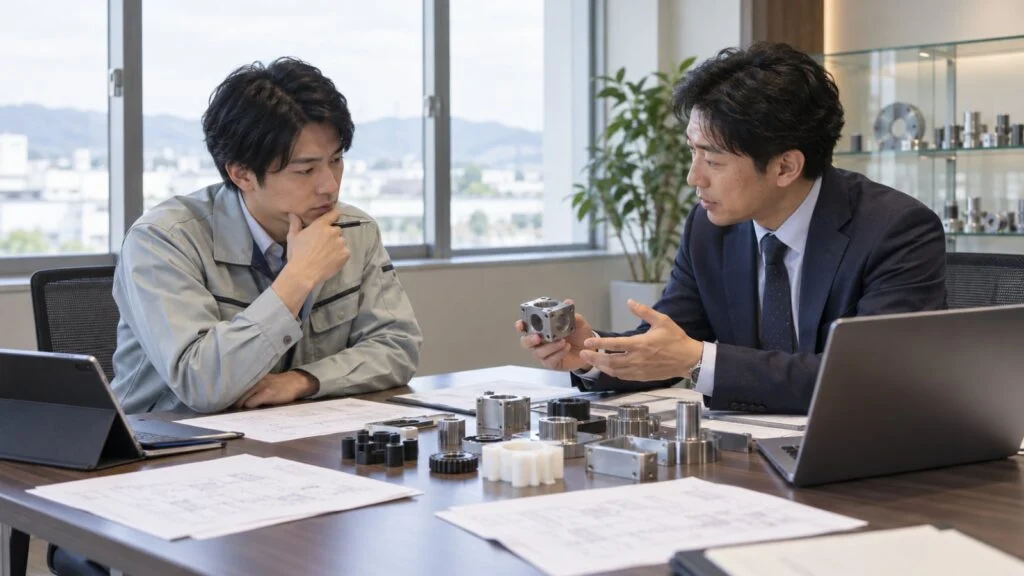
You quote a part for a Japanese manufacturer, or for its plant in Thailand, India, or the US. Before the first purchase order arrives, the buyer asks for a detailed cost breakdown, sends a basic transaction agreement for legal review, registers your company in its vendor master, and may bring a quality engineer to audit your factory. After you start shipping, a supplier scorecard shows up every six months or every year. From the outside, it can look like a lot of steps for one part.
It is a lot of steps, and they follow a set order. Purchasing means buying the parts and materials a company needs from outside suppliers on agreed terms. At a Japanese manufacturer, buying a new part or material for the first time typically goes through eight steps, from the internal purchase request to payment and supplier evaluation. Issuing the purchase order is only one of them.
This guide walks through each step from the buyer's side: what happens, which documents change hands, which departments get involved, and the mistakes that commonly cause trouble. It ends with a checklist of what to clarify at each step, an email template for clarifying an RFQ, and the ways the process differs by industry and company size.
Contents
- The 8 Steps of the Purchasing Process
- Preparation: Steps 1–3
- Negotiation, Contract, and Ordering: Steps 4–6
- After Delivery: Steps 7–8
- How the Process Varies by Industry and Company
- Supplier Checklist: What to Clarify at Each Step
- Email Template: Clarifying an RFQ Before You Quote
- Limits of This Guide
- FAQ
- Sources
The 8 Steps of the Purchasing Process
For a new part or material, purchasing (kobai, 購買) or procurement (chotatsu, 調達) at a Japanese manufacturer generally runs in this order:
Purchase request → Supplier selection → RFQ and quote comparison → Price negotiation → Contract → Purchase order → Delivery follow-up and acceptance → Payment and supplier evaluation
The steps fall into three phases: preparation; negotiation, contract, and ordering; and post-delivery management.
For repeat orders of production parts, the preparation and contract steps are usually skipped and the cycle starts at the purchase order.
A part bought for the first time goes through all eight steps. Repeat purchases of a part already bought from an existing supplier follow a shorter loop, from purchase order to payment, that often repeats every month.
The purchasing department never completes a step alone. At each stage the buyer works with a different internal partner: design, production control (seisan kanri, 生産管理), quality assurance, accounting, or legal. Keeping track of who the buyer works with at each step makes the whole process easier to follow.
Preparation: Steps 1–3
The first phase settles what to buy and where to buy it. Gaps left open here tend to come back later as rework and disputes.
Step 1: Purchase Request
The work starts with a purchase request (kobai irai, 購買依頼) from design and development, production control, or another department in the plant. A request usually includes:
- Part name or drawing number
- Quantity
- Requested delivery date
- Budget
Requests typically come in through an internal purchasing system or a request form. The buyer then checks the drawings and specifications for gaps or contradictions. If material, surface treatment, tolerances, or inspection criteria are left vague, each supplier quotes against its own assumptions and the quotes can no longer be compared fairly.
A common mistake is moving ahead without noticing that the requested delivery date is unrealistic. For some parts, just getting the material takes several months, so the buyer should tell the requester at this stage how long sourcing will take.
Indirect materials such as tools and office supplies follow a different path. More companies now let each department order them directly from contracted online stores or catalogs. Purchasing spends its time on setting up those systems and negotiating prices rather than on individual orders.
Step 2: Supplier Selection
Once the specification is firm, the buyer looks for companies that can make the part. The search starts with existing suppliers. If that does not produce enough candidates, the buyer looks further through trade shows, industry association directories, and the internet.
Before trading with a new company, the buyer checks its company profile and financial condition, and may run a factory audit (kojo kansa, 工場監査): a visit to see the equipment and the quality control system. The buyer usually goes with someone from quality assurance. For what auditors look at, see our supplier audit checklist.
Related: Supplier Audit Checklist: How Japanese Customers Audit You
An approved supplier is then entered in the company's vendor master (torihikisaki masuta, 取引先マスタ) with its bank account, contacts, and trading terms. Registration can take several weeks, so buyers start it early on rush projects. If you are the new supplier, sending registration documents quickly keeps the first order from stalling.
Choosing on price alone tends to cause quality and delivery problems later.
Relying on a single supplier leaves no backup if that supplier stops. For important parts, the buyer decides at this stage whether to keep two or more sources.
Step 3: RFQ and Quote Comparison
The buyer sends a request for quotation (RFQ; mitsumori irai, 見積依頼) to several suppliers, with the drawings, quantity, delivery date, and payment terms attached. Every supplier gets the same conditions; otherwise the quotes cannot be compared. Our guide to sending an RFQ to a Japanese manufacturer covers this step from the other direction.
Related: RFQ to a Japanese Manufacturer: The 7-Step Hikiai Process
The quote deadline should match the difficulty of the part. If it is too short, suppliers cannot study the job properly and may pad the quote with a safety margin.
Buyers compare total cost, not just unit price. The total includes:
- Up-front costs such as molds, dies, and jigs
- Freight
- Minimum order quantity
- Payment terms
If the supplier can break out material and processing costs, the buyer has something concrete to work with in the price negotiation that follows.
Sometimes the buyer skips competitive quotes and negotiates directly with one supplier, for example when only one company can make the part technically, or when the supplier already holds the mold for an additional order. Even then, the buyer has to record why that supplier was chosen, following internal rules.
The results go into a comparison table that the buyer shares with the requester and the manager. A record that explains the choice is essential for internal audits and for handing the work over to a successor.
Negotiation, Contract, and Ordering: Steps 4–6
With a supplier chosen, the buyer settles price and terms, signs the contract, and places the formal order. In this phase, following the law and internal rules is especially important.
Step 4: Price Negotiation
Using the quote breakdown, the buyer checks whether material cost, processing time, overhead, and profit are reasonable, then negotiates. Companies that keep a cost table (kosuto teburu), their own model for estimating what a part should cost, compare the quote against those figures.
In practice, the basic approach is to find ways to lower the price that also reduce the supplier's burden. Examples include:
- Consolidating quantities
- Allowing more lead time
- Slightly revising the specification
Simply demanding a discount does not hold up over time.
Price talks also run the other way: suppliers ask for increases, for example when material prices rise. Japan's Fair Transactions Act (中小受託取引適正化法, Toriteki-ho), which took effect on January 1, 2026, prohibits a buyer from setting the price unilaterally while refusing to negotiate. The buyer has to check the basis for the request and negotiate in good faith. The Act covers specific transactions between a larger buyer and a smaller supplier. See our guide to the Act and tooling storage for which transactions it covers.
Related: Price Increase Requests in Japan: How Suppliers Negotiate
Record the course of the negotiation and what was agreed in meeting minutes or by email. A written record prevents "he said, she said" disputes and helps with next year's negotiation and with handovers.
Step 5: Contract
When trading begins, the companies usually first sign a basic transaction agreement (torihiki kihon keiyaku, 取引基本契約), which sets the rules for the whole relationship, then form an individual contract for each order. A separate quality agreement or nondisclosure agreement (NDA) is also common.
More companies now use e-signature services instead of stamping paper contracts. Contracts get signed in fewer days, and the documents are easier to store and search.
Contracts are usually set up in two layers.
Contract structures vary by company and type of transaction.
Legal often helps draft and review the contract. Two points are especially prone to disputes later: who pays when defective parts occur, and how drawings and other technical information are handled. Read those clauses closely.
Step 6: Purchase Order
When the terms are settled, the buyer issues a purchase order (PO; chumonsho, 注文書). Most companies issue it from a purchasing or production control system, and the order is confirmed when the supplier returns an order acknowledgment (chumon ukesho, 注文請書).
For transactions covered by the Fair Transactions Act, the buyer must state the order terms in writing or electronically, for example by email. Verbal-only orders, or terms changed after the fact, lead to disputes.
A common mistake is getting the drawing revision or the unit of quantity wrong. For parts with frequent design changes, checking that every order uses the latest drawing has to become a habit.
For production parts, many companies send the supplier a forecast of quantities for the coming months, called naiji (内示), and place firm orders with the confirmed quantity shortly before delivery. When the firm quantity differs widely from the forecast, the supplier is left carrying extra material inventory or setup work. Purchasing works with production control to make the forecast more accurate.
After Delivery: Steps 7–8
The job does not end with the PO. Purchasing tracks whether the parts arrive as promised, confirms what was received, pays, and feeds the results into the next round.
Step 7: Delivery Follow-Up and Acceptance
After placing the order, the buyer tracks the supplier's production progress and acts early at any sign of delay. Many buyers keep a list of orders due soon and check in with suppliers on a regular schedule.
Buyers watch closely the parts whose materials often arrive late and the parts from newly added suppliers. Whether a supplier hits its dates also depends on how often the two sides talk day to day.
When a delay cannot be avoided, the buyer adjusts: moving part of the order to another supplier, or working with production control to change the production sequence. The sooner bad news reaches the buyer's company, the smaller the damage. For suppliers, this means reporting a likely delay as soon as you see it, not on the due date.
When the goods arrive, the company performs acceptance (kenshu, 検収): a receiving inspection that checks quantity, appearance, dimensions, and so on. Quality assurance or the receiving team usually does the inspection itself. Purchasing uses the results to ask the supplier to take back defective parts or send replacements.
If defects keep recurring, the buyer visits the supplier with a quality assurance engineer and asks for a report on the root cause and countermeasures. The two sides also discuss how to stop defects from escaping until the fix is in place, for example by having the supplier add 100% inspection.
Step 8: Payment and Supplier Evaluation
After acceptance, accounting matches the supplier's invoice against the PO and the acceptance record, then pays. If the quantity or unit price does not match, purchasing sorts it out with the supplier.
For transactions it covers, the Fair Transactions Act sets payment rules, including:
- Payment within 60 days of the date the buyer receives the goods
- No payment by promissory note (tegata, 手形)
- No passing bank transfer fees on to the supplier
Because setting payment terms is part of the buyer's job, buyers need to understand these rules well.
Every six months or every year, the buyer also rates each supplier's quality, price, and delivery performance, often with a score, and shares the results with the supplier. The ratings feed into the next supplier selection and into improvement requests, which brings the process back to the start.
Highly rated suppliers may get more orders or awards. Low-rated suppliers are asked to submit an improvement plan, and if nothing improves, the buyer may consider switching to another supplier.
How the Process Varies by Industry and Company
The basic flow is much the same at every company, but which steps get the most effort, and how they are run, depends on the product and the size of the company.
The flow is the same, but the time goes into different steps.
The same company can use both approaches, depending on the product.
Mass Production vs. Build-to-Order
At mass-production companies such as automakers, a part chosen once may be bought for years. Buyers spend time up front on supplier selection and contracts, and once production starts they focus on stable supply and cost reduction every year. A difference of a few yen per part can add up to a large amount over a year, so small differences in terms add up to real money. For how this plays out in the auto industry, see Japanese automotive supply chain tiers.
Related: Japanese Automotive Supply Chain: Tiers, Keiretsu, Pricing
Companies that design and build after receiving an order, such as industrial machinery makers and plant builders, source new parts and materials for each project. Buyers request quotes and place orders frequently, and the key skill is getting everything in on a tight schedule. Buyers work backward from the customer's delivery date and order long-lead items first. Sometimes they order materials and major components before the design is complete.
Large Companies vs. Small and Mid-Sized Companies
At large manufacturers, the work is divided: one group sets procurement policy, others are assigned to specific part categories, and others handle ordering and delivery follow-up. Each person covers only part of the flow but builds deep knowledge of particular parts or materials. Large companies also tend to run the whole process, from RFQ to PO to payment, in a purchasing system, with detailed internal approval steps. Expect to deal with several contacts and with rules applied exactly. For why internal approvals take time, see ringi, Japan's approval process.
Related: Ringi in Japan: Why Approvals Are Slow and How to Help
At small and mid-sized companies, one buyer often handles the whole flow, from supplier selection to confirming payment, which gives that buyer experience across every step. These buyers have less bargaining power than large companies, so they rely on long-standing trust with their suppliers to keep relationships where a supplier will go the extra mile when needed.
Domestic vs. Overseas Sourcing
When a Japanese company buys from overseas, which may mean buying from you, import tasks join the flow: arranging transport, customs clearance, and managing exchange-rate swings. Lead times tend to get longer as well.
Differences in language and business practice can also mean the two sides read drawings or think about quality differently. Japanese buyers see clear specifications and inspection criteria at the very start as the key to making overseas sourcing work. As a supplier, you can help by confirming those points before you quote.
More companies are also spreading their sourcing across several countries and regions to prepare for supply disruptions from disasters or shifts in international affairs. Deciding where to buy has become more complex than it used to be.
Supplier Checklist: What to Clarify at Each Step
If you sell to a Japanese manufacturer, use this table to see what the buyer is working on and what to confirm before moving on. Requirements vary by company, so treat it as a starting point.
| Step | What you will typically see | What to clarify |
|---|---|---|
| 1–3. Request, selection, RFQ | RFQ with drawings, quantity, delivery date, payment terms; company profile and financial questions; possible factory audit | Material, surface treatment, tolerances, and inspection criteria; whether the requested date is realistic given material lead time; quote deadline; whether a cost breakdown is required |
| Vendor registration | Vendor master forms (bank account, contacts, terms) | Which documents are needed and how long registration takes |
| 4. Price negotiation | Questions on material, processing time, overhead, and profit | Whether volume consolidation, longer lead time, or spec changes are options; how to submit a price-increase request and its basis |
| 5. Contract | Basic transaction agreement; quality agreement; NDA | Cost responsibility for defective parts; handling of drawings and technical information; payment terms |
| 6. Purchase order | PO; request for an order acknowledgment; forecast (naiji) | Drawing revision and unit of quantity on every PO; how far the forecast can differ from firm orders |
| 7. Delivery and acceptance | Regular delivery check-ins; receiving inspection results | Inspection criteria; how returns and replacements are handled; what a root-cause and countermeasure report must contain |
| 8. Payment and evaluation | Payment after acceptance; periodic scorecard | When the invoice is due and how it is matched; evaluation items, frequency, and how results are shared |
Email Template: Clarifying an RFQ Before You Quote
Vague specifications are the main reason quotes cannot be compared. A short email before you quote saves a round of revisions. Edit the bracketed parts.
Subject: Questions before quoting – [Part name / Drawing No.]

Dear [Name],

Thank you for your RFQ for [part name], drawing [No., Rev.].
To make sure our quote matches your conditions, could you confirm the following?

1. Material and surface treatment: [our reading of the drawing]
2. Tolerances and inspection criteria: which items need inspection records?
3. Quantity and requested delivery date: our material lead time is about [X weeks].
   Is [date] acceptable?
4. Should up-front costs (molds, jigs), freight, and minimum order quantity
   be shown separately from the unit price?
5. Do you need a cost breakdown (material, processing, overhead)?
6. Quote deadline and payment terms.

We will send our quote by [date] once these points are confirmed.

Best regards,
[Name]
[Company]
Limits of This Guide
- The eight steps describe the general flow for buying a new part at a Japanese manufacturer. Names of steps and documents, the number of approval layers, and who handles each task differ by company, industry, and project.
- Repeat orders for parts already in production usually start at the purchase order.
- The Fair Transactions Act applies only to certain transactions, depending on the type of transaction and the size of the companies. This guide does not tell you whether it applies to your contract. Check with the buyer or a legal advisor, and see the JFTC sources below.
- Japanese subsidiaries and plants outside Japan follow local law and may run a modified version of this process.
FAQ
What Are the Steps in the Purchasing Process at a Japanese Manufacturer?
For a new part, there are typically eight: purchase request, supplier selection, RFQ and quote comparison, price negotiation, contract, purchase order, delivery follow-up and acceptance, and payment and supplier evaluation. Repeat orders usually skip the first five.
What Is Kenshu?
Kenshu (検収) is acceptance: the buyer's company checks the quantity and quality of delivered goods, usually through a receiving inspection run by quality assurance or the receiving team. Payment follows after acceptance.
What Is Naiji in Japanese Purchasing?
Naiji (内示) is a forecast of quantities for the coming months that a buyer shares with a supplier. The firm order, with the confirmed quantity, comes shortly before delivery. Large gaps between forecast and firm order leave the supplier with extra material or setup work.
How Soon Must a Japanese Buyer Pay a Supplier?
For transactions covered by the Fair Transactions Act, within 60 days of receiving the goods, without promissory notes, and without charging the supplier bank transfer fees. Outside the Act, payment terms follow the contract.
Sources
- Fair Transactions Act name and effective date: Japan Fair Trade Commission, amendment announcement
- Fair Transactions Act overview: Japan Fair Trade Commission, Fair Transactions Act and Promotion Act (Japanese)
- Effective date and main changes: JFTC and Small and Medium Enterprise Agency, "From January 2026, the Subcontract Act becomes the Fair Transactions Act" (Japanese)
- Rules on price negotiation, promissory notes, 60-day payment, and transfer fees: JFTC and Small and Medium Enterprise Agency, key points on payment (Japanese)
- Payment within 60 days and the written order requirement (English summary): DLA Piper, "Major amendments to Japan Subcontract Act"
Original article in JapaneseThis guide is adapted from a MONOSCOPE article written for readers in Japan: 購買・調達の仕事の流れ|購買依頼から支払・仕入先評価までの各工程を実務目線で解説
About the editor
 MONOSCOPE EditorFOUNDER & EDITOR
Spent about ten years at a plant equipment maker and a plant engineering company, proposing, designing, and commissioning equipment, then moved into web marketing. Now a web consultant for B2B manufacturers, helping them explain their products and technology. Licensed in Japan as an Energy Manager and a Third-Class Chief Electrical Engineer.
Has run an engineering blog since 2017 (500+ articles) and a Japanese YouTube channel with about 20,000 subscribers. Each English guide is written from the Japanese shop-floor point of view and checked against the cited standards.